

Gaspard LEZIN
7 Top Crypto Payment Gateway Options for 2026
Find the top crypto payment gateway for your business. We review 7 leading platforms for features, fees, security, and USDC settlement options for 2026.
A finance lead at a global SaaS company sees the same problem every month. Customers are happy to pay from different regions, but settlement is slow, conversion fees are hard to predict, and reconciliation ends up split across PSPs, wallets, and bank accounts. Revenue comes in. Cash visibility does not.
A top crypto payment gateway earns its place by fixing the back end, not just by adding another checkout badge. The key question is how money settles after the customer pays. For many businesses, that means looking closely at stablecoin rails, especially USDC, alongside card acceptance, fiat payouts, and the operational work required from finance and product teams.
The strongest options usually fit a specific operating model. SaaS companies may need API-based billing flows or hosted payment links. E-commerce teams often care more about plugins, refund handling, and checkout conversion. Creator businesses tend to prioritize fast pay links, lower fees on smaller transactions, and simple settlement to a wallet or bank account. If you are still mapping the basics, this guide on how to accept crypto payments for business covers the setup decisions that matter early.
This market has moved past the trial phase. Merchants now expect clearer settlement options, better compliance controls, and less manual reconciliation. If you want a wider survey of the field, this rundown of the top crypto payment processors for merchants in 2026 maps how the leading providers compare. That is the lens used here: not which provider supports the longest list of coins, but which one gives your business a practical path to get paid, settle in USDC or fiat, and keep operations manageable at scale.
If you're also evaluating alternative rails for online stores, this guide to Solana Pay integration on Shopify is a useful adjacent read.
Table of Contents
Why Suby stands out
Best fit
Where BitPay works well
What to know before choosing it
Best use case
Where it fits best
Why merchants pick it
Where NOWPayments has the edge
Top 7 Crypto Payment Gateways Comparison
Making the Right Choice for Your Global Business
1. Suby
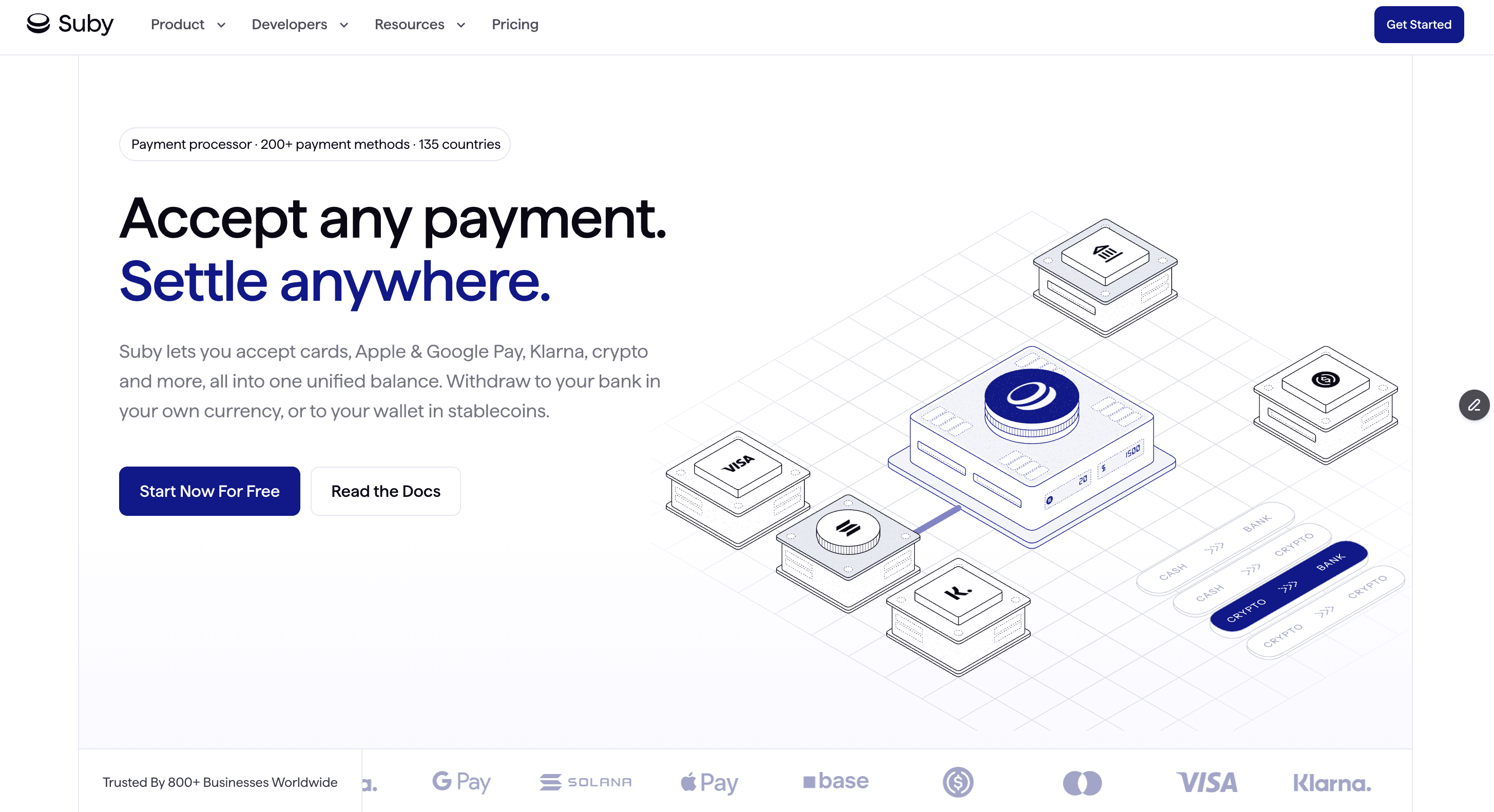
Suby is the option I'd put in front of businesses that care less about collecting a long list of assets and more about getting paid cleanly across borders. It combines card acceptance and crypto acceptance in one flow, then settles merchant revenue in USDC. That matters because many payment teams don't struggle with checkout first. They struggle with what happens after checkout, especially when payouts cross currencies and banking systems.
Suby is built for internet-native businesses that want customers to pay with cards while the business receives USDC. You can launch with pay links, use an embeddable checkout, or integrate through the API and webhooks. It also supports subscriptions and one-time payments, which makes it relevant for SaaS, agencies, freelancers, and online sellers.
For a practical overview of the business case, Suby also has a guide on accepting payments for business, by card, bank transfer, Apple Pay, Google Pay, Klarna, and more, or crypto.
Why Suby stands out
Most comparison lists focus on the headline gateway fee and stop there. That's not enough. Existing content misses the bigger issue that hidden FX spreads and payout delays can eat into platform margins, while Suby's public pricing positions it around transparent, all-inclusive costs with flexible settlement, to your bank account, or in stablecoins (USDC, EURC) to your wallet, through Suby's pricing page.
Practical rule: If you sell internationally, evaluate settlement design before you compare checkout screens. The cheapest listed fee often isn't the cheapest operating model.
Suby is also one of the few options here that connects payment acceptance with community monetization. It offers native Discord and Telegram integrations, so payment events can grant paid access and manage subscription lifecycles without stitching together extra tools. For creators, private communities, and membership products, that's a real operational advantage.
Security and support are part of the pitch as well. Suby states that card processing runs through a PCI-DSS Level 1 certified partner, and the product includes fraud controls, dispute handling, strong authentication options, and zero-fee refunds through the official Suby website.
Best fit
For teams shopping around, Suby also shows up among the broader alternatives to Stripe when card acceptance and stablecoin settlement need to sit in one place. Suby makes the most sense for teams that want one payment layer for global sales and don't want local bank dependencies to define payout speed. It's especially strong for:
SaaS and subscriptions: Card checkout is familiar to buyers, and USDC settlement is simpler for global revenue operations.
Creators and communities: Discord and Telegram access control is built in, not bolted on later.
Cross-border e-commerce: You can accept cards or crypto without forcing your back office into multi-currency bank operations.
Developer-led teams: The API, webhooks, and hosted options give you a fast path whether you want full control or a lighter deployment.
The main trade-off is straightforward. If your finance team needs fiat deposited into a local bank account, you'll need a conversion step outside the platform. Also, public pricing references should always be verified before signing, because official materials mention different fee framing and the live pricing page is the source to trust.
2. BitPay
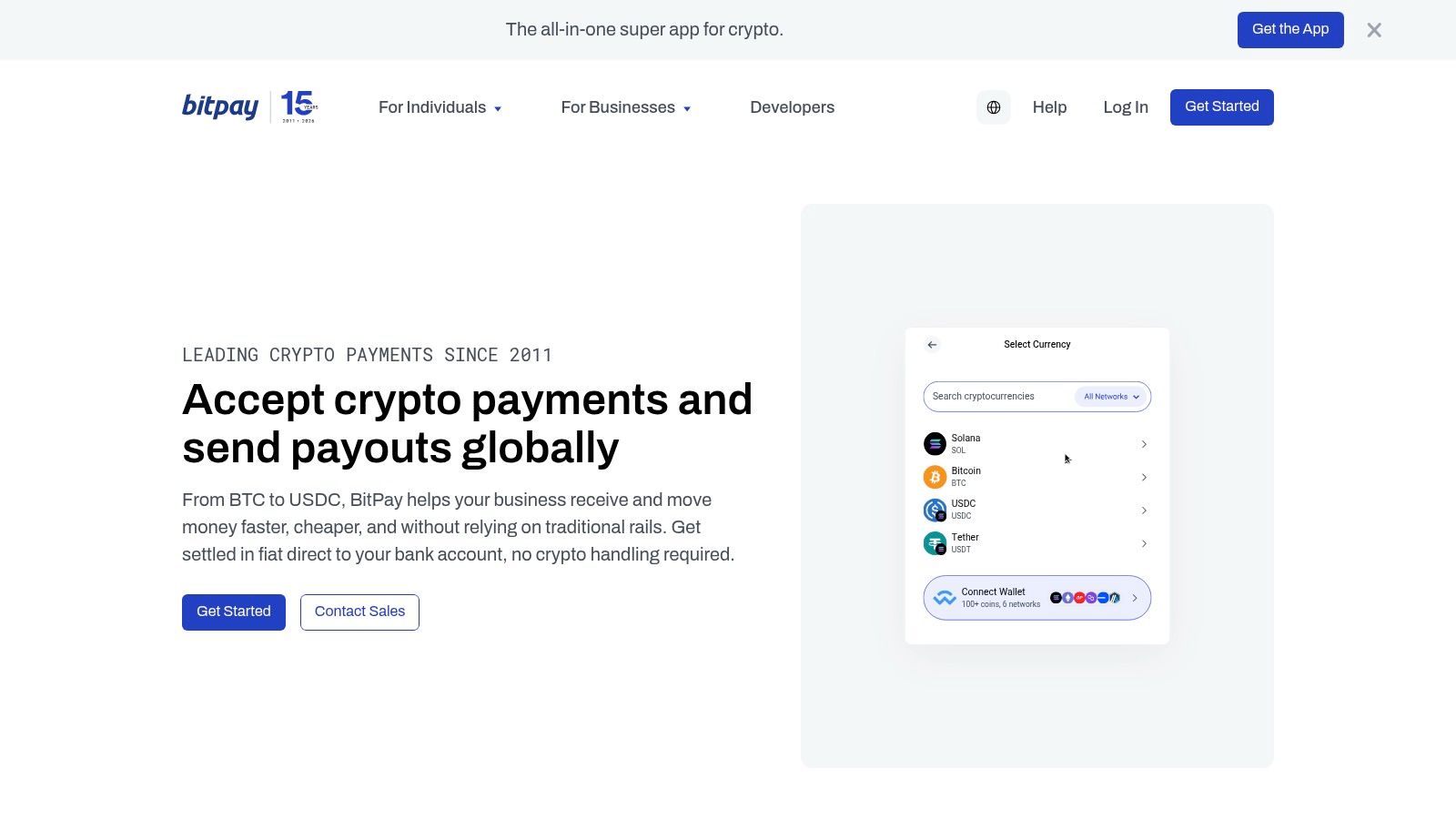
A common buying scenario looks like this. The sales team wants to add crypto quickly, finance wants predictable reporting, and leadership wants a provider they have heard of before. BitPay usually enters the shortlist in that situation because it feels closer to a traditional payment processor than a crypto-native settlement rail.
That positioning matters. BitPay is less about redesigning how your business settles funds, and more about adding crypto acceptance through workflows that accounting, ops, and e-commerce teams can usually understand without much retraining. If you are comparing processor styles, this BitPay alternative breakdown helps clarify where a more stablecoin-settlement-first model differs in practice.
Where BitPay works well
BitPay fits merchants that want crypto checkout, invoices, and integrations without pushing the finance team deep into wallet operations or treasury policy. For many businesses, that lowers internal friction during rollout.
It is often a practical fit for:
E-commerce teams that want a known checkout pattern and broad plugin support.
B2B sellers that use invoicing and want crypto acceptance to slot into an existing collections process.
Donations and one-time payments where buyer flexibility matters more than custom settlement design.
The trade-off shows up after the payment is collected. Businesses that care most about settlement rails, especially direct USDC settlement for global revenue operations, may find BitPay less aligned with their priorities. If your goal is to reduce bank dependency, shorten access to funds, or standardize around stablecoins across markets, BitPay is not built around that thesis in the same way as providers that start with digital dollar settlement.
This distinction is especially important by business model. A SaaS company may prefer stablecoin receipts that map cleanly into recurring global revenue. A cross-border e-commerce brand may prioritize easy checkout and familiar reporting instead. A creator business may only need simple invoices or donation flows, which makes BitPay easier to justify than a more configurable stack.
Fee headlines can also hide the true cost. The gateway rate is only one part of the decision. The more useful question is what your team receives at the end of the flow, crypto, fiat, or stablecoins, and how much operational work it takes to turn that into usable funds.
3. Coinbase Business

Coinbase Business is the relevant path for merchants that want a Coinbase-backed business account rather than a standalone checkout tool. The product direction is narrower than many merchants expect, but it can be a good fit if your company already values Coinbase's treasury, custodial, and off-ramp environment.
The strongest use case is US-centered operations that want stablecoin acceptance with surrounding finance tooling. If you were previously considering Coinbase Commerce, this shift matters because the buying decision isn't only about checkout anymore. It's about whether you want payments tied into a broader Coinbase operating stack.
If you're weighing migration paths, this Coinbase Commerce alternative guide gives a useful operator's perspective.
What to know before choosing it
Coinbase Business is most attractive when your team wants one vendor for payment intake, treasury, and bank off-ramping. That reduces tool sprawl, but it also means you accept a more opinionated setup.
A few practical realities stand out:
Stablecoin-first model: This can simplify accounting and reduce volatility exposure for businesses that already operate in digital dollars.
Custodial approach: Some merchants prefer direct self-custody settlement. Others want a provider-managed environment. Coinbase leans toward the second camp.
Regional fit matters: This is not the broadest option for global merchant availability, so non-US companies need to check whether it lines up with their entity structure and payout needs.
Choose Coinbase Business if your finance team wants payment acceptance to sit close to custody and treasury operations. Skip it if self-custody and broader global flexibility are the priority.
For teams that want customers to pay by card and for the business to receive USDC, a more unified hybrid gateway may be the better match. Coinbase Business is cleaner when the business is already comfortable operating inside Coinbase's ecosystem.
4. Circle Payments
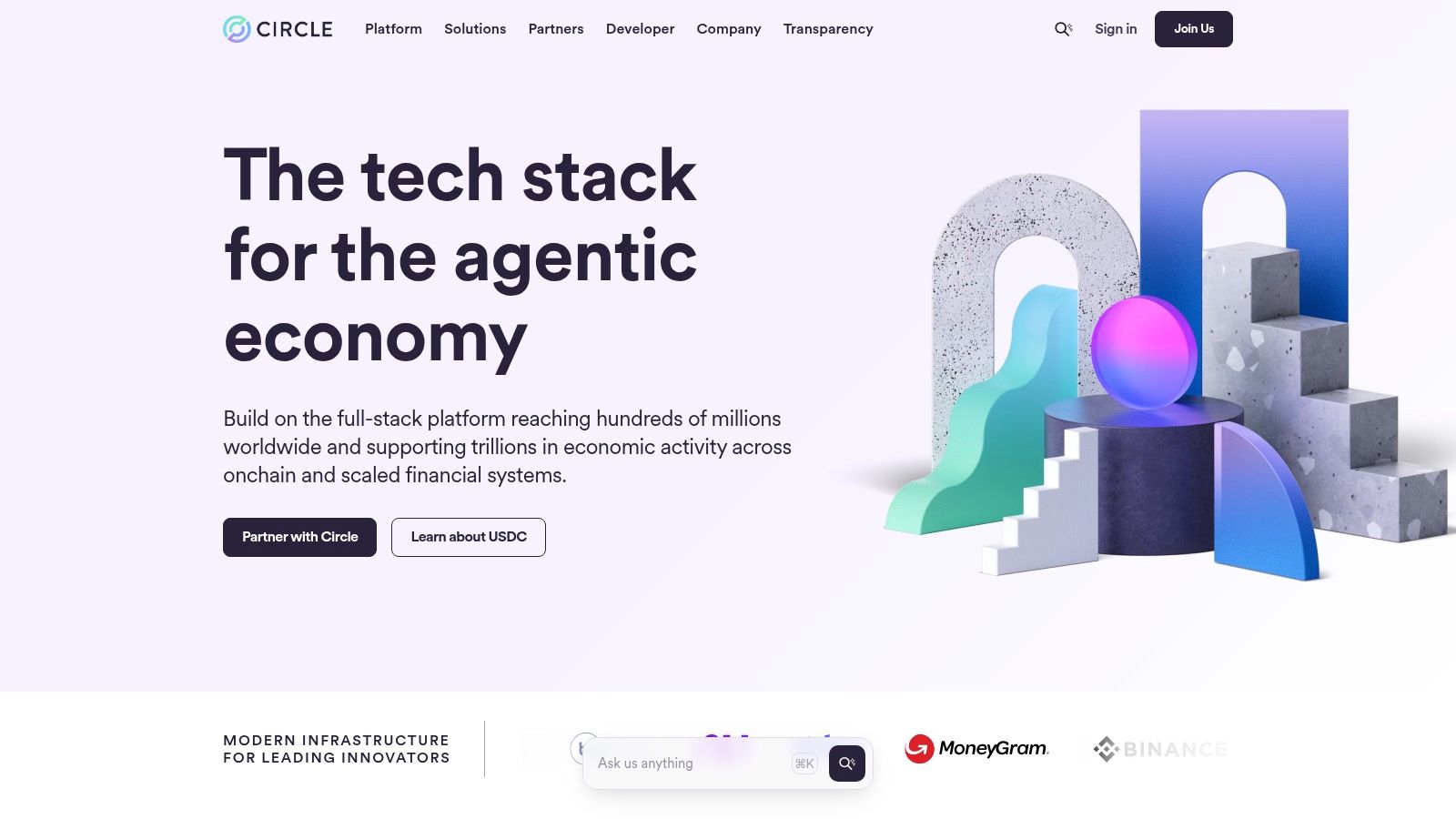
Circle Payments is less of a plug-and-play merchant gateway and more of a stablecoin payments infrastructure choice. That's an important distinction. If your company has developers, treasury requirements, and a reason to control the payment flow in detail, Circle becomes much more interesting.
Its strength is programmable stablecoin movement, not merchant-facing simplicity. Product teams can use APIs to build payment flows around USDC and related settlement logic, which is useful for platforms, marketplaces, and enterprise payment products. Enterprises that already run legacy card infrastructure often compare this against a traditional global payments merchant portal to see where a stablecoin rail actually reduces work.
Best use case
Circle fits best when payments are part of your product, not just a checkout add-on. A software platform that needs stablecoin pay-ins, managed settlement, and treasury coordination is much closer to Circle's ideal customer than a small merchant trying to install a checkout widget.
That developer-first model comes with trade-offs:
Strong for custom payment architecture: You get more control over how stablecoin settlement fits your stack.
Weaker for non-technical teams: This isn't the fastest way for a merchant to start accepting payments next week.
Sales-led pricing: You won't get the same clarity as tools with a public fee page.
The category tailwind behind this approach is real. A 2026 market report estimates the crypto payment gateway market at USD 2.39 billion in 2026, reaching USD 4.74 billion by 2030 at an 18.7% CAGR. That projection points to stronger demand for gateways and payment rails that reduce cross-border friction and support both crypto and fiat acceptance.
Circle benefits from that trend, especially at the infrastructure layer. But if your immediate need is a business-ready top crypto payment gateway with hosted checkout, subscriptions, and quick deployment, this isn't the most practical first stop.
5. Crypto.com Pay

Crypto.com Pay is interesting because it combines merchant tooling with a large consumer-facing ecosystem. That can help if you want more than a back-end processor and see value in meeting buyers inside a payment brand they already know.
It supports online checkout and in-person use cases, and it offers plugins for common e-commerce setups. For merchants who want crypto acceptance without building much themselves, that's a practical advantage.
Where it fits best
Crypto.com Pay makes the most sense for merchants that want reach and convenience rather than the deepest control over settlement architecture. If your business already sells to consumers who are comfortable with the Crypto.com ecosystem, the fit improves.
A few points matter in practice:
Useful for e-commerce and retail-style flows: Plugins and merchant app support reduce setup work.
Flexible settlement options: The appeal is partly in being able to align payout style with your operating model, subject to jurisdiction.
Less transparent on public pricing: That makes procurement slower if your team needs a clean side-by-side fee comparison before talking to sales.
This is also a reminder that brand familiarity influences merchant choice. Buyers often convert better when the payment flow feels recognizable, and merchants often choose processors they believe customers will trust. Crypto.com Pay earns consideration on that front, especially for consumer-facing brands.
6. CoinGate
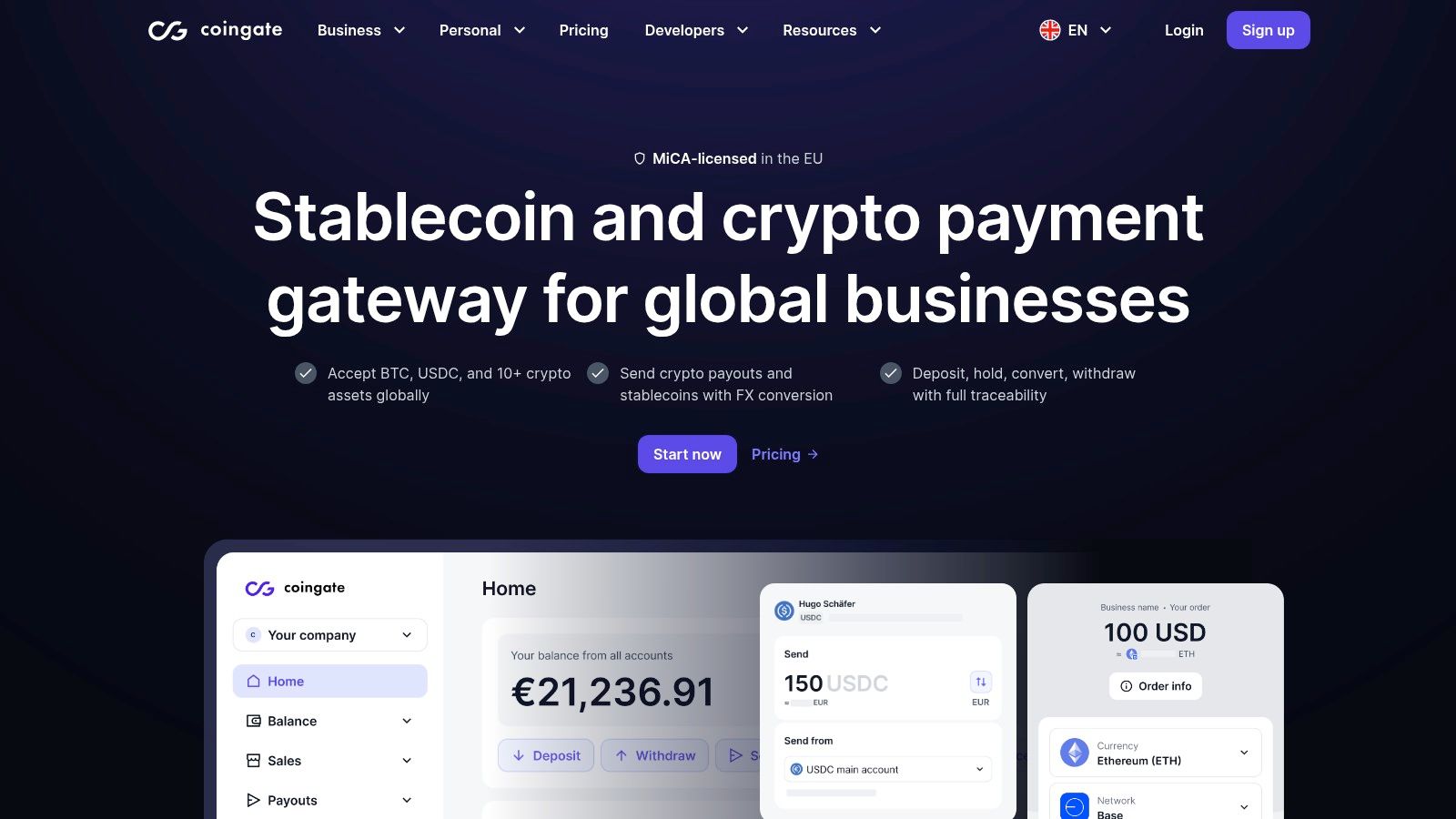
CoinGate is one of the cleaner choices for merchants who want a straightforward, business-friendly gateway without committing to a fully custom integration. Hosted checkout, invoices, plugins, and conversion options make it practical for teams that want to launch quickly and keep operations understandable.
What I like about CoinGate's positioning is that it tends to be easier to explain internally. Finance teams can follow the flow, operations teams can handle the tooling, and e-commerce managers don't need a long implementation cycle to test it.
Why merchants pick it
CoinGate's core appeal is simplicity. It gives merchants a direct route to acceptance and optional conversion, which is often what matters most when you're trying to operationalize crypto payments instead of debate them.
Transparent pricing: CoinGate is typically considered easier to budget because fee framing is clearer than many enterprise-led providers.
Strong for online stores: Plugins and hosted options reduce launch friction.
Reduced volatility handling: Automatic conversion and settlement choices can simplify internal accounting.
If your business wants a top crypto payment gateway that your finance lead and your growth lead can both approve quickly, CoinGate is one of the safer picks.
The main limitation is regional nuance. Some payout and settlement options vary depending on where your business is based, and compliance steps can affect edge cases like refunds. That doesn't make CoinGate weak. It just means you should validate the full payout flow before rollout, especially if your sales are heavily cross-border.
7. NOWPayments
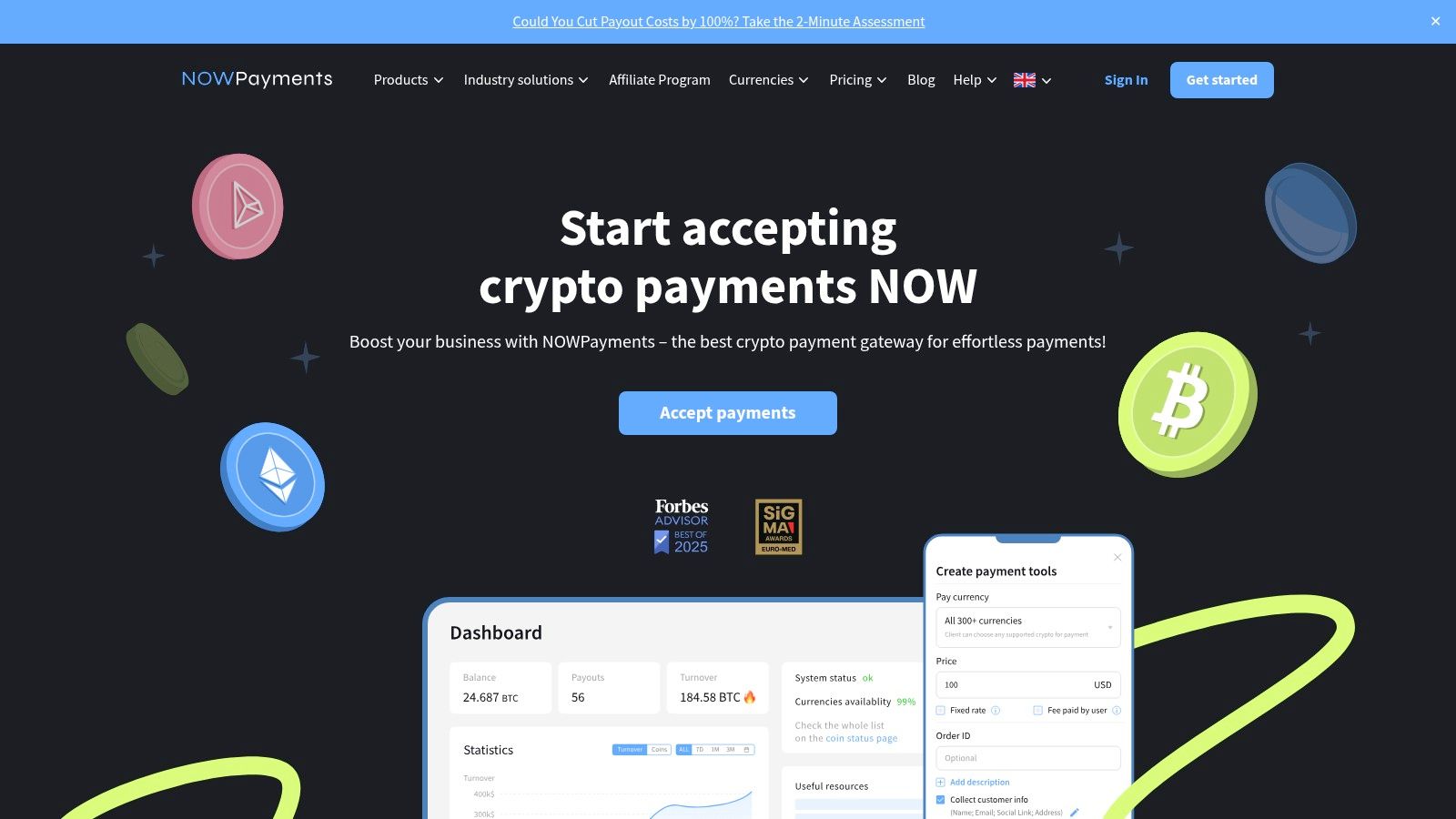
A merchant selling globally often runs into a simple question fast. Do customers want to pay with one or two major coins, or with a long tail of tokens that varies by region and community? NOWPayments is built for the second case.
Its appeal is range. The platform is known for broad asset support, hosted checkout options, invoices, and API access, which makes it useful for businesses that expect customer payment preferences to be fragmented. That can work well for donation campaigns, creator monetization, and online stores that see traffic from crypto-native audiences. Creators weighing where to sell often run the same trust check they would when asking whether Gumroad is safe before routing revenue through any single platform.
Where NOWPayments has the edge
NOWPayments is often shortlisted by teams that start vendor evaluation with published fees and asset coverage. The pricing is easy to understand at a glance, and the setup path is lighter than what you usually see with enterprise-focused providers.
That said, broad acceptance and a low headline fee do not answer the harder operating questions. Merchants still need to check which assets they want to receive, how conversion is handled, what payout routes are available, and how much reconciliation work the finance team takes on after launch.
Best for broad token acceptance: It suits merchants that want to give customers many ways to pay without building custom flows.
Useful for creators and donation-based businesses: Payment links, invoices, and hosted tools make one-off transactions easier to launch.
Less aligned with stablecoin-first treasury goals: SaaS companies and cross-border e-commerce teams that want predictable USDC settlement usually need tighter control over settlement rails than NOWPayments is designed to prioritize.
Worth reviewing for hybrid payment stacks: If your business wants card acceptance plus crypto, check whether NOWPayments fits as the crypto layer only, or whether a provider with native card and stablecoin settlement is the cleaner setup.
There is a real market for this model. Some merchants do see customers choose from a wide mix of tokens, especially in crypto-native segments. This shows that the payment behavior is tied to real commerce, not just experimentation.
The trade-off is operational clarity. If the main business goal is "accept more crypto," NOWPayments is a practical option. If the goal is "settle in USDC, simplify accounting, and combine card and crypto under one payment strategy," it will usually sit behind more settlement-focused providers on this list.
Top 7 Crypto Payment Gateways Comparison
Solution | Implementation complexity | Resource requirements | Expected outcomes | Ideal use cases | Key advantages |
|---|---|---|---|---|---|
Suby | Low–Medium, paylinks, embeddable checkout or simple API | Minimal dev; USDC wallet or on‑ramp for fiat needs; KYC | Predictable USDC settlement, reduced SWIFT/FX delays | International SaaS, creators, communities (Discord/Telegram), devs | Stablecoin‑first settlement, unified card+crypto, native community tools |
BitPay | Low, plugins, invoicing, POS integrations | Merchant bank account for fiat payouts; compliance docs | Daily fiat settlements or crypto payouts; chargeback‑free crypto | US merchants, e‑commerce, in‑store, accounting workflows | Mature compliance, broad merchant integrations, trusted brand |
Coinbase Business | Low, payment links, invoices, API migration path | Coinbase account/custody, KYC; US/Singapore availability | Fast stablecoin (USDC) settlement into Coinbase with off‑ramps | Merchants migrating from Coinbase Commerce; teams needing custody | Integrated custody/treasury, accounting integrations, migration support |
Circle Payments | High, API‑first, developer integration required | Development resources; enterprise sales/KYC; treasury integration | Programmable multi‑chain USDC settlement via CPN | Enterprises and dev teams requiring predictable stablecoin rails | Enterprise‑grade APIs, CPN managed payments, compliance focus |
Crypto.com Pay | Low, plugins and merchant mobile app; region dependent | Merchant account, regional compliance; platform onboarding | Crypto and fiat settlement options where supported; POS acceptance | Merchants seeking crypto consumer discovery and in‑person sales | Access to Crypto.com ecosystem, POS/mobile tools, co‑marketing |
CoinGate | Low, hosted checkout and e‑commerce plugins | Minimal dev; KYC; region‑dependent payout options | Simple fiat or stablecoin settlement with transparent fees | Online stores wanting plug‑and‑play crypto checkout | Clear flat pricing (1%), automatic conversion, easy setup |
NOWPayments | Low, widgets, APIs, invoices, PoS | Integration for many coins; network/payout fees vary by chain | Broad asset acceptance, low advertised fees, fast onboarding | Crypto‑native merchants wanting wide token coverage | Supports 200–350+ coins, low published fees, flexible widgets |
Making the Right Choice for Your Global Business
A customer in Germany pays by card. Your business is based in Singapore. Your contractor is in Argentina. The checkout is the easy part. The harder question is what you receive after the sale, how fast it arrives, and what gets lost to conversion, banking delays, or payout restrictions along the way.
That is why the better evaluation starts with settlement, not logos on a pricing page. A bank-focused business selling mainly in one market may be fine with a familiar processor and fiat payout. BitPay or Coinbase Business can fit that model if the priority is recognizability and conventional back-office handling.
Cross-border operators usually need more precision. SaaS companies care about recurring billing and predictable treasury movement. E-commerce teams care about margin control, refund handling, and payout timing, and resellers in particular often vet their sourcing tools the way this Deal Soldier review examines whether a platform earns its fees. Creators and community businesses often need simple checkout on the front end and stable value on the back end. For them, the stronger differentiator is settlement rail design, especially whether the provider can settle in USDC cleanly and consistently.
Compliance also matters in a practical way. Businesses selling internationally need to know which provider model fits their risk tolerance, reporting needs, and payout geography. As noted earlier, Suby positions itself around a MiCA-aligned payments approach, which will matter more to teams that want compliant global payout options without adding foreign exchange exposure to every transaction.
The most useful gateway is the one that fits your settlement model, finance workflow, and customer checkout expectations.
For many global merchants, the most workable setup combines card acceptance with stablecoin settlement. Customers keep the payment behavior they already trust. The business receives funds in USDC, which is easier to move across borders, hold for treasury, or convert on its own terms. Stablecoin rails also sit closer to newer models like agentic payment, where automated systems settle transactions with minimal human steps. In practice, that model is often a better fit for international SaaS, digital services, agencies, online stores, and creator-led businesses than a crypto-only checkout.
Keep the shortlist practical. Check how customers can pay, how hard the integration is, what you receive after settlement, how refunds work, which jurisdictions the provider supports, and what the cost looks like after conversion and payout fees. If you also need help on the reporting side once funds start moving, getting reliable crypto tax advice early is a smart move.
Suby is a payment gateway and Merchant of Record. Your customers pay with card, bank transfer, Apple Pay, Google Pay, Klarna, and more, or stablecoins, and you get paid out to your bank account, or directly in stablecoins (USDC, EURC) to your wallet, anywhere in the world, no bank account required. It offers a payments API, pay links, embedded checkout, subscriptions, and native Discord and Telegram integrations in one system. As a top crypto payment gateway, it settles the way you choose without the FX spreads and payout delays that erode margins on cross-border sales.
