

Gaspard LEZIN
What Are the Top Crypto Payment Processors for Merchants in 2026
What are the top crypto payment processors for merchants in 2026? Compare features, fees, and USDC settlement to find the best gateway for your business.
A merchant launches cross-border ads, demand shows up from five countries, and checkout starts exposing the underlying problem. Customers want familiar payment options, finance wants predictable settlement, and operations does not want another manual reconciliation process. Crypto can help, but only if the processor reduces friction instead of adding it.
That is the filter for this list.
I'm not treating every crypto gateway as equally useful for merchants in 2026, and if you want a broader lineup you can compare a top crypto payment gateway shortlist alongside this one. The focus here is narrower and more practical: processors that support USDC settlement as a primary path or as a realistic option for merchants that care about stable margins, simpler treasury handling, and fewer conversion surprises. For many stores, accepting volatile assets is less important than receiving stablecoins on time and knowing what lands in the business account.
That also changes how these providers should be judged. The key questions are straightforward. Can the processor support global sales without creating payout delays? Can it fit into the existing ecommerce stack without heavy development work? Can it handle compliance, refunds, and reporting at a level your finance team can live with?
One merchant use case gets ignored in most roundup articles. Some businesses do not need customers to pay in crypto at all. They want customers to pay with cards while the business receives USDC. That is a different operational need, and it deserves its own lens. Suby stands out here because it is built around that flow, which matters for merchants who want to accept card, bank transfer, Apple Pay, Google Pay, Klarna, and more, or crypto without forcing a crypto-native checkout on every buyer.
If you are also reviewing the rest of your payment stack, optimizing payments on Shopify is closely related to the same margin, approval-rate, and settlement questions.
Table of Contents
Why Suby is different
Where Suby works best
Where BitPay still makes sense
Best fit and main caution
Why some US merchants will prefer it
Best fit for plugin-first merchants
Best fit for reach-first merchants
Why it is not a fit for this shortlist focus
Who should actually use BTCPay Server
Best fit for operationally heavy merchants
Why larger merchants consider Triple-A
Top 10 Crypto Payment Processors for Merchants, Features & Fees (2026)
Final Thoughts
1. Suby
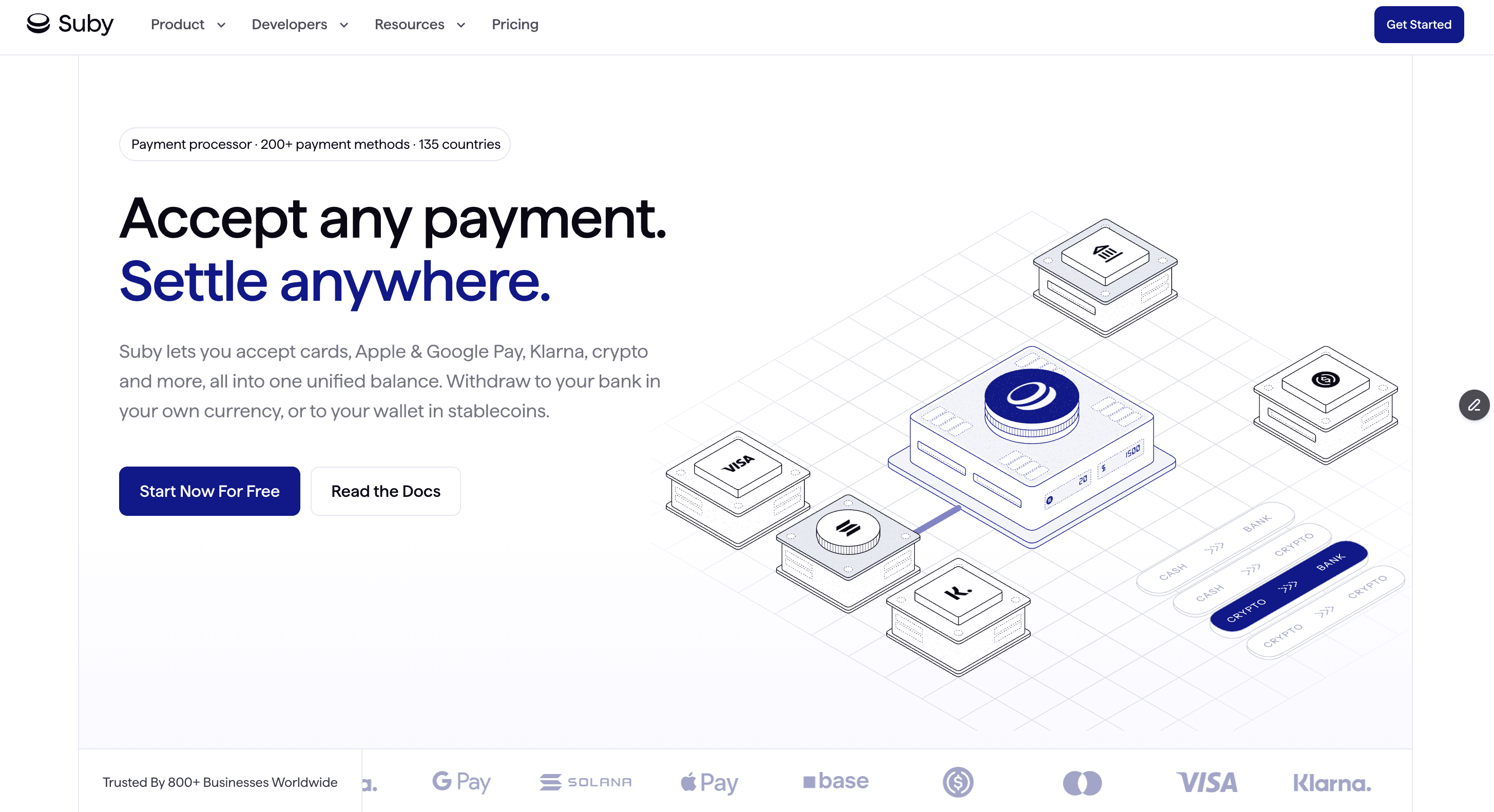
Suby is the most practical option here for merchants who want the reach of card payments but want settlement in USDC. That sounds simple, but it solves a real problem. A lot of processors let customers pay with crypto and then either send you fiat or make you manage a more fragmented settlement flow. Suby goes the other direction. Users pay by card or crypto, businesses receive USDC.
That matters for international SaaS, digital products, agencies, online communities, and creator businesses that don't want to depend on bank payout timing or cross-border FX spreads, and it is a big part of choosing the best payment platform for international SaaS expansion. Suby supports paylinks, an embeddable checkout, and an API with webhooks, so it works whether you're sending invoices manually or wiring it into a product flow. It also supports one-time payments and subscriptions, which removes the need to bolt a separate recurring billing system onto a crypto-friendly checkout.
Many platforms claim to support global payments. Suby is one of the few on this list built around the specific workflow many internet businesses want: familiar checkout for the buyer, and flexible settlement for the merchant, paid out to a bank account, or in stablecoins (USDC, EURC) to a wallet.
Why Suby is different
Suby also provides a second benefit that most payment processors fail to handle effectively. It includes native Discord and Telegram monetization workflows, ensuring that paid access, subscriptions, and community access rights can occur within the same payment system.
For creator businesses and membership products, that removes a lot of operational glue. Instead of stitching together checkout, webhooks, access control, and recurring billing, you can manage payment and access in one stack. That's especially useful for paid communities, premium channels, and subscription-based online access.
Practical rule: If your customers expect to pay by card, but your business wants to hold revenue in USDC, start with a processor designed around that payout logic instead of trying to force-fit a bank-settlement gateway.
On the security side, Suby states that card processing runs through a PCI-DSS Level 1 certified partner, supports strong customer authentication, and includes fraud protections and zero-fee refunds through the product stack, based on its official documentation and product materials. Setup is also straightforward compared with enterprise-heavy platforms. You add products, connect your payout wallet, and start collecting payments.
For merchants comparing implementation paths, Suby's guide on accepting payments for business (card, bank transfer, Apple Pay, Google Pay, Klarna, and more, or crypto) is worth reviewing alongside the main product site at Suby.
Where Suby works best
Suby is strongest when these are your priorities:
Card plus crypto acceptance: Buyers can use familiar card checkout or supported crypto methods, while your business standardizes on USDC receipts.
Subscription revenue: Recurring billing is part of the setup, not an afterthought.
Community monetization: Discord and Telegram access control is built in, which is unusually useful for online memberships.
API-first operations: If your team needs paylinks today and webhooks tomorrow, Suby covers both.
The main trade-off is obvious. You need to be comfortable receiving and managing USDC. If your finance team insists on fiat settlement to a bank account, another processor may fit better. Pricing should also be confirmed directly on the official pricing page before rollout, since public references have varied.
2. BitPay
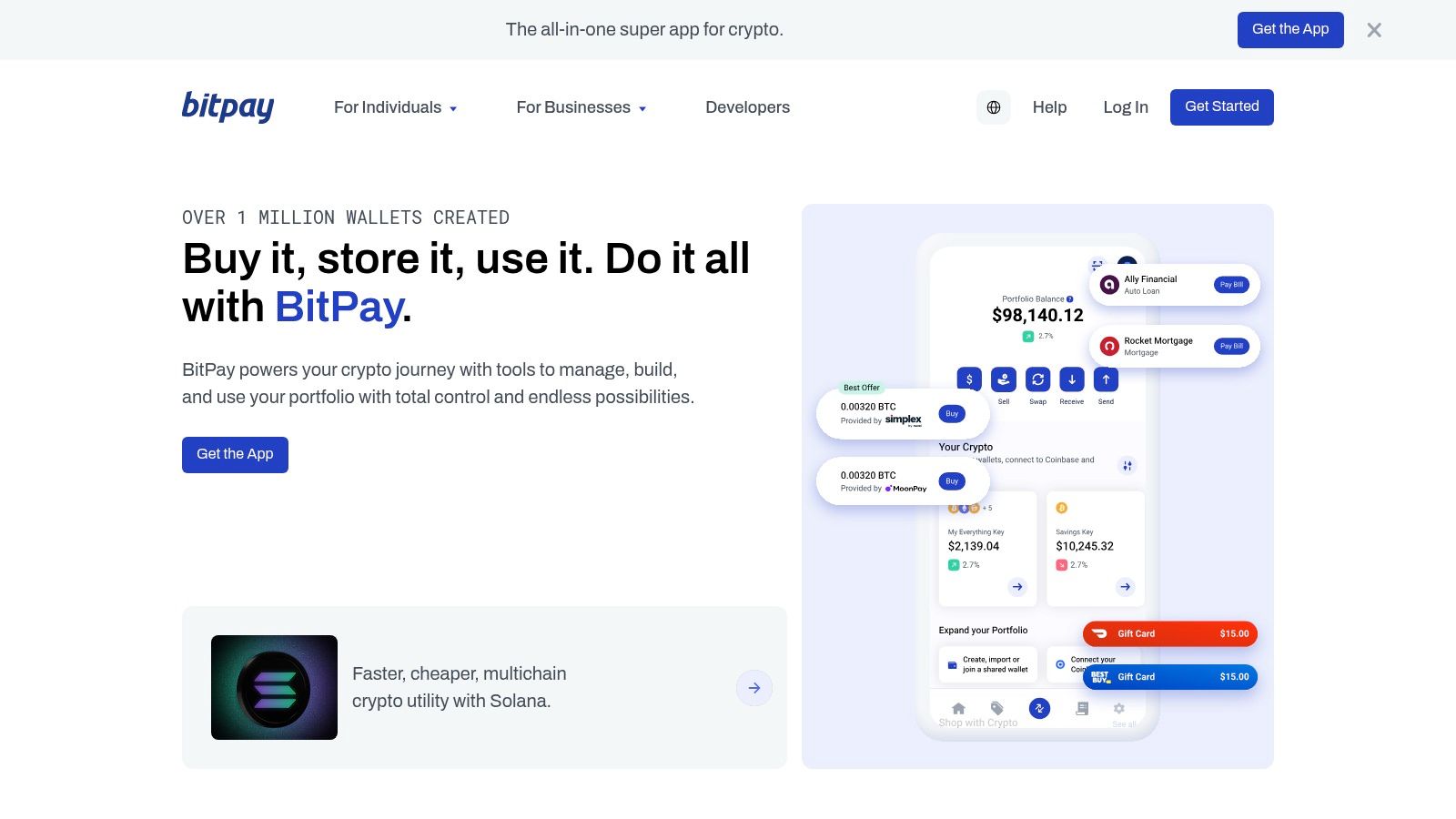
A merchant wants crypto checkout without changing how finance operates. They still want reconciliation, refunds, accounting exports, and bank settlement that looks familiar to the back office. BitPay fits that buyer better than many crypto-native tools.
Its main advantage is maturity. BitPay has been in the category for a long time, and that history reduces procurement friction for larger teams. It also covers more than basic checkout. Merchants get invoicing, point-of-sale support, refund workflows, and reporting tools that matter once transaction volume starts creating accounting work.
The trade-off is clear. BitPay is not the processor I would put in front of a merchant whose main goal is to standardize global sales around USDC settlement. This article filters for processors that support that stablecoin path, either directly or as an option, and BitPay belongs lower on that priority list because its practical appeal is still strongest for businesses that want fiat settlement to a bank account and a more traditional operating model.
That makes BitPay a reasonable fit for established merchants with stricter internal controls, especially if legal, risk, or finance teams are more comfortable with a processor that behaves like a conventional payments vendor.
Where BitPay still makes sense
BitPay works best for merchants that want crypto acceptance without redesigning treasury operations.
Use it if these points describe your business:
Finance wants fiat first: Settlement to a bank account remains the cleanest path for your accounting team.
Operations need standard merchant tools: Invoicing, POS support, refunds, and exports matter as much as the checkout button.
Internal approval is a real hurdle: A long-running provider is often easier to get through procurement than a newer platform.
USDC is optional, not the center of the setup: You want crypto acceptance, but stablecoin settlement is not the main reason for adopting it.
The limitation is speed and flexibility. BitPay can be more compliance-heavy during onboarding, and that can slow down launches for newer online businesses, multi-entity setups, or merchants with less conventional sales flows.
For merchants comparing BitPay against a setup built around stablecoin receipts, this breakdown of Suby versus BitPay is useful. Merchants that want buyers to pay with cards or crypto while the business receives USDC should also review this guide to a Stripe alternative for USDC merchant settlement. That is where the distinction becomes practical. BitPay is generally the better fit for bank-style settlement. Suby is the better fit when USDC receipt is the operating goal.
3. Coinbase Commerce transitioning to Coinbase Business

Coinbase Commerce sits in an interesting middle ground. For small businesses, it has real appeal because the Coinbase name lowers perceived vendor risk and the setup has historically been simpler than many enterprise processors. One cited market summary says Coinbase Commerce has been adopted by more than 50,000 merchants and processes more than $2B annually at 1% fees, with a non-custodial model centered on on-chain acceptance (MEXC gateway comparison).
The stablecoin angle is the main reason it belongs on this list. The infrastructure discussed in market coverage highlights instant settlement through the Onchain Payment Protocol, with automatic conversion directly into USDC so merchants can avoid volatility exposure. For merchants that want crypto acceptance without managing broad asset exposure, that's a meaningful benefit, and it is worth reading a dedicated breakdown of Coinbase Commerce before you rely on it as your settlement path.
Still, the transition from Commerce to Coinbase Business in 2026 creates some uncertainty. Product migrations are never just branding changes. They can affect dashboard flows, withdrawal processes, support pathways, and feature availability.
Best fit and main caution
Coinbase Commerce is best for merchants who want a trusted brand, relatively straightforward on-chain acceptance, and a stablecoin-forward settlement path. If your finance team already understands Coinbase, internal approval is usually easier than with lesser-known providers.
The caution is simple. Verify the current product state before you commit. In a transition year, screenshots, docs, and merchant expectations can drift out of sync. That's manageable, but it matters.
Best for straightforward crypto acceptance: Especially if you want to keep the asset mix narrower and settlement cleaner.
Less ideal for broad token acceptance: Multi-asset gateways are stronger if long-tail token support matters.
Worth validating before rollout: Confirm current withdrawal, onboarding, and support flows with Coinbase directly at Coinbase Commerce.
4. Stripe Stablecoin Payments Pay with Crypto

Stripe's stablecoin payment option is relevant because many US merchants do not want a separate crypto operations stack. They want a familiar dashboard, existing reporting patterns, and one place to reconcile multiple payment types. Stripe offers that kind of convenience for merchants that qualify, though it is worth weighing against the wider set of alternatives to Stripe before committing.
The trade-off is in the settlement model. This isn't built for businesses that want to receive USDC directly into their own wallet as the core payout path. Public product positioning centers on stablecoin acceptance with settlement in USD inside the Stripe balance for US merchants. If your finance team wants that exact outcome, it's clean. If your business wants stablecoin-native payout, it isn't the same thing.
That difference is where many merchants get confused. Accepting stablecoins is not the same as running on stablecoin settlement rails.
Why some US merchants will prefer it
Stripe is attractive if your team already lives inside Stripe and wants to add stablecoin acceptance without retraining staff or reworking reporting. For an existing US merchant operation, that can be enough reason to choose it.
But if the goal is “users pay with cards, business receives USDC,” Stripe isn't the strongest fit. That's where a platform like Suby is structurally better aligned. The comparison is less about feature count and more about payout design. This page on a Stripe alternative for USDC-focused merchants captures that distinction well.
Use Stripe when dashboard continuity and USD settlement matter most. Use a USDC-settlement processor when your treasury workflow matters more. Merchants can review current availability and onboarding directly at Stripe.
5. CoinGate
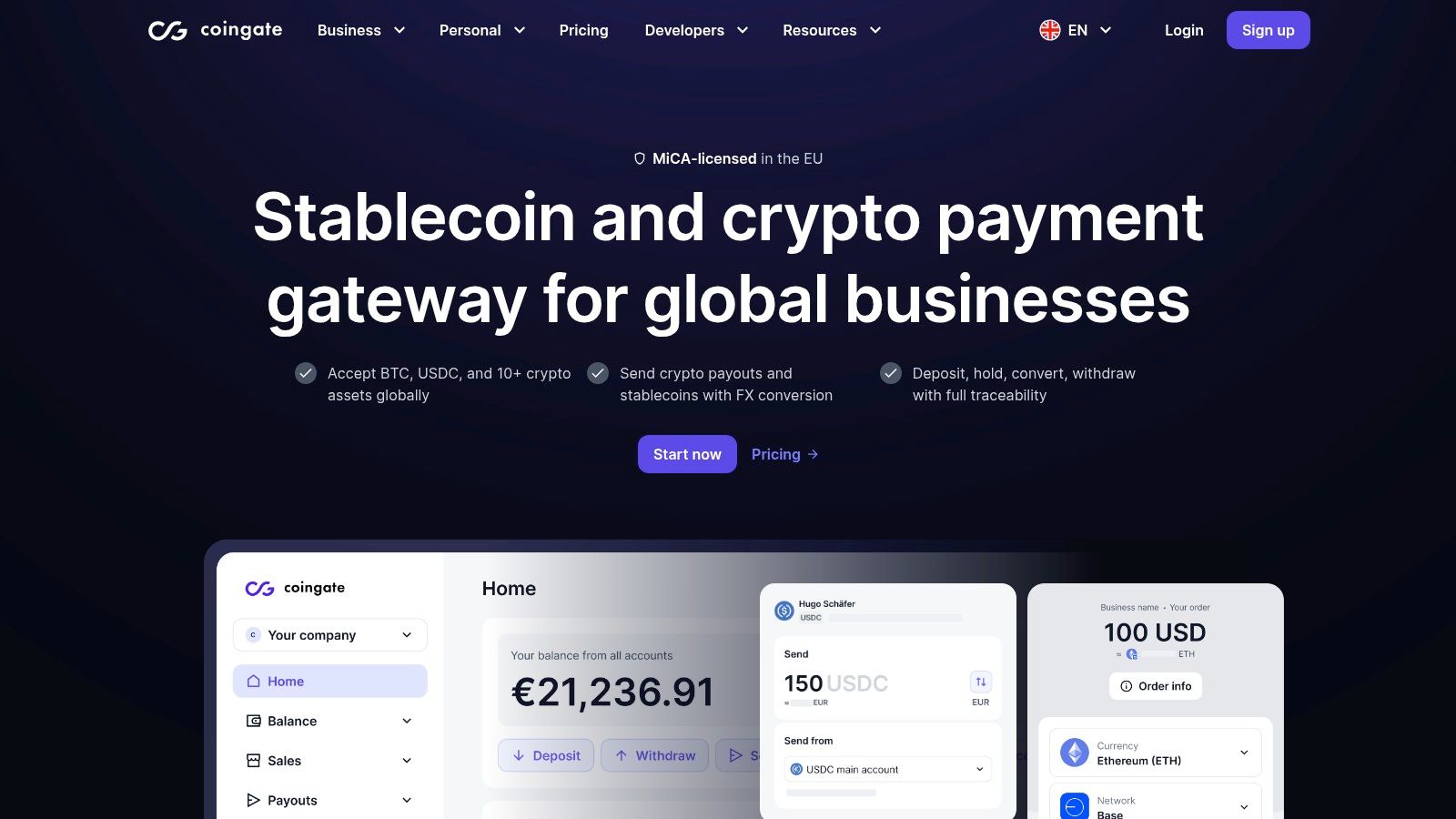
CoinGate usually enters the conversation when a merchant wants speed to launch, not a deep treasury product. It has long been popular with e-commerce businesses that prefer hosted checkout, plugins, and a relatively direct implementation path.
That plugin-first orientation is its biggest advantage. If you're running a store and want to add crypto acceptance without building a custom payments layer, CoinGate is easier to evaluate than more enterprise-led providers. It also appeals to merchants that want optional settlement flexibility without turning the payment stack into a finance infrastructure project.
Best fit for plugin-first merchants
CoinGate works best when the operational question is simple: can we add crypto checkout quickly and keep the implementation manageable? For many digital-first sellers, that's enough.
Its limitations are mostly about fit, not quality. US merchants need to validate onboarding and supported-country status carefully, and merchants looking for USDC-first treasury workflows may find CoinGate less focused than platforms designed around stablecoin settlement logic.
A practical way to think about CoinGate:
Strong for e-commerce rollout: Hosted checkout and plugins reduce implementation time.
Better for straightforward acceptance than treasury design: It helps you get payments live, but it isn't the most opinionated stablecoin settlement tool here.
Worth checking if you sell into Europe: Especially if you value a more traditional gateway feel.
The public website remains the right place to confirm current merchant support and product availability at CoinGate.
6. NOWPayments
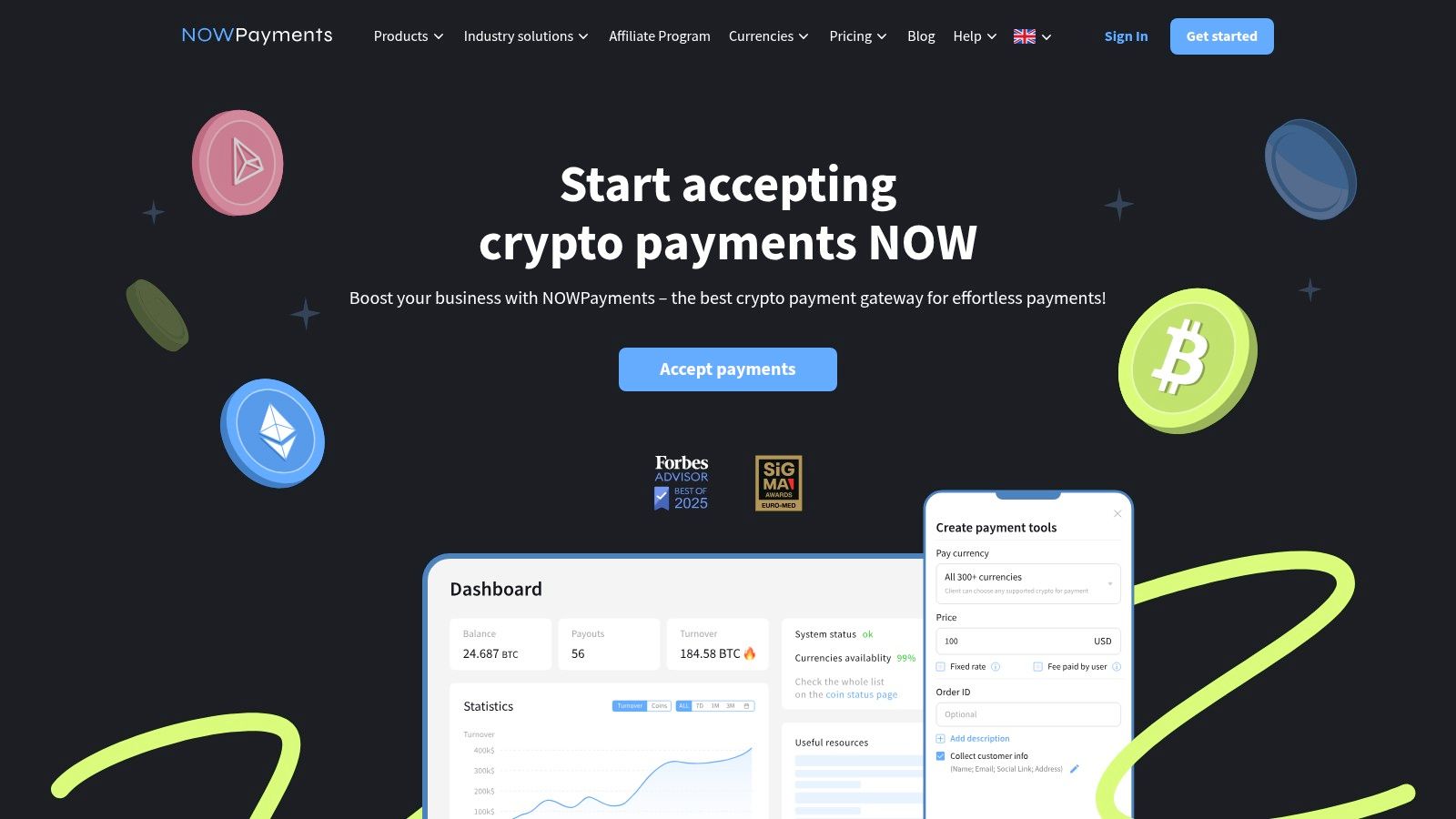
A merchant sells globally, traffic is healthy, and customers keep arriving with different coins in their wallets. NOWPayments is built for that situation. Its main appeal is choice. You can accept a wide range of crypto assets, use hosted tools such as invoices and pay links, and get to market without building a custom payment flow.
That flexibility is useful, but it comes with trade-offs.
For merchants reading this list through a USDC-settlement lens, NOWPayments sits in the middle. It gives you broad crypto acceptance and conversion options, which can help if your customer base is fragmented across assets. It is less focused than providers built around stablecoin-first settlement logic or card-to-USDC workflows. If the goal is "let buyers pay with many different coins," NOWPayments is easy to justify. If the goal is "keep treasury clean and receive USDC with minimal handling," I would rank more specialized options higher.
Its non-custodial setup will appeal to merchants that want more direct control over funds. That said, wider asset support usually means more decisions for the finance and support teams. Someone still has to define which coins to accept, which assets convert on receipt, how refunds work, and how accounting maps those payment paths.
Best fit for reach-first merchants
NOWPayments makes the most sense when acceptance breadth is part of the revenue strategy. That tends to be true for digital products, international sellers, and merchants serving crypto-native buyers outside a narrow set of major assets.
I would not put it first for a finance team that wants the simplest possible settlement stack.
A practical way to evaluate NOWPayments:
Strong for broad coin acceptance: Helpful if customer demand spans well beyond BTC, ETH, and stablecoins.
Useful for faster rollout: Hosted checkout tools, invoices, widgets, and subscription support can reduce implementation work.
Less clean for USDC-first operations: More asset choice can create extra reconciliation and treasury rules.
Better for crypto-heavy audiences than card-led checkout: Merchants who want customers to pay by card while the business receives USDC should compare this category carefully, because that is a different operating model.
Merchants can validate current features, supported assets, and integration options at NOWPayments.
7. OpenNode
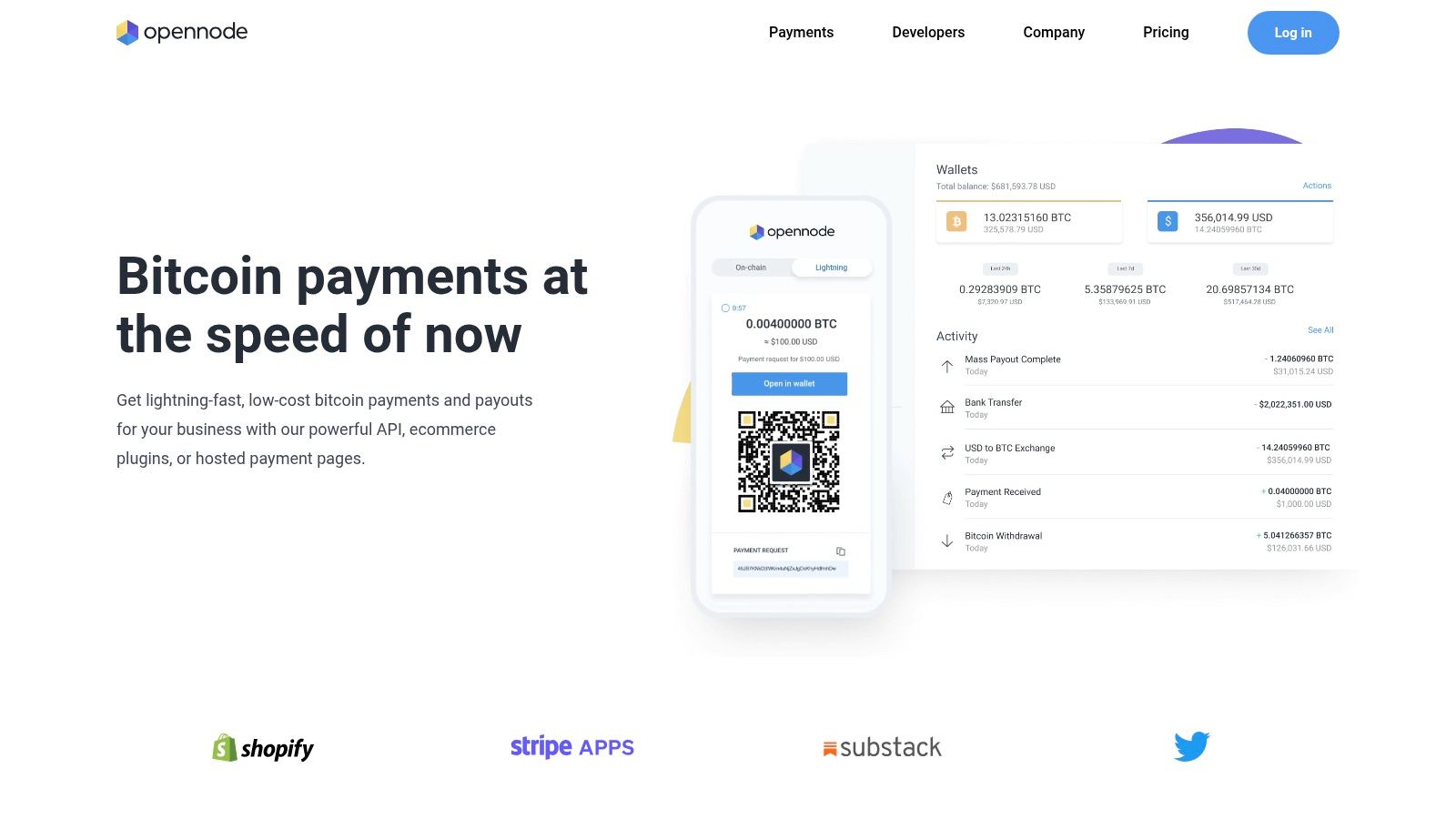
OpenNode is included here mostly as a boundary marker. It has a legitimate place in the broader crypto payments market, but it is not a natural fit for merchants focused on stablecoin settlement and multi-asset flexibility.
Its core appeal has traditionally been speed, simpler developer tooling, and strong support for a narrower payment model. If your merchant strategy depends on a broad set of assets, USDC settlement workflows, or card plus crypto acceptance, OpenNode isn't where I'd start.
Why it is not a fit for this shortlist focus
For this article's filter, OpenNode falls short on strategic fit. The issue isn't quality. The issue is alignment. Merchants asking what are the top crypto payment processors for merchants in 2026 usually aren't asking for a narrow specialist unless they already know they need one.
That's why I see OpenNode as more of a niche processor than a default recommendation. It can still make sense for specific brands with very targeted customer payment behavior, but it doesn't solve the cross-border stablecoin settlement problem as directly as the better-ranked options above.
If you still want to evaluate it on its own terms, review current merchant details at OpenNode.
8. BTCPay Server
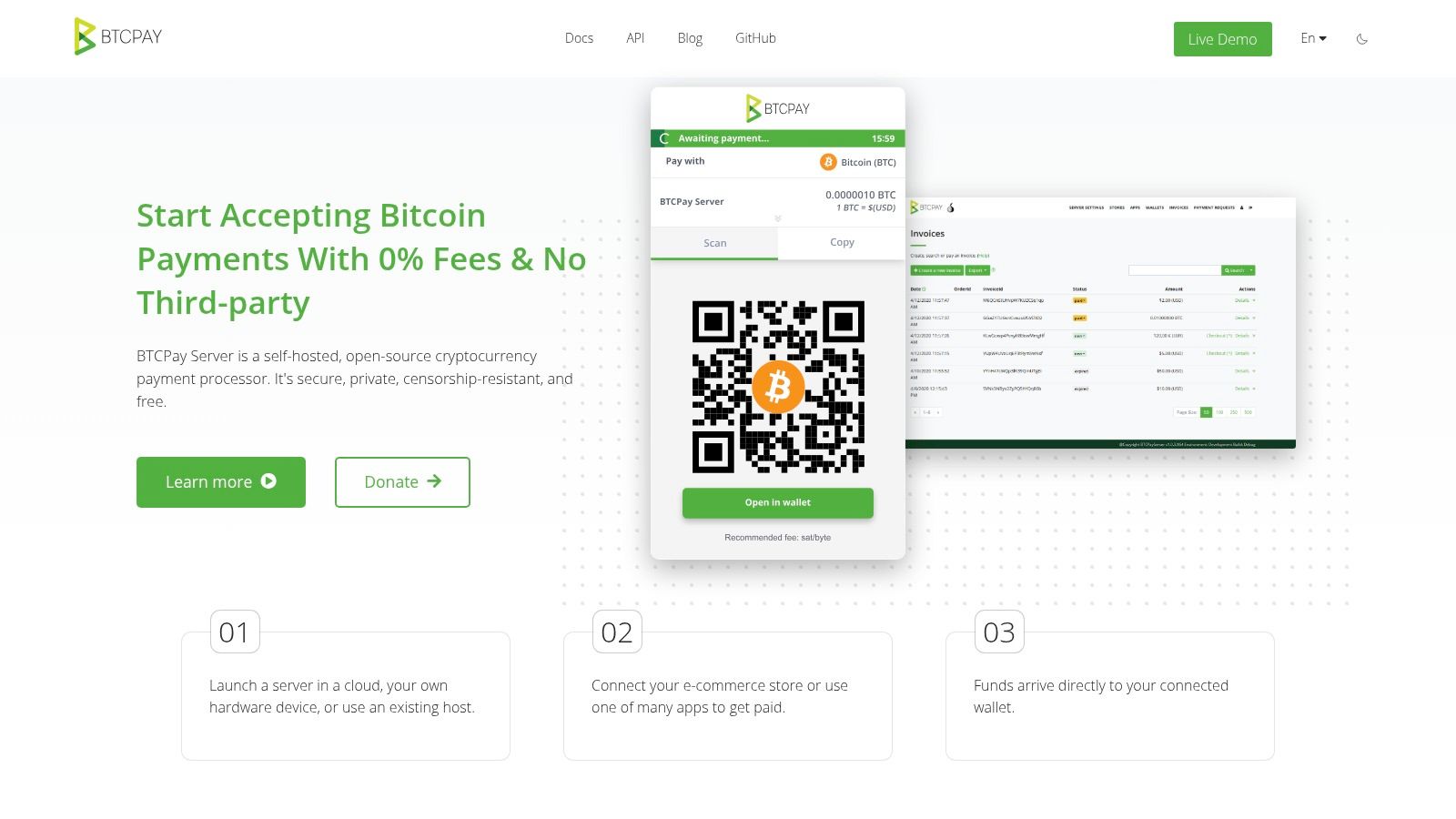
A merchant with in-house technical staff may look at BTCPay Server and see something attractive: full control, no processor taking a cut, and no dependence on a third-party platform for core payment flows. That appeal is real. So is the workload.
BTCPay Server is open-source and self-hosted, which puts it in a different category from the managed processors ranked higher in this article. For teams that care most about sovereignty and direct control over funds, that can be the right choice. For merchants prioritizing global sales, easier operations, and stablecoin settlement to USDC, it is usually a poor match.
Who should actually use BTCPay Server
BTCPay Server fits technical teams that are prepared to run payment infrastructure themselves. That means hosting, updates, security, wallet management, plugin maintenance, and support all stay on your side. If something breaks during checkout, your team owns the fix.
The upside is straightforward. You keep custody. You avoid standard gateway fees. Developers also get a high degree of flexibility.
The downside is just as straightforward. You do not get the managed settlement layer many merchants need.
That matters in this specific shortlist. The focus here is not just crypto acceptance in the abstract. It is practical cross-border commerce, especially where USDC settlement helps merchants reduce banking friction, treasury volatility, or payout delays. BTCPay Server can serve a narrow technical use case well, but it does not address the card-to-USDC path that makes Suby stand out, and it is not the processor I would put in front of a typical ecommerce operator trying to simplify international revenue collection.
Self-hosted payments can reduce fees, but they also turn your payment stack into an internal operations responsibility.
Use BTCPay Server if control is the priority and your team has the skills to support it. If your priority is smoother merchant operations, broader payment flexibility, or settlement options built around stablecoins, a managed provider will usually be the better business decision. The official project site is BTCPay Server.
9. CryptoProcessing by CoinsPaid

CryptoProcessing by CoinsPaid is one of the more enterprise-oriented options in this market. It tends to come up when merchants need operational controls, larger-volume support, and a processor that can handle more demanding settlement and compliance conditions.
One cited market overview notes that Estonia-licensed CoinsPaid has emerged as a specialized solution for high-volume, transaction-intensive industries such as iGaming and Forex, which matches how many operators already view it. It is not aimed at the solo merchant looking for the easiest possible plugin setup. It is aimed at businesses where payment operations are a serious discipline.
Best fit for operationally heavy merchants
If your company processes a lot of transactions, spans multiple entities, or works in sectors where risk controls matter as much as checkout conversion, CoinsPaid deserves a look. It has a reputation for being built around operations, not just storefront convenience.
The main trade-off is accessibility. Public pricing is not as simple or transparent as lighter self-serve tools, and implementation usually feels more sales-led. That can be frustrating for small merchants, who often care more about the basics of accepting credit cards for a small business than about enterprise settlement controls, but it's often normal for enterprise payment infrastructure.
A few practical notes:
Best for higher-complexity operations: Especially if you need stronger process controls.
Less ideal for quick self-serve launch: Expect a heavier onboarding path.
Useful if stablecoin and fiat flexibility both matter: Particularly for businesses with more complex treasury needs.
Merchants can review the current enterprise offering at CryptoProcessing by CoinsPaid.
10. Triple-A
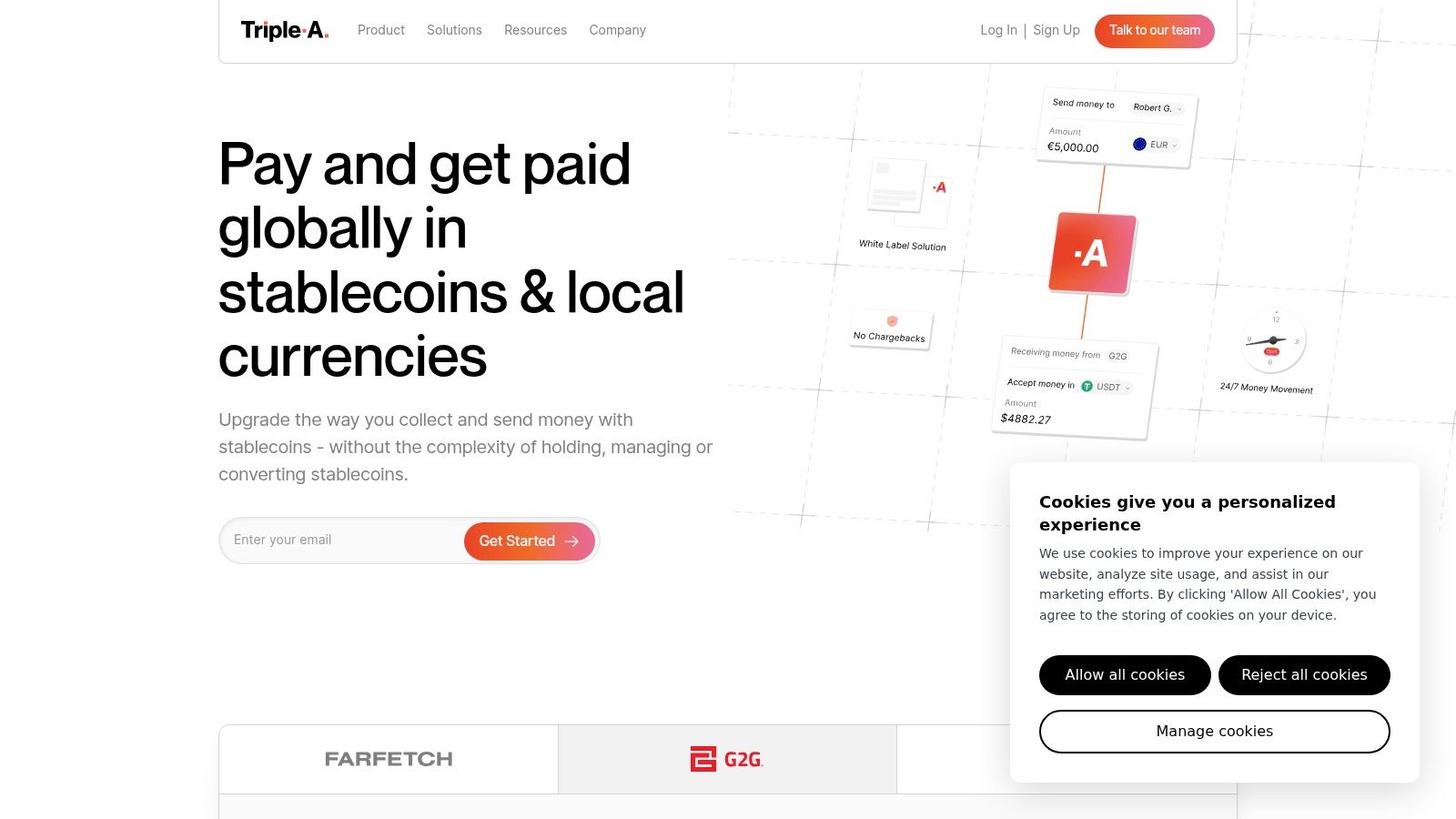
A merchant selling across Southeast Asia, Europe, and the Middle East usually runs into the same problem fast. Accepting crypto at checkout is the easy part. Settlement rules, payout flows, and compliance reviews are what slow the project down.
Triple-A stands out because it is built for that second layer. Its pitch is less about adding another crypto button and more about giving regulated businesses a processor that can handle acceptance, payouts, and cross-border money movement in one system. That makes it more relevant for merchants with finance and operations teams than for a small store testing crypto for the first time.
For this list, the main question is stablecoin settlement. Triple-A belongs here because it has taken stablecoins seriously as part of its cross-border payments model, which fits merchants trying to reduce FX friction and shorten the path from customer payment to usable funds. If your priority is receiving USDC from card-paying customers, Suby is more directly aligned with that use case. If your priority is enterprise crypto infrastructure with stronger compliance framing, Triple-A is the more natural comparison.
Why larger merchants consider Triple-A
Triple-A is worth reviewing if crypto payments sit inside a broader treasury and payments operation. Businesses with regional entities, approval requirements, or payout needs often care less about plugin convenience and more about settlement controls, auditability, and jurisdiction coverage.
The trade-off is straightforward. Triple-A is not the option I would choose for the fastest self-serve launch or the simplest small-business setup. It makes more sense for merchants that expect onboarding questions, policy checks, and a more structured implementation process.
In practice, that means:
Better fit for regulated international sales: Useful when compliance and payout structure matter as much as checkout conversion.
Relevant for stablecoin-focused settlement planning: A stronger fit for merchants that treat stablecoins as part of cross-border operations, not just a customer payment preference.
Less appealing for lightweight launches: Smaller merchants may find simpler tools easier to test and deploy.
Current merchant information is available at Triple-A.
Top 10 Crypto Payment Processors for Merchants, Features & Fees (2026)
Product | Core features | Settlement & payouts | Target audience | Unique selling points | Pricing / fees |
|---|---|---|---|---|---|
Suby | Card + crypto acceptance; paylinks, embeddable checkout, API & webhooks; one‑time & subscriptions | Revenue settled directly in USDC to merchant wallet; no bank/SWIFT delays or payout holds | Internet‑first businesses, creators, global sellers, communities | Built‑in Discord & Telegram access management; unified card+crypto→USDC flow; PCI‑DSS Level 1 partner; real‑time dashboard | Public materials reference ~4–5% (inconsistent). Verify current rates on Suby pricing page |
BitPay | Hosted checkout, invoices, plugins (Shopify/WooCommerce/etc.), refunds & exports | Settlement to fiat or crypto with dispute/chargeback mitigation | Merchants needing mature crypto checkout + e‑commerce plugins | Long‑running gateway, strong refund/audit tools, broad plugin ecosystem | Transparent, tiered transaction pricing (public) |
Coinbase Commerce (→ Coinbase Business) | On‑chain crypto acceptance; Coinbase integrations and tooling | Settlement to supported assets (USDC primary today) | Merchants valuing Coinbase brand/compliance and tooling | Coinbase brand trust; familiar developer UX | Historically 1% (Commerce). Verify current fees and migration details |
Stripe, Stablecoin Payments | Accept USDC on multiple chains; Wallet handoff; Stripe checkout & risk tools | Settles as USD to Stripe balance (US‑merchant functionality) | US merchants already on Stripe wanting crypto checkout | Consolidated Stripe dashboard, reporting and risk tooling | Public crypto pricing not detailed, confirm with Stripe |
CoinGate | Hosted checkout, API, recurring billing, e‑commerce plugins | Settlement to fiat or crypto; multiple payout options | EU/e‑commerce merchants needing broad coin support | Clear public compliance docs; wide crypto support | Clear 1% headline processing fee (public) |
NOWPayments | Paylinks, invoices, subscriptions, POS; 300–350+ currencies supported | Auto‑conversion and settlement to chosen assets; off‑ramp modules | Merchants needing long‑tail token coverage and fast setup | Extremely wide coin coverage; quick go‑live | Low headline fees advertised; effective cost varies by coin/conversion |
OpenNode | Hosted checkout, payment buttons, invoicing; Lightning Network support | Near‑instant Lightning settlement; auto‑conversion and locked rates | BTC‑centric brands and Lightning users | Production Lightning support for low fees and speed | Low transaction costs (Bitcoin/Lightning focus) |
BTCPay Server | Self‑hosted invoices, POS, pay buttons, Greenfield API | Merchant retains custody; on‑chain & Lightning support | Teams wanting sovereignty and zero gateway fees | Open‑source, 0% processor fees (self‑hosted) | 0% processor fees (merchant‑operated) |
CryptoProcessing (CoinsPaid) | Invoicing, checkout, treasury/treasury features, "Pay with Wallet" UX | Predictable miner fee handling; global multi‑entity settlement options | Enterprise/high‑volume merchants needing compliance & ops | Enterprise operational tooling and predictable fee treatment | Pricing sales‑led / custom quotes (public pricing not disclosed) |
Triple‑A | API, hosted checkout, plugins; stablecoin payouts & local‑currency settlement | Stablecoin rails plus fiat settlement and B2B payout paths | Businesses selling into APAC or needing B2B cross‑border payouts | MAS‑licensed, compliance‑forward operator with APAC focus | Custom / quote‑based pricing (public fee schedule limited) |
Final Thoughts
The answer to what are the top crypto payment processors for merchants in 2026 depends less on feature lists and more on settlement design.
If you want the shortest summary, it looks like this. BitPay is still the conservative choice for merchants that want established processor behavior and bank-style settlement. Coinbase Commerce is attractive for a stablecoin-forward path with a familiar vendor, but the platform transition means you need to verify the current setup carefully. NOWPayments is useful when asset breadth matters more than operational simplicity. CoinsPaid and Triple-A make the most sense when you're dealing with enterprise requirements, higher transaction complexity, or stronger compliance expectations. BTCPay Server is for technical teams that intentionally want to self-host.
Suby stands out because it solves a different and increasingly important merchant problem. Customers want to pay in familiar ways, especially by card. Businesses want faster, more predictable global settlement. Suby combines those two realities by letting customers pay with cards or crypto while the merchant receives USDC. That is a more useful model for many internet businesses than a processor that starts and ends with wallet checkout.
This is especially true for SaaS companies, agencies, creators, online communities, and digital-first merchants selling across borders. If your biggest friction points are frozen payouts, slow bank transfers, opaque conversion costs, or the operational mess of stitching together payments with access control, then the right processor is the one that simplifies the whole revenue flow, not just the checkout step.
There is also a broader market shift behind that recommendation. Market coverage of the category shows that crypto payment processing has matured beyond simple checkout into multicurrency settlement, integrated compliance, and treasury management, with newer flows like agentic payment starting to reshape how automated transactions are handled. That's why comparing processors only on coin support or headline fees misses the core decision. The better question is: what happens after the customer pays?
For many merchants, that answer should be USDC settlement with as little banking friction as possible. If that's your goal, Suby is the most distinctive option in this list. It gives businesses a direct path to accept card or crypto payments globally, manage subscriptions, and receive USDC without building a patchwork stack around legacy payout systems.
Suby is a payment gateway and Merchant of Record, not just another crypto payment processor. Your customers pay with card, bank transfer, Apple Pay, Google Pay, Klarna, and more, or stablecoins, and you get paid out to your bank account, or directly in stablecoins (USDC, EURC) to your wallet, anywhere in the world, no bank account required. With native Discord and Telegram integrations for subscriptions and paid access, it is the most distinctive option on this list for merchants who want predictable global settlement instead of a wallet-only checkout.
