

Gaspard LEZIN
How to Accept Crypto Payments for Your Business: A Practical Guide
Discover how to accept crypto payments for business with this practical guide. Learn to integrate card and crypto checkouts with instant USDC settlements.
Thinking about accepting crypto payments? It's not about turning your business into a crypto trading desk. It's about giving customers more ways to pay while you get paid faster and more predictably. The most practical way to do this is by working with a payment provider who can handle both credit cards and crypto, converting everything into a stablecoin like USDC for you. This simple switch can remove price volatility from the equation and make your accounting life a whole lot easier.
Why Your Business Needs a Hybrid Payment Solution
If you operate in a global market, you know the headaches that come with traditional payment methods. Relying solely on them creates a lot of friction. We're talking about slow cross-border settlements that can take days, high currency conversion fees, and the sheer operational drain of managing revenue from multiple countries. These aren't just minor inconveniences, they can seriously choke your cash flow and stunt your international growth.
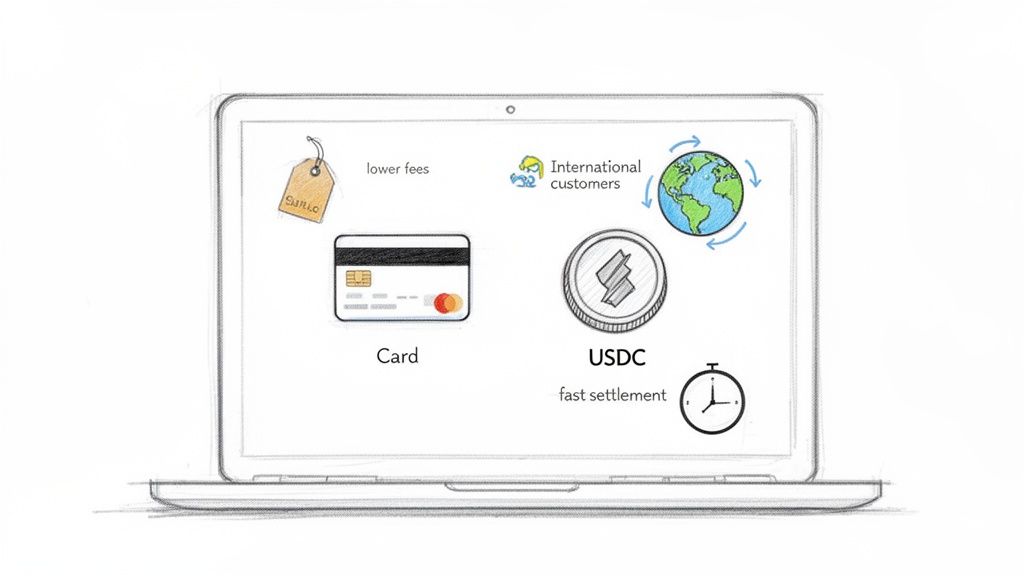
This is exactly where a hybrid payment model comes in. It’s a smart approach that blends the familiar world of card payments with the raw efficiency of modern digital currency. Customers can pay with their card, and businesses receive USDC.
Bridging Traditional and Modern Commerce
A hybrid system lets you meet every customer where they are. Someone who wants to pay with their Visa or Mastercard can do so just as they always have, without a second thought. At the same time, you’re opening your doors to a growing, digitally-native audience that prefers the speed and lower costs of crypto. You're not forcing a choice, you're just adding a better option.
This isn’t some niche trend, either. A recent study found that nearly 40% of U.S. merchants now accept digital currencies at their point of sale. This shift is being pulled by consumer demand for faster, borderless payments that sidestep old-school banking delays and fees. You can dive deeper into these insights in PayPal’s research on the shift to digital assets.
The beauty of this approach is that the complexity is handled for you. Your customer gets a smooth checkout, and your business reaps the rewards of a far superior settlement system.
The Power of Instant USDC Settlements
For your business operations, getting paid in USDC is the real game-changer. Forget waiting days for an international wire to clear. USDC settlements are nearly instant and happen 24/7, weekends and holidays included. This gives you immediate access to your revenue and transforms your cash flow.
Just look at how this model stacks up against the old way of doing things.
Traditional Payments vs USDC Settlement
Here's a direct comparison of traditional payment rails and a modern system using USDC settlements, highlighting key business benefits.
.tbl-scroll{contain:inline-size;overflow-x:auto;-webkit-overflow-scrolling:touch}.tbl-scroll table{min-width:600px;width:100%;border-collapse:collapse;margin-bottom:20px}.tbl-scroll th{border:1px solid #ddd;padding:8px;text-align:left;background-color:#f2f2f2;white-space:nowrap}.tbl-scroll td{border:1px solid #ddd;padding:8px;text-align:left}FeatureTraditional Payment SystemsFlexible Settlement Model (via Suby)Settlement Speed2-5 business days, longer for cross-border transactionsNear-instant, available 24/7/365Cross-Border FeesHigh wire fees and 2-4% currency conversion markupsMinimal network fees, no forced conversion costsCash Flow AccessDelayed, subject to banking hours and holidaysImmediate access to funds, improving liquidityOperational OverheadComplex reconciliation across multiple currencies/regionsSimplified accounting with a single, stable unit of accountGlobal ReachLimited by correspondent banking relationshipsTruly global and borderless by design
This table makes it clear: settling on your terms, to your bank account, or in stablecoins (USDC, EURC) to your wallet, is about gaining efficiency, control, and speed.
By accepting familiar card payments and settling in a stablecoin like USDC, you create a frictionless global sales process. This model removes the operational burdens of international commerce, allowing you to focus on growth.
Ultimately, a hybrid solution is about future-proofing your business. It allows you to accept crypto payments without forcing anyone, your customers or your finance team, to deal with the complexity. We provide an API that allows any business to accept payments by card or crypto, and we also offer native integrations with Discord and Telegram for use cases like subscriptions and paid communities. With a solution like Suby, you can integrate this capability seamlessly, where users pay with cards and your business receives USDC.
Choosing the Right Crypto Payment Gateway
Picking a payment partner is a huge decision. This isn't just about slapping a new button on your checkout page, it's about laying the groundwork for how your business makes money. When you start accepting crypto, the right gateway feels like a natural part of your team. The wrong one can lead to operational nightmares.
You're looking for a provider that can gracefully handle both traditional card payments and modern crypto transactions, ultimately settling everything into stable USDC. Reviewing how different crypto payment processors for global business compare is a good way to shortlist candidates. This hybrid model gives you the best of both worlds. Your customers get the familiar options they trust, while your business reaps the rewards of a fast, stable digital dollar.
To get your bearings, it helps to understand what the standard players offer. A quick look at the top payment gateways for ecommerce gives you a solid baseline. Once you know what "normal" looks like, you can really appreciate what a crypto-native provider brings to the table.
Core Evaluation Criteria for a Hybrid Gateway
It’s easy to get bogged down in endless feature lists when comparing providers. Cut through the noise and focus on what actually moves the needle for your revenue, operations, and customer experience.
Here’s what I always look for:
Payment Methods Offered: Can customers pay with their Visa or Mastercard? What about popular cryptocurrencies? The goal is to offer plenty of choices without making the checkout process a convoluted mess.
Settlement Currency and Speed: This is a big one. The provider absolutely must offer automatic settlement in USDC. You also need to confirm that payouts are quick and not tied to ancient banking hours or frustrating multi-day holds, a classic headache with old-school systems.
Pricing Transparency: Hunt for a simple, all-in fee structure. I've seen businesses get eaten alive by hidden costs for currency conversion, international payouts, or monthly "maintenance." A straightforward, flat percentage per transaction is usually the cleanest and most predictable way to go.
Integration Flexibility: How much work is it to get this thing hooked up to your business? A top-tier provider gives you options, from dead-simple, no-code paylinks and embeddable checkouts to a powerful API for a completely custom setup.
The ideal partner removes complexity, not adds to it. They should be handling the technical and compliance headaches so you can focus on what you're actually good at: growing your business.
Technical and Operational Excellence
Beyond the basics, you can tell a lot about a gateway by its technical chops and operational support. This is where you separate the good from the truly great.
Take Suby, for example. They offer native integrations with platforms like Discord and Telegram. For anyone running a paid community or subscription service, that's a game-changer. It shows they get how modern, internet-first businesses operate.
It's about more than just processing a transaction, it's about enabling the entire commercial flow, from the moment a customer pays to the moment they get access. This thinking lines up with the massive institutional shift toward digital assets. By mid-2025, tokenized real-world assets hit a $23 billion market value, proving that regulated, practical digital finance is here to stay. You can dig into more of the data in Vaultody's research on institutional crypto adoption.
Lastly, don't overlook the quality of their support and documentation. When something inevitably goes wrong, you need fast, competent help. Crystal-clear API docs, genuinely helpful guides, and a support team you can actually reach are all signs of a mature, reliable platform that cares about its customers' success. If you weigh these factors carefully, you’ll find a partner that doesn't just process your payments but actually helps you build your global vision.
Getting Your New Payment System Up and Running
Integrating a new payment system shouldn't be a drawn-out, complex engineering project. You need practical, real-world options that plug right into how you already do business, whether you're sending a one-time invoice or managing a global SaaS product. The entire point is to start accepting payments quickly, using a method that fits your team's technical skills and your business model.
A good payment layer gives you the tools to go live in minutes, not months. You can start with no-code solutions like paylinks, drop an embedded checkout right onto your website, or go for a full-blown API for a completely custom build. Whichever route you take, the result is the same: your customer gets a dead-simple payment experience, and you get settled in stable USDC.
Three Paths to Payment Integration
So, how do you choose the right way to integrate? It really boils down to your immediate needs. Are you looking for raw speed and simplicity for a single sale? Do you want a polished, branded experience on your website? Or do you need granular control over every aspect of the payment flow inside your app?
Let's walk through the three main approaches.
Paylinks for Instant Invoicing and Sales: This is by far the fastest way to get paid. You generate a unique payment link for a product or service and fire it off to a customer via email, Slack, social media, or wherever. It’s perfect for freelancers, agencies, and anyone who needs to spin up an invoice without a full e-commerce backend.
Embedded Checkout for Websites: If you have a website, an embedded checkout provides that professional, trustworthy feel customers expect. With just a few lines of code, you can add a pre-built payment form to your site that’s already optimized for conversions. This keeps your customers on your domain while the checkout handles all the heavy lifting, from card validation to generating crypto addresses.
API for Custom Solutions: For businesses that need total control, a developer-friendly API is the way to go. This lets you build the payment experience from the ground up, right inside your own application. You can programmatically manage subscriptions, use webhooks to trigger actions, and customize every single step of the user's journey.
This visual guide breaks down the decision-making process, weighing speed, pricing, and the technical lift required for each option.
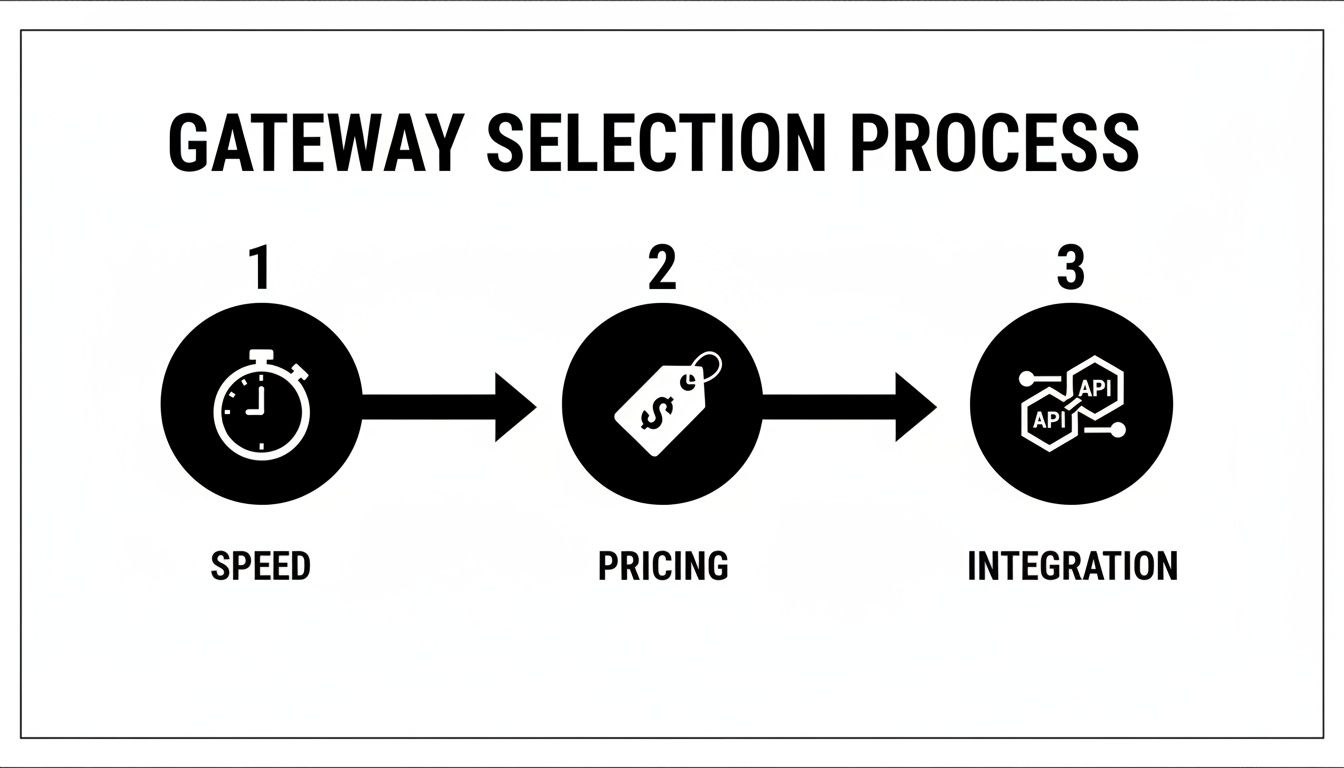
As you can see, while a full API integration offers the most power, no-code tools like paylinks get you accepting payments almost instantly.
Real-World Integration Scenarios
Theory is one thing, but seeing how this works in practice is what really matters. Let's look at a few common scenarios to show how you can accept crypto payments for business without friction.
Take a creator who runs a paid community on Discord or Telegram. By using a native integration, they can set it up to automatically grant access to anyone who signs up for a subscription. The member pays with their card, the creator receives USDC, and the platform handles all the recurring billing and role management. This setup completely eliminates the manual headache of chasing payments and updating member lists.
For an e-commerce shop, an embedded checkout is a no-brainer. A customer adds products to their cart and moves to a payment page that looks and feels like it belongs to the store. They enter their card details just like they always do, and the transaction goes through smoothly. On the backend, that payment is settled as USDC directly to the merchant’s wallet, which is a game-changer for simplifying cross-border sales.
The best integration is the one your customer never even notices. A smooth, familiar checkout process builds trust and has a direct, positive impact on your conversion rates, no matter what payment rails are running underneath.
Customizing Your Payment Flow with an API
When off-the-shelf options just won't cut it, an API gives you the power to build precisely what you envision. Our API is designed to be straightforward, allowing any business to accept payments via card or crypto. For those building on the cutting edge, understanding how to handle new transaction types like the X402 payment protocol can unlock entirely new business models.
With our API, you can programmatically create customers, manage complex subscription plans, and use webhooks to listen for payment events. This is ideal for SaaS companies that need to tie payments directly to user accounts or for platforms that require sophisticated billing logic. You get all the power of a global payment infrastructure without having to build it yourself. To dive into the technical details, our guide on payment gateway API integration is a great place to start. This kind of flexibility means your payment system can scale right alongside your business.
Nail Your Checkout Security and User Experience
Think about the last time you abandoned an online shopping cart. Was it because the checkout process felt clunky, confusing, or just a little bit sketchy? My guess is yes. Trust is the currency of online sales, and a poor checkout experience is the fastest way to lose it.
When you're accepting crypto payments, the stakes are even higher. You need to balance ironclad security with a silky-smooth user experience. The goal is to make the entire payment flow so intuitive that your customer barely thinks about it.
Fortunately, security and user experience aren't opposing forces, they actually reinforce each other. A secure, professional-looking checkout naturally makes customers feel more confident, which is exactly what you want when they’re about to click "buy."
Build a Foundation of Trust with Top-Notch Security
Security isn't a "nice-to-have" feature, it's the bedrock of your payment system. If you're handling card payments in any capacity, working with a PCI-DSS compliant provider is absolutely mandatory. This isn't just a best practice, it's a set of rigorous industry standards designed to protect sensitive card data from breaches.
But today's security landscape goes beyond that baseline. In many parts of the world, regulations like Strong Customer Authentication (SCA) are the new norm. This adds a crucial verification step, like a one-time code sent to a phone, to prove the customer is who they say they are, drastically reducing the risk of fraud.
A secure and compliant payment process is your best defense against the headaches of fraud and chargebacks. When you get this right, you create a trustworthy environment that encourages customers to follow through, which has a direct, positive impact on your conversion rates.
Partnering with a provider that handles this heavy lifting is a game-changer. It frees you from the constant, resource-draining task of staying on top of complex compliance rules. For a deeper look at these standards, you can learn more about what PCI-DSS compliance means for your business in our detailed guide.
To help you vet potential providers, here's a quick checklist of the essentials.
Essential Security and Compliance Checklist
Before you commit to any payment provider, run them through this checklist. Ensuring these features are in place is critical for protecting your business and your customers.
FeatureWhy It Matters: Availability in Suby:
- PCI-DSS Compliance: Non-negotiable standard for securely handling card data. Protects against data breaches and massive fines.
- Strong Customer Auth (SCA): A regulatory requirement in Europe and a best practice globally for preventing fraudulent transactions.
- 3D Secure 2 (3DS2): The latest protocol for authenticating card payments, improving security while reducing friction for legitimate buyers.
- Tokenization: Replaces sensitive card details with a secure token, minimizing the risk if your systems are ever compromised.
- Fraud Detection: Uses machine learning and advanced analytics to identify and block suspicious transactions in real-time.
A provider that ticks all these boxes demonstrates a serious commitment to security, giving you peace of mind.
Design a Checkout Flow That Actually Converts
While you're enjoying the benefits of USDC settlement on your end, your customer shouldn't notice anything different. Their checkout experience needs to feel familiar, simple, and totally frictionless. Anything less is just leaving money on the table.
A high-converting checkout is all about clarity. No one likes surprise fees, so be transparent with your pricing from the start. When it's time to pay, the interface should look exactly like every other online store they've used, with standard fields for card number, expiration date, and CVC. Don't try to reinvent the wheel here.
Here are a few quick tips to create a checkout experience that converts:
Be Upfront with Pricing: Always show the final cost, including taxes or shipping, before asking for payment details.
Keep It Familiar: Stick to a conventional layout for card entry fields. Familiarity breeds trust.
Think Mobile-First: A huge chunk of online shopping happens on phones. Test your entire checkout flow on mobile to ensure it’s flawless.
Cut Out the Clicks: Every extra step or page you add is another chance for a customer to drop off. Keep it as short as possible.
By maintaining a traditional and trustworthy payment journey, you make it incredibly easy for customers to complete their purchase. Whether they're paying by card or crypto, the process should feel effortless. This focus on a seamless, secure experience is the key to maximizing conversions and turning one-time buyers into loyal fans.
Managing Global Operations with USDC Payouts
One of the biggest misconceptions about accepting crypto is that it adds complexity to your financial operations. In my experience, the opposite is true, especially if you're a business with a global footprint. When your revenue comes in as USDC, you actually gain a stable, predictable foundation that traditional cross-border banking rarely offers.
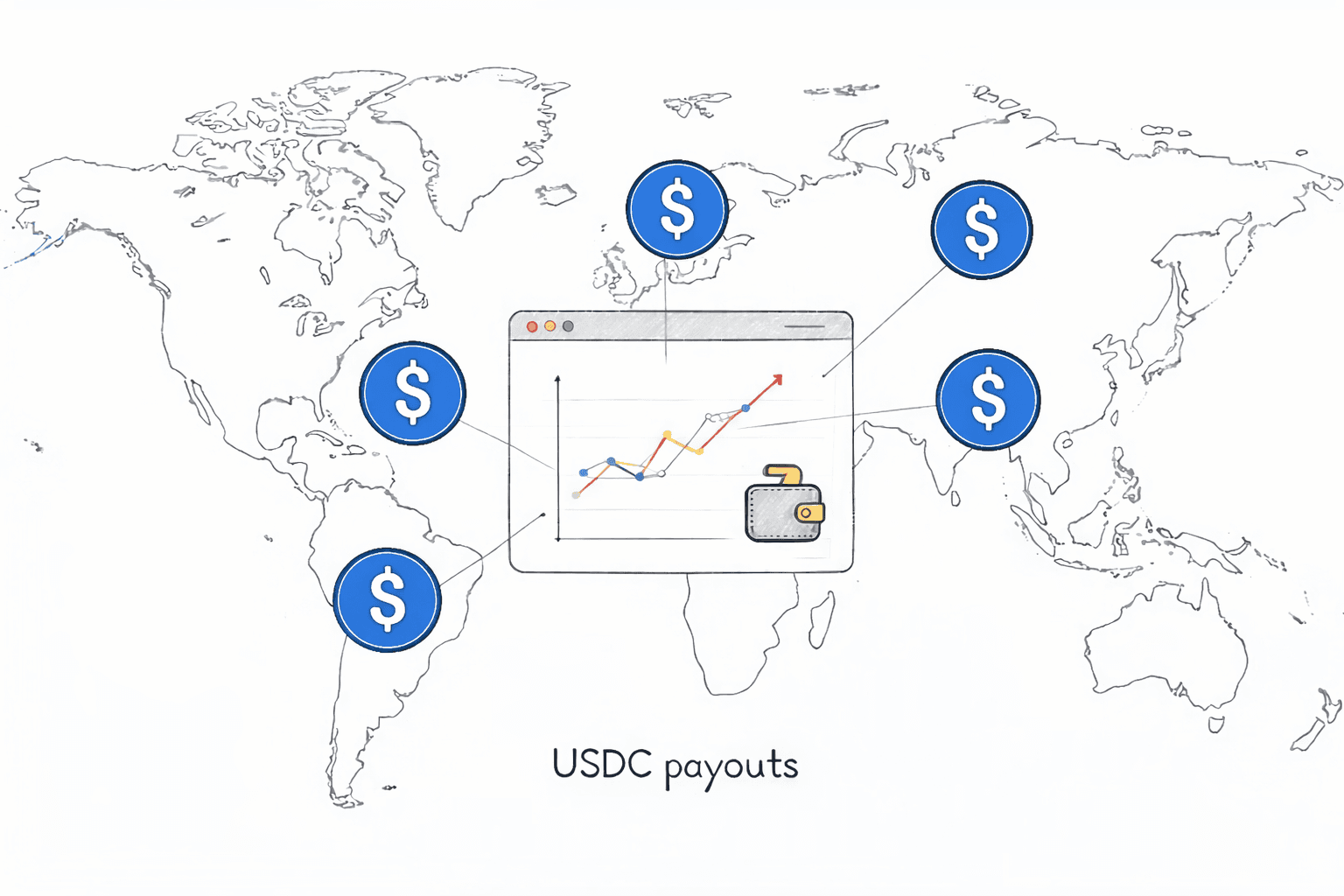
Think about it: you get to sidestep the absolute headache of managing multiple foreign bank accounts and the constant worry of volatile exchange rates. Instead of juggling euros, pounds, and yen, every payment settles as a digital dollar. Your accounting just got a whole lot cleaner.
The Power of a Stable Unit of Account
At its core, USDC gives you a consistent unit of account, which makes financial planning and forecasting much more straightforward. Because it’s pegged 1-to-1 with the US dollar, you effectively remove currency fluctuation risk from your revenue. You can price your products with confidence, knowing the value you receive won't evaporate between the time of sale and settlement.
This isn't just a niche advantage anymore. The 2026 Global Digital Asset Adoption Index shows a world where stablecoin utility is skyrocketing in places like Latin America for everything from simple remittances to hedging against inflation. If you're running a cross-border e-commerce site or a SaaS business with international subscribers, this trend is a massive signal of demand for stable, digital payment rails. You can explore more insights on global digital asset adoption to see how these patterns are taking shape.
A smart payment platform like Suby lets customers pay how they want, card or crypto, but you get the final settlement in clean, simple USDC.
By standardizing your revenue in USDC, you eliminate the operational drag of currency conversion and international wire transfers. This frees up your finance team to focus on strategic growth instead of tactical reconciliation.
Real-Time Financial Monitoring
Any modern payment system worth its salt should give you a live, crystal-clear view of your company's financial health. A centralized dashboard, or global payments merchant portal, isn't a "nice-to-have," it's essential for tracking revenue as it hits, managing subscriptions, and keeping an eye on key metrics without the usual banking delays.
With that kind of instant visibility, you can:
Track incoming payments the moment they happen, not days later when they finally clear.
Monitor subscription health by watching your monthly recurring revenue (MRR) and churn rates in real-time.
Simplify reconciliation by having all transaction data, no matter the original payment method, funneled into one place.
This level of insight is what allows you to make sharp, informed business decisions on the fly. For a deeper dive into streamlining your global sales process, check out our guide on how to accept international payments with a lot less friction.
A Note on Accounting and Tax Considerations
While USDC makes the day-to-day much easier, don't forget it's still a digital asset. The way it's treated for accounting and tax purposes can differ quite a bit between countries, and it’s an area of financial regulation that's still firming up. This is why keeping meticulous records of every single transaction is non-negotiable.
Look for a payment provider whose dashboard gives you detailed transaction histories and lets you export reports easily. This data will be a lifesaver for your accounting team.
That said, always bring in a qualified tax professional or accountant who really understands digital assets in your region. They can offer specific advice to keep you compliant and help you set up your financial reporting correctly. A little proactive planning here will save you from major headaches as you scale globally.
Answering Your Top Questions About Crypto Payments
Diving into crypto payments for your business can feel like a big step. It’s a new world, blending familiar e-commerce with some powerful new tech. It's totally normal to have questions, so let's walk through some of the most common ones I hear from business owners.
Do My Customers Actually Need a Crypto Wallet to Pay Me?
This is the biggest misconception out there, so let's clear it up right away: absolutely not.
The whole point of a modern, hybrid payment system is to give your customers more choice without forcing them to learn something new. They can still pull out their Visa or Mastercard and pay just like they would on any other site. The experience is exactly what they're used to, simple and secure.
But for your customers who are crypto-savvy, they get the option to pay with their digital assets. Either way, the checkout flow is seamless for them, and you get settled in stable USDC. It's the best of both worlds, where customers pay with their card and businesses receive USDC.
Is Getting Paid in USDC an Accounting Nightmare?
Honestly, it’s usually the opposite. It can actually make your accounting much cleaner, especially if you sell internationally.
Think about it. If you have customers in Europe, Japan, and the U.S., you're normally juggling euros, yen, and dollars. With USDC, which is pegged 1-to-1 with the US dollar, every single payment comes in as a stable digital dollar. All that currency conversion mess and volatility? Gone.
This makes your bookkeeping, financial planning, and cash flow management way more predictable. A good payment provider will give you a real-time dashboard to see every payment and payout in one place, which simplifies things even further.
When you standardize your revenue in a stablecoin, you take a messy, multi-currency accounting problem and turn it into a single, streamlined process. It’s a huge operational win that frees up your finance team to focus on growth instead of constant reconciliation.
What Are the Real Costs? I Don't Want Any Surprises.
Pricing transparency is everything when you're looking to accept crypto payments for business. You have to watch out for providers who charge you with hidden fees for currency conversion, cross-border transfers, or even just keeping your account open.
Look for a provider with a simple, all-in-one pricing model. Some of the best platforms charge a single, straightforward percentage per transaction that covers everything, both card and crypto payments. When you add up all the little fees that come with traditional global payment systems, this approach is often much more cost-effective.
My advice? Always map out the entire journey of a transaction, from the customer's click to the money being usable in your bank account. That’s the only way to see the true cost.
How Do I Handle Refunds or Customer Disputes?
This is non-negotiable. Any payment gateway worth its salt has to provide tools for managing refunds and disputes. Running a professional business and keeping customers happy depends on it.
Your payment platform should let you handle these issues right from your dashboard. A critical feature to look for is the ability to process refunds without getting hit with extra fees. This means if you need to send money back to a customer, you can return the full amount without losing even more on the transaction.
It's a fundamental part of keeping your operations smooth and your customer service on point.
Can I Use This for Subscriptions and Recurring Billing?
Yes, and this is where these systems really shine. A robust platform will offer a powerful API that lets you manage the entire subscription lifecycle, not just one-off payments.
This is a game-changer for SaaS companies, paid communities, and membership sites, and it is especially relevant if you use Stripe and need to support global crypto subscriptions. For example, our native integrations with platforms like Discord or Telegram completely automate paid access. When a user subscribes, they get in. If their payment fails, their access is automatically revoked. No more manual membership management.
The system takes care of everything from the initial signup and recurring charges to dunning (chasing down failed payments). And all the while, your revenue settles consistently in USDC, bringing much-needed stability to your recurring revenue model.
Suby is a payment gateway and processor. Your customers pay with card, bank transfer, Apple Pay, Google Pay, Klarna, and more, or stablecoins, and you get paid out to your bank account, or directly in stablecoins (USDC, EURC) to your wallet, anywhere in the world, no bank account required. That is exactly what makes it simple to accept crypto payments for your business without holding volatile assets or wrestling with cross-border banking. Get started with Suby today.
