
Gaspard LEZIN
Deal Soldier Review 2026: Is It Worth It for Resellers?
An in-depth Deal Soldier review for 2026. We analyze its features, pricing, and operational risks to see if it's a sustainable tool for your business.
You're probably looking at Deal Soldier for one reason. You want a faster path to revenue than building a store, launching a product, or growing an audience from scratch. A paid community that pushes real-time clearance alerts sounds like a shortcut. You pay a monthly fee, follow the alerts, buy discounted products, and resell them on Amazon or eBay.
That pitch is appealing because it reduces the hardest part of retail arbitrage, finding inventory worth buying. It also taps into something a lot of side-hustle content gets right. People don't just want information. They want a repeatable system, access to people who are already doing it, and some confidence that they're not wasting time.
Most Deal Soldier reviews stop at legitimacy. They ask whether the community is real, whether alerts exist, and whether members like it. Those are useful starting points, but they miss the harder question. Is this a durable business model, or is it a paid information feed that works best only under narrow conditions?
Table of Contents
The appeal is real, but so is the trade-off
The bigger question behind this Deal Soldier review
The basic operating model
What public evidence supports
Where the membership can create value
Why information decays fast
The real benchmark is execution
Geography and retailer dependence limit consistency
Margin risk appears after purchase
Platform dependency makes scale less durable
Comparison of business model economics
What serious operators optimize for
Why payment infrastructure scales better than sourced deals
A good fit for early resellers
A weak fit for global internet businesses
The dividing line is control
Is Deal Soldier legit
Can retail arbitrage become a stable business
What should creators use if they want recurring revenue instead
How can a business monetize a Discord or Telegram community globally
What matters most when accepting payments internationally
The Allure of Reselling and the Promise of Deal Soldier
Retail arbitrage attracts people who want action, not theory. You don't need to manufacture a product. You don't need to wait months for SEO. You just need a good buy, a marketplace account, and enough speed to act before someone else does.
That's why communities like Deal Soldier get attention. They package the scavenger hunt into a subscription. Instead of manually checking store aisles and retailer apps all day, you get alerts, discussion, and tools that are supposed to narrow the gap between opportunity and purchase.
For a beginner, that can feel like an advantage. You're borrowing the eyes and experience of a larger group. You also get a form of paid confidence. If other members are tracking Walmart, Target, Home Depot, or Lowe's clearance, you don't have to start from zero.
The appeal is real, but so is the trade-off
A deal community solves an information problem. It does not solve the full business problem.
You still need to determine if the item is resellable after marketplace fees, shipping, possible returns, and the time it takes to source and list it. That distinction matters because an alert can be accurate and still be economically weak for the average member.
Practical rule: In retail arbitrage, finding a discounted item is only the first filter. The harder test is whether you can convert that discount into cash consistently.
Many surface-level reviews commonly fall short. They focus on whether access feels valuable, not whether the model compounds. A subscription that helps you source inventory can be useful. It doesn't automatically become the foundation of a scalable business.
If you're still learning how Amazon resale works at the operational level, broad resources like MDS Amazon selling tips are often more helpful than hype-heavy reviews because they frame the day-to-day realities of selling, not just the excitement of sourcing.
The bigger question behind this Deal Soldier review
The most important issue isn't whether Deal Soldier is fake. It appears to be a real paid membership with active demand and visible customer feedback. The tougher issue is whether a shared-alert model creates durable advantage, or whether it turns members into competitors chasing the same thin spread.
That's the lens that matters if you're thinking like an operator instead of a hobbyist.
What Is Deal Soldier and How Does It Work
A subscriber sees a discounted product alert, buys fast, and hopes the margin still exists by the time the item is listed on Amazon or eBay. That is the operating reality Deal Soldier is selling access to.
Deal Soldier appears to be a paid membership built around retail arbitrage. Public descriptions frame it as a community for finding discounted products, checking inventory, and getting guidance on whether an item can be flipped for profit. A public review on Scribehow describes the offer as a mix of real-time deal alerts, software, and reseller education.
The basic operating model
The workflow is straightforward. Members pay for access, monitor alerts, buy inventory from retailers, and try to resell before pricing changes or stock disappears.
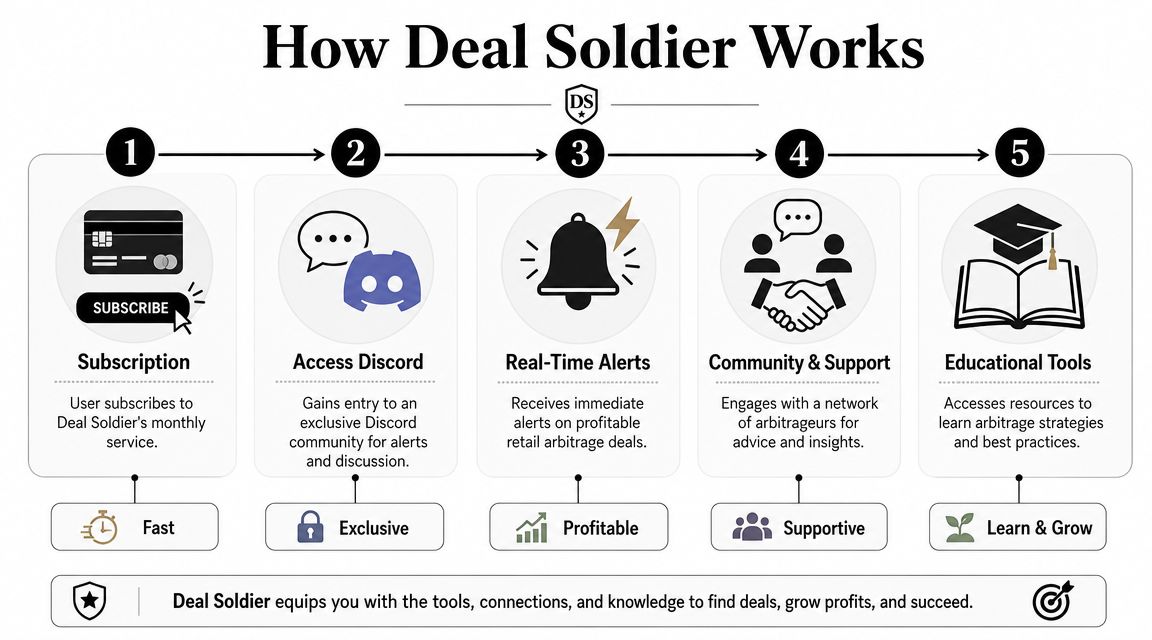
The product appears to center on five functions:
Deal alerts: Notifications about discounted or clearance inventory.
Retail sourcing: Opportunities tied to large stores where products can be purchased quickly.
Research tools: Public write-ups mention inventory checks, barcode scanning, and location-based availability checks.
Member discussion: Subscribers can compare notes on pricing, sell-through, and risk.
Beginner guidance: Educational material helps newer sellers understand the resale process.
That model can be useful, but it has a built-in limitation. Deal Soldier does not create the margin. It distributes information about possible margin, and members still have to execute better than other buyers who received the same prompt.
What public evidence supports
Public traction suggests this is a real product with active demand, not an empty storefront. One separate write-up on Google Sites describes Deal Soldier as a subscription sold through Whop and cites strong customer review volume, a high average rating, and a monthly pricing model with a free trial.
The exact membership price is less clear. Public coverage does not align perfectly, which usually means pricing changed over time, promotions were running, or reviewers captured different plan screens. For a buyer, that matters because a low monthly fee can look attractive until you add sourcing errors, returns, repricing pressure, and marketplace fees.
From an operator's perspective, the more important point is structural. Deal Soldier depends on third-party retail inventory for sourcing and third-party marketplaces for monetization. That means both ends of the business sit on platforms the member does not control.
That dependency is fine for testing resale economics or learning arbitrage mechanics. It is weaker as a long-term monetization system.
A creator, educator, or online business with its own audience usually needs the opposite setup. Direct payment acceptance, direct settlement, and control over customer relationships scale better than competing for retail inventory and resale spread. That is where a payment infrastructure like Suby is materially different. Instead of buying products with margin risk and waiting on marketplace payout cycles, a business can accept card payments and settle in USDC, which is a cleaner model for global sales, faster treasury access, and repeatable monetization.
The narrow conclusion is clear. Deal Soldier appears to function as an active paid sourcing community. The harder question is whether that model stays attractive once a seller wants predictable cash flow, less platform dependency, and a business that compounds outside the retail arbitrage cycle.
Evaluating the Core Features and Community Value
The feature list sounds strong because it addresses the three pain points most new resellers have. They need sourcing ideas, faster research, and people to sanity-check decisions. Deal Soldier appears to offer all three.
What matters is whether those features create an edge that lasts long enough to matter financially.
Where the membership can create value
A shared alert channel can absolutely help a beginner avoid wasted time. Instead of scanning every retailer manually, members can focus on opportunities that another person or tool has already flagged.
The community element also matters more than it first appears. In arbitrage, confidence often comes from seeing how other operators interpret the same opportunity. One person spots a clearance item. Another checks local availability. A third points out whether Amazon pricing is likely to hold or collapse.
That kind of collaboration can shorten the learning curve in ways a static course can't.
A practical reading of the product looks like this:
Alerts reduce search time: You spend less time hunting blindly for inventory.
Tools reduce guesswork: Barcode scanning and inventory checks help members filter noise faster.
Peer discussion adds judgment: Community responses can expose obvious bad buys before you commit capital.
Education helps beginners start: New sellers often need frameworks, not just deals.
Why information decays fast
This is the core weakness in nearly every paid-deal model.
A good alert loses value as more members act on it. Inventory disappears. Marketplace listings get crowded. Sellers undercut one another. What began as a clear spread can tighten quickly, sometimes before the average user even reaches the store or places an order.
That doesn't mean the alert was bad. It means shared information has a short half-life.
A public review of Deal Soldier points directly at this blind spot. It notes that most reviews confirm the service finds deals, but rarely analyze whether an average member can consistently profit after fees, shipping, and competition from other members acting on the same alerts, which can compress margins, according to this Whop review of Deal Soldier.
A membership can be legitimate, active, and well-reviewed while still producing uneven outcomes across users.
That sentence is the difference between a customer satisfaction story and a business viability story.
The real benchmark is execution
If you evaluate Deal Soldier only as an information product, the early signals are good. Active purchases and strong ratings suggest users perceive value. If you evaluate it as a business tool, the standard becomes harsher.
The right questions are operational:
Can you act on alerts fast enough in your market?
Do you live near the retailers the community focuses on?
Can you absorb mistakes in buying decisions?
Do you know how to calculate profitability after all selling costs?
Can you repeat the process often enough to justify the subscription and your time?
A newcomer may benefit even if only some alerts convert into profitable flips, because the membership also teaches sourcing behavior. An experienced reseller may judge it differently. They don't just want ideas. They want a durable edge.
That's where the community's value becomes conditional. It's strongest as an accelerator for learning and weakest as a promise of stable, repeatable margin.
The Operational Risks of a Retail Arbitrage Model
A deal alert hits your phone at 2:14 p.m. By 2:40, another member may already be in the aisle, local inventory may be gone, and the resale spread may have narrowed before you even leave home. That timing problem explains why retail arbitrage often looks more scalable on social media than it is in practice.
Deal Soldier can improve sourcing speed. It does not remove the operating constraints that sit underneath the model. Retail arbitrage still depends on third-party retailers for supply, third-party marketplaces for demand, and local execution for margin capture. A business built on that stack has limited control over its inputs.
Geography and retailer dependence limit consistency
The model is structurally uneven because the opportunity set is local. A member near dense Walmart or Target coverage can test more alerts in less time. A rural buyer may spend more on fuel and dead trips. An international user may find that many leads do not apply at all.
That gap matters because reselling economics are sensitive to small frictions. A short drive, reliable in-store stock, and fast listing turnaround can preserve margin. Longer travel times, empty shelves, or regional pricing differences can remove it.
The result is a model with very different outcomes for different operators:
User profile | Likely experience |
|---|---|
U.S.-based reseller near target retailers | More chances to source before inventory changes |
Rural or low-density shopper | More travel, fewer viable alerts, lower time efficiency |
International seller | Limited relevance if the retailer base is mostly U.S.-centric |
Margin risk appears after purchase
The key business risk is not whether the alert was accurate. The key risk is whether the full chain from purchase to resale still produces acceptable unit economics.
Once inventory is bought, the seller takes on several forms of execution risk:
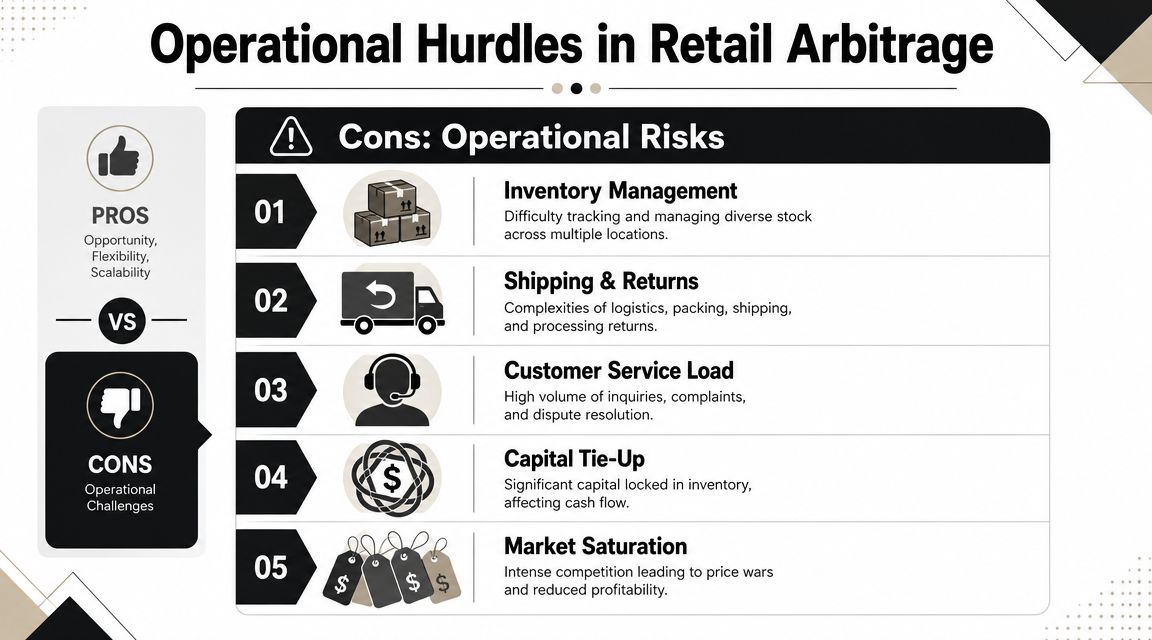
Inventory complexity: Mixed SKUs, partial quantities, and storage errors add administrative work.
Listing quality: Titles, images, condition grading, and repricing affect conversion and selling speed.
Fulfillment overhead: Packing, labeling, shipping, and customer communication consume time that is rarely included in profit screenshots.
Returns and disputes: One return on a low-margin product can erase profit across several sales.
Cash flow drag: Capital remains tied up until items sell and marketplace payouts clear.
This is why retail arbitrage should be evaluated as an operations business, not just a sourcing activity. The buyer is effectively running a small inventory and fulfillment system on top of someone else's retail infrastructure.
An expert guide to increasing e-commerce sales focuses on conversion and revenue growth. Retail arbitrage has an added constraint. Revenue can rise while operational complexity rises faster, which weakens actual business quality.
Platform dependency makes scale less durable
Deal Soldier members are not only dependent on the community. They are also dependent on retailers keeping products mispriced or discounted long enough to act, and on resale platforms continuing to support profitable exit channels.
That dependency matters more at scale. A hobby seller can tolerate irregular sourcing and uneven sell-through. A serious online business usually needs more predictable inputs, cleaner cash conversion, and stronger control over customer relationships. Retail arbitrage offers none of those by default because the seller does not own the original product supply or the checkout layer.
Payments add another layer of risk. Chargebacks, refund requests, payout holds, and delayed settlement can create stress precisely when cash is already sitting in inventory. Suby's guide to chargeback risk and dispute handling is useful here because it explains disputes as an operating cost, not a rare exception.
For creators and internet-native businesses, that distinction is important. Selling your own membership, digital product, software, or community access through a direct payment stack is usually more scalable than flipping third-party goods. Suby is better aligned with that model because it converts card payments into USDC settlement, which gives global sellers faster, more portable access to revenue than a retail arbitrage workflow tied to store shelves, marketplace rules, and local stock conditions.
Deal Soldier can still be useful as a learning tool or a tactical sourcing channel. Its business model remains fragile at scale because the operator controls the least stable part of the chain.
Deal Soldier Versus a Direct Monetization Strategy
A seller pays for a deal alert, buys inventory, sends it to a marketplace, waits for the listing to convert, then waits again for payout. A creator sells a membership or digital product and gets paid at checkout. Those workflows may both produce revenue, but they create very different operating economics.
Deal Soldier sits in the information layer. It helps members identify resale opportunities built on other companies' products, stock, and marketplace demand. A direct monetization strategy starts from owned demand. The business sells its own offer, controls pricing, and captures the payment relationship at the point of sale.
Comparison of business model economics
The difference becomes clearer when you compare what each model controls.
Factor | Deal Soldier Model (Information Access) | Direct Payment Model (e.g., Suby) |
|---|---|---|
Core asset | Access to shared deal flow | Ownership of customer payments |
Revenue source | Profit depends on buying and reselling third-party products | Revenue comes from selling your own offer |
Margin stability | Variable, because competition can compress spreads | More controllable, because pricing is set by the business |
Geography | Often tied to retailer footprint and local inventory | Global by design if the offer is digital or internet-native |
Customer ownership | Limited, because the original demand often belongs to marketplaces | Stronger, because the business owns the buyer relationship |
Operational load | Sourcing, inventory, listings, shipping, returns | Checkout, fulfillment, subscription or service delivery |
Scalability | Constrained by sourcing speed and stock availability | Better suited to recurring and international sales |
Dependency | High dependence on third-party retailers and marketplace conditions | Higher control over offer, pricing, and payment flows |
The table points to a practical conclusion. Deal Soldier can improve execution inside a resale model, but it does not change the model's underlying dependency on third-party inventory and third-party platforms.
That distinction matters once the goal shifts from side income to a durable online business.
What serious operators optimize for
A larger operator usually cares less about finding the next underpriced SKU and more about shortening the path from demand to cash. That means clearer revenue capture, less working capital tied up in inventory, fewer payout delays, and tighter control over the customer relationship.
Retail arbitrage has a structural ceiling because each sale requires fresh sourcing. Direct monetization compounds differently. A paid community, course, software product, or digital service can sell the same core offer repeatedly without rebuilding supply from store shelves every week.
The revenue quality is different too. Resale margins are exposed to stockouts, price matching, suppressed listings, and fee changes. Direct monetization shifts the focus to conversion, retention, and payment performance. If you want a broader strategic benchmark, this expert guide to increasing e-commerce sales is useful because it centers on revenue systems rather than temporary sourcing spreads.
Why payment infrastructure scales better than sourced deals
For creators and internet-native businesses, the stronger long-term asset is the payment layer.
If a customer is buying access to your product, service, or community, the business gains more from controlling checkout than from chasing resale margin on someone else's goods. Payment infrastructure determines how quickly you collect funds, which geographies you can serve, what currencies you can support, and how reliably money reaches your treasury.
Suby fits that model better than a sourcing community because it is built for direct monetization. Customers pay by card, and settlement arrives in USDC. That structure is more scalable for global creators, agencies, SaaS companies, and online communities that need cross-border revenue collection without tying growth to local retail inventory or marketplace payout rules.
For a closer look at that model, this analysis of creator monetization infrastructure explains why businesses with owned audiences often outgrow third-party platform dependence and need a payment stack designed for international sales.
Deal Soldier remains useful for users who want help spotting resale opportunities. A direct monetization strategy is usually the better business system for operators who want repeatable revenue, global reach, and tighter control over how cash enters the business.
Who Should Use Deal Soldier and Who Needs a Global Payment Layer
The fairest verdict is that Deal Soldier can be useful, but only for a specific type of user.
If you are U.S.-based, comfortable with the mechanics of Amazon or eBay resale, and willing to trade time for sourcing opportunities, the membership can function as a practical learning environment. It may help you move faster than you would on your own.
A good fit for early resellers
Deal Soldier makes the most sense for people in a narrow lane:
New resellers testing retail arbitrage: You want exposure to how deal evaluation works in real time.
Side-hustlers who enjoy sourcing: You don't mind store visits, product checks, and listing work.
People close to major U.S. retailers: The closer you are to the stores that dominate the alerts, the more useful the feed may become.
Learners who value community feedback: You want conversation, examples, and a faster path to competence.
If your main goal is to understand marketplace dynamics across major retail channels, a comparative read like Amazon vs Walmart vs Target helps frame how those ecosystems differ before you commit fully to one sourcing style.

A weak fit for global internet businesses
The model becomes much less attractive if you already own a business that can sell directly.
That includes SaaS companies, agencies, freelancers with international clients, e-commerce brands with their own catalog, and creators monetizing digital communities. For them, retail arbitrage is usually a detour, not a foundation.
These businesses don't need more sourced inventory. They need better conversion, reliable settlement, and fewer cross-border payment headaches. A direct payment stack serves those needs better because the business controls the offer and captures revenue at the point of sale.
For companies in that position, this global payment API overview is relevant because it reflects the fundamental infrastructure question serious online businesses face. How do you accept payments worldwide without adding banking complexity to every new market?
The dividing line is control
A simple test helps.
Choose Deal Soldier if you want to learn resale mechanics and you accept that the business depends on outside inventory, market timing, and your ability to act quickly.
Choose a global payment layer if you already have something people want to buy and need a more scalable way to collect revenue. In that model, users pay with cards, and the business receives USDC. That is structurally different from arbitrage because the revenue comes from owned demand rather than temporary retail inefficiencies.
That's the dividing line most reviews miss. Deal Soldier can be a useful tool. It is not the same as owning payment infrastructure, customer relationships, and recurring revenue.
Frequently Asked Questions
Is Deal Soldier legit
Based on the public review material cited earlier, Deal Soldier appears to be a real paid membership with active demand, positive ratings, and a clear retail-arbitrage focus. That supports legitimacy in the narrow sense.
The harder issue is usefulness. A legitimate sourcing community can still produce inconsistent results depending on geography, speed, experience, and marketplace execution.
Can retail arbitrage become a stable business
It can, but “stable” depends on your standards.
For some sellers, it works as a flexible side income. For others, it becomes operationally heavy because the model depends on temporary pricing gaps, limited stock, and fast reaction time. Stability usually improves only when the seller becomes disciplined about product selection, cost calculation, and cash flow management.
If your margin disappears when inventory gets crowded or returns increase, you don't have a stable business. You have a temporary edge.
What should creators use if they want recurring revenue instead
Creators usually do better with direct monetization than with resale models.
If you run memberships, paid communities, coaching, digital products, or subscription access, the stronger path is a payment system designed for recurring billing and global checkout. The ideal setup lets customers pay with familiar methods while the business receives settlement in a predictable form.
How can a business monetize a Discord or Telegram community globally
The cleanest setup is one where payment, access control, and subscription lifecycle management live in the same system.
Suby provides an API that lets businesses accept payments by card or crypto, and it also offers native integrations with Discord and Telegram for subscriptions, paid access, and online communities. Users pay with cards, businesses receive USDC. That matters for global communities because it reduces manual admin and avoids patching together separate tools for checkout and access.
What matters most when accepting payments internationally
Three things usually matter most.
Settlement clarity: You need to know what you'll receive and when.
Checkout familiarity: Buyers should be able to pay with methods they already use, especially cards.
Operational simplicity: The payment stack should reduce FX friction, banking delays, and reconciliation work.
For global internet businesses, that's why card-to-USDC settlement is a meaningful design choice. Customers get a familiar checkout, and the business receives USDC directly.
Suby is a payment gateway and payment processor. Your customers pay with card, bank transfer, Apple Pay, Google Pay, Klarna, and more, or stablecoins, and you get paid out to your bank account, or directly in stablecoins (USDC, EURC) to your wallet, anywhere in the world, no bank account required. Unlike a retail arbitrage model like Deal Soldier that depends on third-party inventory and marketplace payouts, Suby lets creators, SaaS companies, and agencies own the checkout and collect recurring revenue from their own demand, with native Discord and Telegram integrations for paid access.
