

Gaspard LEZIN
International Business Payments: A Modern Guide for 2026
A complete guide to international business payments. Learn how to navigate payment rails like SWIFT, cards, and USDC to reduce fees and speed up settlement.
You're probably dealing with one of two problems right now.
Either customers can buy from you globally, but getting paid still feels slower, messier, and more expensive than it should. Or you've already learned that a low advertised transaction fee doesn't mean the payment was cheap once FX markup, bank hops, payout timing, and reconciliation are included.
That gap is where most international business payments go wrong. The checkout might work. The invoice might get sent. The transfer might eventually land. But the full cost shows up later, in margin loss, support tickets, delayed cash flow, and finance teams cleaning up payment exceptions.
For internet businesses, that matters more than ever. You're not just choosing a payment method. You're choosing a settlement model, a currency exposure model, and an operations model. If those don't fit the way your business runs, growth starts creating payment overhead instead of an advantage.
Table of Contents
Why Your International Payment Strategy Matters
The visible fee is rarely the real fee
The submerged part of the iceberg
Delay has a cost even when no one invoices you for it
Bank wires and SWIFT
Card networks
Fintech platforms and multi-currency accounts
Stablecoin settlement rails
What the customer sees
What happens behind the scenes
For SaaS and subscription businesses
For e-commerce, agencies, and creators
What to evaluate first
What a practical rollout looks like
Do customers need to understand crypto to pay
How should I think about compliance and records
What about refunds and disputes
Is this model only for SaaS companies
Why Your International Payment Strategy Matters
A familiar pattern shows up when a company starts selling internationally. Sales expands faster than finance operations. A customer in another country pays on time, but the payout arrives late, lands short, or takes extra work to reconcile. Nothing is broken in the literal sense. It's just inefficient enough to become a recurring tax on growth.
That friction sits inside a much bigger system than most founders realize. JPMorgan says it moves over $10 trillion every day across 60 million transactions spanning more than 200 countries and territories and 120 currencies, which is why small payment inefficiencies have outsized consequences for global commerce (JPMorgan on cross-border payment scale). International business payments aren't a back-office edge case. They're part of the operating layer of the internet economy.
For founders selling across borders, the problem rarely starts with a dramatic failure. It starts with little compromises.
A buyer hesitates at checkout because the payment flow feels unfamiliar or the final cost looks unclear.
A finance lead waits on settlement before approving supplier payments or contractor payouts.
An operator manually checks transfers because the amount received doesn't cleanly match the amount invoiced.
If you sell physical goods, the payment layer also shapes the customer experience before the money even settles. Cart abandonment, local expectations, taxes, and payment trust all compound. Cart Whisper's guide to cross-border buying experience is useful because it looks at the buying side, where payment friction often starts before the payout problem becomes visible.
International expansion often fails in the boring places first, checkout trust, settlement timing, and reconciliation.
A strong international payment strategy fixes more than money movement. It protects margins, shortens the time between sale and usable cash, and reduces the number of operational workarounds your team has to invent.
The Hidden Costs of Traditional Global Payments
Most businesses compare international payment options by looking at the visible fee first. That's understandable, and it's usually the wrong comparison.
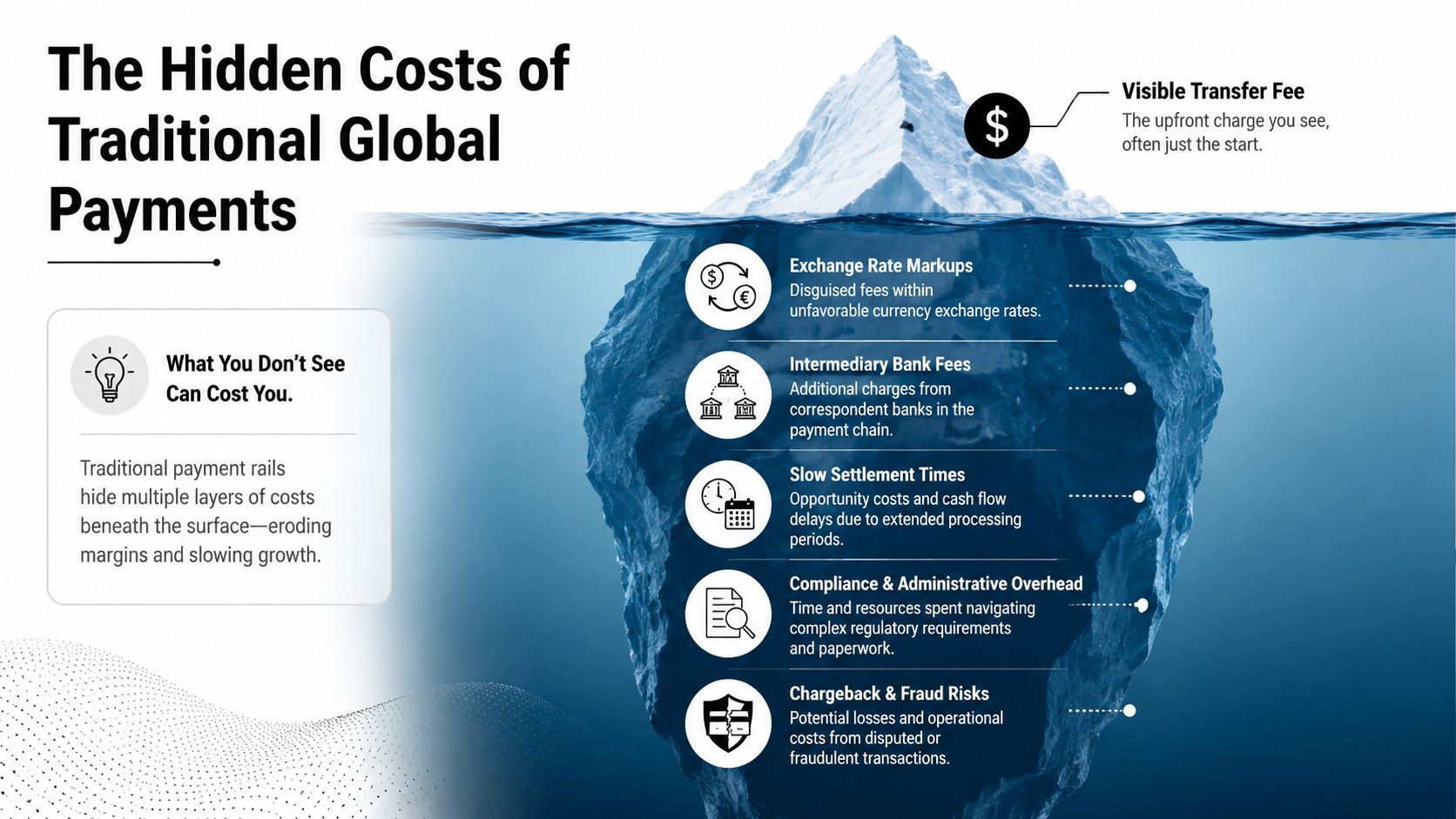
The overall cost operates like an iceberg. The fee you can see is only the top. Under the surface sit FX markup, intermediary deductions, settlement delay, failed retries, and the internal time needed to chase missing details or explain mismatched amounts.
The visible fee is rarely the real fee
A transfer might look acceptable on the surface, then become expensive after conversion and routing. In a survey cited by Jeeves, companies outside North America named speed of payment as a concern 73% of the time, transaction cost 60% of the time, and currency risk 52% of the time. The same source notes that international payments can cost $10 to $50 more per transaction than domestic ones, while FX markups can add roughly 2% to 4% above the mid-market rate (Jeeves summary of B2B payment statistics).
That's why “cheap wire” is often a misleading phrase. The upfront line item may be modest, while the all-in result is not.
A practical way to think about landed cost is to ask four questions:
What did the sender pay to initiate the transfer
What exchange rate was applied
What arrived, and when
How much team time did the payment consume
If you don't measure all four, you're not measuring the payment.
The submerged part of the iceberg
Traditional global payments often still move through bank messaging and correspondent networks. That introduces extra stops, and every stop creates the possibility of cost or delay.
Common hidden costs include:
FX spread loss. The transfer can clear, but the conversion rate subtly reduces what you keep.
Intermediary fees. One bank hands off to another, and deductions appear after the payment has already been sent.
Settlement delay. Finance can't use the funds while they are still in transit.
Operational drag. Teams spend time matching invoices, confirming receipts, and handling exceptions.
Practical rule: Never compare international payment methods on headline fees alone. Compare them on final amount received, final currency received, and time to usable funds.
There's a good reason many operators now focus on reducing conversion leakage first. If you want a deeper look at that problem, this guide on how to avoid currency conversion fees is a useful reference point.
Delay has a cost even when no one invoices you for it
Settlement delay is easy to normalize because it doesn't show up as a fee. But it still costs money.
When revenue arrives days later than expected, businesses end up making operational adjustments around that lag. They hold bigger buffers, delay payouts, or treat incoming revenue as uncertain until it fully settles. For a global SaaS business or marketplace, those small delays create planning friction every week.
The mistake is thinking of settlement time as a convenience issue. It's a treasury issue, a forecasting issue, and often a customer support issue too. If a payment system forces your team to build process around uncertainty, that process becomes part of the payment cost.
A Modern Map of International Payment Rails
Not every rail solves the same problem. Some are built for bank-to-bank movement. Some optimize for customer familiarity. Some reduce FX friction. Some reduce settlement time. The right choice depends on what you need from the payment, not what the rail was historically designed to do.
Bank wires and SWIFT
Wires still matter for large invoices, supplier payments, and businesses that operate inside traditional banking workflows. They are widely understood and globally accepted.
But the trade-off is baked into the architecture. Traditional SWIFT wire transfers have an average total cost of 4.5% to 5.5%, including a hidden 3% to 4% FX spread, and they settle in 2 to 5 business days. Stablecoin rails like USDC can settle in seconds and remove FX spreads entirely, based on the verified data provided for this article.
Wires work. They just don't work especially well for internet-native businesses that need predictable settlement and clean unit economics, which is why many teams start weighing a swift alternative built for faster global rails.
Card networks
Cards solve a different problem. They make payment easy for the customer.
That matters because businesses don't only need a payout rail. They need a conversion-friendly checkout. For subscriptions, digital goods, communities, and online services, card acceptance is still the simplest path for many buyers because they already know how to use it. Even smaller merchants benefit here, and a clear primer on accepting credit cards for a small business shows how much conversion depends on that familiarity.
The limitation is that card acceptance alone doesn't tell you how the merchant gets settled. A familiar front-end experience can still feed into a back-end payout model with FX exposure, banking delays, or fragmented reporting. So cards are often excellent on the pay-in side, but they need the right settlement design behind them.
Fintech platforms and multi-currency accounts
Modern fintech platforms improved the old model by reducing dependence on correspondent banking and giving businesses better control over balances and conversions. Multi-currency accounts help companies hold funds in more than one currency and convert on their own timing instead of converting immediately on receipt.
That approach can make sense when your business spends in several currencies. It can reduce unnecessary conversion and simplify regional operations. This overview of cross-border payment flows gives a useful framing for how these newer routes differ from legacy bank paths.
The drawback is that multi-currency operations still create decisions and operational work. You're managing balances, deciding when to convert, and often reconciling across more than one ledger context.
Stablecoin settlement rails
Stablecoin settlement changes the question from “how do I move fiat across borders efficiently” to “how do I settle revenue in a single digital dollar format without inheriting bank-network friction.”
For global internet businesses, that is often the cleaner design. If customers can pay in familiar ways and the business receives USDC, the company avoids a large share of the landed-cost problem that comes from conversion uncertainty and payout timing.
The most practical use of stablecoin rails is not asking customers to change behavior. It's changing settlement behind the scenes.
Here's the high-level comparison founders usually need:
Payment Rail | Settlement Speed | Typical Cost (All-in) | FX Exposure | Operational Complexity |
|---|---|---|---|---|
SWIFT bank wire | 2 to 5 business days | 4.5% to 5.5% based on verified data | High when conversion is involved | High |
Card networks | Varies by provider and payout setup | Depends on processor and settlement model | Depends on settlement currency | Medium |
Fintech platforms and MCAs | Faster than traditional correspondent routes in many cases | Often lower than traditional bank wires | Lower if balances are held in local currencies | Medium |
USDC settlement rails | Seconds based on verified data | Lower landed cost when FX spread and payout delay are removed | Low when settling directly in USDC | Low to medium depending on implementation |
What works best in practice:
Use wires when banking relationships and large invoice flows make them unavoidable.
Use cards when buyer familiarity and checkout conversion matter.
Use fintech platforms or MCAs when you actively operate in several fiat currencies.
Use USDC settlement when you want one internet-native payout currency and less operational drag.
How Card Payments with USDC Settlement Works
The simplest version of this model is easy to explain.
Users pay with cards, businesses receive USDC.
That's the important part. Your customer doesn't need to think about wallets, chains, or settlement mechanics just to complete a purchase. They pay in a way that already feels normal. The merchant gets revenue settled in USDC instead of waiting on a bank payout path.
What the customer sees
From the buyer's perspective, this should feel like a standard online checkout. They choose a product, enter card details, complete authentication if required, and get confirmation.
That matters because adoption drops fast when payment systems ask customers to learn something new just to pay you. A strong international setup keeps the customer experience familiar while upgrading the settlement layer on the merchant side.
For founders evaluating implementation paths, one useful reference is this overview of crypto payment flows, especially if you want to understand how digital settlement can be separated from the customer's pay-in method.
What happens behind the scenes
Behind the checkout, the business uses a provider that accepts card payments and settles merchant revenue in USDC. That means the customer-facing rail and the merchant-settlement rail don't have to be the same.
One option is Suby, which provides an API that lets businesses accept payments by card or crypto and settle revenue in USDC. It also offers native Discord and Telegram integrations for use cases like subscriptions, paid access, and online communities. The practical value is straightforward: customers can pay with cards, while the business receives USDC.
That structure solves several real problems at once:
Customer familiarity stays intact because buyers can use cards.
Settlement becomes more predictable because revenue lands in USDC rather than moving through traditional payout delays.
FX exposure drops because the merchant is not waiting for a chain of conversions and bank handling steps.
Accounting gets simpler when one settlement currency is used consistently for global inflows.
If your customers are comfortable paying by card, you don't need to retrain them. You need a better settlement outcome.
The strongest use case is for online businesses with cross-border revenue and digital delivery. SaaS platforms, communities, agencies, and global sellers usually care less about preserving old banking habits and more about receiving usable funds quickly, clearly, and in one consistent currency.
Choosing the Right Payment Strategy for Your Business
A good payment setup depends on where friction shows up in your model. The right answer for a subscription SaaS company is different from the right answer for an agency sending invoices or a creator selling access.
For SaaS and subscription businesses
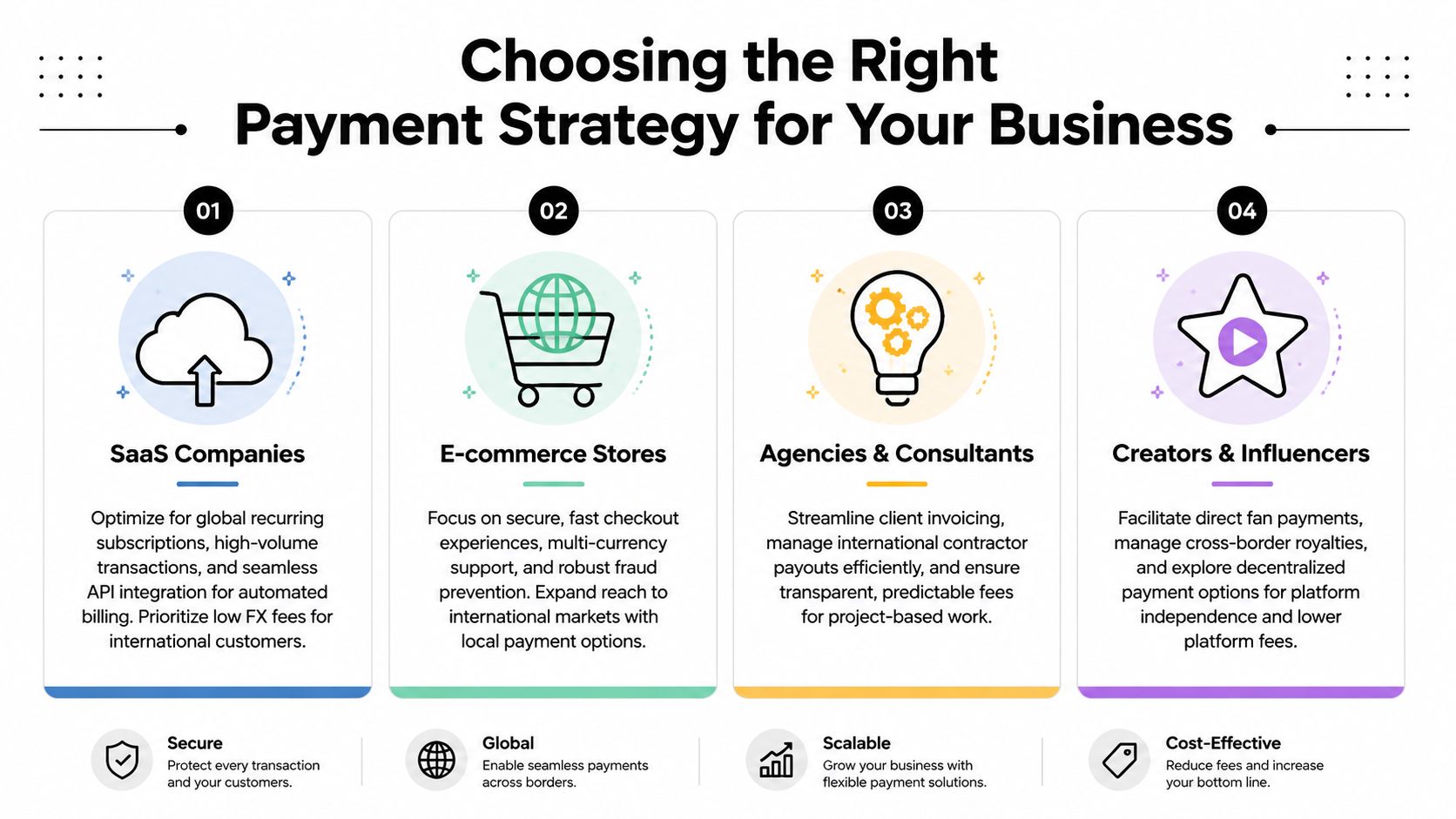
SaaS companies usually need three things from international business payments: a checkout customers trust, recurring billing support, and settlement that doesn't create finance cleanup every month. Choosing the most reliable global payment processor for a SaaS startup often comes down to how well those three needs are met at once.
If you sell subscriptions globally, a card-first pay-in flow with USDC settlement is often the practical fit. Customers keep using cards. Your team receives one settlement currency. That reduces the operational mess that appears when recurring revenue is collected in many places but lands through fragmented payout routes.
This matters even more if your product includes paid access and community layers. Businesses with subscription products, gated communities, or member programs often benefit from payment systems that connect billing with access control. Native Discord and Telegram integrations are useful here because payment and access changes can happen inside the same workflow instead of across separate tools.
A quick decision filter for SaaS teams:
If your buyers are mainstream and expect a standard checkout, prioritize cards on the front end.
If your finance team wants predictability in global collections, prioritize settlement in a single currency.
If access is part of the product such as memberships or communities, use payment tooling that handles both billing and entitlement.
A short demo helps make that concrete:
For e-commerce, agencies, and creators
E-commerce businesses have a different pressure point. They care about checkout trust and conversion, but they also need a clean way to collect revenue internationally without carrying unnecessary currency complexity on the back end.
For many cross-border stores, the practical question is not “which country should I settle in” but “how do I avoid building a patchwork of local banking decisions around a global catalog.” USDC settlement can simplify that if the business prefers a single payout asset over a growing set of fiat balances.
Agencies and consultants usually want fewer steps between invoice paid and funds available. They don't want to explain bank fees to clients, chase transfers, or wait through opaque routing. A card or crypto acceptance layer with direct USDC settlement fits well when speed and predictability matter more than preserving a bank-centric workflow.
Creators and community operators often need something else entirely. They need to sell access, automate renewals, and avoid manual admin. In that context, the payment system is part checkout, part membership infrastructure, and selling direct also helps them sidestep the Apple 30% payment cut that in-app billing would otherwise take.
Choose the payment model that removes your most expensive operational habit. For many online businesses, that habit is manual reconciliation across currencies and payout timelines.
The wrong strategy often looks fine in isolation. Each payment succeeds, eventually. The right strategy removes the repeated work between the successful payment and the usable revenue.
Getting Started with Modern International Payments
Most businesses don't need a full payment overhaul on day one. They need a better test.
Start by looking at the last set of international transactions your business handled and answer a simple question: what did those payments cost after conversion, delay, and manual work? That usually tells you more than any processor pricing page.
What to evaluate first
Before switching rails, review your current setup through an operations lens.
Map the landed cost. Look past the posted fee and check what arrived after FX and deductions.
Review settlement timing. Note when the payment was approved versus when funds were available for use.
Count manual steps. Include support follow-ups, reconciliation work, and payout exception handling.
Separate pay-in from payout. Customer payment method and merchant settlement method don't need to be the same.
Security and compliance matter here too. A modern provider should handle these as product requirements, not afterthoughts. In practice, that means using partners and flows built for secure card acceptance, strong customer authentication, dispute handling, and clear records.
What a practical rollout looks like
The safest rollout is usually narrow and specific. Pick one revenue stream or one international segment where the current setup is obviously inefficient.
For example, you might start with:
One-time payments first, if you want a clean pilot with limited edge cases.
A subscription flow next, if recurring revenue is where settlement friction hurts most.
A paylink or embedded checkout, if you want to validate buyer behavior before building deeper API logic.
API and webhooks later, once the settlement model has proven itself operationally.
This is also where the modern model becomes attractive for lean teams. You don't need to stitch together separate tools for card acceptance, crypto acceptance, settlement logic, and paid access if one platform already combines those pieces in a coherent way.
The goal isn't to sound modern. It's to remove failure points that your team has learned to tolerate. If your business sells internationally and still depends on payout timing you can't control, settlement currency you don't want, or reconciliation work that never goes away, the next step is straightforward. Test a setup where customers can keep paying normally and your business receives USDC.
Frequently Asked Questions about International Payments
Do customers need to understand crypto to pay
No. In the model described here, customers can pay by card through a familiar checkout. The business receives USDC on the settlement side.
That separation is what makes the model practical. The customer experience stays simple, while the merchant gets a more efficient payout format.
How should I think about compliance and records
Treat this like any other serious payment workflow. You need clear transaction records, clean reconciliation, and a provider that builds compliance and security into the payment flow.
If your company is expanding into a new region and needs broader business setup guidance alongside payments, resources like 中国企业澳洲落地指南 can help frame the operational side of entering a foreign market.
What about refunds and disputes
This depends on the provider and payment flow, so it should be confirmed before rollout. In general, businesses should check how refunds are initiated, how disputes are handled, and whether customer authentication is built into the checkout experience.
For teams using a platform for card acceptance and USDC settlement, this is one of the first operational questions to verify, along with reporting and webhook behavior.
Is this model only for SaaS companies
No. It fits any online business that wants global checkout and simpler settlement.
That includes:
SaaS businesses with subscriptions and recurring billing
E-commerce sellers collecting revenue from multiple countries
Agencies and freelancers invoicing international clients
Creators and community operators selling digital access or memberships
Developers who want one API instead of a patchwork of regional payment tools
The deciding factor isn't industry label. It's whether your current international business payments setup creates unnecessary cost and operational friction after the customer has already paid.
Suby is a payment gateway and Merchant of Record. Your customers pay with card, bank transfer, Apple Pay, Google Pay, Klarna, and more, or stablecoins, and you get paid out to your bank account, or directly in stablecoins (USDC, EURC) to your wallet, anywhere in the world, no bank account required. You can start with paylinks, use an embeddable checkout, or integrate through the API and webhooks, with native Discord and Telegram integrations for subscriptions and paid access. For international business payments, that means one clean settlement layer instead of the FX spreads, bank hops, and payout delays that make cross-border revenue expensive.
