

Gaspard LEZIN
Stablecoin Subscription Payments: How to Bill SaaS Customers in USDC (2026)
Discover how to implement stablecoin subscription payments: how to bill saas customers in usdc (2026) for your SaaS. Learn dunning & crypto accounting.
If you're running a SaaS product across borders, you're probably already feeling the friction. Card acceptance works, but payouts lag. Bank wires are slow. FX conversion adds noise to margins. Then finance asks a fair question: if more customers want to pay in stablecoins, how do you support that without breaking subscriptions, revenue reporting, and renewals?
That's where most guides fall short. They explain how to take a one-time crypto payment. They don't explain how to run a real subscription business on top of USDC, with recurring billing logic, failed renewal recovery, and clean accounting for a global team.
Stablecoin subscription payments in 2026 are no longer just about adding another checkout button. The critical aspect involves designing the billing model, automating renewals, and making sure your finance stack can reconcile what happened on-chain with what your books need to show.
Table of Contents
Why SaaS Is Shifting to USDC Subscriptions in 2026
A lot of founders still treat USDC billing like an edge case. It isn't. For global SaaS, it's becoming a practical treasury and operations decision.
In the first half of 2026, USDC accounted for approximately 70% of adjusted stablecoin trading volume, while USDT was roughly 25%, which is why USDC is increasingly treated as the main rail for programmable payments and B2B settlement, including SaaS subscriptions, according to KuCoin's market update on USDC volume in H1 2026.
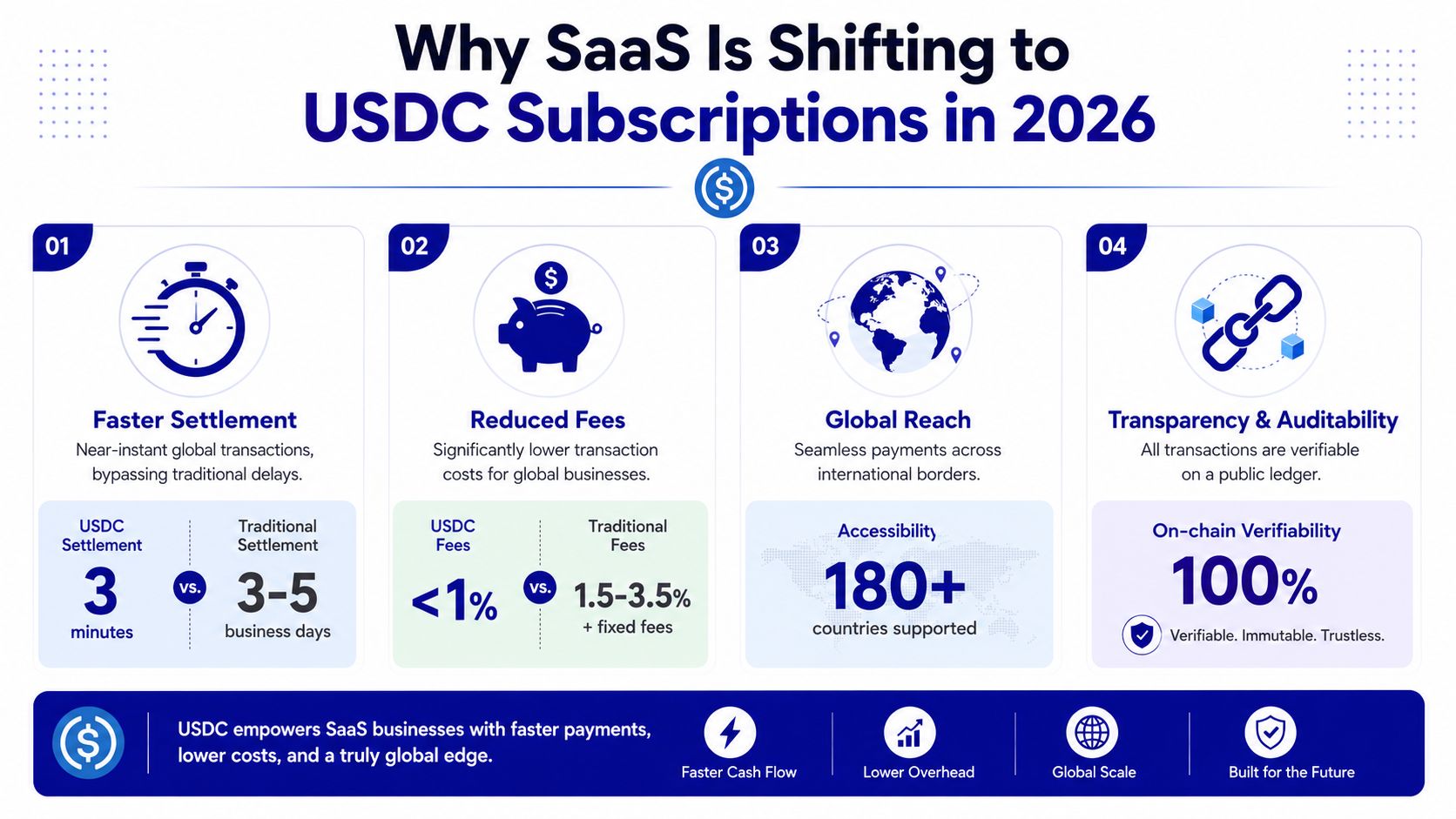
USDC has become the business rail that matters
Subscription billing necessitates stability, liquidity, and predictable bookkeeping. A SaaS company doesn't want revenue to float around with token volatility if the product is priced in dollars. It wants the customer to pay, the system to recognize the right invoice amount, and finance to reconcile the same number later.
That's why the strongest implementation pattern is often not “accept crypto only.” It's broader. Customers pay the way they want, and the business settles the way it chooses.
Practical rule: Don't design your billing stack around what a small subset of power users prefers. Design it around what keeps checkout flexible and settlement predictable.
The strongest setups give the customer options like card, wallet, bank, or crypto, while the merchant chooses whether to receive funds to a bank account or in stablecoins like USDC. That model is much closer to how modern SaaS teams operate.
The practical benefit is operational, not ideological
The appeal isn't novelty. It's removing operational drag from cross-border billing.
If your customers are spread across markets, traditional payment rails can create unnecessary delays and conversion costs before money reaches your treasury. By contrast, some payment infrastructure now supports the flow where a customer pays by Visa or Mastercard and the merchant settles 100% of that revenue directly into USDC, avoiding SWIFT delays and reducing cross-border FX friction that typically costs businesses 1–3% per transaction, as described in Suby's international payment gateway overview.
That's a meaningful shift for finance teams. It means MRR can still be recorded in stable USD terms, while treasury receives a digital dollar balance that's easier to move globally.
If you're weighing token choice, it's worth comparing the trade-offs in this breakdown of USDC vs USDT for SaaS payments. For recurring SaaS billing, the strongest argument for USDC is simple. It fits how subscription businesses already think about pricing, reserves, and reconciliation.
Designing Your USDC Subscription Billing Model
Before you wire up webhooks or test wallets, decide what exactly customers are buying and how the price should appear. Most failed stablecoin billing rollouts start with a technical implementation before the team settles the pricing logic.
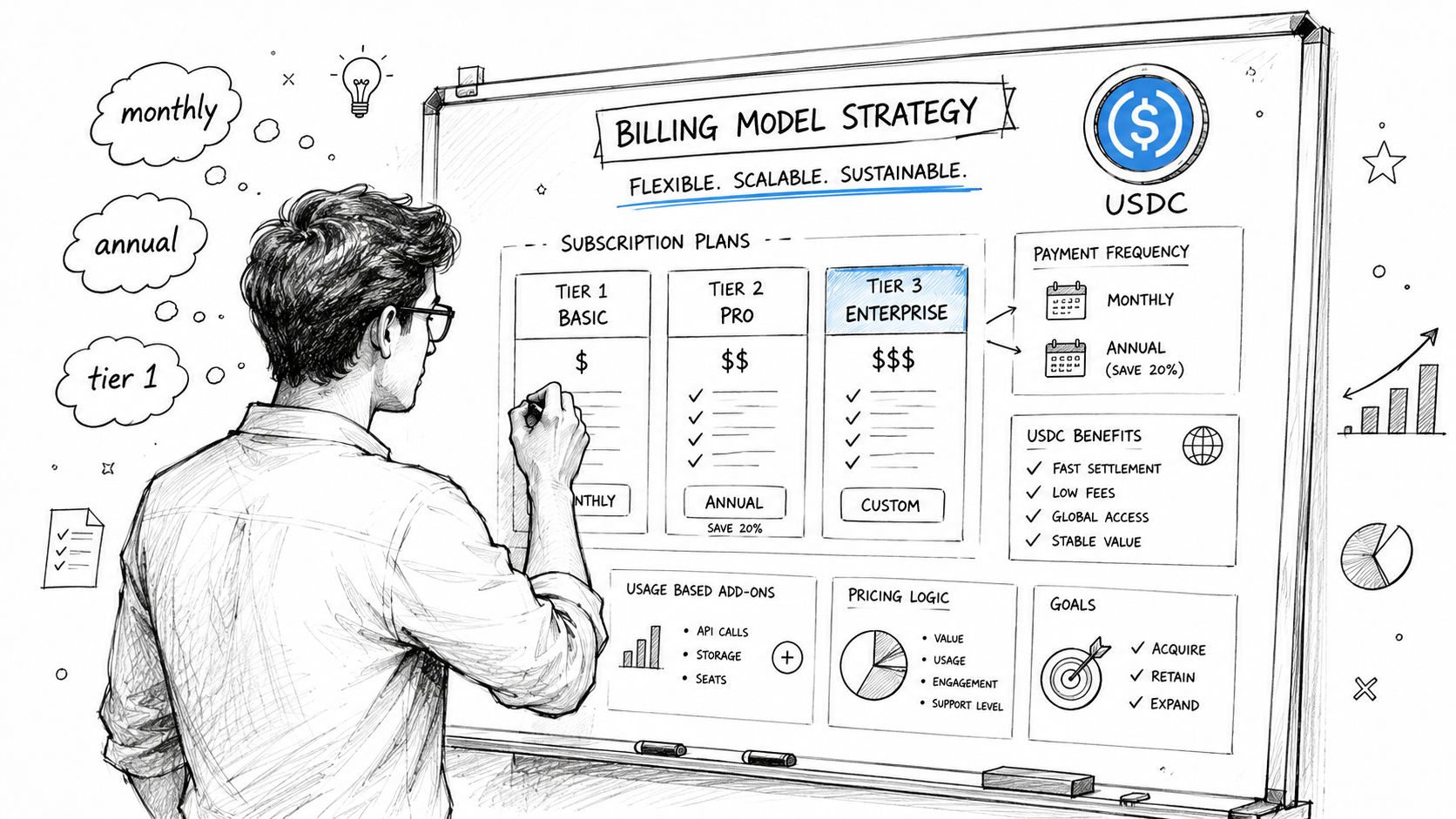
Choose the pricing model before the API work
There are three models that make sense in practice:
Model | How it works | Where it fits | Main trade-off |
|---|---|---|---|
USD-denominated with USDC payment | Plan is priced in USD, customer can settle in USDC at checkout | Mainstream SaaS, B2B, global products | Requires clear conversion UX |
USDC-native pricing | Plan is presented directly in USDC | Products with customers already comfortable with on-chain balances | Can feel unfamiliar to non-crypto buyers |
Hybrid offering | Some customers use cards, others use crypto, same product catalog | Mixed customer base, international products | Requires clean checkout and internal reporting discipline |
For most SaaS teams, the first model is the safest starting point. Your plan still reads like normal software pricing. The customer sees a familiar monthly amount, while the checkout quotes the crypto equivalent when needed.
Price the product for your buyer, not for your ledger.
That's especially useful when you sell to both traditional buyers and crypto-native teams. You don't need two billing systems or two plan catalogs. You need one product model with multiple payment paths.
Payment choice matters more than token purity
At the API level, flexibility matters. The documented model is straightforward. The Suby API supports three payment method configurations per product: “Card only,” “Crypto only,” and “Card + Crypto,” which lets you match the checkout experience to the audience instead of forcing one payment behavior on everyone, as shown in the Suby API introduction.
That matters because customers don't all arrive with the same preferences:
Card-first buyers want familiar checkout and quick approval.
Wallet-first buyers want to pay on-chain without extra handoffs.
Mixed teams want the freedom to choose at purchase time.
If you're evaluating the commercial side of this setup, especially when your business sells internationally, it also helps to understand the banking and processor layer behind your billing stack. A useful primer is this guide on selecting the right merchant facilities, because payment method flexibility only works if your underlying setup supports the regions and customer types you serve.
One practical note on positioning. Suby is a single product with four ways to use it: Suby Payments for API-first card and crypto checkout, Suby Crypto for crypto payment flows with swap handling and gas sponsorship, Suby Gating for paid access in Discord, Telegram, downloads, and courses, and Suby Invoicing for client billing where the payer chooses the method and the business chooses how it gets paid. That's useful if your SaaS business also runs a community, gated content, or invoice-driven enterprise sales alongside subscriptions.
A Step-by-Step Guide to Implementing USDC Billing with Suby
The implementation should be boring. That's the goal. Recurring billing needs fewer moving parts, not more.

Start with the recurring product definition
For stablecoin subscription payments, the key technical requirement is not just wallet acceptance. It's scheduled, repeating stablecoin charges. That's the difference between a payment page and a billing system.
The documented pattern for stablecoin subscription payments in 2026 is clear: use a gateway that supports scheduled recurring charges, quotes the crypto equivalent in USDC in real time at checkout, records the transaction with its USD value, and prefers USDC on Base or Solana because those networks are fast and cheap for renewals, according to Eco's recurring stablecoin billing comparison.
A practical product definition usually includes:
Billing cadence such as monthly or annual.
Invoice currency in USD if that's how you track SaaS revenue.
Settlement preference in USDC if treasury wants stablecoin balances.
Access rules tied to successful payment events.
If your pricing page already works well, don't rewrite the commercial model just because you're adding USDC. Keep your plans familiar. Add a new settlement path.
Configure the checkout for card and crypto
The cleanest default is a hybrid checkout. Set the payment methods to both card and crypto so the customer chooses what's easiest at the moment of purchase.
A common implementation pattern uses a payload like this:
The important part is not the exact field naming in your internal model. It's the intent. Your recurring product should preserve a fiat reference amount while letting the checkout present the live USDC equivalent when the customer pays on-chain.
That hybrid setup also supports a valuable operational flow. A customer can pay with card, while the merchant still chooses to receive funds in USDC. That keeps checkout broad and treasury cleaner.
If you force every customer into wallet-based payment on day one, you'll learn less about demand and create more support load.
When teams are migrating from older card-only stacks, this is often the easiest bridge. If that's your current setup, this guide on supporting global crypto subscriptions alongside your existing billing flow is useful because it frames crypto billing as an additional path, not a full replacement project.
Handle fulfillment and settlement correctly
Once checkout is live, the next job is event handling. Provision access only when the payment state is final enough for your business rules, and make the subscription record the source of truth for entitlements.
A reliable backend flow looks like this:
Create the subscription product in your billing system.
Generate a pay link or embed checkout in your app.
Listen for success webhooks such as
payment.succeeded.Activate or renew access only after the successful event lands.
Store the original invoice value and settlement asset on the subscription record.
Trigger customer messaging for renewals, failures, and cancellations.
For developers, the main trap is assuming stablecoin subscriptions behave like cards under the hood. They don't. You need policy enforcement for renewals, a clean event model, and network choices that don't add cost or latency at each cycle.
Suby's documented capabilities fit this implementation pattern because it provides an API that lets businesses accept payments by card or crypto, and it also offers native Discord and Telegram integrations for use cases like subscriptions, paid access, and online communities. That matters if your SaaS includes member spaces or gated delivery in addition to app access.
Automating Dunning for Failed Stablecoin Renewals
This is the chapter most articles skip. They show how to generate an address or collect a wallet payment, then stop right before the part that affects retention.
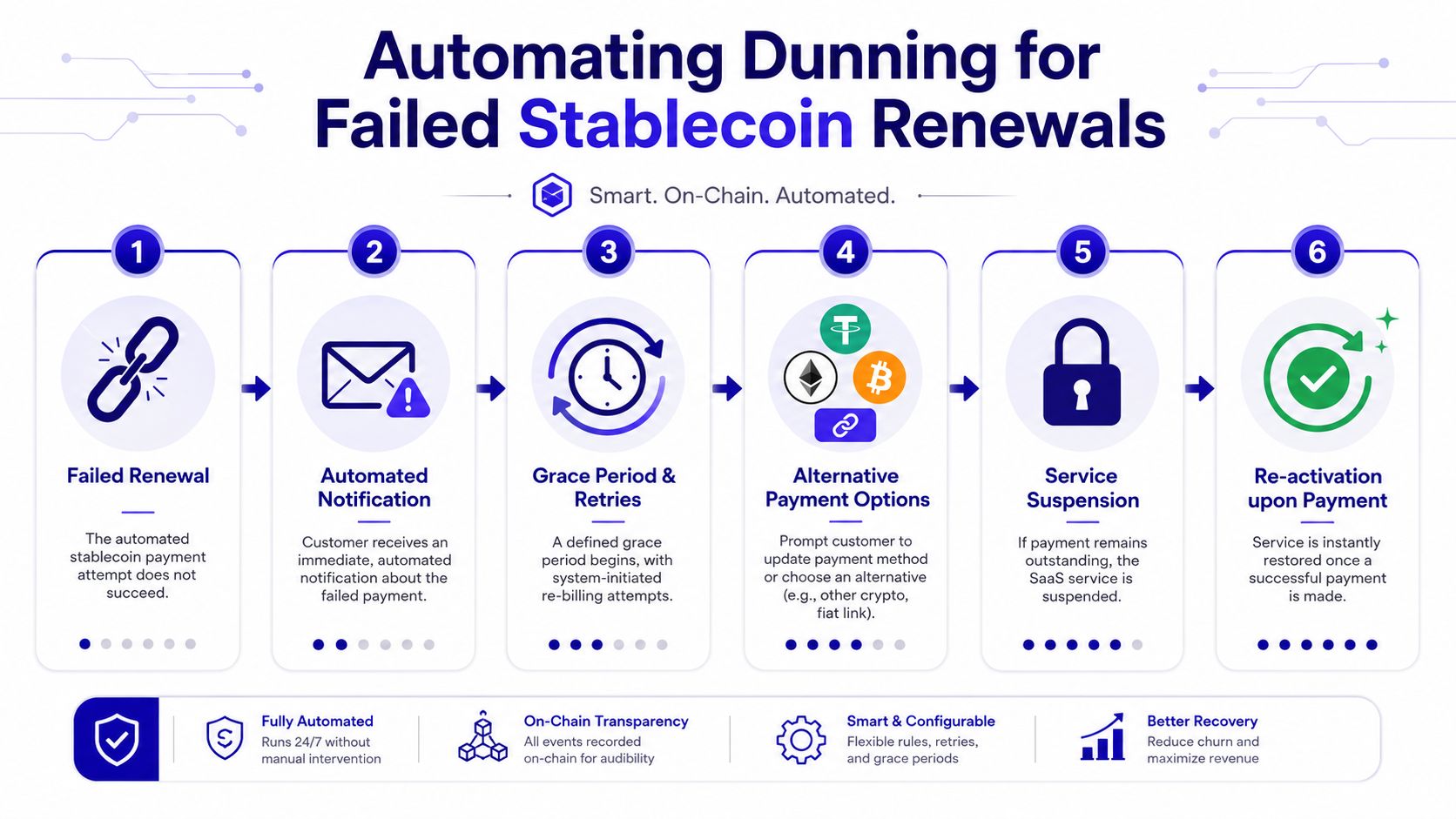
Why stablecoin renewals fail differently
With cards, the network and processor usually give you some retry behavior. With on-chain subscription payments, that fallback isn't standardized.
The gap is documented plainly: automated dunning and retry logic for failed USDC subscriptions is the most underserved area in current coverage, because most guides stop at generating a deposit address and don't explain how to handle non-delivery by the due date. Stablecoin subscriptions lack a standardized protocol for automatic retries, which forces teams to build their own dunning paths, as noted in Eco's 2026 recurring crypto infrastructure guide.
That changes your operational model. When a renewal doesn't complete, you can't assume the infrastructure will save the subscription for you. Your app and billing workflow need to detect failure, communicate clearly, and offer a path to recovery before access is removed.
Most churn in stablecoin subscriptions isn't a pricing problem. It's a systems problem.
A dunning workflow that actually works
A workable dunning system has six parts:
Detect the miss early
When the due date passes without inflow, treat that as a billable failure state, not a vague pending condition.Send an immediate reminder
The customer should get an email or in-app notification that explains what happened and what action is needed.Issue a fresh payment request
Don't keep sending the customer back to an old address or stale request. Generate a new payable request tied to that renewal cycle.Offer an alternative route
If the original on-chain path didn't complete, present another option such as card checkout or another supported crypto path.Apply a grace window
Keep access active for a defined period if that fits your product economics. B2B SaaS usually benefits from a grace buffer.Suspend and instantly restore
If payment still doesn't arrive, revoke access automatically. When payment succeeds, restore access without manual intervention.
A few implementation rules help:
Separate failed payment from cancelled subscription so support can recover accounts cleanly.
Log every reminder and retry action on the subscription record.
Make the recovery link single-purpose so the customer lands in a focused payment flow, not the general app.
Re-enable entitlements through webhook confirmation, not manual review, unless your risk policy requires otherwise.
A one-time payment flow can tolerate messy follow-up. Subscription billing can't. If you don't build this layer, missed on-chain renewals become involuntary churn.
Managing Accounting and Reconciliation for USDC Revenue
Getting paid in USDC is the easy part. Closing the books is where teams usually discover the true complexity.
Where finance teams get stuck
The hard question isn't whether USDC is close to one dollar in commercial use. The hard question is what your accounting and tax treatment should be when invoice currency, reporting currency, and settlement asset don't perfectly match.
That issue is sharper for international SaaS companies. A key challenge is reconciling USDC subscription revenue with multi-currency tax reporting, such as USD invoices and EUR reporting, without triggering deemed disposal events. Tax authorities may treat each on-chain settlement as a taxable event if the merchant's balance currency differs from the invoice currency, as discussed in this analysis of USDC subscription payments and tax treatment.
If your finance team hasn't mapped this yet, don't improvise. Revenue recognition, treasury accounting, and tax reporting are related, but they're not the same workflow.
Build one source of truth
The strongest operating model is a unified ledger view where each payment carries:
The original invoice value in the commercial currency.
The settlement asset used for payout.
The payment method that the customer used.
The event history across authorization, success, failure, and refund.
The reference needed for internal matching between billing, product access, and accounting records.
That's why reconciliation process design matters before launch. If you need a finance-side refresher, this guide to financial reconciliation for businesses is a useful overview of how teams structure matching, exception handling, and audit trails.
A practical platform model also helps. When card and crypto revenue land in one operating balance with transaction records tied back to the original fiat value, finance gets a cleaner path to month-end reporting. That's the primary benefit of using a single payment system instead of stitching separate card and on-chain tools together.
For teams building this workflow, Suby's payment reconciliation article is worth reviewing because the operational challenge isn't just receiving funds. It's preserving a consistent record from checkout through payout and internal reporting.
Your ledger should answer two questions fast: what the customer bought, and what the business actually received.
That's the threshold for a finance team to trust a USDC subscription program at scale.
Your Go-Live Checklist for Stablecoin Subscriptions
Launch issues usually come from skipped operational checks, not from the checkout itself. A stablecoin subscription system is ready when engineering, finance, support, and compliance can all trace the same payment lifecycle.
Technical and billing readiness
Use this as a final pass before enabling live traffic:
Test the full lifecycle
Create a subscription, complete the first payment, process a renewal, trigger a failure state, recover the account, and cancel the plan.Verify webhook handling
Make sure success, failure, and cancellation events reach your backend and update entitlements correctly.Review customer-facing renewal messaging
The customer should understand what renews, when it renews, and what happens if payment doesn't complete.Check payout expectations
If your business wants to receive in stablecoins, confirm where those funds arrive and how your team accesses them operationally.Confirm pricing visibility
Pricing depends on the payment method used, so check Suby's pricing page for the current per-method details instead of assuming a flat rate.
Finance and customer operations readiness
There are also business-side checks that need sign-off before launch:
Run a reconciliation dry run
Match a sample set of payments from checkout through settlement and into your accounting process.Validate your compliance posture
Terms, refund handling, tax settings, and invoice presentation should reflect the payment methods you now support.Prepare support scripts
Support needs ready answers for renewal failures, wallet issues, payment-method changes, and access restoration.Review your launch process
A broader essential launch guide can help teams catch operational gaps outside the payment layer, especially when several departments are involved.Decide how you want to receive funds
One practical advantage here is that a Merchant of Record model can automate tax compliance and subscription logic while accepting payments through cards, bank transfers, Apple Pay, Google Pay, and multichain stablecoins, with payouts to bank accounts or stablecoins without forced currency conversion, as documented in Suby's overview of how the product works.
The strongest final check is simple. Your team should be able to answer, without guessing, what happens when a customer pays by card, when a customer pays on-chain, when a renewal fails, and how finance records both cases.
If you want to add USDC subscriptions without splitting card and crypto into separate systems, Suby is one option to evaluate. It provides a payment API that lets businesses accept payments by card or crypto, supports recurring subscriptions and invoicing, and includes native Discord and Telegram integrations for paid access and community use cases. The practical value is flexibility: customers can pay the way they want, and the business can choose whether to receive funds to a bank account or in stablecoins like USDC.
