

Gaspard LEZIN
Crypto Payment Fees Compared: Stripe vs Cryptomus vs Suby vs NowPayments
A deep dive into crypto payment fees compared: Stripe vs Cryptomus vs Suby vs NowPayments. Analyze transaction costs, hidden fees, and settlement options.
You're probably looking at a pricing page that says one processor charges 0.5%, another 1.5%, another 0.4%, and a fourth has a card fee that looks obviously higher than the rest. On paper, that seems easy. Pick the lowest rate and move on.
That's rarely how payment costs work in practice. The advertised fee is only one layer. The full cost shows up in conversion spreads, gas charges, payout fees, settlement constraints, and the friction of getting money into the currency your business prefers to retain.
For a global SaaS company, an online store selling across borders, or an agency billing clients internationally, that difference matters more than the headline percentage. A gateway that looks cheap at checkout can become expensive once you account for FX, withdrawals, and the time cost of moving funds into stablecoins or a local bank account. That's the gap most comparisons miss.
Table of Contents
Navigating the Maze of Modern Payment Fees
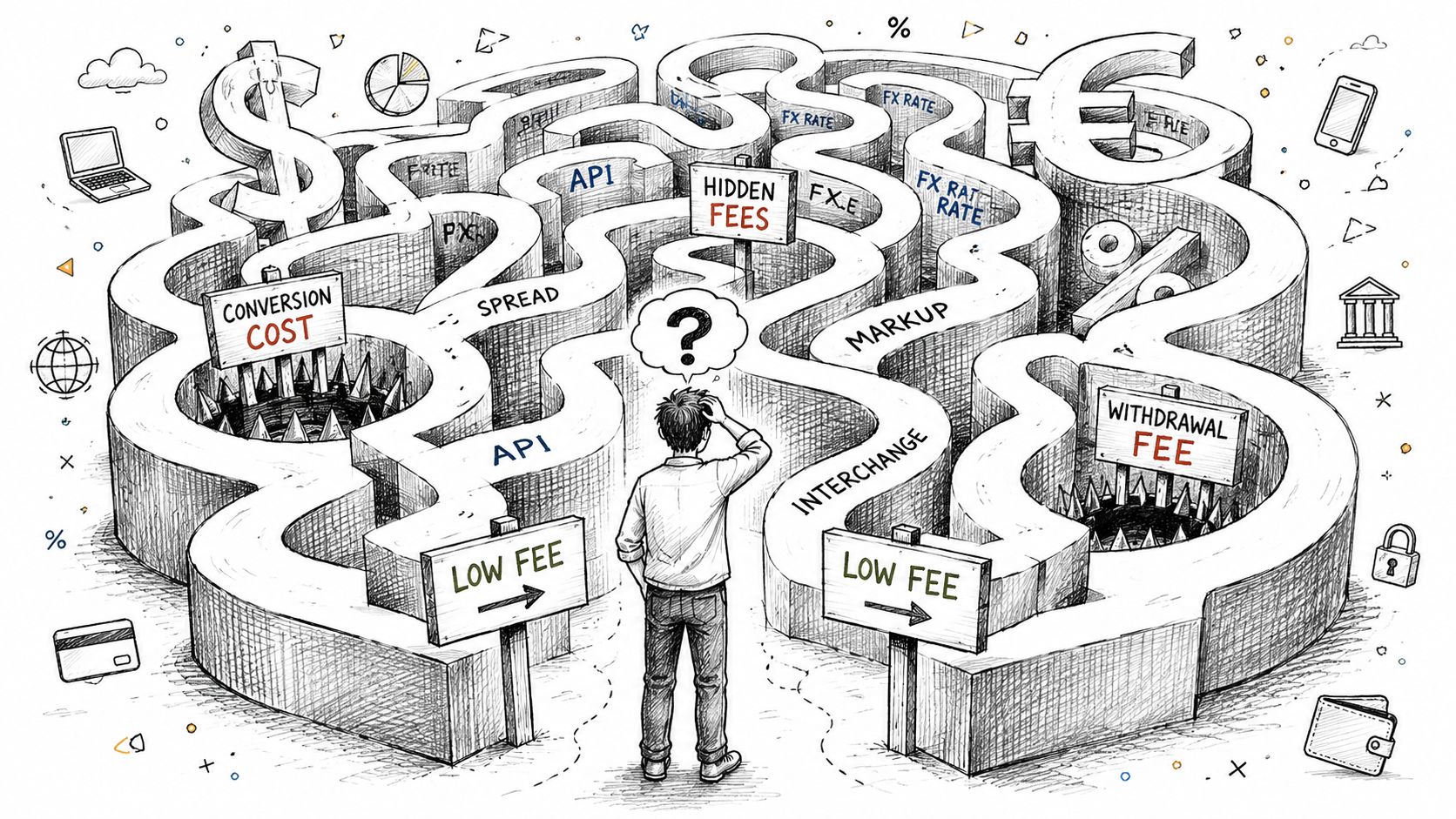
A merchant sees a low processing rate, starts accepting payments, and only later notices the rest of the bill. Network fees show up on withdrawals. Conversion takes a cut when the customer pays in one asset and the business wants another. Settlement lands in a balance that still has to be moved somewhere useful.
That's why payment pricing feels harder than it should. The fee table is simple. The money flow isn't.
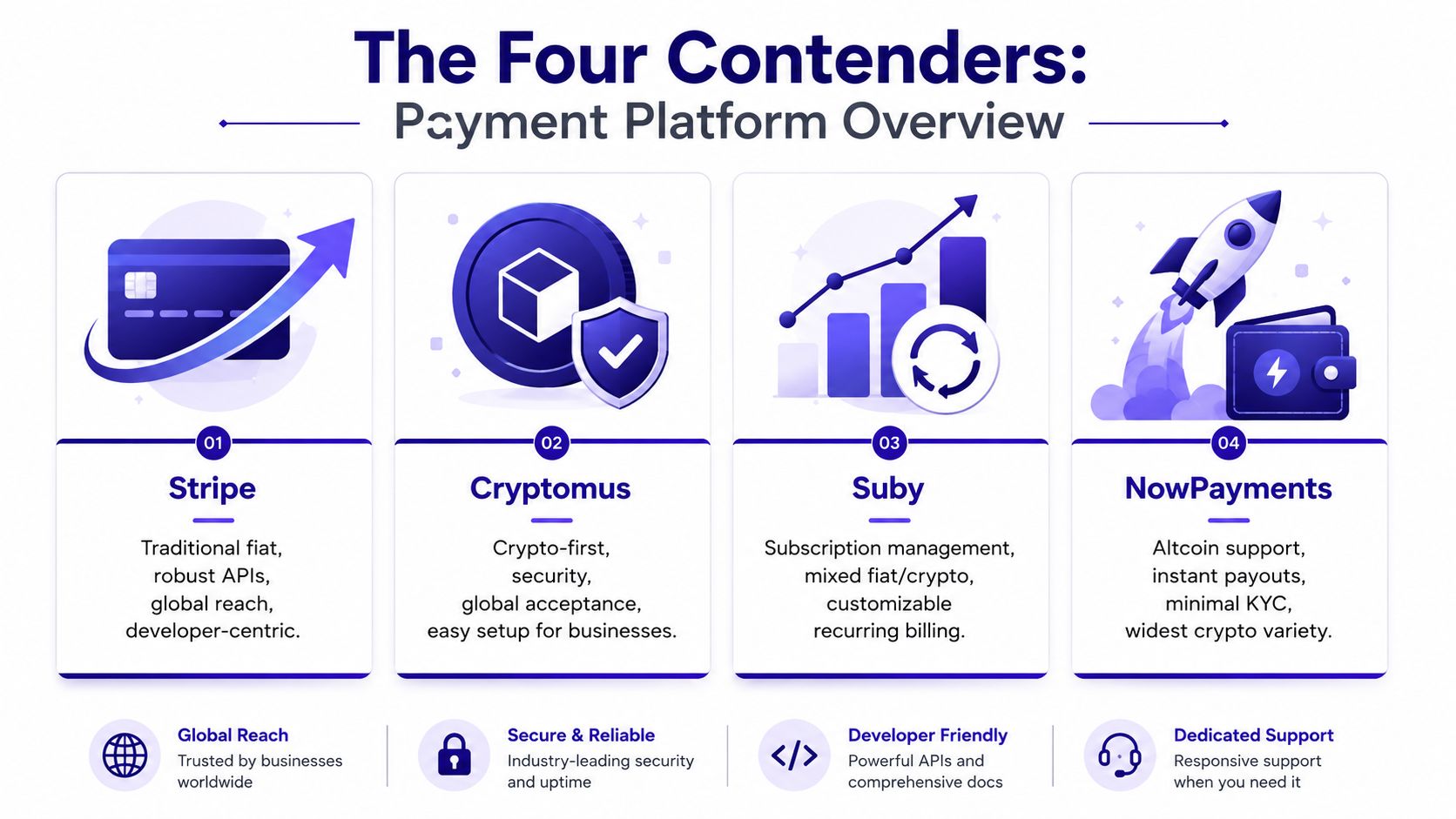
Stripe, Cryptomus, Suby, and NOWPayments all solve a version of the same problem, but they solve different parts of it. Stripe starts from a traditional online payments model and adds stablecoin support. Cryptomus and NOWPayments are crypto-first gateways built around broad asset acceptance and low crypto processing fees. Suby is built around a different question, how a business wants to accept money and how it wants to receive it at the end of the flow.
If you're trying to reduce payment costs, a useful starting point is to separate transaction fees from settlement costs. That's the same logic behind broader merchant fee analysis such as Steingard Financial on reducing costs. You don't save money just by lowering one visible percentage. You save money when the full chain, pay-in, conversion, payout, and treasury handling, gets cheaper and more predictable.
The cheapest processor at checkout isn't always the cheapest processor by the time cash reaches your operating balance.
The Four Contenders at a Glance
A merchant selling software globally can see four very different cost outcomes from the same $100 sale. One provider may look cheaper at checkout, then add conversion spread or payout friction later. Another may charge more upfront but reduce treasury handling because settlement arrives in the form the business employs.
That is the right lens for this comparison. Stripe, Cryptomus, Suby, and NOWPayments are not interchangeable processors. They sit at different points on the pay-in, conversion, and payout chain.
A quick comparison table
Platform | Core orientation | Verified fee signals | Settlement posture | Best fit |
|---|---|---|---|---|
Stripe | Fiat-first payments platform with stablecoin support | Stripe outlines a 1.5% fee for stablecoin payments in its stablecoin payments documentation | Funds settle into the Stripe balance in fiat terms | Businesses already operating around card rails, fiat accounting, and Stripe treasury workflows |
Cryptomus | Crypto-first gateway | Cryptomus publishes merchant pricing and payout conditions in its business pricing pages | Crypto-native, with options to hold or convert within a crypto workflow | Merchants optimizing for low visible crypto acceptance fees and direct crypto settlement |
Suby | Payment infrastructure for internet businesses that need payment method and payout method to differ | Suby's pricing page lists 2.9% + $0.30 for successful card payments and a +1% payout fee for bank and stablecoin withdrawals | Bank or stablecoin settlement, including USDC payout options | Cross-border businesses that care about how funds leave the gateway, not just how they enter |
NOWPayments | Crypto-native processor with broad asset support | NOWPayments lists its merchant rates in the official pricing overview, including 0.5% for standard payments and 1% where conversion is involved | Crypto-first, with broad token acceptance and conversion paths | Merchants that want broad coin coverage and low listed crypto processing rates |
How each platform approaches cost
Stripe starts from the assumptions of a conventional online payments stack. The product is strongest when the merchant already reconciles in fiat, reports in fiat, and wants crypto acceptance to feed an existing Stripe-led finance workflow. That usually reduces operational complexity, even if the visible crypto rate is not the lowest in the group. Teams comparing card and crypto economics side by side may also want this breakdown of Stripe processing fees for online businesses.
Cryptomus and NOWPayments begin from a different premise. Their listed rates are built to make crypto acceptance attractive on the front end. That matters for merchants whose customers already hold crypto and prefer to pay on-chain. It matters less for a business that must convert receipts into operating currency quickly, because the checkout fee is only one layer of total cost.
Suby sits in a separate operating category. Its product structure centers on payment acceptance and payout choice as two related but distinct decisions. That design matters for global online businesses that may accept cards from one customer segment, crypto from another, and still want settlement in bank rails or stablecoins based on working capital needs. In practice, that can reduce the hidden cost of moving funds after payment, which is often missed in headline comparisons such as this merchant's guide to Shopify fees.
The non-obvious takeaway is simple. A low gateway percentage usually benefits merchants that can remain inside the same asset and rail from checkout to treasury. Once a business needs conversion, off-ramping, or cross-border payout flexibility, the cheapest-looking processor at the point of sale often stops being the cheapest option overall.
A Detailed Breakdown of Core Fee Structures
A merchant closes a sale in crypto at a headline fee under 1%, then loses margin on conversion, network costs, and withdrawal friction before the funds reach treasury. That gap between checkout pricing and usable proceeds is the ultimate fee question.
Headline fees versus all-in cost
The advertised rates across Stripe, Cryptomus, Suby, and NOWPayments are only the first layer of cost. Earlier verified pricing in this article shows a familiar pattern. Crypto-native gateways often look cheaper at the point of acceptance, while platforms tied more closely to fiat settlement can look more expensive on the initial transaction fee.
That comparison is incomplete if the business does not keep the same asset from customer payment through final settlement.
NOWPayments, for example, separates single-currency acceptance from acceptance plus conversion. Cryptomus also varies pricing by asset and flow. Stripe's crypto pricing sits inside a broader fiat-oriented payments stack. Suby combines payment acceptance with separate payout economics, which means the quoted checkout fee does not represent the full merchant cost if funds are later withdrawn through bank rails or stablecoins.
The practical result is straightforward. A processor can rank cheapest on the invoice line and still cost more once treasury receives usable funds.
Where fee comparisons break down
Three cost buckets usually decide the effective rate:
Conversion spread and routing cost. If a customer pays in one asset and the business needs another asset or fiat, the merchant is no longer paying only a gateway fee. The conversion step can add an explicit charge, an embedded spread, or both.
Network fees. On-chain settlement can introduce gas costs that vary by chain and token. Those costs may be paid by the customer, the merchant, or absorbed indirectly through pricing and refund policy.
Withdrawal and settlement friction. Moving funds from gateway balance to bank account or stablecoin wallet can trigger extra fees, minimums, delays, or manual treasury work.
This is why side-by-side fee tables often mislead finance teams. They compare authorization cost, not total cost of ownership.
A useful parallel exists in card processing. Merchants comparing commerce platform economics run into the same problem, which is why ECORN's merchant's guide to Shopify fees is useful. The listed rate is only part of the margin story.
The same logic applies here. A merchant that accepts low-fee crypto payments but converts frequently into operating currency may end up with a higher effective processing cost than a merchant paying a visibly higher front-end fee inside a cleaner settlement model.
That pattern also shows up in card rails. Businesses reviewing Stripe processing fees for online businesses often find that payout structure, cross-border charges, and currency handling matter as much as the base processing rate.
The non-obvious cost difference
Stripe, Cryptomus, NOWPayments, and Suby are not just pricing the same service in different ways. They are pricing different operating models.
Stripe generally suits merchants that want payment acceptance and fiat settlement to remain closely connected. NOWPayments and Cryptomus can look more economical for merchants that already operate on-chain and do not need frequent off-ramping. Suby sits between those models by separating acceptance from payout choice, which can help or hurt total cost depending on how often the merchant withdraws and in what form.
For a global online business, the right comparison is not “Which platform has the lowest percentage?” It is “What does one dollar of customer spend become after conversion, gas, payout, and treasury handling?” That is the number that reaches the P&L.
Payment Rails and Settlement Flexibility
A payment gateway doesn't just determine how customers pay. It shapes how money lands, what currency you keep, and how much friction sits between revenue and treasury.
Pay-ins and payouts are different decisions
Many comparisons, however, flatten important differences.
Stripe's crypto flow, based on the verified data, settles funds in USD within the Stripe balance. That's clean for a business that books revenue in fiat and wants a conventional payout process. It's less elegant for a company that wants to hold stablecoins directly.
Crypto-native processors come at the problem from the opposite side. They start with asset acceptance and then work outward toward conversion and withdrawal. That can be a better fit if your customers already pay in crypto and your operating model can tolerate asset-by-asset treasury handling.
Suby's documented model is structurally different. Suby functions as a single API-first payment stack that accepts both card and crypto payments through one unified checkout, supporting flexible configurations where merchants can accept card only, crypto only, or both methods simultaneously, according to the official API introduction.
Why settlement design changes the economics
The strategic question isn't just “What can customers use?” It's “What do we want to receive when the transaction is done?”
For many international businesses, card pay-ins are still essential because customers expect them. But card acceptance often creates a treasury mismatch if the business wants stablecoin-denominated working capital. That mismatch usually creates extra handling, timing delays, or FX costs somewhere else in the stack.
A gateway that lets the merchant accept mainstream payment methods while settling into stablecoins changes that equation. The key flow to watch is card pay-in with USDC settlement. That isn't the only way a business might operate, but it solves a very practical issue for teams paying contractors, vendors, or internal expenses in a stablecoin-based treasury.
Here's the broader pattern:
Fiat-first model: Easy for fiat accounting, less flexible if you want direct stablecoin settlement.
Crypto-first model: Cheap for on-chain receipts, but can introduce more work when customers still prefer cards.
Hybrid settlement model: More interesting for global online companies because it separates customer preference from treasury preference.
That separation is where a lot of hidden value lives. It doesn't show up in a single transaction percentage, but it changes how fast revenue becomes usable.
Integration Complexity and Developer Experience
Fees can be modeled in a spreadsheet. Implementation risk is harder to see until your team starts building.
What implementation actually looks like
There are really three questions technical teams should ask before choosing a gateway:
How many payment methods need to be stitched together?
How much custom payout logic will the finance team need later?
Can the operations team run it without engineering touching every edge case?
A crypto-only processor may look simple if your business only wants wallet payments. It gets more complicated if product managers later ask for cards, invoicing, subscriptions, or community access flows in the same stack.

Suby's official implementation material documents a specific pattern that matters here. It sponsors gas fees for crypto transactions and automatically handles swaps, allowing businesses to settle funds either to a non-custodial wallet or their Suby balance. One documented flow is customers paying by card while the business receives USDC, according to Suby's implementation post.
That's not just a finance detail. It reduces integration complexity because the merchant doesn't have to build separate logic for conversion handling and gas fee management in that flow.
Operational fit matters as much as API quality
The best developer experience is often the one that removes future exceptions, not the one with the shortest first integration.
Teams should evaluate processors on operational questions like these:
Refund workflows: How easy is it to reverse a transaction without creating accounting noise?
Payout control: Can finance choose where funds land without engineering support?
Use-case coverage: Does the stack support invoices, subscriptions, and community access without bolt-on tools?
Non-technical adoption: Can support or operations teams use hosted checkouts or payment links if needed?
For businesses that monetize communities or digital access, native Discord and Telegram integrations can matter as much as the API. For developers, a unified API matters more when the product roadmap includes both card and crypto acceptance instead of only one rail.
Good payment infrastructure reduces the number of systems your team has to reconcile later.
Real-World Cost Scenarios for Online Businesses
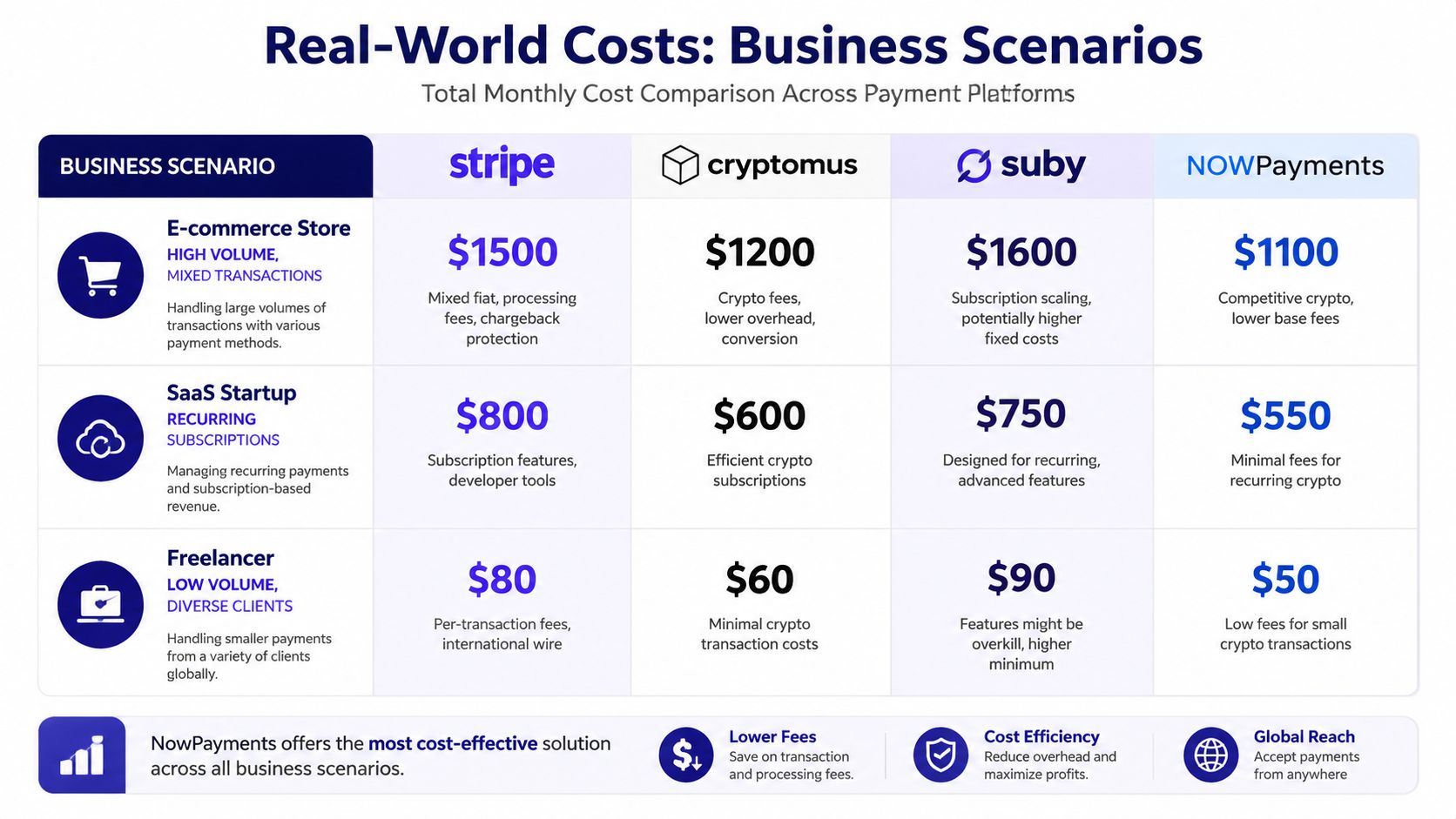
A finance lead closes the month and sees two processors with similar headline fees. One looked cheaper at checkout. The other produced lower net revenue leakage after FX, withdrawals, and treasury handling were finished. That gap is why scenario analysis matters more than a single fee column.
Scenario one, crypto-native checkout
Start with a software business that already sells to customers comfortable paying in crypto. Its real cost base depends less on the advertised processing rate and more on whether the customer pays in the same asset the merchant wants to keep. If the business accepts USDC and retains USDC, fee drag stays relatively contained. If it accepts volatile tokens, converts them, then withdraws across networks, the all-in cost rises even if the gateway's listed fee looks low.
That is why Cryptomus and NOWPayments tend to look stronger in a pure crypto-native flow. Their advantage is clearest when merchants do not need a second conversion step after checkout. Stripe and Suby can still be economically reasonable in this setup, but their value depends more on what happens after payment is approved, especially if the merchant's treasury stack or accounting process benefits from a different settlement model.
The accounting discipline is similar to tracking cost basis for investments. The relevant figure is not the first fee shown to the merchant. It is the net amount left after every conversion, network deduction, and settlement choice.
For teams comparing that net outcome rather than just the sticker rate, this payment gateway pricing breakdown is useful because it frames fees in the context of merchant settlement paths.
Scenario two, card pay-ins with stablecoin settlement
Now take a cross-border SaaS company selling to customers who still prefer cards while finance wants to hold part of revenue in USDC. In such situations, headline comparisons often fail. A card processor can look inexpensive at the point of sale and still produce a higher total cost once funds pass through bank settlement, foreign exchange, and treasury conversion.
Suby is relevant in this case because it supports card acceptance with stablecoin-oriented settlement flows, as noted earlier in the article. The direct card fee may be higher than a standard fiat processor. That does not automatically make it more expensive in practice. If the alternative path involves card settlement into fiat, a bank transfer, an FX conversion, and then a move into USDC, the merchant is paying for several small frictions instead of one visible fee.
For globally distributed businesses, those frictions are rarely trivial. FX spread is usually the least understood line item. It often sits outside the processor's advertised rate and is treated as a treasury or banking issue, even though it is part of payment acceptance economics.
So the correct comparison is operational, not cosmetic. Compare Stripe's card pricing plus downstream conversion costs against a flow where the merchant receives stablecoins earlier in the chain. Compare NOWPayments and Cryptomus where customers already arrive with crypto. Compare Suby where customer payment preference and merchant settlement preference sit on different rails.
A practical rule follows. The lowest-cost gateway is usually the one that removes the most conversion steps between customer payment and the asset your finance team intends to hold.
There's also a short explainer worth watching if you're evaluating how fee structures affect merchant outcomes across processors:
Which Payment Gateway Is Right for You
If your business is tied to fiat accounting and conventional payout workflows, Stripe is still the cleanest conceptual fit. The pricing is easy to understand, but the settlement model is better for teams that want funds landing in USD rather than directly into stablecoins.
If you're fully crypto-native and mostly care about minimizing processing fees, Cryptomus and NOWPayments are the stronger economic candidates. Their lower verified crypto fee ranges give them a real edge when customers already pay in the assets you want to keep.
If your customers want familiar payment methods but your finance team wants stablecoin settlement, the decision framework changes. The most important factor becomes settlement design, not just transaction price.
The hidden cost most merchants miss is still gas and withdrawal handling. As noted in the verified comparison from Crypto University's gateway review, NowPayments and Stripe pass network fees to the merchant, while Suby sponsors gas fees for crypto payments, removing a variable cost layer that can distort all-in pricing. That won't matter equally to every business, but for high-volume or low-margin flows, it matters a lot.
If you're doing this comparison seriously, it also helps to review a focused NOWPayments alternative analysis through the lens of settlement flexibility, not just fee percentages.
The simple decision rule is this:
Choose Stripe if your operation is fiat-first.
Choose Cryptomus or NOWPayments if you're crypto-first and fee-sensitive.
Choose a hybrid setup if customer payment preference and treasury preference are different.
If your business needs card and crypto acceptance in one stack, plus the option to settle to a bank account or in stablecoins, take a look at Suby. It's payment infrastructure for global internet businesses that want customers to pay how they prefer, while the business chooses how it gets paid.
