

Gaspard LEZIN
Best international payment gateway: A 2026 Guide for Global Businesses
Learn how to choose the best international payment gateway for your business. Compare fees, security, and cross-border support to boost conversions.
Selling to a global audience is no longer optional; it's essential for growth. But accepting payments across borders introduces significant complexity. High currency conversion fees, slow bank settlements, and navigating international compliance can quickly erode profits and hinder your expansion efforts. Choosing the best international payment gateway is not just a technical decision, it's a core strategic move that directly impacts your bottom line and customer experience. The right gateway simplifies operations, eliminates hidden costs, and provides a seamless checkout for buyers anywhere in the world.
This guide is designed to cut through the noise and provide clear, actionable insights. We will break down the top solutions for global businesses, comparing them on the criteria that truly matter: fees, settlement times, currency support, and integration capabilities. Whether you are a SaaS company managing subscriptions, an e-commerce store selling cross-border, or a creator monetizing a community, the platform you choose is critical. For a deeper dive into the strategic importance of global transactions, our guide on Small Business International Payments offers valuable context for scaling your operations.
In this comprehensive roundup, you will find detailed profiles for each leading gateway, complete with screenshots, direct links, and a clear breakdown of their pros and cons. We will explore platforms that handle traditional card payments with bank payouts as well as modern solutions that allow customers to pay by card while your business receives stablecoin settlements like USDC. Our goal is to equip you with the information needed to select a gateway that aligns perfectly with your business model, from an API for developers to native integrations for agencies and community managers.
1. Suby
Best For: Businesses prioritizing predictable, global revenue settlement, paid out to their bank account, or in stablecoins (USDC, EURC) to their wallet.
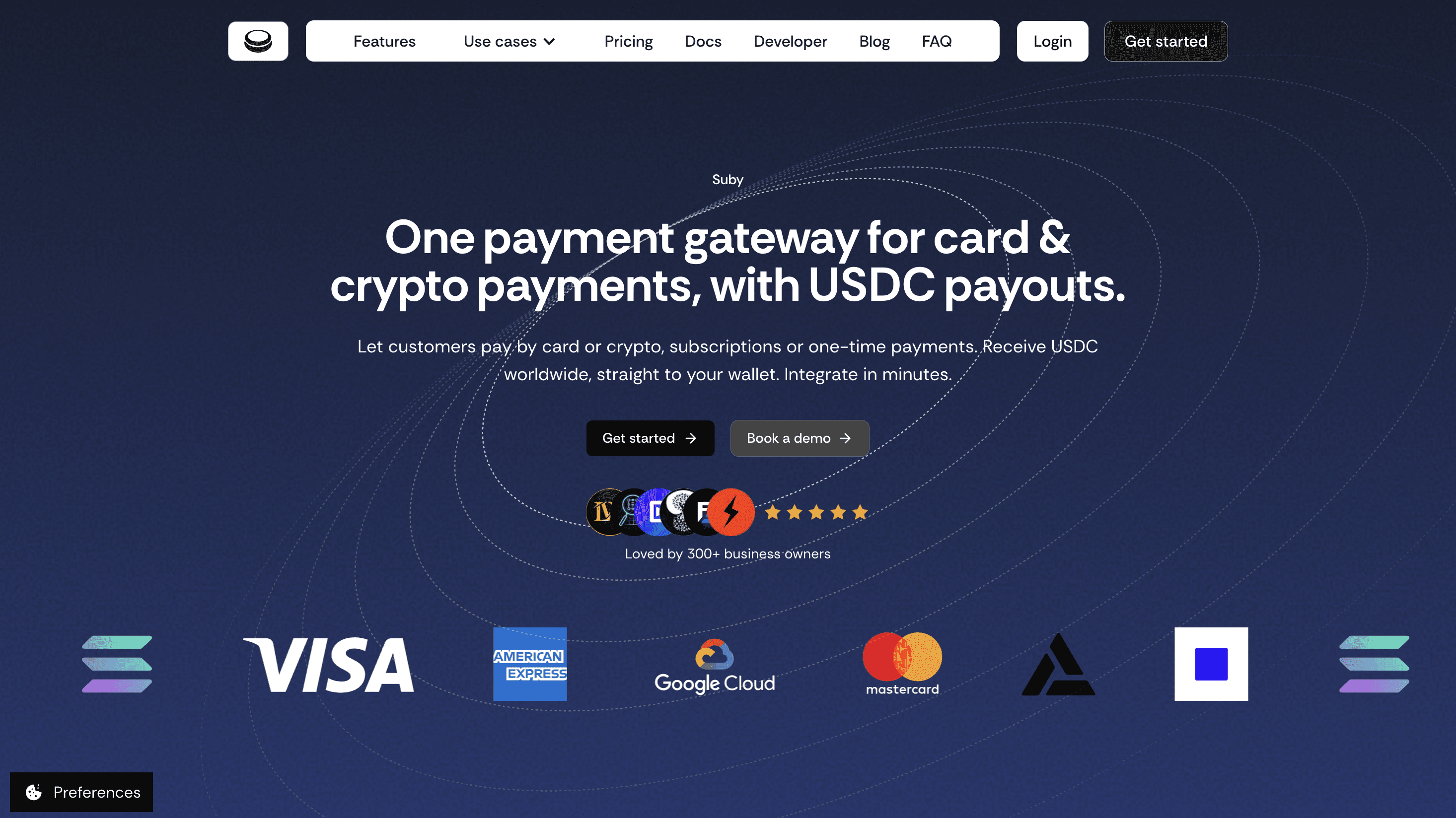
Suby establishes itself as a powerful contender for the best international payment gateway by creating a modern payment layer specifically for global businesses. It directly addresses the core challenges of cross-border commerce, such as currency conversion fees, SWIFT delays, and the friction of managing multiple local bank accounts. Its unique model allows customers to pay with standard Visa and Mastercard, while the business receives the funds settled directly as USDC to their crypto wallet.
This innovative approach is built for online businesses, SaaS companies, e-commerce merchants, and creators who operate on a global scale. By sidestepping traditional banking rails for payouts, Suby delivers near-instant, predictable revenue, removing the volatility and hidden costs associated with foreign exchange (FX) rates and international bank transfers.
Key Features and Strengths
Suby’s platform is designed for flexibility and security, catering to both non-technical users and developers.
Unified Card and Crypto Acceptance: Suby provides an API that lets any business accept traditional card payments (Visa/Mastercard) alongside multi-chain crypto payments. This dual capability allows businesses to cater to a wider international audience without needing separate processors.
Global Flexible Settlement: Get paid out to your bank account, or directly in stablecoins (USDC, EURC) to your wallet. This is Suby’s standout feature. All revenue, whether from card or crypto payments, is settled directly to your USDC wallet. This eliminates the need for local bank accounts in every market you serve, saving you from SWIFT delays and costly FX conversion fees.
Flexible Integration Options: Businesses can implement Suby in multiple ways to fit their needs. You can use simple, shareable paylinks for quick invoicing, embed a conversion-optimized checkout form directly on your site, or leverage a developer-friendly API for custom integrations.
Creator and Community Tools: Suby offers native integrations with Discord and Telegram, making it an excellent choice for creators and community managers. It can automate access management for paid memberships, a crucial feature for monetizing online communities.
Transparent, All-In Pricing: Suby’s pricing model is designed to be predictable. While "2.9% + $0.30" is a common industry claim, it often omits the 2-5% in additional fees for currency conversion, international card processing, and wire transfers. Suby bundles these costs into a single, flat rate, aiming to provide a lower total cost for genuine cross-border transactions.
How Suby Solves International Payment Challenges
For any business scaling globally, payment friction is a significant growth barrier. Suby tackles this head-on by simplifying the entire process from payment to settlement. A consultant in Europe can invoice a client in the United States using a simple paylink. The client pays in USD with their Mastercard, and the consultant receives the equivalent value in USDC almost instantly. This process avoids waiting days for a bank wire or losing a percentage to currency conversion. This level of efficiency is a game-changer for international operations.
Expert Insight: The true cost of an international transaction is rarely just the advertised processing fee. By collapsing payment processing, currency conversion, and settlement into a single stack with a flat fee, platforms like Suby provide financial predictability that is crucial for scaling a global business.
Pricing Structure
Suby offers flat, pay-as-you-go pricing, one rate per payment category with no tiers or plans, plus custom rates once you process over $100k/month.
.tbl-scroll{contain:inline-size;overflow-x:auto;-webkit-overflow-scrolling:touch}.tbl-scroll table{min-width:600px;width:100%;border-collapse:collapse;margin-bottom:20px}.tbl-scroll th{border:1px solid #ddd;padding:8px;text-align:left;background-color:#f2f2f2;white-space:nowrap}.tbl-scroll td{border:1px solid #ddd;padding:8px;text-align:left}PlanMonthly CostCard FeesCrypto FeesPayout Speed (Cards)Free$0/mo10% + $0.503%15 daysStandard$99/mo6.5% + $0.351.5%7 daysBusiness$299/mo5% + $0.270%Fastest
Annual subscriptions offer a discount on the monthly price.
Pros and Cons
Pros:
True Global Settlement: USDC payouts eliminate the need for local bank accounts and protect revenue from FX volatility and SWIFT delays.
Combined Payment Options: A single platform for accepting both traditional card payments and popular stablecoins.
Predictable Costs: Flat, all-inclusive fees simplify financial planning for international sales.
Creator-Focused Features: Native Discord and Telegram integrations are a significant advantage for community monetization.
Robust Security: Utilizes a PCI-DSS Level 1 processing partner, supports SCA, and offers dispute assistance.
Cons:
Flexible settlement: Suby pays out to your bank account (USD, EUR, or local currencies) or to your wallet in stablecoins (USDC, EURC), so no third-party off-ramp service is needed.
Fee Structure: While competitive for international transactions, the base transaction fees may be higher than domestic-only processors for merchants with low volume or a primarily local customer base.
Ultimately, Suby presents a compelling and forward-thinking solution for any business ready to embrace a truly global, digital-first financial workflow.
Website: https://suby.fi
2. Stripe
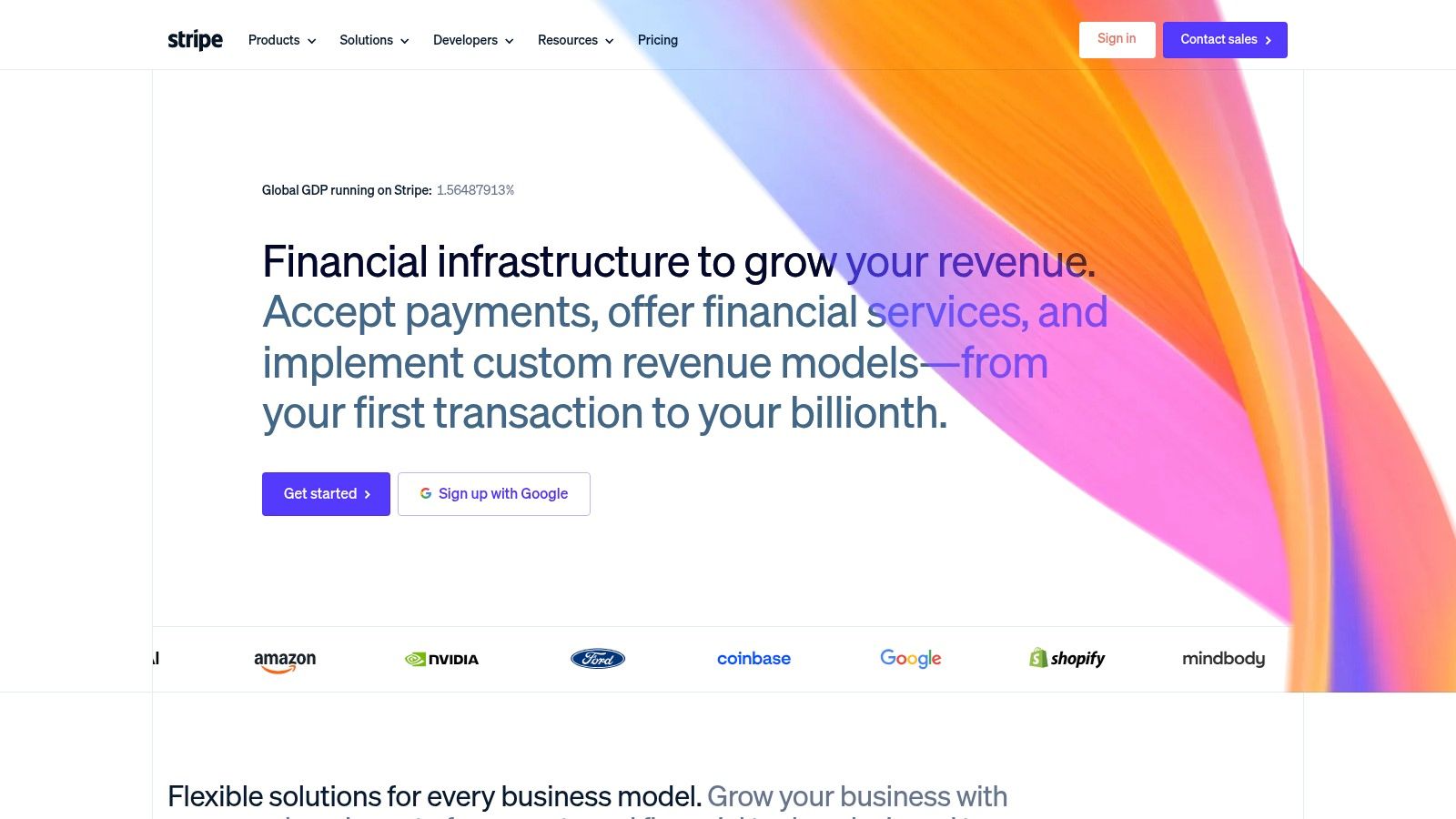
Stripe has established itself as a global leader in online payments, largely due to its developer-first approach and extensive, well-documented API. It's an excellent choice for businesses that need a powerful, customizable, and scalable payment infrastructure. From startups to large enterprises, Stripe provides the tools to accept payments, manage subscriptions, and facilitate complex marketplace transactions.
Its reputation as one of the best international payment gateway options is built on a mature ecosystem of products. These tools work together seamlessly, allowing businesses to manage everything from one-time invoices to recurring billing and platform payouts, all within a single, unified system.
Key Features and Capabilities
Stripe's platform is more than just a payment processor. It’s a comprehensive financial toolkit designed for global commerce.
Global Payment Acceptance: Stripe supports processing for all major credit and debit cards globally. It also offers over 100 alternative payment methods, including local options like SEPA Direct Debit in Europe or Alipay in China, which are crucial for maximizing conversion rates in specific regions.
Multi-currency Handling: The platform can process payments in over 135 currencies, allowing you to display local prices to customers. It also handles currency conversions automatically, simplifying cross-border sales.
Developer Tools and APIs: This is where Stripe truly excels. Its rich APIs, SDKs, and pre-built UI components like Stripe Checkout and Elements make integration straightforward for developers. The documentation is considered the industry gold standard.
Product Ecosystem: Stripe offers a suite of integrated products, including Billing for subscriptions, Connect for marketplaces and platforms, Invoicing for professional invoices, and Tax for automating sales tax calculation.
Pricing and Availability
Stripe's standard pricing in the US is a transparent, pay-as-you-go model. The fee is 2.9% + 30¢ for domestic online card transactions. However, international transactions incur additional costs:
International Cards: An extra 1.5% fee is applied.
Currency Conversion: An additional 2% fee is charged if a currency conversion is required.
These fees can add up for businesses with a high volume of cross-border sales. Custom pricing is available for large-volume merchants. While Stripe is a powerful tool for traditional finance, those looking for different payout options might explore other solutions. For more details on platforms offering USDC payouts instead of traditional bank settlements, you can find a comprehensive guide on Stripe alternatives.
Pros and Cons
.tbl-scroll{contain:inline-size;overflow-x:auto;-webkit-overflow-scrolling:touch}.tbl-scroll table{min-width:600px;width:100%;border-collapse:collapse;margin-bottom:20px}.tbl-scroll th{border:1px solid #ddd;padding:8px;text-align:left;background-color:#f2f2f2;white-space:nowrap}.tbl-scroll td{border:1px solid #ddd;padding:8px;text-align:left}ProsConsExcellent, comprehensive developer documentation and APIs.International and FX fees can significantly increase transaction costs.Scales from small startups to enterprise-level businesses.Some local payment methods require extra configuration or contracts.A unified platform with a wide range of financial products.Payouts are limited to traditional bank settlements.Transparent pricing for domestic and standard transactions.Customer support can be slow for non-enterprise users.
Website: https://stripe.com
3. Adyen
Adyen is a global payment company offering a single, integrated platform for businesses to accept payments anywhere in the world. Positioned as an enterprise-grade solution, it combines the roles of a payment gateway, risk management system, and payment acquirer. This unified commerce approach is ideal for large, multinational corporations that require a comprehensive and streamlined payment infrastructure for online, in-app, and in-person transactions.
Its strength as one of the best international payment gateway providers lies in its ability to offer deep insights and optimization capabilities. By controlling the entire payment flow, Adyen provides businesses with rich data and advanced tools to increase authorization rates, reduce costs, and simplify global expansion.
Key Features and Capabilities
Adyen’s all-in-one platform is engineered to handle the complexities of global commerce for large-scale businesses.
Global Acquiring: Adyen holds acquiring licenses in key regions, allowing businesses to process payments locally. This direct connection to card schemes like Visa and Mastercard can lead to higher authorization rates and lower transaction costs.
Extensive Local Payment Methods: The platform supports a vast catalog of preferred local payment methods, including iDEAL in the Netherlands, Alipay in China, and OXXO in Mexico, enabling businesses to cater to regional customer preferences.
Unified Commerce: Adyen provides a single integration point for all sales channels. This means a customer’s data and payment history are unified, whether they purchase online, through a mobile app, or at a physical store.
Data and Optimization: It offers access to enhanced Level 2/3 payment data, which can reduce interchange fees on eligible corporate card transactions. Its system also uses intelligent payment routing and machine learning to optimize authorization rates.
Pricing and Availability
Adyen operates on an Interchange++ (IC++) pricing model, which is different from the blended rates offered by many competitors. This model breaks down the cost of each transaction into three parts: the interchange fee (set by the card issuer), the scheme fee (paid to card networks like Visa), and Adyen's processing fee.
This transparent structure is typically more cost-effective for high-volume merchants. However, pricing is bespoke and requires direct engagement with their sales team. Due to its enterprise focus, the implementation process can be more involved than with other platforms, so understanding the technical requirements is key. For those interested in the technical side, a guide on payment gateway API integration can provide valuable insights.
Pros and Cons
.tbl-scroll{contain:inline-size;overflow-x:auto;-webkit-overflow-scrolling:touch}.tbl-scroll table{min-width:600px;width:100%;border-collapse:collapse;margin-bottom:20px}.tbl-scroll th{border:1px solid #ddd;padding:8px;text-align:left;background-color:#f2f2f2;white-space:nowrap}.tbl-scroll td{border:1px solid #ddd;padding:8px;text-align:left}ProsConsUnified platform for online, mobile, and in-person payments.Enterprise focus can mean longer sales and implementation cycles.Direct acquiring connections can increase authorization rates.IC++ pricing model can be complex for smaller businesses to forecast.Extensive support for local payment methods worldwide.Not ideal for startups or businesses seeking simple, out-of-the-box setup.Provides rich transaction data for optimization.Bespoke pricing requires direct negotiation with the sales team.
Website: https://www.adyen.com
4. Checkout.com
Checkout.com has rapidly emerged as a powerful force in the payments industry, positioning itself as a modern, unified platform for enterprise-level and high-growth digital businesses. It offers a single, integrated API that simplifies global payment processing, making it an excellent choice for companies looking to scale internationally with sophisticated data and performance tools.
Its reputation as a best international payment gateway is built on providing deep insights and granular control over the entire payment value chain. For merchants processing significant cross-border volume, this level of data visibility and performance optimization is a critical advantage, helping to improve authorization rates and reduce operational complexity.
Key Features and Capabilities
Checkout.com is designed for performance, offering a comprehensive suite of tools that go beyond basic payment acceptance to provide deep operational intelligence.
Unified Global Acquiring: The platform processes payments in over 150 currencies and offers domestic acquiring in more than 45 countries. This allows businesses to process transactions locally, which often leads to higher approval rates and lower fees.
Granular Data and Analytics: One of its main differentiators is the level of data transparency it provides. Merchants get access to detailed reporting and analytics on every transaction, enabling them to understand and optimize payment performance.
Flexible Commercial Models: Unlike platforms with rigid pricing, Checkout.com offers tailored commercial models, including blended rates or more transparent Interchange++ pricing, which can be more cost-effective for large-volume businesses.
Enterprise-Grade Tools: It provides a full suite of products for risk management, authentication (3D Secure), and reconciliation, all accessible through its single API integration. This helps businesses manage fraud and compliance effectively across different markets.
Pricing and Availability
Checkout.com does not publish a public, self-serve pricing structure. Its model is designed for scaling businesses and enterprises, requiring direct engagement with their sales team to create a custom pricing plan. This approach allows them to offer tailored rates based on transaction volume, business model, and risk profile.
Custom Pricing: Pricing is typically either a blended rate or an Interchange++ model. The latter is often preferred by larger merchants for its transparency.
No Setup Fees: There are generally no setup fees, monthly fees, or gateway fees.
This customized approach is ideal for businesses that have outgrown standard flat-rate pricing and need a more sophisticated financial partner. However, for businesses that need different payout options, such as USDC settlements instead of traditional bank transfers, exploring other specialized providers may be necessary.
Pros and Cons
.tbl-scroll{contain:inline-size;overflow-x:auto;-webkit-overflow-scrolling:touch}.tbl-scroll table{min-width:600px;width:100%;border-collapse:collapse;margin-bottom:20px}.tbl-scroll th{border:1px solid #ddd;padding:8px;text-align:left;background-color:#f2f2f2;white-space:nowrap}.tbl-scroll td{border:1px solid #ddd;padding:8px;text-align:left}ProsConsEnterprise-class data visibility, analytics, and risk management tools.Pricing is not public; requires engaging with a sales team for a custom quote.Tailored pricing and dedicated migration support for larger merchants.Onboarding process is more involved and best suited for scaling or established businesses.A single, unified API simplifies global payment integration.Smaller merchants or startups may find the platform heavier than needed.Strong and growing presence with extensive global coverage.Payouts are limited to traditional currency settlements via bank accounts.
Website: https://www.checkout.com
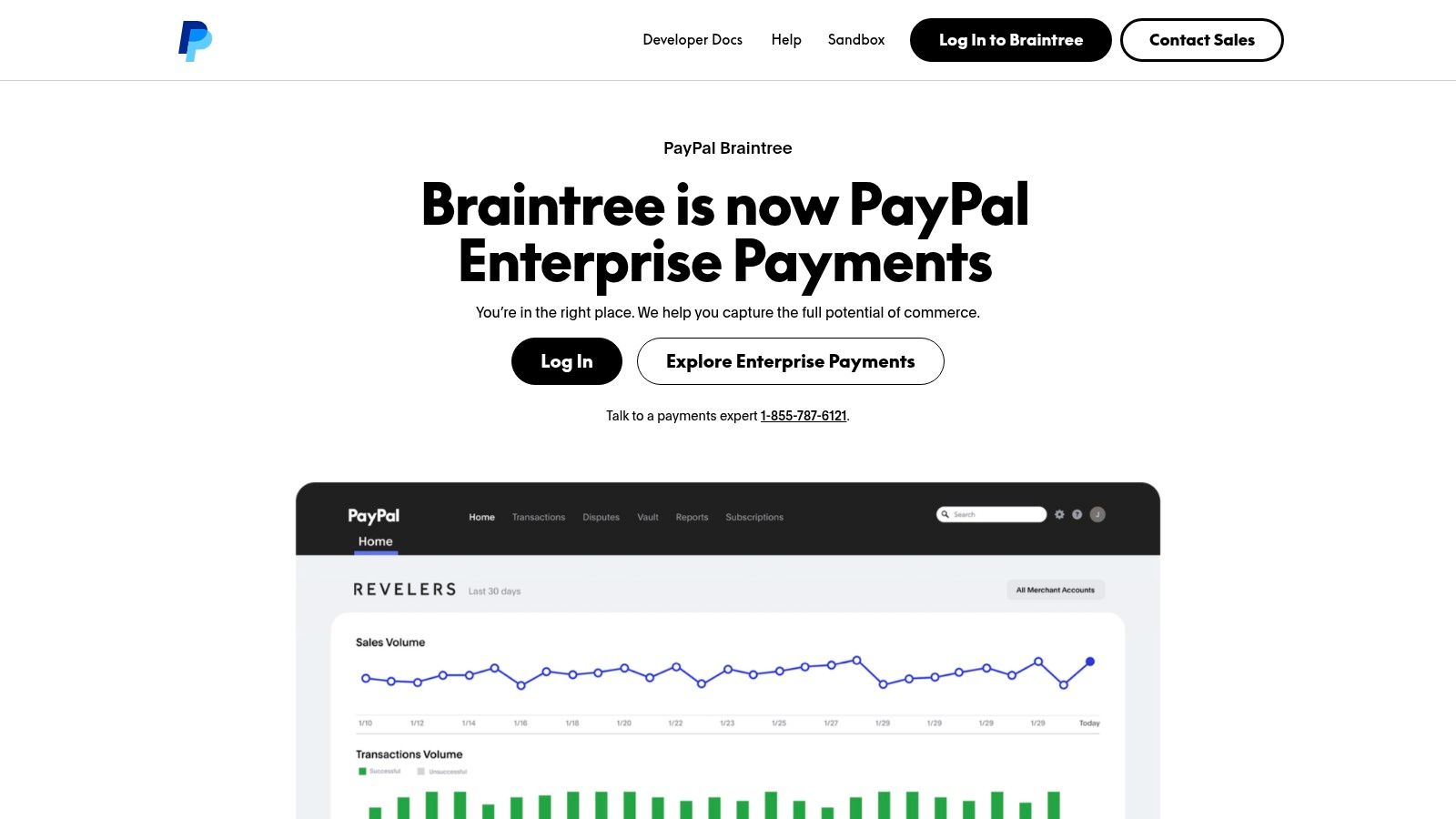
5. PayPal Braintree
Acquired by PayPal, Braintree operates as a full-stack payment platform that gives merchants access to a wide array of payment methods through a single integration. It is an excellent choice for businesses, particularly in the US, that want to combine traditional card processing with popular digital wallets like PayPal and Venmo. This makes it a compelling option for e-commerce stores and marketplaces aiming to maximize conversion by offering familiar payment choices.
As a contender for the best international payment gateway, Braintree’s strength lies in its connection to PayPal's vast global user base. It provides a robust, developer-friendly environment for creating custom checkout experiences while leveraging the trust and convenience of established payment networks.
Key Features and Capabilities
Braintree is designed to be an all-in-one payment solution, bundling a gateway and processing capabilities to simplify global commerce.
Diverse Payment Methods: Braintree supports all major credit and debit cards, along with PayPal, Venmo, Apple Pay, and Google Pay. It also includes local payment options like ACH Direct Debit in the US, which is ideal for recurring payments.
Recurring Billing and Vaulting: The platform offers built-in tools for managing subscriptions and recurring payments. Its secure vault allows businesses to safely store customer payment information for seamless repeat purchases and one-click checkouts.
Developer SDKs and APIs: Braintree provides comprehensive SDKs for various programming languages and mobile platforms, making it relatively straightforward for developers to integrate custom payment flows into their websites and apps.
Access to PayPal's Network: By integrating Braintree, merchants immediately tap into PayPal's ecosystem, offering hundreds of millions of active users a familiar and trusted way to pay.
Pricing and Availability
Braintree offers a standard, published pricing model for US merchants, which is a flat rate of 2.59% + 49¢ per card or digital wallet transaction. ACH transactions are priced at 0.75%, capped at $5 per transaction. However, international payments come with additional fees:
International Transactions: A 1% cross-border fee is applied to transactions where the customer's card is issued outside the US.
Multi-currency: An additional 1% fee is charged for payments presented in a currency other than the merchant's settlement currency.
For businesses with significant transaction volume, Braintree offers custom interchange-plus pricing, but this typically requires contacting their sales team. While Braintree excels at traditional bank settlements, businesses needing the flexibility of stablecoin payouts, such as receiving payments in USDC, would need to consider alternative platforms.
Pros and Cons
.tbl-scroll{contain:inline-size;overflow-x:auto;-webkit-overflow-scrolling:touch}.tbl-scroll table{min-width:600px;width:100%;border-collapse:collapse;margin-bottom:20px}.tbl-scroll th{border:1px solid #ddd;padding:8px;text-align:left;background-color:#f2f2f2;white-space:nowrap}.tbl-scroll td{border:1px solid #ddd;padding:8px;text-align:left}ProsConsEasy access to PayPal and Venmo buyers and wallets.International card and multi-currency fees add on top of base rates.Simple, published US pricing for standard merchants.Advanced features and custom pricing often require sales approval.ACH is available with capped per-transaction fees.Payouts are limited to traditional bank settlements.Robust developer tools and SDKs for custom integrations.The user interface can feel less modern compared to newer platforms.
Website: https://www.braintreepayments.com
6. Rapyd
Rapyd positions itself as a comprehensive "fintech-as-a-service" platform, designed for businesses that require a sophisticated global payments and payouts infrastructure. It excels in unifying complex cross-border financial operations, allowing merchants to accept payments, disburse funds, and issue financial products through a single integration. This makes it a strong contender for businesses needing more than just a simple payment processor.
Its approach as one of the best international payment gateway solutions is rooted in its extensive network of local payment methods. Rapyd provides the tools to not only collect funds globally but also to pay out to suppliers, contractors, or customers in their local currencies and preferred methods, which is critical for marketplaces and platforms with global user bases.
Key Features and Capabilities
Rapyd's platform is built to handle the entire payment lifecycle, from collection to disbursement, on an international scale.
Extensive Local Payment Methods: Beyond major cards, Rapyd supports a vast catalog of alternative payment methods (APMs), including local bank transfers, e-wallets, and cash options across numerous countries, enabling businesses to cater to regional preferences.
Unified Collect and Disburse Platform: A key differentiator is its ability to both accept payments and execute payouts globally. This is ideal for cross-border e-commerce, gig economy platforms, and marketplaces that need to manage incoming and outgoing funds efficiently.
Interchange++ Pricing: Rapyd offers a transparent Interchange++ (IC++) pricing model. This breaks down the cost into its core components: the interchange fee (to the card-issuing bank), the card scheme fee, and a fixed acquirer fee. This can be more cost-effective for high-volume merchants compared to blended rates.
Global Treasury and FX: The platform includes tools for managing foreign exchange and cross-border settlements, helping businesses reconcile funds and optimize their international financial operations from one central hub.
Pricing and Availability
Rapyd's pricing is not a simple, one-size-fits-all blended rate like many competitors. Instead, it relies on the IC++ model, where costs vary based on the card type, country, and other factors. This provides transparency but requires a custom quote based on your business's specific transaction volume, industry, and risk profile.
There is no standard public rate for US card transactions. This model is generally better suited for larger businesses that can analyze and benefit from the granular cost structure. For businesses seeking simpler settlement options, alternative solutions provide straightforward USDC payouts instead of navigating complex traditional banking and FX systems.
Pros and Cons
.tbl-scroll{contain:inline-size;overflow-x:auto;-webkit-overflow-scrolling:touch}.tbl-scroll table{min-width:600px;width:100%;border-collapse:collapse;margin-bottom:20px}.tbl-scroll th{border:1px solid #ddd;padding:8px;text-align:left;background-color:#f2f2f2;white-space:nowrap}.tbl-scroll td{border:1px solid #ddd;padding:8px;text-align:left}ProsConsTransparent IC++ pricing can optimize costs for high-volume users.No simple public blended rate, making it harder to estimate costs upfront.Strong coverage of alternative and local payment methods globally.Setup and integration can be more complex than SMB-focused gateways.Unified platform for accepting payments and making payouts.Better suited for larger enterprises than for small businesses or startups.Suitable for complex, multi-country commerce and payout models.Payouts are limited to traditional currency settlements via banking rails.
Website: https://www.rapyd.net
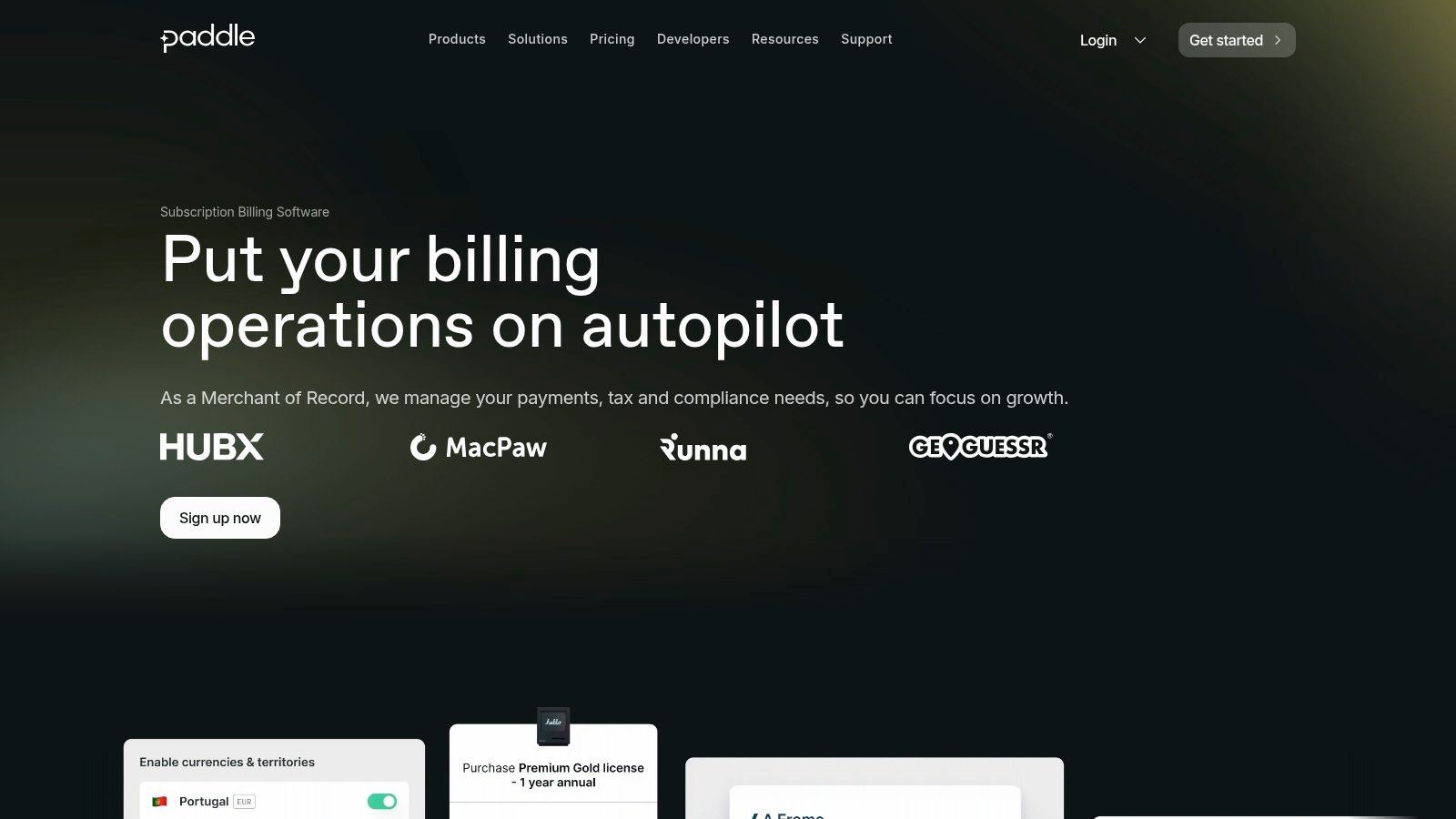
7. Paddle (Merchant-of-Record for SaaS)
Paddle offers a fundamentally different approach to international payments, acting as a Merchant of Record (MoR). This model is specifically tailored for software and SaaS businesses that want to offload the operational complexities of global sales. Instead of just processing payments, Paddle becomes the reseller of your product, handling all payment acceptance, tax and VAT compliance, fraud detection, and even buyer support.
This all-in-one platform makes Paddle an excellent candidate for the best international payment gateway for businesses that prioritize simplicity and compliance. By managing the entire financial stack, it allows software companies to focus on their product and growth rather than building a complex, multi-vendor system for payments, billing, and global tax remittance.
Key Features and Capabilities
Paddle's platform is designed to be a complete revenue delivery infrastructure, bundling services that businesses would otherwise have to source and integrate separately.
Global Tax & VAT Compliance: As the MoR, Paddle automatically calculates, collects, and remits sales taxes and VAT in every country your customers are in. This eliminates a massive administrative burden for businesses selling globally.
Unified Commerce Platform: It combines checkout, payment processing, subscription management, invoicing, and tax compliance into a single integrated system. This simplifies reporting and reconciliation.
Optimized Payment Acceptance: Paddle supports major credit and debit cards, PayPal, and is continuously expanding its local payment methods like BLIK in Poland and Pix in Brazil. Its system automatically routes payments to maximize acceptance rates.
Developer-Focused Tools: The platform provides robust APIs and SDKs that allow for deep integration, flexible pricing models, and automation, making it a strong choice for tech-savvy software businesses.
Pricing and Availability
Paddle’s pricing is based on its all-in-one, MoR model. It offers a simple, transparent fee that covers payment processing, currency conversion, tax compliance, and fraud protection.
Standard Pricing: A flat fee of 5% + 50¢ per transaction.
Custom Pricing: Available for businesses with high transaction volumes or unique needs.
This flat-rate structure is predictable, which is a major advantage for financial planning. While the percentage may seem higher than a raw payment gateway fee, it replaces multiple separate costs, including international card fees, currency conversion charges, and the expense of tax compliance software or services.
Pros and Cons
.tbl-scroll{contain:inline-size;overflow-x:auto;-webkit-overflow-scrolling:touch}.tbl-scroll table{min-width:600px;width:100%;border-collapse:collapse;margin-bottom:20px}.tbl-scroll th{border:1px solid #ddd;padding:8px;text-align:left;background-color:#f2f2f2;white-space:nowrap}.tbl-scroll td{border:1px solid #ddd;padding:8px;text-align:left}ProsConsAll-in-one fee simplifies costs and covers tax, fraud, and payments.The flat fee can be higher than raw gateway costs for very large transactions.Drastically reduces the complexity of global sales tax and VAT compliance.As an MoR, Paddle is the legal seller, which can limit custom invoicing or tax cases.Strong focus on SaaS and subscription management workflows.Less control over the specific payment routing and processing stack.Allows for rapid international expansion without local business registration.Payouts are made via traditional bank transfers, not offering stablecoin options.
Website: https://www.paddle.com
Top 7 International Payment Gateways Comparison
.tbl-scroll{contain:inline-size;overflow-x:auto;-webkit-overflow-scrolling:touch}.tbl-scroll table{min-width:600px;width:100%;border-collapse:collapse;margin-bottom:20px}.tbl-scroll th{border:1px solid #ddd;padding:8px;text-align:left;background-color:#f2f2f2;white-space:nowrap}.tbl-scroll td{border:1px solid #ddd;padding:8px;text-align:left}NameImplementation complexityResource requirementsExpected outcomesIdeal use casesKey advantagesSubyLow–Medium, quick onboarding, embeddable checkout or APIManage crypto wallets & minimal dev for integrationPredictable USDC settlements, near-instant payouts, lower cross-border effective costCreators, SaaS, agencies, merchants wanting crypto settlement and community monetizationCard + crypto acceptance, USDC settlement, conversion-optimized UX, creator integrationsStripeMedium, developer-first SDKs and hosted toolsEngineering time for integration, ops for multi-currency/feesBroad global acceptance, scalable subscriptions and marketplace supportSaaS, platforms, e-commerce needing rich tooling and scaleExtensive APIs, 100+ payment methods, Billing & Connect ecosystemAdyenHigh, enterprise integrations and bespoke pricingDedicated payments ops, legal/compliance, longer rolloutUnified acquiring, optimized authorization and interchange savingsLarge enterprises and platforms requiring advanced routingGlobal acquiring, deep local method coverage, scheme‑level optimizationCheckout.comMedium–High, unified API with enterprise onboardingPayments/data engineers and sales engagement for pricingStrong data visibility, tailored commercial models, reconciliationFast-growing digital businesses and enterprisesAdvanced analytics, flexible pricing, enterprise reconciliation toolsPayPal BraintreeMedium, SDKs and vaulting, wallet-readyDev integration plus PayPal/Venmo account managementAccess to popular wallets, reliable US flows, recurring billingUS merchants, marketplaces, businesses relying on PayPal/VenmoPayPal/Venmo/ACH support, published pricing, vaulting for subscriptionsRapydMedium–High, supports many local methods and IC++ pricingPayments ops for acceptance+payouts across countriesCombined collect + payout capability, transparent cost componentsBusinesses needing multi-country acceptance and disbursementsLarge APM catalog, payouts/issuing, transparent Interchange++ modelPaddle (MoR)Low, merchant-of-record simplifies integrationMinimal dev; Paddle handles tax, compliance, supportRapid international GTM with tax/VAT and chargeback handlingSaaS companies wanting to outsource payments and taxMoR model (tax/compliance handled), predictable all‑in fee, subscription focus
Making Your Choice: When to Choose Card-to-Stablecoin Payments
Navigating the landscape of international payments reveals a clear fork in the road. You have the established, traditional path and a modern, more direct route. Choosing the best international payment gateway for your business ultimately comes down to identifying your primary bottleneck and strategic goals for global expansion.
This article has walked you through the strengths of major players. We've seen how enterprise-grade solutions like Adyen and Checkout.com offer comprehensive, multi-channel processing for large corporations with complex treasury needs. We've also explored how a Merchant-of-Record like Paddle can absorb the burden of sales tax compliance, a critical function for SaaS companies. For broad accessibility, Stripe and PayPal Braintree continue to offer reliable, developer-friendly platforms that have become industry standards, and if you are weighing those two directly our breakdown of Stripe vs PayPal for global business is a useful companion read.
However, each of these traditional gateways operates within a legacy financial system, one that introduces friction points like currency conversion fees, multi-day settlement delays, and the need for corresponding bank accounts in different regions. If your core challenge isn't just accepting payments but efficiently receiving and managing your revenue across borders, it's time to consider a different model.
The Clear Advantage of Stablecoin Settlements
For a growing segment of digital businesses, the most significant barrier to global scale is the financial infrastructure itself. This is where a card-to-stablecoin payment model offers a clear, practical solution.
Imagine this common scenario: an e-commerce store in Asia sells a product to a customer in Europe. With a traditional gateway, the payment travels through multiple intermediary banks, undergoes currency conversion, and finally lands in the merchant’s account days later, minus several layers of fees.
A gateway like Suby fundamentally changes this flow. The customer pays with their card in their local currency, just as they always do. The merchant, however, receives the settlement directly as USDC. This simple shift has profound implications:
Predictable Revenue: You receive funds in a stablecoin pegged to the US dollar, eliminating the volatility and uncertainty of foreign exchange rates.
Reduced Fees: By sidestepping the complex web of correspondent banking, you avoid many of the hidden cross-border and currency conversion fees.
Faster Access to Funds: Settlement times are significantly reduced, improving your cash flow and allowing you to reinvest in your business more quickly.
Global by Default: You can receive payments from anywhere in the world and hold them in a single, universally accessible digital asset without needing a local bank account in every market.
To fully grasp the implications of card-to-stablecoin payments, it's crucial to understand the fundamental key differences between crypto coins and tokens. Stablecoins like USDC are tokens designed for stability, making them an ideal medium for business settlements.
Who Benefits Most from This Model?
If your business fits one of the following profiles, a card-to-stablecoin gateway is not just an alternative, it’s a strategic upgrade:
SaaS and Web App Companies: Offer global subscriptions without worrying about FX loss on recurring revenue.
Cross-Border E-commerce Merchants: Simplify your financial stack and improve margins on international sales, a core theme in our guide to cross border e commerce growth.
Agencies and Freelancers: Invoice international clients and get paid quickly in USDC, bypassing slow and expensive wire transfers.
Creators and Community Managers: Monetize global communities on platforms like Discord and Telegram with a payment system that works for everyone, everywhere.
The decision is no longer just about features, it's about the financial architecture you build your business on. If your priority is to eliminate cross-border friction, accelerate cash flow, and build a truly global operation from day one, then the choice becomes clear.
Suby is a payment gateway and Merchant of Record. Your customers pay with card, bank transfer, Apple Pay, Google Pay, Klarna, and more, or stablecoins, and you get paid out to your bank account, or directly in stablecoins (USDC, EURC) to your wallet, anywhere in the world, no bank account required. It also includes native Discord and Telegram integrations for subscriptions and paid access. For a business hunting the best international payment gateway, that model collapses cross-border card processing, currency conversion, and settlement into one predictable stack instead of correspondent banking and multi-day payouts.
