

Gaspard LEZIN
I Use Stripe and Need to Support Global Crypto Subscriptions
i use stripe and need to support global crypto subscriptions? Learn how to add a crypto-native payment layer with Suby for instant USDC settlements in 2026.
You already have Stripe working. Cards convert well in your main markets, invoices reconcile cleanly, and your team knows how to support failed renewals and disputes. Then growth pushes you into markets where card coverage is weaker, settlement is slower, and some customers do not want to pay with a card at all.
That's the moment behind the search query I use Stripe and need to support global crypto subscriptions. It usually doesn't come from curiosity. It comes from friction. A customer in one region can't get a recurring payment through. Another asks to pay from a wallet. Your finance team asks how this would reconcile. Your support team asks what happens when a renewal fails.
The hard part isn't adding one more checkout button. The hard part is running a subscription business when card billing remains your default rail, but crypto becomes necessary for reach. That means thinking about architecture, off-session renewals, support flows, reconciliation, and operational boundaries before launch.
Table of Contents
Where card-first systems start to strain
Why crypto subscriptions are getting practical
Two workable models
Where a parallel system usually wins
Crypto Subscription Architecture Comparison
Start with one clear ownership model
Create the plan and hosted payment flow
Handle webhooks like billing events, not notifications
Treat lifecycle state as a product concern
Mixed-rail support needs explicit rules
Normalize settlement before you normalize reporting
Build one internal revenue ledger
Technical readiness
Operations and support readiness
The Global Subscription Challenge for Stripe Users
A familiar pattern shows up in growing SaaS teams. Stripe solved the first phase of billing, card acceptance, tax support, invoicing, and recurring charges. Then international demand increases, and the billing stack starts showing a different kind of weakness. Not because Stripe is small, but because global subscription coverage always gets messier at the edges.
Where card-first systems start to strain
Stripe's scale is real. It processed $1.4 trillion in total payment volume in 2024, up 38% year over year, and said that equaled about 1.3% of global GDP. It also reported support for 135+ currencies and 100 payment methods in its 2024 company update. That tells you the core infrastructure is already operating at internet scale.
But scale doesn't remove all subscription friction. It just means the core rail is strong.
The practical problems show up in places your billing dashboard doesn't summarize neatly:
Recurring card failures abroad: Customers can complete one-time payments in some markets, but recurring charges behave differently.
Banking mismatch: A buyer may want your product but not have reliable access to the card rails your stack assumes.
Settlement friction: Cross-border movement of money creates extra waiting, extra conversion steps, and extra support tickets.
Customer expectations: Some customers now expect to pay from a wallet the same way others expect to save a card.
Practical rule: If a payment method creates different support behavior, renewal behavior, and reconciliation behavior, treat it as a new rail, not as a small checkout tweak.
Why crypto subscriptions are getting practical
This isn't only a niche demand anymore. The global crypto payments market was estimated at $1.8 billion in 2024 and is projected to exceed $3.5 billion by 2030, and the same industry roundup reported an average retail crypto payment of $112, which points to smaller, repeatable transactions rather than only large transfers, as covered in this crypto payments market roundup.
That last number matters more than it looks. Subscription products live on repeatable purchase behavior. If the average transaction size were only tied to large treasury movement, it would be less relevant. But smaller payment sizes fit the shape of SaaS plans, memberships, online communities, and creator access.
Teams usually make a mistake here. They frame crypto as a replacement for Stripe. It isn't. The more durable approach is to keep card billing where it works and add a crypto-capable rail for customers who need it. That gives you broader acceptance without destabilizing the system your finance and support teams already understand.
Choosing Your Crypto Subscription Architecture
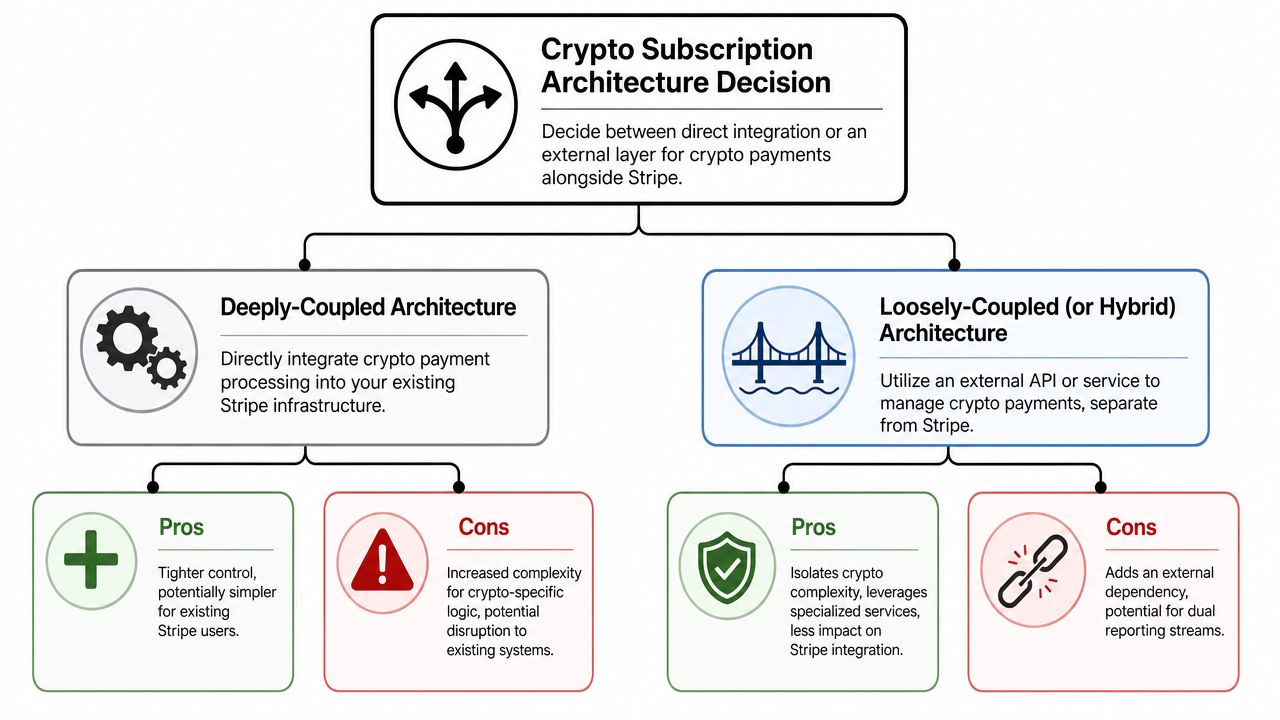
Before you build anything, decide whether crypto will live inside your current billing core or alongside it as a separate payment rail with shared subscription state. That choice determines how much operational pain you create for yourself later.
Two workable models
The first model is tightly coupled. You push crypto payment behavior directly into the same billing logic that currently assumes cards, invoices, retries, and stored payment credentials all follow one pattern.
The second is a parallel system. Your app keeps one customer and entitlement model, but payment execution is split by rail. Card subscriptions stay in Stripe. Crypto subscriptions are handled by a separate layer with its own checkout, renewal handling, and settlement outputs.
Stripe's current rollout history is a good reminder to design for boundaries early. Its crypto payouts started with USDC on Polygon before planning other networks, and stablecoin subscriptions began as a private preview for US-based businesses, as noted in Stripe's crypto payouts announcement. Even large platforms roll crypto features out in stages. Your architecture should expect geography and network limits, not assume universal availability on day one.
Where a parallel system usually wins
A parallel model is less elegant on a whiteboard, but it's usually more resilient in production.
If you closely couple crypto into a card-first stack, you end up rewriting assumptions that were invisible before. Renewal timing differs. Wallet authorization differs. Support scripts differ. Retry semantics differ. Reporting can differ. Suddenly your clean billing layer becomes a pile of exceptions.
A parallel model contains that complexity. Your application still owns customer identity, product access, and subscription state. But the rail-specific mechanics stay where they belong.
One practical example is using Suby as a separate payment layer for card or crypto acceptance while businesses receive USDC. It also offers native Discord and Telegram integrations for subscription access and online communities, and there's a useful overview of that model in this guide on accepting crypto payments for business. Teams comparing hosted crypto checkouts may also want to weigh a MoonPay Commerce alternative when settlement predictability is the priority.
Don't optimize for the fewest vendors. Optimize for the fewest cross-rail assumptions inside your own codebase.
If you operate this way, your product logic asks a simple question: “Is the subscription active?” It doesn't need to know whether the customer paid by card or crypto unless a specific support or compliance workflow requires it.
It also helps to watch network conditions and market sentiment outside your own dashboard. For broader context on asset movement and market activity, some teams keep a general market reference such as the Bitcoin tracker by CoinStats open alongside internal payment monitoring. Not because it drives billing logic, but because support volume and customer behavior often move with market conditions.
Crypto Subscription Architecture Comparison
Consideration | Deeply-Coupled System | Parallel System (Suby) |
|---|---|---|
Core billing logic | Shared across all rails, but harder to keep clean | Shared product state, rail-specific payment logic stays separate |
Risk to existing Stripe flow | Higher, because crypto exceptions can affect card assumptions | Lower, because card billing remains isolated |
Rollout by market | Harder if eligibility differs by region or network | Easier to turn on per segment or geography |
Reporting model | Can look unified early, but often hides complexity | Requires dual ingestion, but boundaries are clearer |
Support operations | Agents need to reason through one mixed logic tree | Agents can follow rail-specific playbooks |
Long-term maintenance | More custom branching over time | More integration surfaces, less shared complexity |
Implementing Crypto Subscriptions with the Suby API
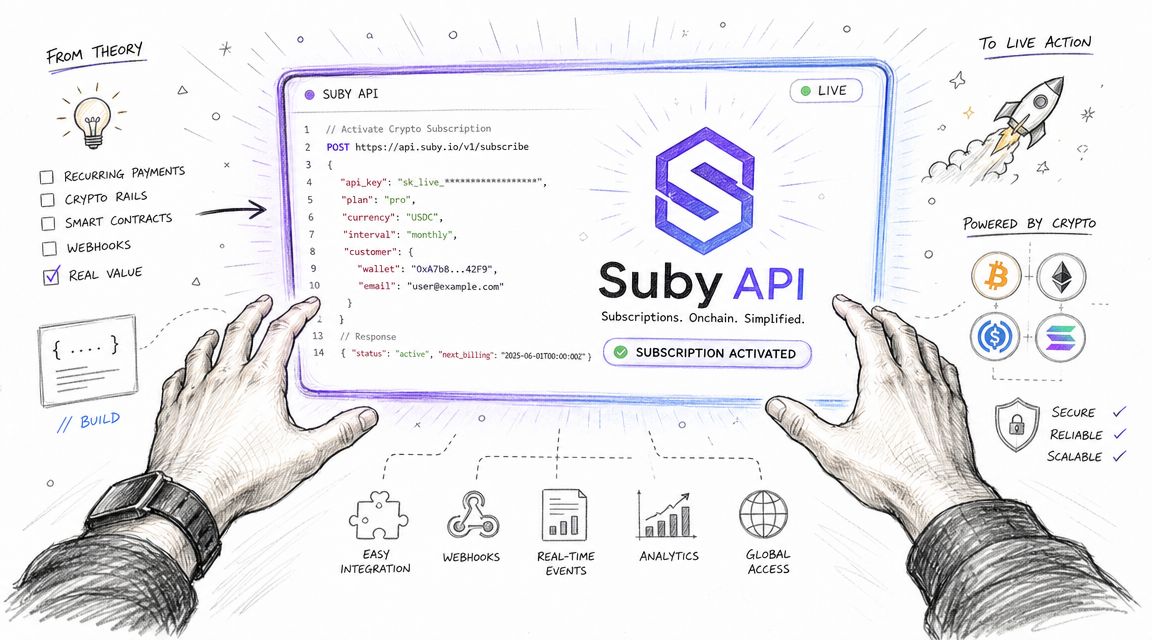
Implementation gets easier when you stop thinking in terms of “crypto checkout” and start thinking in terms of subscription state transitions. The payment provider should create and renew the charge. Your application should decide who gets access, when access changes, and what to do when billing status changes.
Start with one clear ownership model
Keep ownership split cleanly:
Your app owns products and entitlements
The payment layer owns payment collection and subscription billing events
Webhooks sync the two
That sounds obvious, but teams blur this line all the time. They let payment status directly drive frontend behavior before internal state is updated. Then support tickets start: “I paid, but I don't have access,” or worse, “I lost access even though renewal succeeded.”
The safer pattern is event-driven. Your backend receives the billing event, validates it, updates your internal subscription record, then grants or revokes access.
If you want a more general view of the API pattern for global collection and settlement, this overview of a global payment API is a useful companion before wiring subscription flows into your own app.
Create the plan and hosted payment flow
The exact endpoint names depend on the API version you're using, but the shape is straightforward. You create a product or plan, create a customer-linked subscription session, redirect the user to checkout, and persist the external subscription identifier in your own database.
A Node-style integration might look like this:
The important detail isn't the syntax. It's the data contract.
Store these fields immediately:
Internal customer ID
External subscription ID
Plan or price ID
Payment rail
Current status
Entitlement scope
That gives you enough to answer the support questions that always arrive first.
Save the external subscription identifier as a first-class field. Don't bury it in raw webhook payload storage and hope you can dig it out later.
Handle webhooks like billing events, not notifications
Once checkout succeeds, the actual work starts. A subscription system lives or dies by webhook handling.
You want idempotent handlers for events such as subscription creation, renewal success, payment failure, cancellation, and expiration. Even if event names vary, your internal mapping shouldn't.
Here's a simple pattern:
A short product demo helps here because lifecycle handling is easier to understand when you can see the sequence, not just read the docs.
Two implementation habits prevent most launch-week issues:
Make webhook handlers idempotent: The same event may be delivered more than once. Your state transition shouldn't break if it is.
Separate payment status from access status: Access changes should be driven by your confirmed internal record, not by a raw incoming event alone.
Log every state transition: Finance, support, and engineering will all need the timeline later.
Test out-of-order delivery: Assume events won't always arrive in the sequence you want.
If you need one mental model, use this one: checkout is only the beginning. The primary integration is your event pipeline.
Managing the Full Subscription Lifecycle
The first successful payment proves almost nothing. A subscription business gets tested on all the awkward cases after signup.
Treat lifecycle state as a product concern
Stripe's public positioning around stablecoin subscriptions makes mixed-rail billing sound close to standard Billing behavior, but practical issues such as proration, upgrades, and retry logic still remain a real operational challenge in hybrid setups, as discussed in this Bankless coverage of Stripe's recurring stablecoin subscriptions.
That's why lifecycle policy needs to live in your product logic, not only in the payment providers.
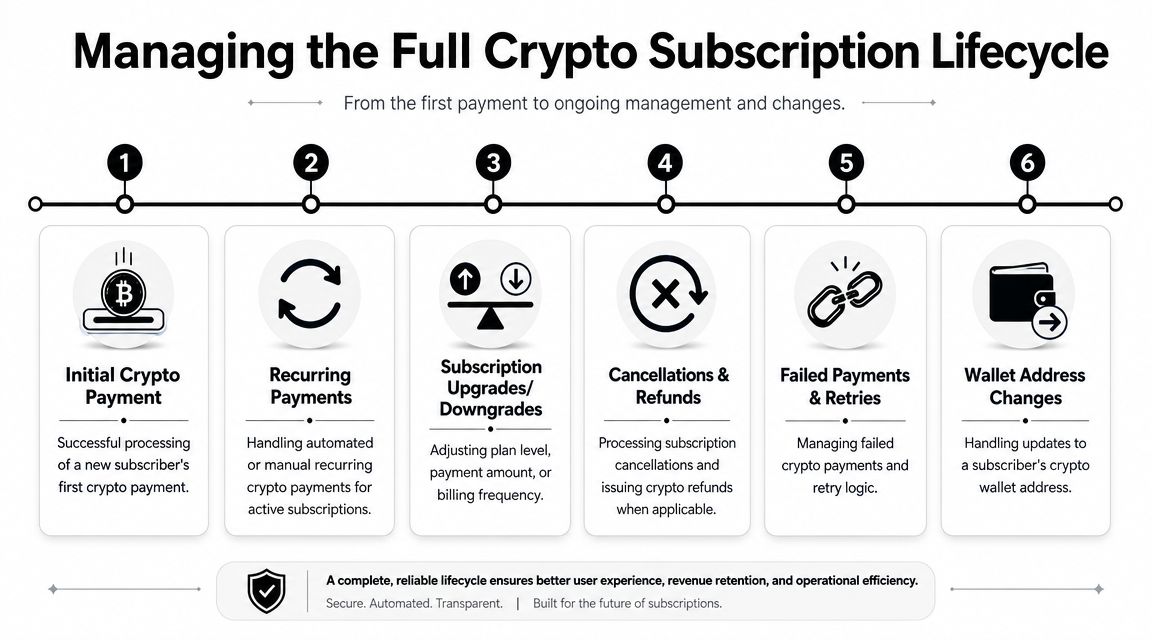
For example, decide these rules before launch:
Upgrades: Does access change immediately, at next renewal, or after a billed difference is collected?
Downgrades: Do you preserve access until period end?
Pause behavior: Is pause a billing action, an entitlement action, or both?
Cancellation timing: Do you revoke instantly or at the end of the paid period?
Wallet changes: Does a payment method change create a new subscription object or update the existing one?
Those aren't payment questions first. They're product questions with payment consequences.
Mixed-rail support needs explicit rules
The customer doesn't care that one plan was billed through cards and another through a wallet. They care whether access is active, whether the invoice history makes sense, and whether support can answer basic questions without escalating to engineering.
A workable operating model is to define one internal subscription state machine that all rails map into:
Internal state | Card flow | Crypto flow | Access outcome |
|---|---|---|---|
pending | Checkout started | Checkout started | No access yet |
active | Payment confirmed | Payment confirmed | Access granted |
past_due | Renewal failed | Renewal failed or authorization issue | Grace period or limited access |
paused | Billing paused manually | Billing paused manually | Access reduced or held |
cancelled | Ended | Ended | Access removed at your chosen rule point |
If your support team can't explain an upgrade or failed renewal without asking which rail was used, the lifecycle model is still too provider-specific.
This matters even more if you run paid communities. A billing status change should immediately flow into your access layer for Discord or Telegram. Otherwise your team ends up doing manual role changes, manual reinstatement, and manual exception handling, which defeats the point of automation.
The strong pattern is simple. One customer record. One entitlement engine. Multiple payment rails. Clear mapping rules.
Reconciliation and Reporting in a Hybrid World
Finance pain usually arrives later than engineering pain, but it lasts longer. If you launch crypto subscriptions without a reporting model, someone will end up reconciling them manually in a spreadsheet.

Normalize settlement before you normalize reporting
Recurring crypto billing usually needs an automation layer because many blockchains don't support native timers, and Stripe's own guidance warns against assuming recurring billing is native to crypto. You have to design around off-session authorization and automation to avoid renewal failures, as Stripe explains in its guide to recurring crypto payments.
That technical fact has a reporting consequence. Renewal events, retries, settlement timing, and authorization behavior can differ from card flows. So your reporting model should not depend on raw processor exports lining up perfectly.
The cleanest path in a hybrid setup is to normalize settlement output as early as possible. That's why a USDC-first settlement model is useful operationally. Customers can pay by card or crypto, and the business receives USDC. That removes one big layer of reporting noise because you aren't trying to manage a pile of end-customer payment assets on your balance sheet.
Build one internal revenue ledger
The system that matters most is not Stripe's dashboard and not your crypto dashboard. It's your own internal ledger, and consistent records start upstream with standardized invoicing templates that make each charge easy to trace.
Track, at minimum:
Customer identity: One internal customer key across all rails.
Subscription identity: One internal subscription record, with external references attached.
Settlement currency: Keep this explicit, even when it is standardized.
Event timeline: Created, renewed, failed, paused, cancelled, refunded.
Access timeline: When entitlement changed, and why.
That lets finance answer business questions without reading raw webhook logs.
For tax treatment, accounting classification, and disposal questions in jurisdictions that treat digital assets differently, your finance team may also want a practical primer on reporting crypto capital gains. Even if you standardize operations internally, tax treatment can still vary by country and entity structure.
A final operational point matters here. If you already run card subscriptions in Stripe, don't try to merge every report at the dashboard layer. Build the merge in your data model. Dashboards are where you inspect. Internal ledgers are where you reconcile. This is also why teams that care about recognition timing often pair payment events with a separate accounting workflow, similar to the issues discussed in this article on revenue recognition with Stripe.
Your Production Launch Checklist
Shipping global crypto subscriptions is mostly about reducing surprise. You want fewer surprises for customers, fewer for support, and fewer for finance.
Technical readiness
Confirm market scope: Write down exactly where the crypto option is available. Don't expose it globally in the UI if your support, legal, or payment flow isn't ready for all markets.
Test renewal paths: Don't stop at first payment success. Run renewal success, renewal failure, cancellation, reactivation, and expired-session tests.
Harden webhook handling: Verify signatures, store raw payloads, make handlers idempotent, and replay test events until you trust the pipeline.
Separate rail-specific config: Keep card and crypto settings independent so one launch doesn't break the other.
Instrument internal status changes: Log the transition from pending to active, active to past_due, and every support-triggered override.
Operations and support readiness
Write support macros: Your team needs scripts for wallet payment questions, failed renewals, duplicate payment concerns, and access restoration.
Prepare customer messaging: Explain what customers will see at checkout, how renewals work, and what happens after cancellation.
Define entitlement policy: Support shouldn't invent grace periods on the fly. Decide them before launch.
Set finance ownership: Someone should own daily review of settlement output, failed renewal counts, and unmatched records.
Document exception handling: Refunds, manual extensions, and plan migrations need a written path.
Launches usually fail operationally, not technically. The API call works. The renewal edge case, support script, or reconciliation gap is what causes the real damage.
If you keep one principle in mind, use this one: add crypto as a new rail, not as a special case hidden inside card logic. Your billing stack stays cleaner, your reporting gets clearer, and your team can effectively support what you ship.
Suby is a payment gateway and payment processor. Your customers pay with card, bank transfer, Apple Pay, Google Pay, Klarna, and more, or stablecoins, and you get paid out to your bank account, or directly in stablecoins (USDC, EURC) to your wallet, anywhere in the world, no bank account required. It runs as a separate rail alongside Stripe, so your card billing stays isolated while it carries global crypto subscriptions, paid access, and Discord or Telegram community workflows through native integrations.
