

Gaspard LEZIN
How to Avoid Currency Conversion Fees for Global Businesses
Discover how to avoid currency conversion fees with this complete guide. Learn practical strategies from multi-currency invoicing to USDC settlements.
Want to sidestep currency conversion fees? The simplest ways are to use multi-currency accounts, always pay in the local currency when using your card abroad, and look into modern payment solutions that settle in a stable currency like USDC. These tactics help you bypass the hidden markups and foreign transaction fees that traditional banks and payment processors love to charge.
The Hidden Fees Draining Your Global Revenue
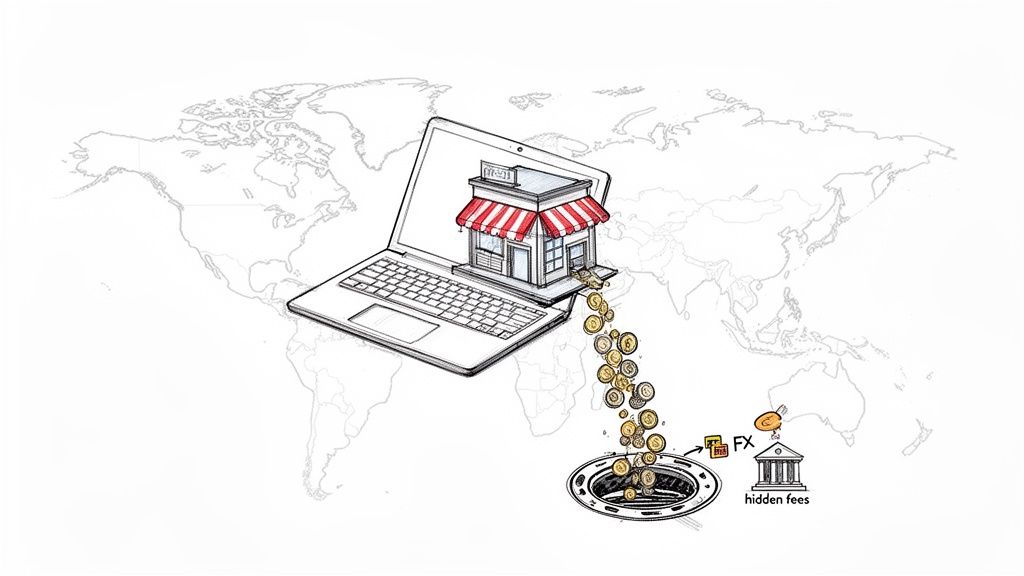
If you're running a business with customers or expenses in other countries, you're almost certainly losing money to fees you never even see. These costs get baked into the exchange rates offered by payment processors and banks, making them nearly impossible to spot on a statement.
These charges come in a few different flavors. The most common are foreign transaction fees, which get slapped on just for making a purchase outside your home country, and currency conversion markups, where processors quietly add a percentage to the real exchange rate.
Unpacking the Real Cost of Global Payments
Another frequent offender is Dynamic Currency Conversion (DCC). This is that "helpful" offer you see on a card terminal abroad, asking if you want to be charged in your home currency instead of the local one. It might seem convenient, but the exchange rate used is almost always terrible, padding the processor's bottom line at your expense.
These little percentages add up fast. To really get a handle on how these small charges can snowball, it's worth digging into understanding forex broker fees and hidden costs.
Think about it: for a SaaS company or online creator spending $500,000 annually on international contractors or services, these fees can easily mean up to $15,000 lost every year. That's money that could have funded a new developer or a major marketing push.
Key Takeaway: Seemingly minor fees of 1-3% per transaction can chew up a huge chunk of your revenue over time. Ignoring them is just leaving money on the table that should be going back into your business.
Let's break down where those costs typically hide.
Where Your Money Goes: A Breakdown of Conversion Fees
Here's a quick overview of the common fees businesses face in cross-border transactions and what they typically cost.
.tbl-scroll{contain:inline-size;overflow-x:auto;-webkit-overflow-scrolling:touch}.tbl-scroll table{min-width:600px;width:100%;border-collapse:collapse;margin-bottom:20px}.tbl-scroll th{border:1px solid #ddd;padding:8px;text-align:left;background-color:#f2f2f2;white-space:nowrap}.tbl-scroll td{border:1px solid #ddd;padding:8px;text-align:left}Fee TypeTypical CostWho Charges ItForeign Transaction Fee1% - 3%Credit card issuer (your bank)Currency Conversion Markup0.5% - 2.5%+Payment processor or acquiring bankDynamic Currency Conversion (DCC)3% - 7%+Merchant's payment providerWire Transfer Fees$15 - $50Sending & receiving banks
As you can see, a single transaction can get hit multiple times, quickly eroding your margins.
How Modern Solutions Bypass These Fees
This is where newer payment infrastructure makes all the difference. We provide an API that allows any business to accept payments by card or crypto. We also offer native integrations with Discord and Telegram, which is perfect for creators managing subscriptions and paid communities.
The whole idea is to keep things simple. Your customers pay with their cards in their own currency, and your business receives the full amount directly as USDC. This approach completely sidesteps the friction of the traditional banking system, wiping out conversion fees and making sure you actually keep the revenue you earn.
Smarter Invoicing and Pricing Strategies
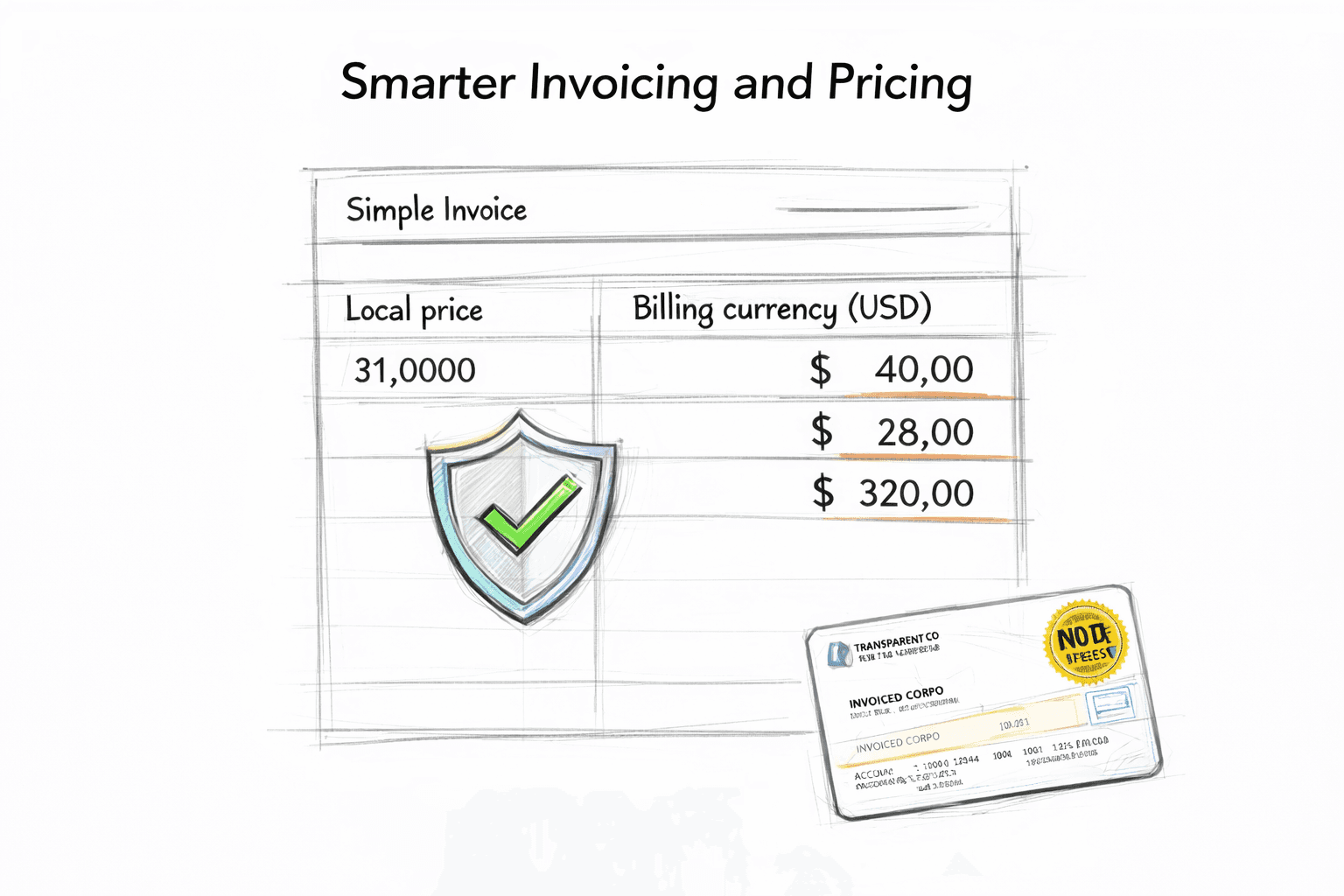
If you want to get a handle on your international revenue, you have to think about it before the payment ever happens. The single best way to dodge currency conversion fees is to build your strategy right into your pricing and invoicing from the start. Stop reacting to hidden charges after they have already hit your account; set the terms from the beginning.
This is not just about defense. Taking this proactive stance puts you in control, letting you give international customers a better, more transparent experience while protecting your margins from the whims of foreign exchange (FX) rates and processor markups.
Implement Multi-Currency Pricing
One of the most powerful moves you can make is implementing multi-currency pricing. This simply means you show prices on your website or app in the customer's local currency. Now, that might sound like you're just inviting conversion costs, but the secret is who controls the conversion.
When you let your payment processor manage it, they typically get a much better wholesale exchange rate than your customer’s bank would ever offer them. So, you’re actually improving the customer experience by showing them a familiar price they understand, and in return, you absorb a much smaller, more predictable fee, one you can easily factor into your pricing model.
Key takeaway: Showing prices in local currencies is a proven way to reduce checkout friction. Customers are far more likely to click "buy" when they see a clear, final price without having to do mental math or guess what their bank might charge them later.
Specify the Billing Currency in Your Invoices
This one is crucial for freelancers, agencies, and any B2B company. Your invoices need to be crystal clear. Don't leave any room for interpretation.
Simply putting "$1,000" on an invoice isn't enough. It needs to be "$1,000 USD".
This tiny change does a few big things for you:
It kills ambiguity. The client knows exactly which currency to send, stopping them from just paying in their local currency and leaving you to eat the conversion costs.
It looks professional. Clear terms show you have done this before and know how to operate globally.
It makes accounting a breeze. Your books are much cleaner when the payments coming in match your invoices down to the dollar.
If you want to go deeper on how pricing models affect your revenue, our guide on USD vs. crypto pricing for subscriptions is a great resource.
Use Business Cards with Zero Foreign Transaction Fees
Don't forget that your business is also a consumer. You're constantly paying for software, ad campaigns, and other services from international vendors. If you're using a standard business credit card for those purchases, there's a good chance you're paying an extra 1-3% on every single one.
Making the switch to a business card that has zero foreign transaction fees is one of the easiest wins you can get. It's a simple operational tweak that can save you thousands of dollars a year. It ensures that when you pay a bill for €100, you are not secretly charged the equivalent of $103 USD by your own bank for the privilege.
Choosing the Right International Payment Processor
Picking an international payment processor is about more than just chasing the lowest advertised transaction rate. Many businesses get burned by traditional platforms that bury their real costs in complex fee structures. These hidden fees, like FX markups, cross-border charges, and settlement delays, can quietly eat away at your revenue, turning a supposed growth enabler into a major cost center.
You have to look beyond the headline number to really understand what you're paying. A processor might proudly display a 2.9% transaction fee, but then you dig into the fine print and find another 1.5% for cross-border payments and a nasty 2-4% markup on the currency exchange. All of a sudden, that simple fee is ballooning to nearly 7%, a massive hit to your bottom line.
Look for Transparent Fee Structures
If I can offer one piece of advice, it is this: demand transparency. Your first question to any potential processor should be, "Can you give me a single, all-in rate for international transactions?" If their pricing page looks like a complex legal document full of percentages, fixed fees, and situational charges, consider it a huge red flag.
Thankfully, modern fintech platforms are starting to break this old, opaque model. They're built on clearer, more predictable pricing. We provide a simple API that lets any business accept payments by card or crypto. The whole idea is to keep it straightforward: your customers pay with their card, and you receive USDC. This completely sidesteps the need for currency conversion on your end, shielding you from volatile FX rates and those sneaky markups.
Choosing a processor with a clear, flat-rate fee structure is the single most effective way to protect your profit margins. It makes your revenue predictable and your accounting simple.
Evaluate Settlement Speed and Currency
The next big questions are: how quickly do you get your money, and in what form? With traditional payment systems, you're often looking at settlement delays of several days, especially for cross-border transactions. This is not just an annoyance; it can create serious cash flow problems and leaves your money exposed to currency fluctuations while it's in limbo.
Look for processors that offer faster, more stable settlement options. Receiving funds in a stablecoin like USDC, for instance, bypasses the slow and expensive legacy banking system entirely. You get your money almost instantly, held in a currency pegged 1:1 to the US dollar. It’s a game-changer that not only saves you money but also gives you immediate access to your working capital. If you want to get into the technical nitty-gritty, our guide on integrating a payment gateway API is a great resource.
This approach is especially powerful for businesses that thrive on community engagement, like creators using Discord or Telegram. We have built native integrations for these platforms, allowing them to easily manage subscriptions and paid access with fast USDC payouts. It lets you focus on what you do best, building your community, instead of trying to decipher complex payment statements.
Using Stablecoins to Eliminate Conversion Fees
Most of the payment systems we use today were designed long before the internet existed. They're built on slow, expensive banking networks that are notorious for tacking on hidden fees. But what if you could just bypass that entire legacy system? A new approach using stablecoins completely changes the game, giving businesses a real way to get rid of currency conversion fees for good.
Here’s a practical example: a customer in Japan buys your product with their yen-denominated credit card. Instead of that payment getting passed between multiple banks, with each one taking a slice and adding a markup, the transaction settles directly. The customer pays in yen, and your business instantly receives the equivalent value in USDC, a stablecoin pegged 1:1 to the U.S. dollar.
This model is incredibly powerful because you know exactly how much you’ll receive from every single sale. There are no surprise deductions days later and no worrying about exchange rates moving against you while the funds are in transit.
The Power of Direct USDC Settlement
The beauty of this method lies in its simplicity and predictability. By cutting out the middlemen like the SWIFT network, you remove all the friction and costs that come with them. The process is clean: your customers pay with their card, and you get USDC.
This shift brings some major advantages:
Zero Conversion Fees: Since the settlement happens in a single, stable digital currency, the need to convert from one fiat currency to another simply vanishes.
Instant Access to Funds: Forget waiting 3-5 business days for money to clear. USDC settlements usually hit your wallet within minutes, which is a massive boost for cash flow.
Global Reach Without the Hassle: You can sell to anyone, anywhere in the world, without the headache of setting up foreign bank accounts or navigating complex regional payment systems.
The chart below shows just how much more efficient this modern approach is compared to legacy and even other fintech processors.
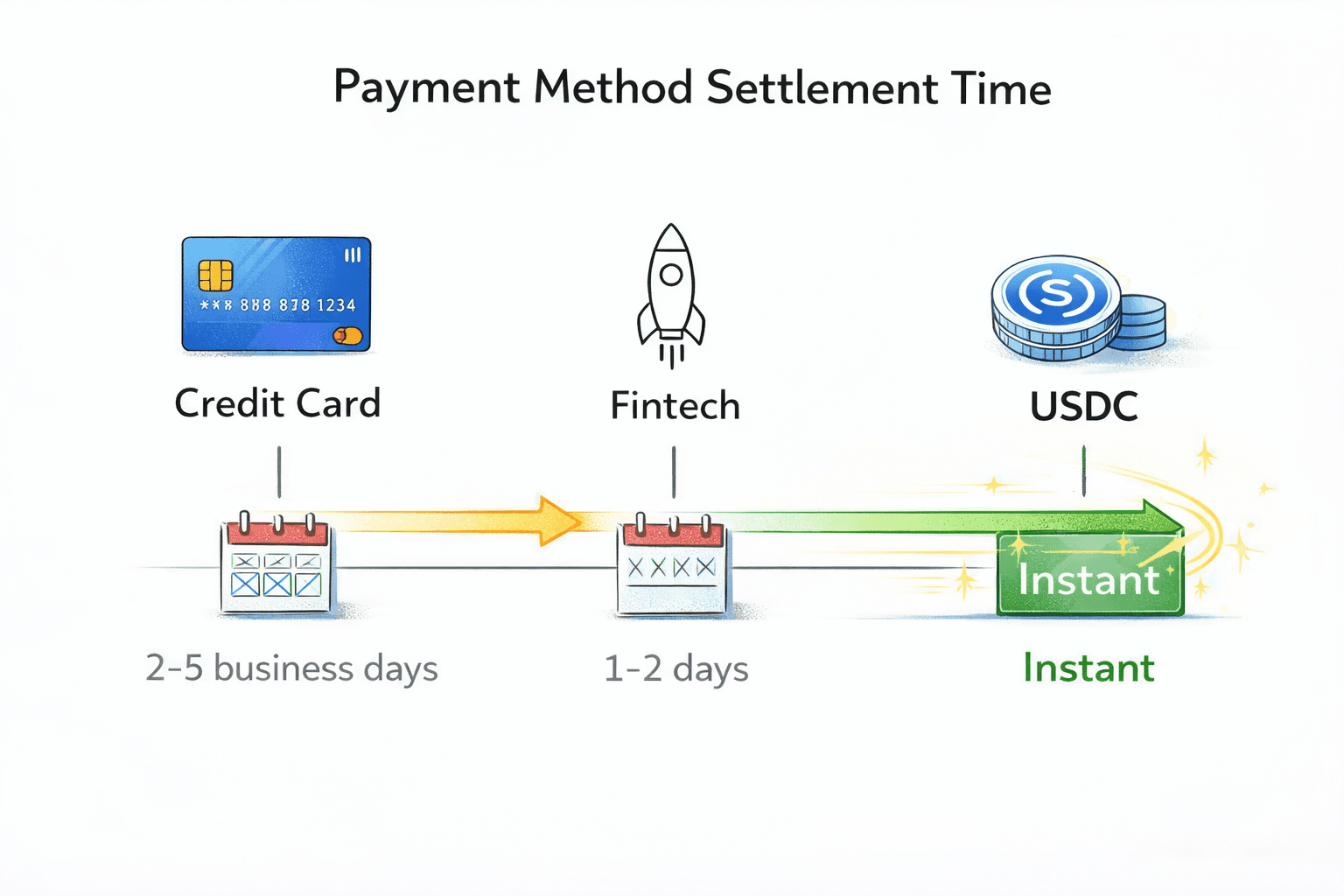
As you can see, moving away from old-school banking infrastructure is a clear path toward greater efficiency and lower overhead for any business operating globally.
How to Implement a USDC Payment Solution
Getting started with this model is far easier than you might think. We have built our solution to settle card payments directly in USDC, eliminating the complexity. This means no banks, no SWIFT delays, and no FX markups, just a simple, predictable fee that often comes in far lower than the real costs of traditional platforms.
Using our API or even just shareable paylinks, you can accept Visa, Mastercard, or crypto from customers around the world and receive instant USDC payouts.
Let's look at how this stacks up against a typical international card payment. The difference in complexity and cost is stark.
Traditional Payments vs. USDC Settlements
.tbl-scroll{contain:inline-size;overflow-x:auto;-webkit-overflow-scrolling:touch}.tbl-scroll table{min-width:600px;width:100%;border-collapse:collapse;margin-bottom:20px}.tbl-scroll th{border:1px solid #ddd;padding:8px;text-align:left;background-color:#f2f2f2;white-space:nowrap}.tbl-scroll td{border:1px solid #ddd;padding:8px;text-align:left}FeatureTraditional Payment ProcessorUSDC Settlement Solution (like Suby)Settlement CurrencyYour local fiat (e.g., USD, EUR)USDC (stablecoin pegged to USD)Conversion ProcessMultiple conversions (local > USD > your currency)None; customer's currency is settled directly to USDCHidden FeesFX markups (2-4%), wire fees, intermediary bank feesNone. A single, transparent transaction fee.Settlement Speed2-7 business daysNear-instant (usually within minutes)Cash Flow ImpactDelayed; funds tied up in transitImmediate; funds are usable right awayGlobal SetupRequires local bank accounts or complex setupsWorks globally out of the box with a single digital wallet
The comparison makes it clear: direct USDC settlement is built for speed and efficiency, giving you more control over your revenue.
By accepting payments that settle directly in USDC, you turn a variable, unpredictable cost into a fixed, manageable one. This is one of the most effective strategies for any business looking at how to avoid currency conversion fees and protect its global revenue.
This approach is especially powerful for creators and online communities. For instance, we offer native integrations with Discord and Telegram that make managing subscriptions and paid access incredibly simple. Members can pay with their card from anywhere, and the community owner gets stable, immediate payouts. You can find out more in our guide on how to accept stablecoin payments on Discord and Telegram.
Your Action Plan for Lowering Fees
Alright, theory is one thing, but making a real change is what matters. You now know where these sneaky fees hide and how different payment setups can either cost you or save you a fortune. It's time to build a concrete plan to stop leaking revenue and start running a tighter ship.
This is not just about shaving a few basis points off your costs. It is about taking active control over your global revenue stream instead of just accepting whatever fees your processor decides to charge.
Audit Your Current Payment Statements
First things first, you need to know exactly what you're up against. Grab your payment processor statements from the last three to six months and get ready to do some digging. Don't just look at the summary; you need to get into the line items for every single international transaction.
You're hunting for a few specific culprits:
FX Markups: What exchange rate did you actually get? Compare it to the mid-market rate for that day. The difference is your markup.
Cross-Border Fees: Look for any line item explicitly labeled "cross-border," "international," or something similar. These are often a percentage of the transaction.
Hidden Costs: Are there any odd-looking fees that only show up on transactions from other countries? Circle them.
This exercise gives you a hard number, your baseline. Knowing you’re losing $500, $1,000, or even more each month to these fees is a powerful incentive to find a better way.
Evaluate New Payment Solutions
Once you have your data, you can approach new providers with a sharp eye and the right questions. When you're on a call or reading their pricing page, cut through the marketing fluff and ask directly:
What is your total, all-in fee for an international card payment?
Do you charge a separate currency conversion markup on top of other fees? How much is it?
What currency will I be settled in, and how fast does that happen?
A modern payment layer should be able to give you straight answers. We provide a simple API that lets you accept card or crypto payments. Your customer pays how they want, and you get USDC settled directly. This model cuts out the middlemen and the variable fees, giving you a predictable outcome on every sale.
Focus on the final amount that hits your account, not the long list of itemized fees. That’s the only number that truly shows you which platform protects your bottom line.
Implement and Communicate the Change
After you've picked a winner, it's time to put it into action. If you have a developer, integrating a new payment API can be surprisingly quick, creating a smooth checkout flow for your customers. No tech team? No problem. You can get started almost instantly using shareable paylinks or pre-built integrations for platforms like Discord and Telegram.
As you make the switch, a little transparency goes a long way. Let your customers know you've updated your payment system to make global transactions easier and more reliable. A quick email or a banner on your site can ensure everyone has a great experience.
Remember, tackling conversion fees is a huge step, but it's part of a bigger picture of financial discipline. For a wider view, check out these essential small business accounting tips. A solid plan does not just cut your costs, it strengthens the financial core of your entire business.
Got Questions? We’ve Got Answers.
Jumping into international payments often brings up a few questions, especially when you're trying to figure out how to sidestep those pesky currency conversion fees. Here are some of the most common things we hear from businesses and creators looking to protect their hard-earned global revenue.
What's the Real Difference Between a Foreign Transaction Fee and a Currency Conversion Fee?
It's easy to get these two confused, but they're definitely not the same thing. Think of it like this:
A foreign transaction fee is what your card issuer (like Visa or your bank) tacks on just because the transaction crossed a border. It's a fee for the privilege of buying something from another country, even if the price was in your own currency.
A currency conversion fee is the markup a payment processor or bank adds for the service of actually swapping one currency for another. The sneaky part? You can get hit with both on the same transaction. This is exactly where modern solutions that settle directly in a single, stable currency like USDC come in, they are built to wipe out those conversion-related costs completely.
Is It a Big Hassle to Start Accepting Payments in USDC?
Not in the slightest. The new wave of payment platforms is built for regular people, not crypto wizards. You don't need any special technical skills.
You can get going with ready-made integrations for communities on Discord and Telegram, create a shareable payment link in a couple of clicks, or use a simple API to plug it into your own website.
The best part? Your customers don't see any of this. They pay with their normal credit or debit card, just like they always do. The magic happens on your end: you get fast, stable USDC payouts sent straight to your digital wallet, cutting out the slow, expensive traditional banking system entirely.
The whole point of a modern payment stack is to make global commerce feel local. Your customer's checkout is smooth and familiar, while your settlement process gets faster, cheaper, and far more predictable with USDC.
How Do I Explain Multi-Currency Pricing to My Customers Without Confusing Them?
The key is to frame it as a benefit for them. Be upfront and transparent.
A simple note on your checkout page like, "For your convenience, prices are shown in your local currency," immediately builds trust and positions the feature as a customer-friendly perk.
You're basically telling them they can see the final, all-in cost right away, with no nasty surprises when their credit card statement arrives. This simple act of transparency improves their experience, cuts down on abandoned carts, and shows you're a business that cares. It's a small detail that goes a long way in building a loyal international following.
Can I Use USDC Settlements for Things Like Subscriptions and Recurring Revenue?
Absolutely. This is actually one of the most powerful ways to use it. Payment platforms that handle USDC settlements are often designed with creators and SaaS businesses in mind, the very people who depend on recurring revenue.
For instance, we provide native integrations for community hubs like Discord and Telegram, which makes managing paid access, subscriptions, and memberships for your online community a breeze.
This setup lets you build a stable, predictable income stream from a global audience, all while getting your earnings as instant, stable payouts in USDC. It’s a game-changer for monetizing your work without the usual financial headaches.
Suby is a payment gateway and processor. Your customers pay with card, bank transfer, Apple Pay, Google Pay, Klarna, and more, or stablecoins, and you get paid out to your bank account, or directly in stablecoins (USDC, EURC) to your wallet, anywhere in the world, no bank account required. Settling in a single stable currency is exactly how you avoid currency conversion fees and the cross-border FX markups that quietly drain your global revenue. Get started today and protect your revenue.
