
Gaspard LEZIN
Implementing Payment Gateway: A Practical Guide for 2026
Transform your business by implementing payment gateway solutions. Accept global card payments & get instant USDC payouts. Learn how here!
If you've ever tried to sell a product or service globally, you know the drill. You’re wrestling with high transaction fees, painful currency conversions, and payout delays that can stall your cash flow for weeks. It’s a frustrating reality for businesses stuck on outdated payment systems. A modern payment gateway is the answer, and this guide will show you how to implement one that lets you take card payments from anyone, anywhere, and get paid out in USDC.
Why Your Business Can't Afford to Ignore Modern Payment Gateways
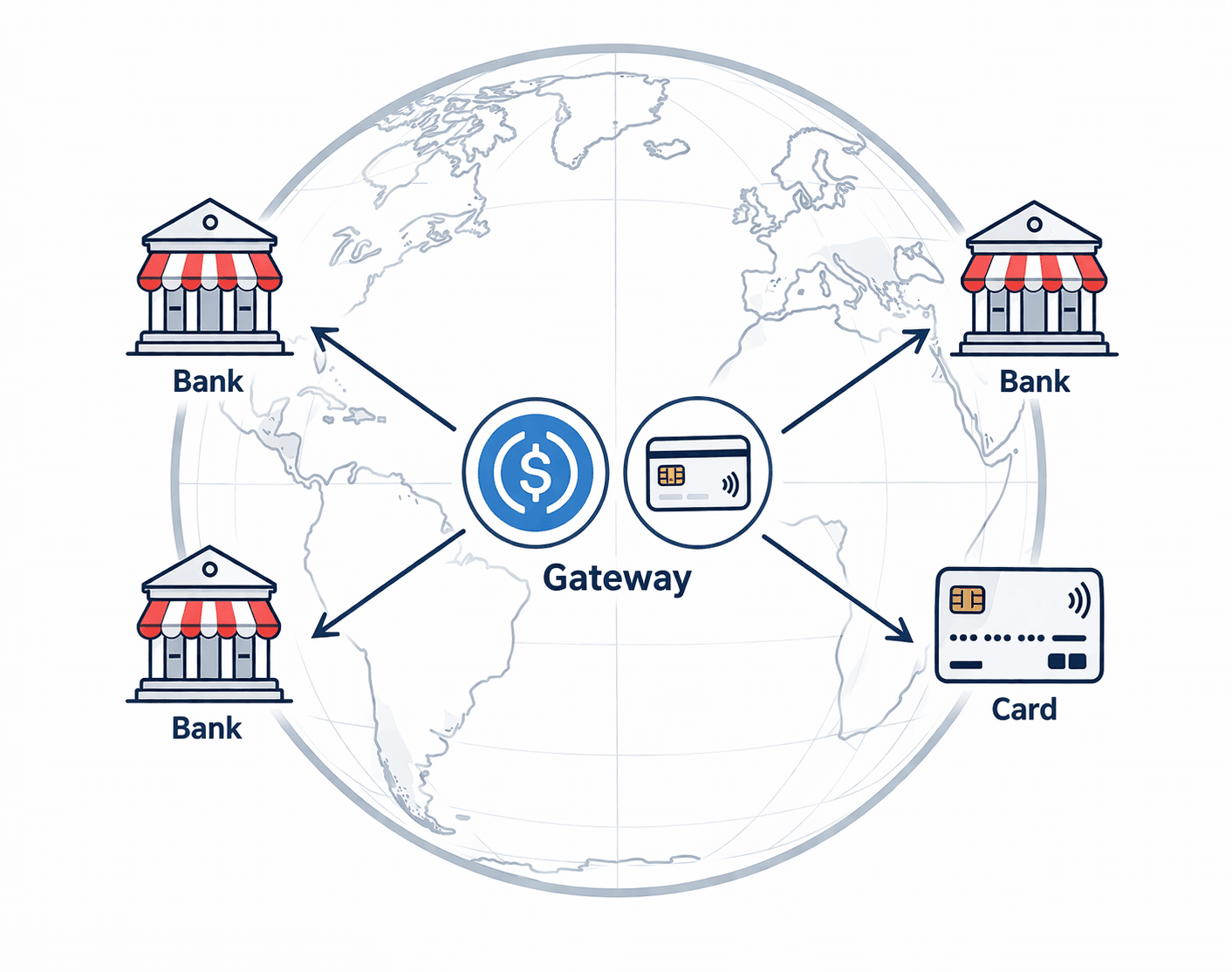
For any business with global ambitions, old payment hurdles are more than just an inconvenience, they're a direct threat to growth. Setting up a solid payment gateway isn’t just a tech task; it's a strategic move that unlocks new markets and drastically simplifies your financial operations. These modern systems are built to handle the messy parts of online sales, from secure card processing to managing different currencies.
This isn’t a niche trend. The market for payment gateways exploded from $26.0 billion in 2022 to $31.0 billion in 2023, with projections showing it will hit $47.0 billion by 2025. That growth tells a clear story: businesses everywhere are dropping clunky, old systems for gateways that make global sales feel local.
The Headaches of Old-School Payment Rails
From my experience, traditional payment systems were built for a different era and create more problems than they solve for today's internet-first businesses. They're tangled up in legacy banking rules and geographic borders, which leads to some common pain points:
Painfully Slow Payouts: Your money can be held in limbo for days, sometimes weeks, before it actually hits your account. This makes managing cash flow a constant guessing game.
A Minefield of Fees: It's never just one fee. You're often hit with a stack of transaction costs, cross-border charges, and hidden currency conversion markups that slowly bleed your revenue.
Friction at Checkout: A clunky checkout or the absence of familiar payment methods is one of the fastest ways to lose a sale. Cart abandonment is a real killer.
Operational Nightmares: Trying to stitch together different payment providers for different regions adds a ridiculous amount of administrative work and complexity.
A modern payment system should remove friction, not create it. The goal is to make it as easy for a customer in another country to pay you as it is for someone next door.
A Fresh Approach to Global Payments with Suby
This guide introduces a fundamentally new model for payment processing by implementing Suby. It's a system designed to let any business accept standard card payments globally but receive settlements almost instantly in USDC. This approach neatly sidesteps most of the traditional hurdles. The core message is simple: users pay with cards, and businesses receive USDC.
To see just how different this model is, let's compare it directly to traditional payment processing.
Traditional Payments vs Suby's USDC Settlement Model
FeatureTraditional Payment GatewaysSuby Payment GatewaySettlement Speed2-7 business days (or longer)Near-instant (minutes)Settlement CurrencyLocal fiat (e.g., USD, EUR)USDC (a stablecoin pegged to USD)Cross-Border FeesHigh, often with currency conversion markupsLow, fixed transaction feesGlobal ReachLimited by banking partnerships and regionsTruly global; accept cards from 150+ countriesBank Account NeedsRequires local bank accounts in multiple regionsNo traditional bank account required for settlementCash Flow ImpactCreates delays and uncertaintyProvides immediate access to funds
This table highlights the core advantage: speed and simplicity. Instead of waiting for the traditional banking system to clear funds across borders, you get your money in a stable digital currency you can use immediately.
We provide an API that allows any business to accept payments by card or crypto, and we also offer native integrations with Discord and Telegram for use cases like subscriptions, paid access, and online communities. It's always smart to see what else is out there, so feel free to compare our approach with some of the top payment gateways for ecommerce, and if you are weighing regional processors, our breakdown of a modern Moneymotion alternative is a useful reference.
In the sections that follow, we'll get into the nuts and bolts. You'll get a clear sense of what a payment gateway is and see why it’s the engine of your online business. We'll walk through everything from creating your first paylink to setting up a fully automated subscription system with Suby.
Your Pre-Integration Checklist
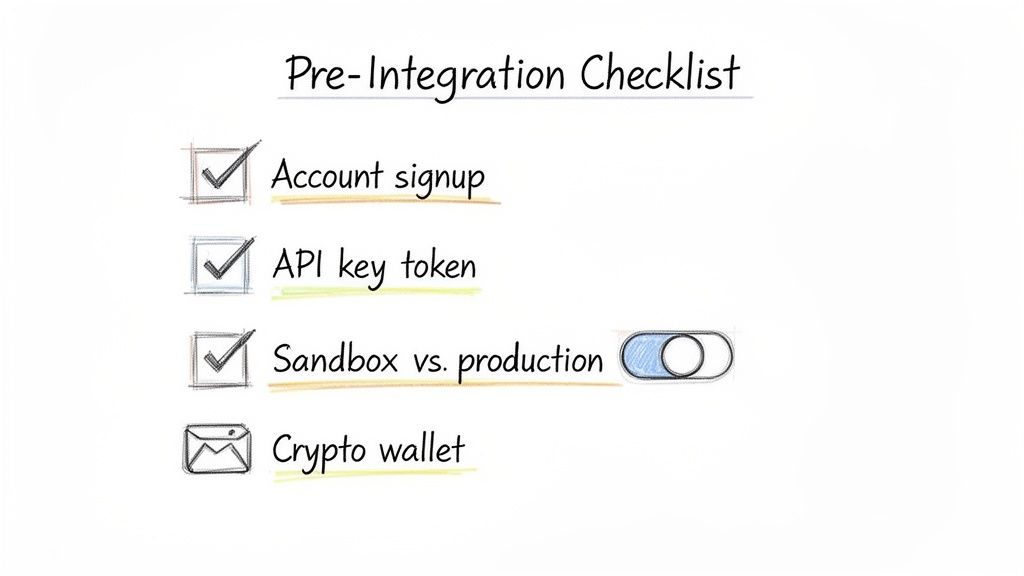
Before you write a single line of code, let's get the foundational pieces in place. Taking care of a few administrative tasks upfront is the fastest way to a smooth integration. A little prep work now saves a ton of debugging headaches later.
First, head over to Suby and create your account. This is your mission control. It gives you access to the dashboard where you'll manage everything from API keys to payment tracking.
Once you’re in the dashboard, the next immediate goal is to grab your API keys. These are the credentials that prove your requests are legitimate and securely connect your app to Suby's infrastructure. You'll notice you have different keys for different environments, which leads us to a critical concept.
Sandbox vs. Production Environments
Every professional integration starts in the sandbox. It’s a complete replica of the live Suby system, but it’s all for testing. No real money ever changes hands here. Think of it as your private playground to build, break, and perfect your payment flow without any real-world consequences.
Starting in the sandbox is non-negotiable, and here's why:
Zero-Risk Testing: You can run through every possible scenario, such as successful charges, declined cards, and failed payments, and see exactly how your system handles it.
No Financial Danger: Since all transactions are simulated, there's no risk of accidentally charging a real credit card or misplacing actual funds.
Bug Hunting: This is where you’ll catch and fix the bugs in your code before they can ever impact a paying customer.
After you've put your integration through its paces and you're fully confident it's ready, you'll make the switch to the production environment. This is the real deal. You’ll swap in your production API keys, and every transaction processed will be live. Customers will pay with their cards, and you’ll receive real USDC.
The golden rule is simple: exhaust every test case you can think of in the sandbox. Only go live when you're 100% certain you're ready to handle real money. This is the hallmark of a professional, risk-free rollout.
Your Most Important Resources
While this guide will get you far, the official API documentation should become your best friend. It’s the ultimate source of truth for every endpoint, parameter, and response you'll work with. I recommend keeping it open in a browser tab at all times.
Finally, let's talk about the whole reason you're here: getting paid. Suby is built around a simple premise: your customers pay with a card, and you receive USDC. To facilitate this, you'll need a crypto wallet that can accept USDC. During the account setup process, you’ll be asked to provide your wallet address. This is the destination where your earnings will be sent automatically after each successful transaction.
Nailing down this quick checklist, getting your account, finding your keys, understanding the sandbox, and connecting your wallet, sets a solid foundation for everything that follows. It's the groundwork that ensures you can build with confidence and meet the security standards required for payment processing. If you want to dive deeper into security best practices, we've put together a guide on what PCI DSS compliance means for you.
Accepting Your First Payment Without Writing Code
The idea that you need a developer to set up online payments is a thing of the past. You can start accepting payments from customers all over the world today, without writing a single line of code.
This is a huge deal for creators, consultants, and small shops that just need to get paid quickly and easily. The principle is simple: your customer pays with their Visa or Mastercard, and you get the funds settled as USDC right in your wallet.
Create Shareable Paylinks in Seconds
The absolute fastest way to get started is with a shareable paylink. Think of it as a universal checkout link you can send to anyone, anywhere. It's perfect for selling a one-time product, invoicing a client, or even collecting donations.
Getting one set up from your Suby dashboard is incredibly easy.
First, you just give your payment a name and set a price.
Then, with one click, the system generates a unique, secure URL for you.
That’s it. Now you can share this link on social media, in an email, or even turn it into a QR code.
When your customer clicks the link, they land on a clean, hosted checkout page to enter their card details. The entire experience is handled for you, from start to finish. You don't even need a website, so if you have an audience on Instagram, X, or a newsletter, you can start selling immediately.
Keep Customers on Your Site with an Embedded Checkout
Paylinks are fantastic for quick, direct sales, but sometimes you want the payment process to feel like a seamless part of your own website. That’s where an embedded checkout is a game-changer. It lets you drop a payment form right onto your site with a simple copy-and-paste code snippet.
The big win here is brand consistency. Customers never leave your domain to pay, which is a massive trust signal and has been proven to boost conversion rates. They stay on your page, use a form that looks like it belongs there, and complete the purchase without any jarring redirects.
The Suby dashboard makes this incredibly straightforward.
As you can see, the interface is designed to be completely intuitive. You can spin up a paylink or an embedded checkout form in just a few clicks. It gives you that professional, on-site payment experience without the headache and cost of custom development.
The goal of modern payment tools should be to get out of your way. Whether it's a simple link or an embedded form, the technology should empower you to make a sale in the moment, not create another project for you to manage.
Native Integrations for Community Monetization
For those of you running paid communities, Suby has native integrations for Discord and Telegram that you’ll love. This is a lifesaver for anyone managing a premium content channel or a subscription-based group.
You can set up subscriptions right inside these apps. When someone subscribes, Suby can automatically assign them a specific role in your Discord server or add them to a private Telegram channel.
And if their payment fails? Their access is automatically revoked. No more chasing payments or manually kicking people out.
This automation saves countless hours of admin work. You can stop checking payments against user lists and just focus on creating great content for your members. For a deeper look at this, check out our guide on how to accept credit card payments for different situations.
Ultimately, no-code and low-code tools have leveled the playing field for online business. They prove you don't need to be a technical whiz to build a global business, manage subscriptions, or make a living from your creative work.
Building Custom Solutions with the Suby API
While our no-code tools are great for getting off the ground fast, the real magic happens when you need a truly custom payment experience. That's where the Suby API comes in. It’s built for developers who need to weave sophisticated payment flows directly into their SaaS platform, marketplace, or e-commerce site.
The API lets you accept payments by card or crypto from anywhere. No matter how the customer pays, the principle is the same: they pay easily, and you get settled in USDC. We also offer native integrations for Discord and Telegram if you're running subscription or paid communities.
This guide is less about copy-pasting code and more about understanding the "why" behind a solid payment integration. Building robust systems isn't just about calling endpoints; it’s about good architecture. Brushing up on general API Gateway best practices is a smart move before you start, as it will make your integration with our API that much more secure and scalable.
Creating One-Time Payments Programmatically
At its heart, any payment gateway needs to handle a simple one-time charge. With the Suby API, we’ve broken this down into a few common-sense steps. You aren't just blindly passing credit card numbers around; you're creating a secure, temporary payment session for your customer.
Here’s the basic flow:
Your backend server pings the Suby API to kick off a new payment. You'll send details like the amount and currency.
Our API instantly replies with a unique payment session ID and a secure URL.
You then simply redirect your customer to that URL. They'll land on a clean, Suby-hosted checkout page to enter their card details safely.
This method is powerful because it means you never have to touch or store sensitive card data on your own servers. That's a massive win for your security and compliance workload. All your application needs to do is initiate the request and then listen for the outcome.
This diagram shows just how simple the flow is, whether you're using a direct Paylink or an embedded checkout on your website.
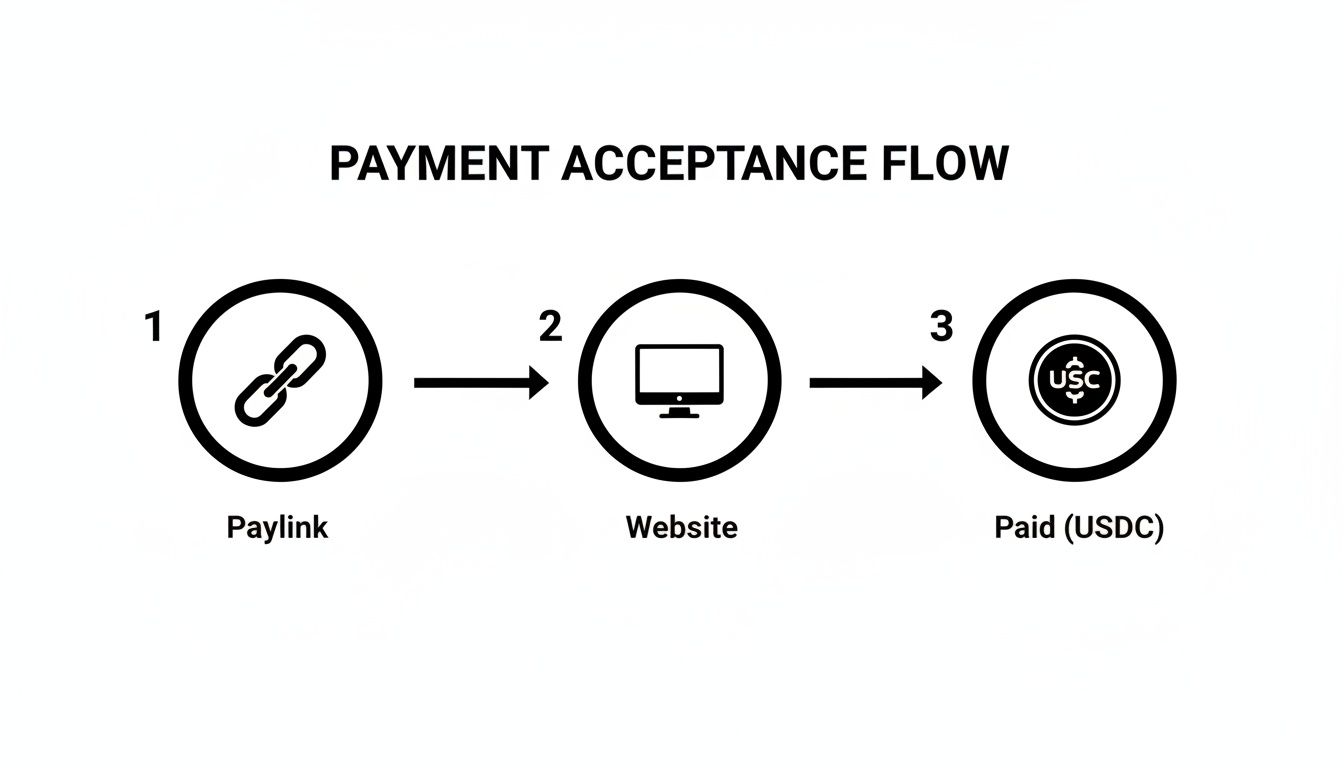
As you can see, different entry points all funnel into the same secure process, ending with a successful payment settled in USDC.
Now, let's look at a couple of real-world examples. The first thing you'll always do is authenticate by including your secret API key in the request header.
A basic cURL request to create a payment session would look something like this:
curl --request POST \--url https://api.suby.fi/v1/payments \--header 'Authorization: Bearer YOUR_SECRET_KEY' \--header 'Content-Type: application/json' \--data '{"amount": 1000,"currency": "usd","success_url": "https://your-site.com/success","cancel_url": "https://your-site.com/cancel"}'
And if you're working in a JavaScript environment, you could use a library like axios or just the native fetch API to get the same result:
const createPayment = async () => {const options = {method: 'POST',headers: {'Authorization': 'Bearer YOUR_SECRET_KEY','Content-Type': 'application/json'},body: JSON.stringify({amount: 1000, // This is in cents, so 1000 = $10.00currency: 'usd',success_url: 'https://your-site.com/success',cancel_url: 'https://your-site.com/cancel'})};try {const response = await fetch('https://api.suby.fi/v1/payments', options);const data = await response.json();// Now, redirect the user to the secure checkout URLwindow.location.href = data.url;} catch (error) {console.error('Error creating payment:', error);}};
The key takeaway is that the API handles all the heavy lifting. You just tell the system what you want to charge, and it provides a secure, temporary environment to get it done. This is the modern, safe way to integrate payments.
Managing the Full Subscription Lifecycle
For so many of us, recurring revenue is the lifeblood of the business. The Suby API gives you all the tools you need to programmatically manage the entire subscription journey, which is about much more than just charging a card every month.
You can create various subscription plans, each with its own pricing, features, and billing cycle. When a user signs up, you associate them with a plan, and our API handles the automatic recurring billing from there.
The real control comes from managing the inevitable lifecycle events:
Upgrades & Downgrades: Let your customers move between plans seamlessly.
Cancellations: Handle cancellation requests and define whether access ends immediately or at the end of the current billing period.
Payment Failures: We automatically retry failed payments based on smart logic and can notify customers about billing issues so you don't have to.
One of the biggest headaches we solve is cross-border friction. To put the scale of global payments in perspective, J.P. Morgan moves over $10 trillion every day across 60 million transactions in over 200 countries and 120 currencies, with an incredible 99.5% straight-through processing rate. That’s the gold standard for efficiency. Suby is built on that same principle: let your customers pay how they want, and get your funds settled quickly in USDC, without the typical international delays and fees. You can discover more insights about these financial trends at jpmorgan.com.
By building with our API, you can create a subscription management system that's a perfect fit for your business model, giving you complete control over how you bill, retain, and grow your customer base.
Making Your Business Run Itself with Webhooks
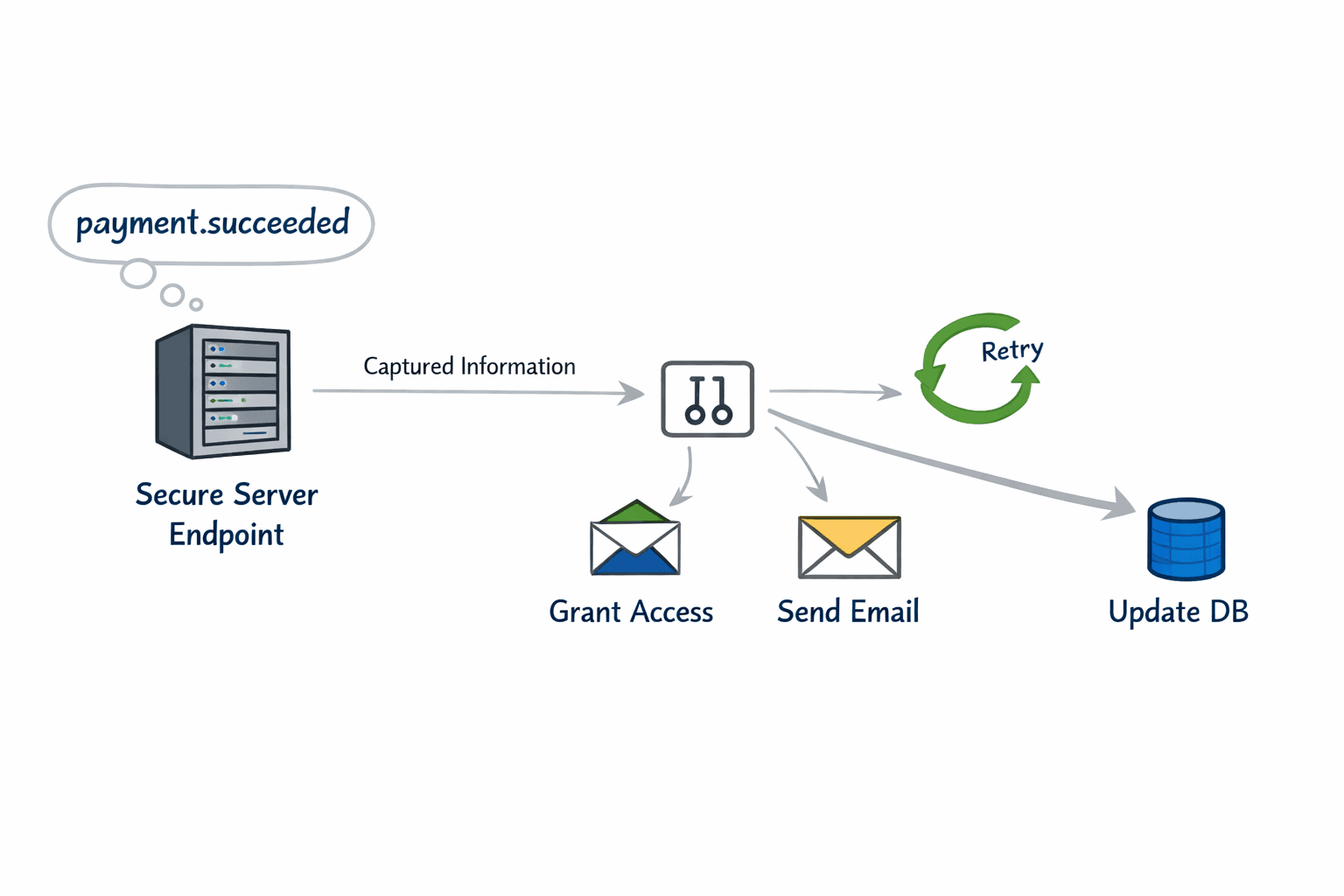
Let's talk about what happens after you get paid. A successful payment isn't the finish line, it’s the starting gun for everything else. This is the moment your business needs to deliver, and doing it manually just won't scale. That's where you put webhooks to work.
Think of webhooks as real-time alerts from Suby to your server. Instead of you constantly pinging the API to ask, "Did that payment clear yet?", Suby just tells you the second it happens. This event-driven model is the secret to building a truly automated operation that doesn’t require you to be constantly watching it.
The Engine of Automation
Most post-payment workflows involve a series of steps. You might need to grant a customer access to a private community, update their status in your CRM, or fire off a personalized welcome email. Webhooks are the triggers that kick off this entire chain of events, completely hands-free.
Without them, you’re either processing orders by hand or building a clunky, inefficient system that constantly polls the API for updates. With a proper webhook setup, you can build an operation where your business essentially runs itself.
For instance, when your server gets a payment.succeeded event, you can set it up to instantly:
Provision an account and unlock a digital course.
Log the sale in your accounting software.
Tell your warehouse to start the shipping process.
This is how you build a business that can handle 10 sales as easily as 10,000.
Setting Up Your Listening Post
To get started, you just need to give Suby a URL in your dashboard. This URL is your webhook endpoint, a dedicated address on your server that listens for incoming notifications.
But simply listening isn't enough; you have to be sure you're listening to the right source. Anyone on the internet could send a POST request to your endpoint, so you need a way to confirm the message is actually from Suby and not a bad actor trying to trigger fraudulent actions.
This is handled by verifying the webhook signature. Every event Suby sends is cryptographically signed. Your endpoint must use your secret key (found in the Suby dashboard) to check this signature. If it doesn't match, you discard the request.
I can't stress this enough: always verify webhook signatures. It’s a non-negotiable security step. Skipping this exposes your business to fake triggers and can wreak havoc on your automated workflows and customer data.
Focusing on the Most Important Events
Suby sends notifications for dozens of different events, but you'll probably only need to focus on a handful to get your core automation running.
Here are the essential ones I always start with:
payment.succeeded: This is your bread and butter. A one-time payment went through successfully. Use this to trigger fulfillment, grant access, and send a thank you email.subscription.created: Fired the moment a new subscription begins. It’s the perfect trigger for adding a user to a members-only area or sending an invite to a private Discord.subscription.updated: If a customer upgrades to a premium tier or downgrades their plan, this event tells your system to adjust their permissions and access levels accordingly.payment.failed: A payment didn't go through. This is your cue to automate a response, whether it's sending a dunning email, temporarily pausing access, or alerting your support team.
Building for Real-World Glitches
Servers go down. Networks have hiccups. A robust webhook handler has to be built with the expectation that things will occasionally fail.
Thankfully, Suby has your back. If your endpoint doesn't respond with a success message (a 200 OK status code), the system will automatically retry sending the event several times over the next few hours. This gives your server a chance to recover and process the event later without losing any data.
Your job is to make sure your code can handle this. You need to build your handler to be idempotent, which is a fancy way of saying it can receive the same event multiple times without creating duplicates. For example, if you get two payment.succeeded events for the same order, your system should be smart enough to only grant access once.
Managing Security and Monetizing Your Community
When you decide to accept payments, you’re not just adding a checkout button; you’re taking on new responsibilities for security and compliance. It’s a serious undertaking. At the same time, this is often the key to unlocking real revenue from the online community you’ve worked so hard to build. Let’s walk through how to handle the security side without the usual headaches and then dive into monetizing your audience.
Security is non-negotiable. The moment you start handling payments, you’re on the hook for protecting sensitive data and navigating a maze of regulations.
It's a bigger challenge than most people realize. Payment fraud is a constant battle, as 71% of businesses reported fighting it in 2023, while data privacy remains a top issue for nearly half of all companies. Then there’s PCI DSS compliance. Getting it right is notoriously difficult; a recent report showed only 14.3% of organizations were fully compliant ahead of the 2024 deadline. You can dig into more of these payment processing industry statistics on airwallex.com.
This is exactly why partnering with a PCI-DSS Level 1 certified gateway like Suby is a game-changer. We handle the heavy lifting. By ensuring sensitive card details never touch your servers, we dramatically shrink your compliance scope. You get to focus on your product, not on becoming a security expert overnight.
How We Handle Security for You
We've built security into the core of our platform so you don't have to. This includes out-of-the-box support for Strong Customer Authentication (SCA), which adds that crucial extra verification step for card payments, a legal requirement in Europe and a best practice everywhere else.
This approach means your payment system is built on a secure and compliant foundation from day one. You can confidently accept payments from around the world without getting bogged down by the operational nightmare of managing the underlying security infrastructure yourself.
Offloading complex security and compliance isn't just about convenience. It's a strategic move that frees up your engineering resources to focus on what actually grows your business.
Turn Your Community into a Business
For anyone running a community on platforms like Discord or Telegram, this is where things get really exciting. Suby’s native integrations can turn those chat apps into automated revenue engines.
Think about how you’d manage a premium Discord server. With our integration, you can completely automate access to paid channels based on a member's subscription.
A user clicks your link and subscribes to your "VIP" tier.
As soon as their payment clears, Suby automatically assigns them the "VIP" role in Discord.
This instantly unlocks all the private channels and perks you've set up for that role.
The whole thing runs on its own. If a member's payment fails or they decide to cancel, their premium role is automatically revoked. No more manually checking payments against user lists or booting people one by one. It’s a hands-off system that lets you scale your paid community effortlessly.
This same powerful automation works for private Telegram channels, making it the perfect tool for any creator building a subscription-based group.
Common Questions About Integrating Suby
As you get ready to integrate Suby, you'll probably have a few questions. Here are the answers to some of the most common ones we hear from developers and business owners.
What Currencies Can My Customers Use?
Your customers can pay with any standard Visa or Mastercard, just like they would on any other site. Our API also allows you to accept crypto payments.
The real magic happens on your end. No matter how your customer pays, you get paid in USDC. This completely sidesteps the hassle of managing multiple currency balances and dealing with conversion fees. It’s a clean, unified way to handle revenue from a global audience.
Do I Have to Worry About PCI Compliance?
No, you don't. This is a huge relief for most businesses. Suby processes all card information through a PCI-DSS Level 1 certified partner.
This design drastically cuts down your own compliance responsibilities, keeping your customers' sensitive data secure without you needing to become a security expert overnight.
How Fast Do I Get My Money?
Forget waiting days for funds to clear. Unlike traditional payment systems that settle on slow banking schedules, Suby gives you near-instant payouts. As soon as a payment goes through, the USDC is sent straight to your connected wallet.
This means you have immediate access to your revenue. It’s a massive improvement for cash flow and gives you predictable control over your finances. No more guessing games.
Can I Use Suby Without Being a Developer?
Absolutely. While our API is robust and ready for custom builds, you don’t need to write a single line of code to get started.
Suby has no-code solutions like shareable payment links and a low-code embedded checkout. These are perfect for creators, consultants, and businesses that just need to start accepting payments quickly and without a technical team.
Suby is a payment gateway and Merchant of Record. Your customers pay with card, bank transfer, Apple Pay, Google Pay, Klarna, and more, or stablecoins, and you get paid out to your bank account, or directly in stablecoins (USDC, EURC) to your wallet. Anywhere in the world, no bank account required. That is what makes it fast to implement: one paylink, embedded checkout, or API integration lets you accept payments globally while Suby handles compliance, settlement, and subscription billing as your Merchant of Record. Get started with Suby today.
