

Gaspard LEZIN
What Is SEPA Bank Transfer: Your 2026 Guide
Learn what is SEPA bank transfer, how it simplifies euro payments, its types, timing, fees, & how businesses can accept SEPA payments easily in 2026.
A SEPA bank transfer is a standardized way to send and receive euro payments across 36 European countries, so cross-border transfers can feel much like domestic ones. It was built to make those payments cheaper, more predictable, and easier to automate.
If you've ever had to chase an invoice across borders, wait too long for settlement, or decode bank formatting rules for a client in another country, SEPA is probably the rail you wished was simpler. For a small business, freelancer, or creator, the useful question isn't just “what is SEPA bank transfer,” it's which SEPA scheme fits the job and how to use it without turning payments into admin work.
Table of Contents
What SEPA Is and Why It Matters
Before SEPA, a payment from one European country to another could feel like a cross-border special case, even when both sides only wanted to move euros. Different national formats, different bank rules, and different processing habits made simple transfers more annoying than they needed to be.
SEPA stands for the Single Euro Payments Area. It was introduced in 2008 and is operated by the European Payments Council. Its credit-transfer scheme works in euros, is available to all payment service providers in the region, and is designed so the full amount reaches the beneficiary without deductions, with settlement typically within up to two business days. Standard SEPA Credit Transfers also have no minimum amount and can go up to €999,999,999 as described here.
That matters because SEPA turns euro transfers into a common business language. A payment from France to Germany or Ireland to Spain doesn't need to feel like a complicated foreign transfer when both banks are using the same scheme rules.
For businesses that invoice across Europe, that standardization reduces friction in a very practical way. If you're comparing payment options for international operations, this guide on international business payments is a useful companion to the basics here.
Practical rule: if the payment is in euros and both sides are inside the SEPA zone, SEPA is usually the first rail to evaluate before looking at broader international transfer options.
How a SEPA Bank Transfer Actually Works
A SEPA transfer can feel simple on the surface. You enter the payment details, press send, and the instruction moves through a shared banking framework that helps European banks handle euro payments in a consistent way.
The message, not just the money
A SEPA bank transfer is an interbank framework built on agreed technical standards and business rules. The European Central Bank explains that payer instructions can be started through online banking or APIs, and that the rail uses ISO 20022 XML messages to support straight-through processing and consistent automation across banks ECB SEPA overview.
That technical layer is what makes SEPA practical at scale. When banks use the same structured language, they can process a transfer with less manual intervention and fewer formatting surprises.
The account details you need
For most standard SEPA transfers, the key detail is the beneficiary's IBAN. In some cases, the bank may also ask for the BIC/SWIFT code, especially if the workflow or destination bank needs it, as outlined in Wise's explanation of IBAN and BIC requirements.
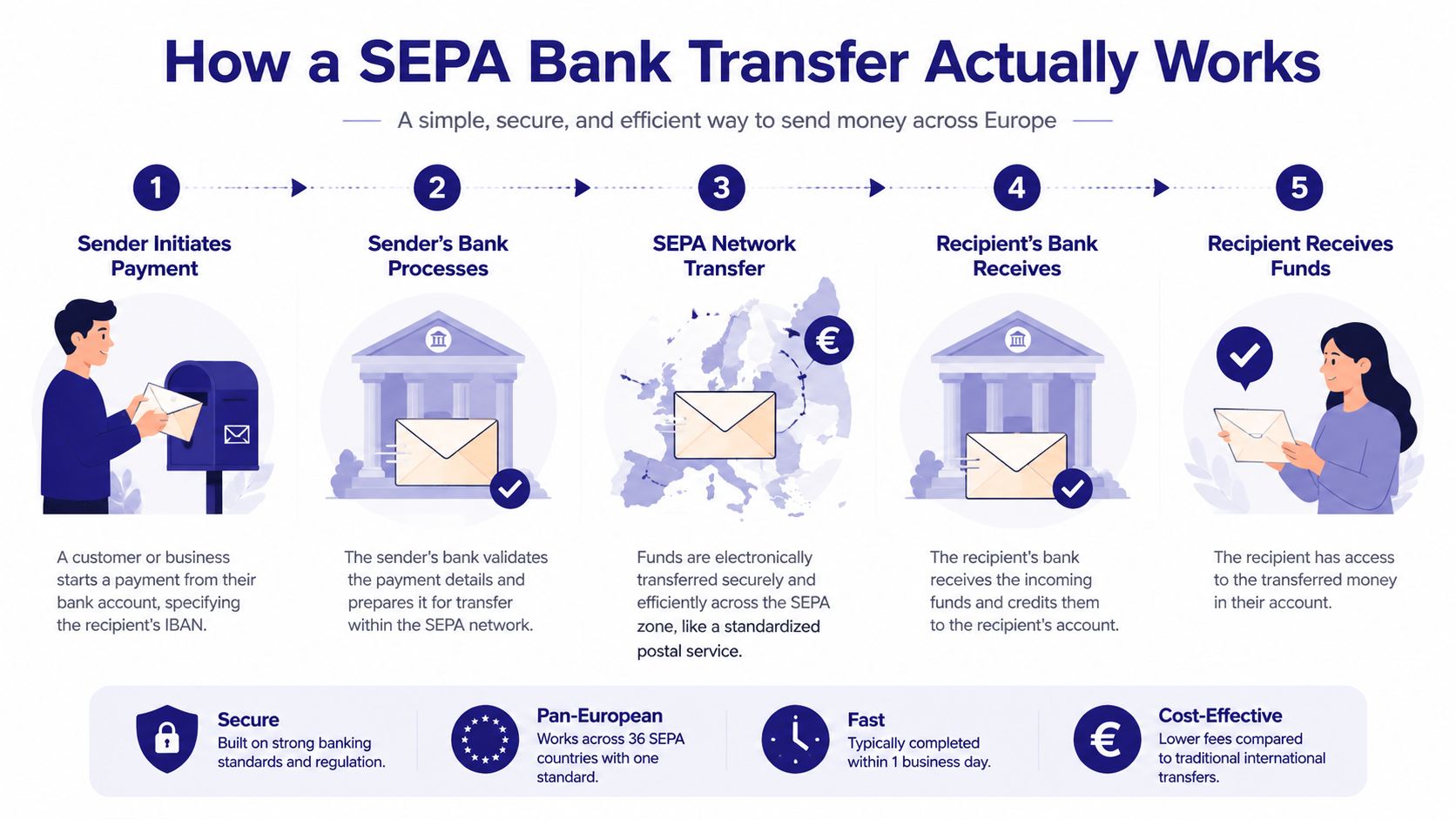
Here's the clean mental model. You enter the recipient's details, your bank validates the instruction, the SEPA network carries the payment, and the recipient's bank credits the account. The process is designed to behave like one shared system, not a collection of country-specific exceptions.
The less you vary the data, the smoother the payment runs.
That is why errors in the IBAN are such a common source of avoidable friction. SEPA works best when the instruction is complete and machine-readable from the start.
The Three Main Types of SEPA Transfers
A lot of confusion starts when people use “SEPA transfer” as if it were one product. In practice, it's a family of payment schemes, and each one solves a different business problem.
Standard, instant, and direct debit
The standard option is SEPA Credit Transfer (SCT). It's the normal one-time euro transfer you use when you want to send money manually from one account to another. The instant version, SEPA Instant Credit Transfer (SCT Inst), is for payments that need to arrive in seconds and can be used around the clock, but it has a cap of €100,000 per transfer in the cited industry sources Spark's glossary.
Then there's SEPA Direct Debit (SDD), which is different from both. It's used for recurring collections, so the business pulls funds from the customer's account under the relevant mandate rules. That makes it useful for subscriptions, bills, and repeat collections where manual sending would be awkward.
Side-by-side view
Feature | SEPA Credit Transfer (SCT) | SEPA Instant (SCT Inst) | SEPA Direct Debit (SDD) |
|---|---|---|---|
Main direction | Push payment | Push payment | Pull payment |
Best for | One-off euro transfers | Urgent euro transfers | Recurring collections |
Speed | Typically within one business day or up to two business days, depending on scheme and bank handling | Under 10 seconds | Depends on the debit cycle |
Amount handling | Can support very large transfers | Capped at €100,000 in the cited source | Set by the mandate and collection rules |
User action | Sender initiates manually | Sender initiates manually | Business collects with authorization |
Use that table as your decision filter. If you're paying a contractor once, SCT usually fits. If you need funds visible right away, SCT Inst is the obvious candidate. If you're billing the same customer every month, SDD is the relevant scheme.
Decision shortcut: if the money should move now, think instant. If the money should be collected repeatedly, think direct debit. If neither is true, standard SCT is often enough.
SEPA Use Cases for Global Businesses and Creators
SEPA is most useful when money has to move across European borders without feeling like a special case. A freelancer in Spain invoicing a client in Germany wants the payment to arrive with minimal back-and-forth. An online course creator billing customers in several euro countries wants a repeatable flow, not a new payment headache every month.
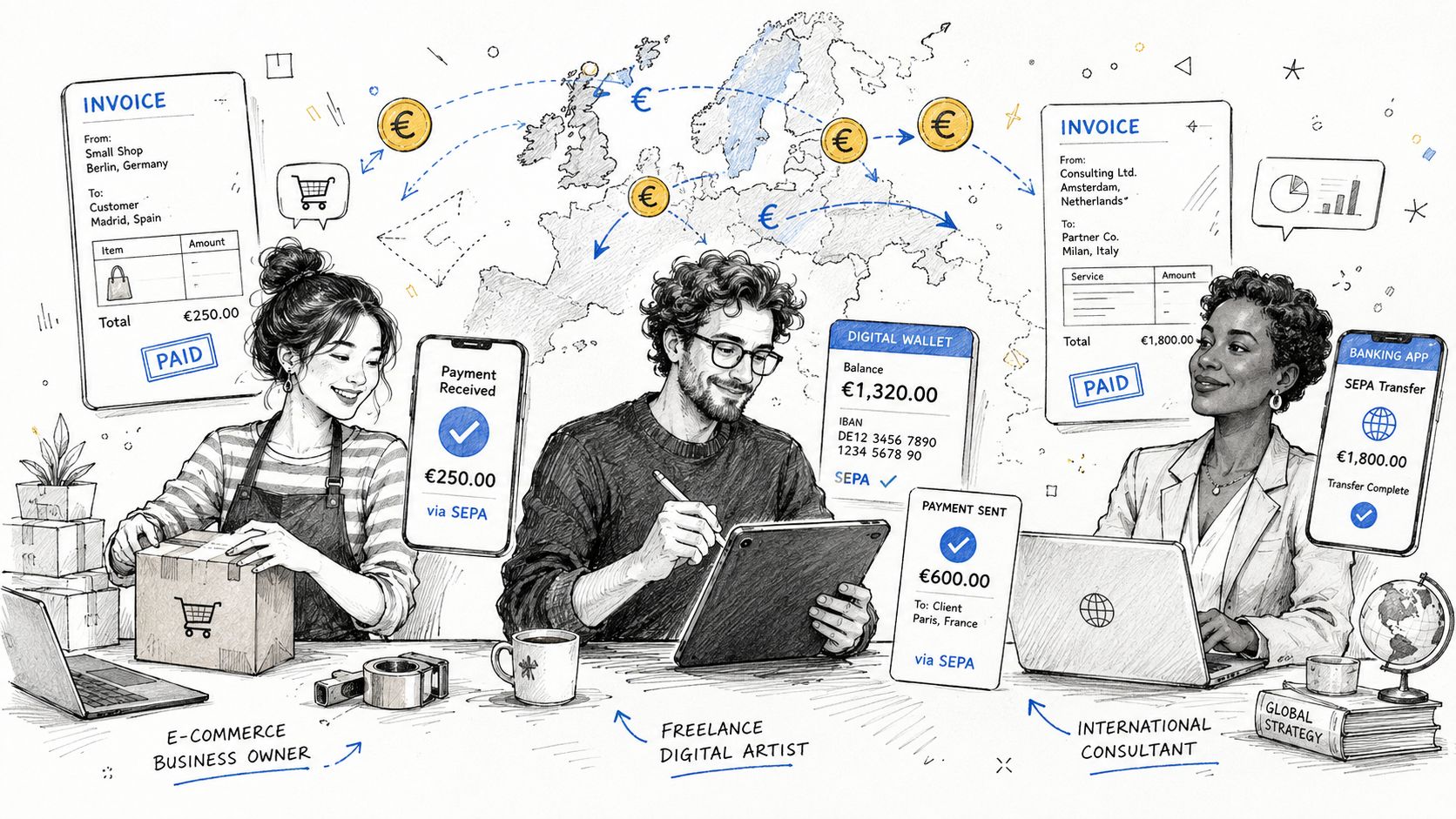
A SaaS company or membership business can also use SEPA to make euro collections feel local, even when the customer sits in another SEPA country. That's why SEPA shows up so often in billing, invoicing, payroll, and recurring service payments. It reduces the payment layer to something customers already understand.
For teams evaluating tooling around this, it helps to look at the payment stack rather than the rail alone. A practical overview like Guide to fintech app development partners can be useful when you're deciding how much of the payment flow you want to build yourself.
Suby fits into this kind of workflow as a single product with four ways to use it. Suby Payments lets businesses accept cards and crypto through one checkout, Suby Crypto handles the swap and gas sponsorship before settling to a non-custodial wallet or the Suby balance, Suby Gating covers paid access for Discord, Telegram, downloads, and courses, and Suby Invoicing lets a client pay how they want while the business receives what it wants. It also provides an API for card and crypto payments, plus native Discord and Telegram integrations for subscriptions and paid communities.
The point isn't that every business needs the same setup. The point is that customers can pay by card, wallet, bank, or crypto, while the business chooses whether to receive funds in a bank account or in stablecoins like USDC.
Here's a useful resource if you're thinking about how cross-border payment choices affect your operating model, cross-border payment considerations matter well beyond just one rail.
SEPA Compared to SWIFT and Other Payment Rails
SEPA is not a universal Europe-wide transfer product. It's a euro-denominated scheme with explicit rules and country coverage boundaries, so it's best understood as the right tool for euro payments inside its zone, not for every international transfer Duck Creek's overview.
When SEPA wins
Use SEPA when the payment is in euros and both sides are in the scheme area. That's when the standardization really pays off, because the transaction logic behaves more like a domestic payment than a traditional cross-border wire.
SWIFT is different. It's global, and it's built for a much wider set of corridors and currencies. That breadth is useful, but it also means the transfer can involve more steps, more routing complexity, and more variability in outcome depending on the corridor and the banks involved.
Why the comparison matters for a business owner
If your customers or suppliers are inside Europe and transact in euros, SEPA is usually the cleaner default. If you need to move money outside that euro framework, then a broader rail such as SWIFT becomes relevant.
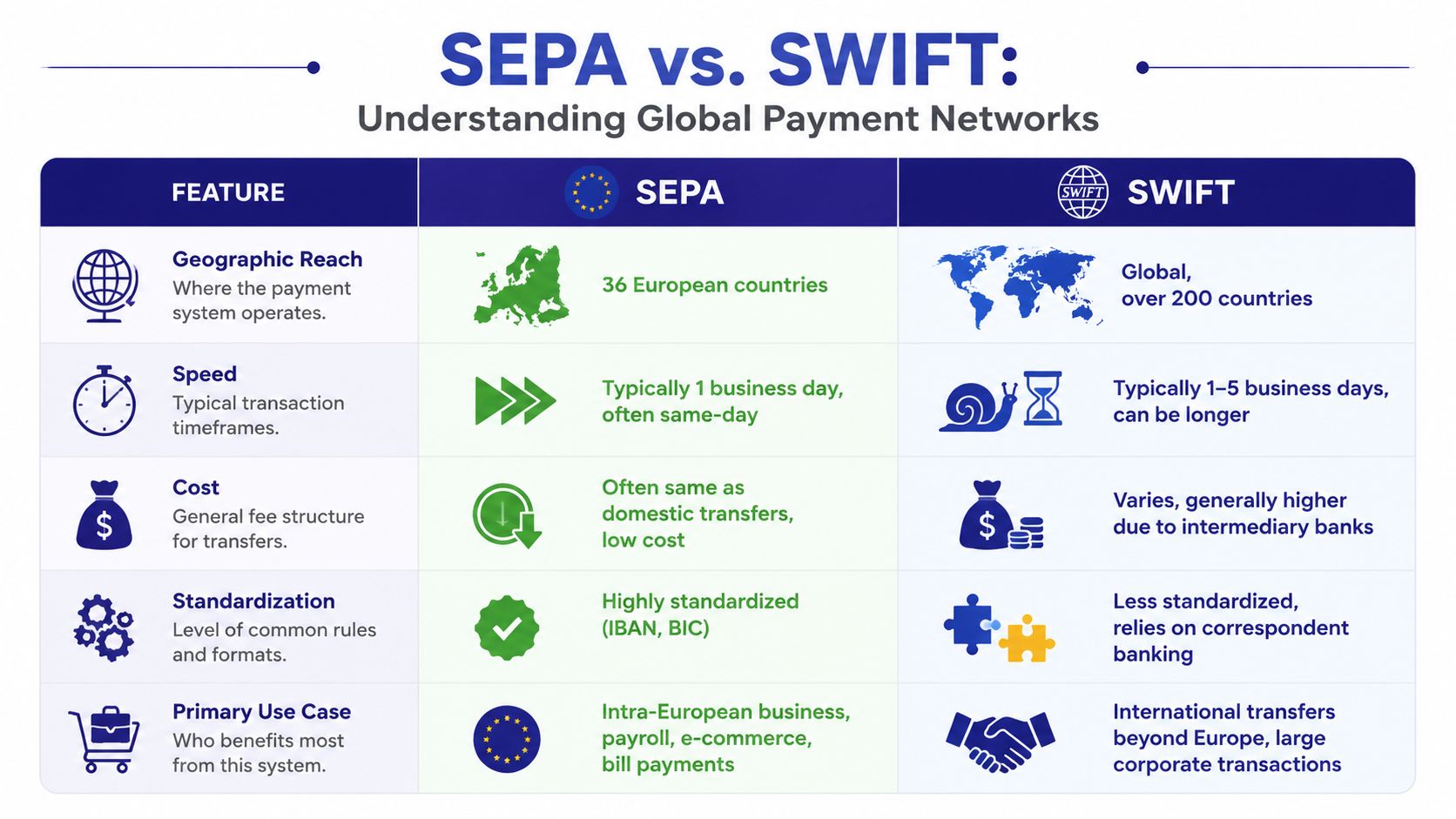
The practical takeaway is simple. SEPA is the local-feeling option for euro payments across its area, while SWIFT is the broader international tool when the transaction falls outside that framework. If you want a deeper product-level comparison for that decision, this SWIFT alternative guide is the right next read.
Bottom line: choose the rail that matches the currency and corridor first. Speed and cost matter, but the payment has to fit the network before anything else does.
Practical Tips for Sending and Receiving SEPA Payments
A clean SEPA payment usually starts before the transfer screen even opens. Check the beneficiary's IBAN carefully, and only add the BIC/SWIFT code if your bank or workflow requires it. If you need a quick refresher on the standard fields and payment setup, this SEPA transfer guide and OneSafe's BingX deposit guide are useful reference points for how euro transfers are handled in practice.
A simple sender checklist
Confirm the IBAN: Copy it directly from the invoice or beneficiary details, rather than retyping it from memory.
Match the name: Make sure the account name matches the intended recipient, especially for business payments.
Choose the right scheme: Use standard SCT for ordinary payments, instant SCT Inst for urgent ones, and SDD only for authorized recurring collections.
Check the cutoff: Banks can process payments differently depending on when you submit them.
For recipients, the operational side matters just as much as the transfer itself. Reconcile the incoming payment against the invoice or order reference, and tell customers whether you expect standard settlement timing or a faster instant transfer. Ordinary SEPA transfers typically arrive on the next business day after the receiving bank gets the funds.
If you handle many payments, tools matter more than manual checks. OneSafe's BingX deposit guide is a useful example of how businesses think about euro deposits and transfer flow when they want to keep operations tidy.
A platform like Suby can also reduce the bookkeeping burden by giving you one API and one balance instead of forcing you to manage multiple regional setups. That helps when customers pay in different ways, while you still settle in the currency and destination you prefer.
