

Gaspard LEZIN
Compliance Documentation: Best Practices for Payments &
Master compliance documentation for payments & crypto in 2026. Discover best practices for organization, retention, plus ready-to-use checklists and templates.
Your payments team is in the middle of an audit request, and the documents are everywhere except where they should be. One policy sits in a shared drive, a scanner report lives in someone's inbox, and the latest remediation note is buried in a chat thread. The work wasn't sloppy, but the records are scattered, so the audit suddenly feels bigger than it should.
Compliance documentation is what turns that mess into something auditable. It gives reviewers a clear trail from policy to process to evidence, which is especially important in payments, where controls, retention, and payment flows often cross teams and jurisdictions. For card environments, PCI DSS has been the global baseline since the PCI Security Standards Council began administering it in 2006, and it now organizes expectations around 12 requirements and 6 control objectives that auditors expect to see reflected in records and evidence (PCI guidance PDF).
Table of Contents
Introduction to Compliance Documentation
When an auditor asks for proof, “we have it somewhere” doesn't help much. Teams usually know the controls exist, but they haven't built a clean record of what was done, who approved it, when it changed, and which requirement it supports. That's why compliance documentation is less like filing paperwork and more like keeping a controlled evidence trail.
In payments, that evidence trail has to cover more than one lane. A merchant may need card-processing records, access logs, incident-response procedures, and training evidence, while a cross-border team may also need due diligence files, payment logs, and retention controls that can survive review across jurisdictions. The practical challenge is not creating every document from scratch, it's organizing the right records so an internal reviewer, an acquirer, or an external auditor can follow the logic without guessing.
A useful mindset is simple. Treat every document as proof of a control, not just a stored file. If a policy says a control exists, the surrounding evidence should show it operating in real life, with dates, owners, and version history that hold up under scrutiny.
Understanding Compliance Documentation
A factory floor helps make the idea easier to grasp. If a plant wants to pass a safety audit, it doesn't just list its machines, it maps where each machine sits, how materials move, what checks happen, and who responds when something goes wrong. Compliance documentation works the same way for a business, it maps the operating process and the evidence that proves it's being followed.
The layers auditors expect to see
At the top level are written policies. These explain the rules, such as information security, access control, or incident handling. Below that sit the operational records, including network diagrams, access-control logs, vulnerability evidence, monitoring logs, and incident-response procedures that can be traced back to specific PCI requirements (PCI guidance PDF).

That structure matters because PCI DSS isn't just a policy checklist. It's a control system with expectations spread across documents, evidence, and corrective actions. For auditors, the point is traceability, not volume.
What “good” looks like in practice
Good compliance records show what happened, why it happened, and how recurrence will be prevented when relevant. They also need clean timestamps, signatures where appropriate, and controlled late entries when something is added after the fact (Drexel good documentation practices).
Practical rule: if a reviewer can't tell whether a record is original, updated, or corrective, the document is hard to defend.
That's the definition of compliance documentation, a system of records that connects policy, process, evidence, and change history. It's not a single file, and it's never just storage.
Purpose and Business Impact
Teams often treat documentation as a cost until they need it fast. Then it becomes obvious that its true value is speed, clarity, and lower friction with auditors, partners, and internal risk teams. Clean records reduce back-and-forth because the evidence already answers the obvious questions before anyone has to ask them.
Why retention rules shape the whole program
Retention isn't a filing habit, it's a control decision. Cross-border payment guidance commonly instructs businesses to keep transaction records, due-diligence files, and monitoring logs for a minimum of five years, which makes the five-year rule a practical benchmark for compliance programs in major markets (cross-border payment checklist).
That matters because documentation doesn't stop at onboarding. Mature programs also track who was paid, what was paid, why it was paid, and how risk checks were performed. In a payments team, those details often live across KYC files, sanctions-screening results, payment logs, and audit trails, so retention strategy has to be designed before the first audit request lands.
The business value is operational, not abstract
Good documentation lowers confusion during remediation. If a control gap appears, a clear record makes it easier to decide whether you already have enough evidence or whether you require more from the customer, vendor, or internal owner. That distinction prevents unnecessary rework and keeps teams from turning every missing file into a re-onboarding exercise.
It also supports expansion. A company adding new payment methods, new markets, or new partners needs records that show how controls were adapted, not just that controls exist. Without that trail, every new launch feels like a custom investigation.
A mature documentation program doesn't just satisfy an auditor, it helps the business move faster because the evidence is already organized.
The short version is simple. Strong compliance documentation protects revenue, reduces delay, and makes growth easier to defend.
Common Document Types and Their Roles
Payments teams usually need more than one document family. Some records explain the rules, some prove the rules were followed, and some show what happened when controls broke or were corrected. If you sort them by role, the whole system becomes easier to manage.
Document Type | Purpose |
|---|---|
Policy documents | State the rule or control expectation |
Diagrams and flowcharts | Show how money, data, or approvals move |
Access records | Prove who could see or change systems |
Logs and monitoring evidence | Show activity over time |
Incident-response procedures | Show how the team responds when something goes wrong |
Training records | Prove staff were told what to do |
SAQ, AOC, ROC, ASV evidence | Show PCI validation evidence at the merchant's validation level |
For PCI, the evidence packet can include a Self-Assessment Questionnaire (SAQ), Attestation of Compliance (AOC), Report on Compliance (ROC), and Approved Scanning Vendor (ASV) scan evidence, depending on validation level (SecureTrust PCI certification). That's why merchants should think in terms of evidence families, not one-off documents.
How auditors use these records
An auditor wants to see whether a document matches the control it claims to support. A policy without logs is just intent. A log without an owner is just data. A remediation note without a timeline is incomplete context.
If you're building or reviewing a policy library, a good neutral reference point is the Privacy Policy used by Disputely, because it shows how a public-facing document can be organized for clarity and user trust.
For teams trying to understand how PCI fits into the broader payment stack, this internal reference is useful: what PCI DSS compliance means in practice. It helps connect the document categories to the controls they're meant to prove.
Ownership matters: every major document type should have one owner, one review path, and one current version.
That simple rule keeps compliance documentation from turning into a shared-folder guessing game.
Best Practices for Retention and Organization
The biggest failure in documentation programs is usually not missing content, it's missing structure. If records are stored by convenience instead of by control type, teams spend audit week searching instead of answering. A better setup is more boring, and much more usable.
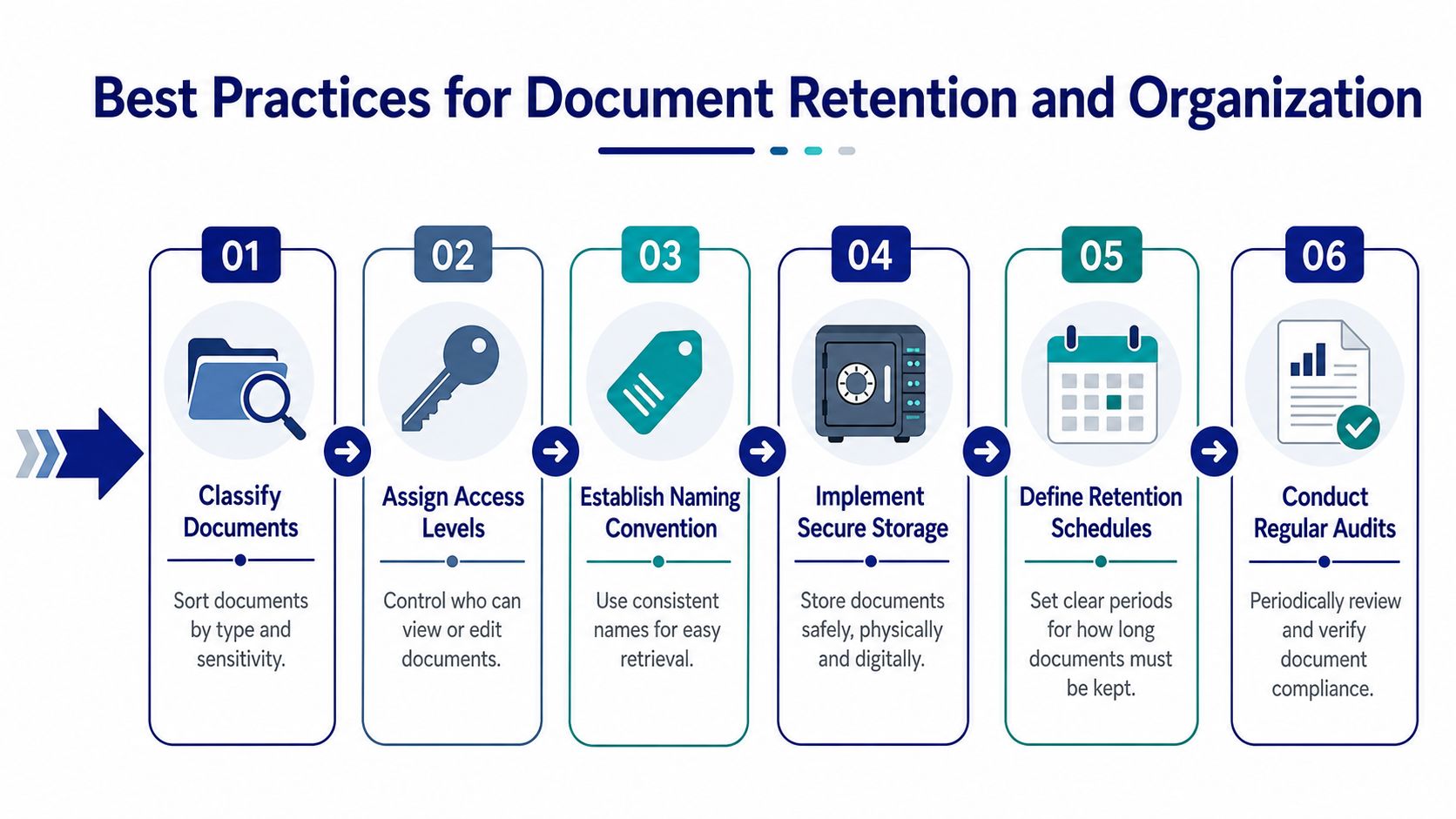
A simple process flow that works
Start by classifying documents by type and sensitivity. That lets you separate public policies from restricted evidence, and it makes access control much easier to explain later.
Then define who can view, edit, or approve each folder. After that, standardize naming conventions so a file can be found without opening ten versions of the same draft.
A useful sequence looks like this:
Classify first: separate policies, logs, approvals, and incident records.
Set access levels: limit editing rights to the people who own the control.
Use consistent names: include date, version, and document type.
Store securely: keep records in controlled repositories, not inboxes or desktops.
Assign retention schedules: apply jurisdiction-specific rules, with five years as a baseline for many payment records.
Review regularly: retire obsolete files and check whether evidence still maps to the current process.
For teams comparing document review tools, AI document review software can help spot missing metadata or inconsistent language, but it still needs a human reviewer to confirm control relevance.
What to archive and what to keep active
Active folders should hold current policies, current diagrams, and the latest evidence cycle. Archive folders should hold superseded versions with clear date ranges. That way, auditors can see the control history without mixing old procedures into current operations.
This is also where reconciliation discipline helps. A clean documentation system should mirror the way payment records are reconciled, with a clear path from source activity to final reporting. For a practical comparison, see payment reconciliation best practices.
The goal is traceability. If someone asks why a file exists, the answer should be obvious from its name, its owner, and its place in the folder structure.
Payments and Crypto Specific Considerations
Payments documentation gets more complex when card, wallet, bank, and crypto flows all sit in the same business. The records have to show not only what was paid, but also how settlement happened, what entity touched the funds, and what checks were performed along the way.
What extra evidence payments teams should capture
For card and crypto workflows, the most useful records usually include:
Payment creation details: customer, product, amount, method, and timestamp.
Settlement evidence: where the funds landed, including wallet or account references.
Webhook logs: the event trail that triggered access, fulfillment, or subscription actions.
Risk checks: KYC, sanctions screening, and any review notes tied to the transaction.
Custody notes: whether the business or platform held funds, keys, or balances at any point.
Exception handling: records of gaps, disputes, refunds, or failed attempts.
For a technical example of how one payment layer can support card only, crypto only, and card plus crypto checkout modes, the platform documentation for Suby's API shows a flow where merchants can generate webhook events and audit logs across those modes. That kind of event trail is exactly what compliance teams want to preserve.
Why the operational model matters
Crypto documentation is especially sensitive to custody and settlement boundaries. Some systems orchestrate the transaction and pass settlement through to a merchant-designated destination, while others retain more control. The documentation should make that boundary obvious, because auditors and internal reviewers will ask who controlled what, when, and for how long.
For businesses evaluating broader payment architecture, OTC trading platform development is a useful external reference point for understanding how complex digital-asset flows can introduce documentation and control requirements beyond standard card processing.
There's also a customer-contact question that teams often get wrong. If a gap can be closed from existing licensed data, do that first. Only reach out when outside evidence is required, and be deliberate about when source-of-funds information is unavoidable. That approach keeps remediation focused instead of noisy.
Keep the trail together: if a payment triggers access, the payment record, webhook event, and fulfillment action should sit close enough in your system that a reviewer can trace them without a scavenger hunt.
That's the difference between a payment log and a defensible audit trail.
Compliance Checklists and Templates
A checklist is useful only if it helps someone act today. For compliance documentation, the best templates are the ones that tell owners what to collect, where to store it, and how to tell when the file is complete.
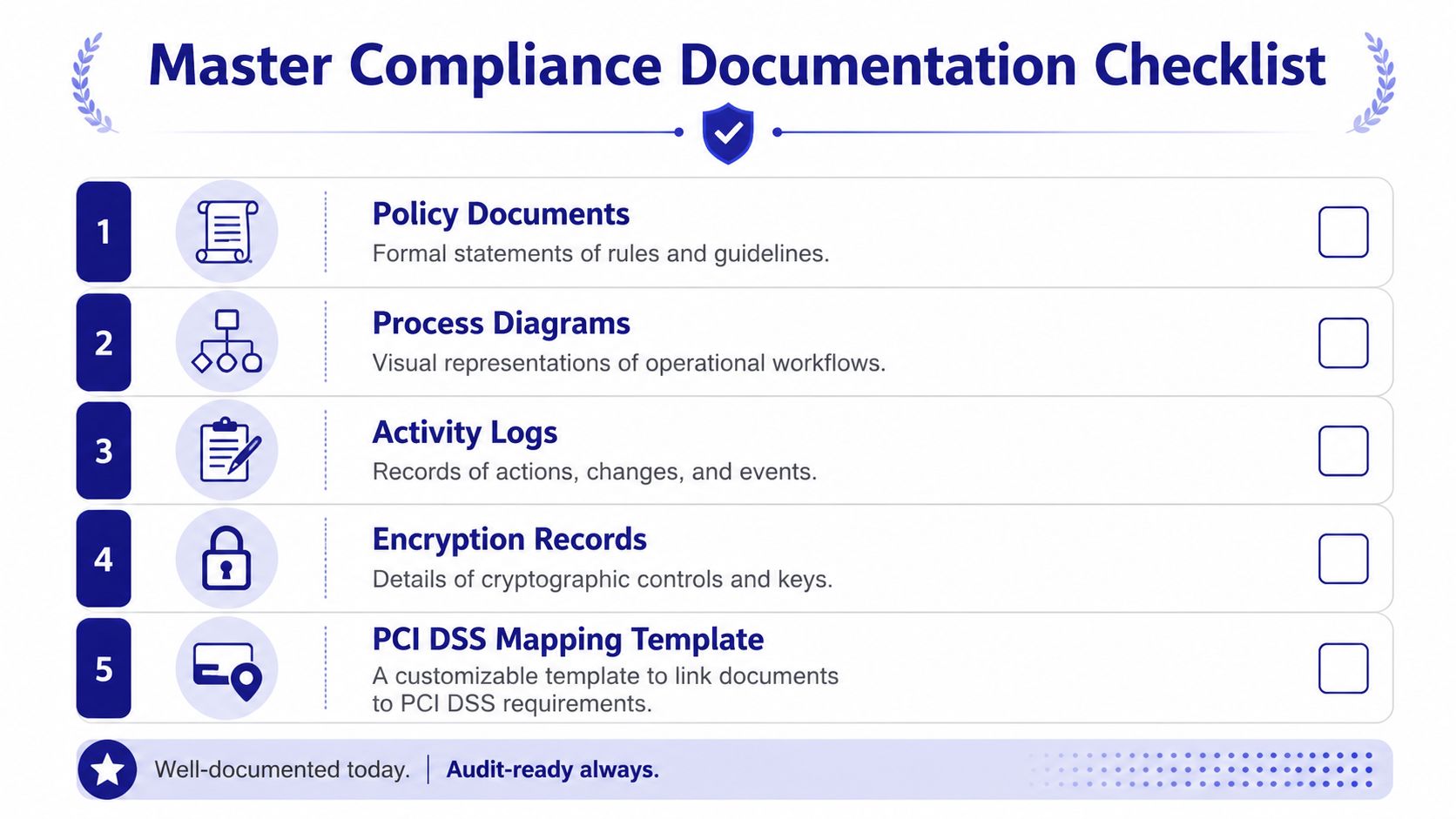
Master checklist for a payments team
Policy documents: Collect the current policy, the owner, the approval date, and the next review date.
Process diagrams: Keep the latest workflow map, the system owner, and the control step each diagram supports.
Activity logs: Store transaction logs, access logs, and review logs with clear time stamps.
Encryption records: Document the control design, any key-handling notes, and the review owner.
PCI mapping template: Map each document to the requirement or control objective it supports, then note the evidence location.
A simple mapping template
Use one row per control. The columns can be:
Control or requirement
Required document
Document owner
Storage location
Review cadence
Open issues
That layout makes it easy to spot gaps quickly. If a control has no owner or no current evidence, the problem becomes visible immediately instead of surfacing during an audit.
A clear documentation standard also helps with late entries. Drexel's guidance is straightforward, records should show what happened, why it happened, and how recurrence will be prevented when relevant, with date, time, and signature, and any late entry should be explicitly noted with timestamps (Drexel good documentation practices).
Here's a practical rule to use right away:
If a document can't be mapped to a control, it probably doesn't belong in the audit pack yet.
For teams that need a visual refresher, the embedded training video below can help reinforce document organization habits in a simple way.
The right checklist won't do the work for you, but it will stop the most common misses.
Conclusion and Next Steps
Strong compliance documentation makes audit work predictable. It shows what the control is, who owns it, what evidence proves it, and how long the record must be kept. In payments, that structure matters even more because card, crypto, and cross-border workflows often share the same operational surface.
The practical path is straightforward. Define the scope, gather the documents, organize them with retention rules, and keep the evidence close to the transactions it supports. If your team needs payment infrastructure that can support card or crypto flows while keeping settlement choices flexible, Suby's product pages and documentation are a sensible place to compare workflows and pricing, starting with the official pricing page and the Suby documentation hub.
Start with one folder, one map, and one owner. Then schedule a review of the records that support your highest-risk payment flows, especially the ones that touch settlement, access, and audit logs.
A CTA for Suby.
