
Gaspard LEZIN
Ecommerce Fraud Prevention: A Practical Playbook for 2026
A practical ecommerce fraud prevention playbook for 2026. Learn risk tiers, layered controls, manual review workflows, and chargeback mitigation that work.
You usually don't notice fraud controls until they get in the way. A checkout that felt clean last month starts throwing false declines during a promo, support tickets spike, finance sees chargebacks arrive later, and the team argues about whether the problem is the model, the rules, or the traffic mix.
That's the shape of ecommerce fraud prevention. It's not a single filter at the edge of checkout. It's an operating system for risk, with tiers, latency limits, reviewer workflows, and a feedback loop that keeps learning after the order is captured.
Table of Contents
Where Most Ecommerce Fraud Programs Actually Break
A mid-sized merchant runs a one-day flash sale, sees order volume jump, and watches the checkout team celebrate a small lift in approvals. Six weeks later, the chargebacks start arriving. By then the orders have shipped, the goods are gone, and the fraud stack has nothing to say about the bad pattern because it was tuned for normal traffic, not a burst of unusual behavior.
That's the core mistake. Teams buy a detection platform and think the platform is the program. It isn't. A platform can score risk, but ecommerce fraud prevention still fails if nobody decides where to absorb friction, when to step up authentication, or how fast to close the loop when a bad pattern appears.
The pressure is real because the stakes keep rising. Stripe cites estimates that online payment fraud cost the world $130 billion in 2020 and is expected to reach $206 billion by 2025, with especially large exposures in Asia-Pacific ($54 billion), North America ($50 billion), and Europe ($35 billion) by 2025, plus $60 billion in combined losses for digital goods and money transfer businesses by 2025 in the same source (Stripe fraud statistics). That scale is why prevention can't live only inside finance or only inside engineering.

A better way to think about the stack is simple. You need four tiers of friction, from trusted customers to hard blocks, and you need two feedback loops, the live rules engine and the chargeback loop. That model gives you something a dashboard can't, a way to keep conversion intact without letting the same fraud pattern come back every week.
For teams running complex checkout flows, a practical resource on adjacent commerce infrastructure is find a white-label casino system. It's useful because high-risk verticals often face the same operational reality, friction has to be earned, not sprayed everywhere.
A Risk Tier Model That Maps Controls to Friction
A fraud program works better when it stops treating every order the same. Sort transactions into risk tiers, then apply only the friction the order deserves, enough to protect margin without pushing away legitimate buyers. That matters even more in checkouts that accept multiple payment methods, because cards and digital wallets both show up among the highest-fraud accepted methods in the global merchant survey cited by CyberSource (global fraud report 2024).
Tier 0 and Tier 1 keep trusted traffic fast
Tier 0 is for known customers with clean history. No extra prompts, no extra steps, just a fast checkout. Add friction here and you mostly block good buyers without reducing meaningful risk.
Tier 1 is where baseline checks begin. Use AVS and CVV as soft verification, and keep the path light unless the signals disagree. AVS compares the billing address entered by the customer with the address on file with the issuer, and mismatches can flag potentially fraudulent payments (Sift AVS explanation). That makes Tier 1 a place for gentle inspection, not immediate rejection.
Practical rule: if an order looks normal except for one weak mismatch, do not block it immediately. Add a soft step, log the signal, and let the rest of the model make the final call.
Tier 2 and Tier 3 need step-up and review
Tier 2 is the escalation zone. Orders with higher value, device drift, unusual shipping patterns, or repeat attempts should move to 3D Secure 2.0, device fingerprinting, and tighter velocity controls. CyberSource notes that 55% of companies use credit card verification services, 50% use identity verification services, 44% use two-factor phone authentication, and 39% use 3-D Secure authentication, which shows how common layered escalation has become in fraud operations (global fraud report 2024). The trade-off is straightforward, step-up controls reduce exposure, but they can also add enough friction to shave completion on borderline legitimate orders.
Tier 3 is the hard edge. It is the point where manual review or a block makes sense, especially for highly anomalous orders or repeated abuse. Keep the logic time-boxed and reversible, because static rules age badly once fraudsters learn the pattern.
A useful internal reference for how 3-D Secure fits into checkout escalation is this 3-D Secure payments guide. It treats 3DS as one control inside a larger risk strategy, which is how it should be used.
The same operating model needs a back-end loop, too. Fraud prevention does not end at authorization, and remediation does not belong in a separate silo. To keep the control stack honest, teams should also browse the ATO prevention guide, because account takeover often feeds the same checkout abuse that tiering is meant to slow down.
The trade-off is predictable. Every extra step can stop a bad order, but every extra step can also cut completion for a good one. The best programs escalate only when the tier changes, not when someone looks uneasy.
The Four Signal Layers That Score Risk
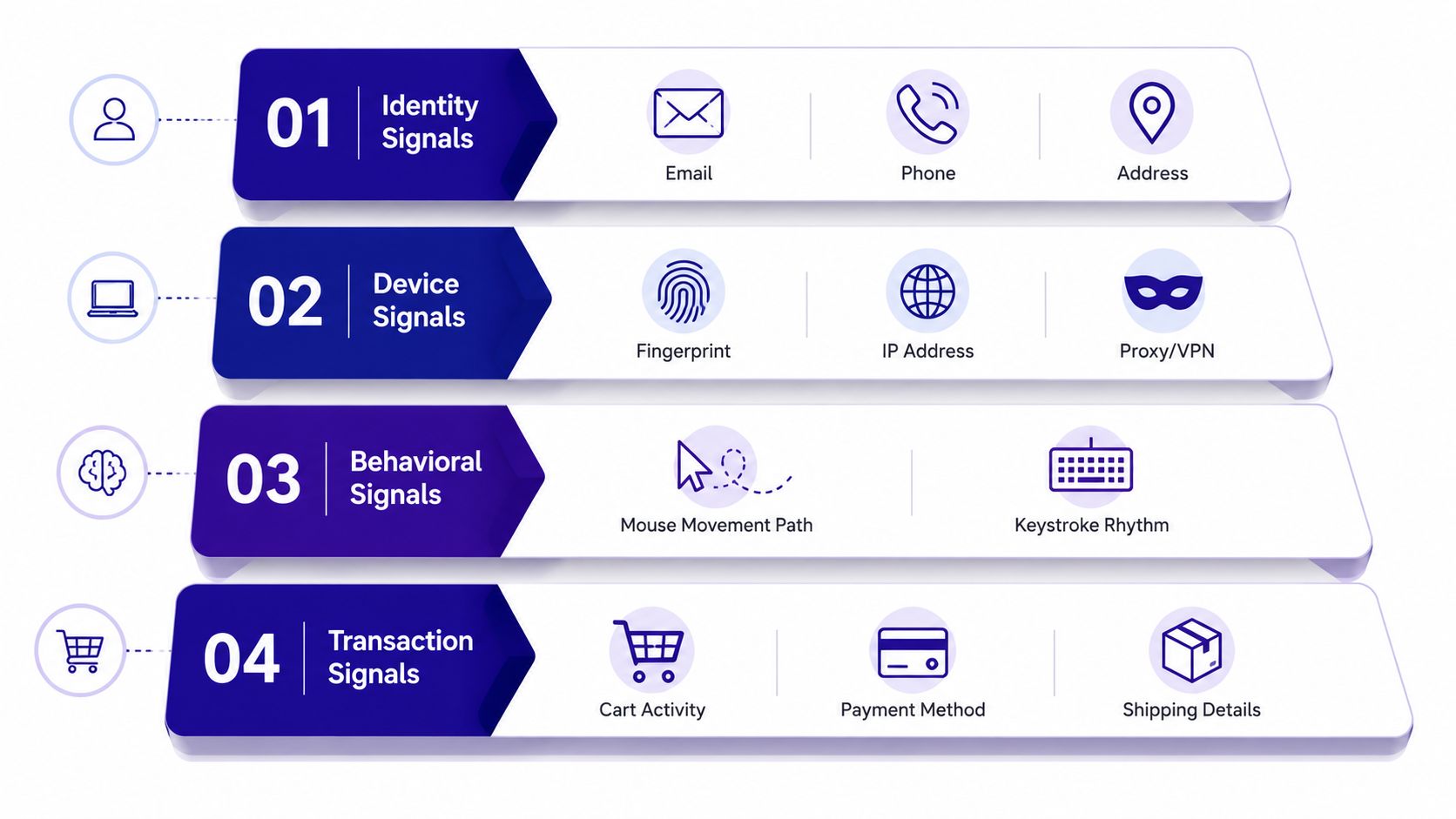
Real-time risk scoring works when the engine reads several signal types together, not when it leans on one brittle control. Ping Identity recommends combining strong login methods, device intelligence, transaction monitoring, and behavioral signals so attacks get caught without adding unnecessary friction (Ping Identity fraud detection). That layered approach is more useful than any single blacklist.
Identity and device signals carry the first weight
Identity signals are most useful when they line up with each other. A stable email address, a phone number that fits the account age, and a billing address that matches issuer data carry more weight than a profile that looks complete. A new email address by itself is a weak signal, because real customers do open fresh accounts.
Device signals are usually sharper. A known device fingerprint, a clean IP reputation, and no proxy masking tell you more than a familiar first name in the form field. One mismatch in isolation is noisy, because travelers, mobile users, and privacy tools all create false positives.
If you need a broader lens on account compromise patterns, browse the ATO prevention guide. It matters most when login risk starts spilling into checkout fraud.
Behavior and network signals show intent
Behavioral signals help when they describe how the session unfolds. Normal mouse movement, steady pacing, and a cart that changes gradually are more informative than a single long session, because bots can mimic duration but often struggle with natural interaction patterns. A lone rapid click is not enough on its own, since impatient humans do that too.
Network signals connect the order to the wider environment. BIN, shipping country, velocity across accounts, and repeated attempts from the same network become stronger when they cluster. A country mismatch on its own is a noisy signal, because cross-border commerce is normal in global checkout.
Latency matters. A production risk engine needs to score fast enough to run inline at checkout. The useful benchmark is sub-100ms real-time risk scoring latency, because slower scoring starts to affect abandonment and pushes the decision out of the checkout path.
The order of operations matters too. Wire up identity and device signals first, then add behavior and network context. If you start with only one layer, you will overfit to the easiest fraud pattern and miss the next one.
Designing Rule Engines and Manual Review Workflows
Automation should handle the obvious decisions. Humans should handle the messy ones. That split only works if the rule engine is designed to sort by risk score plus order value, not risk score alone, because a low-score, high-value order can still be a bad day if it slips through.
Build the queue so reviewers see the right cases first
The review queue should be short, focused, and triaged by business impact. High-value borderline orders deserve the fastest attention, while lower-value ambiguous cases can wait longer. A practical service target is 15 minutes for high-value orders and 4 hours for everything else, which keeps the queue useful instead of stale.
The reviewer's job isn't to guess. It's to confirm whether the signals support the order, then record the reason in a way the rules engine can reuse later. Keep decisions reversible, because a bad rule should be rolled back in minutes, not days.
A simple decision matrix works well in practice:
Approve: consistent identity, known device, clean payment signals, no velocity issues.
Review: mixed signals, new customer, moderate value, or one suspicious dimension.
Decline: repeated attempts, multiple high-risk signals, or clear abuse patterns.
Avoid the workflow mistakes that stall the team
The most common failure is staffing the rule engine before staffing the review queue. That creates a pile of unresolved orders and pushes good buyers into delay. Another failure is letting every reviewer apply personal judgment without a shared policy, which makes the data hard to learn from.
For adjacent operational detail on issuer challenge handling, the chargeback management guide is useful context, because manual review and dispute handling often get built by the same ops team.
Keep the queue as a learning signal. Every reviewed order should teach the rules engine something, even if the final decision is to approve it.
The review workflow should also be time-boxed. If a case has sat too long, the merchant is no longer managing risk, it's just holding revenue hostage.
Running the Chargeback Loop as Part of Prevention
Chargebacks are usually treated like the end of the story. That's a mistake. The best teams treat them as a new input into prevention, because each closed case shows which signals were missed, which rule was too loose, and which customer story needs to be handled differently next time.
A chargeback starts as a notification, not a mystery. The case lands, the merchant identifies the order, and the analyst pulls together the evidence package. That usually includes order details, device fingerprint, delivery proof, and customer communication, because those are the artifacts an issuer or processor can evaluate when the dispute window is open. Thomson Reuters recommends multi-layered prevention with encryption, tokenization, and SSL certificates, and it also calls out unusual transactions such as high-order values, multiple transactions in a row, or shipping to multiple addresses (Thomson Reuters fraud tools).
The decision point is practical, not emotional. Some disputes are worth representment, some are better accepted. The line depends on evidence quality, order value, and how often the pattern repeats, because a weak case can burn time that should go toward prevention.
For sellers in tighter policy environments, regulated sellers chargeback reduction tactics are a useful reference point. Those businesses usually have to be stricter about shipping, proof, and account controls, so their playbooks are often more disciplined than general retail.
The last step is the most important one. Feed each closed case back into the rules engine as a labeled example, then tag it by fraud type, payment method, and shipping pattern. If that doesn't happen, the same fraud cluster will return under a slightly different mask.
Fighting the case and learning from it should be one workflow, not two separate departments. Finance, fraud, support, and operations all touch the same order history, so they should all work from the same evidence package.
Monitoring KPIs That Actually Predict Fraud Loss
Dashboards usually over-emphasize lagging metrics. By the time chargeback rate rises, the damage already happened. A better monitoring stack uses leading indicators that move earlier in the funnel, then uses the lagging metrics to confirm whether the controls are working.
Metric | What it tells you | Target range | Cadence |
|---|---|---|---|
Authorization rate | Whether legitimate traffic is still flowing through checkout | Watch for unusual drops versus your normal baseline | Daily |
Decline rate by BIN | Whether issuer or model friction is clustering on specific card ranges | Watch for spikes in one BIN segment | Daily |
Manual review queue depth | Whether human review is keeping up | Queue should stay short enough to meet review SLAs | Hourly |
Step-up abandonment rate | Whether extra friction is hurting conversion | Watch for sudden increases after policy changes | Daily |
Chargeback rate | Whether bad orders are still landing | Review as a lagging confirmation signal | Weekly or monthly |
Fraud dollars | The size of the loss after prevention | Review as a lagging finance measure | Weekly or monthly |
Visa notes that merchants are shifting screening from manual review to automated screening at an average rate of 52% versus 23% manual, which is one reason fast, event-driven monitoring matters more than old batch-style review (Visa ecommerce fraud insights). Automation makes the monitoring loop faster, but it also means alerts have to be precise, not noisy.
A useful way to read the dashboard is by ownership. Fraud teams watch model drift and queue depth, finance watches loss and dispute recovery, and product watches abandonment tied to step-up friction. That shared view keeps one team from fixing fraud by breaking checkout for everyone else.
For merchants who want a broader reporting lens that connects payments performance with risk, this payment analytics guide is a practical companion. It helps keep risk and revenue in the same conversation.
Alert on change, not noise. If every small fluctuation wakes the team, they'll stop trusting alerts.
The weekly question is simple. Did the controls lower loss without damaging completion? The monthly question is whether the model and the rules still match how customers buy.
A 90-Day Rollout Checklist and What to Watch For
Weeks 1 to 2 should focus on data hygiene and signal wiring. The owner is usually payments ops with engineering support. The usual mistake is trying to write rules before the signals are clean, which leads to false confidence and bad tuning.
Weeks 3 to 6 are for tier definition and rule engine setup. The owner is fraud ops or risk product, and the prerequisite is agreement on what counts as Tier 0, Tier 1, Tier 2, and Tier 3. The common failure here is overcomplicating the policy before the queue exists to absorb the edge cases.
Weeks 7 to 10 should build the manual review workflow and train reviewers. The owner is operations, with support from fraud leadership. The biggest problem is staffing the queue after launch instead of before it, which makes the first wave of unusual traffic hard to contain.
Weeks 11 to 12 should connect monitoring and the first chargeback feedback loop. The owner is cross-functional, because finance, fraud, and support all need the same case history. Skipping this step is how the same abuse pattern returns with a different device, address, or payment method.
A one-page recap looks like this, four tiers, four signal layers, one rule engine, one review queue, one chargeback loop. That's the whole system.
If you're building from scratch, start with the controls that catch the most obvious bad actors, then tighten only where the data justifies it. If you're already running a stack, audit where friction is landing, because the biggest leak is often not fraud volume, it's the good customers you lost by accident.
If you're ready to simplify checkout while keeping risk controls practical, take a look at Suby and check the pricing page for the payment method that fits your flow. Suby lets any business accept payments by card or crypto through one API, includes native integrations with Discord and Telegram for subscriptions and paid access, and gives businesses a choice in how they receive funds, including bank settlement or stablecoins like USDC.
