

Gaspard LEZIN
What Are SMBs and Why They Matter in Business
Learn what are SMBs, how size thresholds vary by country and industry, and why these businesses shape the global economy and product strategy.
In the United States, 36,207,130 small businesses make up 99.9% of all businesses, employ 62.3 million people, and generate 43.5% of U.S. GDP. In the European Union, an SME can be micro, small, or medium-sized depending on staff count and financial thresholds, so the answer to “what are SMBs?” changes with the market.
If you're trying to figure out whether your company counts as an SMB, you're probably comparing yourself to two very different things at once, a solo operator on one side and a large enterprise on the other. That's where the label gets useful, but also messy, because SMB is a category, not a single regulated class.
Table of Contents
The Basic Definition of an SMB
A business owner might ask, “Do we count as an SMB yet?” after hiring a few employees, opening a second location, or crossing a revenue milestone. That question sounds simple, but the answer depends on where you are and who's doing the defining.
At its broadest, SMB stands for small and medium-sized business. It usually refers to companies that are bigger than a one-person operation but smaller than a large enterprise, with the exact cutoff set by governments, analysts, or vendors rather than by one universal rule.

What the label really means
The reason the term matters is practical. Banks, software vendors, tax authorities, and public agencies use size categories to decide who qualifies for programs, pricing, support tiers, or reporting rules. That means SMB is less like a legal species and more like a useful shorthand for a middle layer of the business world.
A lot of search confusion comes from the fact that SMB also means Server Message Block in networking, a client-server protocol for file, printer, and resource sharing over a network, including remote file access over TCP/IP according to Microsoft's overview of the protocol (Microsoft SMB overview). In this article, the focus is the business meaning, not the networking one.
Practical rule: If a source gives you only a company size label, ask what it uses to measure it. Headcount, revenue, turnover, and balance sheet total can all change the answer.
The safest way to think about SMBs is this, they're the broad middle of commercial life. They aren't tiny hobby projects, and they aren't sprawling corporations either.
How the United States Defines SMBs
A bakery with a few locations, a regional construction firm, and a software company selling to hospitals can all feel like “small business” from the outside. In the United States, the label still depends on the rule being used, because the government does not apply one universal headcount line to every company.
The most familiar reference point is the Small Business Administration, which sets industry-based size standards. Those standards change by sector, so the cutoff for “small” can look different depending on what the business does and how the activity is classified. The SBA's public FAQ on small business size explains that framework in straightforward terms (SBA small business FAQ).
A useful way to read the U.S. model is as a grid with different cells, not one straight line. A business can meet the size standard in one industry and miss it in another, which affects loans, set-asides, and tools aimed at smaller firms.
Why one number doesn't work
The U.S. system follows the industry first, then the size standard. That makes the label practical, because a company's workforce needs can look very different in manufacturing, services, retail, or other sectors.
Industry | SBA Size Standard (Employees) | Notes |
|---|---|---|
Industry standard varies | Industry-specific | The SBA uses size standards tied to sector classification, not one universal employee cap |
Manufacturing and other sectors | Industry-specific | A company can be “small” under one sector rule and not another |
Services and retail | Industry-specific | Qualification can shift with how the activity is classified |
Other SBA-covered industries | Industry-specific | The standard follows the industry table, not a universal headcount threshold |
The table looks technical because the rule itself is technical. In practice, SMB status depends on the standard being applied, and that standard usually follows the industry table.
A business does not become “small” or “medium” because it feels that way. The category comes from the rule used to measure it.
That matters for a lender, a software vendor, or a public program deciding who fits a target group. A company can look modest in daily life, yet land in a different bracket once the official standard is applied.
For product teams, this is more than paperwork. If you sell to U.S. SMBs, the word “SMB” is a market shortcut, not a single legal class, so customer fit can change with the sector, the program, and the buyer's own definition.
How the European Union Defines SMEs
A buyer can look at the same company and see a different size label depending on where the deal is being made. In the European Union, that label starts with staff headcount, then uses either turnover or balance sheet total as the second test, so the category is built in layers instead of from one blunt cutoff (EU SME definition).
The EU breaks the category into three groups. A micro enterprise has fewer than 10 staff, a small enterprise has fewer than 50, and a medium-sized enterprise has fewer than 250. The turnover caps are €2 million, €10 million, and €50 million, while the balance sheet caps are €2 million, €10 million, and €43 million, respectively. That means the headcount test and the financial test work together, like two locks on the same door. A company has to fit the definition on the basis the rule asks for (EU SME definition).
Why this creates cross-border confusion
A business can sit comfortably inside the EU's medium-sized range and still land somewhere else under U.S.-style rules, because the two systems do not measure size the same way. For a compliance team, that changes the paperwork. For a sales team, it changes how a segment gets built. For pricing, it can change which package feels realistic for the buyer.
The Global NAPS SME reference points to the way this category shifts across markets. It notes the common employee cap of 250 workers, while the United States uses 500 employees, and it also describes EU turnover at EUR 40 million or less and balance-sheet total not exceeding EUR 27 million (Global NAPS SME overview). The numbers do not line up neatly because each framework is trying to solve a different sizing problem.
EU Category | Staff Headcount | Annual Turnover | Annual Balance Sheet Total |
|---|---|---|---|
Micro enterprise | Fewer than 10 | €2 million | €2 million |
Small enterprise | Fewer than 50 | €10 million | €10 million |
Medium-sized enterprise | Fewer than 250 | €50 million | €43 million |
The practical takeaway is simple. SME in the EU is not just a loose way to say “small company.” It is a classification built from staffing and financial capacity, and that matters when a product team sets fit rules, a finance team checks eligibility, or a go-to-market team serves customers across borders.
Why Definitions Vary by Industry and Analyst
A 120-person software company might be treated as an SMB by one sales team and placed in a different bucket by a research firm. A vendor may apply yet another rule. That does not reflect confusion, it reflects purpose. Each group is trying to answer a different question about size, buying power, or operational complexity.
Salesforce SMB definition overview notes that there is no single global definition, and that thresholds can stretch from fewer than 100 employees and under $50 million in revenue to fewer than 500 employees and under $10 million in revenue, depending on region, industry, and methodology. The point is simple. A label that looks tidy on paper can change as soon as you cross into another market or use a different measurement method.
Revenue.io SMB glossary gives another version, describing SMBs as companies with fewer than 500 employees and annual revenue typically under $10 million. That narrower frame is useful for sales and operations teams that need a practical working boundary. It helps them decide which accounts belong in a segment, which buyers need simpler packaging, and which deals need lighter-touch support.
Gartner's SMB glossary adds a different angle by focusing on constrained budgets and staff. That matters because a company can be large enough to hire more people and still behave like an SMB in practice if its teams are stretched thin and its purchasing process stays cautious. A definition based on headcount alone misses that reality.
Reading the label like an analyst
A retail chain, a services firm, a SaaS company, and a crypto-native startup can all be called SMBs even when they buy software in very different ways. The shared thread is not a single revenue band. It is that these businesses are still working with limited internal capacity, smaller teams, and fewer layers between a need and a purchase decision.
Gartner lens: focuses on constrained budgets and staffing, which shapes buying behavior.
Salesforce lens: shows that the definition shifts by market and region.
Revenue.io lens: uses a tighter revenue and employee profile for sales and operations.

That is why the safest approach is to treat SMB as an analytical lens, not a fixed legal identity. A product team, a finance team, or a marketing team should define the segment before they act on it. Without that shared definition, the same account can be priced one way, routed another way, and measured against the wrong expectations.
Real-World Examples of SMBs Across Sectors
A 12-person design studio can be an SMB. So can a 60-person e-commerce brand or a 200-person software company. The label doesn't tell you what they sell, only that they sit in the smaller-to-mid-sized part of the market.
Think about the difference between a local accounting firm, a boutique agency, and a growing SaaS vendor. Each one may have a small leadership team, close customer contact, and systems that need to stay simple. That's the connective tissue behind the label.
A good example of the SaaS angle is a company that sells subscriptions to a niche workflow tool, where the buying team is small and the sales cycle is short. A product guide like how to sell software as a service makes more sense when you think about SMB customers as practical buyers, not abstract segments.
What these businesses tend to share
The common pattern isn't industry, it's operating style. SMBs often make faster decisions, keep tighter control over cash, and depend on a smaller set of tools.
Retail SMBs: often juggle inventory, online checkout, and customer support with a lean team.
Professional services SMBs: usually sell expertise, so their main constraint is time, not stock.
SaaS SMBs: need recurring billing, onboarding, and retention to stay healthy.
Agencies and creators: tend to need invoicing, access control, and quick client communication.
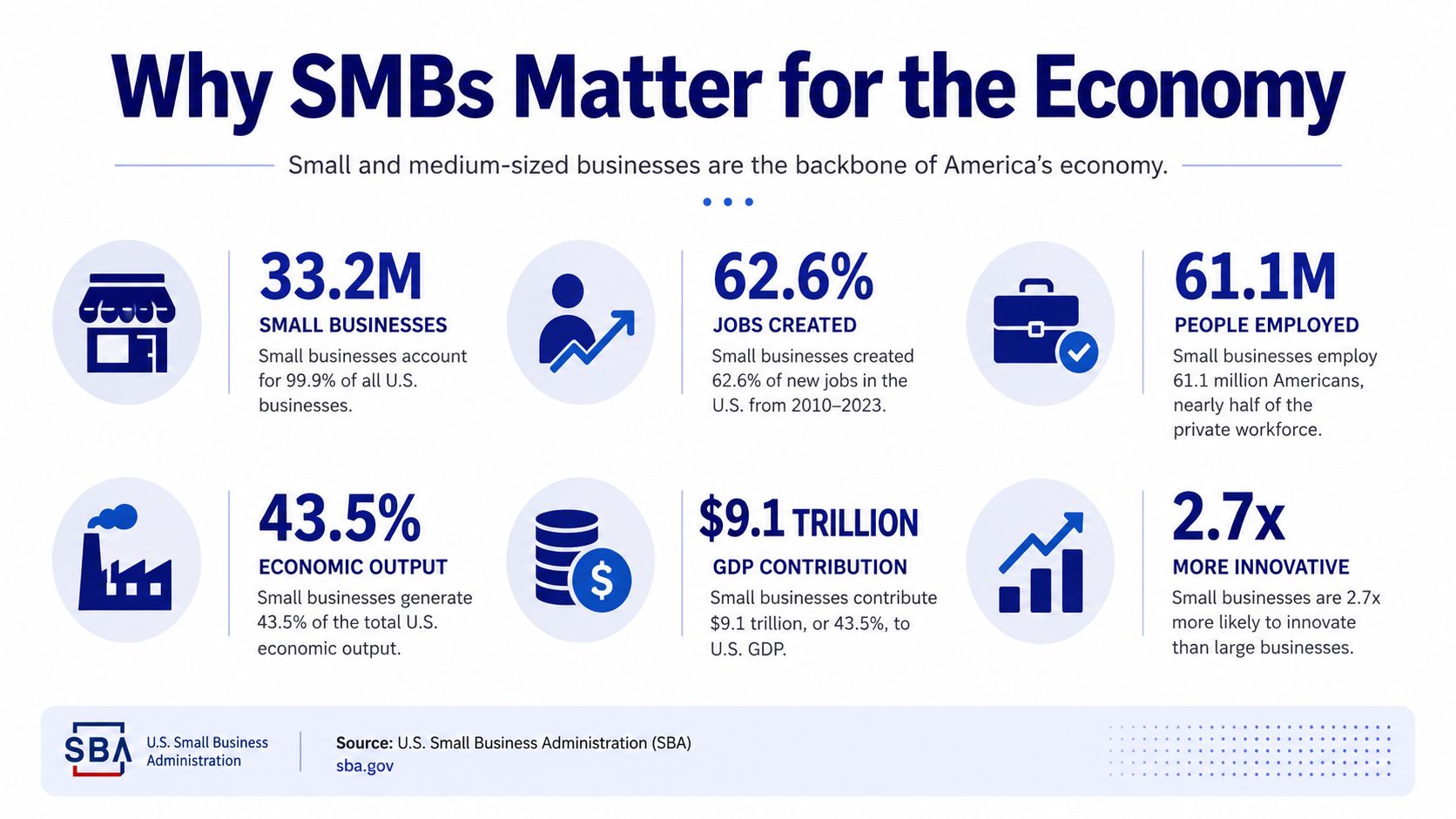
The broader U.S. data helps explain why the category matters so much. The SBA says small businesses account for 99.9% of all businesses in the United States, employ 62.3 million people, and generate 43.5% of U.S. GDP (SBA small business FAQ). That means SMBs aren't a side market, they're the main market structure.
Why SMBs Matter for the Economy
A neighborhood café, a small accounting firm, and a five-person software company may look unrelated, yet they all sit inside the same economic category. That category matters because SMBs are where a lot of hiring, spending, and day-to-day commerce happens.
Small businesses are central to the economy because they're everywhere. The SBA's numbers show that they make up 99.9% of all businesses in the U.S., employ 62.3 million people, and pay 38.7% of total private-sector payroll.
They also drive labor-market growth. Between March 2023 and March 2024, small businesses opened 1.1 million new establishments and produced a net increase of 1.2 million jobs, with small businesses creating about 9 out of every 10 net new jobs in that period. Over the longer stretch from 1995 to 2021, the SBA says small businesses generated roughly 17.3 million net new jobs, or about 62.7% of all net jobs created in that span (SBA small business job creation report).
Why the numbers change business strategy
Those figures explain why so many tools are built with SMBs first. If a product helps a smaller firm get paid, hire faster, or cut manual work, it reaches a very large part of the business economy.
The structure of SMB buying shapes the product itself. Smaller teams usually work with tighter budgets, fewer specialists, and less room for complex procurement. That makes them more likely to value simple setup, clear pricing, and tools that cover several jobs without demanding a big internal rollout.
A payroll platform for a ten-person company, for example, cannot rely on long training or a long list of approvals. A payment tool for a local retailer has to fit into a busy week, not a perfect planning cycle. Those constraints are part of the category, not exceptions to it.
Business rule: If a product saves time for a lean team, it often matters more than a long feature list.
The bigger point is that SMBs are not a side market. They are the operating layer where a huge share of economic activity happens, and that changes how companies design products, set prices, and sell across borders.
How SMBs Actually Operate Day to Day
A small business day can feel like several jobs stacked on one desk. The same person may answer customers, update software, track invoices, and keep operations moving. That reality helps explain why SMBs usually prefer tools that are quick to set up and simple to keep running.
Buying decisions follow that same pattern. Smaller companies often want fewer integrations, clearer pricing, and less setup friction because they do not have time for a long implementation cycle. They also tend to choose tools that the team can use on a busy afternoon, not systems that only make sense after a long internal rollout.
Service businesses show the point clearly. A staffing or support decision may start with a practical question about how much work can be handled in house, which is why a resource like the HR services provider guide can be useful for understanding outsourced help when internal teams are thin. The same logic shows up in billing, customer support, and payment workflows.
What that means for product teams
Product teams serving SMBs need to build around how these companies work. Short onboarding matters because the buyer is often also the operator. Clear pricing matters because budget decisions happen quickly. A clean path to value matters because no one has time to sort through clutter.
Keep setup simple: SMBs rarely want a long implementation project.
Limit handoffs: every extra approval step slows a small team down.
Make pricing predictable: cash-sensitive buyers want to know what they'll pay.
Reduce admin load: a generalist operator shouldn't need a specialist to run the system.
That is also why payment behavior should not be treated as a side issue. A small business may need a product that fits the way it bills customers, collects cards, or handles recurring charges, and a guide like accepting credit cards for a small business fits that kind of decision-making. In practice, the product has to support the buyer's daily flow, not just look good in a demo.
The main lesson is simple. SMBs buy for practicality. They do not have time for clutter, and they do not have teams built to absorb it.
What SMBs Mean for Product and Marketing Teams
If you're targeting SMBs, the first decision is definitional. Pick the market standard that matches the country and industry you serve, then keep it consistent across product, pricing, and messaging. That avoids the common mistake of applying one country's size threshold everywhere.
The second decision is operational. SMB customers usually care less about abstract feature depth and more about how fast a tool fits into a real workflow. A guide like best AI customer service for Shopify is useful in that context because it speaks to the kind of practical, small-team buying behavior many SMBs show.
A simple checklist for SMB-facing teams
Define the segment clearly: use the right employee, revenue, or turnover lens for the market.
Match the offer to the workflow: don't force enterprise onboarding on a small team.
Keep pricing easy to read: cash-conscious buyers notice complexity fast.
Support the payment habits of the market: customers may pay one way while the business prefers to settle another.
Localize internationally: don't assume U.S. and EU SMBs fit the same category.
For subscription businesses, a resource like SaaS subscription models helps reinforce why billing flexibility matters for smaller buyers. The same principle applies to onboarding, checkout, and customer support.
The takeaway is that SMB is a category with shifting boundaries. If you build for that reality instead of pretending the label is universal, your product and marketing decisions get clearer.
If you're building payments, checkout, or subscription flows for SMB customers, Suby gives you one API for card and crypto payments, plus native integrations with Discord and Telegram for paid access, subscriptions, and online communities. It's built for the way this article describes, customers pay the way they want, and businesses get paid the way they choose. Visit Suby to see how it supports that flow.
