

Gaspard LEZIN
SaaS Subscription Models: A Guide to Pricing & Growth
Explore the top SaaS subscription models for 2026. This guide covers tiered, usage-based, and hybrid pricing to help you boost revenue and reduce churn.
You're probably in one of two situations right now. You either launched with a price that felt reasonable and now suspect it's limiting growth, or you're still debating whether to charge per seat, per feature set, per unit of usage, or some mix of all three.
That uncertainty is normal. Pricing is one of the few decisions that touches product design, sales motion, onboarding, retention, forecasting, and cash collection at the same time. For global software companies, it also affects billing complexity, failed payments, settlement timing, and how much operational drag your finance team absorbs.
SaaS subscription models look simple from the outside. Charge monthly or annually, offer a few plans, collect renewals. In practice, the model you choose shapes who buys, how fast accounts expand, and whether your billing system supports growth or slows it down.
Table of Contents
Pricing changes acquisition and retention at the same time
Predictable revenue still needs the right structure
Flat rate works when the product is narrow
Per user pricing is intuitive but often leaky
Tiered pricing creates upgrade paths
Freemium is a growth model, not just a pricing choice
Why usage pricing spread so quickly
Why hybrid usually beats purity
Revenue metrics tell you if the model scales
Behavior metrics show whether customers actually use what they bought
Where global billing gets messy
Why settlement design matters as much as pricing design
Billing logic you need before launch
Operational controls teams add too late
A practical selection framework
Why Your SaaS Subscription Model Is a Growth Engine
Founders often treat pricing like a line item. It's not. It's part of the product.
The SaaS market is large enough that pricing decisions now carry strategic weight, not just financial weight. One industry tracker projects the global SaaS market will reach $300 billion in 2025, and the same research notes that hybrid models show a 21% median growth rate, compared with 19% for pure subscription models and 18% for pure usage-based models. It also reports that companies offer an average of 3.5 tiers to segment customers more effectively, according to BetterCloud's SaaS market statistics.
That matters because your subscription model decides more than how money comes in. It influences who can say yes quickly, how sales handles expansion, how product teams package value, and how finance forecasts recurring revenue. A weak pricing structure creates friction long before churn shows up in a dashboard.
Pricing changes acquisition and retention at the same time
A flat plan can reduce buying friction. It can also hide your best upgrade paths. A seat-based plan can be easy to understand. It can also punish adoption inside customer accounts if every added user feels expensive.
That's why strong SaaS subscription models usually map price to a clear value driver. Buyers should understand what they're paying for without needing a sales call to decode the page.
Practical rule: If your pricing page creates confusion, your sales team will inherit it, your support team will explain it, and your finance team will clean up the edge cases later.
The best operators think about pricing as system design. Not just monetization design.
Predictable revenue still needs the right structure
Recurring revenue gives companies room to plan hiring, support, infrastructure, and go-to-market. But predictability only helps if the model reflects how customers consume value. If it doesn't, you'll see the symptoms quickly: stalled upgrades, discount pressure, awkward enterprise exceptions, and renewal conversations that feel defensive.
If you want a broader commercial lens on why recurring revenue models changed software economics, this primer on how to understand subscription business models is a useful companion.
The Core SaaS Subscription Models Explained
Most SaaS companies don't start with a perfect model. They start with the least wrong one, then refine it. The key is understanding what each model is good at, and what problems it creates.
Flat rate works when the product is narrow
Flat-rate pricing means one product, one price, one package.
This works best when customers get roughly similar value from the product and don't need much packaging flexibility. Think niche tools with a tight use case, or early-stage products that want to reduce decision friction. For a small team selling one clear outcome, flat rate can speed up conversion.
The downside is obvious once customer types diverge. Small buyers may think the plan is too expensive, while larger buyers may get far more value than they're paying for. You also lose natural expansion paths unless you add services, add-ons, or a higher plan later.
Per user pricing is intuitive but often leaky
Per-user pricing, or per-seat pricing, ties revenue to headcount. Buyers understand it instantly, which is why it became common in B2B software.
It works when each added user clearly increases product value. Collaboration tools, workflow products, and internal systems often fit this pattern. Finance teams like it because it's easy to forecast.
But seat models create strange incentives. Teams delay adding users. Admins share logins. Managers ask whether every teammate really needs access. That reduces product spread inside the account, especially if the true value driver is activity, output, or automation rather than a person having a login.
Tiered pricing creates upgrade paths
For many vendors, tiered pricing is the default structure because it lets them segment buyers by feature depth, usage ceilings, and willingness to pay. Stripe's guide on tiered SaaS subscription pricing explains why it remains such a common pattern.
Done well, tiers help teams sell to different customer segments without custom quoting every deal. Done badly, they create feature confusion and decision paralysis.
Model | Best For | Pros | Cons |
|---|---|---|---|
Flat rate | Narrow products, early-stage tools | Simple to explain, low buying friction | Weak segmentation, limited expansion |
Per user | Team software, collaboration products | Familiar, forecastable, easy to budget | Can discourage adoption, invites seat scrutiny |
Tiered | Broad customer mix, products with clear packaging layers | Clear upgrade paths, better segmentation | Can confuse buyers if tiers are messy |
Freemium | Product-led growth, self-serve tools | Low barrier to try, strong top-of-funnel | Free users create support and infrastructure load |
A good tier structure usually answers three questions fast:
Who is this for
What limits change by plan
Why should someone upgrade
If buyers can't answer those in a quick scan, the packaging needs work.
Tiering works best when each plan feels like a coherent use case, not a random pile of gated features.
Freemium is a growth model, not just a pricing choice
Freemium isn't merely “free plus paid.” It's a deliberate bet that broad adoption, product familiarity, and self-serve conversion will outperform tighter access.
That can work well for products with low onboarding friction and obvious collaboration or habit loops. It works poorly when implementation is complex, support is heavy, or the free tier solves too much of the paid problem.
The biggest mistake with freemium is generosity without strategy. If free users consume real cost and never hit a strong upgrade trigger, you haven't built a funnel. You've built a subsidy program.
The Rise of Usage-Based and Hybrid Models
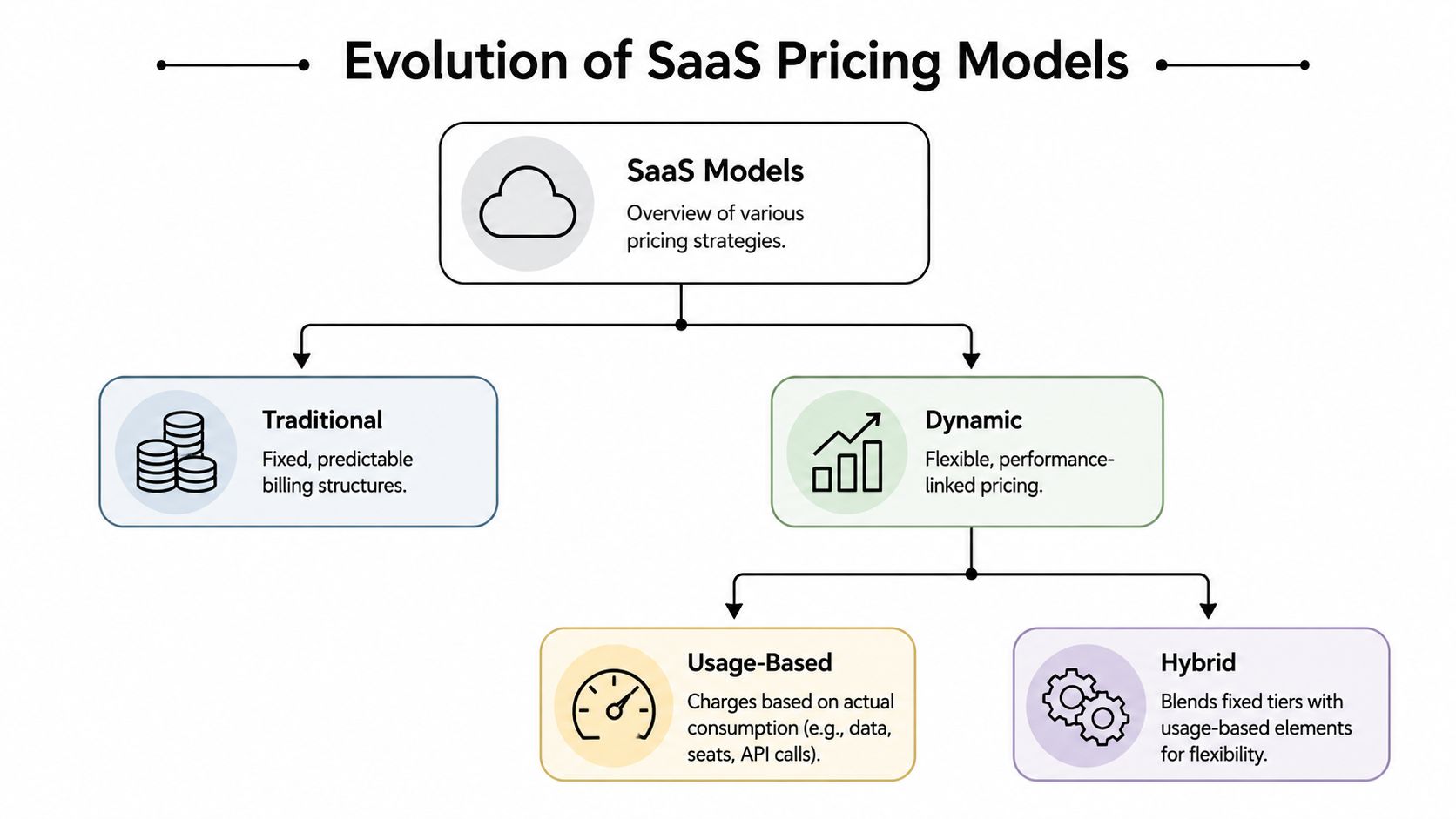
Usage pricing moved from edge case to mainstream. That shift is especially visible in API products, infrastructure software, and AI-heavy tools where customer value often scales with consumption rather than seat count.
Why usage pricing spread so quickly
A January 2025 survey of 100 SaaS companies found that 85% had already adopted usage-based pricing, and 78% of those companies adopted it within the last five years, according to Metronome's 2025 usage-based pricing report. That isn't a niche trend. It's a broad pricing shift.
The reason is straightforward. In many software categories, customers don't experience value in neat seat increments. They experience value through API calls, compute, transactions, storage, bandwidth, or workflow volume. A fixed subscription can feel arbitrary when actual demand changes week to week.
Usage-based pricing reduces that mismatch. Small customers can start without a heavy commitment. Larger customers can expand naturally as their activity grows.
Why hybrid usually beats purity
Pure usage pricing has one obvious problem. Finance teams dislike revenue volatility, and customers dislike surprise bills.
That's why many teams end up in hybrid territory. A base subscription creates predictability. A usage component captures upside and aligns expansion with customer demand. This model is especially practical when you need minimum account value, platform access, support coverage, or included capacity before overage charges begin.
Operationally, though, hybrid pricing is harder to run than it looks. You need trustworthy metering, clear billing events, and a way to control entitlements so that plan access matches what the customer bought. Metronome's guide to usage-based billing design is a helpful read if you're evaluating where metering complexity starts to affect packaging decisions.
A few patterns work better than others:
Base plus overage works when customers want a predictable starting bill with room to scale.
Tier plus usage ceiling works when you need packaging clarity but still want consumption alignment.
Commitment with metered expansion works when larger accounts need negotiated predictability without losing upside.
If customers can't estimate their future bill, they'll hesitate to adopt. If you can't explain the bill clearly, support volume will rise.
Teams also need the operational pieces behind the pricing page. Industry guidance on SaaS pricing systems emphasizes A/B testing, detailed usage telemetry, and centralized entitlement management because those are what let operators refine pricing instead of arguing about it in meetings.
Key Metrics to Track for Subscription Success
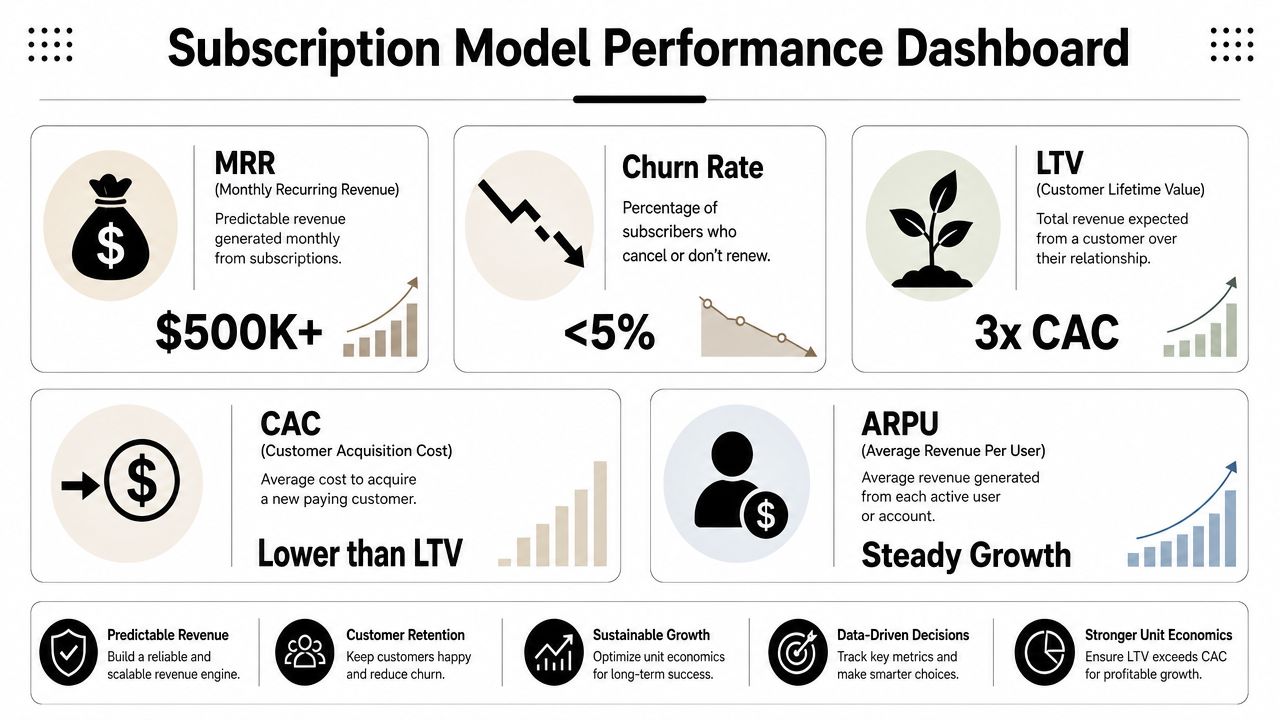
A pricing model isn't successful because it looks good on a slide. It's successful when the numbers show healthy expansion, manageable churn, and real usage.
Start with a dashboard view.
Revenue metrics tell you if the model scales
MRR and ARR are your operating heartbeat. Monthly Recurring Revenue helps you spot change quickly. Annual Recurring Revenue is useful for planning, board reporting, and understanding the shape of the business over a longer cycle.
ARPU tells you whether account value is moving in the right direction. If new signups are growing but ARPU is falling, your acquisition engine may be outrunning your packaging discipline. If ARPU rises while churn worsens, the pricing move may be overreaching.
LTV matters because it forces you to ask whether the model creates durable revenue or only short-term bookings. A company can look healthy on top-line recurring revenue while gradually losing customers before payback becomes attractive.
Here's the video I often recommend to founders who need a plain-language refresher on subscription metrics:
Behavior metrics show whether customers actually use what they bought
Many teams miss the underlying problem. Pricing gets blamed when usage is the issue.
BetterCloud's guidance on underutilized SaaS subscriptions makes an important point: the key cost driver is often low user activity, low feature utilization, and orphaned accounts after offboarding, not just list price. That's why tracking cost per active user and actual feature engagement is often more useful than staring only at headline subscription spend.
In practice, I'd watch these questions every week:
Are active users rising with paid seats
Which features correlate with renewals
Which segments expand without sales intervention
Do downgraded accounts still have high product activity
Are offboarded users still consuming licenses or access
Watch behavior before you rewrite pricing. Weak adoption can masquerade as a packaging problem.
Churn then becomes easier to interpret. If customers leave after low engagement, onboarding or product fit may be the issue. If they leave despite strong activity, your model may be capturing value poorly or charging on the wrong unit.
Navigating International Billing and Payments
The moment you sell outside one country, your neat pricing model starts colliding with operational reality. Customers want a familiar checkout. Your finance team wants predictable revenue. Your bank stack often gives you neither.
Where global billing gets messy
Cross-border SaaS billing breaks in small ways before it breaks in obvious ones. Card acceptance varies by market. Settlement timing can be inconsistent. Foreign exchange adds noise to forecasting. Finance teams reconcile one amount sold, another amount received, and a third amount reported after fees and conversion.
Monthly subscriptions make that worse because the friction repeats. It's not one delayed payout or one disputed charge. It's the same noise layered across renewals, upgrades, downgrades, and international customer support.
Common pain points show up fast:
Currency mismatch creates confusion for both customers and finance teams.
Settlement delays make cash forecasting less reliable than booked recurring revenue suggests.
Cross-border fees eat into margins that looked fine on the pricing page.
Local payment expectations affect conversion in ways product teams don't always see.
Why settlement design matters as much as pricing design
A lot of subscription advice stops at packaging. Operators can't. You have to care how revenue lands.
For internet-native companies, one workable approach is to separate the customer payment experience from the merchant settlement experience. Customers pay with a familiar method. The business receives a consistent settlement asset. That reduces conversion friction on the front end and reduces payout uncertainty on the back end.
If you're comparing payment infrastructure options, it's worth reading this practical guide on billing for SaaS. It focuses on the operational layer that many pricing articles skip.
One example is Suby, an API that lets businesses accept payments by card or crypto while receiving USDC. It also offers native integrations with Discord and Telegram for subscriptions, paid access, and online communities. That model is useful when you want customers to pay with cards, but you want revenue to settle in USDC instead of dealing with banking delays, payout uncertainty, or repeated currency conversion.
That's the operational point many teams miss. Your SaaS subscription model doesn't end at checkout. It ends when funds settle cleanly and your team can reconcile them without manual work.
An Implementation Checklist for Your Billing System
A billing setup usually fails in a predictable moment. A customer in Germany upgrades mid-cycle, a customer in Brazil pays with a local method your stack does not fully support, and finance sees a settlement total that does not match the invoices in the product. The pricing model was clear. The operating rules were not.
Billing logic you need before launch
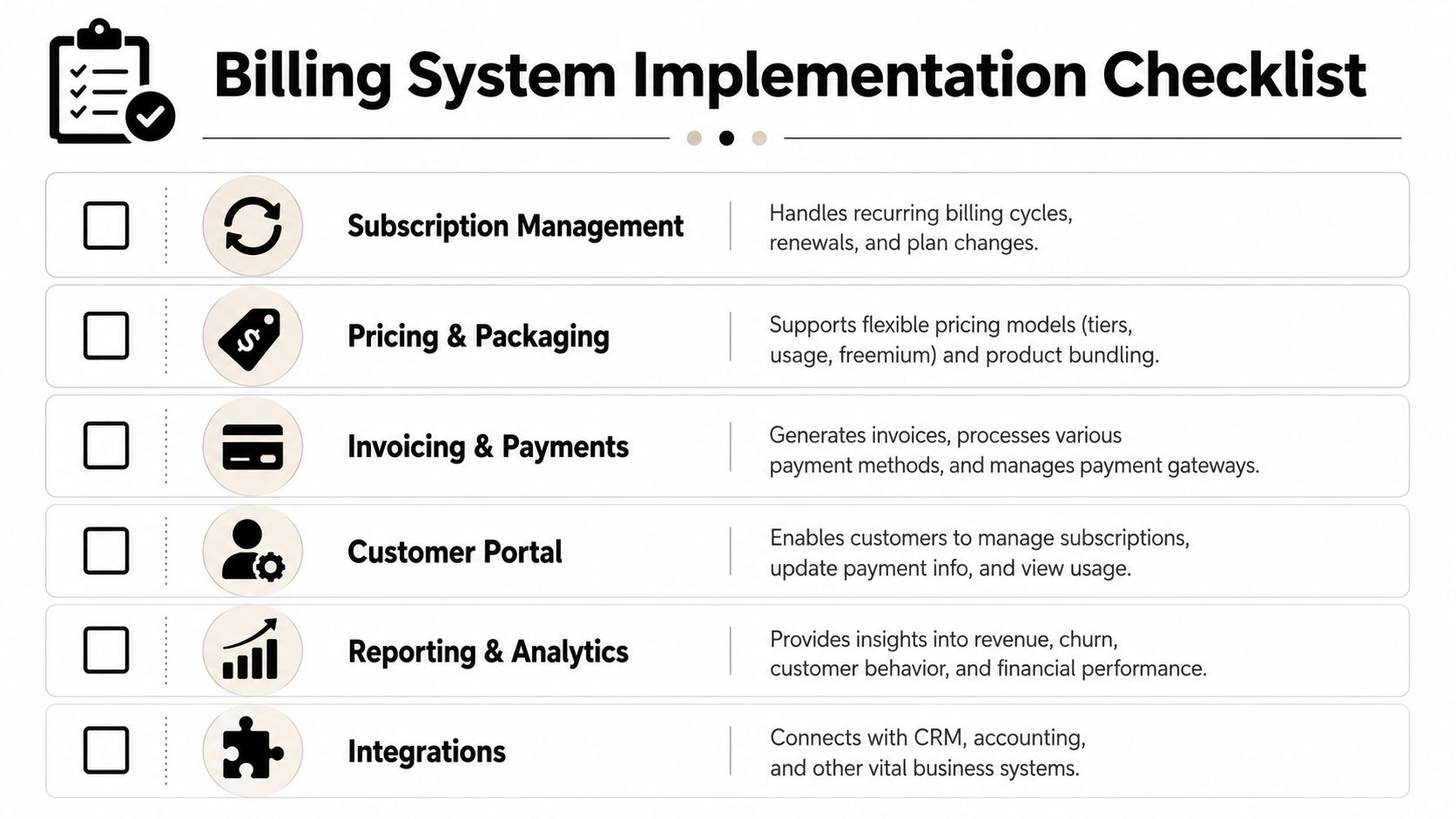
Start with the events that change revenue, access, and settlement. If those rules are vague, support writes exceptions by hand and finance cleans up the aftermath later.
Set your billing cadence first. Monthly reduces buying friction. Annual improves cash flow and can lower churn if onboarding is mature enough to justify the commitment. The trade-off is operational. Annual plans create larger refund disputes, more revenue deferral work, and more pressure to handle tax, invoices, and currency presentation correctly across markets.
Then define the rules for the events that break systems:
Upgrades and downgrades. Decide whether to prorate immediately, issue credits, or apply changes at renewal.
Trials. Define the conversion trigger, reminder flow, and what happens to access if payment fails at the end.
Plan changes. Specify whether entitlements change in real time or on the next invoice date.
Usage events. Lock down the meter definition, aggregation logic, overage treatment, and dispute process.
Taxes and invoice data. Decide what customer fields are required by market before the first invoice goes out.
Settlement and reconciliation. Define how payments map back to invoices, especially if you sell internationally and settle through multiple providers or currencies.
For teams evaluating tooling, this guide to subscription billing software is a useful reference for the features a billing stack should support before implementation starts.
Good billing logic also has to match how you price. If your packaging is still fuzzy, work through Sensoriium's pricing methodology before you encode plan logic into product, checkout, and finance systems. Reversing bad pricing decisions after contracts, invoices, and reporting are live is expensive.
Operational controls teams add too late
Invoices are the easy part. Exception handling is where margin gets lost.
You need automated invoicing, a customer portal for payment method updates, and a dunning flow that reflects customer value. An enterprise account should not get the same retry logic and cancellation timing as a self-serve trial. Refunds, credits, chargebacks, and contract overrides also need written rules, owner assignment, and auditability.
International billing raises the bar. A card failure is not just a failed renewal. It can also mean local payment preference mismatch, additional bank friction, FX differences between charge and settlement, or a tax field that blocked invoice acceptance. Teams that sell across borders need billing logs that support support, finance, and compliance, not just engineering.
A practical checklist looks like this:
Define the billable unit. Seat, workspace, transaction, API call, storage, or a hybrid.
Map entitlements to plans. Product access has to match packaging, invoices, and sales terms.
Automate lifecycle events. Renewals, cancellations, retries, and access changes should not depend on manual tickets.
Make invoices readable. Usage charges, credits, taxes, and overages should be easy for customers and finance to verify.
Set an exception policy. Refunds, disputed charges, credits, and contract-specific billing rules need approval paths.
Prepare for international edge cases. Support local payment methods where they matter, capture the right tax data, and decide how currency conversion affects invoices and settlement.
Review logs and webhooks. Billing failures often start as sync issues between product events, payment collection, and accounting records.
Billing should run quietly in the background. If every failed renewal turns into a manual investigation, the system is under-specified.
How to Choose the Right Subscription Model for Your Business
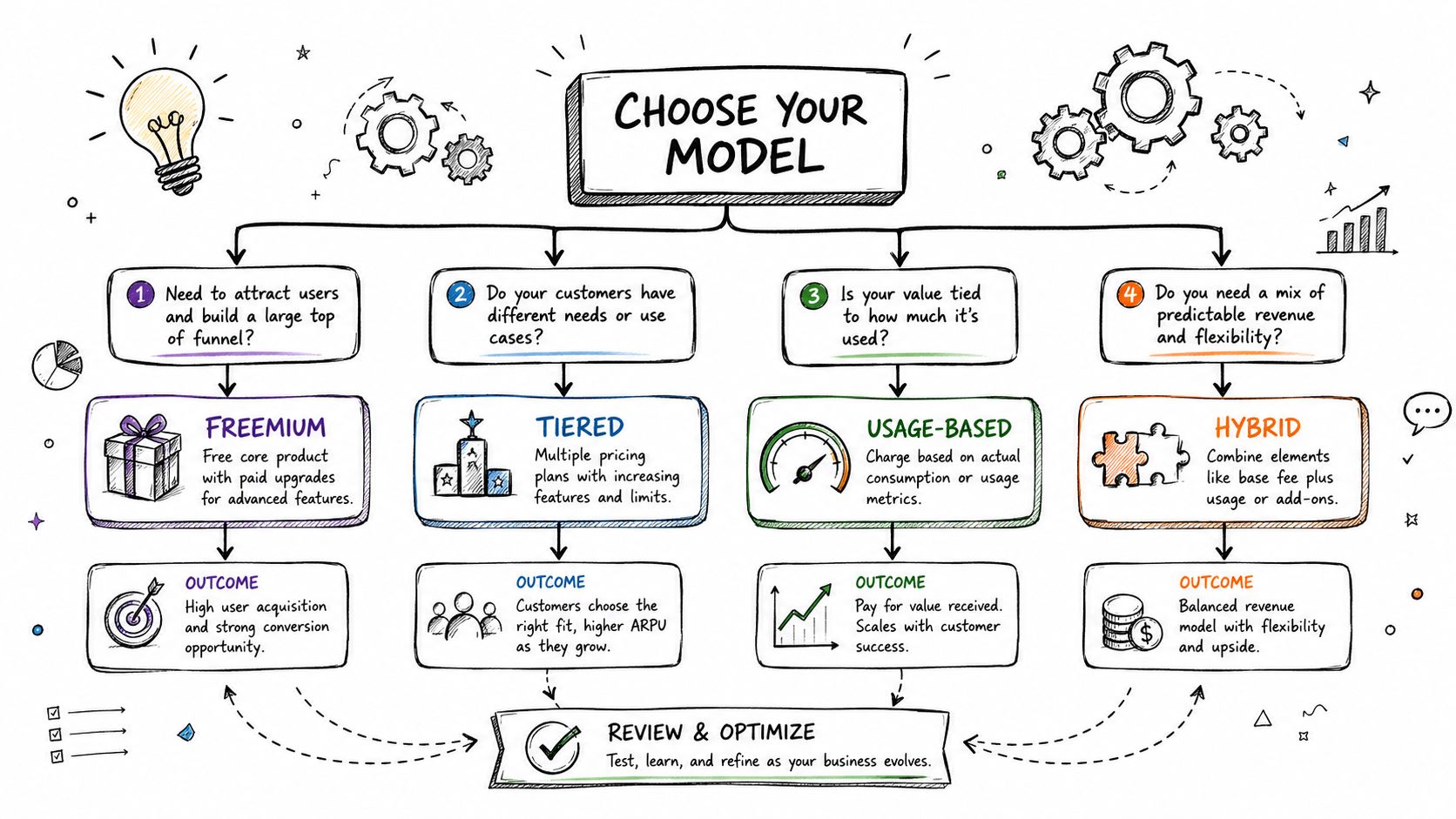
There isn't one correct answer. There's a best-fit starting point based on how customers receive value, how they buy, and how hard your billing operation can realistically be on day one.
A practical selection framework
If you sell B2B workflow software, start by asking whether value scales with seats or with feature depth. If teams buy by department size and admin control matters, per-user can work. If needs differ sharply by customer maturity, tiered packaging is usually cleaner.
If you run a self-serve B2C app, simplicity matters more than pricing elegance. Freemium can work if the free experience leads naturally to a paid habit. If not, a low-friction paid plan is often healthier.
If you operate an API-first, infrastructure, or AI-heavy product, avoid defaulting to seat pricing just because it's familiar. Consumption often tracks value more accurately. In those cases, usage-based or hybrid models usually make more operational sense.
If you monetize paid communities, memberships, or creator access, perhaps building on the best side hustle app for your niche, a simple recurring subscription often beats complex packaging. Keep the offer clear. Reduce checkout friction. Tie payment directly to access control.
For teams building pricing from customer value instead of guesswork, Sensoriium's pricing methodology is a solid framework to pressure-test your assumptions.
The best SaaS subscription models aren't the most clever. They're the ones customers understand, finance can forecast, product can enforce, and billing can run without constant exceptions.
Suby is a payment gateway and payment processor. Your customers pay with card, bank transfer, Apple Pay, Google Pay, Klarna, and more, or stablecoins, and you get paid out to your bank account, or directly in stablecoins (USDC, EURC) to your wallet, anywhere in the world, no bank account required. It gives you an API, recurring subscriptions, and native Discord and Telegram integrations for paid access. That matters for your SaaS subscription model because the work doesn't end at checkout: it ends when funds settle cleanly and your team can reconcile them without manual work.
