

Gaspard LEZIN
Billing API for SaaS Startups: A Practical Guide for 2026
Choosing a billing API for SaaS startups? Learn features, integration patterns, evaluation criteria, and launch checklists for global SaaS in 2026.
If you're trying to launch a SaaS and billing still feels like a maze, you're not alone. Most first-time founders start with the wrong question, they ask what payment tool to buy, then end up buried in checkout, subscriptions, invoicing, taxes, retries, and usage metering before they've even shipped a stable product.
The better question is simpler, what's the smallest billing stack that lets you get paid in month one without painting yourself into a corner? That's the right framing for a billing API for SaaS startups, because the billing layer is not just about taking money, it's about controlling how a customer relationship starts, changes, renews, fails, and gets recovered.
Table of Contents
The Three Pricing Primitives Every SaaS Billing API Must Support
Inside a Typical Billing API Flow From Checkout to Subscription
Subscription vs Usage-Based vs Invoicing APIs and When to Pick Each
Launch Checklist and Metrics to Monitor in the First 90 Days
What a Billing API Actually Does for a SaaS Startup
The first question founders usually ask is, “Do I need a payment gateway or a billing API?” Those are not the same thing. A gateway moves money, a billing API sits inside your product and manages the commercial lifecycle around that money.
Stripe's billing objects make the separation obvious. Product, Price, Customer/Payment Methods, Invoice, and PaymentIntent are distinct objects, and each invoice creates a PaymentIntent to try collection from a stored payment method Stripe billing APIs. That architecture matters because pricing, customer identity, and payment execution should not be welded together into one fragile flow.
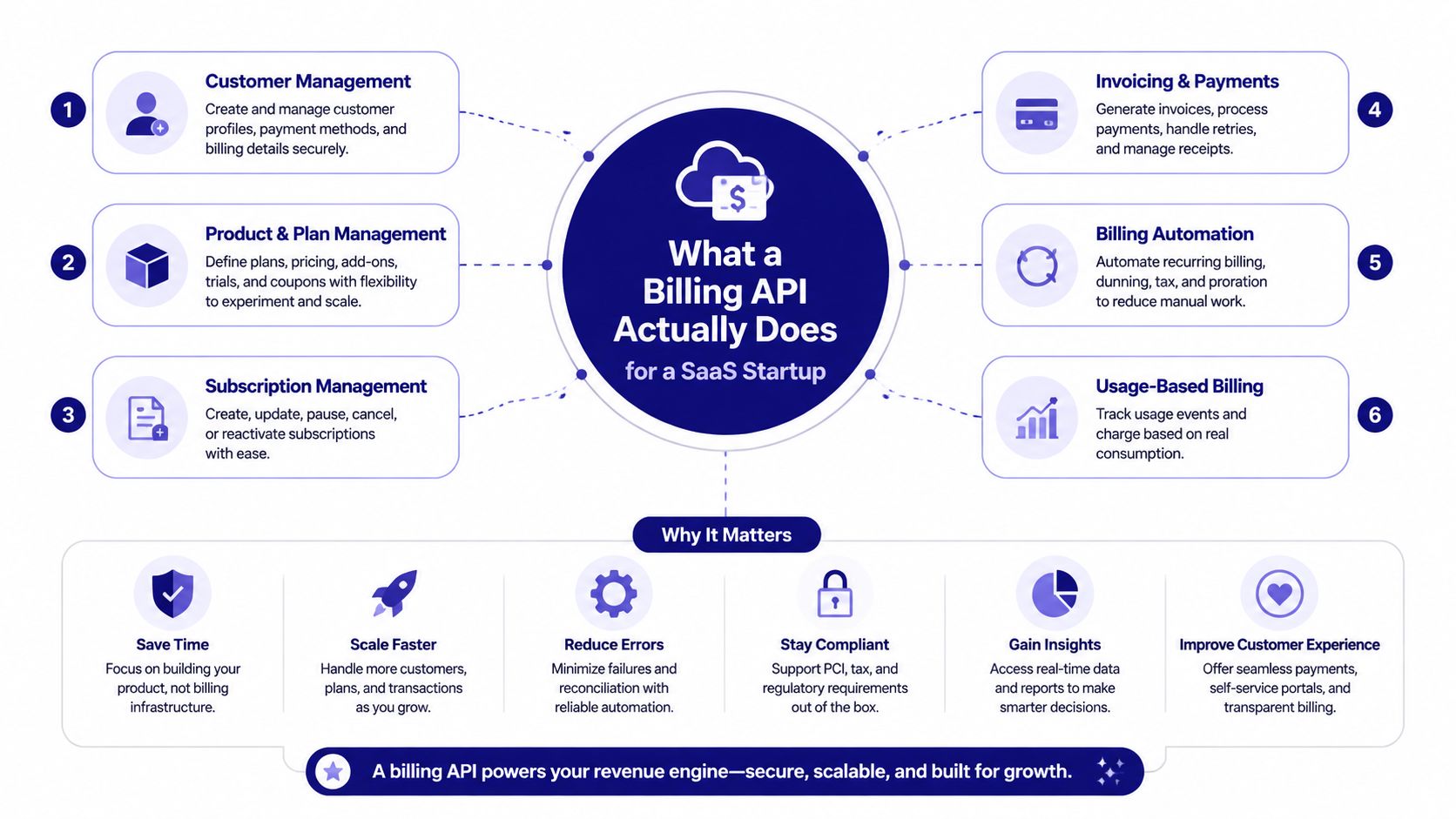
What belongs in the billing layer
A billing API handles the record of who the customer is, what they bought, what plan they're on, what they owe, and what happens when payment fails. That includes upgrades, downgrades, renewals, refunds, and cancellation logic. A SaaS payment API is defined this way too, as software that enables digital transactions inside the program itself, including upgrades, cancellations, refunds, and subscriptions SaaS payment API definition.
Practical rule: if a change affects entitlement, renewal timing, or invoice state, it belongs in billing logic, not in the checkout form.
This is why billing is an architecture decision, not a vendor checkbox. If you force everything into checkout, you'll rebuild the same rules later in a less controlled place. If you keep billing separate, you can swap payment methods, adjust plans, and handle retries without rewriting your whole application.
For founders building pipeline building for software, a clear mental model saves weeks of confusion. pipeline building for software is useful here because it shows how much process sits behind a simple “pay now” button.
The Three Pricing Primitives Every SaaS Billing API Must Support
A billing stack only stays sane if you know which primitive you're buying. Subscription billing, usage-based billing, and invoicing solve different problems, and founders get into trouble when they try to make one tool do all three before they need it.
Subscription billing is the right fit when revenue is seat-based, tiered, or recurring on a fixed cadence. A project management app charging per seat fits here. So does a CRM with plan tiers and monthly renewals.
Usage-based billing is for consumption. The model charges for actual usage, such as API calls, tokens, compute, or data transfer, and it relies on metering, rating, and invoicing usage-based API billing. An AI API billed per token belongs here, not in a seat-based subscription wrapper.
Invoicing is for sending a bill document and tracking settlement, often in B2B flows with custom terms. A B2B agency sending PDF invoices to enterprise clients doesn't need a complex recurring stack on day one. It needs clean invoice creation, delivery, and collections.
Primitive | Best fit when | Example SaaS | Watch out for |
|---|---|---|---|
Subscription billing | Revenue is mostly recurring and predictable | Project management tool with monthly seats | Overbuilding usage logic too early |
Usage-based billing | Revenue tracks consumption | AI API billed per token | Bill shock if customers can't see usage |
Invoicing | Customers pay on custom terms | B2B agency with net terms | Forcing self-serve flows onto manual buyers |
The hard truth is that the best billing API is often the one with the smallest scope that fits today's model. Seed-stage teams don't need a monolith. They need the primitive that matches how customers are already willing to pay.
If you want a deeper view on usage billing before you commit, this internal guide is worth reading, usage-based billing.
Inside a Typical Billing API Flow From Checkout to Subscription
A SaaS billing flow starts before the charge clears. You create the customer, attach a payment method, define the product and price, start the subscription, and wire your system to listen for lifecycle events. Founders usually underestimate that sequence because the API calls look simple. The state changes are where billing integrations get messy.

Where the engineering work happens
The first layer is object creation. Then comes the lifecycle, which means changes over time, not just the first charge. Stripe's billing model keeps pricing objects separate from customers and invoices, which is the right shape when a user upgrades mid-cycle or a payment method changes.
The next layer is reliability. A billing API design guide from Vantage says server-to-server integrations should use API key authentication, user-facing apps should use OAuth 2.0, and any POST that creates a financial record should accept an optional X-Idempotency-Key billing API design guide. That is the part that prevents duplicate charges when your app retries the same request.
Your webhook handler should be idempotent too. If
invoice.paidarrives twice, your app should update state once and ignore the duplicate.
Why webhooks and retries matter
Billing does not stop when the card is charged. Failed payments, retries, and proration happen after checkout, and they affect access. Your app has to trust webhooks for subscription state transitions and reconcile them cleanly in your own database.
That matters because the billing system should sit behind your product logic, not drive it. Plan upgrades, downgrades, renewals, and payment retries all happen while the customer still expects the app to behave normally. If you tie entitlements too tightly to charge success, a failed payment can break access in ways that feel random to users.
For SaaS startups, the right billing API keeps the core product stable while billing state changes underneath it. Start with the smallest flow that matches how customers buy today. If you need subscriptions plus gated access, Suby is one API-first option that also supports cards and crypto, and it includes native Discord and Telegram integrations for paid communities. Treat that as a product choice only after the billing primitives match your current model.
Subscription vs Usage-Based vs Invoicing APIs and When to Pick Each
Founders waste time when they buy for the future instead of the present. A big platform can look comforting in a demo, but if your revenue model is still changing, the wrong abstraction will slow you down.
Primitive | Best fit when | Example SaaS | Watch out for |
|---|---|---|---|
Subscription API | Plans are mostly fixed, recurring, and self-serve | Seat-based collaboration tool | Overcomplicating pricing before product-market fit |
Usage-based API | Consumption is the value metric | AI model endpoint or infrastructure tool | Customers need clear usage visibility |
Invoicing API | Sales are custom, manual, or contract-driven | Agency or enterprise services business | Forcing automatic renewals on custom deals |
Subscription APIs work best when the customer can understand the bill without a finance review. Usage-based APIs work when the bill maps directly to consumption, but only if you can meter accurately and explain the unit clearly. Invoicing APIs belong in B2B motion where custom terms, approval chains, and net terms are normal.
The decision is not philosophical, it's operational. If you start with invoicing because that's how customers already buy, you can always layer subscriptions later. If you start with subscriptions when sales are still custom, you'll spend your early months fighting your own billing system.
My rule of thumb: don't buy more billing than your current go-to-market motion needs.
The same logic applies to usage. If your product bills by tokens, API calls, or compute, usage-based billing is not a nice-to-have. It's the billing model. But if you're still selling annual contracts with a hand-signed order form, forcing usage into the first version only adds noise.
Must-Have Features in a Modern SaaS Billing API
Once customers are paying, some features stop being optional. The first is idempotency. Every financial POST should be safe to retry, because network failures and duplicate submits happen all the time billing API design guide.
The second is authentication. Server-to-server flows should use API keys, and user-facing billing access should use OAuth 2.0 where customers are granting access on behalf of themselves billing API design guide. If a vendor can't describe both clearly, keep moving.
The features that actually protect revenue
You also need webhooks for state changes, because billing doesn't live only in your frontend. Failed renewals, successful payments, cancellations, and upgrades should flow back into your app in a way your database can trust.
Dunning matters once failed cards start showing up. That's the difference between a temporary payment issue and involuntary churn. Proration matters any time someone upgrades or downgrades mid-cycle, because founders need to know exactly how the invoice changes.
The last layer is data freshness. Some billing systems sync usage or resource-level costs every six hours, some in real time, and some with no hard latency guarantee billing API design guide. If you're showing customers a usage dashboard, that timing difference becomes a trust issue fast.
For teams that want a practical checklist before they ship, the internal guide billing for SaaS is a solid companion to this decision.
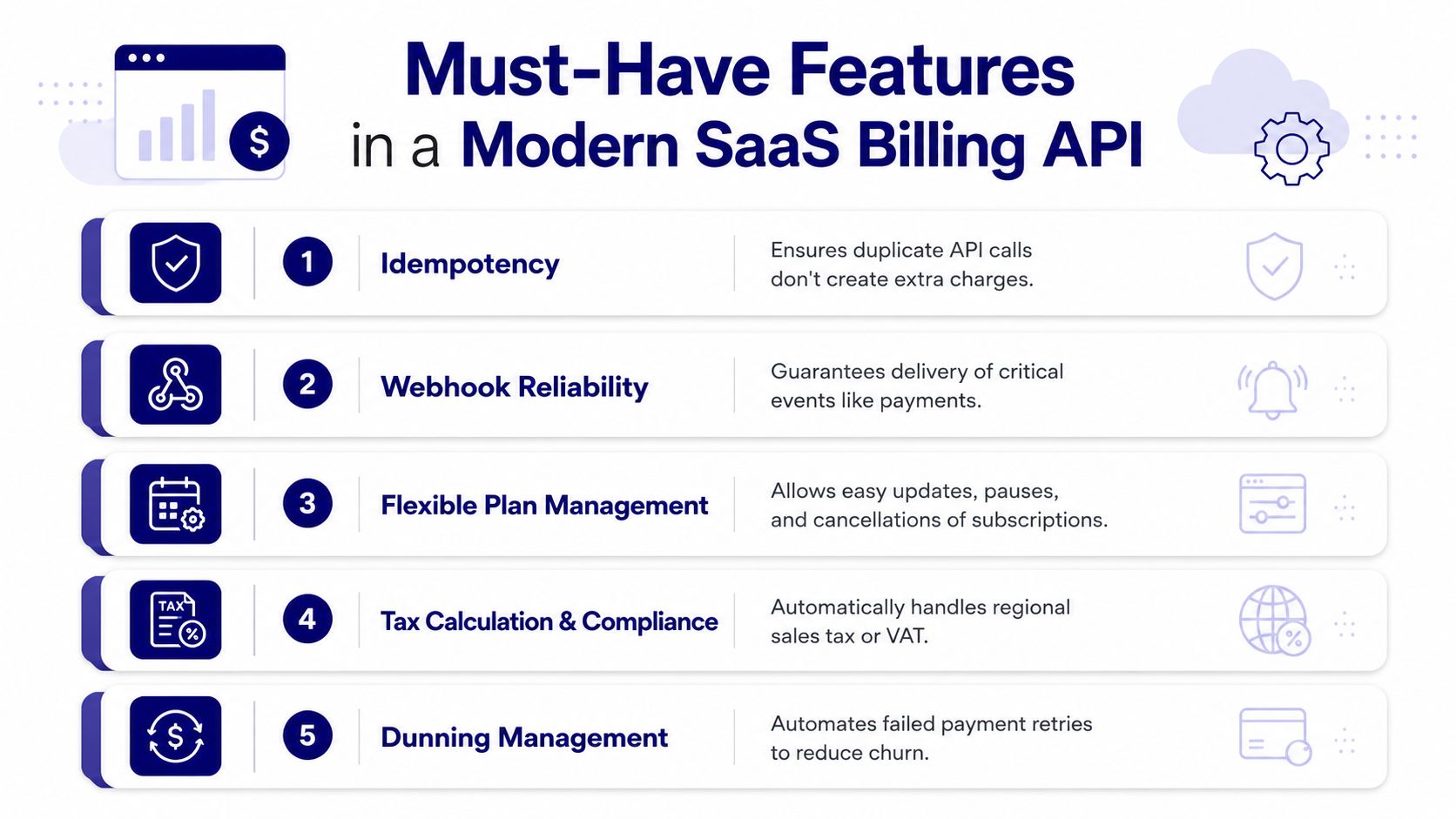
Tax, multi-currency, and dunning are not premium extras. They're what keep billing from breaking when you leave your home market.
Evaluation Criteria Founders Often Miss
Most vendor pages focus on features. That's not where the pain shows up. The things that hurt you later are data freshness, webhook reliability, sandbox realism, support quality, and migration tooling.
Usage spikes are the biggest trap for API-first and AI products. If customers can't see what they're consuming, a single large bill can become a trust problem instead of a revenue event. The operational failure isn't charging usage, it's charging usage in a way the customer didn't expect.
What to test before you commit
Test the sandbox with real event volumes, not toy examples. A billing system can look fine in a demo and still fall apart under your actual usage shape. That's especially true when the product meters API calls, tokens, compute, or other variable units.
Check whether the vendor gives you clear sync rules. If usage data arrives late, your dashboard and invoices will drift. That drift creates support tickets, manual credits, and arguments over what was consumed.
If the sandbox can't mimic production event volume, the demo doesn't matter.
Support matters more than founders want to admit. Billing problems sit on the boundary between product, finance, and customer success. When something breaks, you need a vendor that can answer quickly and clearly, not one that hides behind docs.
Migration tooling is another quiet filter. You might start with invoices, then move to subscriptions, then add usage. If the system makes those transitions painful, it's too rigid for a startup that's still learning its pricing motion.
Launch Checklist and Metrics to Monitor in the First 90 Days
Before launch, harden your webhook endpoint and make sure your handlers are idempotent. Separate staging and production keys, and verify that your team can't accidentally run live money through test logic.
You also need refund and dispute paths, plus a rollback plan if the integration misbehaves. If a billing release fails in production, you want a controlled fallback, not a panic patch.
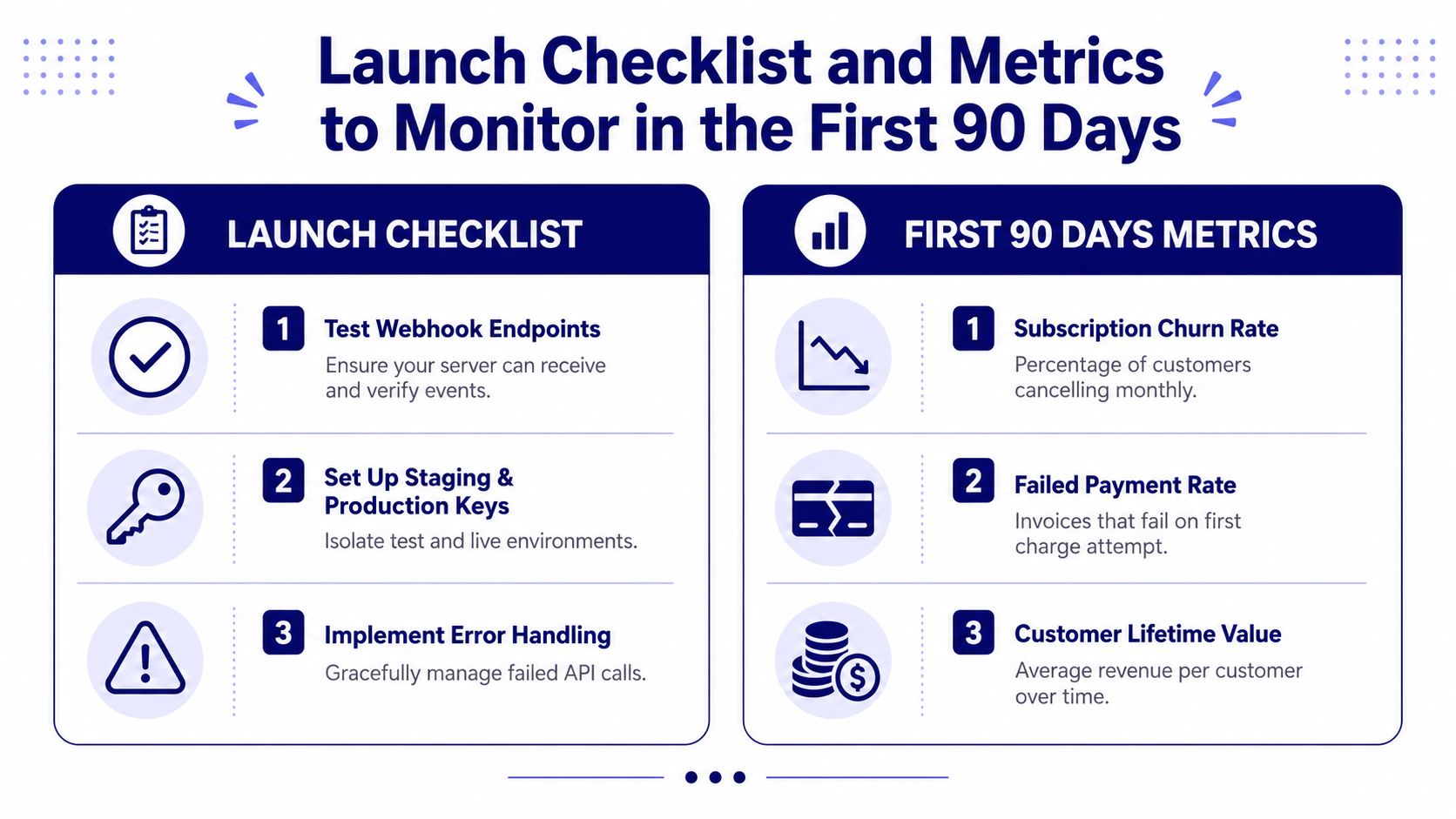
What to watch after launch
The first signal is payment success. If charges are failing, something in your flow is wrong, whether it's payment methods, retries, or your webhook sync. The second is involuntary churn, because failed renewals eat recurring revenue.
You should also track how long it takes to recover from a dunning cycle. That tells you whether recovery logic is working or just creating noise. Refund rate and dispute rate matter too, because they reveal whether the customer experience is aligned with the billing experience.
Average revenue per customer by plan helps you spot pricing drift. If one plan is underperforming, the issue might be packaging, entitlement design, or a bad upgrade path.
Going Global Without Bolting on Extra Vendors
The simplest way to scale billing internationally is to accept more payment methods on the way in and settle in the currency you want on the way out. Most startups don't need a separate vendor for every country. They need one stack that handles the merchant and customer sides cleanly.
Suby is one example of that model. It positions itself as payment infrastructure for the global internet economy, with customers able to pay by card, wallet, bank, or crypto, and merchants choosing whether to receive funds to a bank account or in stablecoins like USDC Suby documentation. The product is presented as one system with four uses, Suby Payments, Suby Crypto, Suby Gating, and Suby Invoicing.
Where this matters for SaaS founders
If you sell across borders, the merchant side matters as much as checkout. A stack that can settle into a bank account or stablecoins, while keeping one balance view, reduces the need to bolt on separate payout workflows. That's especially useful when your customer wants to pay one way and your business wants to receive another.
Suby also documents native integrations for Discord and Telegram, which matters if your product includes paid communities, gated courses, or subscription access inside messaging platforms Suby documentation. That's a different use case from standard SaaS subscriptions, but it's still part of the same billing problem, who gets access, when, and after which payment event.
For teams comparing settlement and merchant-of-record style trade-offs, the internal guide merchant of record gives a useful framing. It's worth reading before you decide how much billing and tax complexity you want to own yourself.
Pricing depends on the payment method used, so the right move is to check the pricing page for exact figures instead of assuming a flat rate Suby pricing. That's the only honest way to compare it with anything else.
If you want a billing API that fits how your startup sells, not how a vendor demo looks, take a close look at Suby. It lets businesses accept card or crypto payments through API-first flows, and it also supports native Discord and Telegram use cases for subscriptions and paid access. Start there if you want one stack that can handle getting paid, access control, and settlement without forcing a monolith on day one.
