

Gaspard LEZIN
Calculation of ARR Made Simple with Formulas and Examples
Learn the calculation of ARR with clear formulas, worked examples, and edge cases for upgrades, downgrades, and churn. Avoid common pitfalls and miscounts.
You're in the middle of a board prep, the MRR dashboard says one thing, the billing export says another, and someone wants to know why the ARR number changed again. That's usually the moment founders realize calculation of ARR is less about a formula and more about choosing the right lens for a subscription business. Get that lens wrong, and you end up defending a number instead of using it.
Table of Contents
What ARR Really Measures and Why It Matters
ARR, or Annual Recurring Revenue, is the annualized value of recurring subscription income. In practice, it's the number that tells you what your contracted revenue looks like on a clean yearly basis, not what happened to hit the bank this month. That's why SaaS finance teams use it to compare monthly, quarterly, and annual billing on one common scale, rather than arguing about calendar timing.
ARR is a recurring revenue lens, not a catch-all revenue label
A founder can collect cash quickly and still have a weak ARR base. That's because ARR should reflect contractually recurring revenue, not setup fees, services, or other one-time items. It also needs to be distinguished from accounting rate of return, which shares the same abbreviation but is an investment metric, not a subscription metric. HighRadius' explanation of accounting rate of return is useful if you ever need to separate the two in a meeting.
ARR matters because board members and investors want to know what part of revenue behaves like a repeatable subscription engine. Monthly collections can hide billing cadence, annual contracts, and churn timing. ARR gives you the normalized view, while MRR, bookings, and ACV each answer a narrower question.
Practical rule: if the revenue wouldn't still make sense after you strip out one-time items and normalize the billing term, it probably doesn't belong in ARR.
For a deeper operator's view of retention and ARR quality, Querio's piece on mastering SaaS retention ARR per head is a smart companion read. It's especially helpful when you're trying to connect the metric to team efficiency, not just top-line growth.
The Two Core Formulas for Calculating ARR
A founder can get to ARR two different ways, but the right method depends on how clean the subscription book is. If billing is straightforward, the shortcut is usually enough. If contracts vary by term, customer, or invoice cadence, the contract-level approach is the one I would trust in a board meeting.
Shortcut method using MRR
The quickest route is ARR = MRR × 12. If a company has $50,000 MRR, its ARR is $600,000, because monthly recurring revenue is annualized across 12 months (Wall Street Prep). If revenue is billed quarterly, the annualization factor is 4 instead of 12 (HiBob).
This shortcut works well when the recurring base is clean and the product behaves like a standard subscription. It is fast, easy to explain, and fine for a quick read on run rate. It starts to break down once one-time charges, uneven billing cycles, or other non-recurring items slip into the number.
Contract-level method using customer contracts
The more defensible approach starts with each active contract. You take the contract value, divide it by the contract term in years, then add up the annualized amounts across the active customer base (HiBob). That is why a customer paying $1,200 per year, $100 per month, or $300 per quarter all map to the same $1,200 ARR once annualized (Paddle).
This method holds up better when billing is not uniform. It strips out the noise and makes the math easier to defend when someone asks why the number moved. It is also the better choice when you need to exclude non-recurring lines before annualizing them.
A practical way to separate the two is simple. The MRR shortcut shows the run rate from the current recurring base. The contract-level method shows what each active agreement contributes after normalization.
Method | Formula | Best use case |
|---|---|---|
MRR shortcut | MRR × 12 | Simple subscription billing |
Quarterly shortcut | Quarterly recurring revenue × 4 | Quarterly invoicing |
Contract-level | Contract value ÷ contract years, then sum | Mixed terms, board-ready reporting |
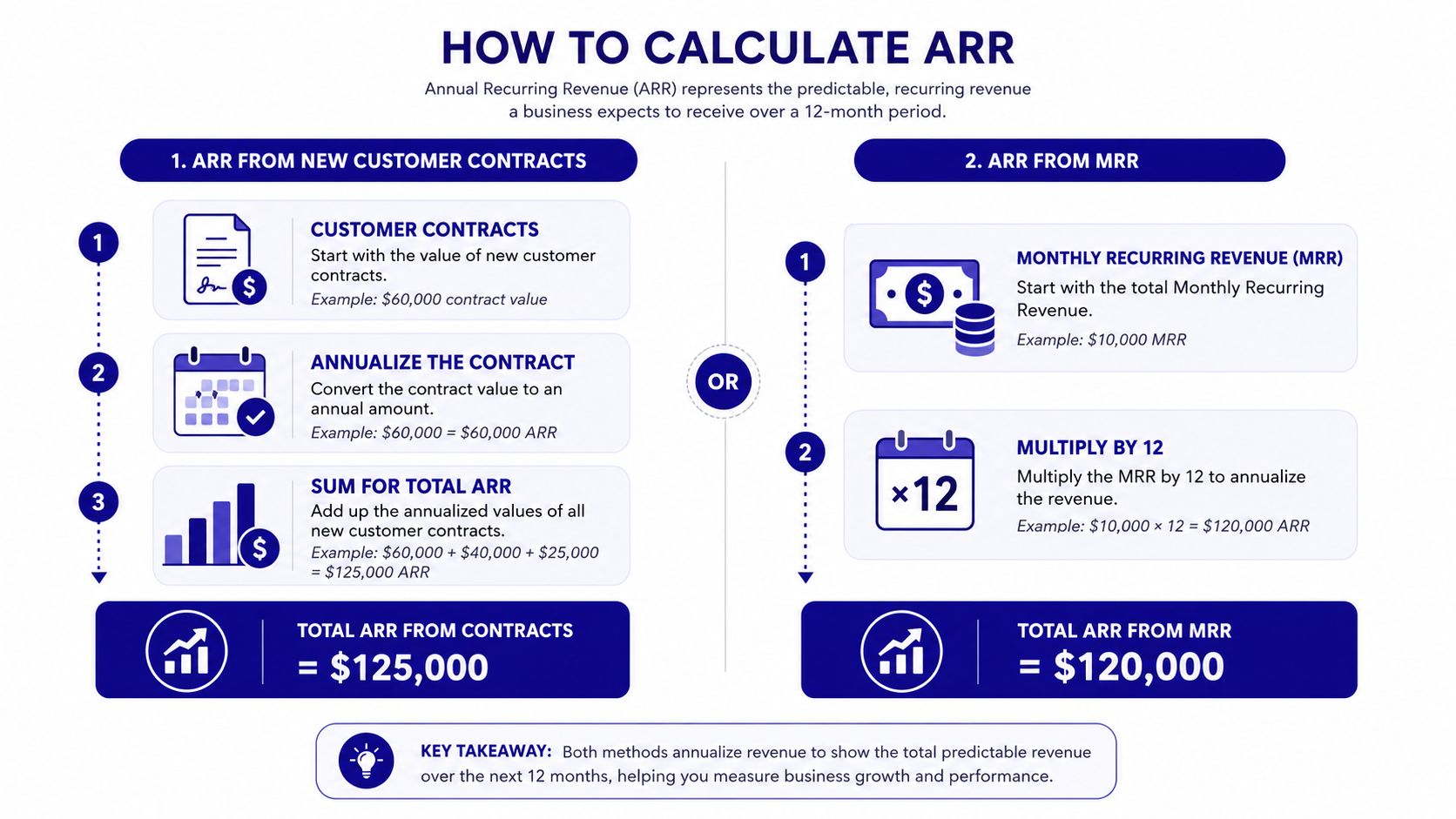
The cleanest check is whether both methods land on the same business. If they do not, the problem is usually in the inputs, not the formula.
Reconciling ARR With New Expansion Contraction and Churn
Static formulas are useful, but they don't tell you how ARR changed from one quarter to the next. Finance teams usually need the roll-forward view, because that's where the story lives. It shows whether growth came from new logos, expansion, or a shrinking churn base.
Build ARR from the ending balance
A practical roll-forward starts with last quarter's ending ARR and then moves through the customer motions that changed it. You add new ARR from new customers, add expansion ARR from upgrades and cross-sells, then subtract contraction ARR and churn. That same logic is reflected in the way finance teams reconcile churn internally, and the related workflow is worth keeping close with a resource like calculating churn rate.
The value of the reconciliation isn't just accuracy. It shows whether the business is growing because the product is expanding inside accounts or simply because new logos are masking attrition.
Here's the worked example. Start with $500,000 ARR. Add $80,000 in new ARR and $30,000 in expansion ARR. Then subtract $20,000 in contraction and $40,000 in churn. The ending ARR is $550,000.
Component | Value (USD) | Effect on ARR |
|---|---|---|
Starting ARR | $500,000 | Beginning balance |
New ARR | $80,000 | Increases ARR |
Expansion ARR | $30,000 | Increases ARR |
Contraction ARR | $20,000 | Decreases ARR |
Churn | $40,000 | Decreases ARR |
Ending ARR | $550,000 | Final balance |
This structure matters because it turns ARR from a headline number into a management tool. A board can see whether growth is broad-based or fragile. A finance lead can see where the base is leaking.
The roll-forward also pairs naturally with tracking churn in more detail, especially when cancellations and partial contractions happen in the same period. If you're building a metric pack, the ARR bridge should sit next to the churn analysis, not buried in a footnote.
Upgrades Downgrades and Churn in ARR Calculations
Upgrades, downgrades, and churn are really one decision tree. The only thing that changes is direction. If the customer pays more on a recurring basis, ARR goes up. If they pay less, it goes down. If they leave entirely, it drops out.
Follow the contract, not the headline change
A customer on a $1,200 annual plan who upgrades to $1,800 has generated expansion ARR. If that same customer later downgrades to $1,500, the ARR should step down at the moment the lower recurring commitment takes effect. Timing matters more than the size of the adjustment, because ARR is supposed to reflect the current recurring base, not the average mood of the quarter.
Teams often get sloppy with partial refunds, paused subscriptions, and free-trial conversions. If a customer pauses service, you need to decide whether the recurring obligation still exists. If a refund or credit reverses revenue, it shouldn't stay inflated in ARR. If a trial converts into a paid subscription, that's the point where recurring revenue begins.
The internal logic is straightforward. Upgrades and cross-sells expand ARR. Downgrades and seat reductions contract ARR. Full churn removes ARR entirely. That's the ledger rule finance teams should use every time.
For prorations, the cleanest explanation is to separate the billing event from the recurring commitment. The full treatment on prorated charge meaning helps when you're sorting out whether a mid-cycle price change should affect ARR immediately or only after the new term starts.
Useful distinction: ARR follows the recurring contract value, not every invoice line that happens to be raised during the month.
That distinction keeps one-off billing noise out of your annualized number. It also prevents the classic mistake of counting the same customer twice, once at the old rate and again at the new one.
Common Pitfalls and How to Avoid Inflating ARR
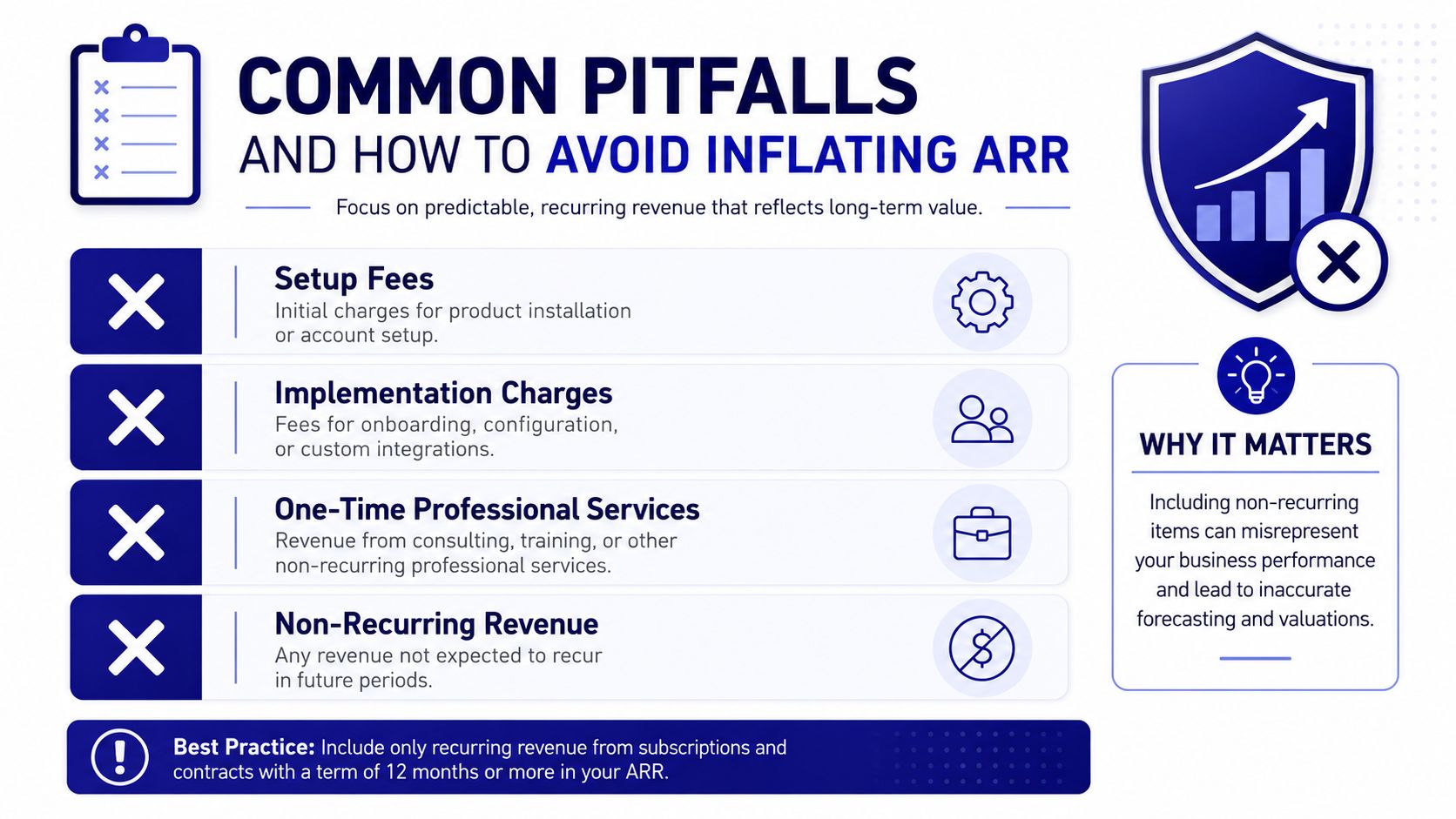
The biggest ARR errors come from including things that feel recurring but aren't. Setup fees are the usual offender, but implementation charges, one-time professional services, non-recurring add-ons, refunds, and credits can all distort the number in the same way. A defensible ARR calculation excludes those items and keeps only the recurring base.
Exclude non-recurring lines before annualizing
ARR should not absorb implementation or onboarding revenue. It also shouldn't absorb one-time professional services, because those don't recur by contract design. Chargebee's glossary on annual recurring revenue makes the exclusion logic explicit, and it aligns with how board-level reporting usually gets rebuilt anyway.
That same discipline matters for revenue recognition. If the revenue line doesn't belong in recurring revenue, it shouldn't be smuggled into ARR through a spreadsheet shortcut. The cleanest reference point for that distinction is the treatment of revenue recognition in Stripe-related workflows, because it keeps recognition and recurring metrics from getting blended together.
For usage-based contracts, the annualization cadence changes. Ordordway's guidance on calculating ARR for usage-based pricing points to annualizing the most recent recognized usage revenue rather than relying on a long-average that can hide the current run rate. The common practice is to take the most recent quarter's recognized usage revenue and multiply it by 4. If the business is volatile, trailing-twelve-month revenue is usually less noisy.
Don't mistake a clean number for a true number
Many founders overstate ARR without meaning to. A large usage spike can make one month look like a permanent step-up, but that doesn't mean the revenue base changed. The more variable the business, the more careful the annualization has to be.
A practical reading order helps here:
Setup fees and implementation charges: exclude them from ARR because they're one-time.
One-time professional services: exclude them for the same reason.
Credits and refunds: subtract them if they reverse recurring value.
Usage revenue: annualize the most recent recognized period, not a lucky spike.
That's the same discipline a strong FinOps operator would use. If you want a broader view of the discipline behind the numbers, the role of a FinOps analyst is a good mental model for how careful cost and revenue tagging protects reporting quality.
The boring adjustment is usually the correct one. In ARR reporting, boring beats impressive.
Putting It Together Step by Step
A clean ARR workflow doesn't need a massive project plan. It needs a repeatable habit. The point is to make the number easier to trust every time the books close.
Use the same four moves every cycle
Start by extracting active contracts. Then separate recurring lines from one-time lines so setup fees and services don't slip in. Normalize every billing cadence to annual terms, whether the customer pays monthly, quarterly, or annually. Finally, reconcile ending ARR into new, expansion, contraction, and churn buckets so the metric stays consistent quarter over quarter.
A short checklist works well in practice:
Extract active contracts.
Split recurring from non-recurring items.
Normalize each billing cadence to annual terms.
Reconcile the bridge into movement buckets.
If the ARR number can't be rolled forward from the prior period, it's usually not ready for a board deck.
The better teams treat ARR as a living metric, not a spreadsheet snapshot. They keep the logic stable, document the exclusions, and update the bridge every cycle. That makes trend discussions much easier, because the number means the same thing every time someone asks for it.
Final Takeaways and Common Questions
ARR is the annualized recurring base, not total revenue and not accounting rate of return. Use MRR × 12 for a clean shortcut, use contract-level annualization when billing is mixed, and use the roll-forward when you need to explain movement. Include upgrades and add-ons when they expand the recurring base, and let downgrades reduce it when the lower rate takes effect.
Common questions usually boil down to four things. ARR is not the same as MRR, one-time fees don't belong in ARR, TTM is safer than last-month annualization when usage is volatile, and usage-based pricing needs extra care because one period can mislead the next.
If you need payment infrastructure that supports how modern subscription businesses bill, Suby gives you one API to accept cards or crypto, plus native integrations for Discord and Telegram use cases like subscriptions and paid access. It's built so customers can pay the way they want, while your business receives funds the way it wants, so visit Suby and see which payment flow fits your model.
