

Gaspard LEZIN
What Are Embedded Payments: A 2026 Business Guide
Explore what are embedded payments: their architecture, benefits, & implementation for global businesses in 2026. See how they transform traditional payment
You're probably seeing this in your own product already. A user signs up, upgrades, renews, or pays an invoice, and the payment flow becomes part of the product experience instead of a separate trip to a checkout page. That shift sounds small, but it changes a lot. It changes how fast people complete a purchase, how much control your team has over the customer journey, and how you handle money once it arrives.
That's why so many founders and developers are asking a basic but important question: what are embedded payments?
The short answer is simple. Embedded payments let users pay inside the software they're already using, without being pushed out to a separate payment destination. The more useful answer is that embedded payments aren't only about checkout design. They also change the operating model behind acceptance, settlement, compliance, and payouts, especially for internet businesses that sell across borders.
Table of Contents
What Are Embedded Payments and Why Do They Matter Now
If you've ever paid for a ride, upgraded a SaaS plan, or bought access to a digital product without leaving the app, you've used embedded payments. The payment step feels native to the product because it happens in the same interface, in the same flow, with no obvious handoff.
That's the core idea. Embedded payments are payments built directly into a non-financial product experience. Instead of sending the user away to another site or a hosted payment page, the software itself becomes the place where the transaction happens.
Customer expectations have changed. People no longer consider gateways, acquirers, and payment rails. They focus on getting something done with as little interruption as possible. When paying feels like part of the task, the product feels better.
The market signal is hard to ignore. The global embedded payments market was valued at USD $24.7 billion in 2024 and is projected to reach USD $689.4 billion by 2034, a projected 24.4% CAGR, according to embedded payments market research from Market Intelo.
Why this is showing up in more products
For software teams, embedded payments usually start as a UX decision. A team wants fewer steps between intent and payment. A gym platform, for example, may want memberships, class packs, and recurring billing to happen inside the same product workflow. If you work in that segment, this guide to best gym payment software is useful because it shows how payment design affects day-to-day operations, not just billing screens.
For product teams building globally, the topic gets bigger fast. Once payments are native, your app is no longer just collecting money. It starts acting like part storefront, part billing system, and part finance layer.
Embedded payments look simple on the surface because the customer sees fewer steps. The complexity doesn't disappear. It moves behind the interface.
If you want a useful adjacent concept, it helps to compare embedded payments with the broader role of a payment provider. That lens makes it easier to separate the visible checkout experience from the infrastructure doing the actual work.
Embedded Payments vs Traditional Payment Methods
A lot of confusion comes from grouping every digital payment flow together. They aren't the same. A payment link, a hosted checkout, a basic gateway integration, and a fully embedded flow solve different problems and create different tradeoffs.
Four common ways businesses collect payments
Here's a practical comparison.
Method | User Experience | Integration Effort | Brand Control |
|---|---|---|---|
Hosted checkout page | User leaves the product to complete payment | Lower | Limited |
Payment link | User opens a separate payment destination from email, chat, or invoice | Lower | Limited to moderate |
Traditional payment gateway | Payment processing is connected to the site, but handoffs or separate hosted elements may still shape the flow | Moderate | Moderate |
Embedded payments | User pays within the product workflow itself | Higher upfront product planning | High |
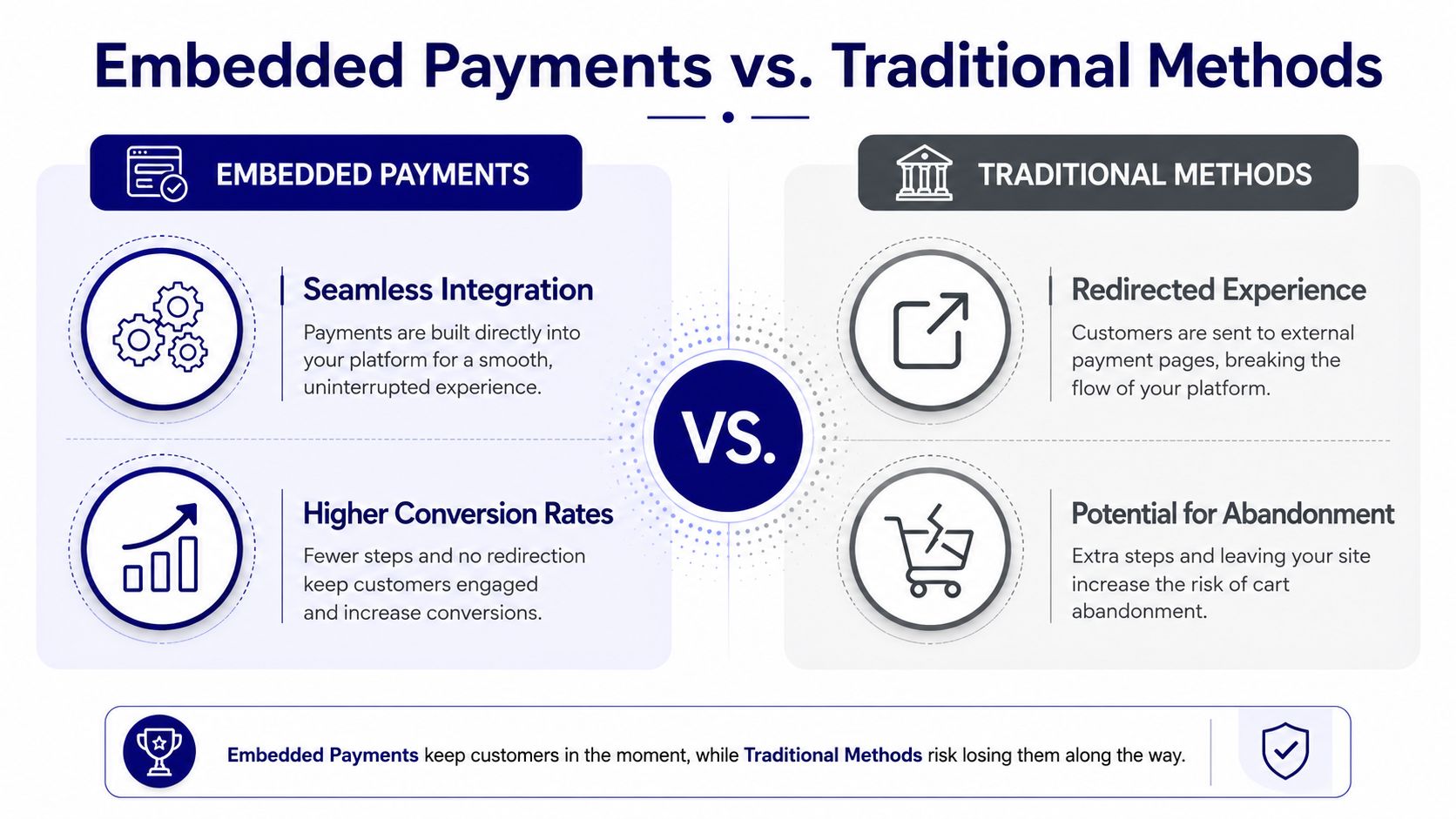
A hosted checkout page is often the fastest way to start accepting money. It's useful when speed matters more than product continuity. The tradeoff is obvious. The user leaves your interface at the moment you most want to keep them focused.
A payment link is even lighter weight. It's great for invoices, ad hoc charges, or support-led sales. But it isn't fully integrated into the product. It behaves more like a payment shortcut than a native capability.
A traditional gateway setup can be somewhere in the middle. You may collect payment through your app, but many implementations still rely on handoffs, hosted pages, or fragmented experiences around authentication, retries, and method selection.
Where embedded payments change the experience
Embedded payments are different because the product owns the flow. The payment screen feels like another product screen, not a transfer to a different system. That doesn't just affect branding. It affects how users perceive trust, continuity, and effort.
For developers, alternative payment methods become particularly important. Once you embed the experience, users expect the payment options to match their preferences too. This overview of alternative payment methods is useful because method choice and checkout design usually have to be solved together.
Practical rule: If the payment step feels like an interruption, it's probably not embedded. If it feels like a natural continuation of the task, you're much closer.
The main point isn't that older methods are obsolete. Hosted pages and payment links still make sense in many contexts. The point is that embedded payments give product teams tighter control over the purchase journey, which is why they've become such a common choice for software-led businesses.
The Architecture of an Embedded Payment Flow
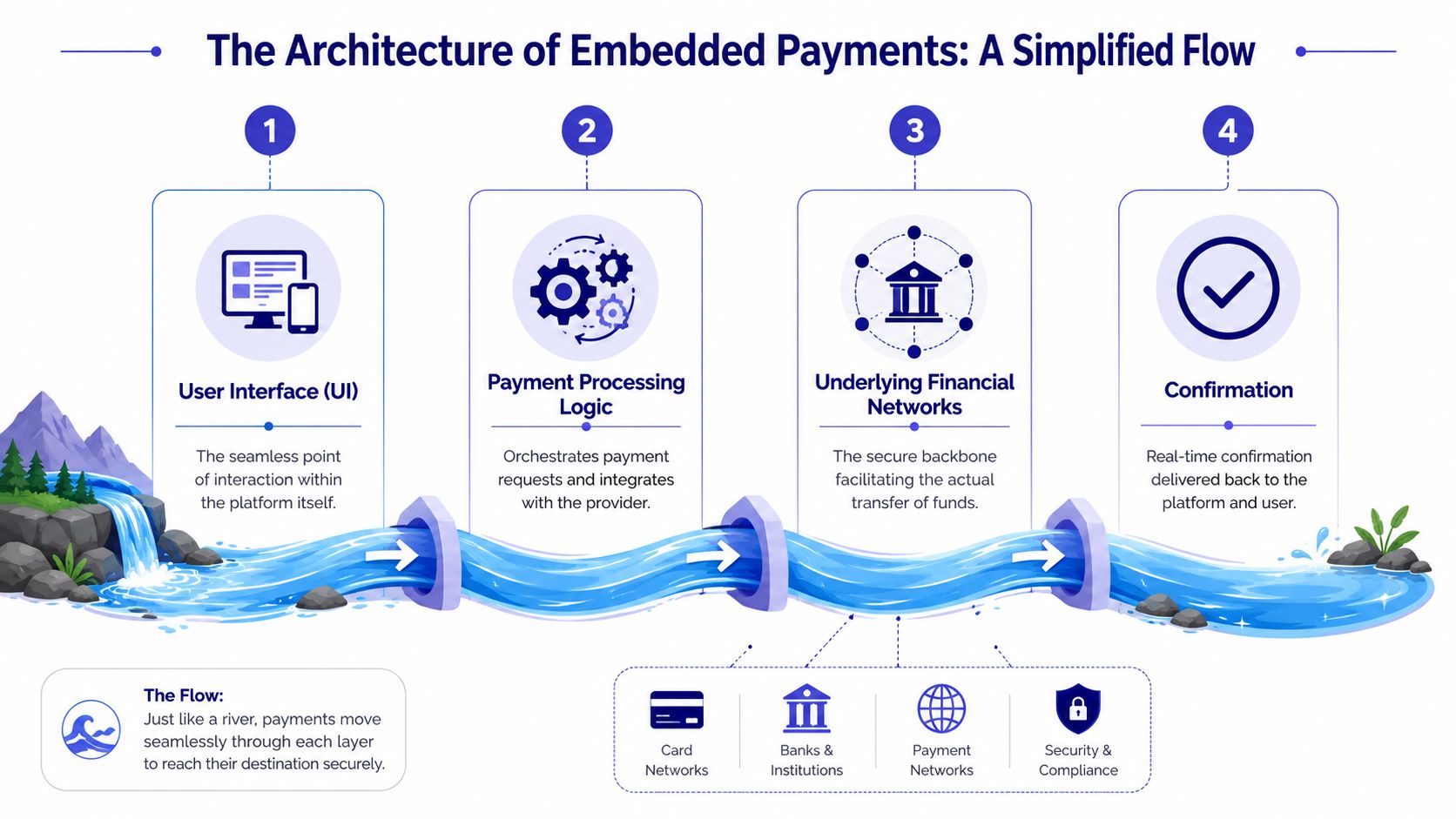
A useful way to understand embedded payment architecture is to stop treating "payment" as a single event. In practice, it is a chain of coordinated systems. One part collects intent from the user, another decides how to handle that intent, and another connects to the financial rails that authorize and settle funds.
According to Payneteasy's embedded payments definition, embedded payments use a three-layer structure: the platform's user interface, a payment orchestration layer that handles routing and compliance, and a processing layer that connects to acquirers and card networks. That structure removes external redirects and third-party handoffs, but the more important change often happens behind the screen. For global businesses, the architecture also determines how funds move across borders, which rails are used, and how much settlement friction the product can absorb on behalf of the user.
A restaurant comparison helps here, but the mechanics matter more than the metaphor. The user interface is the part the customer touches: selecting a plan, confirming a purchase, choosing a payment method. The orchestration layer works in the middle. It applies rules, routes transactions, checks risk and compliance requirements, and decides which downstream path makes sense. The processing layer connects to the actual money movement infrastructure, such as card networks, acquirers, bank rails, and in newer setups, stablecoin-based settlement paths.
That distinction explains why a polished checkout alone is not enough.
A team can build a clean payment form and still run into failed cross-border payouts, slow settlement, limited local method coverage, or expensive routing because the back-end layer was designed around a single processor and a single rail. This is the part many guides skip. Embedded payments are not only about keeping users inside the app. They are also about giving the product a programmable settlement engine. That is especially relevant for platforms serving global merchants, marketplaces, and SaaS companies, where flexible rails, including stablecoins, can reduce some of the friction that traditional cross-border settlement introduces. Suby focuses on this back-end problem, not just the checkout surface.
What happens when a customer taps pay
A simplified embedded payment flow usually looks like this:
The customer confirms a purchase inside the app
The product captures the payment intent, amount, currency, customer context, and chosen method without sending the user to a separate experience.The orchestration layer evaluates the request
This layer applies business logic. It may choose a processor, trigger fraud checks, determine whether local bank rails or cards are a better fit, and decide what compliance steps are required for that transaction.The processing layer sends the transaction to the relevant rail
For a card payment, that usually means authorization through card networks and acquiring partners. For other flows, it could mean bank transfer networks, wallets, or blockchain-based settlement infrastructure.The result returns to the product in context
The application updates the order, account status, or subscription state based on the payment outcome. If the payment succeeds, access can be granted immediately. If it fails, the product can retry, request another method, or present the next step without breaking the user journey.
A short technical walkthrough can help if you want to visualize that movement in a product environment.
If you are evaluating implementation choices, this guide to payment gateway API integration is a useful next read because it translates the layered model into practical decisions about APIs, components, routing logic, and workflow ownership.
Key Benefits for Global Merchants and Developers
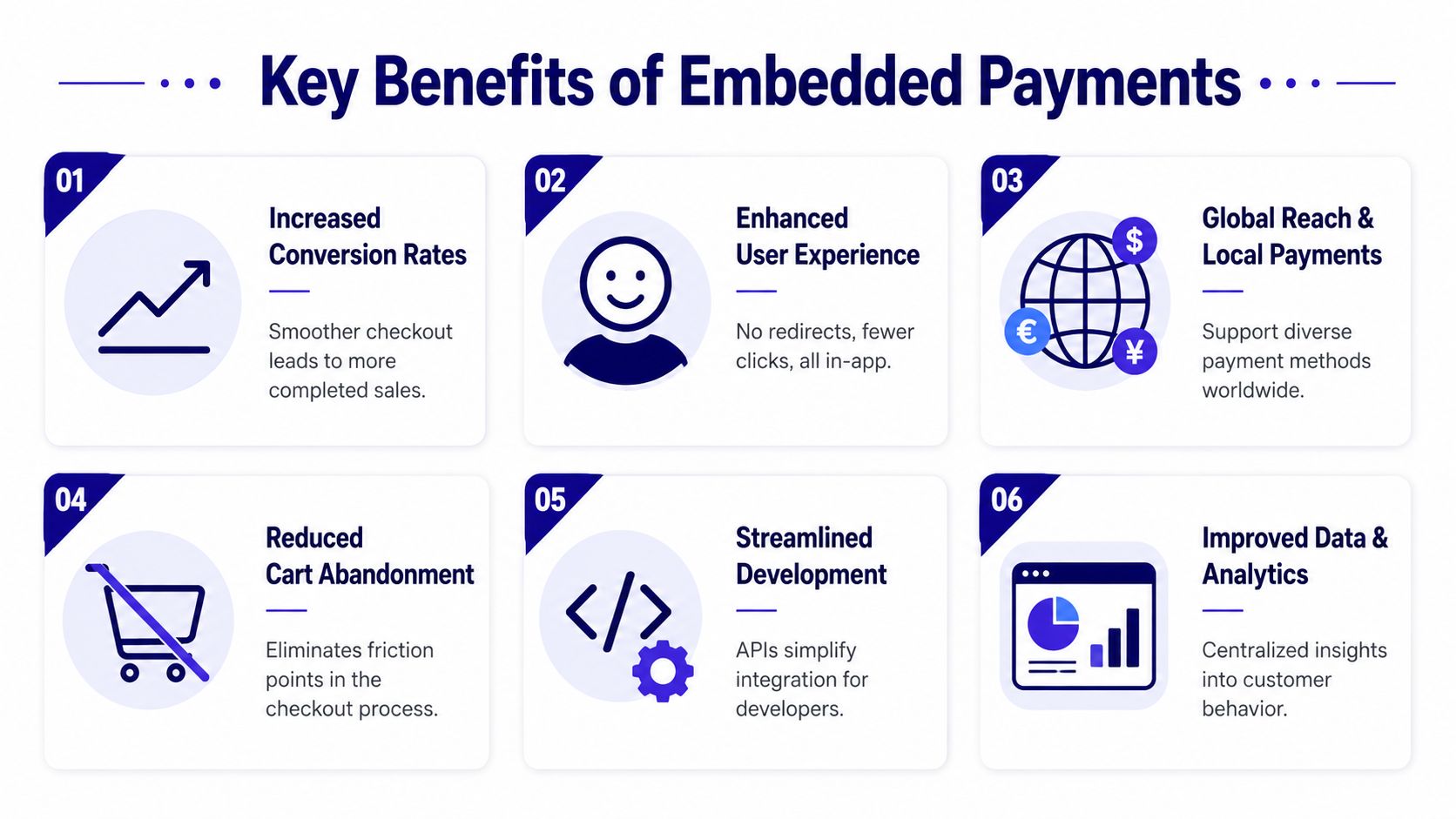
The surface-level benefit is easy to see. Embedded payments remove steps, keep users in the same interface, and make the buying process feel more natural.
That matters, but it isn't the whole story.
The obvious win is less friction
When users stay in one product flow, teams usually gain a cleaner checkout experience, stronger branding control, and a tighter feedback loop between payment events and product actions. If a customer upgrades a plan, grants access, or renews a subscription, the product can react immediately because payment isn't happening in a separate silo.
This is also easier on engineering teams in the long run. A unified payment layer usually gives developers a cleaner place to manage billing states, retries, access rules, and payment events than a patchwork of links, portals, and disconnected tools.
A few practical benefits tend to matter most:
Better continuity: The user stays inside the product from decision to confirmation.
Cleaner product logic: Access, renewal, and billing events can be tied directly to payment outcomes.
More method flexibility: Teams can present card, wallet, bank, or crypto options in the same product context.
Less fragmentation: Support, reporting, and payment operations are easier when money movement is connected to the product itself.
The bigger win is settlement flexibility
The more strategic benefit is on the back end. Many articles stop at “pay without leaving the app,” but global businesses often run into a different problem after acceptance: how to settle funds efficiently.
As NMI's embedded payments overview points out, most standard definitions focus on integrated checkout but don't answer the harder question of how to settle cross-border payments in a single balance without losing value to FX friction or managing multiple bank accounts.
That's where modern embedded systems become more interesting. They can separate how the customer pays from how the business receives funds.
The front-end story is convenience. The back-end story is financial routing.
For a global merchant, those are very different concerns. A customer may want to pay by card, wallet, bank transfer, or crypto. The business may want to receive funds to a bank account or in stablecoins such as USDC, depending on treasury, geography, or operating needs. When those choices are decoupled, embedded payments stop being only a checkout feature and start becoming infrastructure.
Navigating Compliance and Common Pitfalls
A common mistake is treating embedded payments like a design enhancement. It's more accurate to think of them as a product and operating model decision.
That distinction matters because once your software becomes the place where merchants or customers transact, your team sits closer to onboarding, support, risk, and money movement than before.
Embedded payments create operator responsibilities
Forte's operator-focused guide makes an important point: most guides leave out the fact that embedded payments turn a platform into the front door for merchant onboarding, ongoing risk monitoring, and funding. Teams that treat it only as a UX win often run into trouble later.
That doesn't mean every software company needs to become a regulated payments specialist internally. It does mean you need a realistic view of the work behind the checkout.
Here are the areas that usually surprise teams:
Merchant onboarding: Someone has to decide who can use the payment product and under what conditions.
Risk monitoring: Payments create dispute, fraud, and abuse exposure over time, not just at signup.
Support workflows: When money is involved, users expect fast answers about failures, delays, refunds, and chargebacks.
Funding expectations: Businesses care about when and how they receive funds, not just whether the charge succeeded.
Common mistakes teams make early
One mistake is underestimating compliance boundaries. Payment flows often involve PCI-related handling, authentication requirements, and data responsibilities. Good infrastructure can abstract much of that complexity, but abstraction isn't the same as irrelevance. Your product and support teams still need to understand what the provider handles and what your company still owns.
Another mistake is ignoring disputes until volume appears. Chargebacks and payment complaints don't feel urgent during early integration work, but they quickly become operational issues once real customers are paying inside your product.
If you embed payments, you're designing both a checkout flow and a support model.
A third mistake is forgetting that payouts are part of the user experience too. If funds arrive unpredictably, settle awkwardly across borders, or require too much manual reconciliation, the pain just moves from checkout to finance.
The right implementation mindset is simple. Treat embedded payments as infrastructure that affects product, finance, support, and compliance at the same time.
How to Implement Embedded Payments with Suby
For teams building for international customers, the implementation question usually becomes practical very fast. How do you let customers pay the way they prefer, while your business receives money in the form that works for operations?
That's the part many payment stacks split across multiple vendors. Suby approaches it as one product for the global internet economy. The core model is simple: customers can pay by card, wallet, bank, or crypto, and the business can receive funds to a bank account or in stablecoins like USDC, in the currency it wants. A key example is the flow where a customer pays by card and the business receives USDC, but that's only one available option.

Two practical implementation paths
One path is a faster deployment route using a prebuilt or embeddable checkout. That works when you want payment inside the product without first building a full billing interface from scratch.
The other path is direct API implementation for teams that want more control over the payment experience and product logic. Suby provides an API that lets businesses accept payments by card or crypto, and the API supports three configurations through the paymentMethods field: ['CARD'], ['CRYPTO'], or ['CARD', 'CRYPTO'], as documented in the Suby API introduction.
The broader product documentation also states that Suby supports 300+ payment methods natively through one integration and offers payouts to either bank accounts or stablecoins in the merchant's chosen currency, according to Suby's product introduction.
One technical idea is especially important here. As described in Suby's guide to implementing a payment gateway, modern embedded payments can separate the pay-in rail from the settlement rail. That means a business can accept standard card payments globally while receiving settlement in stablecoins like USDC, avoiding the usual delays and local FX friction associated with older cross-border flows.
For global software, accepting a payment and settling a payment are related tasks, but they don't have to use the same rail.
That design gives founders and finance teams more control. The customer sees a familiar payment method. The business chooses how funds land.
How the product can be used
Suby is one product with four ways to use it:
Suby Payments: An API-first payment stack to accept cards and crypto through one checkout.
Suby Crypto: A crypto payment gateway that handles the swap, sponsors the gas, and settles to a non-custodial wallet or to the Suby balance.
Suby Gating: Paid access for Discord, Telegram, downloads, and courses.
Suby Invoicing: Invoice flows where the client pays how they want while the business receives what it wants.
It also offers native integrations with Discord and Telegram for use cases like subscriptions, paid access, and online communities. That matters for teams monetizing software-adjacent products, not just traditional app checkouts.
If you're pricing an implementation, check the Suby pricing page because pricing depends on the payment method used. There isn't a single flat rate that applies across all flows.
Your Path to Modern Global Payments
Embedded payments matter because they move payments from the edge of the product into the product itself. For users, that means less friction. For product teams, it means more control over the purchase journey. For global businesses, it can mean something bigger: the ability to separate customer payment choice from settlement choice.
That's the fundamental shift. A customer can pay in the way that feels normal to them, while the business receives funds in the format that fits its operations. Once you understand that split, embedded payments stop looking like a checkout pattern and start looking like core infrastructure.
If you've been asking what are embedded payments, the best answer is this: they're a way to turn payments into a native product capability, while modernizing the back-end movement of money at the same time.
If you're evaluating global payment infrastructure, Suby is one option to review. It provides an API for accepting card and crypto payments, supports native Discord and Telegram monetization use cases, and is built around a straightforward model: customers pay the way they want, and businesses get paid the way they choose.
