

Gaspard LEZIN
How to Accept Crypto Payments Without Holding Crypto: The SAAS Founder's Guide
Discover how to accept crypto payments without holding crypto: the saas founder's guide. Learn instant fiat settlement, subscription management, and accounting
You've probably already had this conversation with your team or accountant.
A customer wants to pay in crypto. Sales likes the idea because it could open markets where cards fail, cross-border banking is slow, or local payment options are messy. Finance hates the idea because nobody wants subscription revenue bouncing around with asset prices, wallet ops, and unclear reconciliation. Engineering gets stuck in the middle and ends up reading setup guides that stop right after “create an API key.”
That's the gap most content misses. The core problem isn't how to turn on crypto checkout. It's how to accept crypto payments without holding crypto and still run clean SaaS operations after launch. That means stable settlement, predictable revenue recognition, workable reporting, and a checkout that doesn't scare off normal customers.
Table of Contents
The Global SaaS Founder's Payment Dilemma
A familiar SaaS pattern looks like this. You can acquire users globally, but you still collect money through a narrow set of rails. A prospect is ready to buy, then hits a payment page that doesn't support how they prefer to pay, or does support it but settles slowly, creates FX headaches, or fails in ways your team can't diagnose.
That's why crypto payments keep coming up in global SaaS. Not because every founder wants treasury exposure to digital assets, but because they want another way for customers to pay. The useful version of crypto adoption is operational, not ideological. Customers get another route to checkout, and the business still receives something stable enough to run payroll, pay vendors, and close the books.

Why stable settlement changed the conversation
The turning point for many operators was stablecoin settlement. In 2024, stablecoins accounted for 35.5% of all transactions on major crypto payment platforms, which shows how strongly businesses are gravitating toward payment flows that reduce volatility rather than absorb it, according to CoinGate's 2024 crypto payments report.
That matters because the old objection was valid. If you accepted a volatile asset and held it on your balance sheet, you took on risk your SaaS company never asked for. Stable settlement changes that. You can let the customer pay through crypto rails while your side of the transaction lands as something designed to remain stable, such as USDC, or as fiat depending on the provider and configuration.
Practical rule: If finance can't explain what lands in your books at the moment of settlement, you're not ready to launch crypto payments.
What founders actually want
Most founders don't want “crypto strategy.” They want fewer lost deals, more global payment coverage, and cleaner cash movement.
In practice, the desired outcome is simple:
Customers choose the rail: card, wallet, bank, or crypto, depending on what's available and familiar to them.
Finance chooses the settlement: bank payout or stablecoin settlement, based on treasury and accounting policy.
Ops avoids asset exposure: no one on the team has to actively manage volatile holdings just because a customer used a crypto rail.
That's the frame for this guide. The setup matters, but the architecture behind settlement matters more.
How Instant Settlement to Stablecoin or Fiat Works
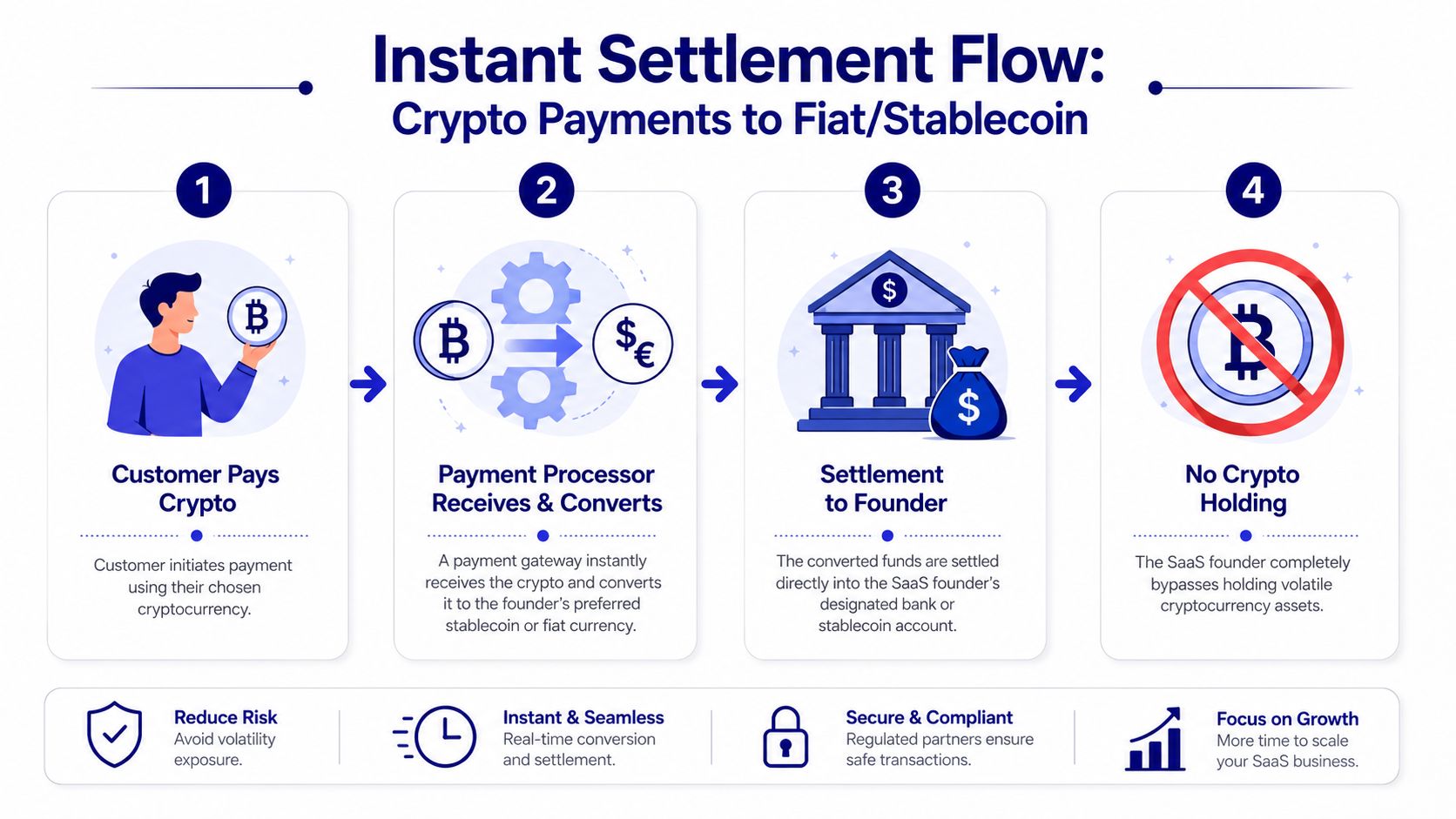
The easiest way to think about this is as an automated exchange layer sitting between the customer's payment method and your final settlement destination. The customer pays one way. Your business receives another. The processor handles the conversion logic in the middle.
What actually happens during payment
The technical control that matters most is the Settlement Currency combined with the Price Lock Window. The critical step is configuring those settings so the processor can automatically trigger a swap and convert the incoming asset into fiat or a stablecoin like USDC before the funds land in the merchant's balance, with a typical lock window of 10–15 minutes, as described in BVNK's guide to accepting crypto as a business.
That sounds more complex than it is. Operationally, the flow is usually:
The customer selects a payment method and sees the price quoted for that session.
The processor locks the price window long enough to reduce slippage risk during checkout.
The incoming payment is received and swapped according to your settlement settings.
Your business receives the configured output, which might be stablecoin settlement or fiat payout.
Later, if you want to think through how this helps with international collections, this breakdown of cross-border payment flows using crypto rails is useful because it frames crypto as infrastructure rather than treasury exposure.
A short walkthrough helps make the mechanics concrete:
Why price lock matters more than most founders think
Founders often focus on the headline feature, “accept crypto without holding it,” and skip the execution details. That's risky. A weak price lock setup can create small but annoying mismatches between what the customer saw and what finance expected to receive.
The price lock window is doing two jobs at once:
Protecting checkout clarity: the customer sees a valid quoted amount for long enough to complete payment.
Protecting settlement integrity: the processor has a defined window to complete the swap without introducing unnecessary variance.
The right setup feels boring after launch. That's what you want. Payment ops should disappear into routine, not become a weekly finance exception.
For SaaS, this matters even more with subscriptions and annual plans. If your product sells a fixed price in USD or EUR, your payment architecture should preserve that commercial logic all the way through settlement. The customer can pay through alternative rails. Your revenue operations still need a stable base unit on the back end.
Designing a High-Conversion Global Checkout
Founders lose conversions when they treat crypto as a separate, specialist experience. Most buyers don't want a “crypto journey.” They want to pay and get access.
A high-conversion global checkout gives customers familiar options in one place and keeps the business-side settlement logic hidden in the background. That's the standard. Customers pay any way they want, and the business gets paid the way it chooses.
The checkout should feel normal
The best checkouts don't force the buyer to think about your treasury setup. They show relevant options and let the user complete the purchase with the least friction.
That usually means a single payment surface with multiple paths, such as:
Card for mainstream buyers, especially when they expect a standard SaaS checkout.
Bank or wallet options for users who already prefer alternative rails.
Crypto for users who want it, without forcing everyone else into that mental model.
When teams over-isolate crypto, they create a side entrance that converts poorly. When they unify it, crypto becomes just another payment option, which is exactly how it should behave in a SaaS product.
A useful design reference is this piece on checkout page design for payment conversion, especially if your team is deciding how much choice to show up front versus progressively during the flow.
How to reduce wallet friction
The biggest conversion mistake is assuming every crypto-paying customer has a self-custody wallet ready to go. Many don't. According to Suby's writeup on exchange payments and wallet-free onboarding, the wallet barrier causes 60–70% of potential customers to abandon crypto checkout when they lack a self-custody wallet or gas tokens. The practical fix is to support flows that let users pay directly from centralized exchanges.
That changes checkout design in a meaningful way.
Instead of one narrow crypto option, you want a structure like this:
Payment path | Best for | Operational effect |
|---|---|---|
Card | Standard SaaS buyers | Familiar flow, broad usability |
Wallet payment | Crypto-native users | Direct payment from supported wallets |
Exchange payment | Non-expert crypto users | Reduces friction from wallet setup and gas requirements |
If a buyer already has funds on an exchange, asking them to create or fund a separate wallet is often where the conversion dies.
This is one reason mixed-method checkout matters. A user in one market may prefer card. Another may want to pay from a wallet. Another may hold funds on an exchange and just want the simplest path to complete the purchase. Good payment design meets all three without making your back office more chaotic.
Choosing Your Integration Path
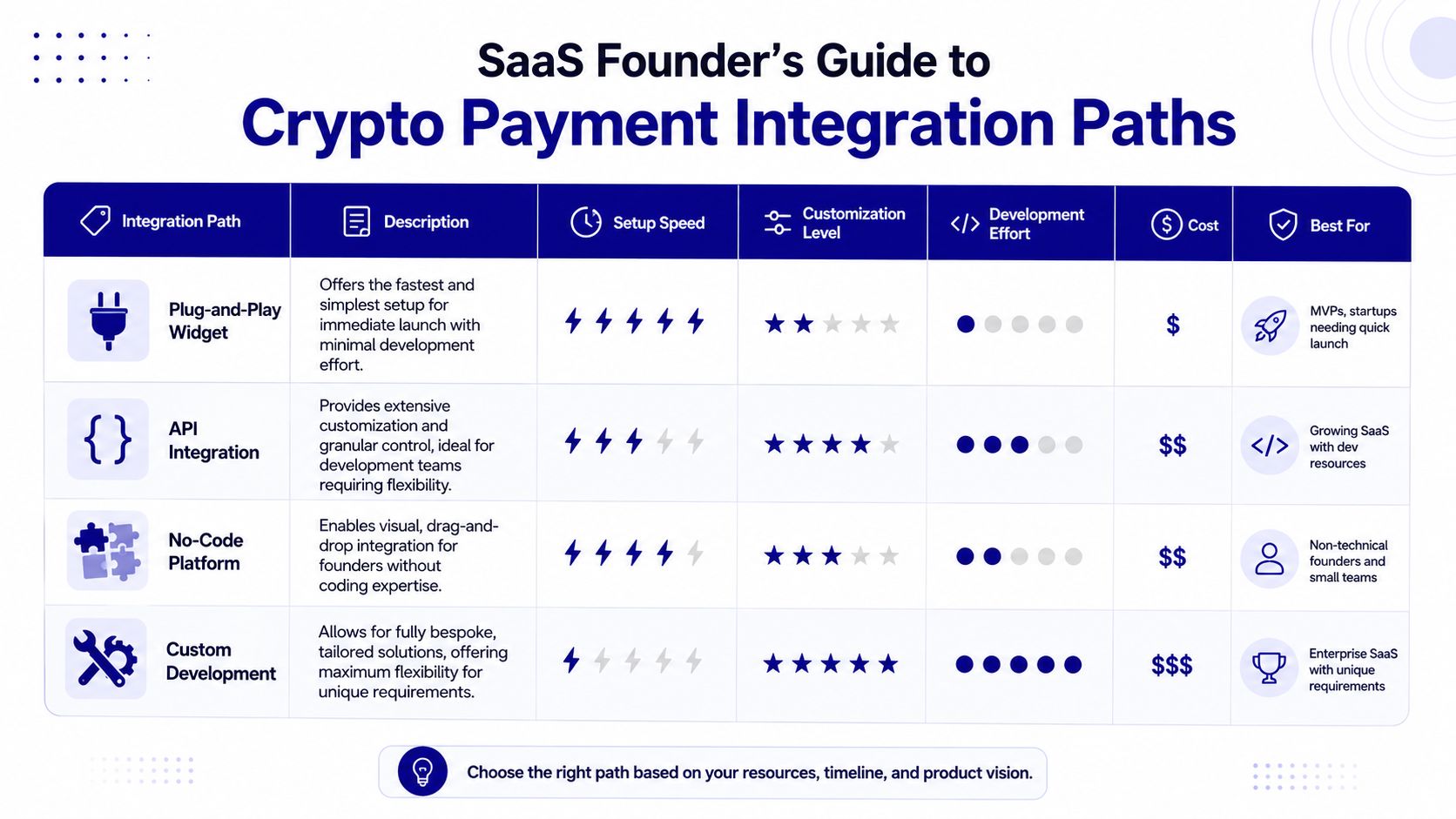
Not every SaaS business needs the same implementation. A product-led SaaS team with in-house developers should make different choices than an agency issuing invoices, or a community operator selling paid access. The mistake is treating “accept crypto” as one feature with one setup path.
When to use an API-first checkout
If your product already has billing logic, user provisioning, and custom subscription rules, API-first usually makes sense. You keep control over the product experience and wire payment events into your own entitlement and lifecycle systems.
One useful capability to look for is flexible payment configuration at the product level. For example, Suby's API introduction states that its API supports three payment configurations per product: Card only, Crypto only, or Card + Crypto on the same product, so merchants can let customers choose how to pay while the business chooses settlement in USDC or fiat.
That model is practical because it separates two decisions that often get tangled:
Front-end choice for the customer
Back-end settlement choice for the business
If your team needs custom checkout, webhooks, recurring logic, or deep connection to your app, API-first is usually the cleanest route.
For a broader view of gateway trade-offs, this roundup of crypto payment gateway options for internet businesses is a useful comparison point.
When invoicing or gated access makes more sense
Not every business needs a full custom checkout on day one.
If you run a service-heavy business, invoicing can be the smarter first move. The customer gets flexibility in how they pay, and your team doesn't have to redesign core app billing immediately. This is especially useful for agencies, implementation partners, and enterprise SaaS teams that close deals manually before they automate self-serve flows.
If your monetization model is access-based, gating tools matter more than a classic subscription page. Paid communities, private downloads, course access, and member channels in chat apps need payment plus entitlement together, not just payment alone.
One product, four ways to use it
A practical way to evaluate a platform is to map your use case to the delivery model. Suby is one product with four ways to use it, and that structure is a good example of how founders should think about implementation choices.
Suby Payments fits teams that want an API-first payment stack to accept cards and crypto through one checkout. This is the builder path.
Suby Crypto fits teams that want a crypto payment gateway where the provider handles the swap, sponsors the gas, and settles to a non-custodial wallet or to the Suby balance.
Suby Gating fits access businesses that monetize Discord, Telegram, downloads, or courses.
Suby Invoicing fits businesses that want the client to pay how they want while the business receives what it wants.
The important point isn't the naming. It's the operating model behind it. A modern payment system should let customers pay by card, wallet, bank, or crypto, while the business decides whether to receive funds to a bank account or in stablecoins like USDC, in the currency it wants. It should also expose that flexibility through an API and, where relevant, offer native integrations for channels like Discord and Telegram for subscriptions, paid access, and online communities.
One caution matters here. Pricing depends on the payment method used, so don't design around a single headline rate. Check the provider's pricing page and model the methods your customers will use.
The Founder's Guide to Post-Payment Operations
Most “how to accept crypto payments without holding crypto” guides become unhelpful after payment collection. They help you collect the payment, then go silent on what finance has to do next.
That gap is real. As noted in Payyd's discussion of crypto payment acceptance, existing guides often miss the tax and accounting mechanics of instant fiat settlement for SaaS subscriptions, even though that's exactly where founders and finance teams get stuck.
Treat settlement and revenue records separately
The cleanest operating model is to separate three records in your internal process:
The commercial event
What the customer bought, for what price, under what subscription terms.The payment event
The method the customer used and the timestamp of the successful charge.The settlement event
What arrived, where it arrived, and when it became available in your bank account or stablecoin wallet.
That separation matters because recurring SaaS revenue rarely maps perfectly to one payout timestamp. Even when settlement is fast, finance still needs a policy for how to match invoices, subscription periods, payment confirmations, and final settled amounts in the ledger.
A practical bookkeeping approach looks like this:
Record the customer charge against the invoice or subscription object in your billing system.
Store the processor transaction ID and settlement reference with that record.
Reconcile settled funds in batches against successful charges, especially when payout timing differs from charge timing.
Document the treatment of stablecoin receipts before month-end close, so accounting doesn't improvise later.
Don't force your accountant to reconstruct payment logic from dashboard screenshots. Exportable records and consistent internal references matter more than payment novelty.
What finance should document before volume grows
Founders don't need to become tax specialists, but they do need clear internal rules. If you settle to USDC and later convert to fiat, your team should know whether finance is treating that as a separate treasury action from the original customer payment. If the processor converts before settlement, your records should show that distinction too.
For teams building that policy, these stablecoin tax reporting insights are a helpful starting point because they frame the reporting questions finance will eventually ask once payment volume increases.
Before you scale, document:
Revenue recognition policy: how subscription revenue is recognized versus when funds settle.
Settlement policy: whether the company receives bank payouts, stablecoins, or both.
Conversion policy: who is responsible if stablecoins are later swapped into fiat.
Audit trail policy: where transaction IDs, wallet references, payout reports, and invoice records are stored.
This isn't glamorous work, but it's what keeps a promising payment channel from becoming a reporting mess.
Your Go-Live Checklist and Scaling Plan
Launches go wrong when teams only test the happy path. Before you turn on crypto-capable checkout for live customers, run a short operational checklist.
Test a successful payment: make sure the customer gets access, the internal record is created, and the settlement route matches your configuration.
Test a failed payment: confirm your app doesn't provision access or mark the invoice paid by mistake.
Test a refund scenario: verify who initiates it, what records are generated, and how finance will classify it.
Check support readiness: your customer team should know how to answer “where did my payment go?” without escalating every case.
Update customer-facing terms: payment methods, refund handling, and billing language should reflect the flow you're offering.
Review reporting exports: if you can't reconcile a week of transactions from exports alone, month-end will be painful.
After go-live, watch a small set of signals:
Conversion by payment method
Settlement timing by rail
Refund and support ticket patterns
Subscription collection issues by region
Accounting exceptions during close
The scaling advantage is simple. Once the payment layer supports multiple pay-in methods and flexible settlement, you can expand into new customer segments without adding a separate banking relationship or rebuilding checkout every time.
If you want one system that lets customers pay by card, wallet, bank, or crypto while your business settles to a bank account or stablecoins like USDC, Suby is built for that model. It offers an API for card and crypto payments, plus native Discord and Telegram integrations for subscriptions, paid access, and online communities. The practical value is straightforward. Customers pay the way they want, and your business gets paid the way you choose.
