

Gaspard LEZIN
Value Added Tax Payment: A Practical Guide for 2026
Learn how to handle value added tax payment efficiently with our 2026 guide. Simplify compliance and avoid penalties for your modern business.
You're staring at a VAT line on a return, or maybe a customer invoice, and the same question keeps coming back: what gets paid, when, and by whom? For founders, VAT gets confusing fast because the tax is simple in theory, but the payment flow touches pricing, invoicing, filing, registration, and cash timing all at once. The good news is that once you see the mechanics clearly, value added tax payment stops feeling like a mystery and starts looking like a process you can manage.
Table of Contents
What Value Added Tax Means in Practice
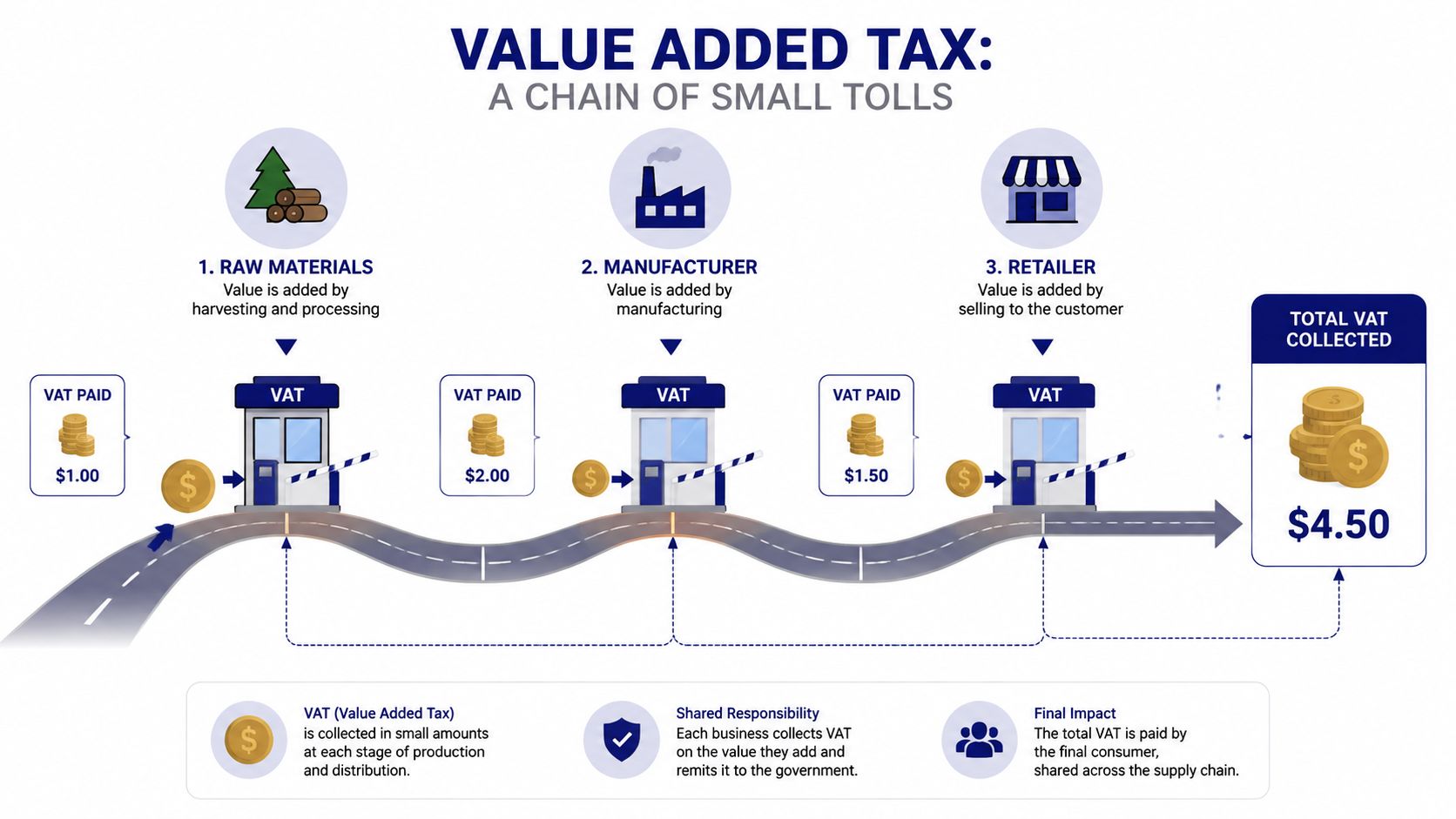
You sell a product, the invoice shows VAT, and the number can feel like a fee added on top of your price. Under the hood, it works more like a chain of small tolls collected as value moves from one business to the next, with the final consumer carrying the cost in the end, while registered businesses act as collection points in the middle. That is why the European Commission describes VAT as due, as a rule, when goods are delivered or a service is supplied, and why EU law generally treats the supplier as the liable party, with some clear exceptions for customers and importers. The legal detail matters, but the operating model is easier to hold in your head once you picture the chain. European Commission VAT timing rules and EU rules on who pays VAT
A simple way to think about the chain
A factory buys inputs, adds value, and sells to a wholesaler. The wholesaler adds value again, then the retailer does the same before the item reaches the customer. Each registered business charges VAT on its sale, deducts the VAT it already paid on its purchases, and sends only the net amount onward, which is why the tax does not stack on top of itself at every step. The EU explains this as an invoice-credit mechanism, and that design keeps VAT neutral across long or short supply chains. How VAT works in the EU
Practical rule: if you are VAT-registered, you are usually collecting the tax for the government, not paying it out of your own margin.
That distinction matters for cash planning. A customer may see VAT as part of the purchase price, but your business only holds that money temporarily before it is due on the return. When founders confuse VAT with income, they can spend money that was never theirs to keep.
Why it does not work like a normal sales tax
A sales tax usually appears once, at the end of the line. VAT appears throughout the chain, but only on the value each seller adds. That is why a business buying stock for resale can often reclaim the VAT on its purchase invoices, while the end consumer cannot. The result is a tax that is broad-based, but not duplicated at every hop.
For founders selling online, the practical wrinkle is that the chain can cross borders without much warning. A checkout can route through a marketplace, a payment processor, or a digital delivery system, and the VAT logic still follows the place of supply and the party that must account for it. ATO GST compliance tips are a useful reminder that registration triggers, not just tax rates, are what usually catch smaller sellers off guard, and Suby's guide to taxes for online businesses is a helpful way to compare how these duties show up in real ecommerce operations.
If you are dealing with card payments, bank transfers, or stablecoin-style settlement, the tax question does not change just because the money moved faster. The invoice still needs the right VAT treatment, the return still needs the right figures, and cross-border digital sales still need the right jurisdiction picked before the funds settle. That is the practical gap many teams miss, the commercial payment rail may feel modern, while VAT still follows the older legal logic underneath.
Who Has to Register and When
A founder can get VAT wrong long before the first return is filed. The issue usually starts with registration, because that is the point where a business moves from selling to also collecting tax, keeping records, and sending payments to the right authority, sometimes in a place where the business has no office at all. In the UK, HMRC reported 2,330,400 traders in the VAT population in the 2024 to 2025 year, with 234,000 new registrations and 218,000 de-registrations, so even established systems keep shifting businesses into and out of the VAT net. HMRC VAT annual statistics
Thresholds, voluntary registration, and no-threshold systems
Some tax systems use a turnover threshold. Others require registration from the first taxable sale in specific cases, especially for nonresident sellers. The UK example in public guides often centers on a turnover test, while the EU also uses cross-border simplifications and special regimes for small businesses, which is why a founder cannot assume one country's rule will carry over neatly to another. For a practical comparison of how this shows up in online sales, Suby's guide to taxes for online businesses is a useful companion, and EndureGo Tax's ATO GST compliance tips are a reminder that registration triggers, not just tax rates, are what usually catch smaller sellers off guard.
A registration threshold is not a suggestion. It is the line that decides whether you are collecting VAT as a business duty or quoting it inside your pricing.
The question is usually not, “Do I sell enough overall?” It is, “Where am I deemed to be selling, and what does that jurisdiction require once I cross its trigger?” Permanent establishment, distance selling, and activity-based rules start to matter at that point. A checkout that runs through a marketplace can bring one set of obligations, while a direct storefront or digital delivery flow can bring another, even if the customer-facing experience looks the same.
What the threshold really means in practice
A threshold tells you when the tax authority expects you to register, file, and pay. Voluntary registration can make sense if you want to reclaim input VAT or sell to business customers who expect VAT invoices. In practice, the issue is often less about legal theory and more about whether your accounting system can separate taxable sales, exempt sales, and cross-border sales cleanly enough to survive a return. That separation matters even more if you sell into multiple countries from one storefront, because payment rails can move the money quickly while the tax treatment still depends on the underlying sale.

How VAT Is Calculated and When It Becomes Due
A VAT bill is usually a simple subtraction problem with a timing rule attached. A VAT-registered business charges output VAT on sales, subtracts input VAT paid on business purchases, and remits the difference. If input VAT is higher than output VAT, the business may be in a reclaim position rather than a payment position, so the bookkeeping has to be clean enough to support the claim. The invoice-credit model described by the European Commission is what keeps VAT from being taxed twice at each stage of the chain.
A small worked example
Say you sell a taxable item for £1,000 and your invoice shows £200 of output VAT. You bought stock or inputs for £500 and paid £100 of input VAT on those purchases. Your net VAT to pay is £100, because the VAT collected on the sale is reduced by the VAT already paid on the business purchase chain. That is the logic behind the invoice-credit system, and it is why supplier invoices matter so much. They are not just admin paperwork, they are the evidence that supports the deduction.
Useful habit: match each sales invoice to the purchase records that created the input credit. If the link is broken, the calculation gets shaky fast.
Timing can change the answer even when the arithmetic is easy. VAT usually becomes due at the time of delivery of goods or, for services, when the service is supplied. Some cases work differently, including deferred payment until the 15th day of the following month for intra-Community traffic, or liability arising on invoicing or cash collection. That is why the invoice date, the payment date, and the tax due date are not always the same thing.
Why the due date can surprise founders
A founder might invoice in one month, receive cash in another, and owe VAT based on a third date if the local rule uses delivery or supply timing. That is manageable once the finance stack tracks the event that creates the liability. The surprise usually shows up in subscription businesses, project work, and cross-border orders, where the service period, billing date, and cash settlement can all fall into different months.
For founders selling into Ireland, the filing calendar can shift the pressure point as well. The reform described in Irish VAT filing and payment reform shows how payment timing can move even when the basic VAT calculation stays the same, which is another reason the due date has to be tracked separately from the sales date.

Filing, Deadlines, and Payment Methods by Region
VAT filing changes from country to country, and the payment rail changes with it. A founder can get the tax math right and still miss the practical piece if the local system expects a specific filing rhythm, a specific reference number, or a specific payment channel. In the UK, the scale of the system is clear from the receipts side, with HMRC reporting £171 billion in VAT receipts for the 2024 to 2025 financial year, and the Office for Budget Responsibility projecting £179.6 billion for 2025 to 26. In Ireland, Revenue said VAT was the third largest source of tax receipts in 2025, representing 21% of net tax receipts, with €23.0 billion transferred to the Exchequer. HMRC VAT annual statistics and Ireland VAT payments and returns 2025
VAT Filing and Payment at a Glance
Jurisdiction | Typical Return Frequency | Common Payment Methods | Reference Identifier |
|---|---|---|---|
UK | Varies by filing setup | Online filing and payment through the tax authority's systems | VAT number and return reference in the filing record |
EU | At least annual, often monthly or quarterly | Online portals and local transfer rails | VAT registration details and filing reference |
Ireland | Filing and payment tied to Revenue processes | Revenue online services and direct payment channels | VAT reference linked to the return |
South Africa | Return-based filing through SARS systems | Payment through SARS-linked payment flows | Payment Reference Number (PRN) |
South Africa shows why the reference number matters so much. SARS uses a pre-populated Payment Reference Number (PRN) on the VAT201 return, and vendors must include it when paying so the payment links back to the declared return. That is not a small admin step. If the payment cannot be matched to the filing record, reconciliation becomes messy even when the money has already left your account. SARS VAT201 guide
For a practical UK and Ireland comparison, the article on Irish VAT filing and payment reform shows how filing systems keep changing around the edges, especially when payment methods and filing cadence get updated.
If the return and the payment live in different systems, the reference number is what stitches them back together.
The founder-friendly rule is simple. Put the payment calendar on the same timetable as the filing calendar, then make sure every tax payment carries the exact reference the authority expects. That keeps the cash trail, the return trail, and the audit trail aligned. If you sell digitally across borders, the same discipline also applies when local payment systems, invoice portals, or cross-border VAT schemes expect a different identifier, as the overview on internet sales tax makes clear.
Cross-Border Sales and Digital Services
Cross-border VAT gets complicated because the seller's location, the customer's location, and the service type can all point to different tax outcomes. A SaaS founder selling a subscription to a customer in another member state can't just copy the domestic invoice template and hope it works. The place of supply, the customer status, and the reporting scheme all matter, and the wrong assumption can turn a simple sale into a registration problem.
A SaaS sale across the border
Think of a founder in one EU country selling monthly software access to a business customer in another. The customer may be the party that accounts for VAT under the local reverse-charge logic, or the seller may need to report through a special scheme depending on the transaction type and destination. That's why the same product can be operationally simple domestically and much more sensitive once the buyer sits across a border. The internal overview on internet sales tax is a useful companion if you sell digital products, subscriptions, or memberships.
OSS, IOSS, and imported digital services
The EU's OSS and IOSS systems exist to reduce the number of separate registrations and filings a business may need when it sells across borders. In parallel, the research note in the brief highlights that VAT on imported digital services can be paid through commercial rails such as SWIFT transfer, PayPal, Western Union, and credit or debit cards, which shows how broad the payment side has become. The important point is that the payment rail doesn't change the tax logic. The underlying transaction still determines whether VAT is due, where it's due, and who accounts for it.
The card, wallet, or bank rail only moves the money. It doesn't decide the tax treatment.
That distinction helps a lot when a customer pays from one country, the merchant is incorporated in another, and the service is delivered digitally. The finance team should map the sale to the right place-of-supply rule first, then decide which registration or reporting route applies. If you get that order wrong, the payment may clear perfectly while the tax position remains wrong on paper.
For founders, the cleanest approach is to treat every cross-border digital sale as two tasks. First, identify the tax rule that attaches to the sale. Second, make sure the payment and invoice records can prove the same story later.
Invoicing, Recordkeeping, and the Compliance Gap
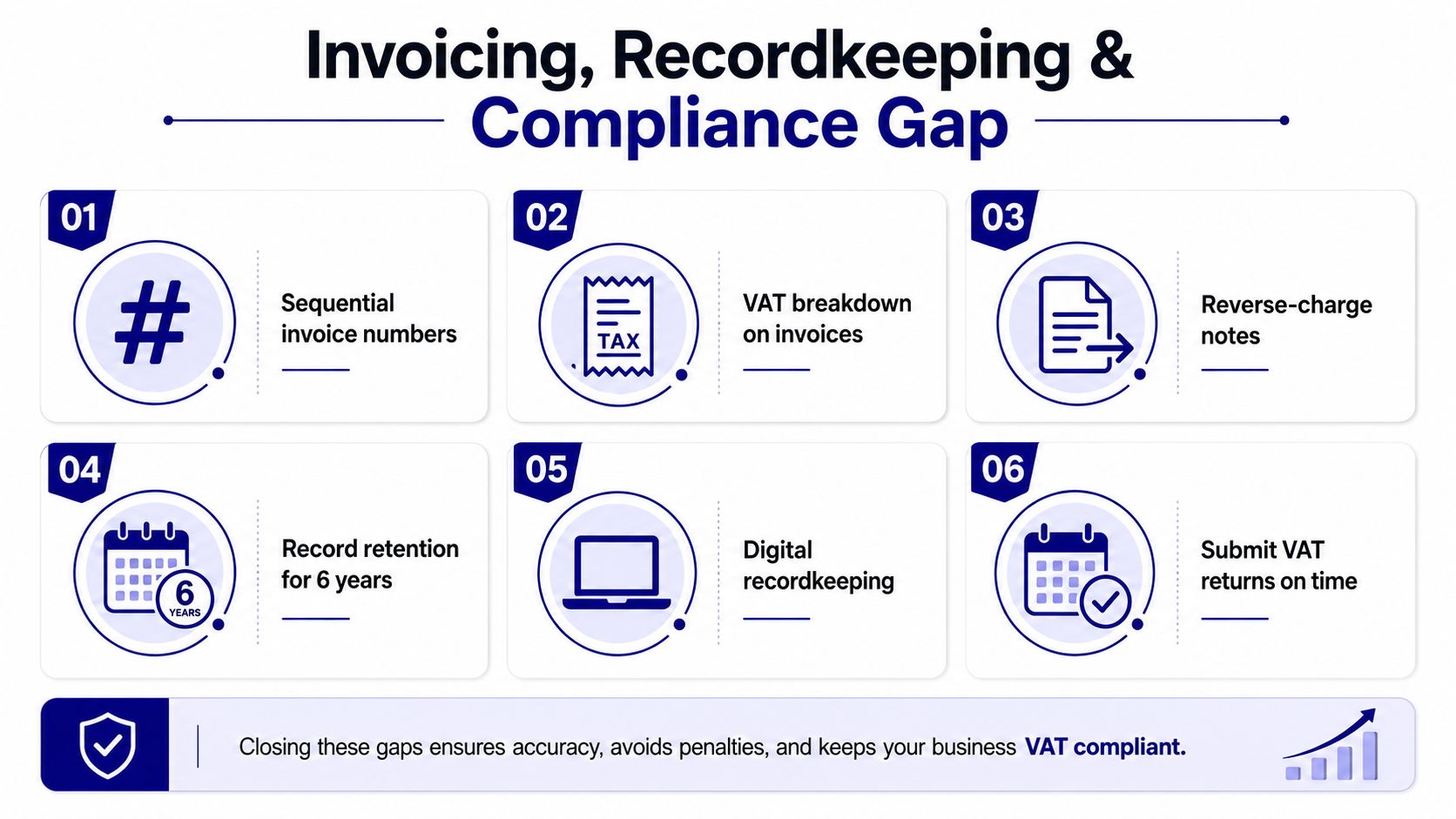
A VAT return is only as defensible as the invoice trail behind it. That means sequential invoice numbers, a clear VAT breakdown, and notes where reverse charge rules apply, because tax authorities don't want to guess what a payment meant after the fact. The UAE's VAT documentation rules are a useful example of how detailed the paper trail can become, with invoice content, adjustments, and retained records all tied to compliance. UAE VAT invoicing and recordkeeping rules
What clean VAT paperwork usually needs
A good invoice set normally tells a simple story. It should show what was sold, when it was sold, how much VAT was charged, and whether any special treatment applies. Smart Receipts' smart receipts tips for invoice tasks is a practical resource if you want a more operational view of how invoices support bookkeeping without turning every sale into a manual chore.
The policy debate sits above that paperwork. The brief's research points to a real tension between simpler rate structures and stronger compliance. The European Parliament's work on the VAT gap frames the difference between expected and collected VAT as a policy concern, and IMF work on VAT efficiency points to design choices that affect collection outcomes. The takeaway is straightforward. Complex exemptions and reduced rates may look attractive on paper, but they can widen the gap between what should be collected and what gets paid.
Compliance trade-off: simpler headlines don't always mean simpler administration.
That's why recordkeeping matters even when the rate looks stable. If your invoices are sloppy, your audit trail gets weak. If your categories are inconsistent, your return may technically be filed but still be hard to defend. A clean system reduces the chance that a small coding mistake becomes a larger tax issue later.
Keep the record, not just the payment
The payment itself is only one part of compliance. Authorities care about the invoice, the supporting records, and the logic that ties the return back to the sale. If you sell cross-border or digital products, that trail becomes even more important because the tax treatment often depends on facts that aren't obvious from the payment receipt alone.
Modern Payment Rails and Stablecoin Settlements
VAT rules don't change just because the settlement rail looks modern. If a customer pays by card, wallet, bank transfer, or crypto, the tax treatment still follows the underlying sale, the place of supply, and the parties involved. That's especially important when a business receives settlement in a stablecoin such as USDC, because the accounting team still has to reconcile the sale, the tax due, and the final settlement amount cleanly. Suby is one example of payment infrastructure that lets businesses accept card or crypto payments through a single API, offer native integrations with Discord and Telegram, and settle to a bank account or in stablecoins, with pricing that depends on the payment method used and should be checked on its pricing page before relying on figures.
Why the rail doesn't change the tax
A customer can pay in one way and the business can settle in another, but VAT still follows the transaction itself. That means the invoice needs to show the correct tax logic, and the bookkeeping needs to map the payment to the right sale without confusion. If a founder treats the settlement currency as the tax currency, reconciliation gets harder, not easier.
The same logic applies when a payment stack handles multiple methods under one roof. The finance team still needs a clear record of what was sold, to whom, where, and under what VAT treatment. That's what keeps the tax side stable when the payment side is flexible.
For subscription businesses, the connection between billing and settlement is particularly sensitive. The guide on stablecoin subscription payments for SaaS customers is relevant if you're trying to connect recurring billing with modern settlement options without losing track of the VAT trail.
If your payment stack can route money in several ways, your invoice data needs to be the stable part.
That's the operational lesson. Modern rails can reduce friction, but they also make clean reconciliation more valuable. The more flexible the payment flow, the more disciplined your VAT records need to be.
Your Value Added Tax Payment Action Checklist
Start with registration. Check whether your home jurisdiction requires you to register now, later, or voluntarily, then check any country where you sell cross-border and may trigger a separate obligation. After that, set a filing calendar that matches the local return cycle, because a late return often creates a payment problem even when the cash is sitting in the account.
Then lock down the payment workflow. Use the payment method and reference format the tax authority expects, keep the return and the payment tied together, and store invoices in a way that makes the VAT breakdown easy to prove later. Keep records for the statutory retention period in the relevant country, because the invoice trail is what turns a filing into a defensible position.
Finally, make your systems do more of the work. If you sell across borders, use official tax authority guidance for the jurisdictions that matter to you, and pair that with payment infrastructure that keeps the sale, the invoice, and the settlement record in sync. If your setup includes card, crypto, recurring billing, Discord access, or client invoicing, review the product documentation before you wire anything into production.
If you want to simplify VAT-aware billing, card and crypto acceptance, and settlement workflows in one stack, take a look at Suby. It's built for businesses that need customers to pay in different ways while the business receives funds in the format it prefers. For founders managing VAT across subscriptions, invoices, and cross-border sales, that kind of flexibility can make reconciliation a lot cleaner.
