

Gaspard LEZIN
Your Guide to Internet Sales Tax Compliance in 2026
Struggling with internet sales tax? Our 2026 guide explains economic nexus, state rules, and compliance steps for your online business.
If you're selling online in the U.S., you're in the sales tax business, whether you realize it or not. Internet sales tax is simply the sales tax that online businesses must collect from customers in certain states and then send to the state's tax authority.
The days when this only applied to businesses with a physical storefront are long gone. Today, these rules affect nearly every e-commerce company selling to customers across state lines.
Why Internet Sales Tax Matters for Your Business Now
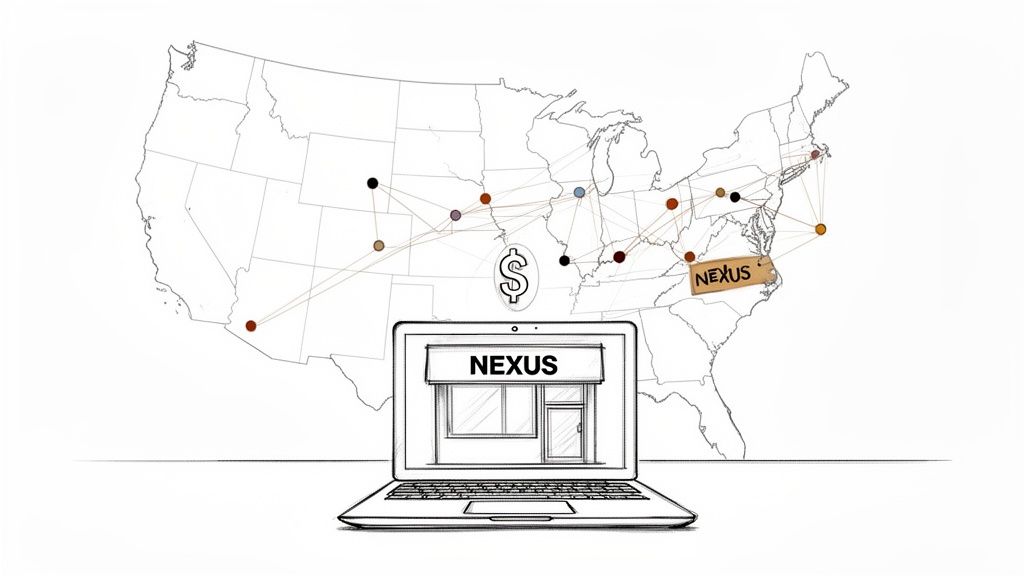
For a long time, online sellers operated with a huge advantage. Unless you had a physical office, warehouse, or employee in a particular state, you generally weren't required to collect its sales tax. A single Supreme Court decision changed everything.
The Big Shift From Physical to Economic Presence
The old rule of thumb was something called "nexus," which is just a legal term for the connection your business has to a state. For decades, this connection had to be physical. No office? No warehouse? No problem.
That all changed in 2018 with the landmark Supreme Court case, South Dakota v. Wayfair.
The Wayfair ruling gave states the power to create economic nexus laws. This means your business can now have a tax obligation in a state just by selling a certain amount there, even with zero physical footprint.
This was a direct response to the explosion of e-commerce. States were watching billions in potential tax revenue disappear as sales moved online. By 2017, it was estimated that states were losing $26 billion a year from uncollected internet sales tax.
A Quick Look: Old vs. New Rules
To really understand the shift, it helps to see the old and new rules side-by-side. The concept of "nexus" is still central, but what creates it has completely changed.
Physical Presence vs Economic Nexus at a Glance
Factor | Old Rule (Pre-Wayfair) | New Rule (Post-Wayfair) |
|---|---|---|
Primary Trigger | A physical footprint in the state (office, employee, warehouse, etc.). | Meeting a specific economic threshold (sales revenue or transaction count). |
Key Concept | Physical Presence Nexus: If you weren't "there," you didn't collect. | Economic Nexus: Your digital sales create a taxable "presence." |
Seller Scope | Mostly affected larger businesses with multiple locations. | Affects almost all online sellers, regardless of size or location. |
Complexity | Relatively simple; tax obligations were tied to physical locations. | Highly complex; must track sales into dozens of different states. |
Essentially, the Wayfair decision meant your digital sales footprint now matters just as much as your physical one.
What This Means for Your Online Business
Today, almost every state with a sales tax has its own economic nexus law. These laws kick in once your business crosses a specific threshold. While they vary, the most common triggers are:
$100,000 in annual sales into the state.
200 separate transactions with customers in the state.
These rules add a new layer of complexity, particularly for businesses selling across the U.S. and beyond. As you figure out how to accept international payments, keeping your finances organized becomes critical for tax compliance. Using a payment solution that settles every sale into USDC can make life much simpler. Customers pay with their card, and you receive USDC, which gives you a clear, unified view of your revenue. This helps you track these state-by-state thresholds without the noise of currency fluctuations.
From Main Street to the Cloud: A Brief History of Sales Tax
It’s hard to wrap your head around modern internet sales tax without a quick look at how we got here. The idea of a sales tax isn't new; it became a lifeline for states during the Great Depression, offering a steady way to fund public services. For decades, the rules were simple and tied to a physical location, the classic "Main Street" model.
If a customer bought a hat from a shop in Ohio, that shop collected Ohio sales tax. Easy enough. But when e-commerce came along, that straightforward system started to unravel. Suddenly, a business in California could sell to customers in all 50 states without ever having a physical storefront outside its home base.
The Wild West of Early E-commerce
In the early days of online shopping, lawmakers intentionally gave the new industry a pass on complex tax rules. The prevailing fear was that forcing small, budding online sellers to manage thousands of different tax jurisdictions would smother the internet's economic potential before it could even take off. This created a period where online sales were often tax-free, giving them a significant price advantage over the local brick-and-mortar stores down the street.
This hands-off approach was eventually codified by a few landmark court cases and key pieces of legislation, which effectively created a tax shelter for the booming digital marketplace.
The Internet Tax Freedom Act: A Line in the Sand
A major turning point came with the Internet Tax Freedom Act (ITFA) of 1998. This federal law did two big things. First, it banned states from taxing internet access itself (your monthly ISP bill). More importantly, it stopped states from putting discriminatory taxes on e-commerce. In other words, a state couldn't just invent a special "internet tax" that didn't apply to other forms of commerce.
This act, combined with an earlier Supreme Court ruling in Quill Corp. v. North Dakota (1992), reinforced the core idea that a business needed a physical presence in a state to be on the hook for collecting its sales tax. Back in the late 90s, when e-commerce was less than 1% of all retail sales, the tax revenue states were missing out on was just a rounding error. You can get a much deeper look into the history of sales tax on digital products and its evolution from the Multistate Tax Commission.
The core principle of the ITFA was tax neutrality. It was designed to ensure online businesses weren't unfairly targeted, a philosophy that still resonates today in discussions about global payment systems.
Of course, that system couldn't last. As online shopping exploded from a niche hobby into a dominant force, states watched their tax revenues shrink year after year. This growing tension set the stage for a massive legal and political battle that would completely redefine what "presence" means in the digital age, leading directly to the economic nexus rules every online seller deals with today.
Alright, let's move from the legal history to what really matters for your business day-to-day: understanding your sales tax obligations. This all boils down to one critical concept: economic nexus.
Think of economic nexus as an invisible tripwire. You no longer need a physical store or warehouse in a state to be on the hook for its sales tax. Simply having enough economic activity, enough sales, crossing into a state is enough to trigger that wire.
Once you hit a state's specific sales threshold, you’ve established economic nexus. From that moment on, you have a legal duty to register with that state, collect sales tax from its residents, and send that money to the state's tax authority. For the vast majority of online sellers, this is the new reality of sales tax compliance.
The Thresholds That Define Your Tax Duties
So, where exactly is that tripwire set? While the idea of economic nexus is the same everywhere, the specific rules are a patchwork quilt of state-by-state regulations. That said, a common standard has definitely emerged since the Wayfair ruling.
Most states have adopted thresholds that look something like this:
Over $100,000 in gross sales delivered into the state.
200 or more separate sales transactions delivered into the state.
These are typically measured over the previous or current calendar year. If your business crosses either of these lines, you have nexus. It’s not always both; one is enough.
It’s easy to see how different business models can trigger these thresholds differently. A company selling high-ticket furniture might hit the $100,000 sales mark with just a handful of orders. On the other hand, a store selling low-cost stickers could easily fly past the 200-transaction limit without getting anywhere near the revenue threshold. You have to track both.
This concept isn't limited to the US. For instance, businesses selling into Australia need to be just as aware of their local thresholds. It's crucial to understand things like when to register for GST in Australia to stay compliant globally.
State Rules Are a Moving Target
Of course, not every state plays by the same rules. The $100,000/200 transaction standard is more of a guideline than a hard-and-fast law. This is where compliance gets tricky, you have to check the specific requirements for every single state where you make sales. The differences can be significant.
To make this easier to visualize, we've grouped states by their common threshold types.
Common Economic Nexus Thresholds by State Type
Threshold Type | Example States | Typical Sales Requirement | Typical Transaction Requirement |
|---|---|---|---|
Sales or Transactions | Georgia, Hawaii, Illinois | $100,000 | 200 Transactions |
Sales Threshold Only | California, Massachusetts | $100,000 | None |
Sales Threshold Only (Higher) | New York, Texas | $500,000 | None |
Other Unique Rules | Kansas, South Dakota | Varies | Varies |
Note: This table is for illustrative purposes. Always verify the current thresholds directly with each state's Department of Revenue, as rules can and do change.
As you can see, there's quite a bit of variation. Some states have decided the transaction count is too burdensome and have dropped it entirely, focusing only on sales revenue.
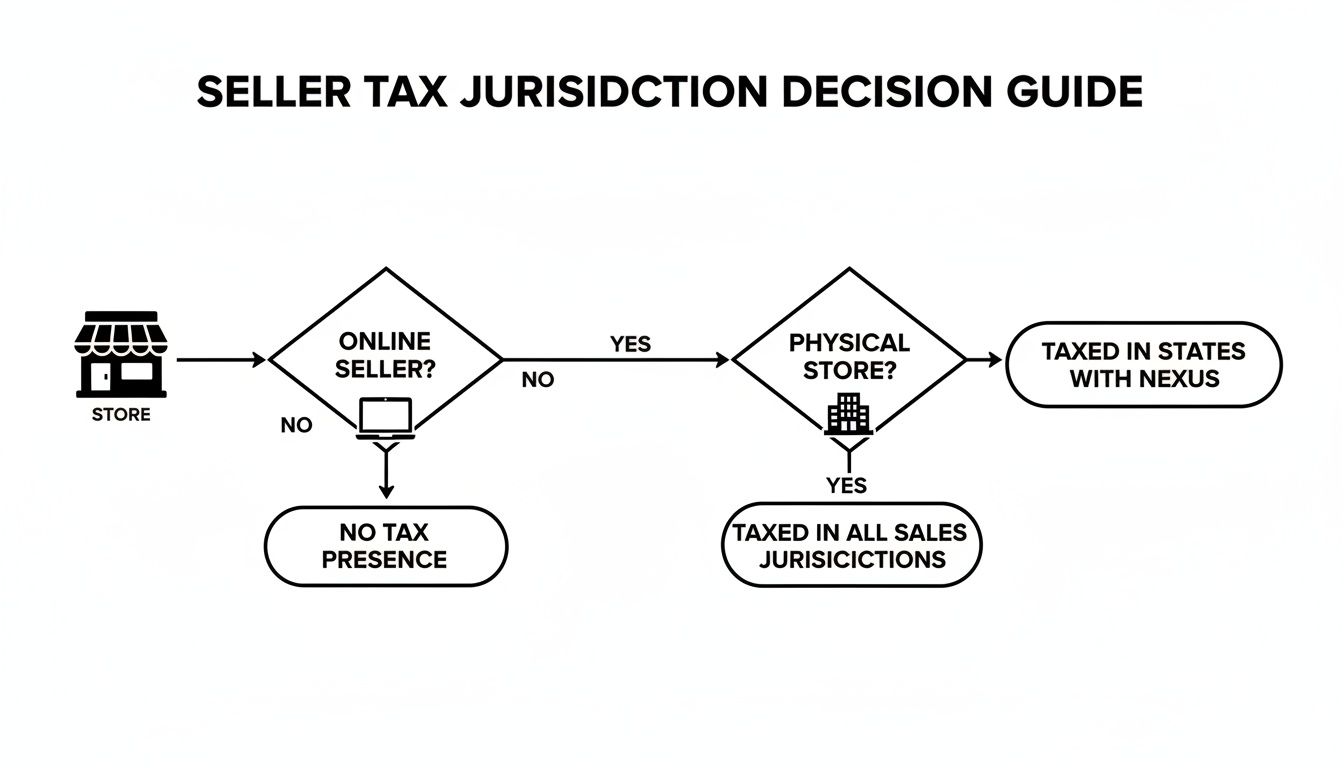
Here are a few key variations you need to watch out for:
Sales-Only Thresholds: A growing number of states, like California and Texas, have simplified their rules. They’ve dropped the 200-transaction test, focusing solely on a higher sales figure (like $500,000 in Texas).
Different Timeframes: Most states look at the "previous or current calendar year," but some use a "rolling 12-month period," which requires continuous monitoring.
What Counts as a "Sale": This is a big one. Some states require you to include revenue from non-taxable items when calculating your total sales. Your tax-exempt products could be the very thing that creates your obligation to collect tax on your taxable ones.
Staying on top of this patchwork of rules demands clean, organized sales data. For global sellers, having a payment system that unifies all your revenue streams is a lifesaver. With Suby, every customer payment settles as USDC right into your account. Customers pay by card, and you receive stablecoin. This gives you a single, unified ledger, making it far simpler to track your sales against each state’s threshold without battling multiple currencies or payout schedules.
What About Marketplaces Like Amazon and Etsy?
If you sell through a platform like Amazon, Etsy, or eBay, things get another twist. Most states have now passed marketplace facilitator laws.
These laws essentially shift the burden of collecting and remitting sales tax from you, the individual seller, to the marketplace platform itself. The marketplace becomes the "facilitator" responsible for handling the tax on your behalf for sales made through their site.
But here’s the catch: this doesn't get you completely off the hook. Your sales through a marketplace still count toward your economic nexus thresholds in a state.
Let’s say you sell $80,000 on Amazon and $30,000 through your own website into Georgia. Your total is $110,000, which is over the $100,000 threshold. Even though Amazon handled the tax for its portion, you now have nexus and must register to collect and remit tax on all future sales from your own site. You’ll also likely have to file a return reporting the marketplace sales, even if the tax due on them is zero.
Your Step-by-Step Guide to Sales Tax Compliance
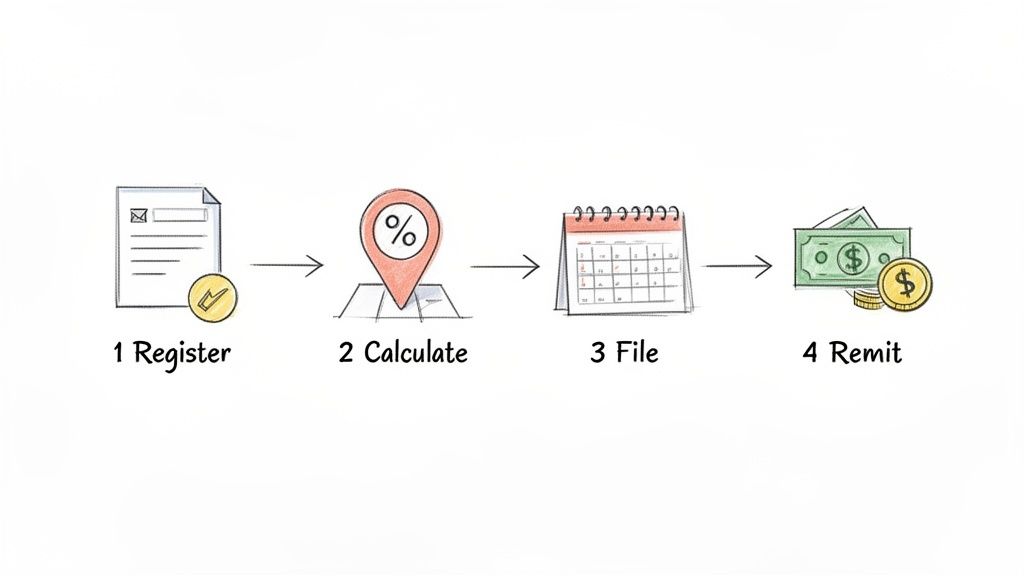
So, you've figured out your business has economic nexus in a new state. That’s the first hurdle. Now comes the real work of staying compliant.
Getting this right isn't just about avoiding audits; it's about building a solid operational foundation for your business. The good news is that the entire process can be broken down into four clear, manageable steps. Let’s walk through what you need to do.
Step 1: Register for a Sales Tax Permit
First things first: you cannot legally collect sales tax from customers without a permit. Before you do anything else, you must register with the department of revenue in every state where you have nexus. Collecting tax without being registered is a serious offense.
This means if your sales have crossed the threshold in Georgia, Illinois, and Colorado, you’ll need to complete three separate registrations. Most states let you handle this online. While it might feel like an administrative chore, think of it as getting your license to do business properly in that state. The process is similar worldwide, and guides on how to register for VAT in UAE can even offer a glimpse into how these obligations are managed internationally.
Step 2: Calculate the Correct Sales Tax Rate
Once you're registered, your next job is to charge the right amount of tax on every single sale. This part gets tricky fast. The United States has over 13,000 different tax jurisdictions, and rates can change based on the city, county, or even a specific transit district.
You are on the hook for collecting the full combined rate, which includes state, county, city, and all other local taxes. The only way to get this right is by using the customer’s complete shipping address to pinpoint their exact location.
Guessing or using a generic statewide rate is a recipe for disaster. This is where automation is a lifesaver. Modern sales tax software plugs directly into your e-commerce store and calculates the precise rate for every transaction in real-time, eliminating the risk of costly errors.
Step 3: File Returns and Remit the Tax
Collecting the tax is only half the job. You then have to report and pay every dollar you’ve collected to the correct state authorities. When you register, each state will assign you a filing frequency.
Your schedule will typically be:
Monthly: Common for businesses with a high volume of sales.
Quarterly: The standard for most small and medium-sized businesses.
Annually: Usually for businesses with very low sales tax liabilities.
Don't be late. Missing a filing deadline can trigger hefty penalties and interest, and you're often required to file a "zero return" even if you had no sales in that state for the period.
Step 4: Maintain Detailed Records
Finally, you need to keep spotless records of all your sales and the tax you've collected. State tax agencies have the authority to audit your business, and when they come knocking, you’ll need the paperwork to prove you’ve done everything by the book.
Your records should always include:
Detailed sales data: Transaction totals and the specific amount of tax collected on each.
Exemption certificates: If you sell to tax-exempt entities like non-profits, you must have their valid certificate on file.
Copies of your filed returns: Keep a digital or paper copy of every sales tax return you submit.
This is where having clean, organized financial data really pays off. A unified payment system can be a huge help here. For example, Suby settles every customer payment into a single USDC ledger. Customers pay with their card, and you get USDC. This creates an organized record of all your transactions, making it far simpler to track sales volume and manage your compliance documentation when it’s time to file.
Managing Global Sales Tax and Payments
Once you start selling to customers outside of the US, the internet sales tax puzzle gets a whole lot bigger. Suddenly, you're not just tracking state-by-state rules; you're dealing with entirely different tax systems for each country you sell into. For most online businesses, this means getting familiar with Value Added Tax (VAT) and Goods and Services Tax (GST).
At first glance, these consumption taxes feel a lot like US sales tax. The key difference is that they are typically applied at every step of the production chain, not just at the final sale. If your business sells to customers in regions with these taxes, you're often on the hook to collect and pay them, just like you would for a sale in a US state.
Navigating VAT in the European Union
For anyone selling digital goods, software, or paid subscriptions, the European Union's VAT rules are a top priority. The EU operates under "place of supply" rules for digital services, which is a formal way of saying that VAT is owed in the country where your customer is, not where your business is.
This rule creates an immediate tax obligation for many US and other international sellers. If your American company sells a software license to a user in Germany, you're required to charge the German VAT rate of 19%. These rates swing wildly across the EU, from a low of 17% in Luxembourg to a high of 27% in Hungary.
Understanding GST in Other Major Markets
Many other countries, including Canada, Australia, and New Zealand, use a similar system called a Goods and Services Tax (GST). The principle is identical: if your sales into these countries pass a certain threshold, you have to register for, collect, and remit GST.
Canada: Has a federal GST, but some provinces add their own Provincial Sales Tax (PST). In some cases, these are blended into a single Harmonized Sales Tax (HST).
Australia: Foreign businesses must register for GST once their sales to Australian buyers top A$75,000 in a year.
You can see how this gets complicated fast. For a creator with a global paid community or a SaaS business with customers all over the world, keeping these different rates, rules, and registration thresholds straight can become a full-time job.
The real challenge of selling globally isn’t just making the sale, it's getting paid cleanly while juggling dozens of tax jurisdictions. Your financial stack should make this simpler, not harder.
Streamlining Revenue for Easier Tax Management
This is where your choice of payment solution becomes so important. While a payment platform won't file your taxes for you, the right one can dramatically simplify the financial data you need to get it done right. Imagine handling payments from the EU, Canada, and the US, you'd be juggling euros, Canadian dollars, and US dollars, all with different conversion fees and settlement delays.
This kind of currency chaos makes it incredibly difficult to track your revenue accurately against various tax thresholds. A payment layer that unifies every transaction into a single, stable currency gives you a massive advantage. Our API, for instance, lets any business accept payments by card, but every sale settles in USDC. Your customers pay how they want, and you receive a predictable digital dollar.
This approach cuts out the noise of currency conversions and cross-border bank transfers. With one clean, unified ledger of USDC revenue, it becomes far simpler for you or your tax software to track sales by country and stay on top of your global tax obligations. For businesses that operate across borders, like those with paid Discord and Telegram communities via our native integrations, this financial stability is a game-changer.
The history of sales tax shows that governments are always adapting to new ways of doing business. The first state sales taxes appeared during the Great Depression, with Mississippi leading the way in 1930. You can discover more about the origins and evolution of sales tax to see how those early rules shaped today's landscape. Just as states adapted back then, they're adapting to digital commerce now, making clean financial data more critical than ever.
It's also worth exploring how different business models, such as operating as a Merchant of Record, can shift your global tax and compliance responsibilities.
Frequently Asked Questions About Internet Sales Tax
Even with the rules laid out, a few common questions always seem to pop up. Let's tackle some of the most frequent sticking points we see online businesses run into when it comes to internet sales tax.
Do I Need to Collect Sales Tax on Digital Products or SaaS?
This is one of the trickiest questions in e-commerce, and the answer is a definite "it depends." The tax rules for digital products, like ebooks, online courses, and Software-as-a-Service (SaaS), are a real patchwork across the United States.
Right now, more than half of U.S. states tax digital goods in some way, but no two states seem to agree on the specifics. One state might tax all SaaS subscriptions, while its neighbor only taxes software you actually download, and a third doesn't tax it at all. Your responsibility boils down to where your customers live and whether you've hit the economic nexus threshold in their state. Simply assuming your digital goods are tax-free is a costly mistake many businesses make.
What Happens If I Have Nexus but Fail to Collect Tax?
Ignoring your sales tax obligations, even unintentionally, can create serious financial headaches down the road. State tax authorities have the power to audit your business, and they can look back several years to uncover what you owe.
If they find you had nexus but weren't collecting, you'll be on the hook for all the back taxes. On top of that, they’ll add hefty penalties and interest charges.
This isn't a small risk. What starts as an oversight can quickly snowball into a significant debt that puts a real strain on your business. It's always cheaper to handle compliance from the start.
If you realize you’ve had nexus for a while without collecting tax, the best first step is to talk to a tax professional. They can guide you through programs like a Voluntary Disclosure Agreement (VDA), which helps you get compliant while often reducing the penalties you have to pay.
How Does a Payment Platform Affect My Tax Duties?
Your choice of payment platform doesn't change your core tax responsibilities. As the seller, you're still the one responsible for knowing where you have nexus, registering in those states, calculating the right tax rates, and remitting what you've collected.
However, the right payment platform can make your financial admin much cleaner, which in turn makes tax compliance far less painful. For example, our API allows any business to accept payments by card, but we settle every transaction in USDC. This gives you a single, clean ledger of your revenue, completely free from the messy data that comes with currency conversions or tracking down international bank transfers. Your customers pay with their card, and you receive USDC.
This unified revenue stream makes it incredibly simple for you or your accounting software to see your total sales volume and monitor how close you are to hitting nexus thresholds. For sellers using our native integrations to manage paid communities on Discord or Telegram, this kind of stable, predictable financial data is absolutely crucial for staying on top of global sales and tax duties.
Suby is a payment gateway and Merchant of Record. Your customers pay with card, bank transfer, Apple Pay, Google Pay, Klarna, and more, or crypto, and you get paid out to your bank account, or in stablecoins (USDC, EURC) to your wallet, anywhere in the world with no bank account required. When you are tracking nexus thresholds and internet sales tax across borders, a Merchant of Record model and clean, unified revenue data take a large part of that compliance load off your plate.
