

Gaspard LEZIN
Usage Based Billing SaaS: A Practical Guide
Discover how usage based billing SaaS helps you align pricing with customer value. Learn key strategies and best practices to boost revenue.
Usage-based pricing has moved from a niche idea to the default conversation in SaaS. OpenView's 2023 research found that 61% of the general SaaS index had already adopted some form of usage-based pricing, with another 21% planning to test it, and earlier OpenView data showed adoption rising from 27% in 2018 to 45% in 2021 (OpenView usage-based pricing research). By 2025, a survey of 100 SaaS companies found 85% had adopted it in some form (Metronome and Greyhound Capital survey). The model is clearly no longer experimental.
That shift makes sense once you strip away the jargon. Usage-based billing charges customers for what they consume instead of a flat fee, so the bill moves with activity rather than seat count. In practice, the system tracks measurable events like API calls, messages sent, transactions, or storage used, then converts that activity into a charge at the end of the billing cycle (Salesforce on usage-based billing). For SaaS teams, the question isn't whether the model is popular. It's whether the product, the finance stack, and the customer experience can survive the move.
Table of Contents
Why Usage Based Billing SaaS Is Reshaping Software Pricing
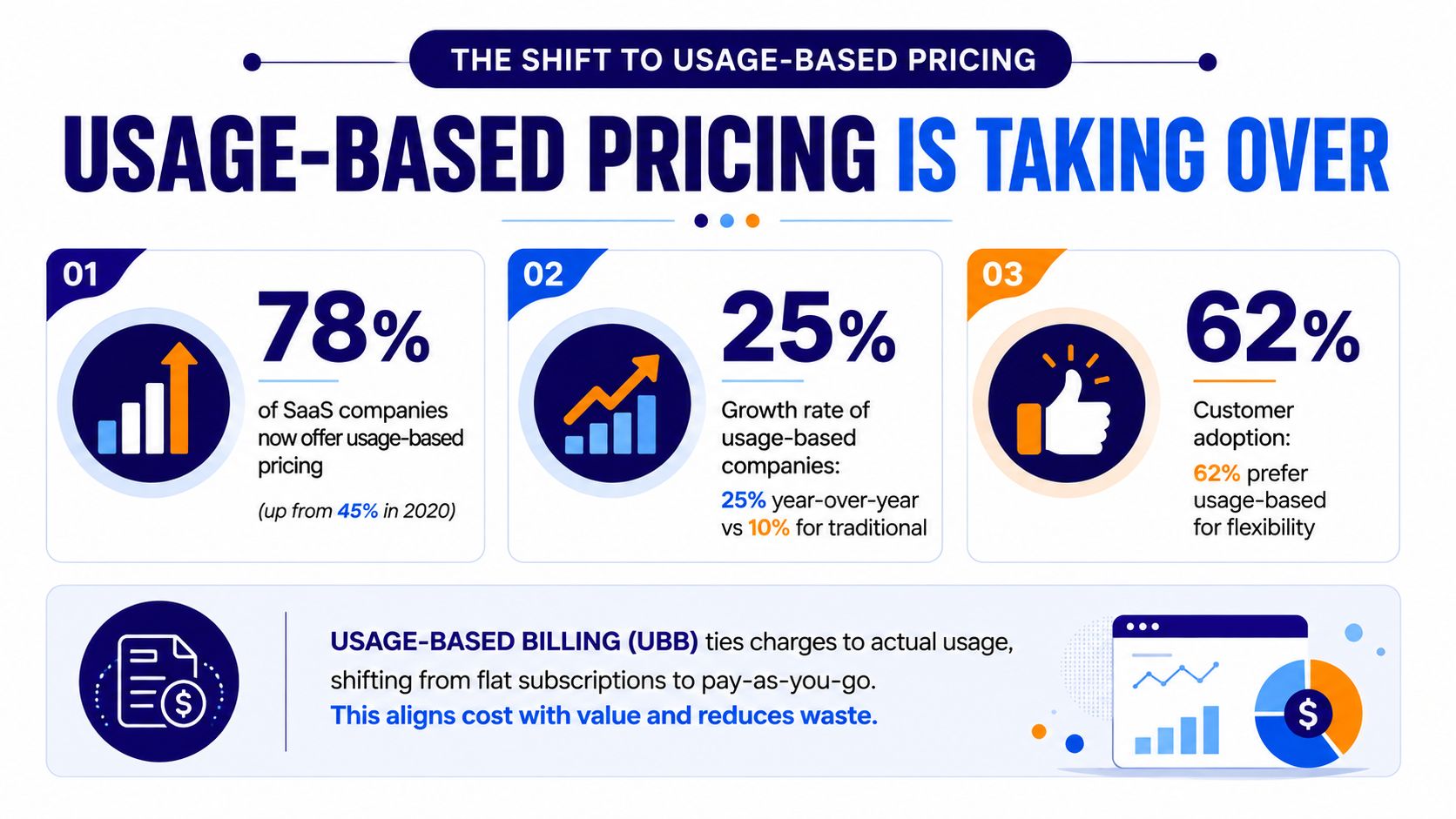
A flat subscription asks customers to pay for access. Usage-based billing asks them to pay for activity. That sounds like a small distinction until a product is used unevenly, by software, or in bursts that don't map cleanly to seats. In those cases, measured consumption is a better proxy for value than headcount.
The strongest fit is usually a product with clear, trackable units. API platforms, data tooling, infra products, AI products, and communication systems all lend themselves to event-based measurement because the business can count the thing being consumed. A per-seat model can still work for collaboration tools and role-based software, but once the value driver becomes calls, tokens, records, minutes, or transactions, the subscription model starts to feel blunt.
Practical rule: if your product already emits events that matter operationally, you're closer to usage billing than you think.
This is also why the model has spread so quickly. It aligns price with value, but it also matches how modern software is used. Systems, integrations, agents, and automations increasingly consume the product without a human clicking every action. That makes the product itself a metered service, not just a seat license.
The catch is that usage pricing isn't automatically better. It works best when customers can understand what they're paying for, when usage naturally reflects value, and when the bill doesn't become a surprise every month. If you can't measure usage reliably or explain it plainly, the model creates friction instead of fairness. That's the first filter I use with product teams, whether they're launching a new motion or reconsidering an old one.
Common Pricing Models and Rate Structures
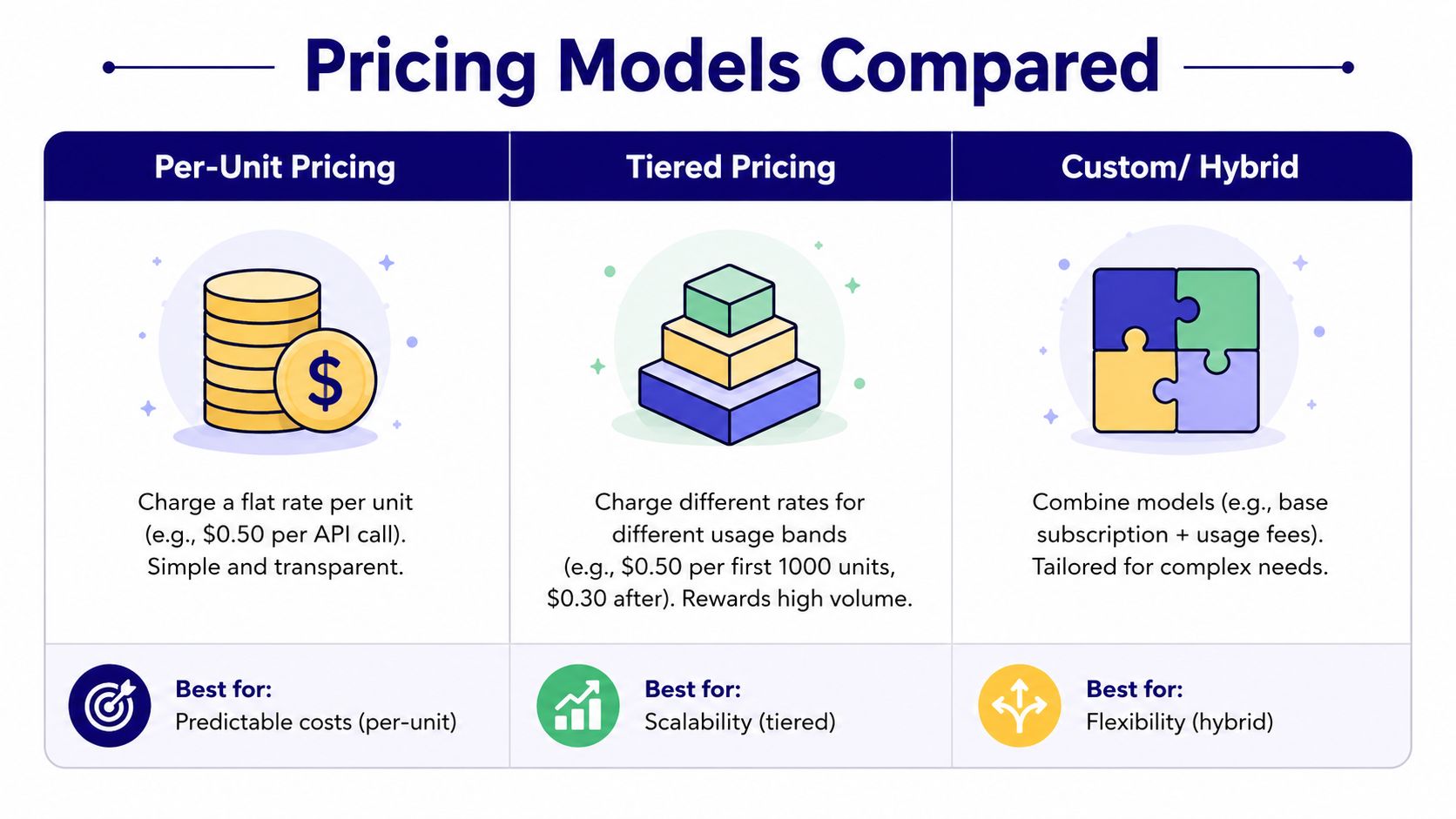
The simplest usage model is per-unit pricing. The formula is straightforward, invoice amount = quantity of units consumed multiplied by price per unit (RightRev on usage-based billing). If a customer consumes 1,000 units at a fixed per-unit rate, the arithmetic is easy for both sides. This works best when the metric is unambiguous and customers can estimate spend without a lot of guesswork.
Per-unit pricing
Per-unit pricing is the cleanest starting point when one metric dominates. It's transparent, easy to explain on a sales call, and easy for finance teams to reconcile. It can also be unforgiving if the unit is too small or too noisy, because customers will obsess over line items they don't understand.
Tiered pricing
Tiered pricing introduces volume bands and rate changes as usage rises. It's useful when higher volume should earn a better unit price, or when the business wants to reward scale without giving away margins too early. A good tiered plan can soften bill shock, but it also requires careful explanation so customers understand why the marginal rate changes.
Hybrid pricing
Hybrid models combine a base fee with usage charges, or mix several meters together. That's often the most practical choice when a product has both predictable and variable cost drivers. It gives finance teams a floor, and it gives customers a clearer entry point than a pure consumption model.
The rate structure matters less than the value metric behind it. If customers don't recognize the thing they're being charged for, the model will feel arbitrary no matter how elegant the math is.
For SaaS teams comparing options, it helps to look at how a provider handles packaging, billing, and customer communication together. A useful external reference is find your plan on pricing page, because it shows how a real billing system presents options without hiding the structure behind vague labels.
Building the Metering and Invoicing Pipeline
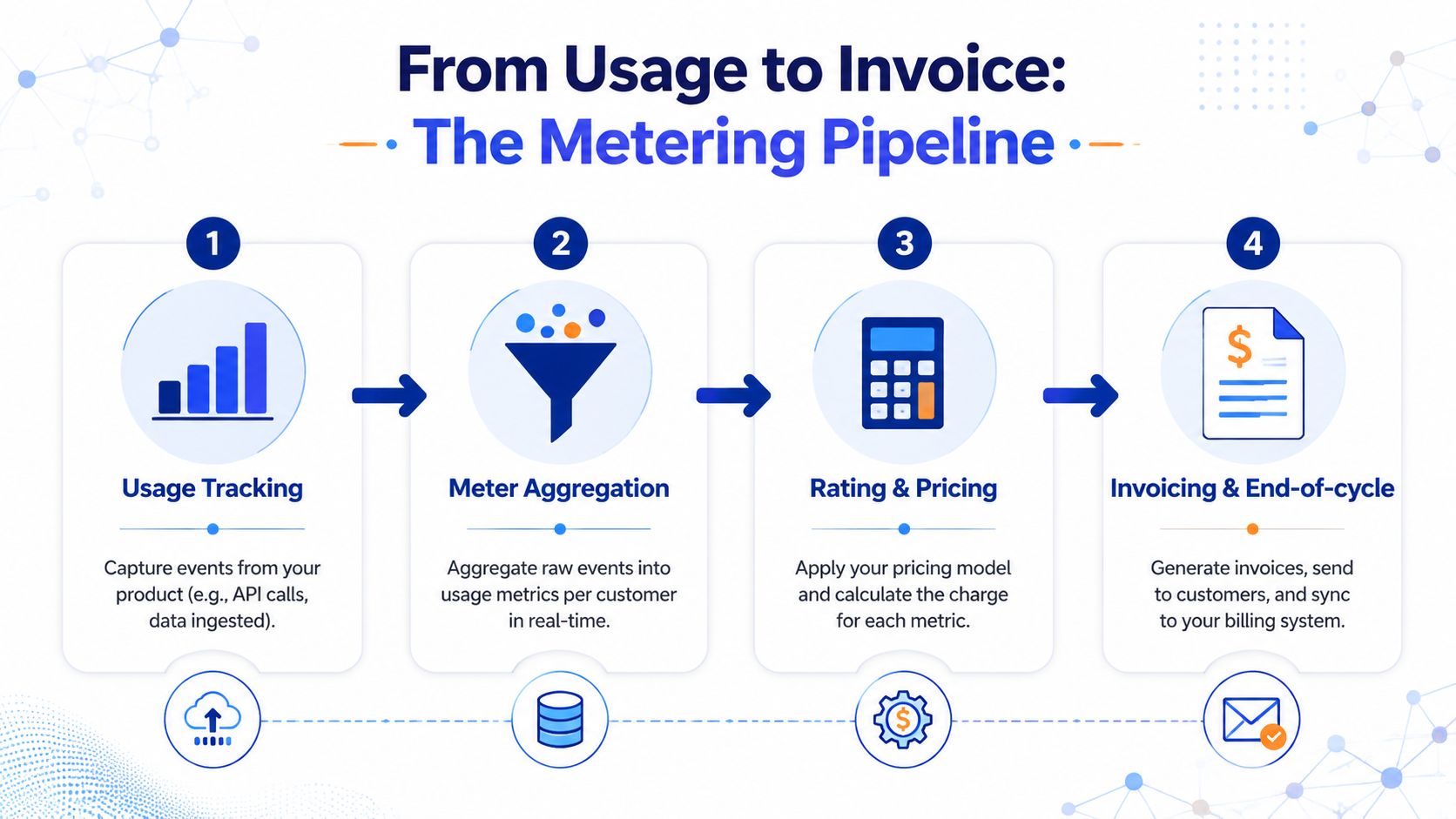
A production billing system needs more than a pricing table. It needs an event-driven pipeline that can ingest usage, protect data integrity, rate the event, and produce invoices without slowing down the product itself. In the pattern described in billing engineering guidance, product events go into a durable queue, a billing consumer deduplicates them with an idempotency-key store, and usage moves into the rating layer. That separation lowers double-billing risk and keeps billing latency away from application latency (usage-based billing engineering deep dive).
Meter first, price second
That order matters. Product teams often want to attach pricing logic too early, but the safer pattern is to capture raw events first, then apply pricing rules later in a controlled layer. A version-controlled rating engine can then handle tiered pricing, volume discounts, multi-dimensional rates, and currency conversion without changing the product code every time finance updates a plan (usage-based billing system guide).
Late events are normal
Late-arriving events are common enough that billing systems usually leave a grace window of about 24 hours before closing a billing period. That keeps you from issuing invoices before delayed usage records land. If your event pipeline cannot tolerate lateness, month-end turns into dispute resolution instead of revenue collection.
The rest of the stack should follow the same logic. Meter usage in real time, validate it, generate itemized invoices automatically, and trigger dunning workflows if payment fails (Tabs usage-based billing overview). For teams deciding whether to build or buy, the cleanest architecture usually starts with a warehouse or event backbone. If your reporting layer is already centralized, the guide to SaaS data warehouses is worth reading before you wire billing into the rest of the stack.
I've seen teams break production by doing the opposite. They treat billing as a spreadsheet problem, then discover that retries, duplicates, and backfills turn the month close into a reconciliation exercise.
Stripe-specific implementations usually need the same discipline around meter design, invoice timing, and retry handling, which is why the Suby guide to Stripe usage-based billing is a useful companion when you are mapping the operational flow.
Solving the Revenue Forecasting Problem
Usage-based pricing changes the shape of the revenue line. Fixed subscriptions give finance teams a clean monthly number to model, but variable usage introduces noise, timing shifts, and cohort differences that don't fit neatly into classic ARR or MRR thinking. The hard part isn't calculating the invoice. It's predicting what the invoices will look like next month, next quarter, and across customer segments.
Forecasting needs new guardrails
When usage swings month to month, cash flow planning has to move from single-number forecasts to ranges and cohorts. Product-led teams need to know which accounts are trending upward, which are stable, and which are volatile because of seasonality or bursty workloads. Revenue recognition also has to respect contract terms and usage timing, which is why variable billing calls for tighter coordination between billing, finance, and the data team. The internal guide on revenue reporting is useful here because the reporting problem appears long before the invoice lands.
One thing that gets missed often is product rollout strategy. Don't flip the entire subscription base at once unless you're prepared for churn risk and reporting confusion. Start with a new product, a new segment, or a narrow cohort where usage is naturally measurable. That lets you observe spend patterns before you tie the whole company's forecast to the new model.
Forecasting gets easier when the product has a narrow value metric and a clear usage distribution. It gets harder when every customer behaves differently and nobody agrees on what “normal” looks like.
A common mistake is treating usage pricing as a pure monetization win. It can be, but only if the finance team gets a model it can live with. Otherwise, the business inherits volatility without gaining enough predictability to manage it.
Migration Strategies From Flat Subscriptions
The cleanest migrations I've seen weren't big-bang launches. They were staged, with legacy customers protected while new cohorts moved into usage-based plans. A mid-market SaaS company I worked with kept existing customers on grandfathered subscriptions, introduced usage pricing only for new deployments, and let sales offer a hybrid plan when the buyer wanted predictability. That avoided a sudden reset of trust.
Segment before you change pricing
Not every customer should move at the same time. Heavy users often welcome usage pricing because they already see the product as a utility. Light users may prefer the certainty of a fixed fee. The migration decision should start with usage patterns, not with the desire to simplify the pricing page.
Keep a hybrid escape hatch
Hybrid pricing is often the safest bridge between old and new. It gives customers a baseline they recognize, while the variable portion captures actual consumption. It also gives customer success teams a story they can explain without defending every line item as if it were a tax form.
Communication is where migrations succeed or fail. Customers don't resent pricing changes as much as they resent surprise. The best rollouts give notice early, explain the metric in plain language, and make the transition feel like an operational update rather than a bait-and-switch. If the team can't explain the bill in one sentence, the migration isn't ready.
Preventing Bill Shock and Building Customer Trust
Usage pricing can be fair and still feel risky. That's especially true in AI and API-heavy products, where metrics can expand from simple calls into tokens, model invocations, and blended consumption. Customers don't just ask what the metric is. They ask whether they can predict spend well enough to stay in control.
Predictability is part of the product
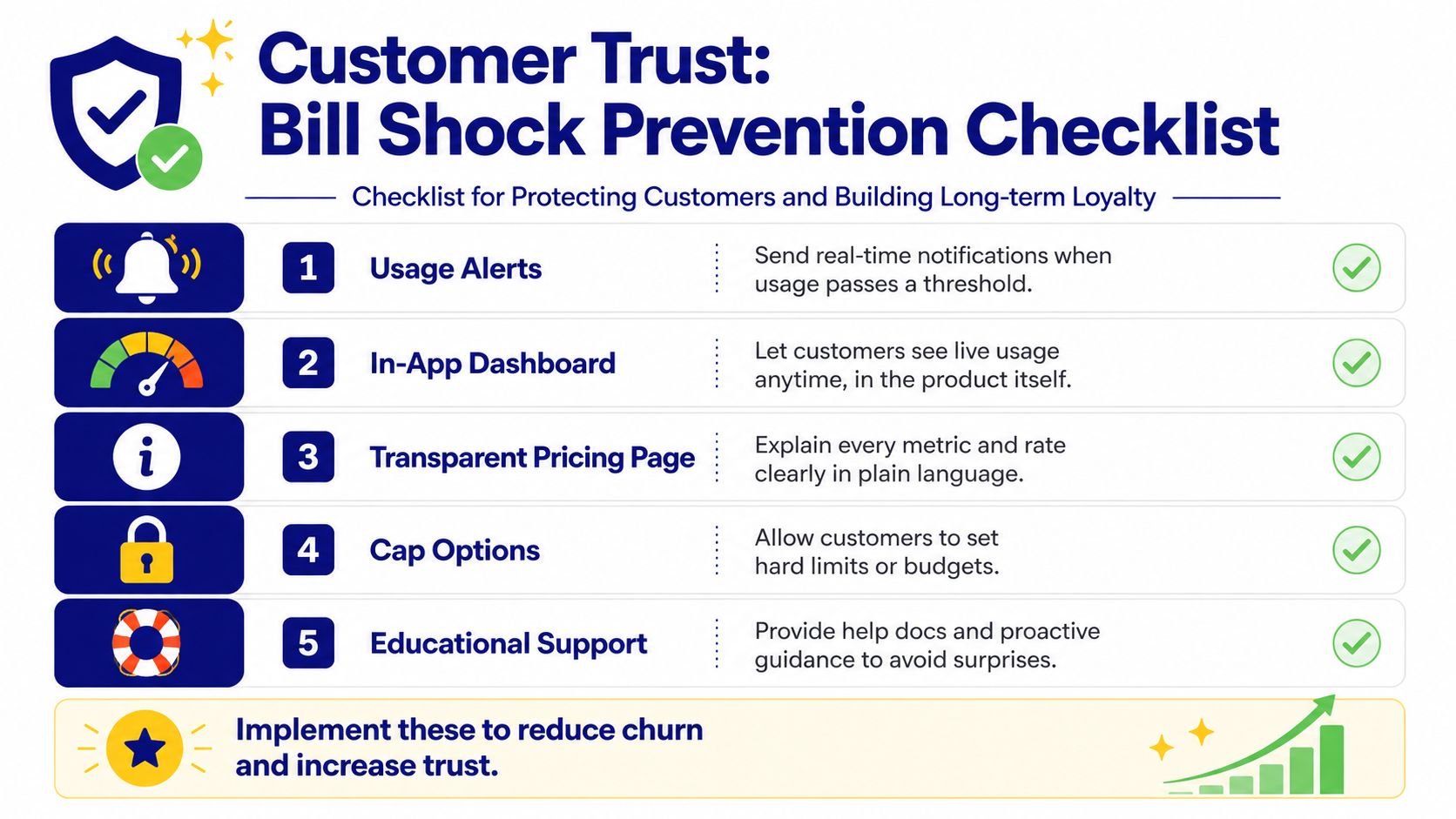
Trust starts with visibility. Customers need dashboards that show live usage, alerts that fire before thresholds are exceeded, and pricing language that doesn't force them to decode the invoice. The practical guidance I trust keeps circling back to the same point, choose a metric customers understand, make spend predictable, and avoid metrics that create perverse incentives (usage pricing guidance).
Design for the first surprise
The first surprise invoice is usually the one that damages adoption. If the customer can't tell how a task, a token, or a model run translates into cost, even a fair bill can feel hostile. That's why pilot pricing and cap options matter. They give buyers room to learn the model before the stakes rise.
A few trust mechanics belong in almost every rollout:
Usage Alerts: send notifications before a threshold turns into an unpleasant invoice.
In-App Dashboard: keep live usage visible inside the product.
Transparent Pricing Page: explain the metric in plain language.
Cap Options: let customers set budgets or hard limits.
Educational Support: give them enough guidance to interpret the bill before they ask support.
The goal isn't to hide usage. It's to make it legible. Once customers can connect their actions to their spend, the model feels like control rather than exposure.
Choosing Billing Infrastructure and Payment Settlement
Billing architecture only solves half the problem. Global SaaS companies also need payment infrastructure that can accept different payment methods and settle in the form the business wants. Suby is one example of that layer, it's an API that lets businesses accept card or crypto payments, and it also offers native integrations with Discord and Telegram for paid access, subscriptions, and online communities. Its product line includes Suby Payments, Suby Crypto, Suby Gating, and Suby Invoicing, so the same stack can support checkout, crypto settlement, gated access, and invoicing workflows.
Billing and settlement are separate decisions
That separation matters. A billing engine decides how usage turns into charges. A payment layer decides how the money moves, where it lands, and in what currency or asset the business receives it. For global SaaS, those decisions often need to be decoupled so finance can keep the reporting logic stable while payments adapt to customer preference.
If you're evaluating payment rails for recurring or usage-driven SaaS, a useful external reference is the guide by Jumpstart Partners, because it helps frame the processor choice alongside settlement requirements rather than treating payments as a commodity layer.
Suby's published product model is straightforward. Customers can pay by card, wallet, bank, or crypto, and the business can choose to receive funds in a bank account or in stablecoins like USDC. A common flow is card in, USDC out, but it's one option among several, not the only one. For implementation details that sit closer to SaaS billing and payment processor choice, the Suby guide on payment processor selection for SaaS is the right companion read.
The operational takeaway is simple. Usage-based billing needs reliable metering, but it also needs a payment layer that matches the customer's geography, payment habit, and settlement preference. When those two systems work together, global SaaS stops forcing buyers into one payment shape and starts letting them pay any way they want while the business gets paid the way it chooses.
If you're mapping usage-based pricing into a real SaaS stack, start with the billing logic, then check whether your payment flow can support the settlement model you want. Suby gives teams an API-first way to accept card or crypto payments, handle native Discord and Telegram use cases, and settle in the currency or asset they prefer. If you're ready to simplify global checkout and invoicing without locking yourself into one payment path, it's worth taking a look.
