

Gaspard LEZIN
Revenue Reporting: Global Best Practices 2026
Master accurate revenue reporting in 2026. Explore cash vs. accrual, crypto, best practices, and data architecture for global businesses.
Your finance team closes the month. Product is looking at dashboard bookings. Engineering is looking at successful payment events. Support is looking at refunds and converted tickets. Leadership asks a simple question: “What did we earn?”
That question gets hard fast when revenue data lives in five systems and each one tells a different story. One tool shows money collected. Another shows subscriptions created. A third tracks credits, refunds, and disputes. If you also sell internationally, the complexity jumps again because the payment method, settlement method, and recognition timing may all differ.
Revenue reporting evolves from an accounting back-office task into an operating system for the business. If the numbers are late, inconsistent, or impossible to audit, every downstream decision gets weaker. Pricing gets misread. Forecasts drift. Teams debate whose dashboard is “right” instead of fixing the data flow.
Table of Contents
The cost of fragmented revenue data
Why this becomes a growth lever
Cash collected is not revenue recognized
The metrics that matter most
Where modern payment flows create confusion
Start with policy before tooling
Build reconciliation into the operating rhythm
Treat auditability as a product requirement
Design one source of truth
Use event flows that finance can trust
What good architecture changes operationally
Daily sales report
Monthly revenue summary
Payout reconciliation report
The real reporting problem in global payments
A practical reporting model for hybrid payment flows
What finance needs from product and engineering
From Complex Data to Clear Strategy
Why Accurate Revenue Reporting Is Your Business's Superpower
A familiar pattern shows up in growing companies. Sales says the month was strong. Finance says recognized revenue is lower than expected. Support points to refunds. Product says active subscriptions rose anyway. None of those teams is necessarily wrong. They're just measuring different moments in the customer and cash journey.
That mismatch causes practical damage right away. Forecasts become fragile because collected cash and recognized revenue drift apart. Margin analysis gets noisy because discounts, refunds, and payment costs are handled inconsistently. Leadership loses time in review meetings because the debate shifts from strategy to spreadsheet cleanup.
The cost of fragmented revenue data
When revenue reporting is weak, three things happen:
Planning gets distorted. Teams staff and spend against numbers that may reflect payment activity, not earned revenue.
Ownership gets blurry. Product, finance, and engineering each maintain their own logic for the same business event.
Close cycles stay manual. Analysts spend their time reconciling exports instead of explaining business movement.
Practical rule: If two dashboards can answer “revenue” differently and both seem plausible, you don't have a reporting problem. You have a system design problem.
The strongest finance teams treat revenue reporting as a cross-functional discipline. Product defines the commercial model. Engineering defines the event flow. Finance defines recognition policy and control points. When those three stay aligned, the business gets one version of reality instead of three partial ones.
Why this becomes a growth lever
Accurate revenue reporting changes the quality of decisions. You can separate temporary cash spikes from durable recurring revenue. You can see whether refund trends are operational or structural. You can identify where a geography, channel, or pricing model looks strong in payment volume but weak in net contribution.
That's why I treat revenue reporting as infrastructure. It doesn't just satisfy compliance. It gives the company a reliable way to understand what it sold, what it earned, and what it should do next.
Understanding Core Revenue Reporting Concepts
Most reporting problems start with language, not software. If teams use “revenue” to mean cash received, booked contract value, and recognized income interchangeably, the reports won't reconcile no matter how polished the dashboards look.
Cash collected is not revenue recognized
Start with the most important distinction. Cash-basis accounting answers, “What money landed?” Accrual-basis accounting answers, “What revenue did we earn during the period?”
For a SaaS example, if a customer prepays for a yearly subscription in January, cash may arrive immediately. Under accrual logic, that doesn't mean the full amount is recognized in January. Revenue is recognized across the service period according to the company's accounting policy and applicable standards.
Revenue reporting standards also need cadence discipline. According to Salesmate's revenue reporting overview, SaaS companies typically track revenue on a monthly basis through MRR to align performance with operating costs, while high-volume retailers often update data daily or weekly to match faster decision cycles. The same source notes that consistency depends on using established accounting methods such as accrual accounting or cash basis and following frameworks like GAAP or ASC 606.
Cash tells you liquidity. Revenue tells you performance. Good reporting keeps them connected without treating them as the same thing.
A useful companion read for non-finance teammates is this guide for SaaS and creator success, because it helps frame recurring revenue in commercial terms before you map it into accounting treatment.
The metrics that matter most
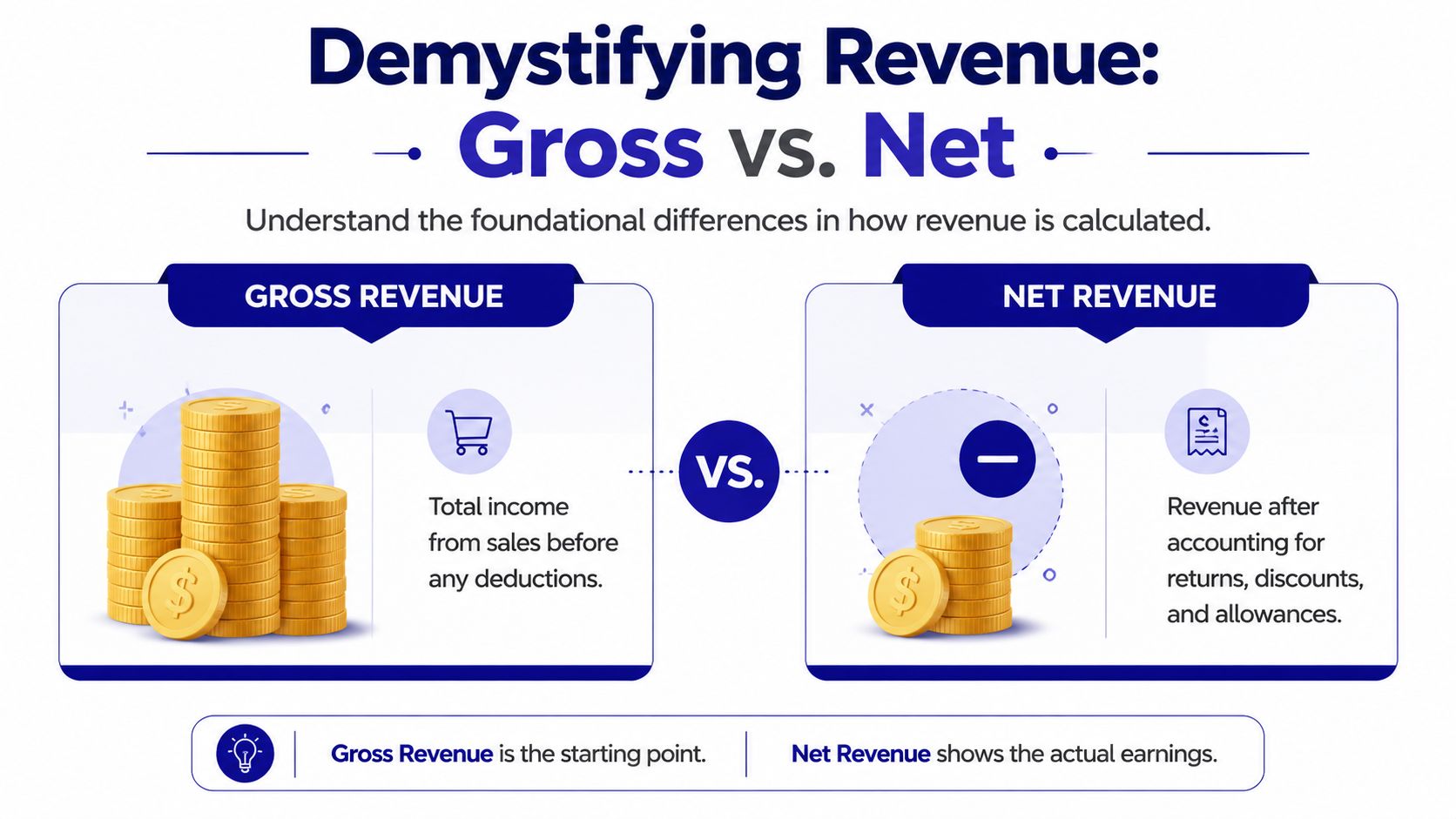
Gross revenue is the total income from sales before deductions.
Net revenue is what remains after items like refunds, discounts, and allowances are accounted for.
For recurring businesses, MRR is the monthly view of recurring revenue performance. ARR is the annualized view. These are operating metrics first. They are useful for planning, but they still need clear rules so they don't drift away from recognized revenue.
A clean way to align teams is to define each metric in a shared data dictionary:
Metric | What it answers | Common failure mode |
|---|---|---|
Gross revenue | What was sold before deductions | Refunds handled outside the report |
Net revenue | What remains after reductions | Different teams subtract different items |
MRR | What recurring monthly run rate looks like | One-time fees accidentally included |
ARR | What recurring annualized run rate looks like | Built from inconsistent MRR logic |
If your team needs a practical discussion of recognition logic in payment systems, this internal reference on revenue recognition and payment flows is worth reviewing for implementation thinking.
Where modern payment flows create confusion
The hardest reporting issues now sit at the edge between traditional accounting and modern payment operations. That's especially true when subscriptions involve multiple currencies or crypto-linked payment paths.
As noted in Upcell's glossary entry on revenue reporting, the gap between cash-basis “what landed in the bank” and accrual-based GAAP/ASC 606 revenue recognition remains poorly explained for modern subscription and crypto-pay SaaS. The same source says a 2025 KLAS report shows deep adoption of revenue-integrity tools reduces underpayments by 18–23%, yet many guides still don't explain how to apply this when revenue is split across 300+ payment methods and recognized over multiple GAAP periods. It adds that SaaS firms can misreport net revenue by 5–12% when they ignore deferral and recognition timing for multi-currency, multi-token subscriptions.
That's the part product and engineering teams often underestimate. A successful charge event isn't the end of the story. It's one input into a revenue model that also has to account for service period, reversals, fees, and settlement behavior.
Best Practices for Auditable and Accurate Revenue Reports
The easiest revenue report to build is a dashboard nobody can defend. It updates fast, looks clean, and falls apart the moment finance asks how a number was derived. Auditable reporting takes more discipline, but it saves enormous time once the company grows.
Start with policy before tooling
Before building tables, agree on policy. Teams need one written answer for each of these:
Recognition basis: Is the company recognizing revenue under accrual logic, and how is that operationalized for subscriptions, usage, and one-time fees?
Revenue reductions: Which items reduce net revenue, and when do they hit the report?
Period logic: What date controls reporting, payment date, invoice date, service period start, or recognition schedule?
Without those definitions, the data model turns into a debate engine. With them, engineering can encode the logic once and analysts can stop rebuilding it in spreadsheets.
A twelve-month software subscription is the classic example. If the customer pays upfront, collected cash is immediate, but recognition follows the service obligation over time. That rule sounds simple. It only stays simple if refunds, credits, plan changes, and cancellations are captured the same way every time.
Here is a useful explainer to ground the reconciliation side of that work:
Build reconciliation into the operating rhythm
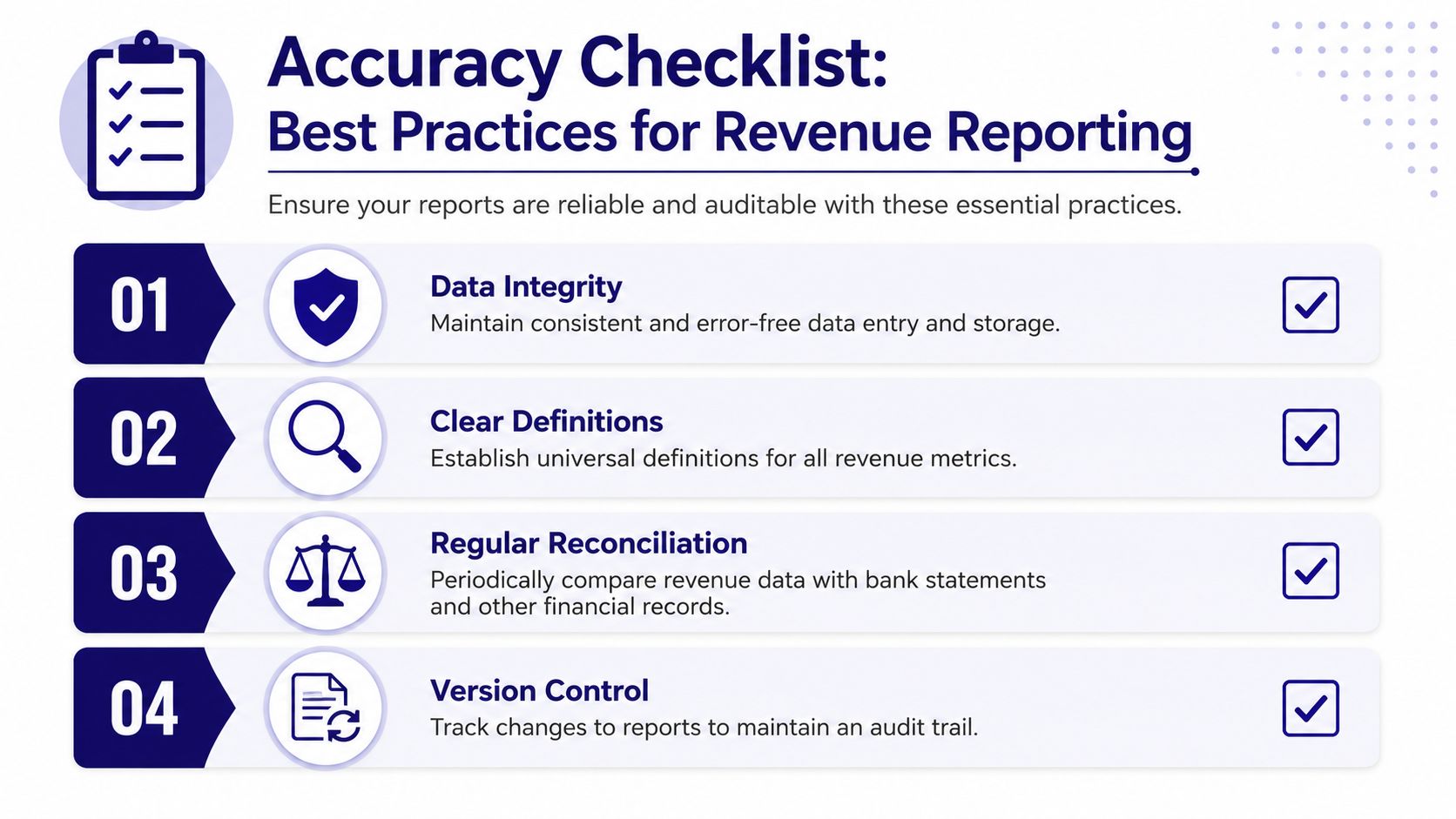
Teams often treat reconciliation as month-end cleanup. That's too late. Reconciliation should happen throughout the period so exceptions surface while operational context still exists.
A strong operating rhythm usually includes:
Daily checks for payment ingestion failures, duplicate events, and refund mismatches.
Weekly review of unresolved exceptions, especially across disputes, credits, and payout timing.
Monthly close controls that tie revenue reports back to bank activity, ledgers, and supporting transaction logs.
If you're mapping this into payments operations, this internal guide to payment reconciliation workflows is a practical reference.
The report is only as trustworthy as the trail behind it. If an analyst can't trace a revenue line back to a source transaction, the number is operationally weak even if it looks correct.
Treat auditability as a product requirement
Auditability isn't only for regulated companies. It's a design choice about whether financial data can be traced from report to transaction and back again.
That pressure is becoming more explicit in compliance settings. According to Coley GSA's summary of the new SBA 8(a) financial requirement, the SBA now mandates 8(a) firms to submit three years of detailed financial records, including total assets, liabilities, revenue, and operating cash flow, by January 5, 2026, using standardized formats. The same source says this requirement enforces strict data integrity by demanding reconciliation of financial statements to trial balances and bank reconciliations, so reported revenue is auditable, traceable to source transactions, and free from manual manipulation.
Even if your company never files under that framework, the lesson applies broadly. Build controls early:
Preserve source IDs from payment, invoice, and subscription systems.
Version metric logic so definition changes don't inadvertently rewrite history.
Store adjustment reasons for refunds, credits, and manual corrections.
Separate raw events from modeled revenue tables so finance can inspect both.
Teams that do this early don't just pass audits more easily. They close faster and argue less.
The Data Architecture of Modern Revenue Reporting
Most finance pain is architecture pain wearing an accounting mask. When revenue reporting depends on exports from disconnected tools, the business pays a tax every close. Data architecture removes that tax.
Design one source of truth
The target isn't “one dashboard.” The target is one governed revenue model that downstream dashboards use consistently.
That model usually starts with a few foundational layers:
Layer | Purpose | Typical contents |
|---|---|---|
Raw events | Preserve original system activity | Charges, refunds, invoices, subscription updates |
Normalized transactions | Standardize fields across systems | Currency, customer ID, timestamps, order IDs |
Revenue schedules | Apply accounting logic | Deferral, recognition dates, reversals |
Reporting marts | Serve teams with stable outputs | Daily sales, MRR, net revenue, payout reports |
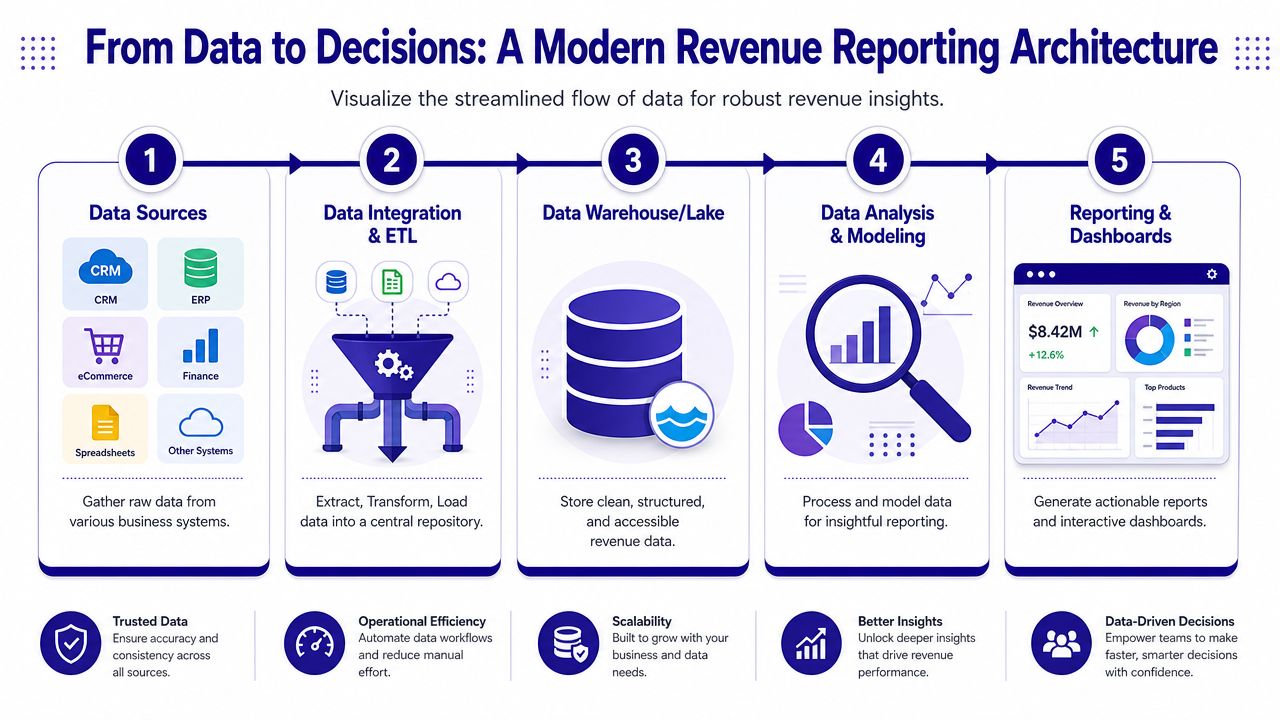
The mistake I see most often is skipping the middle. Teams jump from raw payment events straight into executive reporting. That works until refunds, plan swaps, backdated changes, and currency conversions hit the system.
Use event flows that finance can trust
Good architecture gives finance a stable event chain: customer action, payment event, fulfillment state, revenue schedule, payout result, reconciliation outcome. Product and engineering own much of that chain, even if finance is the final consumer.
Modern systems increasingly support this kind of responsiveness. As described in Scoro's revenue report documentation, revenue can be dynamically tracked based on approved quotes and active projects, and any modification to a quote or project instantly recalculates the reported revenue. That kind of model improves real-time accuracy and reduces lag between operational changes and financial visibility.
That principle matters beyond project businesses. When a subscription changes mid-cycle, finance shouldn't wait for month-end detective work to understand the impact. The data model should recalculate downstream outputs from the underlying event change.
What good architecture changes operationally
A better architecture doesn't just improve cleanliness. It changes how teams work.
Engineering stops rebuilding bespoke exports for every finance request.
Finance reviews exceptions instead of rekeying records.
Product can evaluate pricing and packaging decisions against consistent revenue outcomes.
Build the pipeline so operations can change and reporting still holds. That's what makes revenue reporting scalable.
The practical design test is simple. If a refund, contract amendment, or payout delay happens today, can the system reflect the impact without manual spreadsheet surgery? If not, the model still depends on heroics.
Building Your Key Revenue Reports with Examples
A strong revenue reporting stack produces a small set of reports that answer recurring business questions. Most companies need fewer reports than they think. They need better-defined ones.
Daily sales report
This is the operating report. It answers, “What happened today, and does anything need attention now?”
Include fields such as:
Transaction date
Order or payment ID
Customer ID
Gross sales
Refunds recorded
Net sales for the day
Payment method
Status or exception flag
This report is especially useful when support, operations, and finance all need the same daily picture. In support-driven commerce contexts, Gorgias documents that revenue reporting can track ticket creation, ticket conversions, and total sales generated by support teams. For e-commerce and retail, the same report structure can track gross revenue, net revenue, and refunds with flexible date ranges and visual graphs, and export CSV views such as Sales per day and Sales per agent.
Monthly revenue summary
This is the management report. It answers, “What did we earn this month, and why did it move?”
The summary should separate cash movement from revenue recognition. At minimum, include:
Section | Why it matters |
|---|---|
Recognized revenue for the month | Core performance view |
Gross revenue and deductions | Explains movement to net |
Refunds and credits | Highlights revenue reduction trends |
Recurring vs one-time mix | Shows quality of revenue |
Period adjustments | Makes close changes visible |
Finance should add commentary, as numbers alone won't explain whether a decline came from seasonality, churn, delayed recognition, or higher refund volume.
Payout reconciliation report
This report answers the question leadership asks when a bank balance doesn't match a sales dashboard: “Where did the money go between payment and payout?”
Build it around the payment lifecycle:
Payment captured
Fees or adjustments applied
Refunds or disputes posted
Net amount available for payout
Actual payout date and destination
Variance or unresolved exception
Don't let the bank statement become the source of truth for revenue. It's the final movement of cash, not the full commercial history.
A good payout reconciliation report also helps product and engineering. It shows whether operational events are reaching finance correctly, and whether missing metadata is creating blind spots later in the flow.
Managing Revenue from International and Crypto Payments
International revenue reporting breaks when teams assume payment acceptance, settlement, and recognition all happen in the same currency and on the same timeline. That assumption rarely holds for modern internet businesses.
The real reporting problem in global payments
A customer may pay by card, wallet, bank, or crypto. The business may choose to receive funds in a bank account or in stablecoins such as USDC. Those are not just payment experience choices. They create accounting and data-model consequences.
Suby is payment infrastructure for the global internet economy. It provides an API that lets businesses accept payments by card or crypto, and it also offers native integrations with Discord and Telegram for use cases like subscriptions, paid access, and online communities. It is one product with four ways to use it:
Suby Payments, an API-first payment stack to accept cards and crypto through one checkout
Suby Crypto, a crypto payment gateway that handles the swap, sponsors the gas, and settles to a non-custodial wallet or to the Suby balance
Suby Gating, for paid access to Discord, Telegram, downloads, and courses
Suby Invoicing, where the client pays how they want while the business receives what it wants
Its payment infrastructure supports over 300 distinct payin methods globally, including cards, wallets, bank transfers, BNPL, and multi-chain crypto, according to Suby's API introduction. The practical message is simple: customers pay any way they want, businesses get paid the way they choose. Pricing depends on the payment method used, so the exact figures should always be checked on the pricing page rather than flattened into one rate.
This flexibility is commercially powerful, but it increases reporting complexity. The amount a customer paid, the asset that settled, and the period in which revenue is recognized may all differ.
A practical reporting model for hybrid payment flows
The hardest case is the hybrid one. A customer pays through one method, but the business settles into a different asset or currency. A common example is a customer paying by card while the business receives USDC. That's one valid flow among several, not the only one.
According to DealHub's glossary entry on revenue reporting, no mainstream resource addresses how to report revenue from hybrid fiat-crypto subscriptions where customers pay in card, wallet, or crypto but are billed in a single stablecoin. The same source notes data from a 2025 Innovaccer survey indicating significant revenue leakage from unreported crypto-fiat conversion spreads and timing mismatches, leading to understated margins by 8–14% in 2024–25 reports.
That's why finance needs a reporting model with separate fields for:
Customer payin method
Customer payin currency or asset
Quoted commercial amount
Settlement currency or stablecoin
Conversion and fee metadata
Recognition schedule by accounting period
Refund or dispute linkage
If your team also tracks market-facing crypto holdings outside revenue operations, a portfolio tool can help treasury or ops teams track your crypto assets like Bitcoin. That's a separate job from revenue reporting, but teams often confuse the two.
What finance needs from product and engineering
To keep revenue reporting accurate in these flows, finance needs product and engineering to preserve intent and traceability.
For implementation thinking around merchant acceptance paths, this guide on accepting crypto payments for business is a useful technical reference.
The essentials are straightforward:
Keep source-level payment metadata. Don't collapse card, wallet, bank, and crypto into one generic “paid” event.
Record settlement outcomes explicitly. Finance needs to know what the business received, not just what the customer selected.
Separate conversion economics from revenue logic. If you net everything together too early, margin analysis becomes unreliable.
Preserve timestamps across the flow. Payment initiation, completion, settlement, and recognition may belong to different dates.
A global payment stack can be flexible for customers and still be strict for reporting. The flexibility belongs in the checkout. The discipline belongs in the ledger.
When teams get this right, international and crypto revenue stops feeling exotic. It becomes another governed reporting flow with explicit fields, clear controls, and fewer surprises at close.
From Complex Data to Clear Strategy
The payoff from disciplined revenue reporting isn't only cleaner books. It's better judgment.
Once the company can separate cash collection from earned revenue, product decisions become easier to evaluate. Pricing changes can be assessed on net revenue, not just checkout conversion. International expansion can be judged on actual economics, not gross payment volume. Support and refund patterns can be read as business signals instead of month-end noise.
This also improves operating cadence. Finance spends less time reconciling mismatched exports. Engineering gets fewer one-off data requests. Leadership can ask harder questions because the baseline numbers hold up.
If your team is also working through liquidity pressure on top of reporting complexity, it helps to study operators who tackle e-commerce cash flow challenges in practical terms. Cash flow discipline and revenue reporting are different jobs, but strong companies connect them closely.
The teams that win here don't chase prettier dashboards. They build a reporting system that is consistent, auditable, and close to the actual commercial event. That's what turns messy transaction data into strategy.
Suby is a payment gateway and payment processor. Your customers pay with card, bank transfer, Apple Pay, Google Pay, Klarna, and more, or stablecoins, and you get paid out to your bank account, or directly in stablecoins (USDC, EURC) to your wallet, anywhere in the world, no bank account required. Because every payin and settlement runs through one system, the source-level detail that auditable revenue reporting depends on stays intact from charge to payout, so cash collected and revenue recognized never split into separate stories at close.
