

Gaspard LEZIN
Payment Processor for SaaS: How to Choose the Right Stack
Compare the best payment processor for SaaS companies. Learn must-have features, pricing pitfalls, and how to evaluate vendors for recurring revenue.
Most advice about a payment processor for SaaS starts with the wrong question. Teams obsess over the brand name, then discover months later that the cost sits in failed-payment recovery, proration, billing retries, and the operational mess that appears when subscriptions stop paying cleanly.
A SaaS stack is not just a card acceptance tool. It has to support recurring revenue, flexible settlement, and the payment methods your buyers prefer, because the market itself has moved from one-off software sales to subscription infrastructure. The broader payments industry was valued at $61.1 billion in 2023 and is projected to grow at a 10.5% CAGR through 2032 (Airwallex), while the SaaS market was estimated at about $157 billion in 2023 and projected to reach roughly $300 billion by 2026 (Airwallex). That's why the processor question is really a revenue-operations question.
Decision area | What SaaS teams should optimize for |
|---|---|
Checkout acceptance | Authorization rate by payment context, not just brand recognition |
Recurring revenue | Dunning, retries, proration, invoicing, and usage-based billing |
Settlement | Bank payout, stablecoin payout, or both, depending on the business model |
Global reach | Multiple payment methods, currency flexibility, and cross-border readiness |
Operations | Lower manual reconciliation, fewer support escalations, and cleaner cash flow |
Table of Contents
Why the Default Choice Often Costs SaaS Companies More
The most recognizable processor is not automatically the safest choice for a SaaS company. A brand can be excellent at card acceptance and still leave you to assemble the parts that keep recurring revenue alive, especially dunning, retry logic, proration, and billing recovery.
That gap matters because SaaS revenue is recurring by design. The processor has to do more than move money once. It has to support subscription creation, renewal, payment failure recovery, and the sort of workflow that keeps a customer active after a card expires or a bank declines a charge.
Practical rule: if a vendor makes checkout look simple but makes recovery and lifecycle billing feel improvised, you're likely buying more churn than you think.
The processor brand also tends to distract teams from the harder question, which is whether the stack matches the way revenue behaves. A clean one-time payment flow is not the same thing as a subscription system with upgrades, downgrades, pauses, retries, and invoices that have to stay coherent across finance, support, and product.
That's why the recurring-revenue workflow should be the center of the evaluation. A SaaS company that over-optimizes for headline fees can still lose more money through failed renewals, support labor, and manual reconciliation than it saves on the transaction line item. If you need a benchmark for how fees and features get discussed in practice, compare them against what Stripe fees really look like in a SaaS context, then ask whether the rest of the workflow is covered or just implied.
There's also a structural reason the default choice can be expensive. When SaaS sold as software packages, payment was a one-time event. Subscription software changed that. Now the payment layer has to protect lifetime value, not just capture a sale. If the system loses a renewal because the retry logic is weak, the processor didn't just miss a transaction, it affected retention.
Must-Have Payment Features for SaaS Businesses
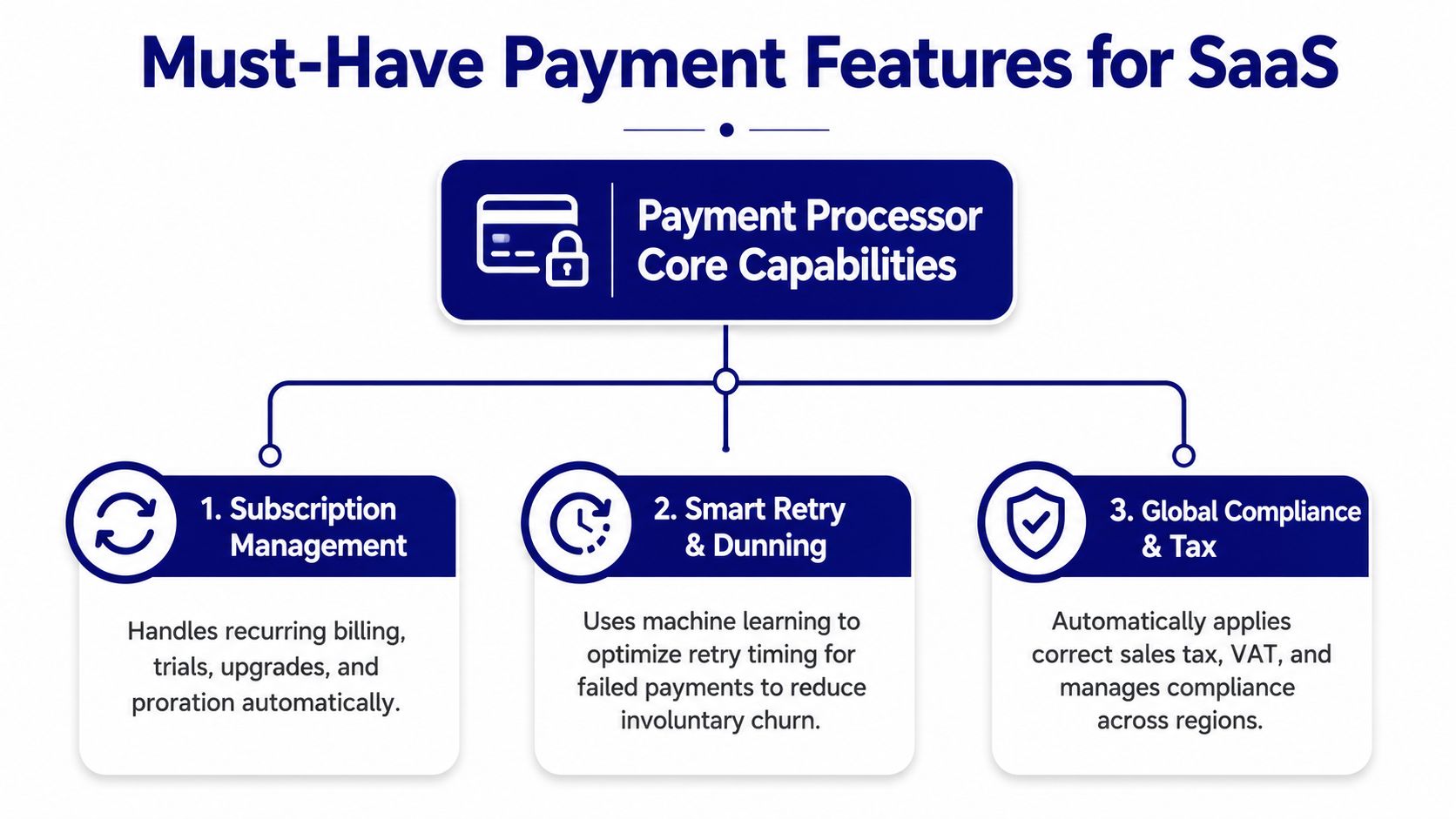
The first filter is authorization rate by payment context, not the sticker price on the pricing page. The useful benchmark is whether a method succeeds in the exact checkout context you use, because typical success ranges differ: 82-88% for ecommerce credit cards, 90-95% for digital wallets, 88-93% for BNPL, and 92-97% for SaaS ACH/bank transfer in B2B enterprise (Tagada). That's a strong sign that bank-transfer rails can outperform cards in B2B SaaS when issuer declines and checkout friction are the primary bottleneck.
Subscription logic comes before checkout polish
A SaaS-ready processor needs native support for subscriptions, trials, upgrades, downgrades, and usage-based metering. If those pieces sit in separate tools, every billing edge case becomes a product and support problem. The processor may still collect the money, but your team ends up stitching together revenue logic by hand.
The other critical component is smart retry and dunning. Failed renewals are rarely a customer saying no forever. They're often a temporary decline, a stale card, or a bank-side issue. My experience integrating multiple stacks is that the companies that recover revenue best are the ones that treat retry timing and notification flow as part of the billing product, not an afterthought.
Payment method breadth changes the economics
SaaS buyers don't all want to pay the same way. A serious stack should accept cards, wallets, bank transfers, and crypto, then let the business choose how to receive the funds. That flexibility matters most when you sell across regions or serve both self-serve and enterprise customers from one checkout.
Settlement flexibility is just as important as payment acceptance. If a vendor lets you receive funds in your bank account or in stablecoins like USDC, you can align your treasury flow with your operating model instead of forcing every transaction through the same payout path. Suby documents exactly that model, plus native support for Discord and Telegram use cases, which is useful for subscriptions, paid access, and online communities, although pricing still depends on the payment method used and needs to be checked on the pricing page.
For teams that need clean finance operations, reconciliation matters too. A practical companion resource is Matil's reconciliation automation, especially if your finance team is already wrestling with multiple payment rails and payout formats.
A good processor reduces customer friction. A better one also reduces finance friction, because every mismatched settlement or failed retry becomes someone's manual task.
Comparing Leading Payment Processor Archetypes for SaaS
SaaS teams usually end up choosing between four archetypes, not one magic product. The differences show up in integration effort, recurring billing depth, settlement flexibility, and how much of the revenue stack you still have to assemble yourself.
The comparison below is useful because it separates checkout capability from operational burden. That distinction is easy to miss when you're reading vendor pages.
Criteria | API-First Developer Platform | Crypto-Native Gateway | All-in-One Billing Suite | Hybrid Infrastructure Layer |
|---|---|---|---|---|
Subscription support | Usually strong, but often requires assembly | Varies by product scope | Usually broad and opinionated | Strong, with mixed payment and settlement options |
Integration effort | Higher, but highly flexible | Usually focused on crypto flows | Lower upfront, less customization | Moderate, with broader workflow coverage |
Settlement flexibility | Often bank-centric | Usually wallet-centric | Usually platform-defined | Bank or stablecoin settlement options |
Global reach | Strong if the platform is mature | Depends on chain and wallet coverage | Broad if the suite handles local methods | Broad, with multiple payin options |
Operational complexity | Can be high if you own the stack | Can rise quickly outside crypto-native use cases | Lower initially, but less modular | Lower when payin, payout, and billing are unified |
Best fit | Teams that want control | Teams that need crypto-first acceptance | Teams that want one vendor to do most of the work | Teams that want flexible settlement and multiple payment types |
Where each archetype wins
The API-first developer platform works when engineering wants control over checkout, billing, and lifecycle logic. It can be the cleanest path for custom SaaS products, but only if the team is comfortable owning the integrations around retries, invoicing, and reporting.
The crypto-native gateway is best when the core customer behavior is already crypto-led. Once the buyer base is broader, it can become awkward to support cards, wallets, and traditional invoicing without bolting on extra systems.
The all-in-one billing suite lowers the number of vendors, which is attractive for lean teams. The trade-off is that the product often defines your workflow for you, so you need to decide whether the constraints fit your subscription model before you commit.
The hybrid infrastructure layer is where the more interesting trade-offs show up. It tries to combine card and crypto acceptance with flexible settlement, so the payment flow, subscription logic, and payout behavior can stay inside one operating model. For a practical framework on how finance and procurement teams compare options in B2B contexts, choose a B2B payments platform with your billing workflow, not just your checkout brand, in mind.
Suby sits in that hybrid category as a single product with four ways to use it, including Suby Payments, Suby Crypto, Suby Gating, and Suby Invoicing. That matters because one product can serve card, wallet, bank, and crypto payins while letting the business decide whether settlement lands in a bank account or in USDC, depending on the use case.
Vendor Evaluation Checklist and Scoring Framework
A good buying process needs a scorecard, not a feeling. I've seen teams get stuck because sales demos make every processor look capable, then the first failed renewal exposes how much of the workflow was never validated.
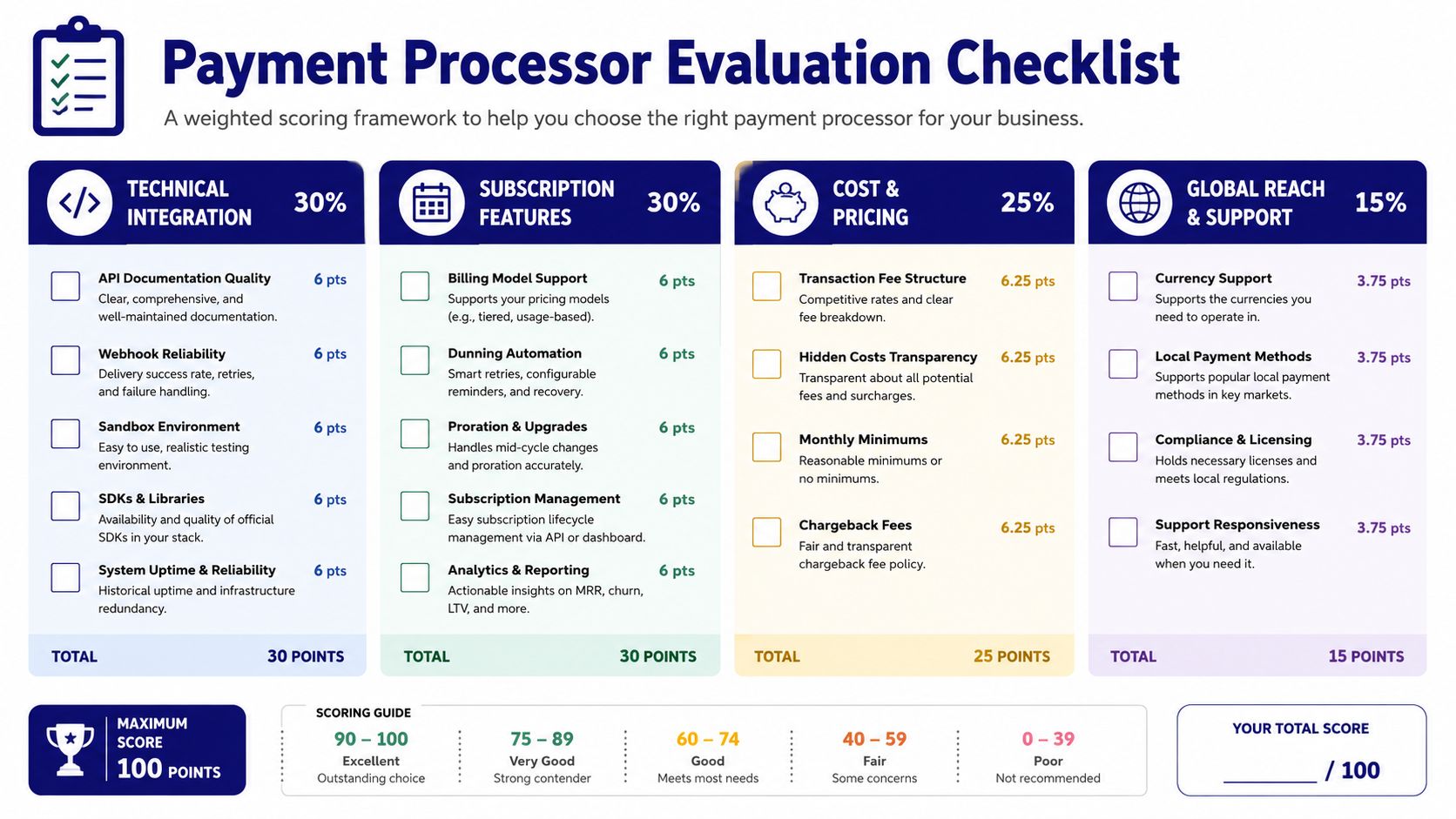
Use a weighted rubric like this:
Criterion | Weight | What to test |
|---|---|---|
Technical integration depth | 30% | API clarity, webhook reliability, sandbox quality |
Subscription billing | 30% | Trials, proration, dunning, renewals, metering |
Cost and pricing transparency | 25% | Fee structure, hidden charges, settlement terms |
Global reach and support | 15% | Currency support, local methods, response time |
How to score a vendor
Start with the integration. Read the documentation, create a sandbox checkout, and confirm that the webhook events match your app logic. If the vendor can't support the states your product needs, the rest of the conversation is mostly noise.
Then test the lifecycle billing pieces with real scenarios. Create a trial, force a failed renewal, change plans mid-cycle, and verify that invoices, access control, and dunning behavior stay consistent. If the vendor says it supports recurring billing but can't handle the full customer journey cleanly, the score should drop fast.
The final pass is operational. Ask finance how settlement is reported, ask support how disputes are handled, and ask engineering how much custom glue is needed for reconciliation. If those answers are vague, that's usually a sign that the hidden work has been pushed downstream.
The infographic below is useful for turning that into a repeatable review process.
If you want a practical way to map the scoring to your own stack, watch the walkthrough below and use it alongside your sandbox tests.
Scoring rule: if a vendor wins on checkout polish but loses on retries, invoicing, or reporting, it's probably not the right SaaS processor yet.
Pricing Pitfalls and Hidden Costs in SaaS Payment Processing
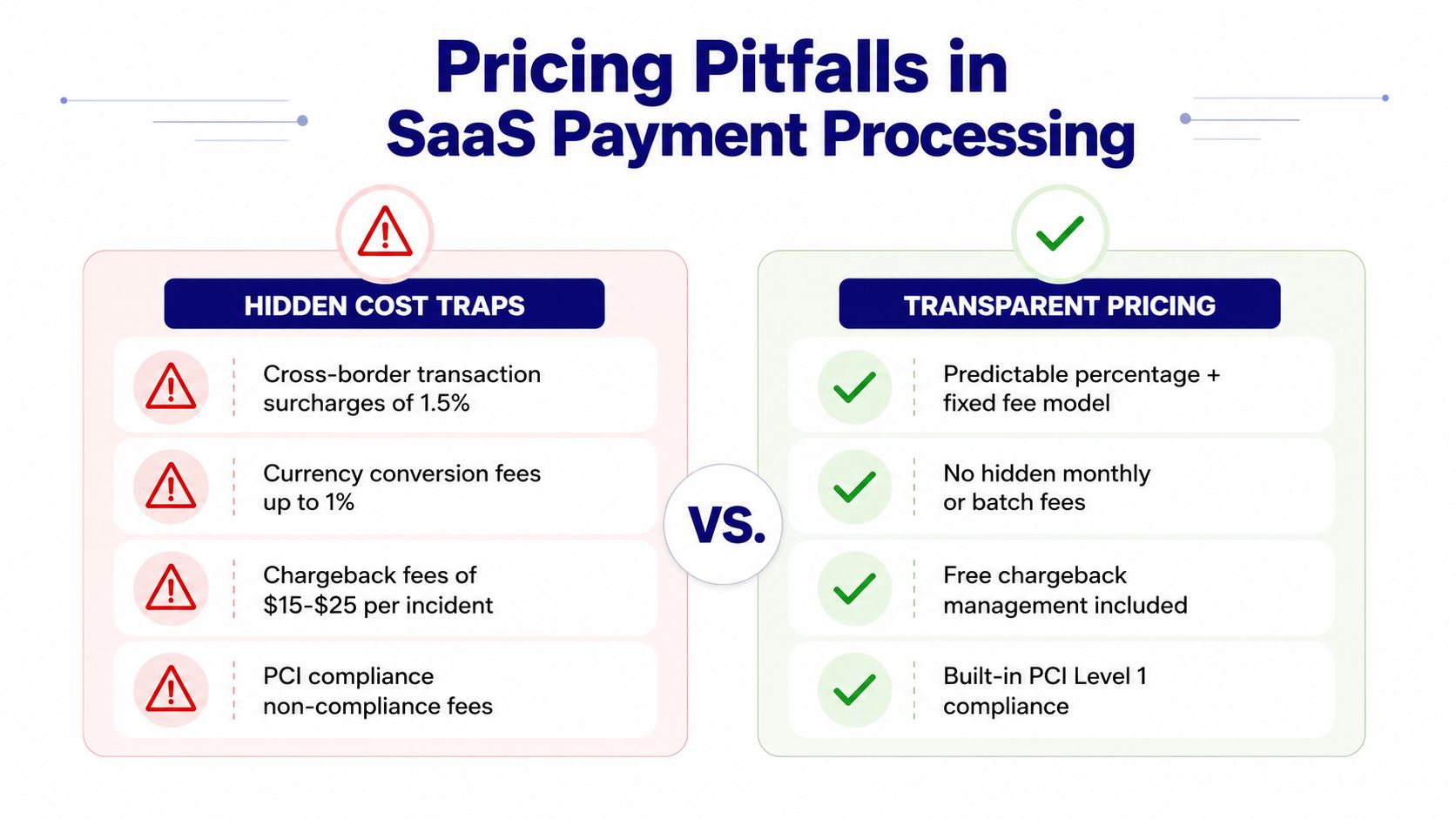
Headline fees only cover part of the bill. A SaaS business can accept a competitive rate on paper and still pay more once cross-border fees, currency conversion, chargebacks, refund handling, and the work involved in recovering failed renewals are added back into the recurring-revenue workflow.
Settlement choice affects real cost
The cheapest-looking processor can turn expensive if your payout flow forces avoidable FX conversion or manual treasury work. Receiving funds in a bank account works for many teams, but receiving them in stablecoins like USDC can reduce settlement friction when the business already operates that way. The point is not that one path always wins. Payout flexibility changes how much of the cost lands in operations versus fees.
That is why pricing should never be reduced to one flat number unless the product itself uses one. Suby is explicit that pricing depends on the payin method used, so the exact figure has to be checked on the pricing page rather than assumed. For a practical reference on how pricing models are usually presented, Suby's payment gateway pricing guide is a useful place to compare the listed model with the settlement and billing behavior your stack needs.
The hidden line items are usually operational
Refunds and disputes rarely create the biggest surprise, but they still add real admin load. Failed payment recovery is harder because the cost often shows up inside churn, not on a vendor invoice. Finance sees lower recurring revenue, while engineering and support absorb the cleanup.
The most expensive processor is often the one that makes your team do the most manual work after the payment has already failed.
A processor that looks cheap at checkout can still drain time if retries, invoice follow-up, and reconciliation all need custom glue. That is the part many SaaS comparisons miss. They compare transaction fees and ignore the labor that keeps revenue moving after the first authorization fails.
The pricing model should stay readable after renewals, refunds, and cross-border settlement are added. Anything else belongs in the category that looks cheap until finance starts reconciling it.
Real-World SaaS Scenarios and Situational Recommendations
An early-stage B2C SaaS app and a B2B enterprise tool should not buy the same payment stack. Their customers pay differently, their support burden looks different, and their tolerance for operational complexity is not the same.
Self-serve SaaS with global card buyers
A self-serve product with low-friction checkout needs fast authorization, clean retries, and minimal user drop-off. Card and wallet support usually matters more than invoice complexity here, because the product lives and dies on conversion at the point of sale.
Enterprise SaaS with procurement-heavy sales
B2B SaaS often needs bank transfers, invoicing, and a payment path that doesn't force every buyer through a card-first flow. In this case, payment acceptance is only half the job. The other half is giving finance teams something they can reconcile without creating extra support tickets.
Crypto-native software and mixed settlement
If the buyer base already expects crypto, the stack needs to accept it without creating a separate operating island. The useful pattern is one product that can handle multiple payin types, then let the business choose where funds settle. That's exactly where Suby's single-product model fits, because it can be used as Suby Payments, Suby Crypto, Suby Gating, or Suby Invoicing, with customers paying by card, wallet, bank, or crypto and the business receiving funds in a bank account or in USDC.
Paid communities and creator-led subscriptions
Discord and Telegram memberships need a different shape again. The payment layer has to connect access, renewal, and entitlement logic without making the operator babysit every renewal. Native gating is useful here because the payment event and the access event need to stay tightly linked.
If I were choosing by stage, I'd keep the rule simple. Young teams should prefer the stack that reduces operational drag first, then optimize for specialization later if the business model demands it. Mature teams with stronger finance and engineering resources can tolerate more complexity, but only if the added control clearly improves revenue operations.
Integration and Migration Playbook for SaaS Teams
Start with the billing map, not the code. Document every state your current system uses, including trials, pauses, upgrades, downgrades, failed renewals, and canceled subscriptions. If the data model is incomplete, the migration will drift into guesswork later.
Then build the checkout and webhook path in a sandbox before touching live customers. The most common mistake is treating payment integration like a front-end task when it's really a contract between product, finance, and subscription logic. For an API-first rollout, Suby's payment gateway API integration guide is a useful reference point for the shape of the implementation.
A phased migration usually works best:
Audit active subscriptions and identify what must move exactly, what can be recreated, and what can be left behind.
Run parallel processors during the transition so you can validate renewals before cutover.
Test failed-payment recovery with real decline scenarios, not just success cases.
Verify settlement and reporting with finance before you migrate the last live customer.
Optimize the checkout path after launch, not before, because the first priority is preserving recurring revenue.
If your team needs a quicker launch path, paylinks and no-code checkout can bridge the gap while the full API integration is being built. For support workflows and handoff coordination, SupportGPT SaaS integration resources can also help teams organize the migration conversation without turning every question into an engineering interrupt.
The safest migration is the one that treats payment as infrastructure, not a one-time task. Keep the old flow visible until the new one has proven that renewals, retries, and settlement all behave the way your business needs.
If you're choosing a payment processor for SaaS and want card, wallet, bank, and crypto acceptance in one API-first stack, take a look at Suby. It's built to handle payments, subscriptions, gating, and invoicing while letting businesses choose how they receive funds, including bank payouts or USDC where that fits the workflow.
