

Gaspard LEZIN
Payment Provider LatAm: A Complete Guide for Global Firms
Find the best payment provider LatAm has to offer. Compare costs, coverage, and compliance to expand your business across Latin America.
If you've ever launched Latin America with the same checkout you use in the US or Europe, you've probably seen the pattern already. Brazilian buyers abandon because the only path is card, Mexican orders sit in limbo because the payment doesn't confirm when the API response says it should, and finance asks why settlement timing doesn't match the sales report. A payment provider LATAM decision is really an operations decision, because the problem is not just acceptance, it's how money confirms, reconciles, and settles across countries with very different rails.
Table of Contents
Why LATAM Payments Are Different From What You Expect
A SaaS team I worked with assumed Brazil would behave like a standard card market. They shipped a clean card-only checkout, tightened the retry logic, and waited for conversion to settle. It didn't, because the checkout matched their internal systems, not the way buyers in the region pay.
The mistake shows up across LATAM. Digital payments expanded quickly across the region, and the IMF's regional analysis points to a market that is now mainstream rather than experimental (IMF). More than 300 million people used digital payment services in 2021, which is the part teams need to internalize. This is not an adoption story anymore. It is an operations problem with real consequences for conversion, settlement, and support.
Country behavior beats regional assumptions
LATAM is not one market. Brazil behaves differently from Mexico, and both differ from Colombia, Peru, or Argentina. A provider can look strong on paper and still miss the method mix that matters in a specific country.
A good way to check a provider's market coverage is to use a structured country matrix instead of a generic “supported countries” claim. The Suby supported countries page is a useful reference because the question is not just where a provider operates. It is where it supports the payment behavior that closes the sale.
Practical rule: if your checkout assumes cards are the default, you are usually designing for your own comfort, not for regional conversion.
The best research process I've used is simple. Start with the country, then the dominant local method, then the settlement path, then the reconciliation flow. If you want a quick way to map that discovery process, Scrape API from Context.dev can help you gather and compare provider pages without manually chasing every country spec one by one.
The market is already past the curiosity stage
Digital banks, wallet usage, and local payment rails have changed buyer expectations. More than 30 million people used digital banks in 2021, with adoption concentrated in Brazil and Mexico (World Bank). That concentration matters because it is often where product teams first see the gap between “we support LATAM” and “we support the way LATAM pays.”
Card-only acceptance misses mainstream behavior in markets where buyers are used to local rails and alternative methods. It also creates avoidable support work, since failed assumptions show up later as reconciliation problems, delayed confirmations, and unnecessary payment retries. If you treat the region like a single expansion checkbox, conversion will keep telling you otherwise.
Local Payment Methods That Drive Conversions
The most expensive mistake in LATAM is designing checkout around the method you prefer instead of the method the buyer trusts. Regional content often lists payment methods as if the goal were completeness, but operations teams care about the method that closes the sale. That is where country-specific design matters more than broad market optimism.
Brazil is the clearest example. PCMI notes that digital wallets and account-to-account systems account for 46% of e-commerce turnover in Latin America, and Brazil's mix is led by credit cards at 44%, with Pix close behind at 40%. That split is the point. In Brazil, you do not design for one winner, you design for multiple rails that buyers use.
What changes by country
Mexico leans heavily on cash vouchers and transfer-based flows. In practice, that means a buyer may start the purchase online but complete it offline or through a bank rail later. Colombia and Peru also rely on local bank methods that do not map neatly to a US-style instant card authorization. The result is that checkout design has to absorb different confirmation timing, different trust cues, and different fallback paths.
For a broader view of how local options affect checkout structure, the local payment methods guide from Tagada is useful because it frames the business problem around the buyer's available rails, not just the provider's country list. If you want a practical reference point for how teams optimize local payment options, that lens is the right one for LATAM.
The table below is the simplest way to keep the checkout conversation grounded.
Country | Primary Methods | Settlement Speed | Consumer Behavior |
|---|---|---|---|
Brazil | Pix, cards, wallets | Fast for instant rails, slower for card settlement | Buyers expect multiple local options and quick confirmation |
Mexico | OXXO vouchers, bank transfer, cards | Asynchronous for vouchers and transfers | Many buyers complete payment after checkout |
Colombia | Bank debit and local transfer methods | Depends on local clearing and rail | Buyers often prefer local bank-based payment paths |
Peru | Online banking and A2A-style methods | Depends on rail and bank | Checkout needs to support bank-led payment behavior |
Argentina | Wallet-first and alternative methods | Varies by method | Wallet behavior is common, so fallback options matter |
LATAM Airlines' own payment pages show this country-by-country reality in a practical way, with different methods by market, including Chile debit card, Ecuador bank transfer, Colombia PSE bank debit, Peru online banking, and Brazil PIX through SafetyPay (LATAM Airlines). That is how the region works in production. Business chooses how to receive the money, but the buyer still chooses how to send it.
You can also see why unbanked and wallet-first users are not niche. Spreedly says unbanked or underserved consumers are often the majority in LATAM, and related LATAM payments research points to a very large unbanked population in the region. The practical takeaway is blunt. If your checkout only covers cards, you are not serving a small edge case, you are skipping a large share of real buyers.
A checkout flow that matches the market
The most effective flows I have seen do three things well:
Offer local alternatives first: show the buyer the rail they recognize in that market.
Keep the confirmation state honest: do not call an order complete until the payment is really confirmed.
Route by market, not by template: a method that works in Brazil may be irrelevant in Mexico.
Buyers do not care that your platform is unified. They care that the payment they trust is visible the moment they hit checkout.
For teams building subscriptions, paid access, or one-off digital sales, this is also where a unified product helps. Suby provides an API for card and crypto acceptance, plus native integrations with Discord and Telegram for subscriptions, paid access, and online communities. In practice, that lets a business keep the same core payment logic while adapting the local checkout experience to the market.
Handling Asynchronous Payments and Webhook Fulfillment
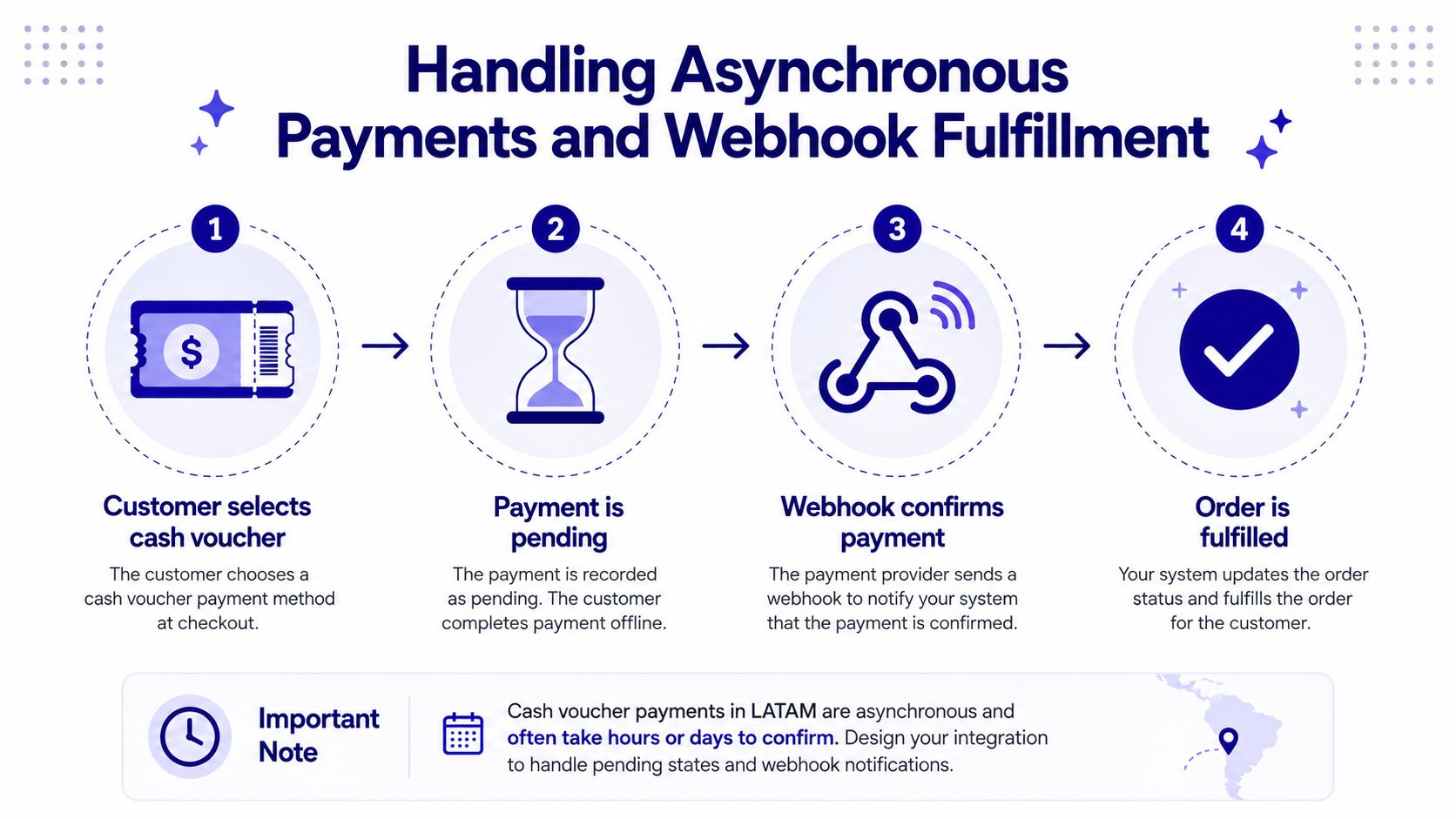
The first time a LATAM team ships fulfillment off the initial API response, the bug usually looks like a fraud problem or a bad gateway. It's neither. It's an asynchronous payment problem. Cash vouchers and bank transfers can confirm after the checkout page has already moved on, which means the order state has to be driven by confirmation, not by optimism.
Build around verified payment events
The rule is simple. Trigger fulfillment from a verified webhook, not from the first response the payment API returns. That's especially important for voucher and transfer-based flows, where the buyer's intent is real but the settlement is not immediate.
Operationally, I've found three controls matter most:
Use the payment ID as the reconciliation key. That avoids mixing one pending order with another confirmed later.
Treat pending as pending. Don't let internal systems infer completion just because the checkout was launched.
Accept out-of-order events. Some confirmations arrive after retries, refreshes, or customer follow-up actions.
Practical rule: if finance and fulfillment aren't reading from the same confirmed payment event, ledger drift is just a matter of time.
Cash voucher and transfer flows differ from card authorizations. The buyer may finish at a convenience store, through a bank rail, or at a later time entirely. A good orchestration layer keeps those states visible without forcing the merchant to guess.
The engineering pattern behind this is not exotic. It's disciplined state handling. Pending, confirmed, failed, refunded. Each status needs a single source of truth, and the order record should move only when the gateway says it has moved. That's how you stop false positives in fulfillment and avoid shipping digital access before the money exists.
Reconciliation has to survive delays
The hardest part isn't the webhook itself, it's the reconciliation trail. If a transfer lands hours later, the payment should still map cleanly back to the original order. If the event arrives after your support team has already flagged the transaction, the system still needs to resolve it without manual spreadsheet cleanup.
That's why the payment ID matters more than the customer-facing receipt number. It gives operations a stable anchor when the payment path is delayed, retried, or confirmed in a different sequence than the customer expected.
A four-step model works well in practice. Customer initiates payment, payment sits in pending status, webhook confirms it, then fulfillment fires. Keep that sequence strict, and the rest of the stack gets easier to operate.
Cross-Border Settlement and Currency Choices
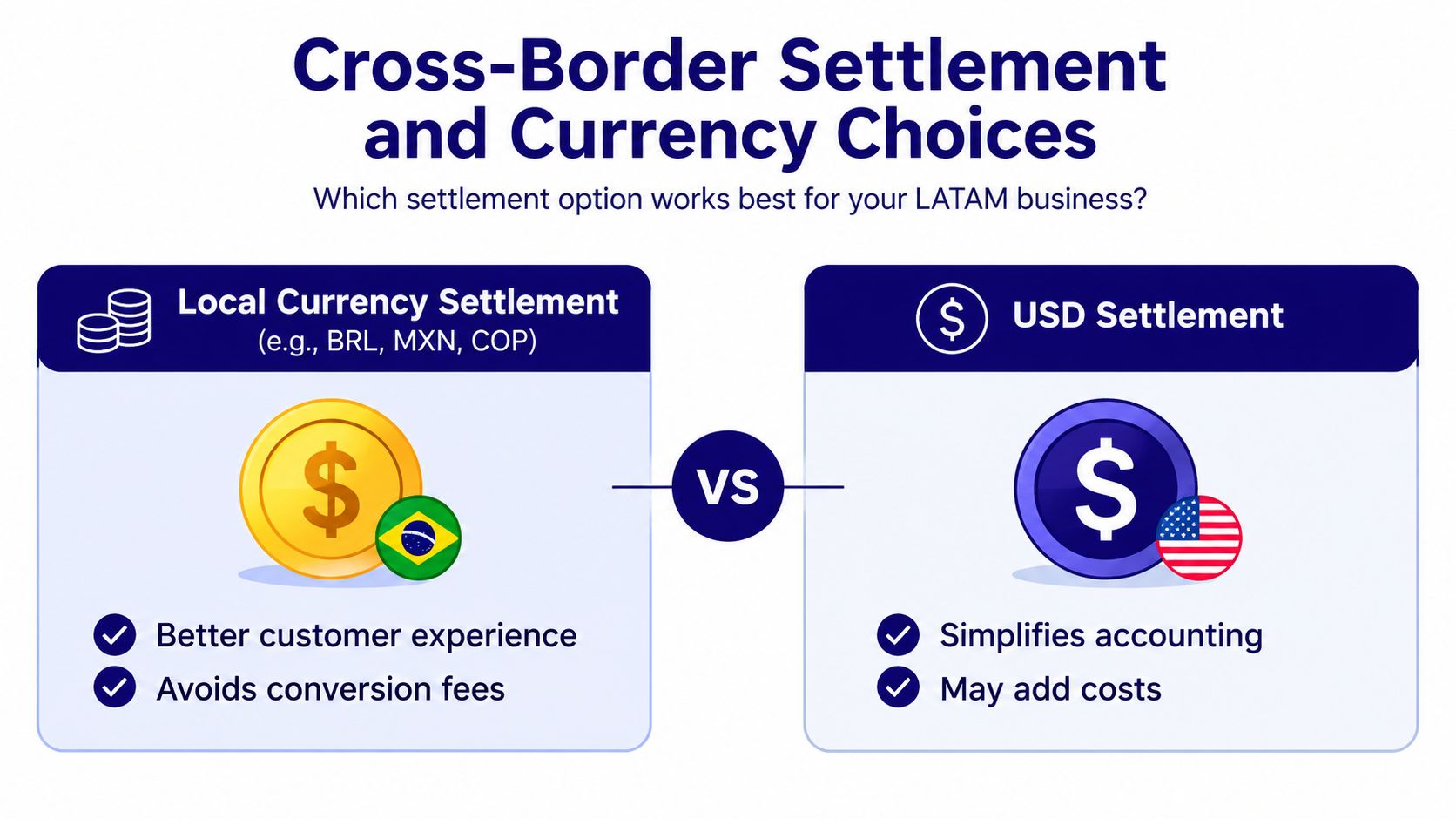
Accepting a payment is not the same as getting paid in a way that helps the business. In LATAM, the key treasury question is whether you settle locally, settle in a foreign currency, or use a non-bank rail that changes how cash moves altogether. That choice affects accounting, margin, and how much FX friction you absorb on the way out.
The cross-border problem is under-discussed in many provider pages, but it's usually where finance teams feel the pain first. Payoneer's LATAM growth guidance says the region is expensive to operate across because of its many currencies and recommends providers with strong local currency settlement and redundant banking or PSP networks (Payoneer). That lines up with how I've seen cross-border operations behave in the field. Payment acceptance is only half the job.
Local currency and USD solve different problems
Local currency settlement helps when the local market is the operating center of gravity. It reduces the mismatch between what the buyer paid and what the business receives, and it usually makes downstream reconciliation easier for local teams. USD settlement can simplify consolidated accounting, especially for international finance teams, but it can also add conversion friction and make the payout path less reflective of the original sale.
A useful reference point is cross-border payment because the operational issue is rarely just “can I receive the money?” It's “can I manage payout timing, currency exposure, and reporting without turning treasury into a manual cleanup function?”
Suby's payout model is one example of how businesses can think about this. The platform is built so a customer can pay by card or crypto, and the business can receive funds to a bank account or in stablecoins like USDC, in the currency it wants. One common flow is card in, USDC out, but it's just one of several settlement options.
Practical rule: choose the settlement currency that matches your operating reality, not the currency that sounds simplest in a sales demo.
When stablecoin settlement makes sense
Stablecoin settlement becomes relevant when a business wants faster movement without relying entirely on traditional banking rails. That doesn't mean it fits every company. It tends to make the most sense when the team already operates across borders, cares about treasury speed, and can handle wallet-based settlement cleanly.
Traditional bank payouts still make sense when local accounting, local banking relationships, or domestic vendor payments dominate the workflow. Stablecoin settlement can be useful when the goal is to reduce the number of conversions between acceptance and treasury, but it still needs good controls, clear reporting, and a team that understands the operational trade-offs.
The right answer depends on your model. B2B services, cross-border SaaS, and agencies often care more about predictable payout timing and currency control. Local commerce teams often care more about receiving in the market's currency and keeping reconciliation simple. The provider you choose should support that decision, not force one settlement path for everyone.
Integration Patterns From Simple to Advanced
Some LATAM projects need a paylink by tomorrow. Others need a fully custom checkout with routing, webhooks, retries, subscriptions, and a finance team that can reconcile every flow without asking engineering for a CSV. The integration pattern should match that reality, not the other way around.
Start with the lightest viable integration
If you're testing a market or launching a narrow offer, a hosted checkout or shareable paylink is usually enough. It gets the payment live quickly and keeps the initial integration surface small. That matters for agencies, creators, and smaller SaaS teams that need to validate demand before they invest in custom UI and routing logic.
Once volume and checkout complexity grow, API-first integration becomes worth the effort. That's where you can control the checkout experience, add local methods where they matter, and build clean webhook handling for payment status changes. For recurring subscriptions, that control matters even more because failed renewals, retries, and status updates all need to pass through the same state model.
Match integration depth to the business model
A simple framework works well here:
Creators and communities: paylinks or gated access flows keep setup fast.
Agencies and freelancers: invoicing flows help clients pay the way they prefer while the business receives what it wants.
SaaS teams: API-first checkout with webhooks gives better control over subscriptions and payment states.
E-commerce brands: hosted checkout can work at first, but custom routing becomes valuable when country mix grows.
Suby fits into this conversation because it's a single product with four ways to use it, Payments, Crypto, Gating, and Invoicing. The useful part is not the label, it's that the same API can support card or crypto acceptance, plus native Discord and Telegram integrations for paid access and subscriptions. That gives teams one payment layer to operate instead of separate tools for every use case.
Operational shortcut: if the support team needs to explain every payment state by hand, the integration is too shallow for the business.
The deeper integrations usually pay off when conversion and reconciliation both matter. That's common in LATAM, because the checkout has to handle local methods, and the finance side has to handle delayed confirmation and settlement complexity at the same time.
Compliance and Fraud Prevention in Fragmented Markets
Compliance in LATAM is not a checkbox exercise. It sits right next to fraud prevention because the region's payment mix, rail fragmentation, and asynchronous methods create openings that bad actors know how to exploit. If your controls are too loose, you'll absorb fraud. If they're too strict, you'll lose good buyers.
A practical baseline starts with provider-grade security controls. For a useful starting point on the compliance side, the PCI compliance checklist with UTMStack is a solid operational reference because it keeps the focus on process, not slogans. That matters in a region where card, wallet, and bank-based flows can all coexist in the same funnel.
Fraud risk follows payment complexity
Asynchronous methods create a particular kind of risk. A payment that confirms later can be mistaken for a duplicate, a failed attempt, or an orphaned event if the merchant's systems don't reconcile cleanly. That is where good fraud controls and good order-state logic overlap.
The answer isn't to block all complex methods. It's to make sure each method has the right validation layer. Cards need authorization and dispute handling. Bank transfers and vouchers need confirmation matching and status reconciliation. Wallet-first flows need the same discipline around identity, order integrity, and refund handling.
Compliance works when it supports the payment flow, not when it sits on top of it as a separate department's problem.
I've seen teams improve operational safety by tightening event handling, aligning support and finance on the same status fields, and making manual review thresholds method-specific instead of region-wide. That approach keeps legitimate local buyers moving while still reducing exposure in the flows that are easiest to abuse.
Evaluating Providers With a Practical Checklist
The fastest way to choose the wrong LATAM provider is to compare feature lists without asking what your payment flow needs. The right evaluation starts with market fit, then moves to settlement, webhook reliability, pricing structure, and compliance maturity. Anything else is just brochure reading.
Ask the questions that affect operations
A provider should be evaluated against the specific realities of your business, not a generic “Latin America support” claim. If you sell in Brazil and Mexico, you need local methods that fit those countries. If you sell cross-border, you need clear answers on settlement currency and payout timing. If your catalog includes subscriptions or paid communities, you need webhook-driven state handling and integration paths that don't force manual workarounds.
The checklist below is the one I'd use in a vendor review.
Payment methods: confirm support for local methods like Pix, OXXO, and cash vouchers.
Settlement speed: verify how quickly payouts land.
Webhook reliability: make sure async payments are confirmed cleanly.
Fees: look for transparent pricing by method, not a vague flat promise.
Cross-border support: check how they handle international payouts and currency choice.
Compliance: verify local regulatory and security readiness.
Price the full system, not just the transaction fee
Pricing in this space depends on the payment method used, so there isn't a single flat rate you can safely compare across providers. You need to model more than the sticker rate. FX conversion, payout timing, and the engineering time needed to keep reconciliation accurate all affect the cost.
A provider can look cheaper and still cost more if it forces extra manual work or slows settlement. It can also look expensive and still be the better choice if it removes conversion friction in the markets that matter most. That's why the decision should be made by finance, operations, and product together.
The biggest red flag is a provider that treats LATAM as one checkout template. The strongest providers let the business choose how to receive the money, while the customer pays the way that feels normal in their market. That's the standard to use when you compare options.
If you're building payments for Latin America and want one stack that lets customers pay by card or crypto while your business receives funds the way you choose, take a look at Suby. It supports API-first payments, native Discord and Telegram integrations, and settlement options that fit cross-border operations without forcing a single payment model on every market.
