

Gaspard LEZIN
How to Invoice International Clients and Get Paid Fast
Learn how to invoice international clients with confidence. Covers currency, payment methods, taxes, FX, templates, and follow-up best practices for 2026.
You finish the work, send the invoice, and then the weird part starts. The client says they've paid, your bank says the transfer is short, and somewhere in the middle a fee or currency conversion ate money you expected to see. If you've ever had to explain to a client why the invoice total and the cash received don't match, you already know that international invoicing is not just admin, it's risk control.
At scale, this is a real payments workflow, not a side task. Billentis estimates that businesses issued about 560 billion invoices worldwide in 2024, with roughly 125 billion of them electronic, and e-invoicing volumes are growing at a minimum of 20% CAGR over the next five years according to summaries of the same research, while the global e-invoicing and enablement market sits at about EUR 8.3 billion in 2024 and is projected to reach EUR 22.2 billion by 2028 Billentis invoicing statistics. That volume is exactly why a small error on one invoice can become a recurring cash-flow problem.
Friction often arises from three key areas: currency choice, fee responsibility, and tax compliance. Get these wrong, and disputes can start before payment is even initiated. Get them right, and the invoice becomes a contract the client can pay without extended negotiations.
Table of Contents
Lock Down the Client and Tax Details Before You Write a Single Line
Deliver the Invoice, Track Payment, and Handle Disputes Without Drama
Your International Invoice Checklist and Ready-to-Use Template
Why Invoicing International Clients Is Harder Than It Looks
A Berlin client tells a designer in Manila to “just send the invoice in USD.” The designer does. The bank takes a wire fee on one side, an intermediary bank takes another cut on the way through, and the payment lands short. Then the card processor or receiving bank converts the currency at a rate nobody discussed, and the client swears they paid the full amount. That's how a simple invoice turns into a half-day reconciliation mess.
The problem isn't that people are careless. It's that cross-border billing adds extra decision points, and every extra step is another place for a mismatch. Industry guidance consistently flags longer processing times, multiple currencies, and tax differences as the core reasons international invoicing feels slower and more fragile than domestic billing how to invoice international clients.
The invoice is doing more than asking for money
An international invoice has to tell the client what to pay, how to pay, and what the tax treatment is supposed to be. That means the document is closer to a contract note than a simple bill. It should carry a unique invoice number, the invoice date, a clear due date, itemized lines, the currency, and any tax note that applies, such as reverse charge or exempt treatment international invoicing handbook.
Practical rule: if the invoice leaves room for interpretation, somebody will interpret it in the bank's favor.
The three pressure points that cause most pain
First, currency choice. Bill in the wrong currency and you've handed exchange risk to the wrong side of the deal. Second, fee responsibility. If you don't say who pays bank and conversion charges, the client may send the exact invoice total and let the payment rail skim the difference. Third, tax compliance. A clean invoice still gets stuck if it doesn't match local withholding, VAT, or GST expectations.
This is why the fix is usually on the invoice itself, not in some fancy finance stack. Better wording, better payment instructions, and a cleaner on-ramp solve more problems than a prettier PDF ever will.
Lock Down the Client and Tax Details Before You Write a Single Line
Treat invoice setup like contract setup. Before you issue anything, confirm the client's legal entity name, registered address, country of incorporation, tax ID or VAT number, billing contact, preferred currency, payment method, and any withholding requirement in writing. If the client can't confirm those details, you're not ready to invoice yet.
That sounds strict until you've been burned by a short pay caused by a wrong company name or a tax team that wanted the invoice recast after the work was already delivered. A solid workflow starts with locking these details before the invoice is issued, because that reduces disputes caused by FX assumptions or missing compliance data international billing guide.
The pre-invoice checklist I use every time
Legal name: Use the exact registered entity name, not the brand name.
Registered address: Include the full street address, city, and country.
Tax identity: Capture the VAT number, tax ID, or equivalent compliance reference.
Billing contact: Confirm who receives invoices and who approves payment.
Currency and method: Decide the currency and the payment rail before billing.
Withholding status: Ask whether the client expects tax to be withheld at source.
If any of those are unclear, stop and ask. A “we usually pay in euros” answer is not enough.
Here's a simple confirmation email you can send before the first invoice:
Please confirm the exact legal billing name, registered address, tax number, preferred invoice currency, and payment method for this project. If your finance team applies withholding tax or reverse-charge treatment, please reply with the exact wording you want shown on the invoice.
The point is to get one written source of truth that both sides can point to later. Even with friends, former colleagues, or long-term clients, don't issue invoice one until the data is locked in writing. It saves awkward corrections, and it keeps you from chasing a dispute that never needed to happen.

Pick the Right Currency and Payment Rail for the Job
There isn't one “correct” invoice currency. There's only the currency that creates the least friction for that client, on that route, with that tax setup. If you bill in your home currency, you keep control of your pricing, but you may force the client into FX conversion. If you bill in the client's currency, you usually reduce friction, but you may take on more exchange-rate exposure if your own costs sit elsewhere.
The practical answer depends on geography and payment behavior. If the client is in the EU and you're outside it, invoicing in EUR and letting them pay by SEPA or card often keeps the process clean. If the client is global and has no strong local-currency preference, USD or even a stable settlement setup paired with a card link usually wins on speed and simplicity. For a broader comparison of payment route choices, SWIFT vs fintech payment options is a useful reference point.
Compare the common options before you send the invoice
Invoice currency | Typical payment rail | Speed | Fee risk |
|---|---|---|---|
Client's local currency | Local bank rail, card, wallet | Usually smoother | Lower conversion surprise for client, higher FX exposure for you |
Your home currency | SWIFT wire or card | Can be slower | Higher chance of bank conversion and short pay |
Neutral currency like USD or EUR | Bank transfer, card link, wallet | Often the cleanest compromise | Moderate, depends on who pays bank charges |
Stable settlement currency | Card link or dedicated payment flow | Fast if the client accepts it | Lower conversion drag, but only if your stack supports it |
Choose the rail before you choose the format
A wire-only invoice gives the client one way to pay and gives you one way to get delayed. A better invoice offers at least two options, usually a fast card or payment link plus bank transfer fallback. Industry guides recommend listing the client's full legal name and address, the invoice number, the issue and due dates, the currency upfront, and payment details such as IBAN or a payment platform option TransferGo guide.
Practical rule: if speed matters, don't make the client choose between a slow rail and a slower rail.
If you want a clean operational setup, a structured invoicing flow helps. A practical overview of how to accept international payments can be useful when you're deciding how much payment complexity you want to expose to clients.
The trade-off is simple. Local currency is friendlier, home currency is familiar to you, and neutral currency is usually the best compromise when neither side wants a long argument. What doesn't work is assuming the bank will “figure it out” and leaving the invoice vague.
Handle FX, Fees, and Who Actually Pays for Them
A lot of freelancers lose money without noticing it. Everyone remembers to write the amount due, but not everyone says who absorbs bank fees, intermediary fees, or currency conversion costs. When that's missing, the client often sends the exact invoice total and the receiving bank deducts its share on the way in.
The fee problem is bigger than people expect. The World Bank reported that the global average cost of sending remittances was 6.2% in Q1 2024, well above the UN target of 3%, and the G20 still keeps cheaper cross-border payments on the agenda because cost and transparency remain unresolved pain points Wise on international client invoicing. That's the backdrop your invoice sits inside.
Write the fee rule into the invoice
Use language that leaves no wiggle room:
Client covers fees: “Invoice total is final. Client is responsible for all bank, intermediary, and conversion fees.”
Gross amount guaranteed: “Sender pays all transfer fees. Amount received must equal the full invoice total.”
Net settlement accepted: “If local banking charges apply, payment must be grossed up so the net received equals the invoice total.”
That wording matters because a bank fee is invisible until the money lands short. If you don't define the rule, you've handed the client and their bank a loophole.
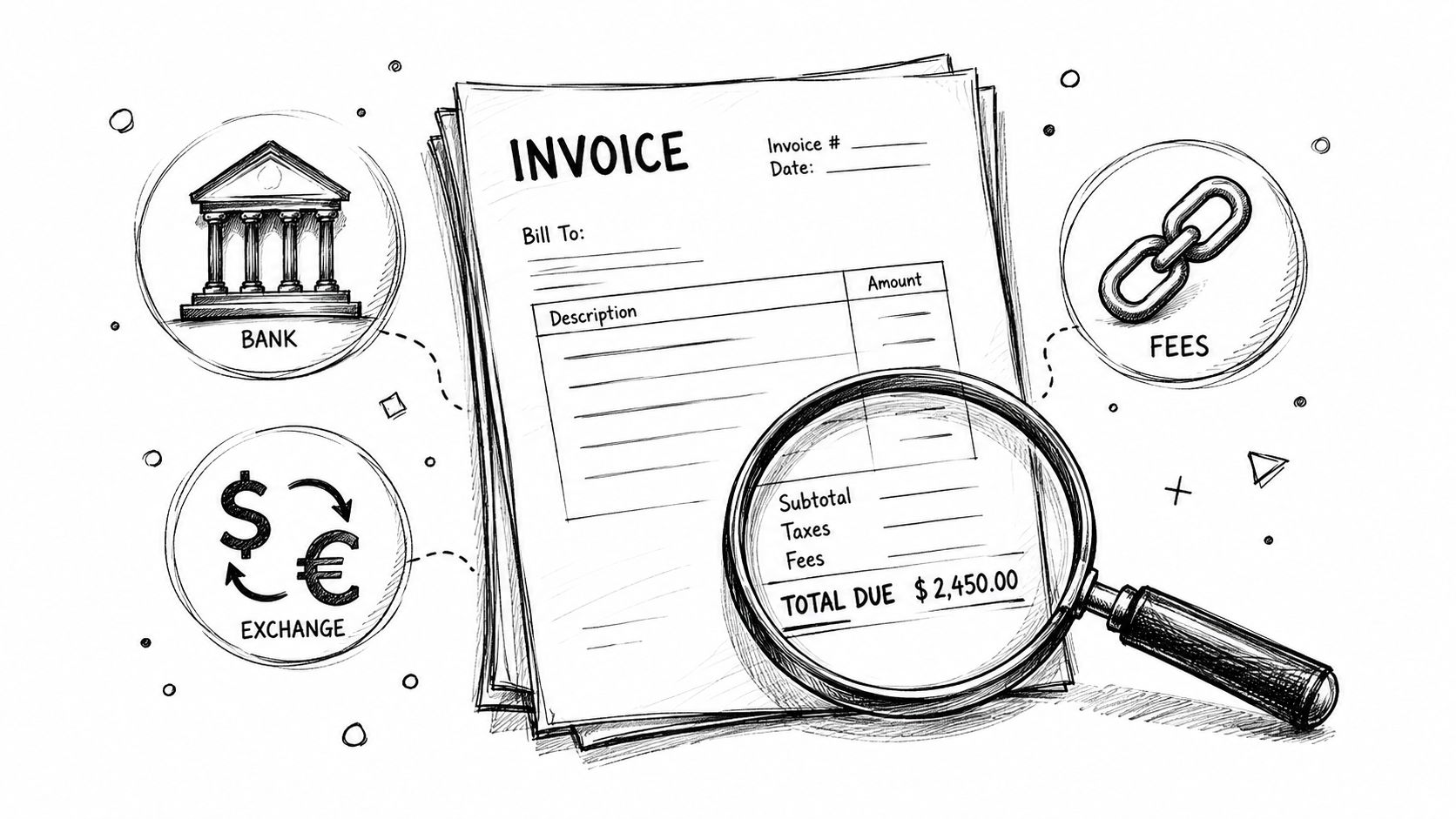
The small math that changes behavior
A 6% drag on a $10,000 invoice means $600 gone before you touch the money. That's not a theoretical problem, it's a payroll or rent problem. Once you see that number, it becomes obvious why “we'll split the fees later” is not a billing strategy.
You can also reduce surprises by recording the exchange rate and date on foreign-currency invoices, so the accounting trail is defensible later international invoicing handbook. I also keep a simple note in my own files showing which payment method was offered, which one the client chose, and whether the invoice was intended to be gross or net. That record has saved me more than once when a client's finance team tried to reinterpret the deal after payment.
If you're building a more structured workflow, there are ways to avoid currency conversion fees that are worth reviewing before you lock the invoice format. The main thing is not to leave fee responsibility implicit. Implicit fees become your problem fast.
Get VAT, GST, Withholding, and Reverse-Charge Wording Right
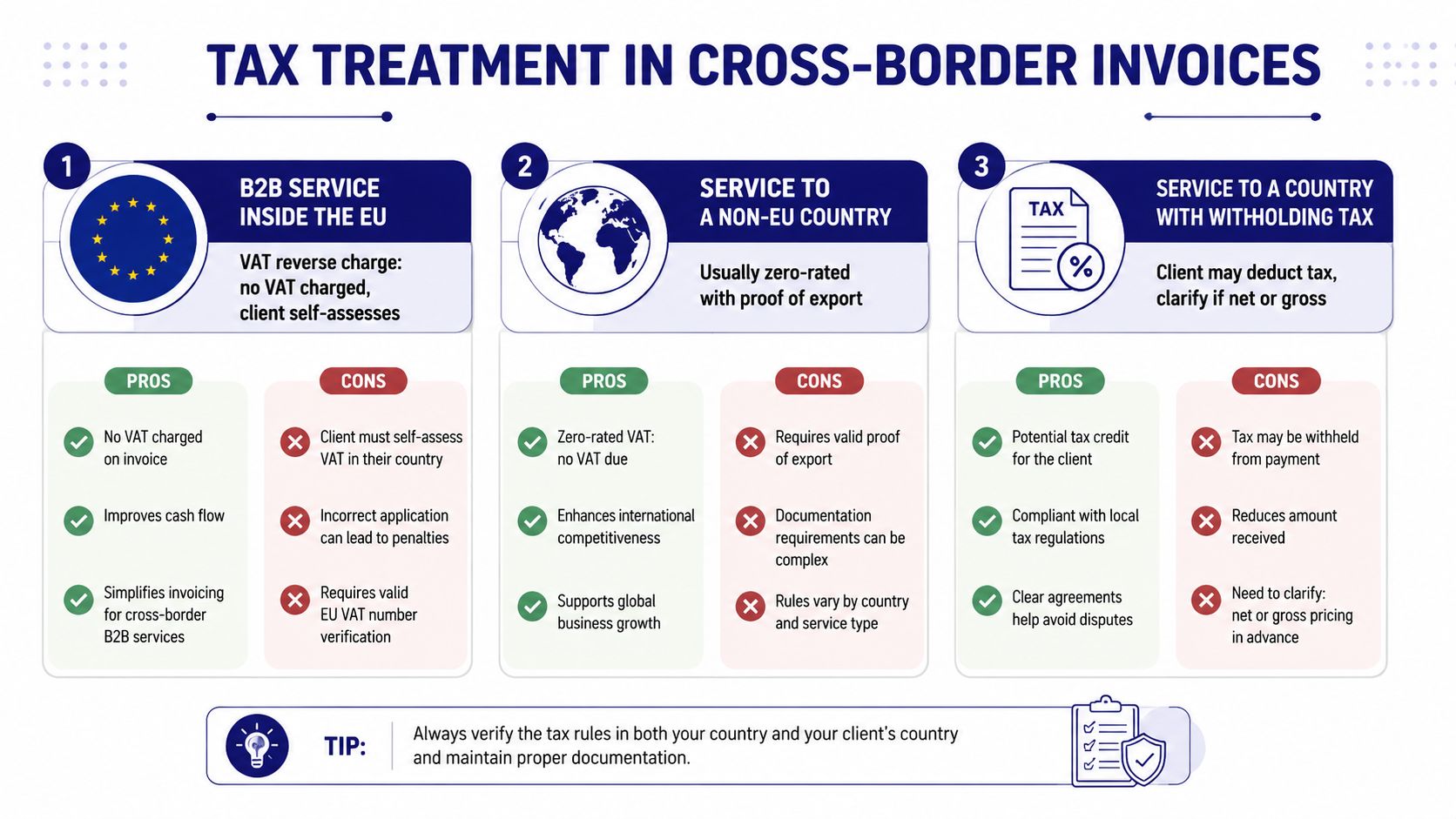
Tax language on an international invoice should be explicit, not implied. A generic “tax may apply” note isn't enough when a client's finance team needs to know whether they're self-accounting for VAT, deducting withholding tax, or treating the service as outside local tax scope. The invoice needs to show the treatment the client expects, and it needs to show it in the place their accounting team will see first.
For export and cross-border work, tax handling gets more data-heavy and less forgiving over time. That's why many invoice guides stop at “check VAT” while missing the wording that gets the invoice paid. If you need outside support on the export side, export support via Stewart Accounting Services is the kind of resource that can help you sanity-check the paperwork before it goes out.
Use wording that matches the tax case
For a B2B service inside the EU where the client self-accounts, use wording like:
Reverse charge applies. VAT not charged by the supplier. Customer to account for VAT in their jurisdiction.
For a US client where the client doesn't withhold tax but may want documentation, keep the invoice clean and add a reference note such as:
Service supplied under cross-border billing terms. Tax forms or withholding references to be handled separately by the client's finance team.
For a UK or APAC client expecting withholding or local consumption tax treatment, state it directly:
If withholding tax applies, payment should be grossed up so the net amount received equals the invoice total.
The point is not to over-explain. It's to stop the client's finance team from making assumptions you didn't agree to.
Put the tax IDs where finance teams look
Place your tax ID, VAT number, or equivalent registration near the invoice header or in the seller details block. Put the tax exemption or reverse-charge note near the totals section so it sits next to the amount due. That makes it easier for accounts payable teams to match the invoice to their own tax process without calling you for clarification.
Say the treatment, don't hint at it.
If a client asks for withholding certificates or reverse-charge wording, get the exact phrase from them before you issue the invoice. The OECD's work on tax transparency and cross-border reporting has pushed the broader environment toward more data-intensive compliance, and invoice wording has to keep up with that reality international tax transparency guidance.
Deliver the Invoice, Track Payment, and Handle Disputes Without Drama
A well-written invoice can still stall if you send it badly. A plain email with a PDF attachment gets buried, especially across time zones. A better send includes the PDF, a payment link if you have one, and a subject line that says exactly what the recipient needs to do, for example Invoice 0142 for March design work, payment due 12 May.
The body should be short and useful. State what the invoice covers, when it's due, and how the client can pay. If you've already agreed on fee responsibility or tax treatment, reference it once so nobody can claim surprise later.
Track status like a finance team, not like a hopeful freelancer
Use simple payment states:
Sent: The invoice left your system.
Opened: The client received it.
Viewed: Someone looked at the details.
Paid: Full amount landed.
Partially paid: Money arrived short, often because of fees.
Disputed: The client or their bank is questioning the amount or treatment.
That status list matters because the fix is different each time. A viewed-but-unpaid invoice usually needs a nudge. A partially paid invoice usually needs a fee conversation. A disputed invoice usually needs the original written agreement and the tax wording you already sent.
Keep the follow-up cadence calm and firm
Send on day zero. Nudge on day three if nothing lands. Send a reminder on day seven with the agreed fee clause if the payment is short or missing. Escalate on day fourteen, and after that, move the conversation to a human call or direct message. Two chase emails are enough before tone matters more than automation.
Disputes usually come from three places, a tax line the client wasn't expecting, a delivery date they think slipped, or a currency mismatch they didn't notice. Clean invoice design prevents most of that before it reaches the AP desk. If the client can understand the document in one pass, you've already lowered the chance of a fight.
Your International Invoice Checklist and Ready-to-Use Template
Before you send the next invoice, run this checklist once. Client data confirmed, currency and rail chosen, tax treatment written down, fee responsibility stated, and delivery method ready. That's the minimum set that keeps you from chasing your own money later.
For a more reusable format, a good invoice software platform examples roundup can help you compare how different tools structure the same basic information. If you already keep templates, it's also worth tightening your own invoicing templates so every international bill starts from the same clean layout.
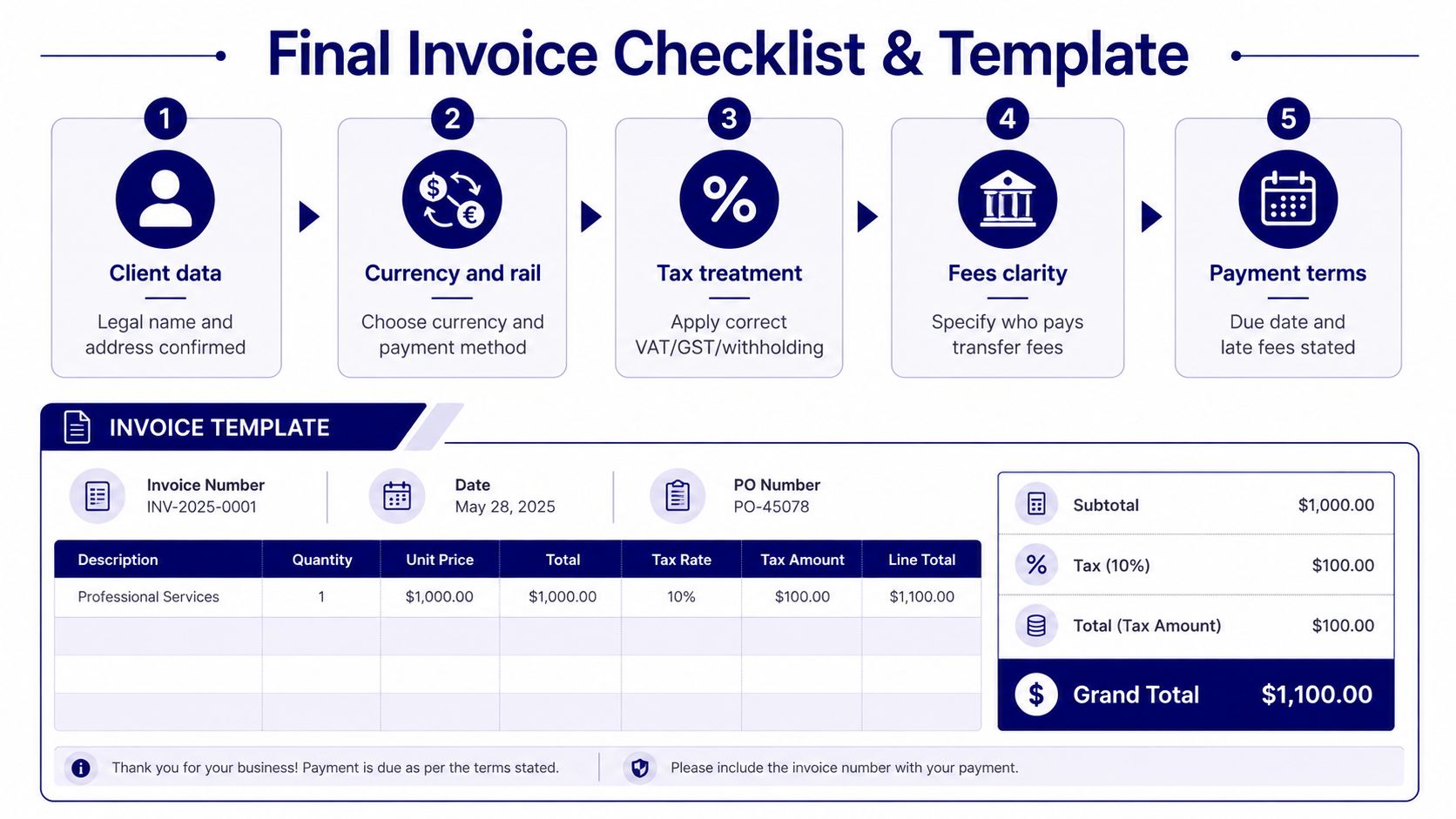
A ready-to-use invoice layout
Seller details
Your business name
Your address
Your tax ID or VAT number
Your email and payment contact
Client details
Client legal name
Registered address
Billing contact
Client tax ID if required
Invoice details
Invoice number
Invoice date
Due date
Currency
Payment method
Payment instructions
FX rate and date if applicable
Line items
Strategy session, 1 x unit price, tax status noted
Design implementation, 1 x unit price, tax status noted
Tax and totals
Subtotal
Tax rate or reverse-charge note
Grand total
Fee responsibility note
A clean note at the bottom works well:
Payment terms: Invoice total is final. Client covers bank and conversion fees. If withholding tax applies, the client must gross up the payment so the amount received matches the invoice total.
The four habits that pay off most are simple. Confirm client data first. Decide who pays fees and write it on the invoice. Offer a fast card link alongside the wire. Record the FX rate the day you send. That combination prevents most of the short-pays and reconciliation headaches that make international billing feel harder than it should.
If you want a setup that lets clients pay by card or crypto while you receive the way you prefer, Suby provides an API and native integrations for billing, gated communities, and online payments, so you can keep the invoice clean and the payout flow flexible.
