

Gaspard LEZIN
Recurring Revenue Model Explained for SaaS and Creators
Learn how a recurring revenue model works, from subscriptions to hybrid billing, key metrics like MRR and churn, pricing strategies and real examples.
You've just had your best sales month, but the excitement is mixed with a familiar worry. Next month, you'll need to start selling again from zero. A recurring revenue model changes that pattern. Instead of treating every billing period as a fresh race, you build a customer base that can continue paying when the product keeps delivering value.
That doesn't make revenue automatic. Customers can cancel, payment methods can fail, and the wrong billing cadence can create unnecessary friction. The durable advantage comes from combining a useful offer with strong retention, flexible billing, payment recovery, and clear measurement.
The subscription economy is already a broad commercial market. One recent industry report estimated it at USD 492.34 billion in 2024, with a projection of USD 1.512 trillion by 2033, implying a 13.3% CAGR from 2025 to 2033. North America represented 38.2% of revenue in 2024, while B2B subscriptions accounted for 55.2%, according to the recurring revenue market data.
This guide moves from the basic mechanics to model selection, health metrics, pricing decisions, and launch operations. It also treats payments as part of the product experience. Customers should be able to pay by card, wallet, bank, or crypto, while the business chooses whether to receive funds in its bank account or in stablecoins such as USDC.
Table of Contents
Introduction Why Predictable Revenue Changes Everything
A one-time sale gives you cash today and a customer relationship to rebuild tomorrow. A recurring charge creates a continuing agreement: the customer gets ongoing access, service, products, or benefits, and the business bills them on an agreed schedule.
The difference is easiest to see with a community creator. Selling a standalone course can produce a strong launch, but the next launch may depend on another campaign, another audience push, and another round of promotion. A paid community can create a steadier base if members continue finding value in access, discussions, lessons, or support.
That steadiness improves planning. You can forecast upcoming collections, decide how much support the business can afford, and invest in improvements without relying entirely on the next promotion. It can also make the business easier to evaluate because buyers and investors can see whether customers continue paying, not just whether new customers arrive.
Operator's rule: predictable revenue isn't the same as guaranteed revenue. It's revenue supported by a repeatable customer relationship and measured retention.
The model works across SaaS, ecommerce, professional services, memberships, online communities, and digital products. The format may be monthly, annual, usage-based, or flexible, but the operating challenge remains similar: acquire the right customers, deliver enough value to retain them, and remove avoidable payment friction.
The most useful way to think about recurring revenue is not “Which subscription price should I choose?” It's “What billing relationship matches how customers experience value?” A software team may combine a recurring platform fee with usage charges. A creator may offer a membership with a pause option. A cross-border agency may invoice clients through several payment methods while settling in its preferred currency.
That broader view matters because a recurring revenue model is both a pricing choice and a payment-operations system. Billing cadence, failed-payment recovery, cancellation flows, and win-back offers can determine whether revenue compounds or leaks away.
How a Recurring Revenue Model Actually Works
Start with a simple comparison. A gym day pass creates one transaction. A gym membership creates an ongoing relationship, with repeat billing in exchange for continued access. The gym still needs to attract members, but it doesn't need to resell the entire relationship every morning.
A recurring revenue engine has three connected parts:
Acquisition brings customers into the relationship. Marketing, sales, referrals, and partnerships create the initial conversion.
Retention keeps the relationship active. Customers renew because the product remains useful and the billing experience stays manageable.
Expansion increases account value. Customers may upgrade, add seats, increase usage, or purchase related services.
The important distinction is that each successful renewal adds to an existing base. A one-time business often resets its revenue target after every transaction. A recurring business starts the next period with customers who haven't cancelled, then adds new customers and expansion on top.
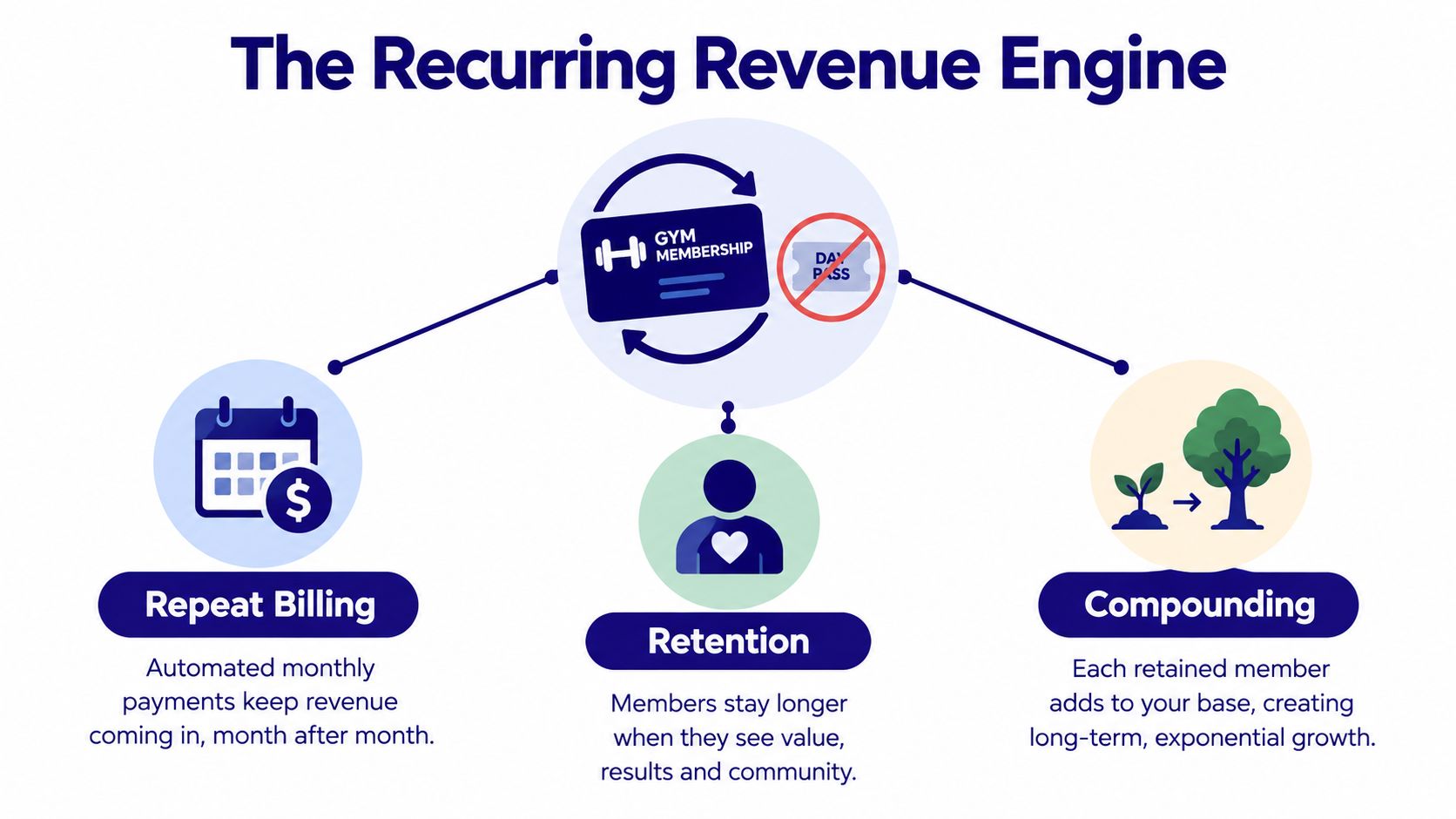
That structure creates a powerful advantage, but only when the customer receives ongoing value. A subscription to software that nobody uses will eventually cancel. A replenishment plan that sends products too quickly will create frustration. A community that stops producing useful interaction will lose members even if its payment setup works perfectly.
Billing operations sit between the promise and the renewal. The checkout must accept the customer's preferred method. The recurring charge must run at the right time. If a payment fails, the business needs a sensible recovery process rather than immediately treating the customer as lost.
A practical guide to setting up recurring payments can help teams map the customer journey from signup through renewal, cancellation, and recovery. It's also useful to review the operational questions involved in choosing a payment provider, especially when customers and businesses operate across currencies and payment methods.
A product team can also use recurring billing without forcing every customer into the same plan. Annual commitments, monthly access, weekly participation, usage charges, and one-time setup fees can coexist when each option has a clear purpose.
Comparing the Main Types of Recurring Revenue Models
The word “subscription” covers several different commercial relationships. A customer paying for access to a project management tool has a different expectation from a customer receiving a replenishment box or joining a paid Telegram group.
Five structures worth considering
Subscriptions charge a repeated fee for access to software, content, or a service. They're a natural fit when customers receive continuous value and usage is relatively consistent. The main churn risks are weak adoption, unused features, unclear outcomes, and a price that no longer feels justified.
Memberships sell belonging, privileges, or access to a group. They work well for communities, professional networks, clubs, and creator-led education. Retention depends on participation and perceived access value, not only on the underlying content.
Consumption-based models connect the bill to usage. This can feel fair when customer demand varies, but revenue becomes less predictable and customers may reduce usage when budgets tighten. Clear measurement and transparent billing are essential.
Licensing charges for the right to use intellectual property, software, media, or other assets over a defined period. It can suit business software and commercial content, but renewal risk rises when the customer no longer sees the license as strategically important.
Hybrid models combine structures, such as a platform subscription plus usage charges, or a membership with paid workshops and downloads. Hybrids can match different customer needs, but too many variables make pricing difficult to understand.
Model | How Billing Works | Best For | Watch Out For |
|---|---|---|---|
Subscription | Repeated fee for access | SaaS, media, digital services | Low product usage |
Membership | Repeated fee for privileges or community access | Communities, clubs, professional groups | Declining participation |
Consumption-based | Charge follows measured usage | APIs, variable workloads, services | Unpredictable customer bills |
Licensing | Payment for time-bound usage rights | Software, intellectual property, commercial assets | Renewal justification |
Hybrid | Fixed recurring fee plus variable or one-time charges | SaaS with add-ons, creator businesses | Confusing plan design |
The right choice follows customer behavior. If value arrives continuously, access billing may work. If value arrives when the customer consumes something, usage billing may be more honest. If customers need flexibility, offering more than one cadence can reduce the pressure to cancel.
Suby supports one-time payments and recurring subscriptions through its API and paylinks, with native integrations for Discord and Telegram gating. That makes it relevant to both product-led businesses and communities that sell paid access, but the commercial model still needs to be designed before the checkout is connected.
The model comparison is a starting point, not a final answer. Ask what customers use, how often they use it, what causes them to leave, and whether a predictable bill or a variable bill better matches the value they receive.
Key Metrics That Determine If Recurring Revenue Is Healthy
A recurring business can add customers every week and still weaken. Cancellations, failed payments, discounts, downgrades, and poor activation can drain the base faster than new sales replace it. Healthy revenue measurement therefore combines retention with payment operations.
Start with the revenue base
Monthly recurring revenue, or MRR, estimates the recurring revenue expected in a month from active customers. Annual recurring revenue, or ARR, shows that same recurring base across a year. MRR helps operators spot short-term movement, while ARR supports longer planning. Use the ARR calculation guide to keep the definition consistent across reports.
Churn measures customers or revenue lost during a period. Split it into voluntary churn, when a customer cancels, and involuntary churn, when a failed payment or account issue interrupts billing. The two causes need different responses. Product, onboarding, or value communication may address voluntary churn, while retries, reminders, and updated payment details may recover involuntary churn.
One 2025 industry summary reported total churn of around 3.60%, including 2.34% voluntary churn and 1.25% involuntary churn. Those figures appear in subscription economy data on churn. The useful lesson is operational: cancellation analysis and payment recovery belong in separate workstreams.

Measure economics, not only renewals
Customer lifetime value, or LTV, estimates the revenue or gross profit associated with a customer over the relationship. Customer acquisition cost, or CAC, captures the cost of winning that customer. Comparing LTV with CAC shows whether growth creates economic value or just purchases revenue at an unsustainable cost. This relationship also helps operators assess options such as Fundl traction-based funding.
Track how the base changes between periods:
Expansion revenue comes from upgrades, added seats, higher usage, or additional products.
Contraction revenue comes from downgrades, reduced usage, discounts, or removed seats.
Recovery rate shows how much revenue returns after failed payments.
Activation shows whether new customers reach the product experience that supports retention.
Existing customers carry much of the model. Industry research in the subscription commerce statistics overview found that about 70% of subscription revenue comes from existing customers. The same source reports that the average company in Zuora's Subscription Economy Index grew revenue by 321% from January 2012 to December 2018, equal to 18.1% annualized growth, compared with 3.6% average growth for the S&P 500 and U.S. retail sales over that period.
A useful dashboard puts subscriptions, payments, churn, failed charges, recoveries, upgrades, downgrades, and payouts in one view. That makes leakage visible during renewal, rather than after new sales have hidden it.
Pricing and Billing Strategies That Reduce Churn
Pricing attracts the customer, but billing design often determines whether the customer stays. The best recurring revenue model gives people a clear way to start and a manageable way to continue.
Match cadence to customer commitment
Monthly billing lowers the upfront commitment and can suit products customers evaluate continuously. Annual billing can simplify planning and work well when the product becomes embedded in a workflow. Weekly billing may fit habit-based products or communities where value arrives frequently, but it can also make every payment more visible.
Recent data points to greater demand for payment flexibility. In a large app-revenue sample, weekly plans rose from 42% to 46% of revenue, while monthly plans fell from 12% to 11%, according to Recurly's State of Subscriptions report. The practical conclusion isn't that weekly billing is universally better. It's that the cadence should reflect customer risk tolerance, usage, and the speed at which value becomes visible.
Offer a small number of meaningful choices rather than a confusing menu. A SaaS product might provide monthly and annual options, with usage-based add-ons where demand varies. A community might offer recurring access with a pause option instead of forcing a permanent cancellation.
Design for hesitation and payment failure
Trials should answer a clear question: can the customer experience enough value to make an informed decision? A feature-limited trial, a time-limited trial, or a guided onboarding path can work, but the customer needs to understand what happens at conversion.
Pause flows deserve equal attention. Customers may leave temporarily because of travel, budget pressure, seasonality, or workload. A pause option can preserve the relationship without pretending that every cancellation is permanent.
Failed cards require a separate recovery path. Send clear reminders, retry at sensible intervals, let customers update payment details, and explain what access changes if the balance remains unresolved. This is dunning, but it should feel like customer assistance rather than punishment.
A win-back flow can offer a lower-commitment plan, a pause, or a relevant reason to return. Don't hide the cancellation route. A difficult exit often creates distrust and makes future recovery less likely.
Suby provides an API that lets any business accept payments by card or crypto, and it also offers native integrations with Discord and Telegram for subscriptions, paid access, and online communities. Its payment infrastructure can accept cards, wallets, bank payments, and crypto through one checkout. Funds land in one Suby balance, and the business can choose a bank payout or settlement in stablecoins such as USDC. For crypto payments, Suby handles the swap and sponsors the gas, with settlement to a non-custodial wallet or the Suby balance.
Pricing depends on the payment method used, so there isn't one flat rate. Check the official Suby pricing page for exact figures before choosing a payment mix, and use this subscription pricing model guide to pressure-test the offer itself.
Real World Examples for SaaS Ecommerce and Creators
The same recurring revenue model behaves differently depending on how customers receive value. A useful design starts with the product experience, then chooses the billing structure.
SaaS
A SaaS company might offer a recurring platform plan by team size, then add usage charges for storage, API calls, or automated processing. Monthly billing lowers the entry barrier, while annual prepayment can suit customers who already depend on the product.
The common mistake is charging for capacity customers don't understand. Explain what each tier includes, show how usage affects the bill, and notify customers before an add-on becomes material. Track activation, feature usage, upgrades, downgrades, failed payments, and cancellation reasons.
Ecommerce
An ecommerce merchant can use replenishment billing for products customers regularly need. The customer receives convenience, while the merchant earns repeat orders without requiring a new purchase decision each time.
The risk is sending the product on the wrong schedule. Let customers skip, pause, change quantity, or adjust the delivery timing. A membership layer can add benefits such as access or preferred terms, but those benefits must remain useful between orders.
Creators and communities
A creator can charge for a recurring Discord or Telegram membership, then sell courses and downloads separately or bundle them into a higher access tier. Suby Gating supports paid access for Discord, Telegram, downloads, and courses, while Suby Invoicing lets a client pay by card or crypto while the business receives the chosen settlement currency.
The creator still needs a retention plan. Regular events, useful resources, active moderation, and clear member outcomes give people reasons to stay. If the community goes quiet, a technically perfect renewal process won't protect the revenue base.

Across all three examples, the payment promise should stay simple: customers pay any way they want, and businesses get paid the way they choose. Suby is one product with four ways to use it: Suby Payments for an API-first checkout, Suby Crypto for crypto payment processing, Suby Gating for paid digital access, and Suby Invoicing for flexible client billing.
Choosing and Launching Your Recurring Revenue Model
Choose the model by answering four questions:
What creates repeat value? Access, usage, replenishment, belonging, or a combination?
What commitment feels reasonable? Offer a cadence that matches how quickly customers see results.
What causes revenue loss? Separate cancellation from failed payment and measure both.
What will you change first? Keep plans simple, provide pause or downgrade paths, and build recovery before adding complexity.
Launch with one clear offer, a small set of billing choices, and a dashboard that shows activation, renewals, churn, failed payments, recoveries, and payouts. Shareable paylinks can validate demand quickly, while an API and webhooks can support a deeper product integration. The subscription tracker app can also help customers monitor their active commitments, but your internal reporting should remain the source for business decisions.
Suby provides an API that lets any business accept payments by card or crypto, alongside native Discord and Telegram integrations for subscriptions, paid access, and online communities. Verify implementation details in the official Suby documentation before going live.
If you're building SaaS, ecommerce, invoicing, or a paid community, visit Suby to choose between paylinks, API and webhooks, recurring subscriptions, gating, and invoicing. Set up a checkout where customers can pay by card or crypto, then choose whether your business receives funds through a bank payout or in stablecoins such as USDC.
