

Gaspard LEZIN
How to Receive Payments Online and Get Paid Your Way
Learn how to receive payments online with cards, wallets, bank and crypto. Choose methods, set up checkout, and launch payouts your way.
You've launched the product, connected a checkout, and watched the first customer pay. Then the operational questions arrive. Did the payment settle? Where did the money land? Can the next customer use a wallet or bank transfer? Can you receive funds in a different currency without opening another banking relationship?
That's why how to receive payments online isn't only a checkout question. A dependable setup connects payins, a clear balance, and flexible payouts. Customers pay any way they want, while the business chooses how to receive the money.
Table of Contents
Why Receiving Payments Online Is Harder Than It Looks
A payment button is easy to add. A reliable payment operation is harder because several systems have to work together. The customer needs a familiar payment method, the transaction needs to pass authentication and risk checks, the payment needs to appear correctly in your records, and the funds need to reach the destination you use.
This matters at global scale. The payments sector generated $2.5 trillion in revenue from $2.0 quadrillion in value flows, supported by 3.6 trillion transactions worldwide in 2025, according to McKinsey's Global Payments Report. That infrastructure includes card networks, wallets, bank rails, alternative payment methods, fraud controls, currency conversion, settlement accounts, and payout systems.
A SaaS company might want recurring card payments, while an international customer prefers a bank-based method. An online community may need paid access in Discord or Telegram. A freelancer may send an invoice and want the client to pay by card while the freelancer receives stablecoins. These are different customer experiences, but they all depend on the same underlying money flow.
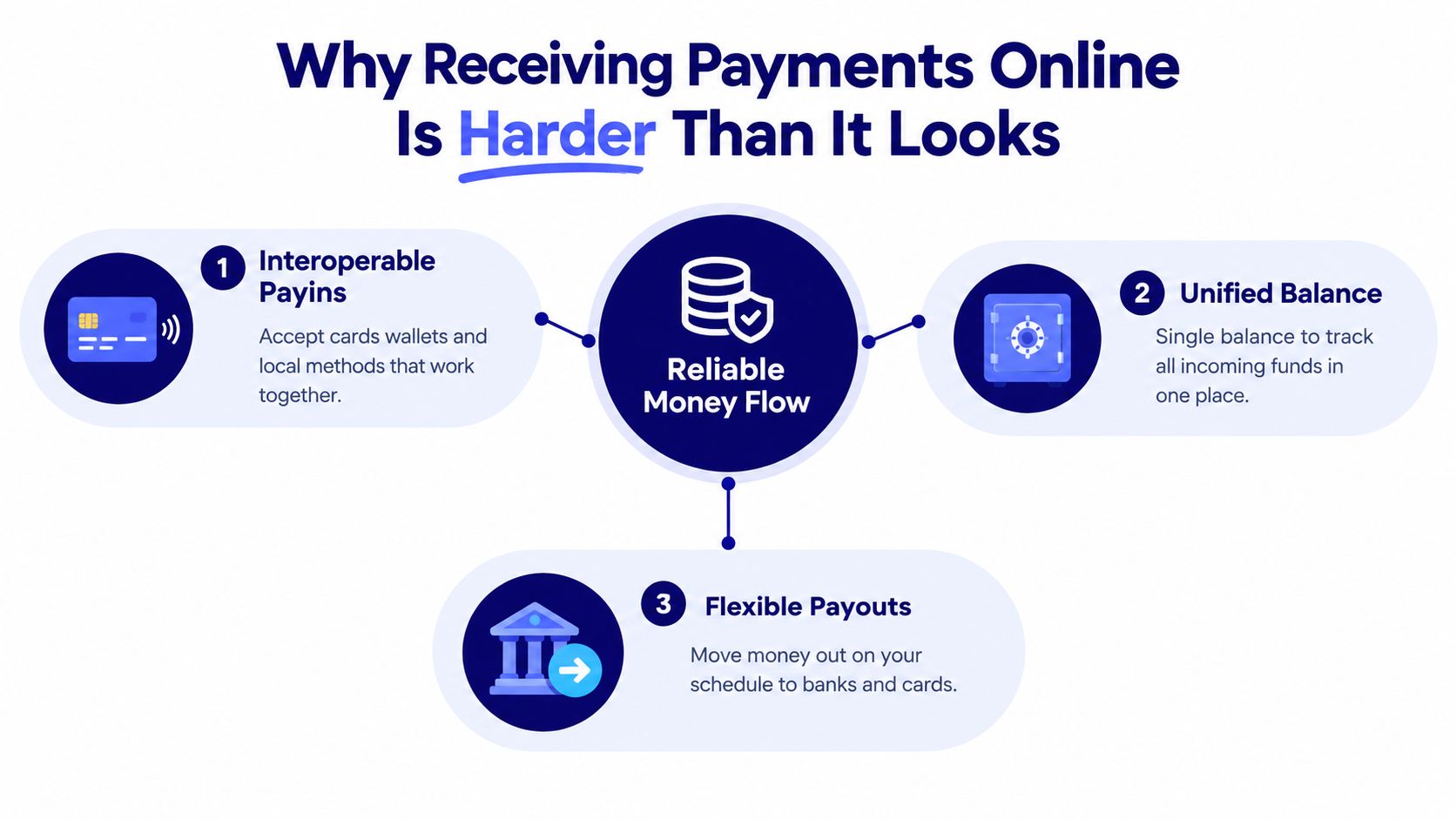
Think in three connected layers
Payins are the ways customers send money. Cards, wallets, bank transfers, BNPL, and crypto can all be useful, but the right mix depends on your customers and markets.
Balance is where incoming funds are tracked after payment. Without a unified view, teams often reconcile separate dashboards, currencies, refunds, fees, and payout records by hand.
Payouts are how the business receives the money. A payout might go to a bank account or to stablecoins such as USDC, depending on the business's needs and the provider's supported configuration.
Practical rule: Don't choose a payment method until you know how the resulting funds will be reconciled and paid out.
The strongest payment infrastructure supports this complete path rather than treating checkout as the whole product. Suby is positioned as payment infrastructure for the global internet economy, with customers able to pay by card, wallet, bank, or crypto while the business chooses how to receive the money. The card-to-USDC flow is one possible example, not the only operating model.
Choosing How Customers Will Pay You
Payment-method selection starts with the customer, but it shouldn't end there. Cards are familiar and work well for many online purchases. Wallets can reduce typing and make mobile checkout easier. Bank transfers may suit higher-value invoices or customers who prefer account-based payments. BNPL can fit selected retail purchases, while crypto can matter when your audience already holds digital assets or operates across borders.
The trade-off is operational. Every additional method can introduce different settlement timing, refund behavior, reconciliation fields, dispute rules, and fees. Merchants already accept an average of 4.6 methods globally. Cards, digital wallets, and bank transfers are each accepted by more than 60% of merchants, while real-time payments have 43% adoption and are rising fastest year over year, according to MRC payment-method data.
Use that information as a starting point, not a checklist. A SaaS business with recurring subscriptions may prioritize cards and wallets because customers expect stored payment details and automatic renewals. A cross-border store may add local bank methods or BNPL where those options are familiar. A consultant sending invoices may need a payment page that lets each client choose a suitable method without requiring separate instructions.
Payment Method | Best For | Consideration |
|---|---|---|
Cards | SaaS, ecommerce, services, subscriptions | Familiar for customers, but declines, expired details, and authentication need active management |
Digital wallets | Mobile checkout and repeat buyers | Fast customer experience, but availability varies by device, country, and wallet |
Bank transfers | Invoices and higher-value payments | Can suit account-based buyers, but reconciliation and payment confirmation need careful handling |
BNPL | Selected ecommerce purchases | May help customers spread payments, but eligibility and provider terms affect the experience |
Crypto | Crypto-native audiences and cross-border transactions | Requires clear settlement, conversion, refund, and accounting decisions |
Real-time payments | Markets with strong instant account-to-account usage | Adoption is growing, but availability and integration requirements vary |
Fees should be evaluated alongside conversion and finance work. Pricing depends on the payment method used, so there isn't one universal rate to apply across cards, bank transfers, wallets, and crypto. Review the available payment methods and verify the provider's current pricing before committing to a checkout design.
The practical test is simple: can your customers pay comfortably, can your team identify each payment, and can you receive the proceeds in a useful form? If a method improves neither customer access nor back-office control, adding it creates complexity without solving a real problem.
Picking Your Provider and Setting Up Checkout
Choose the integration model based on how much control your team needs. An API gives developers control over the checkout and payment lifecycle. An SDK can speed up implementation inside an application. Hosted checkout reduces front-end work, while a paylink is useful for invoices, sales conversations, and simple campaigns.
Suby presents one product with four ways to use it: Suby Payments, Suby Crypto, Suby Gating, and Suby Invoicing, as described on the official Suby website. Suby Payments is an API-first payment stack for builders. It provides an API that lets any business accept payments by card or crypto, and it also offers native integrations with Discord and Telegram for subscriptions, paid access, and online communities.
Match the implementation to the launch
An API-first approach makes sense when you need custom pricing, account logic, subscription states, or a checkout embedded in a product. Hosted checkout is usually more practical when speed matters more than front-end control. Paylinks work well when a salesperson, freelancer, or creator needs to send a payment request without building a complete purchase flow.
Before selecting a provider, check the parts that become painful after launch:
Payment events: Confirm that webhooks cover successful payments, failures, refunds, disputes, renewals, and payout changes.
Recurring billing: Make sure subscription renewals update access and accounting records correctly.
Dashboard visibility: Your operations team should be able to inspect payments, subscriptions, churn, and payouts without asking engineering for database exports.
Method coverage: Confirm that the payment types you plan to advertise are available for your customers' regions and business model.
Settlement controls: Understand how balances, currencies, conversion, payout destinations, and payout timing work before live traffic arrives.
A developer planning a more complex financial product may also benefit from a broader fintech software development guide, especially when deciding what belongs in custom code and what should remain with a payment provider.
For a faster launch, a no-code checkout can remove unnecessary front-end work. That doesn't mean skipping testing. You still need to confirm success states, declined payments, refunds, duplicate webhook handling, customer emails, and access provisioning.
Here's the product walkthrough for teams evaluating the setup experience:
The implementation is successful when the customer sees a clear payment result and your internal systems receive an equally clear event. A polished checkout with unreliable webhooks still creates manual work.
Configuring Payins Balance and Payouts the Right Way
The most useful way to configure online payments is to follow the money after the customer clicks “pay.” First decide what you'll accept. Then decide where those payins will be consolidated. Finally decide how and in which currency the business will receive the proceeds.
Suby's payment stack is designed to accept multiple payment types through one checkout, including cards, Apple Pay, Google Pay, Klarna, bank transfers, and crypto. Its official payments page lists Visa, Mastercard, Apple Pay, Cash App, Klarna, SEPA, USDC, SOL, and 200+ more methods in its supported-method presentation at Suby Payments.
Start with the payin layer
Select methods based on customer behavior and business requirements. A card or wallet can serve a recurring SaaS checkout. A bank transfer can work better for an invoice. Crypto can support customers who want to pay from a digital wallet. The point isn't to display every possible button. It's to make the appropriate choices available without fragmenting the operation.
The balance layer should give your team one place to understand incoming funds. A single balance helps connect payment records with refunds, fees, customer orders, and payout decisions. It also gives finance and operations a shared reference point instead of forcing them to combine disconnected provider reports.
Make the payout decision explicit
The business may want funds in a bank account, a selected currency, or stablecoins such as USDC. One important flow is customers pay by card and the business receives USDC, but that's only one option. Customers could pay through other supported methods, and the business can choose a different settlement route where the configuration supports it.
Suby Crypto is described as a crypto payment gateway that handles the swap, sponsors gas, and settles either to a non-custodial wallet or into the Suby balance. That separation matters because the customer's payment preference doesn't have to dictate the asset or destination the business uses for settlement.
Suby Invoicing follows the same principle for client work. The client pays how they want, while the business receives what it wants. For an agency or freelancer, that can make the invoice easier for the customer without forcing the business to manage several separate collection workflows.
Reconciliation should be designed before launch. Store a provider payment ID, customer or invoice reference, payment method, currency, gross amount, fees, refund state, and payout reference in your internal records. Then compare those records with the balance and payout activity on a regular schedule.
The checkout answers whether money can enter. The balance and payout configuration determine whether your business can use and account for it.
Testing Security and Compliance Before You Go Live
A payment flow should be tested as an operational system, not just as a successful card transaction. Run successful payments, declined payments, refunds, subscription renewals, webhook retries, duplicate events, and access changes in a sandbox or test environment. Then verify what the customer sees, what your application records, and what appears in the provider dashboard.
Authentication deserves specific attention. Visa reports about a 9% lift in authorization approval rates for transactions authenticated through Visa Secure and about a 45% reduction in fraud on authenticated versus non-authenticated ecommerce transactions, as reported by Outseer's 3-D Secure coverage. These figures don't mean every transaction should receive the same challenge. They support a risk-aware approach that uses 3-D Secure where it applies, preserves a frictionless path where possible, and monitors results by issuer, country, and authentication outcome.
Test the failure paths deliberately
Industry data cited by payment-failure analysis from DunningCompare says 15% to 20% of ecommerce payment attempts fail. The cited breakdown attributes 38% of failures to insufficient funds, 24% to expired or cancelled cards, 17% to bank security blocks, and 21% to technical errors.
Treat those outcomes differently. A soft decline may justify a smart retry. An expired card calls for a payment-method update prompt. A bank security block may need clearer customer guidance. A technical failure requires logs, webhook inspection, and integration review.
Your pre-launch checklist should include:
Authentication: Test frictionless and challenged 3-D Secure outcomes where applicable.
Declines: Confirm that messages are understandable and that recoverable failures trigger the right next action.
Webhooks: Verify delivery, signature validation, retry handling, and idempotency.
Subscriptions: Test renewals, failed renewals, cancellations, and access changes.
Refunds and disputes: Confirm status updates, customer notifications, and internal accounting treatment.
Data handling: Confirm that card data isn't stored in systems that don't need it and review the provider's documented security model.
Suby's documented security and compliance capabilities include a PCI DSS Level 1 certified processing partner, Strong Customer Authentication, two-factor authentication, dispute handling, and zero-fee refunds. Read the company's PCI DSS compliance explanation alongside your own legal and compliance review. Requirements still depend on your business, locations, products, and customer base.
Even a small food business may need to review local rules separately from payment configuration. A resource such as Peppery's cottage food compliance page can help identify that kind of sector-specific obligation, but it doesn't replace professional advice.
Launch Checklist and Tips to Get Paid Faster
A reliable launch is usually less dramatic than teams expect. The work is in confirming each handoff before customers depend on it.
Start by checking the live environment:
Payment methods: Enable only the methods you intend to support and explain them clearly at checkout.
Live credentials: Replace test configuration with production credentials and verify the correct account.
Payout destinations: Confirm the bank account, wallet, currency, and settlement preference.
Event handling: Make sure successful payments update orders, subscriptions, invoices, and gated access.
Customer recovery: Provide a clear path for declined payments, expired cards, and interrupted authentication.
Reconciliation: Match provider transactions to your internal order or invoice records.
Monitoring: Watch approval outcomes, failed payments, refunds, disputes, renewals, and payout status during the first operating period.
Use wallets alongside cards where they fit your audience. Offer bank-based payment for customers who prefer it. Send paylinks for invoices or direct sales conversations instead of forcing every buyer through a storefront. For communities and digital products, Suby Gating provides paid access for Discord, Telegram, downloads, and courses.
Pricing is method-dependent, not a single flat rate. The Suby pricing page says there are no setup fees, no monthly minimums, and no contracts. It lists cards and wallets at +$0.30 per transaction, bank transfers at +$1 per transaction, crypto across multiple chains, standard payouts as free, and instant payouts as an additional paid option.
Review those figures and the current method-specific terms before publishing prices or forecasting margins. Then launch with a small set of well-supported methods, measure payment outcomes by market and method, and add complexity only when customer demand or operational evidence justifies it.
Suby provides an API for accepting card and crypto payments, alongside native Discord and Telegram integrations for subscriptions, paid access, and online communities. Visit Suby to configure a payment flow where customers pay the way they prefer and your business receives funds in the form and destination you choose.
