

Gaspard LEZIN
ACH Direct Debit Explained How It Works and When to Use It
Learn what ACH direct debit is, how authorization and clearing work, how it compares to ACH credit and cards, and best practices for NACHA compliance.
A subscription business often reaches the same uncomfortable moment every month. A customer wants to stay subscribed, but a card expires, a fraud check blocks the charge, or the payment fails. The finance team then spends time sending reminders instead of delivering the service.
ACH direct debit offers a different collection model. After the customer authorizes the business, the business can request payment from the customer's bank account rather than waiting for the customer to push money or approve every recurring charge. That makes ACH direct debit useful for subscriptions, memberships, invoices, utilities, and other ongoing relationships.
It's also easy to oversimplify. ACH direct debit isn't merely a cheap bank transfer. Authorization evidence, account verification, settlement timing, return windows, and fraud monitoring all affect whether the rail fits a particular business. The right question isn't only, “What does this payment cost?” It's also, “What happens when the account lacks funds, the customer disputes a debit, or a faster settlement window changes our treasury process?”
This guide starts with the basic pull model, then follows a debit from authorization through clearing, settlement, and returns. It compares ACH direct debit with ACH credit and card payments, maps the rail to practical business models, and closes with implementation and control considerations.
Table of Contents
Introduction to ACH Direct Debit for Modern Payments
Consider a software company that bills customers each month. With a card, the company can attempt the recurring charge automatically, but an expired card or issuer decline can interrupt the relationship. With an ACH credit, the customer or its finance team pushes funds to the business. With ACH direct debit, the customer gives the business permission to collect from a specified bank account on an agreed schedule.
That distinction, permission to pull, is the foundation of the method.
In the United States, ACH direct debit operates through the ACH Network, an electronic payments rail used for consumer bill payments, subscriptions, payroll-related flows, and other transfers. The network processed 35.2 billion payments worth $93 trillion in 2025, including 19.6 billion debit transactions valued at $31.7 trillion. Consumer-initiated bill payments and other transfers represented 17.17 billion ACH transactions that year, according to Nacha's ACH payments fact sheet.
Those figures place ACH direct debit firmly inside mainstream U.S. payment infrastructure. It isn't a niche utility for a handful of industries. It's a recurring collection option that can reduce dependence on card credentials, while introducing a different operational responsibility: the merchant must prove authorization and manage returns after settlement.
Why the pull model matters
A card payment generally asks the customer's card issuer to approve a transaction. An ACH direct debit asks the customer's bank account to honor an authorized debit instruction. The customer doesn't need to initiate each recurring payment, but the merchant must collect and retain the mandate that permits the debit.
That makes the method especially suitable when:
The relationship continues: subscriptions, memberships, software access, and service agreements often need scheduled collections.
The amount is predictable or contract-based: the debit can cover a recurring fee or an invoice amount that changes according to the agreement.
The customer has a bank account available: the rail depends on a U.S. account and the relevant account details.
The business can tolerate batch timing: ACH usually doesn't provide the immediate confirmation associated with a card authorization.
The trade-off is important. A lower-cost recurring rail can still create losses or customer friction if the business ignores insufficient funds, unauthorized claims, duplicate submissions, or stale account information.
Practical perspective: Treat ACH direct debit as a managed collection relationship, not as a button that moves money instantly.
By the end of this guide, you should be able to decide whether ACH direct debit suits your billing pattern, understand the workflow your team or provider must support, and identify the controls needed before launch.
What ACH Direct Debit Is and How It Pulls Funds
The easiest way to understand ACH direct debit is to compare it with sending a package. ACH credit is like the customer placing the package in the mail. ACH direct debit is like the customer signing a permission slip that allows the business to collect an agreed package from the customer's account.
The payer first authorizes the payee. The payee then originates a debit instruction through its financial institution. That instruction travels through the ACH Network to the payer's bank, where the account is debited if the transaction can be honored.
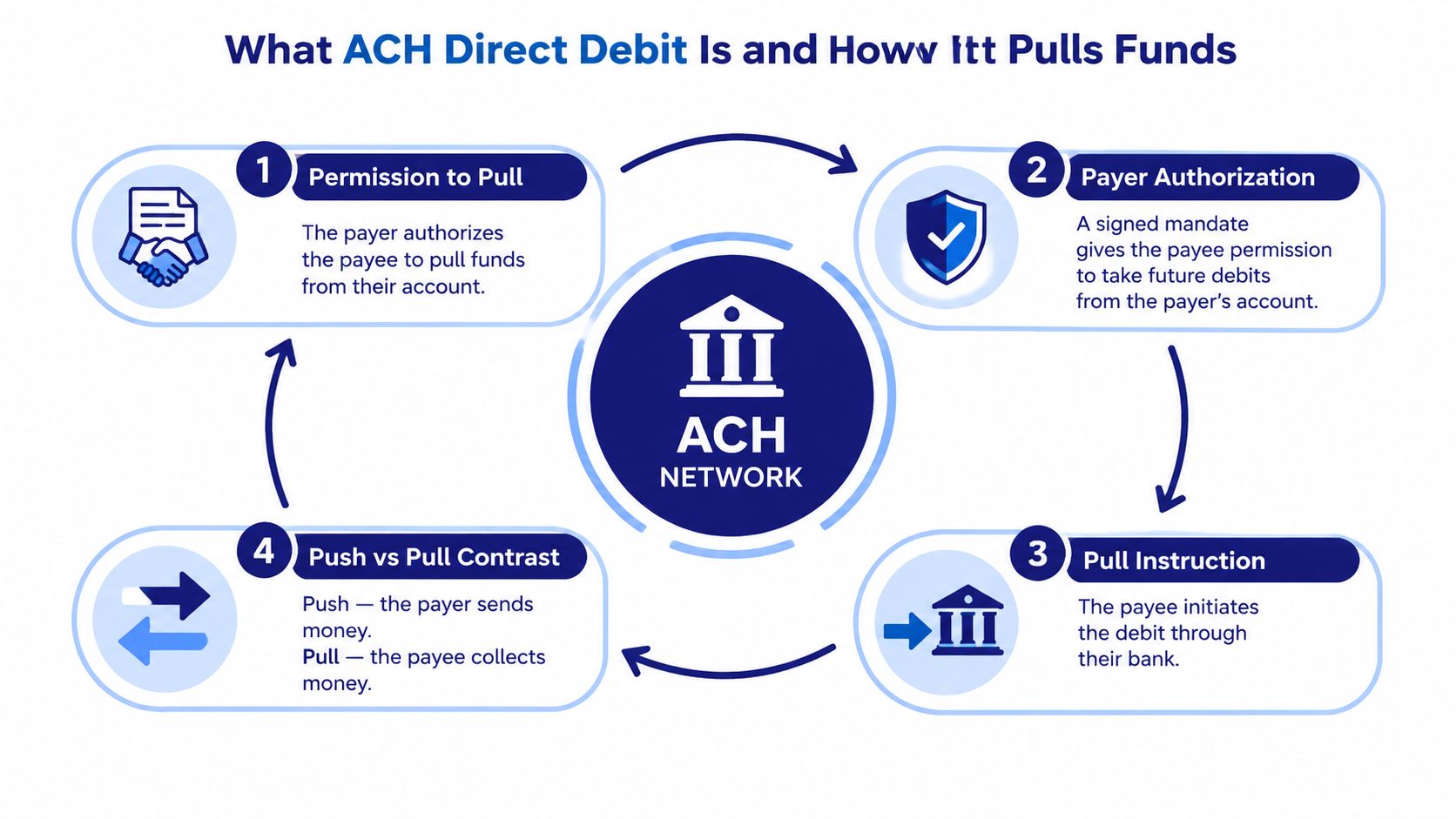
The parties involved
Several names appear in ACH documentation, but their roles are straightforward:
Originator: The business or organization requesting the debit. A subscription company collecting its monthly fee is the originator.
Originating Depository Financial Institution, or ODFI: The originator's bank or financial institution. It accepts the business's ACH instructions and submits them into the network.
Receiving Depository Financial Institution, or RDFI: The payer's bank or financial institution. It receives the debit instruction and applies it to the payer's account.
Receiver: The customer or business whose account is debited.
Nacha: The organization that administers the ACH Network's operating rules and standards.
The terms consumer debit and corporate debit describe different transaction contexts. A consumer debit is connected to an individual's account. A corporate debit concerns a business account and often follows different authorization and return handling expectations.
Authorization comes first
The merchant can't enter a bank account number and pull funds. The payer must authorize the debit before processing. The authorization should identify what the customer agreed to, including the account relationship, payment arrangement, and relevant schedule or amount terms.
Account verification is also part of a responsible setup. Industry documentation states that the first use of an external bank account number, or a change to that number, requires verification under Nacha rules, as described in Airwallex's ACH direct debit documentation.
Verification helps answer a basic question before collection begins: does the account appear to exist and belong in the payment flow? It doesn't guarantee that every future debit will succeed. Funds can change, an account can close, or a customer can later claim that a transaction wasn't authorized.
That's why authorization evidence and verification records belong in the payment system, not in an informal email thread or a spreadsheet that nobody audits.
How ACH Direct Debit Works From Authorization to Returns
An ACH direct debit has a lifecycle, and each stage creates a different responsibility for the merchant. The most common implementation error is treating the settlement date as the end of the process. In practice, the merchant still needs to monitor returns, reconcile entries, and respond to customer claims after funds appear.

Step one, capture authorization and verify the account
The customer provides permission for the business to debit the account. The merchant should retain the authorization record and connect it to the customer, mandate, account details, and billing agreement.
The business also verifies the account when required. Verification can reduce avoidable failures, but it doesn't replace authorization. These are separate controls, one establishing permission and the other helping validate the account information.
Step two, submit the debit instruction
The merchant prepares the debit entry and submits it to its ODFI or payment provider. ACH processing is organized around operating windows and batches, so the submission time affects the expected settlement date.
Nacha states that ACH debits can settle on the same day or the next banking day, and rules prevent an ACH debit from carrying a settlement date more than one banking day in the future. That short horizon means the merchant must align billing schedules, bank cutoffs, customer notifications, and funding assumptions. The Same Day ACH schedule and funds availability guidance provides the relevant timing framework.
A provider may also apply its own eligibility rules. For example, one payment provider says transactions under 1,000,000 USD submitted before 2:00 pm US/Eastern can use Same Day ACH, while larger or later submissions move to the next day, as described in Stripe's ACH direct debit settlement guidance.
Step three, clear through the network
The ODFI sends the entry into the ACH Network. The network routes it toward the RDFI, which applies the debit request to the payer's account. Because ACH uses batch processing rather than a continuously authorized card-style transaction, the customer and merchant may not receive final confirmation at the moment the instruction is submitted.
For a broader discussion of timing, see this guide to how long an ACH transfer takes.
Step four, settle and reconcile
The customer's account is debited and the merchant receives the proceeds according to the applicable schedule. A payment provider describes ACH debit payments as usually settling in 1 to 3 business days, because batch processing and daily cutoff windows affect timing, according to Stripe's ACH debit overview.
Settlement should be treated as provisional for operational purposes. The merchant can record the expected receipt, but treasury and reconciliation systems should preserve enough status information to identify later returns. A service team that grants access immediately may also need a policy for what happens if the debit is subsequently returned.
Step five, manage returns and exceptions
Returns are not all alike. Standard administrative returns are generally expected within 2 banking days, while an unauthorized consumer debit can be returned for up to 60 banking days, according to the ACH return guidance summarized in Worldpay's direct debit FAQ.
A corporate or non-consumer debit generally must be returned within 2 business days of settlement, while an unauthorized consumer debit can be initiated up to 60 days after settlement, according to this ACH return reference guide from East West Bank.
That difference changes how merchants handle access, revenue recognition, collections, and customer support. An insufficient-funds return may call for a retry policy or an alternative payment request. An unauthorized claim requires evidence review, customer communication, and careful compliance handling.
The Same Day ACH system has also become a significant part of the rail. Nacha reports that Same Day ACH reached 1.4 billion payments valued at $3.9 trillion in 2025, showing that faster processing is now a material operational option rather than a novelty. Faster settlement can improve cash visibility, but it also leaves less room for teams that rely on slow manual review before releasing goods or access.
ACH Direct Debit Versus ACH Credit and Card Payments
Choosing a payment rail by headline fee alone creates avoidable problems. ACH direct debit, ACH credit, and card payments each place control in a different party's hands, produce different confirmation signals, and create different failure paths.
Feature | ACH Direct Debit | ACH Credit | Card Payment |
|---|---|---|---|
Who initiates the payment | Merchant requests an authorized debit | Payer or payer's bank pushes funds | Customer presents card details or a saved credential |
Best fit | Recurring bills, subscriptions, memberships, and account-based collections | Customer-controlled transfers, payroll-style credits, and deliberate payments | One-time purchases, instant checkout, and broad consumer acceptance |
Timing | Batch-based, with same-day or next-banking-day ACH debit settlement rules | Batch-based and dependent on submission and receiving processes | Authorization is generally immediate, while final settlement follows card-network processes |
Authorization model | Merchant needs permission to pull funds | Payer instructs its institution to send funds | Cardholder authorizes the purchase through the card flow |
Main failure concern | Insufficient funds, invalid details, administrative returns, or unauthorized claims | Payer doesn't send the payment or sends the wrong amount | Declines, expired credentials, fraud disputes, and chargebacks |
Operational focus | Mandate evidence, account verification, return monitoring, and reconciliation | Payment instructions, matching, and cash application | Authorization rates, credential updates, fraud controls, and dispute handling |
ACH direct debit and ACH credit
The pull-versus-push distinction matters most for recurring billing. A utility provider can calculate a variable monthly bill and collect it under an existing authorization. A business customer paying an invoice by ACH credit retains control over when and how much it sends.
That control can be valuable for the payer, but it can make collections less predictable for the recipient. ACH direct debit can make the collection schedule more systematic, provided the merchant has valid authorization and a process for returns.
ACH direct debit and cards
Cards usually provide a faster customer-facing confirmation. That's useful when a merchant needs to authorize an order before releasing a digital product, reserving inventory, or starting a service. Cards also offer familiar dispute processes, though those processes create their own operational and financial exposure.
ACH direct debit can be better suited to an ongoing account relationship where the merchant values bank-account collection and can manage delayed confirmation. It isn't automatically better for every subscription. A service with frequent account changes, high fraud exposure, or an urgent need to confirm payment may prefer cards, or may offer both rails.
For readers comparing electronic check terminology and bank-rail timing, CEFCore's explanation of eCheck versus ACH settlement times is a useful supplementary resource. The labels can overlap in everyday conversation, but implementation decisions still depend on the specific network, provider, authorization method, and settlement rules.
The lower apparent fee only matters if the business can absorb the timing and return-management work that comes with the rail.
A practical approach is to offer a choice. Let customers use cards when they need immediate checkout feedback, and offer ACH direct debit for customers who prefer account-based recurring billing. Businesses accepting cards can also review this guide on how to accept credit card payments.
Where ACH Direct Debit Fits Best Real World Use Cases
ACH direct debit works best when the merchant has an ongoing reason to collect from the same customer. The value comes from combining a prior authorization with a repeatable billing relationship, not from trying to force every purchase into a bank debit.
Subscriptions and memberships
Software subscriptions, professional memberships, fitness programs, and paid communities often have a clear billing agreement. The customer expects access to continue, while the business needs a repeatable way to collect the next charge.
ACH can be a sensible option when the customer is comfortable linking a bank account and the merchant can handle payment confirmation that isn't necessarily immediate. The business should still provide clear billing notices, store mandate evidence, and define what happens after a returned debit.
B2B invoices and account-based billing
A B2B supplier may collect recurring invoices from a customer's business account. This can simplify payment administration when the amount follows an agreed contract or account balance.
Corporate debits deserve particular attention because return timing and authorization rules can differ from consumer transactions. The finance team should decide who reviews exceptions, how returned invoices are reopened, and whether service access changes while the account is unresolved.
Utilities, bill pay, and variable charges
Direct debit can support bills that follow a schedule but change in amount. A utility customer, for example, may authorize collection while the amount varies with usage. That arrangement makes notification, statement clarity, and customer support important. Customers need to understand when the debit will occur and how the amount was calculated.
Installments and scheduled collections
Installment plans can benefit from a pull model because the merchant knows when each scheduled payment is due. The payment plan still needs a clear authorization scope, especially if the amount changes or the customer falls behind.
ACH direct debit is less suitable for a one-time impulse purchase where the buyer expects an instant success signal. It also deserves extra scrutiny for recurring billing with frequent payment failures, cross-border complexity, or weak account data. In those situations, authorization proof and account validation can matter as much as the processing fee.
Nacha's network data shows why these details matter at scale. In 2025, the network processed 1.45 billion payments, including 821.25 million debits, with $3.92 trillion moved, according to Nacha's ACH Network volume and value statistics. Same Day ACH reached 1.4 billion payments in 2025, while the network averaged 5.8 million same-day payments per day, according to the same source. A small deterioration in return performance can therefore affect a large collection base.

Implementing ACH Direct Debit With Banks PSPs and APIs
Businesses generally choose among three implementation paths.
Direct bank or ODFI integration gives the finance and engineering teams more control over files, schedules, reconciliation, and exception handling. It also places more responsibility on the business to understand operating rules, maintain authorization records, monitor returns, and coordinate with banking partners.
A payment service provider or API can reduce the amount of bank-rail infrastructure the merchant has to build. The trade-off is provider dependency. The team must examine supported payment methods, webhook events, mandate handling, settlement reports, retry behavior, and how the provider presents returns.
An invoicing or no-code tool can suit a smaller operation that wants to collect without building a full payment stack. It may be faster to operate, but the business should still confirm how it exports authorization evidence, matches payments to invoices, and handles failed or disputed debits.
For teams evaluating providers, understanding what a PSP payment service provider is helps separate a payment interface from the wider operational layer behind it.
Suby is one infrastructure option for businesses that want an API to accept payments by card or crypto, while also supporting native integrations with Discord and Telegram for subscriptions, paid access, and online communities. Its four product paths are Suby Payments, an API-first stack for accepting cards and crypto through one checkout; Suby Crypto, a gateway that handles the swap, sponsors gas, and settles to a non-custodial wallet or Suby balance; Suby Gating, for paid access to Discord, Telegram, downloads, and courses; and Suby Invoicing, where the client chooses how to pay while the business receives what it chooses. Customers can pay any way they want, and businesses can choose how they receive funds, including a bank account or stablecoins such as USDC. Pricing depends on the payment method, so teams should check the Suby pricing page for exact figures.
NACHA Compliance Risk Controls and Best Practices
ACH direct debit becomes dependable when the merchant treats compliance and risk controls as part of product design. Authorization must be captured before processing, account information must be verified where required, and every debit should remain traceable to the customer agreement that supports it.
Return monitoring deserves a dashboard, not occasional manual review. Federal Reserve research indicates that a 2.5% return rate is well above acceptable normal-business levels, making return performance a useful fraud and underwriting signal for originators, as summarized in the documented ACH return guidance. Teams should separate administrative returns from unauthorized claims because the response, evidence, and timing differ.
What the 2026 rule changes mean
Nacha's 2026 rule changes expand fraud monitoring beyond WEB debits to all entry types and establish a 0.5% unauthorized debit return threshold, alongside 3.0% administrative and 15.0% overall debit return levels, according to the documented analysis of Nacha's 2026 ACH fraud monitoring rules.
The changes also emphasize shared responsibility between originating and receiving institutions. That matters for merchants because fraud prevention can't be treated as only the bank's problem. The originator still needs sound onboarding, mandate storage, account verification, anomaly review, and an escalation process for suspicious activity.
A practical launch checklist
Record authorization: Store the mandate, customer identity, account details, terms, and relevant timestamps.
Verify account changes: Apply verification when an external bank account is first used or changed.
Monitor return categories: Track insufficient funds, invalid details, administrative returns, and unauthorized claims separately.
Protect the reconciliation process: Keep settlement status provisional until applicable return exposure is addressed.
Review faster windows: Make sure Same Day ACH submissions don't bypass internal approval, notification, or exception controls.
Prepare customer support: Give agents a clear process for cancellations, disputes, retries, and alternative payment requests.
Test access decisions: Decide whether a returned debit pauses service, triggers a grace period, or routes the customer to another payment method.
A strong ACH program isn't defined by low processing cost alone. It combines clear permission, reliable account data, disciplined submission, careful reconciliation, and continuous return monitoring.
If you're deciding how to combine recurring bank collection with broader checkout options, visit Suby to review its API, card and crypto payment flows, invoicing tools, and native Discord and Telegram integrations. Choose the payment method your customer prefers, then evaluate how Suby can help your business receive funds in the form and currency that fit your operations.
