

Gaspard LEZIN
Subscription Pricing Models: A 2026 Guide for Your Business
Explore subscription pricing models like flat-rate, tiered, and usage-based. Learn how to choose, implement, and optimize a model that boosts ARPU and LTV.
You've probably been in this spot already. Your product is working, customers are interested, and the question that should feel simple turns into a strategic headache: what exactly should you charge, and how should you charge it?
A lot of founders treat pricing like a number-picking exercise. It isn't. Your pricing model affects who signs up, how easy your product is to understand, how predictable your revenue feels, and whether customers stay long enough to become profitable. A weak model can create friction even when the product is strong. A well-matched model can make growth feel smoother because the billing logic matches the way customers get value.
That's why subscription pricing models deserve more attention than they usually get. The key decision isn't only monthly versus annual. It's whether your business should use flat-rate pricing, tiers, per-user billing, usage-based charges, or a hybrid structure that combines fixed and variable components.
For global businesses, there's another layer people often miss. A pricing page may look clean on paper, but the economics can fall apart when cross-border payment friction, payout delays, FX costs, or settlement uncertainty enter the picture. That matters a lot if you sell internationally.
Table of Contents
Introduction Why Your Pricing Model Matters More Than Ever
Why the billing unit matters first
Core Subscription Models at a Glance
How each core model works
Freemium as an acquisition tool
Hybrid pricing and add-ons
ARPU and LTV
Churn and CAC
Questions that narrow the choice
Why payment infrastructure changes the answer
What it changes operationally
Where it fits best
How to test without breaking trust
How to migrate existing customers
Introduction Why Your Pricing Model Matters More Than Ever
Founders often freeze on pricing because every option seems to create a different risk. Charge too little and you underfund growth. Charge too much and conversion suffers. Make it too simple and you miss revenue from larger customers. Make it too complex and buyers hesitate because they can't predict the bill.
That tension is normal. It usually means you're asking the right question.
A subscription model is really a way of translating customer value into recurring revenue. If the model matches how customers experience value, pricing feels fair. If it doesn't, every sales conversation gets harder, renewal discussions get awkward, and support gets pulled into billing confusion.
A pricing model isn't just a revenue lever. It's part of the product experience.
This is why the choice matters more now. Many businesses sell globally from day one, serve customers with very different usage patterns, and operate in markets where trust is fragile. Buyers want flexibility, but they also want predictability. They want a low entry point, but they don't want billing surprises.
Here's a practical perspective:
Flat-rate pricing works when simplicity is your edge.
Per-user pricing works when value grows with team adoption.
Tiered pricing works when different customer segments need different packages.
Usage-based pricing works when customer value rises with consumption.
Hybrid pricing works when you need both baseline revenue and room to grow with the customer.
The right choice depends on your product, your cost structure, your sales motion, and, for international companies, your payment setup. Those parts are connected whether your pricing page shows it or not.
The Four Core Subscription Pricing Models
Why the billing unit matters first
Before you compare plans, start with the architecture of the price itself. In subscription pricing, the most technically important design choice is the price metric, meaning the unit you bill on, and the price structure, meaning how charges change over time or usage, as explained by Zuora's overview of subscription pricing.
That sounds abstract until you see the practical consequence. If you bill per seat, revenue scales with headcount. If you bill on usage, revenue scales with consumption. If the metric doesn't line up with how customers get value, you create a mismatch between revenue and value capture.
Core Subscription Models at a Glance
Model | Best For | Predictability | Scalability | Implementation Complexity |
|---|---|---|---|---|
Flat-rate | Simple products with similar customers | High | Low to medium | Low |
Per-user | Team software and collaboration tools | High | Medium | Low |
Tiered | Businesses serving multiple segments | Medium to high | High | Medium |
Usage-based | APIs, infrastructure, variable-consumption products | Lower | High | High |
If you're pricing a support product or assistant layer, it helps to compare how different vendors frame AI support costs, because those examples show how pricing changes depending on whether value comes from seats, resolution volume, or automation usage.
For a deeper example of how metered billing changes packaging decisions, see this guide to usage-based billing.
How each core model works
Flat-rate pricing
Flat-rate pricing means one recurring price for one package.
It's the easiest model to explain. Customers know what they'll pay, finance teams can forecast more comfortably, and your pricing page stays simple. This often helps early-stage products that need low-friction buying.
The weakness is just as clear. Flat-rate pricing treats light and heavy customers too similarly. If one account gets much more value than another, you may undercharge your best-fit customers while overcharging smaller ones.
Good fit: focused product, narrow audience, low variable cost
Strength: simple buying decision
Trade-off: weak expansion path
Per-user pricing
Per-user pricing charges based on the number of seats or people using the product.
This model works when your product's value rises as more people adopt it inside a team. Collaboration software often fits naturally here because the customer already thinks in terms of users, permissions, and team rollout.
The problem appears when the user count isn't the actual value driver. Some customers may share logins, restrict adoption, or question why adding teammates raises the bill even if product usage barely changes.
Tiered pricing
Tiered pricing groups customers into packages, usually by feature access, limits, support level, or some combination of the three.
This is often the most flexible option for SaaS because it gives different types of buyers a self-serve path. Smaller customers can start with a lower tier, while larger ones can move into richer plans without a full custom contract.
Practical rule: If your pricing page needs to serve very different customer profiles, tiers often work better than forcing everyone into one plan.
Tiered pricing gets messy when the boundaries are artificial. If buyers can't tell why one tier exists, or if adjacent tiers feel too similar, the model creates hesitation instead of clarity.
Usage-based pricing
Usage-based pricing charges customers according to consumption. That might be transactions, API calls, processed volume, storage, messages, or another measurable unit.
This model aligns price closely with delivered value when usage reflects customer benefit. It can also lower the entry barrier, because customers don't have to commit to a large fixed bill before they've proven ROI.
Its biggest challenge is emotional, not just technical. Variable bills can create anxiety. Customers may like paying for what they use, but they still want to know what “normal” usage looks like and what happens if they go over.
A quick founder test helps here:
Ask what scales value: team size, features, or consumption?
Ask what scales cost: support load, infrastructure, payment volume, or something else?
Ask what customers can predict: a fixed amount, a seat count, or a usage band?
If those answers point in different directions, a pure model may not be enough.
Advanced and Hybrid Pricing Strategies
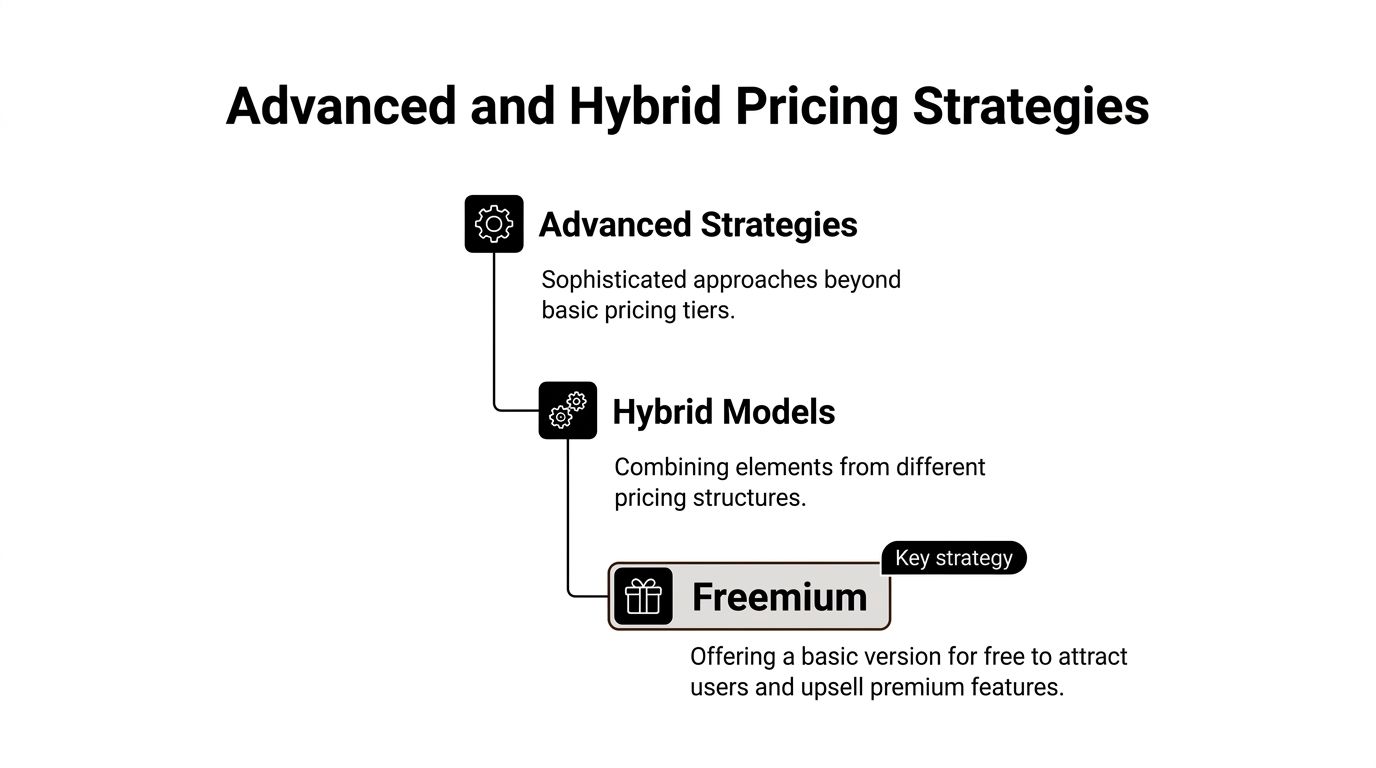
Freemium as an acquisition tool
Freemium isn't just a lower-priced plan. It's a distribution strategy.
You let users start for free, then rely on product experience to move the right people into paid plans. This can work well when the product is easy to try, easy to share, and more useful after users build habit or invite others.
The common mistake is giving away the part people would pay for. If the free version solves the entire problem, conversion suffers. If the free version is too restricted, people never understand why the product matters.
Freemium tends to work best when there's a clear moment of upgrade, such as needing more access, stronger automation, more capacity, or team functionality.
Hybrid pricing and add-ons
Hybrid pricing combines a fixed subscription with variable charges. According to Flexprice's explanation of subscription pricing models, hybrid subscription pricing is the most operationally complex model because it combines a base fee with included volume and overage rates, creating a two-part tariff that requires mature systems to connect, collect, and expose accurate usage events.
That sentence captures the essential trade-off. Hybrid pricing can be commercially elegant and operationally demanding at the same time.
The appeal is obvious:
Base fee: gives you a predictable revenue floor
Included usage: makes entry easier and more understandable
Overages or variable charges: let revenue expand with heavier usage
Commit discounts or add-ons: support larger contracts without rebuilding the model
Add-ons fit neatly into this architecture. Instead of pushing every customer into a higher tier, you let them buy a specific extra, such as advanced reporting, extra usage blocks, premium support, or community access. That can raise average revenue without forcing a full plan migration.
Customers usually accept hybrid pricing when the included amount is clear and the overage logic feels fair. They resist it when they can't estimate their bill.
A hybrid plan works best when the customer can answer one question quickly: what am I guaranteed to get before extra charges begin?
How Your Pricing Model Impacts Key Business Metrics
Pricing isn't only about monetization. It shapes the metrics you watch every month.
A founder can launch the same product with two different pricing models and end up with very different ARPU, retention, and sales efficiency patterns. The product didn't change. The revenue engine did.
ARPU and LTV
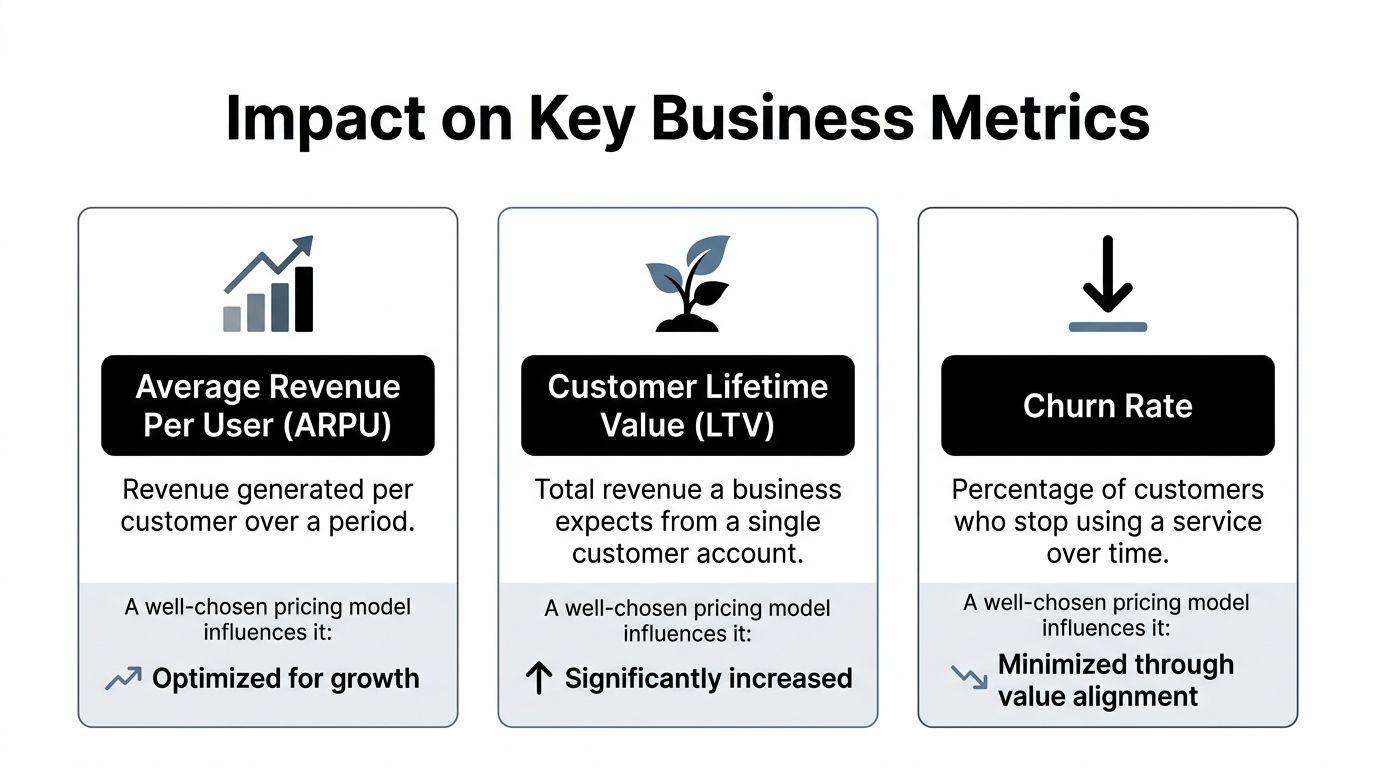
ARPU usually rises when your model gives customers a natural way to expand. Tiered, usage-based, and hybrid pricing often do this better than flat-rate pricing because they create room for accounts to pay more as they grow.
LTV improves when price and value stay aligned over time. If a customer gets more value and the model captures some of that growth without causing resentment, lifetime value tends to strengthen. That's one reason many founders move away from rigid entry-level pricing once they understand how customers use the product, and why it pays to study the full range of SaaS subscription models before locking in a structure.
Flat-rate pricing can suppress ARPU if large accounts get a lot more value than small ones. Usage-based pricing can support stronger LTV when heavy customers happily consume more. But it can also create tension if customers feel they're losing cost control.
If you're trying to evaluate whether pricing changes are affecting retention quality, this guide to calculating churn rate is a useful reference point.
Churn and CAC
Churn often falls when pricing is easy to understand and feels fair in hindsight. That's an underrated point. Buyers don't judge pricing only at checkout. They judge it again when the invoice arrives and again when renewal comes up.
CAC is influenced by how much explanation your pricing model requires. A simple flat-rate or clear tiered offer can reduce sales friction because customers understand the choice quickly. Complex usage rules or layered overages can make acquisition harder unless your buyer already expects that model.
Here's the practical pattern many teams see:
Flat-rate pricing: easier to explain, often good for lower-friction acquisition
Tiered pricing: supports segmentation and expansion, but only if tiers are clearly differentiated
Per-user pricing: helps forecasting when team growth matches value
Usage-based pricing: can improve value alignment, but may raise budget anxiety
Hybrid pricing: balances baseline revenue and upside, though it demands stronger billing communication
The strongest pricing model isn't the one that looks smartest on a spreadsheet. It's the one customers keep accepting month after month.
Choosing the Right Model for Your Global Business
A domestic business can often choose pricing first and sort out payment operations later. Global businesses usually can't.
The reason is simple. Your actual margin may depend as much on collection and settlement mechanics as on the headline price itself. That changes which subscription pricing models are viable.
Questions that narrow the choice
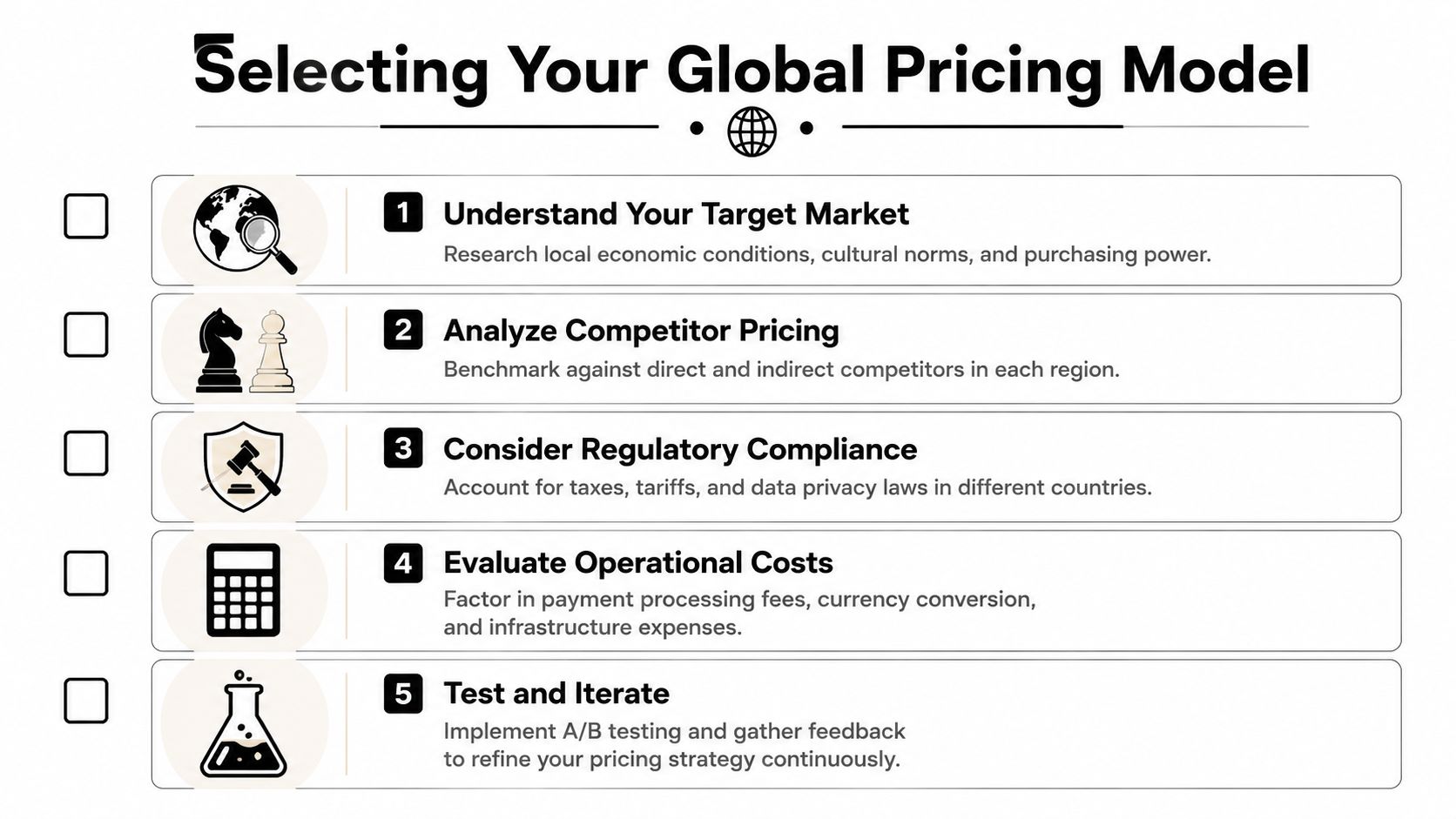
Start with business fit, not competitor mimicry.
What does the customer believe they're paying for? Seats, access, outcomes, processed volume, or convenience.
What cost grows fastest in your business? Support, infrastructure, transaction handling, or payment friction.
How variable is usage across accounts? If usage differs widely, flat-rate pricing can become stressful.
How much bill uncertainty will your buyers tolerate? Some buyers accept variance. Others want clean predictability.
Do you need self-serve simplicity or negotiated flexibility? That answer changes packaging.
This short video gives a useful visual framing for pricing decisions in international contexts.
Why payment infrastructure changes the answer
Most pricing guides rarely quantify the effect of FX spreads, payout delays, or banking fees on global subscriptions. As noted by CCBill's discussion of subscription pricing models, a low headline price can become unprofitable if conversion losses and delayed cash access raise the effective take rate.
That creates a blind spot for international operators.
A few examples make this concrete:
A low flat-rate plan may look attractive, but margins can erode if payment frictions are high across markets.
Usage-based pricing may fit the product, but it becomes hard to run if cross-border settlement introduces delay or unpredictability.
Hybrid pricing can protect margins better, but only when your billing and payout systems can handle complexity cleanly.
If you're selling across borders, your subscription model and your collection method should be designed together. This guide to accepting international payments is a good companion read when you're pressure-testing that decision.
How Suby Simplifies Global Subscription Payments

What it changes operationally
For businesses selling internationally, the hardest part often isn't choosing a pricing model. It's making the model work reliably across payment methods, geographies, and payout expectations.
Suby is an API that lets businesses accept payments by card or crypto, while the business receives USDC. It supports one-time payments and recurring subscriptions, and businesses can use shareable paylinks, an embedded checkout, or direct API and webhook integrations, based on the official Suby website. It also offers native integrations with Discord and Telegram for paid access, subscriptions, and community use cases. The core flow is simple: users pay with cards, businesses receive USDC.
That matters for pricing because it reduces one of the biggest operational headaches in global subscriptions. You can keep the customer checkout familiar while avoiding a payout setup that depends on traditional banking delays.
Where it fits best
This setup is especially practical when your pricing model depends on predictable settlement across markets.
A few examples:
Creators and community operators can sell recurring access in Discord or Telegram without stitching together separate tools for billing and access control.
SaaS teams can use recurring plans and keep payout denomination consistent even if customer payment methods vary.
Agencies and online service businesses can share paylinks for ongoing retainers or subscription-style plans.
Developers can build around the API when they need deeper control over payment flows and lifecycle events.
Suby's pricing starts at 2.9% + $0.30 and is described as all-inclusive on the official Suby pricing page. For a global operator, the operational point is often bigger than the headline fee. If customers pay with cards and the business receives USDC directly, the gap between pricing strategy and payout reality becomes much smaller.
Testing and Migrating Your Pricing Strategy Safely
How to test without breaking trust
You don't need to relaunch your whole pricing page to learn something useful.
Test with a narrow slice first. New signups are usually the safest group because they have no memory of the old packaging. Keep the change focused. Test one variable at a time, such as the price metric, included limits, or the way tiers are framed.
Use customer conversations alongside conversion data. A pricing test can look good in checkout numbers and still create trust problems later if buyers feel trapped or surprised by overages.
Buyers often want the lower entry price of a subscription while disliking bill volatility and unclear overage exposure. The more useful question is which model keeps perceived fairness high enough that customers stay, as highlighted in NetSuite's article on subscription-based pricing models.
How to migrate existing customers
Existing customers need more care than net-new buyers.
A safe migration usually includes:
Clear notice so customers understand what is changing and why.
Grandfathering for customers on old plans when trust matters more than short-term revenue.
A simple comparison between old and new pricing so buyers can see what they gain.
Support readiness because billing questions tend to cluster right after rollout.
If your new model is more complex than the old one, communication matters even more. The billing logic has to feel fair before it feels optimized.
Suby is a payment gateway and payment processor. Your customers pay with card, bank transfer, Apple Pay, Google Pay, Klarna, and more, or stablecoins, and you get paid out to your bank account, or directly in stablecoins (USDC, EURC) to your wallet, anywhere in the world, no bank account required. It supports recurring subscriptions through paylinks, embedded checkout, and API workflows, plus native Discord and Telegram integrations for paid access. That is why your subscription pricing model and your collection method belong together: predictable settlement keeps a low headline price from quietly turning unprofitable once FX spreads and payout delays are priced in.
