

Gaspard LEZIN
How to Set Up Recurring Payments for Global Businesses
Learn how to set up recurring payments for your international business. This guide covers payment models, card processing, and receiving stable USDC payouts.
When you're ready to set up recurring payments, it really boils down to four key decisions: picking your subscription model, choosing a payment platform, building your checkout, and automating the backend. For businesses with a global footprint, a smart move is to accept standard card payments but get your payouts in a stablecoin like USDC. This neatly sidesteps a lot of the usual headaches with international banking.
Your Quick Guide to Global Recurring Payments
For many entrepreneurs, the thought of accepting recurring payments from customers all over the world sounds like a logistical nightmare. You're probably picturing a mess of currency conversions, confusing international banking regulations, and payouts that show up whenever they feel like it. The good news is, a modern payment platform can cut through all that complexity, making global subscriptions a reality for everyone from SaaS founders to community builders.
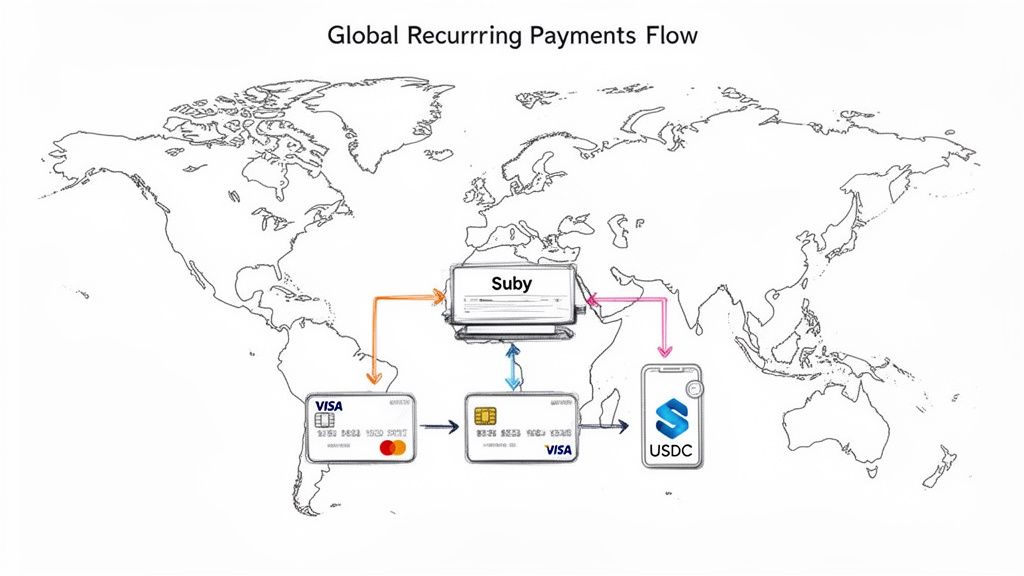
This approach completely rethinks how money moves across borders. On the front end, nothing changes for your customers. They see a familiar checkout, enter their Visa or Mastercard details, and that’s it. The real magic happens behind the scenes, on your end.
How Card-to-USDC Payments Work
Instead of your revenue getting stuck in the slow, old-school banking system, it's settled almost instantly as USDC directly into your digital wallet. This model was built from the ground up to solve the most common friction points that global businesses face every day.
Here’s why it works so well:
No More Hefty FX Fees: Because you receive settlements in USDC, you stop bleeding money on fees for converting dozens of foreign currencies into your own.
Protection from Currency Fluctuation: Your revenue is locked in. It isn't vulnerable to the whims of the foreign exchange market, so the amount you earn is the amount you actually keep.
Fast, Predictable Payouts: Funds arrive quickly without getting held up for days or weeks by intermediary banks or SWIFT network delays.
This gives you a rock-solid financial foundation, whether you’re running a SaaS with tiered plans, an e-commerce store with product subscriptions, or a paid community. If you want to dive deeper into the nuts and bolts of how these payment technologies are built, this guide on Fintech Software Development is an excellent resource.
Comparing Global Payment Setup Options
To see the difference clearly, let's compare the old way of doing things with a modern, stablecoin-based approach.
FeatureTraditional Recurring PaymentsSuby Recurring PaymentsSettlement CurrencyMultiple foreign currencies requiring conversionUSDC stablecoin, no conversion neededPayout Speed3-7+ business days, subject to banking delaysNear-instant, often within minutesCross-Border FeesHigh foreign exchange (FX) and intermediary bank feesMinimal network fees, no FX conversion costsRevenue StabilityVulnerable to currency fluctuation between charge and settlementStable; 1 USDC is pegged to 1 USDGlobal AccessibilityCan be restricted by correspondent banking relationshipsAccessible anywhere with an internet connection and a wallet
As you can see, the benefits go far beyond just saving a bit on fees. It's about gaining speed, stability, and control over your revenue, things that are absolutely critical when you're scaling a business globally.
Recurring payments are no longer just a nice-to-have; they're essential for stable revenue. We're looking at a market where global digital transactions are on track to blow past $20 trillion annually by 2026.
Getting your recurring payment system right can slash customer churn by up to 30%. It’s all about using a flexible system with things like automated payment retries to keep your subscribers active. For anyone selling internationally, this means finding a solution that lets you easily create paylinks or embed a checkout that takes Visa and Mastercard but settles everything neatly in USDC.
Choosing the Right Subscription and Billing Model
Before you even think about setting up a payment link, you need to nail down your subscription strategy. This goes way beyond just picking a price. You're defining a model that has to match the value you're delivering and, just as importantly, make customers want to stick around for the long haul.
Get this right, and you'll see customer lifetime value soar. Get it wrong, and you're looking at high churn and a business that just can't seem to gain traction. Your business model is the deciding factor here. A SaaS company with different feature tiers has entirely different needs than a creator monetizing a community or an agency on a monthly retainer. The key is picking a structure that feels intuitive and fair to your customers.
Common Subscription Models Explained
Let's walk through the three most popular models. I'll use some real-world scenarios to help you figure out which one makes the most sense for you.
Fixed-Rate Subscriptions: This is the simplest path. Customers pay a consistent fee, say, monthly or yearly, for access. Think of a creator charging $10/month for a private Telegram group. It’s incredibly straightforward, giving both you and your subscribers predictable revenue and costs. It's a fantastic starting point.
Tiered Subscriptions: Here, you offer several plans at different price points, each unlocking more value. A classic SaaS example is a "Basic" plan for $29/month, a "Pro" plan for $79/month with extra features, and an "Enterprise" plan with custom pricing. This approach lets you serve a much wider audience, from solo users to entire corporations.
Usage-Based Subscriptions: You'll also hear this called "pay-as-you-go." The bill is directly tied to consumption. An API service charging per 1,000 calls or a cloud storage provider billing by the gigabyte are perfect examples. This model is powerful because it links cost directly to value, which can be a huge selling point for customers who want total control over their spending.
The subscription world is always changing. We're seeing a big push to reduce churn by offering more flexible options, like annual installments and stablecoin payment rails. In fact, digital wallet and card use is projected to grow by 20-25% by 2026 in key emerging markets. For businesses that adapt, the payoff is huge, as subscribers often have a 5-7x higher Lifetime Value (LTV).
Structuring Your Billing Cycles
Once you've landed on a model, it’s time to define the billing cycle. The most common choices are monthly and yearly, and each has its pros and cons. Monthly billing is a lower-commitment entry point, which can make it easier to attract new sign-ups.
Yearly billing, on the other hand, locks in a longer commitment and gives you a nice upfront cash flow boost. It's standard practice to offer a discount for annual plans, something like "get two months free," to encourage that longer-term buy-in. Honestly, offering both is usually the best bet, giving customers the flexibility they expect.
You can dive deeper into how different platforms manage these options in our guide to the best subscription billing software.
Pro Tip: Don't forget to plan for subscription changes. If a customer upgrades from your "Basic" to "Pro" plan mid-month, you need to handle proration correctly. A good payment system will automatically calculate the difference and only charge for the remaining time on the new plan. This keeps things fair and prevents support headaches.
A flexible platform like Suby makes this easy. You can configure all these rules through a simple no-code dashboard or an API, letting the system handle proration automatically. This frees you up to accept global card payments and receive clean USDC settlements without getting stuck doing manual math. After settling on a model, exploring effective subscription marketing tactics is a great next step to really grow your recurring revenue.
Bringing Your Checkout to Life: No-Code vs. API
Alright, you've mapped out your subscription models and decided on billing cycles. Now for the fun part: building the actual payment experience your customers will use. How you do this really comes down to your technical comfort level and how much you want to customize the look and feel.
You essentially have two main routes. You can go the no-code route for a super fast, simple launch, or you can take the developer path and use an API for a completely integrated setup. Both get you to the same place, letting customers pay you by card and getting those sweet, reliable USDC payouts. Suby provides an API that allows any business to accept payments by card or crypto, and we also offer native integrations with Discord and Telegram.
The No-Code Path: Get Paid in Minutes
If you're a creator, freelancer, or a business that just needs to get up and running yesterday, the no-code approach is your best friend. It’s all about using the tools already in your Suby dashboard to start accepting payments without touching a single line of code.
You have two fantastic options here:
Shareable Paylinks: This is as simple as it gets. You generate a unique link that goes straight to a checkout page we host for you. You can drop this link literally anywhere, from your social media bio and email newsletters, to a button on your website or even in a DM. A customer clicks, they land on a secure page, and they subscribe. Done.
Embeddable Checkouts: Think of this as the next level up from a paylink. Instead of sending people away from your site, you can embed the entire checkout form right onto your own webpage. This feels much more seamless for the user because they never leave your brand's environment to pay.
Both are perfect for monetizing content or billing for services. I've seen consultants use paylinks for monthly retainers and creators embed checkouts on their landing pages to sell access to private Discord communities. It’s quick, effective, and requires zero development time.
The Developer Path: Full Control with API Integration
For SaaS platforms, web apps, or any business that needs a deeply custom payment flow, the API is the way to go. Using an API means your own application can talk directly to our payment infrastructure, giving you total command over the user experience from start to finish.
With an API, you can programmatically manage every piece of the subscription puzzle. You can spin up custom pricing plans on the fly, sync customer data with your own internal database, and build a checkout flow that feels like a native part of your app. This is a must-have for businesses that need to tie billing directly to in-app features, user permissions, or specific account states.
My take? The real power of an API is the freedom it gives you. You get to design a front-end checkout experience that is 100% on-brand, while we handle all the heavy lifting of payment processing, security, and compliance on the back end. It's the best of both worlds.
If your team is ready to dive into the technical details, our guide on payment gateway API integration is a great resource. It’s a much deeper look at building out a fully custom implementation.
This flowchart breaks down the most common subscription models you can build with either of these methods.
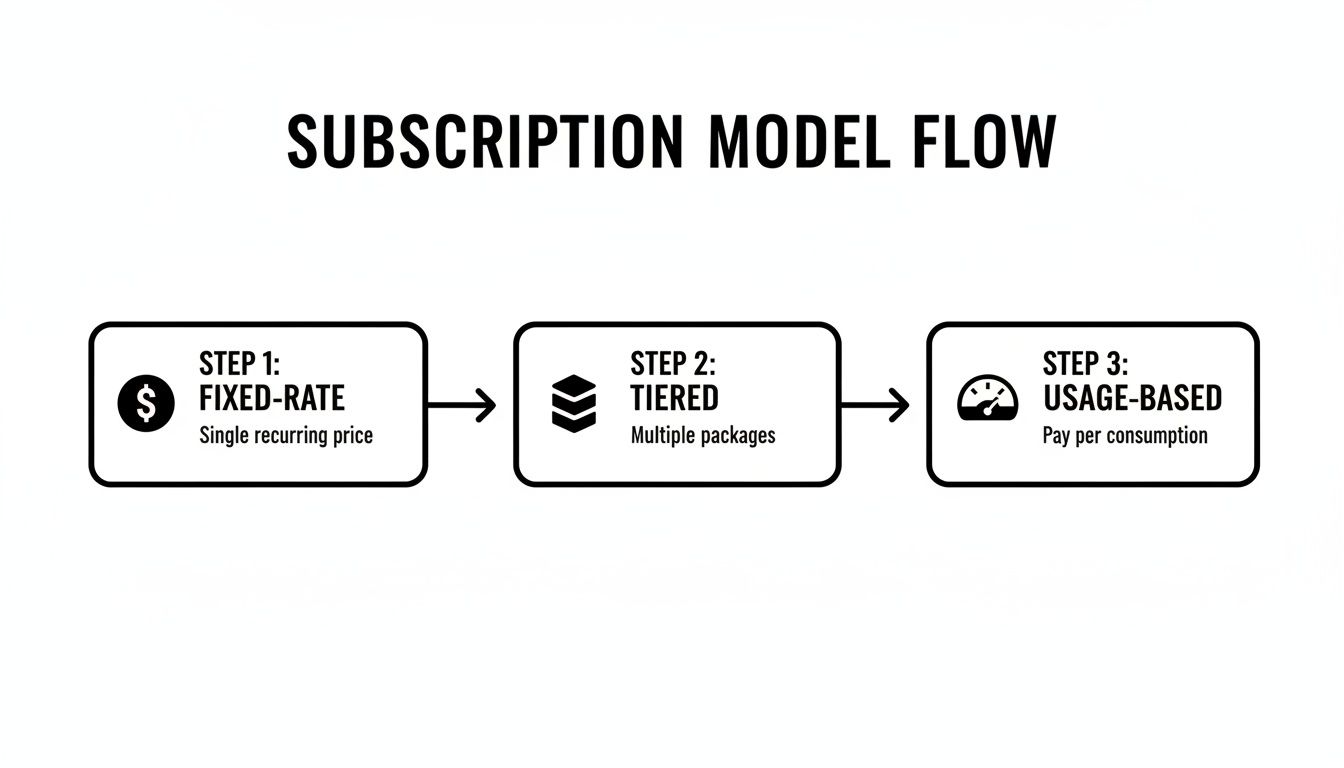
You can see how different models like fixed-rate, tiered, and usage-based pricing serve very different business needs, from a straightforward monthly membership to more complex, value-based plans.
Bridging the Gap with Smart Integrations
There's also a great middle-ground that blends the simplicity of no-code with powerful automation, which is a game-changer for community managers and creators.
For instance, Suby offers native integrations for Discord and Telegram. These tools link your payment setup directly to your community platform. When a new member subscribes through your paylink, the integration can automatically grant them the "VIP" role in your Discord server or add them to a private Telegram channel. If they ever cancel or a payment fails, their access is just as easily and automatically revoked.
This completely eliminates the headache of manually managing member lists, giving you peace of mind that only paying subscribers are getting access to your premium content.
Putting Your Subscription Business on Autopilot
Let's be honest, no one starts a subscription business to spend their nights manually managing user accounts. The real magic happens when you automate the entire lifecycle, from the moment a customer signs up to the day they might cancel. With your checkout in place, it’s time to build the engine that makes your business run itself.
This is where webhooks come into play. They are the key to making your different systems, like your payment processor, your CRM, and your community platform, talk to each other in real-time.
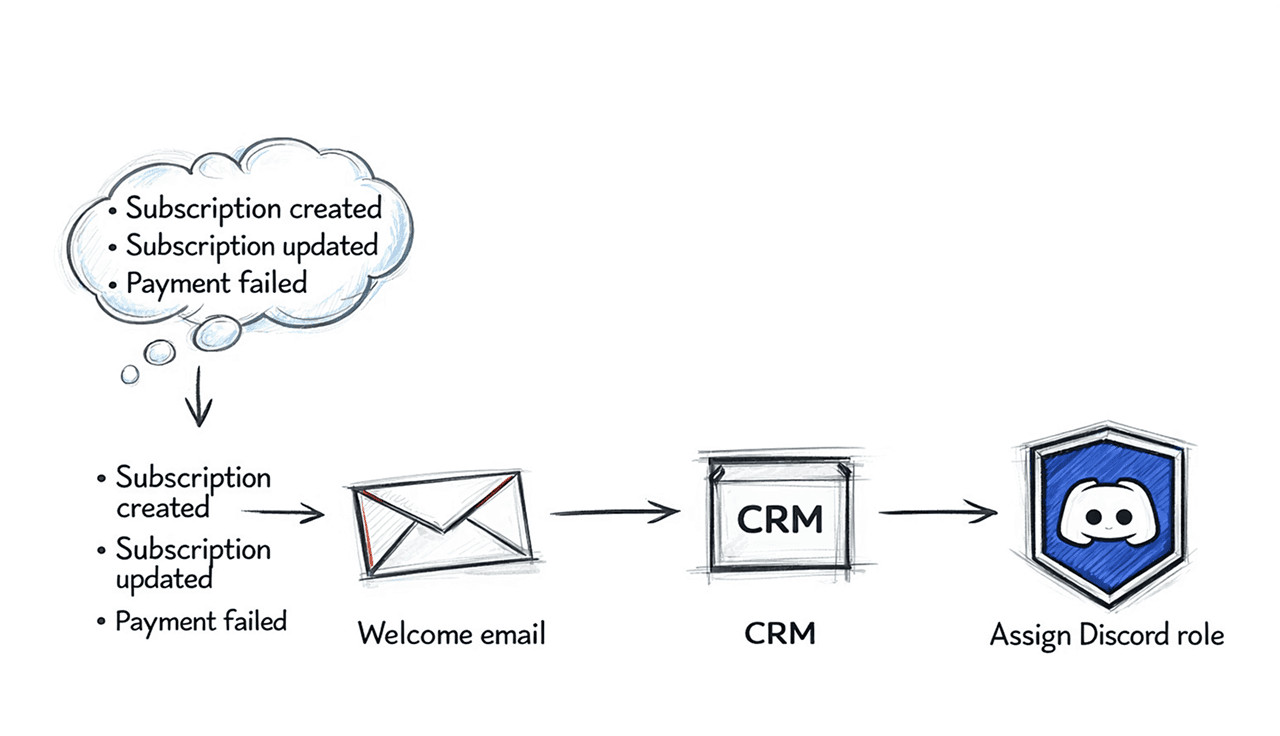
Think of it this way: instead of you constantly refreshing a dashboard to see what’s happening, webhooks send an instant ping to your server the moment a specific event occurs. It’s a hands-off approach that’s absolutely essential for scaling.
How Webhooks Drive Your Automation
Getting started is straightforward. You generate a unique URL on your server (this is your "webhook endpoint") and then simply paste it into your Suby account settings. From then on, whenever a subscription event happens, Suby sends a detailed message to that URL.
Your job is to "listen" for these messages and tell your system what to do when they arrive. This opens up a ton of possibilities for creating a seamless customer journey.
You’ll want to pay close attention to a few key events:
subscription.created: Fires the instant a new customer pays. This is your cue to roll out the red carpet, send a welcome email, add them to your CRM, and grant them access.payment.succeeded: Confirms a recurring payment went through. Use this to issue a receipt and confirm their account is still in good standing.payment.failed: Your trigger to start the dunning process. This event lets you kick off an automated email sequence asking the customer to update their payment info.subscription.canceled: Lets you know a customer has churned. You can use this to trigger an offboarding survey to gather feedback or revoke their access automatically.
With instant payment systems expected in over 80 countries by 2026, building your business around real-time events is just smart strategy. For creators, this kind of automation can make a massive difference, especially when managing a Discord or Telegram community, where we've seen it cut membership churn by as much as 25%. For a deeper dive, check out this detailed analysis of B2B payment statistics.
A Practical Example: Automating a Creator Community
If you're monetizing a private community, automation isn't just a nice-to-have; it's the only way to stay sane. Manually granting and revoking access for hundreds or thousands of members is a recipe for burnout.
This is where Suby’s native integrations for Discord and Telegram are incredibly powerful. You can connect your Suby account directly to these platforms and let the automation handle all the access management.
Here’s how it works in the real world: A fan buys your "VIP" subscription. The moment their payment is confirmed, the subscription.created webhook fires. Our integration instantly gives that user the "VIP" role in your Discord server, unlocking all the private channels they just paid for.
The system keeps working for you long after the initial sale. If that member’s card fails a few months later, the payment.failed webhook can trigger an action to temporarily suspend their role. If they decide to cancel, the subscription.canceled webhook removes their role entirely. It's a self-healing system that ensures only paying members get premium access.
This immediate fulfillment is a huge part of your customer experience. Nobody wants to pay for access and then wait hours for a manual approval. With this setup, you eliminate that friction completely, giving them a smooth card payment experience while you get a clean, predictable revenue stream settled in USDC.
Keeping Payments Flowing and Fortifying Security
Once you’ve got your subscription plans built, the real work begins: making sure the revenue keeps coming in reliably. Two things can derail even the best subscription business: payments that fail for no good reason and security that isn't airtight.
Failed payments, especially the ones that happen because of a technical glitch, are a huge source of what we call involuntary churn. At the same time, your customers are handing over their card details, and they need to know you’re taking that trust seriously. Let's walk through how you can build a system that protects your revenue and your customers.
What to Do When Recurring Payments Fail
It’s easy to assume a failed payment means the customer wants to cancel. In my experience, that’s rarely the case. Far more often, it’s something simple like an expired card, a temporary block from their bank, or just not enough funds on that particular day.
Your first instinct might be to just cancel their access, but that's like throwing away a customer you worked hard to get. This is exactly why you need an automated process for chasing down these payments, a system known in the industry as dunning.
A good dunning system doesn't just try once and give up. Suby, for example, is smart about it. It automatically retries the charge based on an intelligent schedule, maybe a few days later, and then again a week after that. You don't have to lift a finger, and you’ll be surprised how often a payment that failed on Tuesday goes through just fine on Friday.
This behind-the-scenes work is critical for recovering revenue that would otherwise just vanish. If you want to get into the weeds on how this works, we have a complete guide that explains what the dunning process is in more detail.
You'll see dunning work its magic in common situations like:
Expired Cards: Someone simply forgot to update their new card number.
Soft Declines: A bank might temporarily flag a transaction, but it will often go through on the second try.
Insufficient Funds: A retry a few days later might line up perfectly with payday.
Automating these retries is your safety net. It dramatically cuts down on involuntary churn and keeps your cash flow much more predictable.
Locking Down Your Checkout with Rock-Solid Security
In this day and age, security isn't optional; it's the foundation of trust. Your customers expect their payment info to be completely safe. Trying to handle raw credit card data yourself is a massive headache filled with legal and compliance risks. This is why working with a secure partner is a no-brainer.
Suby handles this by working with a partner that is PCI-DSS Level 1 certified. That's the highest, most rigorous standard for payment security in the world. It means all the sensitive data is managed in a bulletproof environment that’s constantly audited, taking that entire burden off your shoulders.
Your job is to create an amazing product or community, not become an expert in payment security. Using a platform with compliance baked in means you can focus on your business while the specialists handle the security.
This setup lets you confidently accept card payments from anywhere in the world. All the heavy lifting happens in the background, and your revenue lands securely in your wallet as stable USDC.
Navigating Global Rules like Strong Customer Authentication
If you plan on selling to customers in Europe, you absolutely have to deal with Strong Customer Authentication (SCA). It's a regulation designed to fight fraud by requiring an extra layer of verification for many online payments, and it is one of several defenses worth understanding when you study how payment fraud targets online businesses. Think of it as a two-factor authentication for purchases, where a customer might have to enter a code from their phone or approve the payment in their banking app.
If your checkout process doesn't support SCA, you'll see a lot of payments from European customers get declined by their banks. Suby’s checkout flow is built for this. It automatically detects when SCA is needed and guides the customer through the extra step without any confusion.
This ensures you stay compliant and don't lose out on the European market, all while keeping things simple: your customers pay with their card, and you receive USDC.
A Few Common Questions About Recurring Payments
As you get your hands dirty setting up recurring payments, a few common questions are bound to come up. We see the same challenges trip people up time and again. Let's walk through some of them so you can get ahead of any potential roadblocks.
What's the Best Way to Handle Different Currencies?
Honestly, the easiest way to deal with global currencies without giving yourself a major headache is to use a payment platform that does the heavy lifting for you. Trying to manage dozens of bank accounts and constantly watch foreign exchange rates is a recipe for disaster and wasted time.
The modern approach is to let your customers pay in their local currency, but you receive your payouts in a stable currency. A system like Suby is built for this. A customer in Japan can pay in JPY with their card, and someone in Europe can pay in EUR. But for you, the accounting is clean and simple because every single payout lands in your wallet as USDC. This completely sidesteps currency volatility and simplifies your revenue tracking.
How Do I Automate Access to My Discord or Telegram Community?
This is one of the most powerful automations you can build for a membership business, and it's simpler than you might think. You just need a payment platform with native integrations for community tools. For example, Suby has built-in connections for both Discord and Telegram.
The setup is pretty straightforward. You just connect your Suby account to your community's server or channel. When a new customer buys a subscription through your paylink, the system automatically grants them the right role in Discord or adds them to your private Telegram group. No manual invites needed.
The real magic happens with lifecycle management. If a member's payment fails or they cancel their subscription, their access is revoked automatically. This single feature ensures only paying members are in your premium community, without you lifting a finger.
Can I Test My Payment Setup Before Going Live?
Not only can you, but you absolutely have to. This is a step I see people skip, and it almost always bites them later. Any serious payment platform will give you a sandbox environment to run simulations without touching real money.
In Suby’s sandbox, for instance, you'll get test API keys and a list of dummy card numbers. This lets you safely run through the entire customer experience from start to finish.
Create test subscriptions to see how new sign-ups work.
Simulate both successful and failed recurring payments.
Fire off different webhook events to make sure your backend systems react correctly.
Walk through the checkout flow exactly as a customer would.
Working out the kinks here is what separates a professional launch from a messy one. It protects your reputation and makes sure you're ready for your first real customer.
What Happens If a Customer's Recurring Payment Fails?
When a payment fails, and it will, you need an automated process called dunning to kick in immediately. This is your first line of defense against involuntary churn. Instead of just canceling the subscription on the first failure, a smart dunning system will automatically retry the charge.
A lot of payment failures are temporary problems, like a soft decline from the bank or an account that's low on funds for a day or two. The Suby platform uses an intelligent retry schedule to attempt the charge again over several days, often recovering revenue you would have otherwise lost.
If the card still can't be charged after all the retries, the system can then notify both you and the customer. This gives your customer a final chance to update their payment info before the subscription is automatically paused or canceled, protecting your business while providing a good customer experience.
Suby is a payment gateway and payment processor. Your customers pay with card, bank transfer, Apple Pay, Google Pay, Klarna, and more, or stablecoins, and you get paid out to your bank account, or directly in stablecoins (USDC, EURC) to your wallet, anywhere in the world, no bank account required. For recurring payments it handles subscriptions, proration, dunning retries, and SCA out of the box, with no-code paylinks, embedded checkout, an API, and native Discord and Telegram access so your global memberships bill and settle without banking delays.
