

Gaspard LEZIN
Payout in BRL: A Merchant's Guide to Brazil
Learn how payout in BRL works for international merchants. Compare FX costs, payout rails, stablecoin options, and compliance steps to settle in reals.
Your finance team just got the same Brazil question again. A client wants to pay in BRL, a contractor wants to receive BRL, and operations wants to know whether the money should land in a Brazilian bank account, stay in USD until the last moment, or move through another settlement path entirely. That's where payout in BRL stops being a currency setting and becomes a treasury decision, because the gap between collection and settlement can change cost, speed, and even how much cash is available to move.
For merchants that sell into Brazil or pay people there, the core issue is rarely “can we send reais.” It's whether the payout rail matches the business model, the local identifiers, the compliance burden, and the FX exposure sitting between booking and final delivery. If you're evaluating payout workflows for traders, the payout process for traders is a useful reference point for how payout expectations shape user experience, even when the underlying rail is very different.
A lot of teams also need a broader LATAM view before they lock in a provider, and that's where the payment provider LATAM guide becomes relevant. Brazil is one market, but the way you structure settlement often spills into how you handle other currencies, other counterparties, and other regulatory environments.
Table of Contents
Why Payout in BRL Matters for Global Merchants
A US SaaS company signs Brazilian contractors, invoices customers in Brazil, and collects revenue in USD through some markets and BRL through others. At month end, finance has to decide whether those Brazilian counterparties should be paid in reais, whether conversion should happen before or after the funds land, and which team owns the spread between collection and payout. That's not a cosmetic choice. It affects margin, reconciliation, and how quickly the recipient sees usable funds.
The same issue shows up for agencies, marketplaces, and creator platforms. A marketplace may receive customer funds in one currency, hold them in a single balance, then pay sellers or partners in another. A creator business may need a local payout rail for Brazilian members or contractors, while still billing clients abroad in USD or EUR. In each case, payout in BRL is part of the product experience, not just the back office.
The reason this matters is simple. Brazil's wage data show that average monthly wages were 3,732 BRL in April 2026, after a record 3,750 BRL in March 2026, with a longer series average of 3,306.33 BRL per month and a record low of 3,025 BRL in December 2021 (Trading Economics). That range tells you two things. Local spending power is real, and nominal income moves enough that timing matters for anyone planning payouts or pricing around Brazil.
Brazil's payroll and payment habits also make local delivery more than a nice-to-have. Payoneer notes that employees in Brazil are paid twice a month in BRL and that salary is deposited into a local bank account (Payoneer). For contractor-heavy businesses, that means the payout format users expect is already anchored in local rails, not in cross-border wires.
Practical rule: If the recipient needs to live on the money in Brazil, the payout design should be judged by local usability first, not by how elegant the treasury stack looks on paper.
Brazil is also a market where scale changes the operational stakes. The National Treasury and Central Bank reporting on online gambling showed monthly betting outlays revised to about BRL 20 billion to BRL 30 billion after regulation took effect on January 1, 2025, which makes Brazil-linked payment flows large enough that a small spread can become material (Agência Brasil). That benchmark isn't about gaming alone. It shows how Brazil-linked payouts can sit inside very large, regulated money movements.
For merchants choosing whether to settle in USD, EUR, or BRL, the actual question is where the business wants to absorb volatility. If you want to see how merchants in another high-frequency payout environment think about timing and delivery expectations, the trader payout patterns in the linked resource above are a good comparison point. For Brazil, the decision usually comes down to the same four variables: customer experience, treasury risk, compliance load, and speed.
How a BRL Payout Works
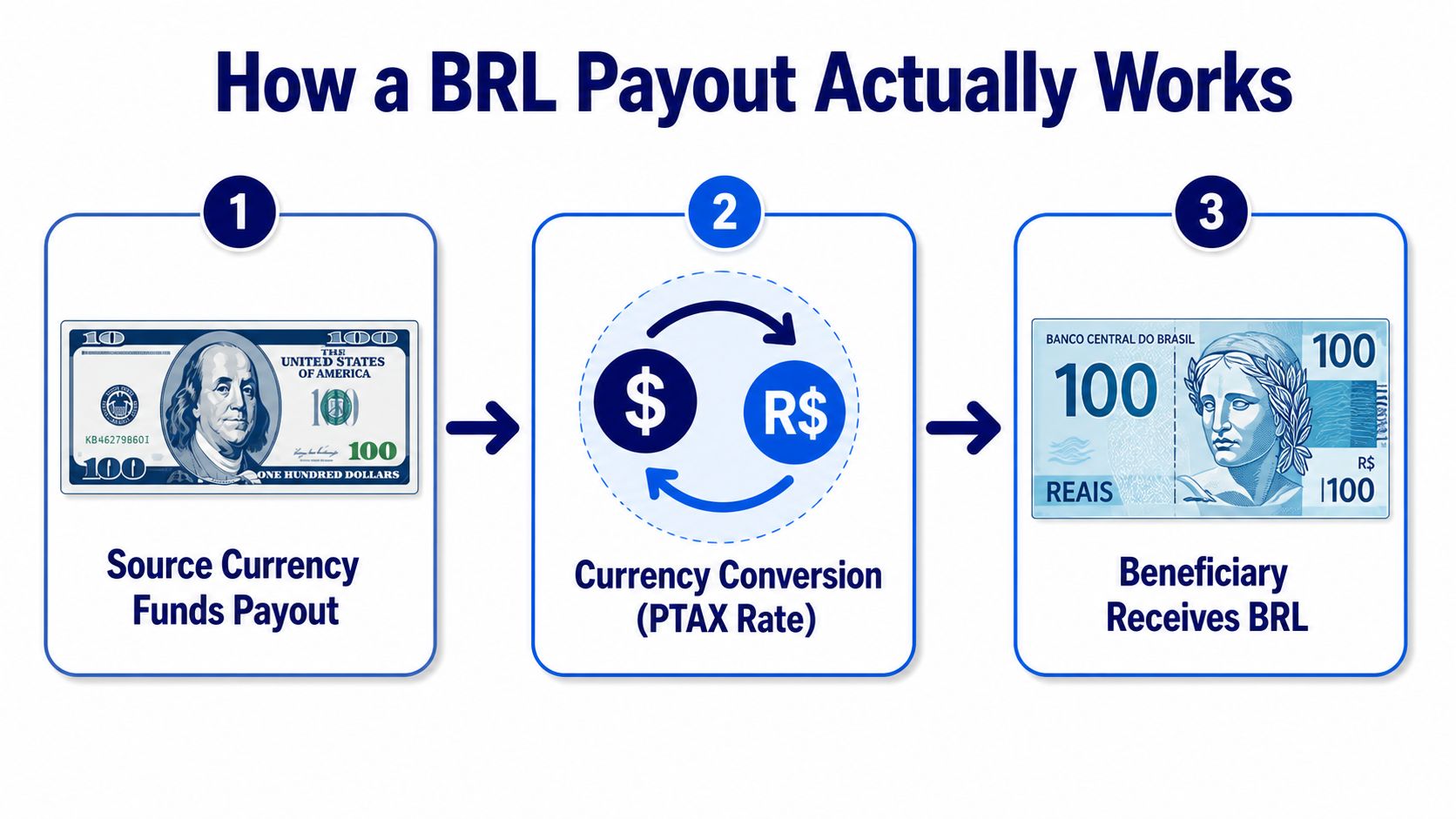
A BRL payout has two separate legs, and mixing them up causes most of the confusion. The first leg is treasury funding, which may start in USD or BRL depending on the provider. The second leg is delivery, which ends in BRL for the beneficiary. In dLocal's Brazil payout spec, currency is the source currency of the FX operation and can be BRL or USD, while the payout is always delivered in local currency to the beneficiary (dLocal docs).
Source currency and beneficiary currency are not the same thing
That split matters operationally. A finance team can fund a payout in USD, convert it through the provider, and still have the recipient receive reais in Brazil. Or it can pre-fund BRL and avoid some conversion complexity on the funding side. Either way, the recipient's experience is local and the payout leg is constrained by domestic rail rules.
Brazilian payout rails also depend on local identifier validation. The beneficiary side is tied to Brazilian account and identity rules, including CPF and CNPJ checks, which is why a payout API for Brazil usually asks for domestic data rather than generic international banking fields. That constraint is what makes the payout leg usable on the local network.
A practical operating model has three steps. Fund the payout, convert if needed, then deliver into the recipient's Brazilian account. A provider can abstract that flow, but it cannot remove the local validation and settlement boundary. If the beneficiary rail is wrong, the payout fails downstream even if the treasury side was perfectly funded.
The cleanest implementation is the one where treasury and delivery are separated in your internal ledger, so you can track funding currency, conversion date, and beneficiary currency as distinct events.
The infrastructure layer matters too. Neutral Brazil settlement documentation notes that BRL conversion and payout may rely on regulated providers with access to bank-account, instant-payment, or wholesale settlement infrastructure, and that SPI/Pix is the instant-payment rail used in payout contexts (StableNexus). Foreign merchants usually do not build a Brazilian payout flow from scratch. They plug into a provider that already has the access, the validation logic, and the settlement connectivity.
A related operational detail is that local delivery is the final state, not an optional destination. Even when treasury funds in another currency, the beneficiary receives BRL locally. That lowers downstream beneficiary-currency handling complexity, but it also means your team needs to understand the local bank account, the rail type, and the acceptable identifiers before going live. Teams that want to avoid surprise spread and funding drift should also review how to avoid currency conversion fees before they lock the payout path.
The Hidden Cost of Settling in Brazilian Reals
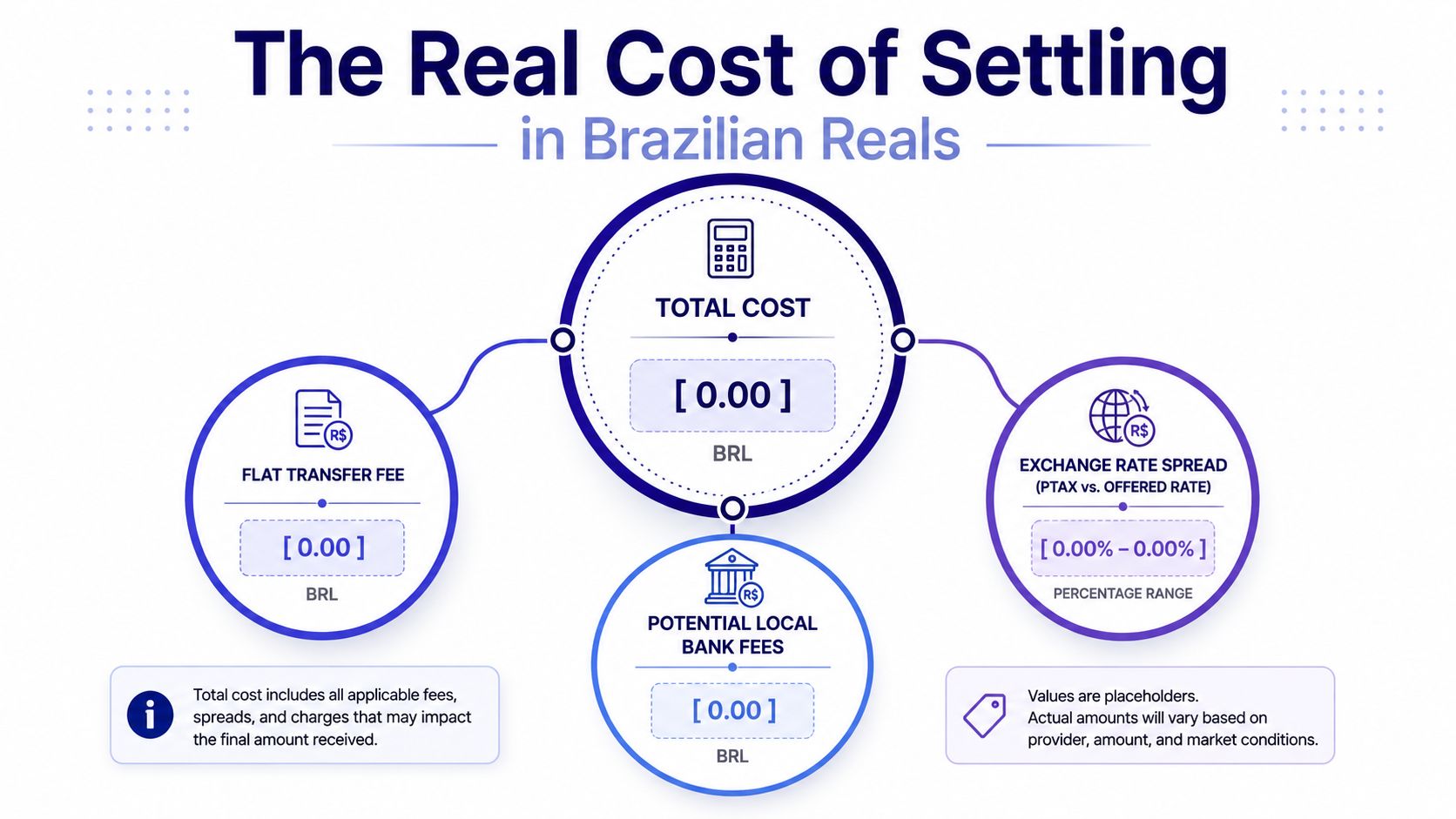
Headline fees hide the part that usually hurts most, the conversion layer. In Brazil, payout pricing is commonly benchmarked against the Central Bank of Brazil's PTAX reference rate, not against an internal mid-market number. PagSeguro's payout terms define PTAX as the USD/BRL rate published by the Central Bank of Brazil for the settlement day and use it to calculate the USD equivalent of a BRL payout, with an additional foreign-exchange cost factor (PagSeguro payout T&Cs). That means the complete cost stack is reference FX plus markup, not just a transfer fee.
Why settlement date risk matters
If your treasury funds a payout in USD today but the conversion to BRL happens on a different settlement day, the effective cost can shift between booking and delivery. Finance teams need to model all-in spread rather than only the visible fee line. The rate used at settlement can differ from the rate seen at initiation, which changes the final USD equivalent.
One practical mistake shows up when teams compare providers on headline fees alone. The conversion layer, the settlement date, and the provider markup can combine into a wider spread than the quote suggests. The comparison that holds up in production is the total amount delivered versus the total amount funded, measured over the actual settlement window.
The business impact is real because BRL movement is still a live variable. Industry guidance on Brazilian currency exposure says hedging can be expensive when forward points are high, and that many firms instead use natural hedges or change billing currency to reduce volatility (Financial Professionals article). For merchants paying out in Brazil, that means you are not just choosing a rail, you are choosing how much FX risk to leave open.
A second point often gets missed. The payout amount the recipient sees in BRL may stay fixed, but the treasury cost in USD or EUR can move underneath it. I have seen finance teams respond by tightening payout funding windows, holding more conservative forecasts, or moving customer billing currency closer to the payout currency where possible.
Working rule: if the provider will not show you the reference rate, the markup, and the settlement date together, you cannot compare it honestly against another provider.
For merchants that want to reduce conversion surprises, the guide on how to avoid currency conversion fees is worth a look. The practical takeaway is not to avoid conversion altogether. It is to know where the conversion happens, which rate is used, and who captures the spread.
Bank Rails Versus Stablecoin Settlement
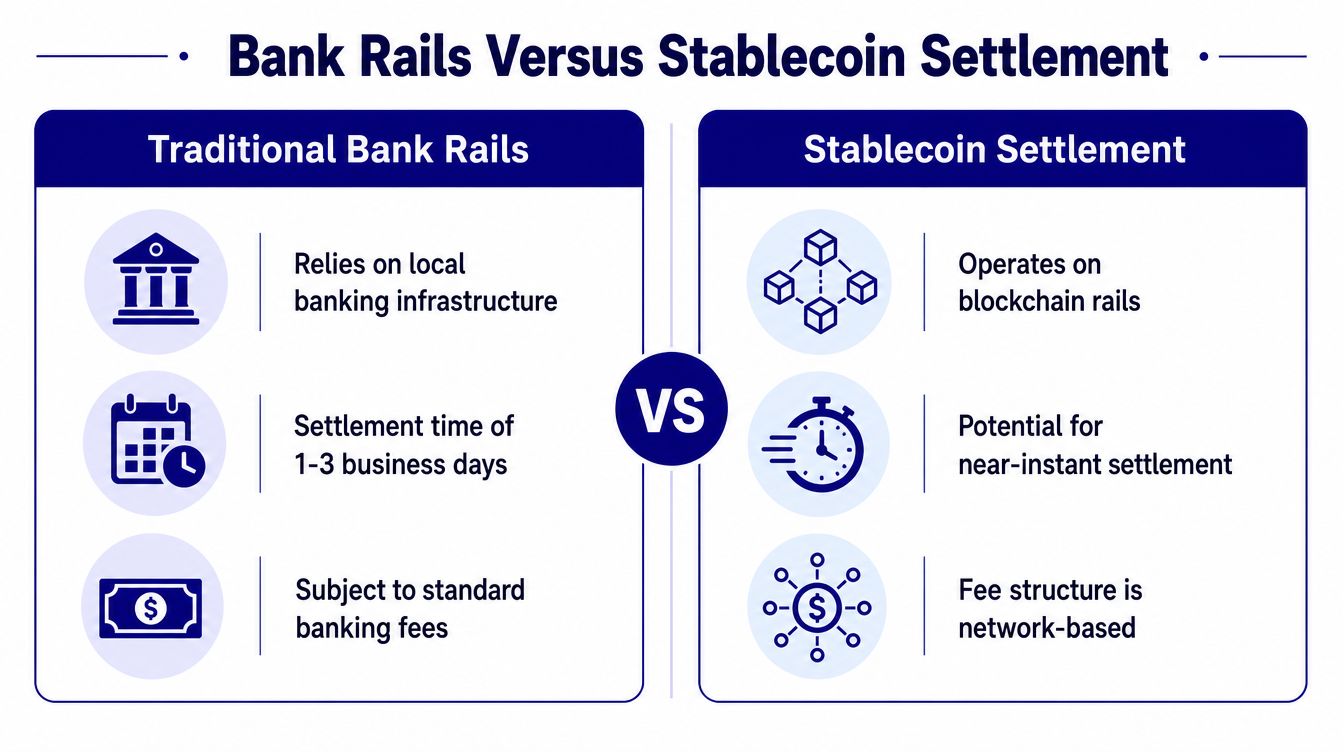
Bank-based BRL payouts and stablecoin settlement solve the same business problem in different ways. Bank rails are the familiar route, funds move through local banking infrastructure and end in a Brazilian account. Stablecoin settlement changes the treasury path, giving merchants more room to time conversion, hold value in a single balance, and decide when to move between fiat and crypto exposure.
Where bank rails still win
Bank delivery is still the cleanest choice when the recipient wants BRL in a domestic account and the business wants to stay inside familiar banking controls. That's especially true for payroll-like payouts, contractors, and vendors who expect local currency with local banking receipts. If the operational unit is a Brazilian bank account, local rails are straightforward to reconcile.
Where stablecoin settlement adds flexibility
Stablecoin settlement is more interesting when the business wants treasury flexibility. A merchant can collect funds, keep value in a unified balance, and decide later whether to settle to a Brazilian bank account or in stablecoins like USDC. That matters when a team wants to reduce the number of times value crosses from one currency system into another.
Suby is one example of a single product that supports that model. It lets businesses accept cards or crypto through an API, with native integrations for Discord and Telegram, and then choose whether to receive funds in a bank account or in stablecoins like USDC. Its published model is simple, customers pay any way they want, businesses get paid the way they choose. Pricing still depends on the payment method, so the exact figures belong on the pricing page, not in a generic summary.
The trade-off is compliance and counterparty design. Bank payouts often lean on regulated providers and local access. Stablecoin settlement adds wallet handling, token movement, and the choice of where to stop the flow, at a wallet, a balance, or a Brazilian bank account. That can reduce some settlement friction, but it also changes the operational surface area.
The right decision usually comes down to who controls the treasury clock. If finance wants to lock in BRL delivery quickly and keep everything inside domestic rails, bank payout fits. If treasury wants more timing control and a broader cross-border settlement model, stablecoin settlement can be the better fit.
For teams evaluating broader payout architecture, the cross-border payments solutions guide helps frame the choice between local delivery, treasury centralization, and multi-currency settlement logic.
Compliance and Timing Constraints You Cannot Ignore
A BRL payout can fail for reasons that have nothing to do with the transfer itself. The first failure point is usually the rule set around who can send, who can receive, and which rails are allowed in that context. In Brazilian betting, Demarest summarizes that deposits and withdrawals must move exclusively through electronic transfers between a bettor's registered account and the operator's transactional account, with permitted methods including PIX, TED, debit or prepaid card, and book transfer, while cash, payment slips, checks, virtual assets or crypto assets, third-party payments, and credit cards are prohibited (Demarest summary).
Why timing and eligibility shape the payout model
The same material says winnings must be paid within 120 minutes after the event ends and operators must maintain a BRL 5 million financial reserve. Even if your company is not operating in betting, that kind of rule set shows how local timing and reserve expectations can shape payout design in regulated verticals.
The operational takeaway is broader than gambling. If a payout provider already handles local rule enforcement, your team avoids building those checks from scratch. If it does not, you own method filtering, account matching, and timing controls, and those controls get harder to keep consistent as volume rises. That is where hidden treasury risk starts, because funds can sit between collection and settlement while FX moves against you or while an unmatched payout waits for review.
Brazil payroll compliance has its own structure too. A separate guide for startups recommends paying attention to worker classification, contract setup, and documentation when operating locally, because payroll problems often start before the transfer itself (payroll compliance tips for startups). That matters even for global merchants that think they are “just paying a contractor.” In practice, the payout method, the payee status, and the documentation trail are linked, and the wrong combination can create both compliance friction and settlement delays.
A useful operating rule is to treat method selection as a compliance control, not a delivery preference. If the rail is prohibited in a given context, it's a mismatch.
Operational takeaway: the best payout stack filters disallowed methods before the transfer is initiated, not after the payout fails.
For foreign merchants, the boundary matters most. If you cannot rely on a local banking relationship, you need a provider that already knows which rails are available, which identifiers are required, and which payout types are allowed in the target context. That is where implementation risk usually hides, not in the API request itself. Bank rails also tie you more tightly to local banking hours and reconciliation timing, while stablecoin settlement can give treasury more control over when value moves, provided you are ready to handle wallet operations and the point where the flow stops inside your own stack.
Your Checklist for Enabling BRL Payouts
Start by defining the payout direction. Are you paying Brazilian contractors, vendors, or employees, or are you receiving BRL revenue and then settling out? Those are different treasury problems, and the answer determines whether BRL should be the funding currency, the delivery currency, or both.
Check the rail before you check the fee
The next decision is the rail. Some flows need a Brazilian bank transfer, others can use instant-payment infrastructure, and some teams may prefer stablecoin settlement at the treasury layer before any local delivery happens. The right choice depends on how much control you want over timing and how much local complexity you're willing to carry.
Then map the identifiers. For Brazil, that means confirming the account data and the local tax identity fields the provider needs, especially CPF or CNPJ where applicable. If you're operating in a regulated vertical, verify whether the provider also requires registered-account matching or additional account ownership checks.
After that, inspect the FX mechanics. Ask whether the provider benchmarks against PTAX, whether the conversion happens at initiation or settlement, and whether the quoted rate includes a markup. If you can't separate those pieces, you can't estimate the true delivered cost.
A practical checklist for the implementation kickoff usually looks like this:
Define volume and frequency: know whether payouts are occasional, scheduled, or recurring, because that changes how treasury funding should be set up.
Choose the settlement path: decide whether the business will pay out through bank rails or through a stablecoin-based treasury workflow.
Verify the FX reference: confirm how the provider uses PTAX or another reference rate in the conversion step.
Confirm compliance scope: check which Brazilian rules, account validations, and method restrictions apply to your use case.
Review the full cost stack: include transfer fees, FX spread, and any local handling costs in the comparison.

The final step is reporting. Finance needs to know what was funded, what was converted, what landed, and when. If your reconciliation can't separate those events, you'll end up debugging payout variance long after the money has moved.
How Modern Payment Infrastructure Changes the Decision
The old way to solve BRL payout was to bolt on local banking access, accept whatever FX path the provider offered, and live with the paperwork. Modern payment infrastructure changes that. A single product can let customers pay by card, wallet, bank, or crypto, while the business chooses how to receive the money, either to a bank account or in stablecoins like USDC, in the currency it prefers.
That matters because the payment experience and the treasury outcome no longer have to be the same thing. A business can keep customer payment choice broad, then narrow the settlement outcome to what finance wants. For some merchants, that means receiving BRL into a local account. For others, it means using stablecoins as the settlement layer and avoiding unnecessary currency hops until the last possible moment.
An API-first stack is useful here because it removes the need to build local banking relationships from scratch for every corridor. It also fits businesses that need more than one use case, one checkout for cards and crypto, gated access for Discord or Telegram communities, and invoicing flows where the client pays how they want while the business receives what it wants. The key idea is simple. Customers pay any way they want, businesses get paid the way they choose.
For teams evaluating payout in BRL, that changes the shortlist. Don't only ask whether a provider can send reais. Ask whether it supports the payout model you need, the funding currency you prefer, the identifiers your recipients use, and the settlement path your treasury can live with. Then verify the pricing by payment method, because there isn't a single flat rate.
If you're building this for production, the next step is to test the flow end to end, from funding to FX to beneficiary delivery, and compare the delivered amount with what finance expected. That's the only way to see whether bank rails or stablecoin settlement fit your BRL exposure.
If you're ready to build a payout flow that fits how your business moves money, take a look at Suby. It lets businesses accept cards or crypto through one API and choose whether to settle to a bank account or in stablecoins like USDC, which makes it a practical option for BRL-related settlement design.
