

Gaspard LEZIN
Payment Gateway Fee: How to Reduce Costs in 2026
Understanding a payment gateway fee means knowing what it covers and how it's stacked. Explore practical ways to reduce costs and compare providers with clear
U.S. merchants paid $187.20 billion in card processing fees in 2024, or about $1.57 for every $100 in card transactions accepted, according to Nilson Report data cited in merchant fee benchmarking research. That one number changes the way you should think about a payment gateway fee. It isn't a tiny checkout detail, it's a line item that scales with volume, and once you accept that, the job is to read the bill like an operator, not like a shopper comparing sticker prices.
A gateway fee usually looks simple on the surface, but the invoice often carries a stack of charges underneath it. Some belong to the card network, some belong to the processor, some sit in the gateway's own markup, and some only show up when you deal with disputes, refunds, international payments, or faster settlement. The right question isn't just “what's the rate?”, it's “what does the all-in cost become when my actual payment mix hits the statement?”
Table of Contents
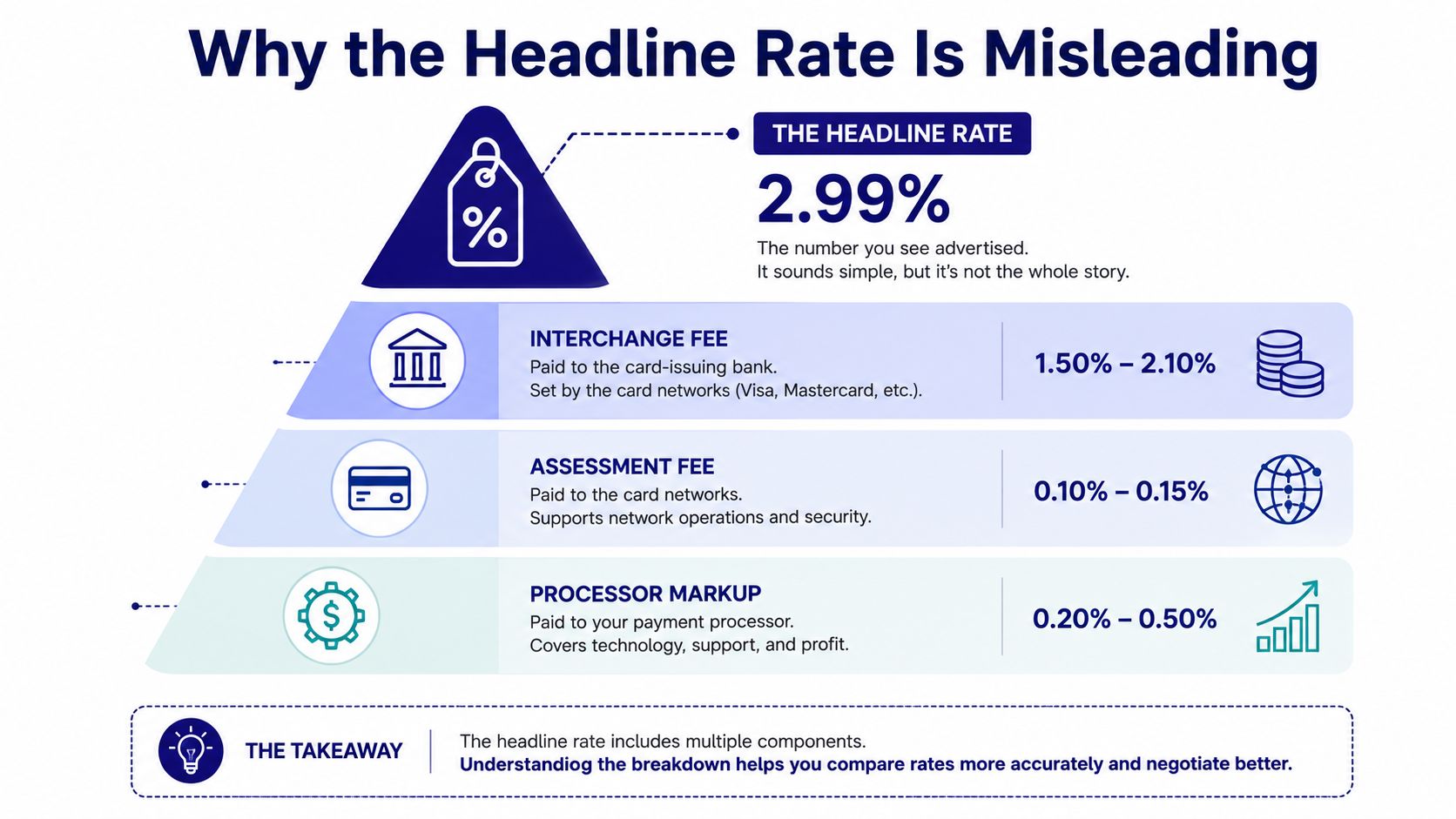
Why the Headline Rate Is Misleading
A merchant can stare at a single percentage and still miss the cost. The reason is simple. A payment gateway fee is usually not one fee, it's a bundle, and the biggest line on the quote rarely tells you what the business will pay once volume, disputes, and settlement choices enter the picture.
The stakes are not academic. U.S. merchants paid $187.20 billion in card processing fees in 2024, which equals about $1.57 for every $100 accepted, based on Nilson Report data cited in merchant benchmarking research. That's why payment pricing belongs in the margin conversation, especially for subscriptions, cross-border sellers, and high-volume retail where tiny differences compound quickly. The same source also notes that average processing rates have moved around over the last decade, so fee pressure isn't a one-time spike, it's a persistent operating reality.
What a gateway fee actually means
In plain language, the gateway is the layer that helps move a payment from the customer's method to the merchant's account. But the bill usually includes more than routing. Industry guides describe interchange, assessment fees, processor markup, platform charges, and sometimes setup or dispute-related costs, so the advertised number is often just the start of the calculation rather than the full answer.
Practical rule: if a provider leads with a single rate, ask for the full fee stack, not just the headline.
That's also why comparing “gateway” prices can get confusing fast. A checkout platform, a processor, and a gateway may all appear in the same invoice even though they do different jobs. For readers who want a broader framing of wallet-based infrastructure versus gateway logic, embedded wallets vs payment gateways is a useful companion read because it shows how easily fee language gets blurred across payment layers.
The mental model to keep is this. Every line item is a lever. Interchange, assessment, processor markup, monthly platform charges, and dispute costs each change the effective rate in a different way. Once you stop treating the headline percentage as the whole story, you can start asking the only question that matters, which is how much of each sale is left after all layers clear.
The Components Most Gateways Stack Together
Most merchants think in terms of a percentage, but the invoice often has several moving parts. A typical market structure is 1.5% to 3.5% plus 10p to 30p per transaction, and some guides also describe monthly platform fees of about $10 to $50, plus per-transaction fees around $0.05 to $0.30 and optional setup or integration charges. Those ranges can overlap because providers bundle the same economics in different ways, but the pattern is consistent. The gateway gets paid by shifting cost between fixed and variable line items.
The most common lines you'll see
Fee Component | Typical Range | When It Matters |
|---|---|---|
Percentage fee | 1.5% to 3.5% | The dominant cost on higher-ticket orders |
Fixed per-transaction charge | 10p to 30p or $0.05 to $0.30 | The pain point on low-ticket baskets and subscriptions |
Monthly platform fee | $10 to $50 | Matters when volume is low or seasonal |
Setup or integration charge | Varies | Shows up during onboarding or migrations |
Dispute or chargeback cost | Varies | Matters when fraud or refund pressure is high |
PCI compliance surcharge | Varies, sometimes $15 to $25 monthly in some models | Important for merchants with extra compliance overhead |
Payment-method-specific pricing | Varies by method | Matters when wallets, bank transfers, or crypto are in the mix |
The logic behind the stack is straightforward. Gateways that waive a monthly fee often recover revenue through higher per-transaction pricing. Subscription-style pricing can lower the marginal cost of each transaction, but only if your volume is high enough to absorb the fixed fee. That trade-off is the core of gateway pricing analysis.
A simple example helps. Suppose a merchant pays a $25 monthly fee, a $0.30 per-transaction fee, and a 2.9% plus 30p variable rate. At $20,000 in monthly volume, the percentage piece is the largest cost driver, but the fixed charge still matters because it hits every order the same way. That's why low-ticket businesses feel fixed fees more sharply than high-ticket merchants, even when the quoted percentage looks identical.
A merchant who only compares the percentage is usually comparing the least interesting part of the invoice.
The question is not whether a gateway charges a monthly fee or a per-transaction fee. It's whether the mix fits your basket size, refund rate, and payment method mix. A small SaaS business, a volume-heavy retailer, and a marketplace with many small payouts will all read the same pricing sheet differently.
How the Same Headline Fee Plays Out for Different Merchants
A quoted rate only becomes meaningful when you test it against a real business model. The same headline fee can look reasonable for one merchant and expensive for another, because the fixed portion of the charge hits small tickets harder while the percentage portion hurts large tickets more. That's why effective rate modeling matters more than memorizing a sales page.
Low-ticket SaaS
Take a SaaS company with many $9 subscriptions. The fixed fee becomes unusually visible here because it sits on every renewal. If the merchant pays a per-transaction charge on top of a percentage, the effective rate climbs fast relative to the price of the product, even before you add failed payments, retries, or refunds.
For this profile, the merchant is really buying predictability. A lower monthly fee can be less useful than a lower per-transaction charge, because the unit economics live and die on small recurring bills. That's why subscription businesses often care more about the fixed component than the quoted percentage.
High-ticket cross-border merchant
Now look at a merchant averaging $2,000 per order and selling across borders. Here, the percentage component drives most of the cost, and the visible gateway fee is only part of the story. Cross-border transactions often add currency conversion markups of about 1% to 3%, international card surcharges of 0.5% to 2%, and other layers that can quickly outgrow the visible processing fee.
Settlement currency and corridor matter. The merchant may think they're comparing gateways, but they're really comparing how each provider handles foreign acceptance, FX conversion, and payout costs.
Marketplace with many small payouts
A marketplace has a different problem. The intake side matters, but so does the payout side, because many recipients mean many settlement events. Per-payout costs and refund handling can become a material drag on margin, especially when the business runs a lot of small-value orders or frequent reversals.
Effective rate is a business-model question, not just a pricing-table question.
That's the part many buyers miss. The same headline rate can be fine for one profile and damaging for another because cost shape matters as much as cost level. A merchant should model their own average ticket size, payout frequency, refund rate, and cross-border share before deciding whether a quoted gateway is cheap.
Settlement Rails, Payout Timing, and the Hidden FX Layer
The fee you see at checkout isn't always the fee that decides your margin. Money has to move from the card rails into the gateway balance, then out again into a bank account or other settlement destination. Each step can add cost, timing friction, or both.
The hidden layer is foreign exchange. On a cross-border payment, the conversion spread may be embedded in the exchange rate instead of shown as a separate fee, which makes the payment look cheaper than it really is. That's especially important when a merchant takes payment in one currency and settles in another, because the conversion cost can show up after the quote has already looked acceptable.
For international businesses, the settlement design matters. A USD payment settled to a European bank in EUR can carry both an explicit conversion fee and a less obvious FX spread. The same logic applies to payout speed. Faster access to funds usually comes at a premium, while slower settlement can lower cost but tie up cash longer.
For merchants comparing international routing options, this guide on avoiding currency conversion fees is a good reminder that FX usually lives in more than one place on the bill. It's not just the conversion itself, it's also the path the money travels after the card is approved.
The practical move is to treat settlement as part of pricing. A gateway that looks inexpensive on the front end can become expensive if it layers conversion, payout, and speed charges on top of the visible fee. That's why merchants selling globally should ask a sharper question than “what is your rate?”. They should ask, “what do I receive after the money clears, converts, and lands?”
Pricing Models and How They Reward Different Volumes
Not every pricing model rewards the same kind of merchant. Flat-rate pricing is simple to understand, interchange-plus is more transparent, and subscription-based pricing can be efficient at scale if the fixed fee is low enough relative to volume. The right structure depends on how much you process, how much your tickets vary, and how risky the business looks to the provider.
The three common structures
Flat-rate pricing bundles the underlying costs into one visible percentage and often a fixed fee. That simplicity is useful for small teams, but it can hide the fact that lower-risk transactions are subsidizing higher-cost ones. Interchange-plus does the opposite. It exposes the pass-through cost and the processor margin separately, which makes it easier to see where money is going but harder to forecast month to month.
Subscription-based pricing, by contrast, shifts more cost into a recurring fee and lowers the marginal rate. That can work well when volume is steady and high enough to absorb the monthly charge. If volume is thin, though, the fixed fee can outweigh the savings.
Risk profile changes the math too. One industry source says standard merchants often pay 2% to 3%, while high-risk businesses face 4% to 8%. That spread shows pricing isn't only about volume, it's also about how the provider reads the merchant's fraud, chargeback, and industry profile.
A useful comparison point is DigiParser rate tiers, since tiered pricing frameworks make it easier to see how providers separate low-volume and high-volume economics in other software categories too. Payments work similarly. Once the bill gets tiered, the merchant who grows into higher volume can often negotiate differently than the merchant who's still early.
The link to the broader pricing discussion is payment gateway pricing, because the decision is less about one cheap number and more about the structure underneath it. If your volume is predictable, a lower marginal cost may beat a low-commitment flat rate. If your volume is volatile, a simple bundled model can be easier to manage even if the blended cost is a bit higher.
The Payment Method Mix That Actually Drives Your Bill
The bill often moves more because of payment method mix than because of the provider name on the contract. Cards are still the default reference point, but the cost depends on how much volume flows through cards, wallets, bank transfers, BNPL, and other methods your customers use. If you want to model your real all-in rate, start with the mix, then work down into the fee stack.
A useful way to frame this is to compare the checkout methods in your own market with a guide to alternative payment methods. A card-heavy checkout, a wallet-heavy checkout, and a bank-transfer-heavy checkout can all sit on the same gateway and still produce very different bills. The gateway fee is only the visible layer, while method choice changes the rest of the math underneath it.
Regional variation makes that easier to see. One industry source places merchant fees in Asia-Pacific generally between 1% and 3%, while Latin America often falls between 2% and 4%. The gap is not just about geography. It also reflects local method preference, card type, and whether cross-border settlement is involved.
A wallet or bank transfer can be cheaper in one corridor and more expensive in another once FX and settlement are added. That is why a headline percentage can mislead merchants who only compare the first line on the quote.
How to audit the cost drivers
Separate by method: Pull card, wallet, bank transfer, and international volumes apart so you can see where the cost sits.
Separate by corridor: Domestic and cross-border payments rarely behave the same way on fees or FX.
Watch the refund path: Some methods add cost again when money has to be returned.
Compare settlement currency: The currency you accept is not always the currency that protects margin.
Look for hidden add-ons: FX spread, payout charges, and compliance fees often explain the gap between the quote and the blended rate.
The cheapest gateway on paper is often not the cheapest gateway in your corridor.
The reason is simple. Payment methods carry different economics, and those economics change again when settlement timing, payout currency, and refund behavior enter the picture. A merchant selling mostly local wallet payments may see a very different all-in cost from a merchant pushing premium cards, even if both started from the same gateway fee. That is also why the choice of methods deserves the same attention as the choice of provider, and why Presidio on choosing a Shopify Plus agency can be useful context for merchants thinking about the broader stack around checkout and implementation.
Savings come from method selection as much as fee shopping. A payment method that looks expensive on the surface can still produce a better blended outcome if it lowers FX drag, reduces refund friction, or settles in a currency that matches your margin.
Practical Tactics to Reduce Your Effective Rate
Start with the fees you can move. Negotiating a better structure usually matters more than chasing a tiny headline discount, especially once volume is steady enough to give you bargaining power. If your provider will discuss pricing, bring your transaction history, ticket size, approval rate, and chargeback profile, because those numbers affect how risky your account looks.
A good operator also trims cost on the payment side, not just the contract side. Tighten fraud rules where chargebacks are eating into margin. Review monthly platform and PCI compliance charges, because those “small” fees can sit in the background. Use payout timing and currency choice to reduce FX drag when you're operating across borders.
Another practical lever is method selection. If a lower-cost local method is available and your customers trust it, steer them there without creating friction. That often does more for blended cost than a small change in percentage points.
The video below is useful if you want to visualize how fee structure shows up in an actual payment flow.
Suby is one option for merchants who want to accept cards or crypto through one API, with native integrations for Discord and Telegram for subscriptions, paid access, and online communities. It also supports a flow where customers pay by card and the business receives USDC, along with other settlement choices, and pricing depends on the payment method used rather than one flat rate, so the exact figures belong on the official pricing page.
That kind of flexibility matters because the effective rate is not just a checkout problem, it's a settlement problem too. If you can match the pay-in method to the payout method more intelligently, you can reduce friction at both ends of the transaction.
Choosing a Gateway and Common Questions
Start with four inputs, your volume, average ticket size, main corridors, and risk profile. Then match those to the pricing structure and settlement rail that fit the business, not the one that sounds easiest in a sales call. If you're still comparing providers, ask for the full fee stack in writing and make them separate card cost, FX cost, payout cost, and dispute cost.
If you're evaluating a broader commerce stack, Presidio's guide on choosing a Shopify Plus agency is a useful reminder that payment decisions sit inside a larger build and operations decision, not in isolation. The same logic applies here. A gateway should match how you sell, where you sell, and how you want the money to arrive.
A few questions are worth keeping on hand. Is a 0% headline rate ever real, or is the cost moving somewhere else in the stack? How do you spot FX markup when it isn't shown as a separate line? And if a provider settles in stablecoins as well as to bank accounts, what exactly changes in your cost and treasury flow? Those are the questions that separate a clean quote from a misleading one.
If you want a payment setup that lets customers pay by card, wallet, bank, or crypto while you choose whether to receive funds in your bank account or in stablecoins like USDC, take a look at Suby. It's built around one API with four ways to use it, so you can match checkout, crypto payments, paid access, and invoicing to the same payment stack.
