

Gaspard LEZIN
How to Receive a Payout in AED Using Suby
Learn how to configure and receive a payout in AED with Suby. Covers prerequisites, FX considerations, timing, and real-world setups for SaaS and ecommerce.
If you're paying contractors, payroll, or suppliers in the UAE, the hard part usually isn't collecting money. It's getting the balance out in AED without tripping over bank rules, currency handling, or settlement delays that don't match how your business moves. Global teams often want one clean payment flow, but the destination side in the UAE is still very specific, and that's where most payout setups start to break.
That gap matters because AED isn't just a local checkout currency, it's tied to real operational flows across employment, dividends, and bank settlement. The UAE market also has a clear legal and rail structure, so “payout in AED” only works when the beneficiary data, currency choice, and destination method line up with the rails you're using. In practice, the businesses that get this right treat payouts as a routing problem, not a generic money transfer problem.
Table of Contents
Why Global Businesses Need AED Payouts
A SaaS company can bill customers in USD, an agency can invoice in EUR, and a creator business can collect community payments globally, then still need to land operating funds in the UAE in AED. That mismatch is normal. The business earns in one currency, but pays rent, salaries, vendors, or service providers in another, and the settlement currency has to match the local operating reality.
That's why a payout layer matters. Suby is payment infrastructure for that exact split, businesses can accept cards or crypto, then settle in the currency and destination they choose. The useful mental model is simple, customers pay any way they want, businesses get paid the way they choose, and the platform sits between those two sides without forcing the same currency at both ends.
The local payment context matters
UAE payout needs don't live in a vacuum. End-of-service gratuity is a major payout category, with one 2026 labor-trends estimate projecting total gratuity payments at AED 12.3 billion annually and another UAE guide saying more than 5.8 million private-sector workers are entitled under Federal Decree-Law No. 33 of 2021. The same 2026 source says MOHRE processed more than 1.2 million end-of-service benefit claims in 2025, with an average payout of AED 28,400 per worker. Those figures, from the same UAE labor-trends reference, show how frequently AED settlement has to work in real operations. See the labor-trends reference on AED gratuity scale and claim volume.
Practical rule: if the payout destination is the UAE, design the flow around AED first, then choose the rail second.
The same currency shows up in capital markets too. Dubai Islamic Bank's dividend record shows an annual payout of AED 0.35, while Abu Dhabi Islamic Bank disclosed a total payout of AED 3.030 billion, equal to 50% of its 2024 net profit. Those examples show that AED payout amounts are used in both per-share and aggregate formats, not just in payroll or retail transfers. For that reason, payout architecture needs to support both small repetitive settlements and larger treasury-style disbursements.
For localization strategy outside the UAE context, I'd also recommend reading how to localize for international e-commerce. It's a useful reminder that currency choice is only one part of making a cross-border experience feel local.
Prerequisites for Receiving AED Payouts
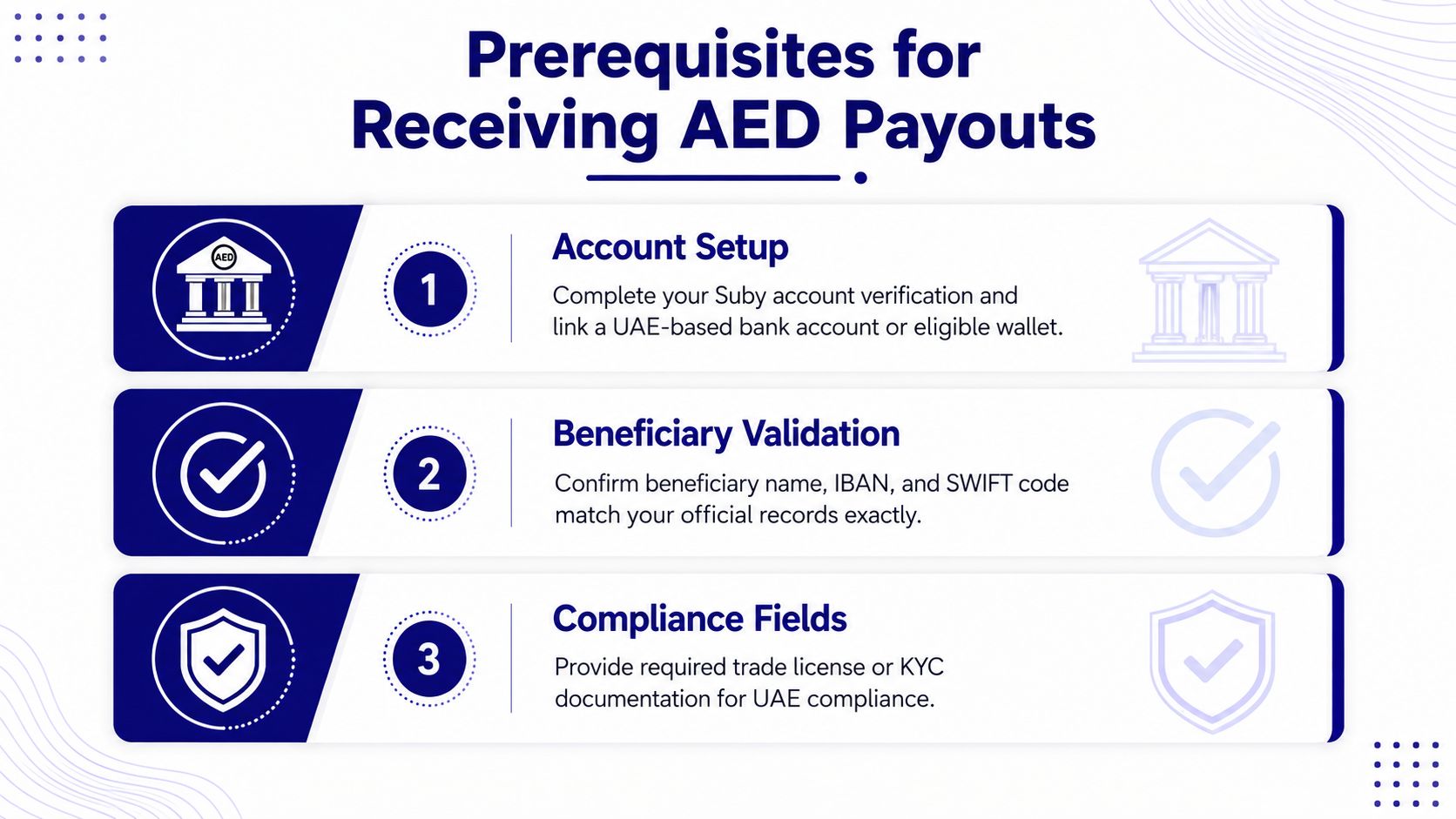
Before you can rely on an AED payout flow, the beneficiary records have to be clean. That starts with the destination bank account. In the UAE payout spec, the beneficiary bank account must be a 23-character UAE IBAN beginning with AE, and the payout country code must be AE. If either field is wrong, the payout usually fails before it becomes eligible for settlement.
Validate the destination before anything else
The most common mistake is treating the UAE like a generic bank destination. It isn't. Local payout specs expect tight schema matching, so the name, IBAN, and country code need to line up with the beneficiary's official details. For local rails, purpose codes matter too, because UAE banks often require specific payment-purpose fields during processing.
A good intake form should force this sequence:
Confirm the beneficiary identity. Match the legal name on the account to the account holder record.
Check the IBAN format. It has to be 23 characters and start with AE.
Set the country code to AE. Don't map the beneficiary to a generic country field.
Capture the purpose code. Use the code required by the bank or payout method.
Separate B2B from B2C logic. UAE payout specifications support both flow types, so don't run them through one generic template.
The failure mode is usually format mismatch, not lack of funds.
That distinction matters because teams often debug the wrong layer. They start looking at balance availability, when the blocker is a malformed IBAN, a mismatched country code, or a missing purpose field. The payout engine won't fix bad beneficiary data on its own.
For supported country and payout coverage, keep the beneficiary review aligned with your operational routing rules and reference the supported countries page once your destination list is finalized. That keeps onboarding clean before any money moves.
Align compliance fields with the rail
UAE payroll and wage flows add another layer. Under Federal Decree-Law No. 33 of 2021, wages shall be paid in AED, though the law allows another currency if both parties agree in the employment contract. It also requires the employer to pay wages and other entitlements within 14 days after the contract ends. The law is the baseline, but the rail still determines how that payment can move. See the statute itself in the UAE legislation portal.
The Wage Protection System FAQ is even stricter, it says the WPS will not handle any currency other than AED, and that salaries or wages cannot be paid in any other currency under the WPS. It also says the money must be paid into an account held by a bank within the UAE's geographical boundaries. That means compliance design and payout routing have to be built together, not separately. For employers, this is a hard destination constraint, not a soft preference. Reference: the WPS FAQ.
Configuring Payout Currency and Destination
Once the beneficiary record is ready, the next decision is the destination format. For an AED payout, that usually means deciding between a local UAE bank account and another permitted destination in your payment stack. A single-balance model makes this easier, because all payins land in one place first, then the payout layer routes funds to the chosen destination in the chosen currency.
Set the currency and route intentionally
In a global business, the cleanest setup is to separate three decisions. First, decide which currency the business wants to receive in. Second, decide which currency the business wants to settle in. Third, decide where the settlement should land. Those are not the same question, and treating them as one is how payout systems become brittle.
Suby's model is built around that split, businesses can take payins in one currency and route payouts in another, with the balance acting as the intermediate layer. In one common setup, customers pay by card or crypto, the balance accumulates centrally, and the business chooses whether the destination should be a bank account or a stablecoin wallet. For a payout in AED, that means the operator maps the settlement target first, then configures the receiving rail to match the destination constraints.
Choose the rail based on latency and purpose
For the UAE, there's a practical difference between instant account-to-account rails and local-bank payout rails. Aani processes AED transfers within seconds, runs 24/7, supports merchant payments, and allows transaction values of up to AED 50,000 per transaction. It's a pay-only rail, though, so it doesn't support refund, authorization, or capture lifecycle steps. Local bank payout methods can settle to UAE bank accounts in AED as well, but documented bank payout routes may take materially longer, such as 3 days for the ae_ach_bank method type.
Use that distinction as a routing rule:
Choose instant rails when the use case needs immediacy and low latency.
Choose bank payout rails when batch settlement and traditional beneficiary routing are enough.
Separate B2B and B2C flows so compliance and beneficiary checks don't blur together.
Keep the destination schema exact because rail-specific constraints are usually strict.
Operational note: don't assume every AED route behaves like a card flow. AED payout infrastructure is rail-specific, and the method type has to match the beneficiary and the country.
The internal configuration also needs to respect Suby's payout structure. For payout use cases, use the payout in USD flow as the comparison point when you're deciding whether to hold funds in one currency and settle in another. It's the same payout logic, just with a different target currency.
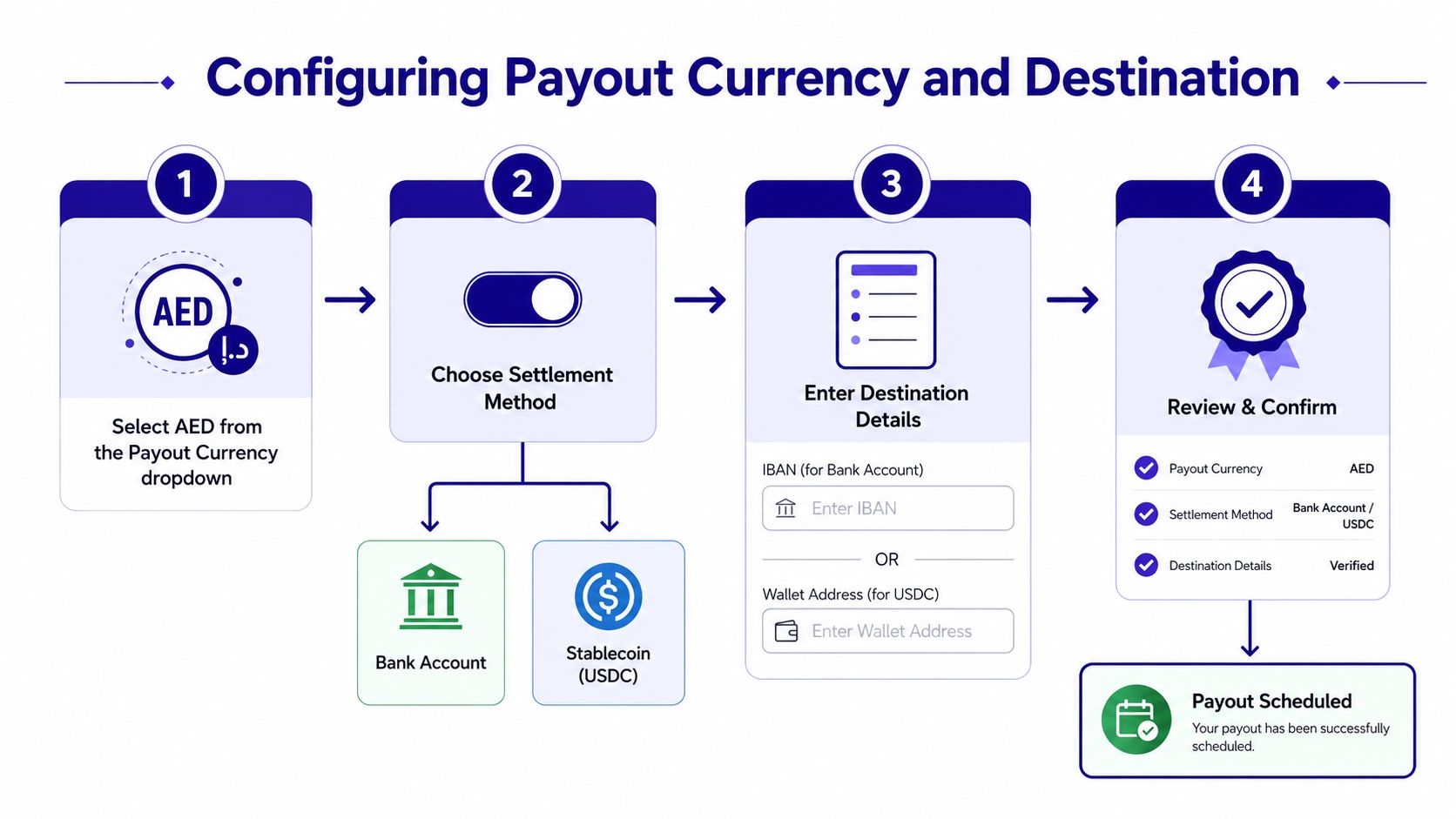
A simple beneficiary form should ask for the bank account or wallet destination only after the currency choice is locked. That prevents accidental cross-routing, especially when teams support both bank settlement and stablecoin settlement in the same product. It also keeps the payout review screen meaningful, because the operator can confirm the currency, method, and destination together before release.
Understanding FX Rates, Timing, and Fees
The biggest mistake in an AED payout setup is assuming the payout currency tells you everything you need to know. It doesn't. If the source balance is not already in AED, then the FX leg, the funding currency, and the payout rail all affect what lands, when it lands, and how much operational friction you inherit along the way.
Separate the funding leg from the payout leg
dLocal's UAE payout specification is useful because it makes the routing rules explicit. The payout amount is denominated in AED, the country code must be AE, and the beneficiary bank account must be a 23-character UAE IBAN beginning with AE. It also says payouts are always paid in local currency, while the source currency for FX can be AED or USD. That means the payout itself is local, even if the source balance is not. See the spec for United Arab Emirates payouts v3.
That local-currency rule matters because FX design isn't just a pricing question. It also changes failure risk. If the funding currency is unsupported, the beneficiary data is malformed, or the purpose code is wrong, the payout can fail before settlement. The most common issue isn't the exchange rate itself, it's a schema mismatch at the rail boundary.
Compare rail behavior before you price the flow
The cleanest way to think about it is to compare the payout rail, not just the currency.
Rail Type | Settlement Time | Max Transaction | Refund Support |
|---|---|---|---|
Aani | Seconds | AED 50,000 per transaction | No |
UAE bank payout rail ( | 3 days | Not stated in the verified data | Not stated in the verified data |
Aani gives you speed and availability, but it's pay-only. Traditional bank payout rails are slower, but they may fit batch operations better. That's why timing has to be designed before release, not after the first payout fails to arrive on schedule.
Practical rule: ask three questions before you send the payout, what currency funds the balance, what rail carries the settlement, and what settlement window that rail actually has.
The fee conversation follows the same logic. Pricing depends on the payment method used, so there isn't a single flat rate you can assume. Check the pricing page before you publish a payout flow, and if you're comparing currency conversion behavior, the article on how to avoid currency conversion fees is the right place to frame the trade-off between rate, timing, and method choice.
Real-World Setups for SaaS, Ecommerce, and Creators
A SaaS team billing U.S. customers in cards doesn't usually care about AED until the back office does. Then the finance team needs the payout to land in the UAE, in local currency, on the right schedule. In that setup, the business can collect through one payment stack, keep the balance centralized, and direct settlement to AED for operating expenses or local contractors.
An ecommerce merchant selling cross-border often cares more about timing than brand purity. If the merchant wants the flexibility to settle without waiting for a slower bank route, a stablecoin destination can reduce friction on the recipient side, while the merchant still keeps AED routing available for UAE obligations. That's where the choice between bank settlement and alternative settlement matters operationally, not philosophically.
Community and support businesses need the same routing discipline
Creators and membership businesses feel the issue sooner because they often combine global payers with local spend. A Discord community can collect membership payments from international fans, while the operator still wants to pay moderators or suppliers in AED. In that case, the payout design should keep the beneficiary data strict and the destination explicit, because community flows are small enough to make mistakes look harmless until they repeat.
Suby also offers native integrations with Discord and Telegram for paid access, subscriptions, and online communities, so the payment flow can be tied directly to access control instead of being managed by separate tools. For support teams that want their payment events to sync with follow-up workflows, connect Stripe to support agents is a relevant adjacent resource, even though the payout logic itself is still a separate problem.
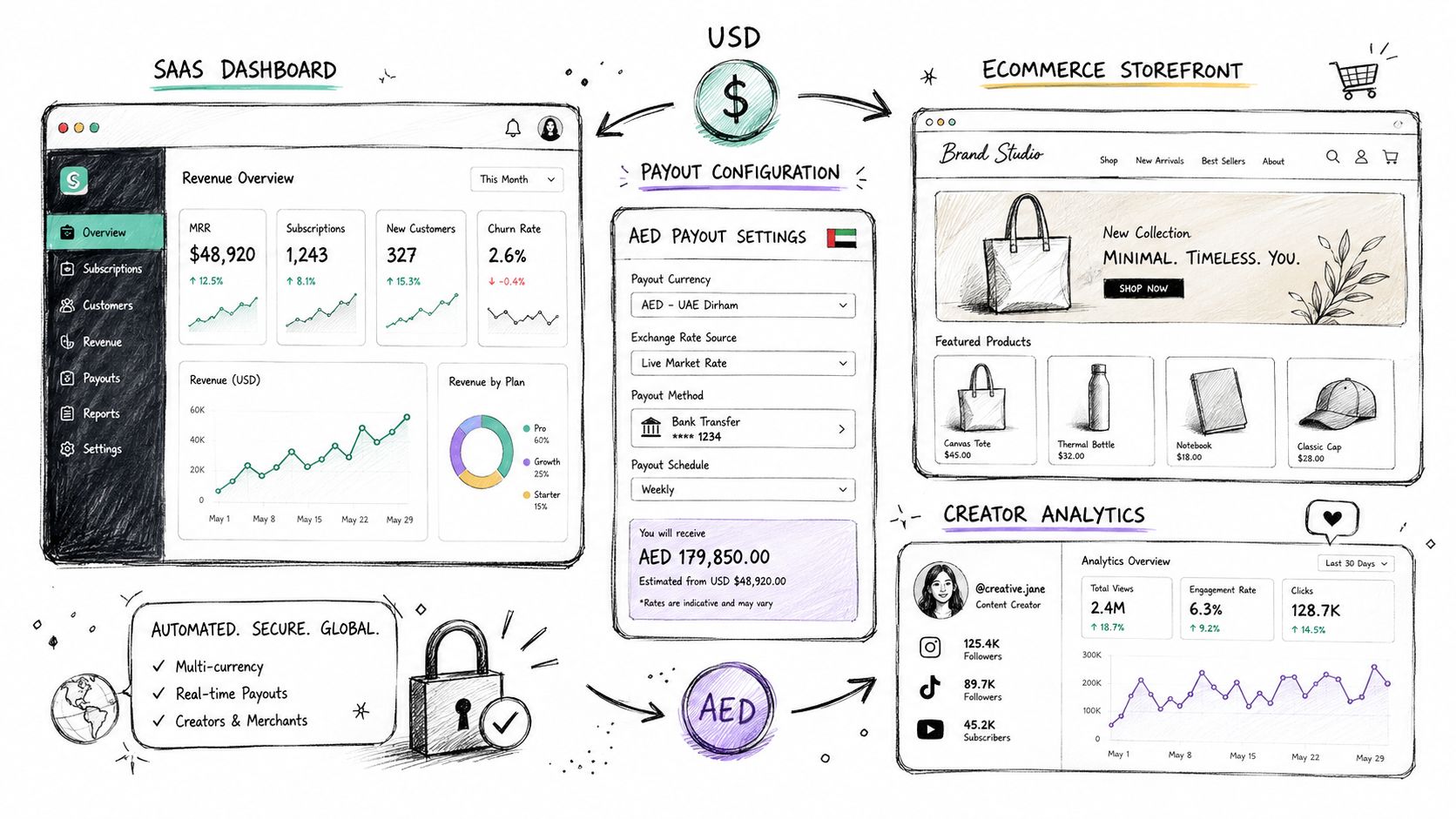
For a creator or SaaS operator, the practical choice is usually not “bank or no bank.” It's whether the business wants the settlement to land in AED, in a local account, or in another destination that fits treasury planning. Once that's clear, the rest of the setup becomes a data problem, not a guess.
Troubleshooting Common AED Payout Issues
Most AED payout failures come from the same few places. The beneficiary IBAN is malformed, the country code doesn't match AE, the purpose code isn't accepted, or the destination doesn't match the rail's schema. Those errors usually surface before settlement, which is helpful because they're fixable without chasing a missing transfer.
Start with the data, not the ledger
If a payout stalls, check the fields in this order:
IBAN length and prefix. It must be 23 characters and start with AE.
Country code. The payout destination needs AE, not a generic country mapping.
Purpose code. Some local rails require it, and missing or incorrect values can block processing.
Flow type. Keep B2B and B2C logic separate, because mixing them creates avoidable validation errors.
Destination rail. Aani is pay-only, while bank rails behave differently and may settle slower.
Stripe's UAE payout support also adds operational timing constraints. It says payouts are paid in AED to UAE-based bank accounts only, on a T+5 business-day schedule, with no payouts on weekends or public holidays. It also says the minimum payout amount is 20.00 AED and the first payout is subject to a 7-day delay. Those constraints matter when you're planning cash flow, because an otherwise valid payout can still arrive later than expected if you don't account for the schedule.
If the payout data is right but the timing feels off, check the rail calendar before you check the balance.
For compliance-sensitive payouts, the safest move is to segment the beneficiary list by payout type and validate each one against the rail you use. That prevents the common mistake of applying one global beneficiary template to every AED route. It also keeps your support workload down, because the team can see whether the failure is a schema issue, a rail rule, or a timing rule.
If you need AED payouts for a global business, Suby lets you keep payins and payouts separated so customers can pay one way and your business can settle another. It's a practical fit for card, crypto, Discord, Telegram, and invoicing use cases where the payout still has to land in the right currency and destination. Visit Suby to review how the payout flow fits your stack and decide whether AED settlement should go to a bank account or another destination your finance team can operate.
