

Gaspard LEZIN
Multi Currency Payout: A 2026 Guide for Businesses
Learn how multi currency payout helps global businesses reduce costs and streamline international payments in 2026.
Priya runs a small SaaS business from Lisbon and charges $29 a month for her core plan. Her first customers arrive from Berlin, São Paulo, and Manila. They pay in the currency shown at checkout, but Priya still has to decide how to hold those proceeds, pay contractors, and move money into the currencies her business needs.
That's where multi currency payout becomes useful. It isn't the ability to accept foreign cards. It's the design of the full money movement, from the customer's payment to the recipient's final settlement, with currency conversion happening only when it makes operational sense.
Table of Contents
What a Multi Currency Payout Actually Means
A multi currency payout lets a business receive money in several currencies and send money onward in the currency a vendor, contractor, creator, or partner prefers. In practical terms, Priya might collect proceeds in one currency, keep them available as separate currency balances, and pay a contractor in another currency without routing every transaction through a personal bank account.
The simplest mental model is one business wallet, many currencies in, and many currencies out. The wallet might contain separate balances rather than one blended total. That distinction matters because a euro balance and a dollar balance have different uses, payout rails, and conversion decisions.
Three terms often get mixed together:
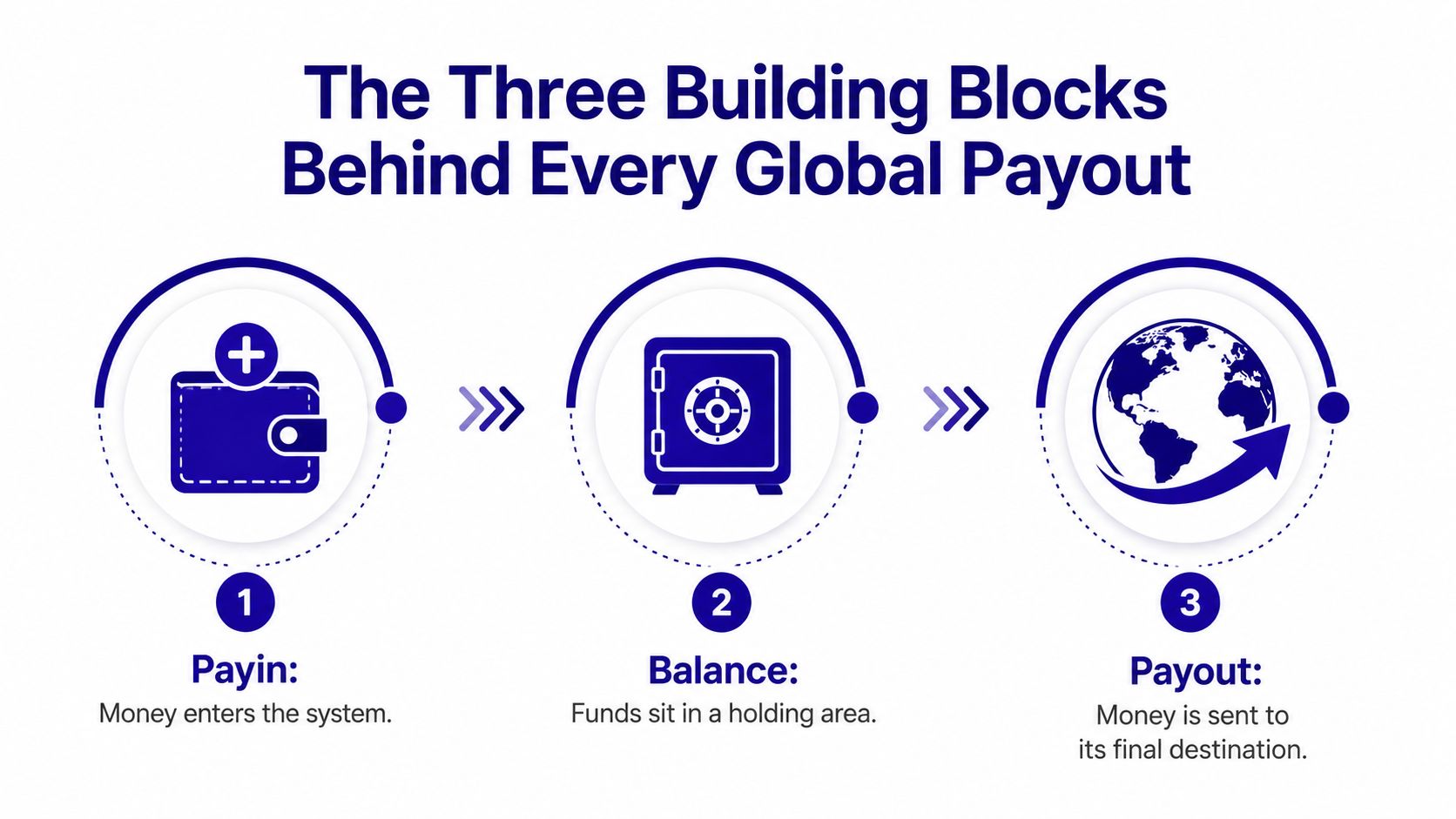
Payin: The way money enters the system, such as a card, bank payment, wallet, or crypto payment.
Balance: The place where funds remain available before the business spends, converts, or withdraws them.
Payout: The outbound transfer to the final recipient, such as a bank account, local payment rail, or stablecoin wallet.
Practical rule: Accepting a foreign card solves the payin problem. It doesn't automatically solve the payout problem.
A retail bank's multi-currency account may let an individual hold several currencies. Business payout infrastructure has a broader job. It needs to support repeatable transfers, recipient details, currency-specific records, fees, settlement timing, and reconciliation across borders.
For example, a customer could pay by card while the business ultimately receives USDC. That's one possible flow, not the definition of multi currency payout. The business might instead accept a bank payment and settle to a bank account, or accept crypto and settle in a different currency.
The system rests on three building blocks: payin, balance, and payout. Once those are separated, you can compare providers more intelligently because you're evaluating how money enters, where it sits, and how it leaves.
The Three Building Blocks Behind Every Global Payout
Think of an international payout like mailing a package across a border. First, the package enters the carrier's network. Then it waits in a sorting facility. Finally, it travels to the recipient's address. Money follows a similar path.
Payin is how money enters
The payin is the customer-facing side. A customer might use a Visa or Mastercard card, Apple Pay, Cash App, Klarna, SEPA, or crypto. The key question is whether the payment methods match how customers in your target markets already pay.
A SaaS company serving European customers may need bank payments such as SEPA alongside cards. A creator platform may need wallets and recurring payments. A crypto-native product may need customers to pay from a supported wallet while the business receives a different asset.
Balance is the holding area
The balance is where the funds sit after the payin and before the payout. A useful system preserves the currency context instead of showing only one converted headline number. That gives the finance team a clearer view of what can be paid locally, what must be converted, and what remains pending.
Providers may bundle payins, balances, and payouts into one product, but you should still evaluate them separately. A convenient checkout doesn't guarantee transparent FX. A broad payout network doesn't necessarily provide the payment methods your customers expect.
Payout is the final disbursement
The payout is the moment money leaves the system. It may go to a bank account, a local rail, a card, or a stablecoin wallet. Recipient preferences become operational requirements.
If you're mapping the broader payment stack before choosing a provider, the Webtwizz payment integration guide provides useful context on how the integration layer fits around these money movements. The important decision is not to inspect the payout rail in isolation. Evaluate the entire route, including payin method, holding balance, conversion point, payout destination, and reporting.
Where FX Conversion Costs Actually Hide
A payout that looks cheap on the invoice can still be expensive in the exchange rate. The FX spread is the gap between the mid-market rate and the rate used for conversion. Routable explains how global payout fees, FX spreads, and local settlement interact, noting that even a 1% to 2% FX spread can become significant at scale, especially when funds are converted more than once. Routable explains the relationship between global payout fees, FX spreads, and local settlement.
Suppose a company pays contractors in four currencies and moves $50,000 each month. With a hypothetical 1.5% spread, the FX cost is $750 per month, or $9,000 per year, before fixed payout charges. At $500,000 per month, that same spread becomes $7,500 per month, or $90,000 per year. These figures show the arithmetic, not a provider quote.
The conversion point matters as much as the headline fee. If funds are converted when they enter the platform and again before recipients receive them, each step can carry its own markup. Intermediary bank charges may add another layer, sometimes deducted from the recipient's amount instead of appearing clearly on the sender's statement.
Monthly Payout Volume | 1.5% Spread Cost/Year | What to Add to Your Calculation |
|---|---|---|
$50,000 | $9,000 | Fixed payout charges, intermediary deductions, and any second conversion |
$500,000 | $90,000 | The same costs, checked against your actual provider quote |
Use your own monthly volume and applied rate to replace the hypothetical figures. Then compare the total route, not only the advertised payout fee. Record the explicit payout charge, the reference rate, the provider's applied rate, conversion timing, intermediary deductions, and any conversion needed before the recipient can spend the funds.
This guide to avoiding currency conversion fees can help structure that review. Ask the provider to show the applied rate, reference rate, and every explicit fee on the same quote. If those items are not separated, comparing corridors reliably becomes difficult.
Bank Settlement vs Stablecoin Settlement Compared
Bank settlement is familiar. Stablecoin settlement can be more direct. Neither is automatically cheaper or better because the right choice depends on the recipient, the currency, the available off-ramp, and the level of operational control your team needs.
Dimension | Bank Settlement (SWIFT/ACH) | Stablecoin Settlement (USDT/USDC) |
|---|---|---|
Speed | Timing depends on the bank and corridor | Can be rapid once the wallet and network are ready |
Reach | Familiar to businesses and recipients with bank accounts | Requires wallet readiness and a practical local off-ramp |
Cost visibility | FX and intermediary charges may be difficult to isolate | Network and provider charges can be easier to inspect, but conversion still matters |
Recipient control | Funds arrive through an established banking relationship | Recipient controls or receives funds through a compatible wallet |
Operational fit | Strong for payroll, suppliers, and formal business accounting | Useful for crypto-native teams and recipients who already use stablecoins |
The cost comparison still comes back to conversion. A stablecoin transfer can avoid some bank intermediary steps, but the recipient may later need to convert into local currency. A bank transfer may be easier for a contractor who already has a local account, but the provider may apply an opaque FX rate or route the payment through intermediary institutions.
Consider a contractor in Argentina. Bank settlement may win if the contractor needs local currency for bills and already expects an account transfer. Stablecoin settlement may win if the contractor holds USDC, has a suitable wallet, and values a clearly traceable digital transfer. The business should ask what the contractor can use, not choose a rail because it sounds more modern.
A hybrid model often makes more sense. The platform can maintain working liquidity in stablecoins, then pay some recipients to wallets and others through local bank rails. That approach creates more moving parts, so the ledger, recipient verification, and reconciliation process need to show exactly which currency entered, which conversion occurred, and which asset or bank account received the payout.
For a plain-language explanation of the model, this overview of stablecoin settlement gives useful background. Stablecoins can improve control over the transfer path, but they don't remove the need to evaluate compliance, wallet readiness, local liquidity, and conversion costs.
When Businesses Reach for Multi Currency Payouts
The best payout design starts with the recipient. Two businesses can collect the same customer currency and still need completely different settlement workflows because their recipients use different currencies and rails.
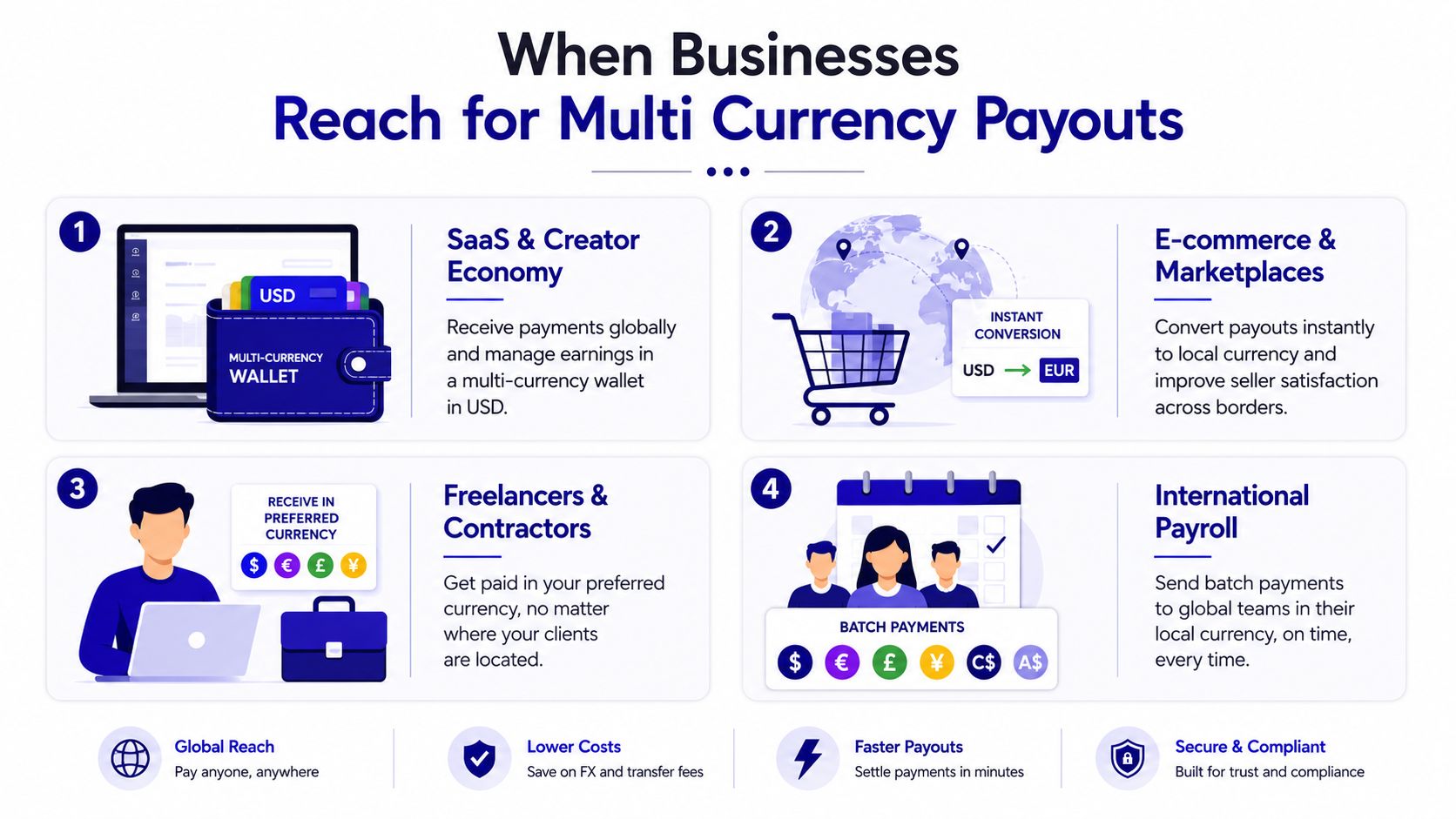
SaaS subscriptions and creators
A SaaS platform that pays creators may want to keep proceeds in a multi-currency balance and let each creator choose whether to hold a major currency or withdraw locally. The platform needs recurring customer payins, a reliable internal record of creator earnings, and a payout schedule that doesn't force every recipient into the same currency.
Cross-border e-commerce
An e-commerce seller may collect from shoppers in one currency while paying suppliers in another. The useful payout shape is the one that reduces unnecessary conversions between customer collection, marketplace settlement, and supplier payment. A seller on Amazon or Shopify should identify the currency the supplier invoices in, rather than assuming the customer's payment currency is the right settlement currency.
Agencies and freelance platforms
Agencies and freelance platforms often batch payments to many contractors. Here, the operational burden includes recipient data, approval rules, payout status, and reconciliation. A small fixed charge on every transfer can matter more than the FX spread for low-value payments, while larger contractor runs may make the spread the dominant variable.
Gated communities and creator platforms
A paid community can combine subscriptions, tips, digital products, and occasional creator payouts. That mix calls for flexible payment infrastructure rather than a single rigid withdrawal schedule. Suby presents four usage modes within one account, Suby Payments, Suby Crypto, Suby Gating, and Suby Invoicing. Its official site describes API access, paylinks, invoicing, and content gating as part of that offering. Suby's product overview explains the combined account model.
Suby provides an API that lets businesses accept payments by card or crypto. It also offers native integrations with Discord and Telegram for use cases such as subscriptions, paid access, and online communities. Its payments stack supports methods including Visa, Mastercard, Apple Pay, Cash App, Klarna, SEPA, USDC, and SOL, with the payments page describing 200+ supported methods. Suby's payments documentation provides the method details.
Across all four use cases, ask one question first: who is receiving the money, and what currency can they use? That answer should drive the payout rail.
What to Check Before You Pick a Provider
A sales call gives you a polished path. A checklist exposes the parts that determine whether the path works in production.
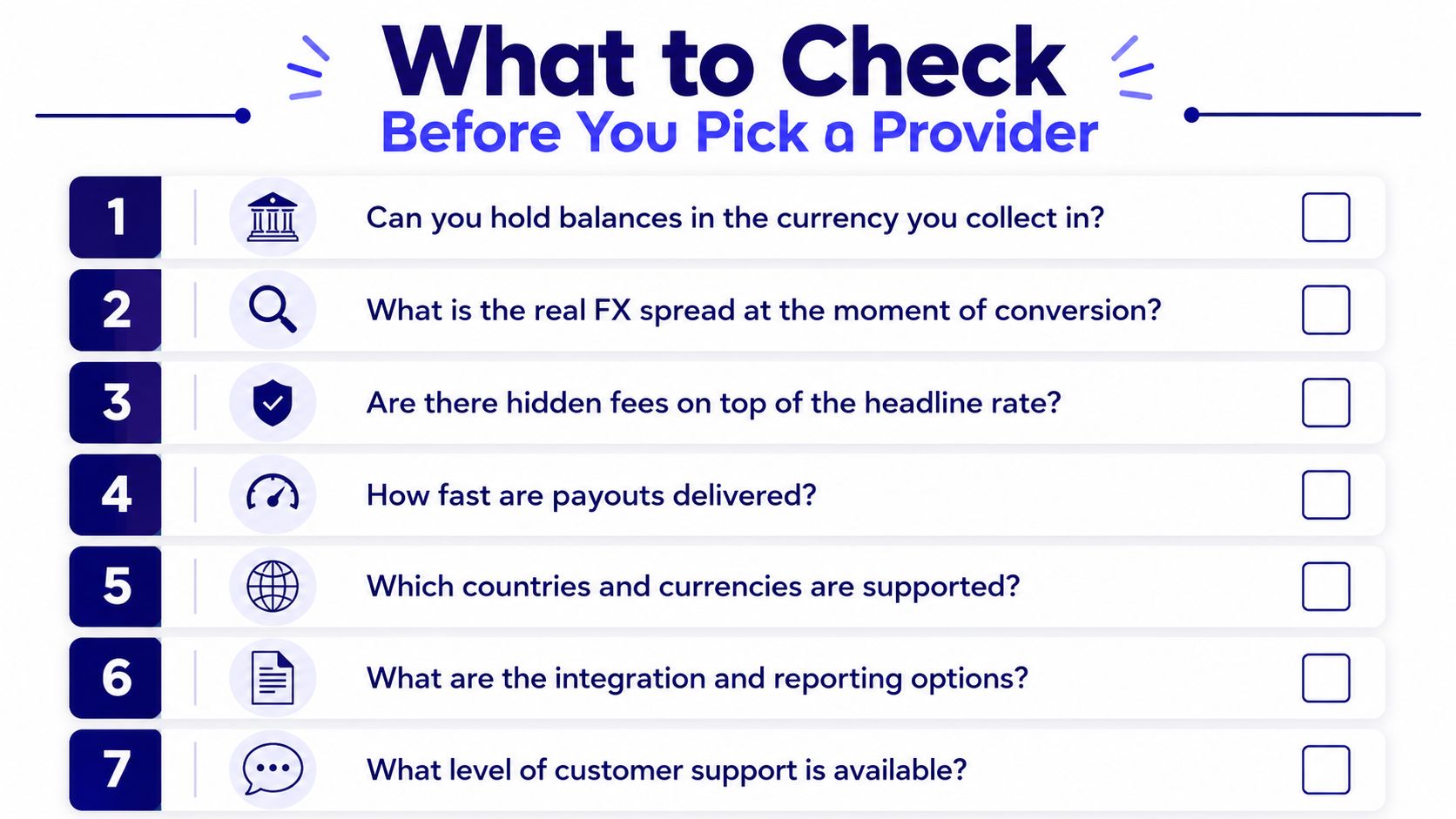
Seven questions for the vendor
Can you hold the currency you collect? If every incoming payment is converted immediately, ask whether that conversion is optional and when the rate is fixed.
What is the FX spread at the moment of conversion? Request the reference rate, applied rate, timestamp, and currency pair. A headline fee doesn't answer this question.
Which payout corridors are live? Ask for the supported destination countries, currencies, rails, recipient account types, and any corridors marked as unavailable or coming soon.
Where do fees appear? Separate percentage charges, fixed transaction fees, network costs, intermediary deductions, instant payout charges, and FX margin.
How long does a bank payout take to land? Ask for normal timing, exception handling, cutoff rules, and whether any service commitment applies.
Which licenses and regulated partners cover each jurisdiction? Verify the sender and recipient-side arrangements instead of treating one regulatory statement as global coverage.
Can accounting reconcile every payout? Look for stable transaction identifiers, currency-specific records, payout status, fee detail, and export options that match your accounting workflow.
Pricing also needs careful reading. Suby's pricing page states that payout timing can be daily, weekly, or on-demand, standard payouts are free, instant payouts cost extra, and an additional $0.50 applies for daily, weekly, or on-demand payouts directly to a merchant's own wallet. Check the current Suby payout pricing before relying on a specific figure. Pricing depends on the payment method used, so there isn't one flat rate for every flow.
For a broader explanation of the role providers play, see what a payment provider does. A written checklist beats a confident sales presentation because it forces the vendor to answer the same operational questions your finance and engineering teams will face later.
Putting It Together and Choosing Your First Step
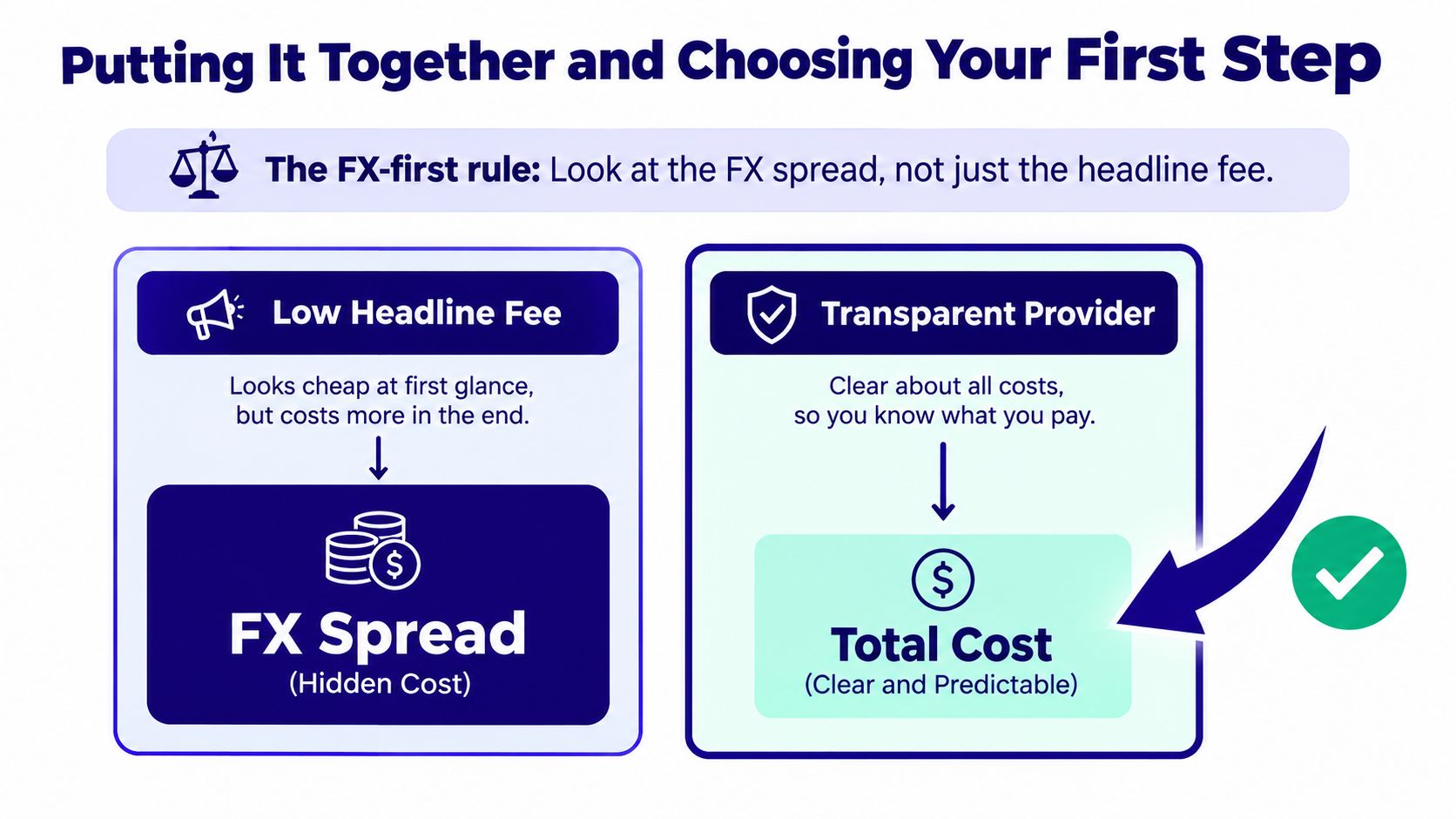
The FX-first rule is simple: compare the total cost of conversion and delivery, not just the advertised payout fee. An inexpensive payout rail can still be costly if the provider applies a wide spread, converts the money more than once, or leaves intermediary deductions for the recipient to absorb.
Make the decision in three layers.
Choose the currencies. List the currencies your recipients request. Don't start with a provider's currency menu. Start with your contractors, suppliers, creators, and customers.
Choose the rails. Decide whether each corridor needs a bank transfer, a local payment rail, or stablecoin settlement. Match the rail to the recipient's practical needs, not only to the transfer speed.
Choose the provider combination. Compare providers that support those currencies and rails while showing the FX margin separately. A provider that handles payins well but gives you little control over settlement may not fit your operating model.
Suby's documented product model covers card, wallet, bank, BNPL, and crypto acceptance through its payment stack, while its product materials describe settlement to a bank account or stablecoins such as USDC. Suby Crypto handles the swap, sponsors the gas, and can settle to a non-custodial wallet or the Suby balance. Product pricing still depends on the payment method, so check the official pricing page for exact figures before making a cost comparison.
For a first setup, map your top three recipient corridors by currency and amount. Request a real quote with the FX margin shown separately, run one test payout for each corridor, confirm what the recipient receives, and only then move more volume.
Take one afternoon to audit your recent payouts. Record the sent currency, received currency, applied rate, explicit fee, intermediary deduction, and payout rail. Then identify the corridor where a tighter spread would have saved the most, and use that corridor as your first provider comparison.
Suby provides an API that lets businesses accept card or crypto payments, plus native Discord and Telegram integrations for subscriptions, paid access, and online communities. Visit Suby to compare its payment, crypto, gating, and invoicing options, then check the current pricing page before choosing your first multi currency payout flow.
