

Gaspard LEZIN
How Long Does an ACH Transfer Take: A Clear Timeline
How long does an ACH transfer take? Get a clear timeline for standard and same-day ACH, the factors that slow transfers down, and ways to speed things up.
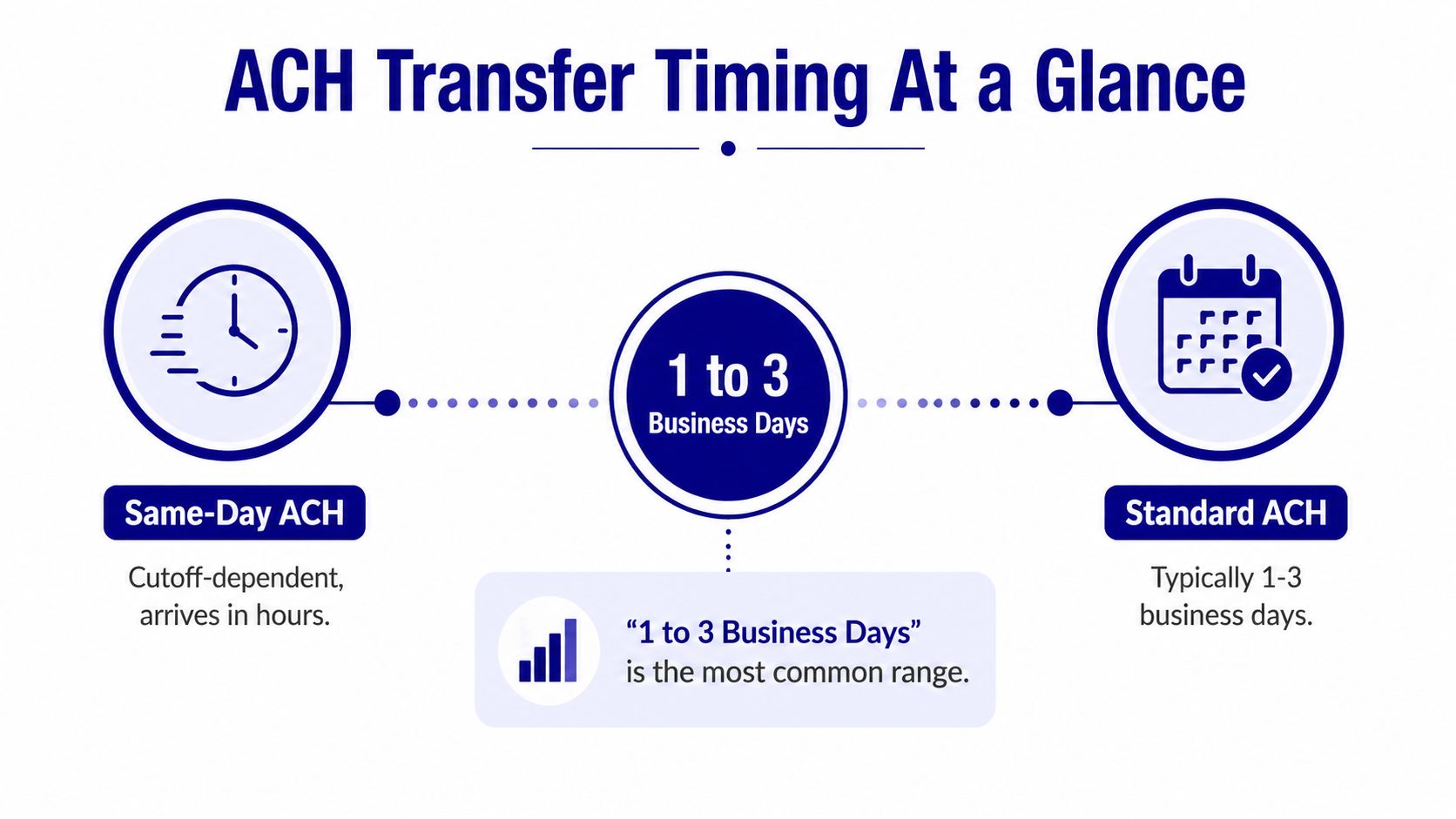
Standard ACH transfers typically take 1 to 3 business days, while Same Day ACH can settle within a few hours when submitted before the day's cutoffs. The exact answer to how long does an ACH transfer take depends on more than the payment date, because the ACH class, direction, bank cutoff, processing window, and calendar all affect when money becomes available.
Why can a payment sent in the morning arrive today, while one sent later appears to take an extra business day? ACH isn't a real-time rail. Banks collect entries, submit them in batches, and process them through scheduled clearing and settlement windows. Once settlement occurs, the receiving bank still has to post the entry to the recipient's account.
For a business owner, the practical question isn't only whether a transfer is “standard” or “same day.” You also need to know whether the payment is a credit or debit, which cutoff it catches, and whether a weekend or banking holiday sits between submission and settlement.
Table of Contents
The Short Answer on ACH Transfer Timing
A standard ACH transfer generally settles in 1 to 3 business days. Same Day ACH can settle in hours when the originating bank accepts the entry before an eligible processing deadline. Nacha explains that ACH payments can be processed within hours on the same business day, scheduled for the following day, or delayed by the sender for up to two business days for credits. The Nacha ACH payments fact sheet also makes clear that timing depends on the ACH class, bank cutoffs, weekends, and holidays.
ACH works through a batch model:
You authorize or submit the payment to your bank or payment provider.
The originating bank, called the ODFI, groups entries into a file.
The ACH operator clears and settles the file during an available processing window.
The receiving bank, called the RDFI, posts the credit or debit to its customer's account.
That process explains why two healthy bank accounts can still show different arrival times. The payment may have settled at the network level, but the receiving bank may not make the balance visible until its next posting cycle.
Practical rule: Treat the settlement date and the account posting time as related, but separate, events.
Take a Tuesday morning transfer between two major U.S. banks. If the originating bank submits it early enough for a same-day window, the receiving bank may post it later that Tuesday. If the payment misses the bank's internal deadline or uses standard ACH, it may move into a later batch and arrive on the next available banking day. A Tuesday submission that misses the relevant cycle can therefore look much slower than another Tuesday payment sent earlier.
The same planning principle applies when you're forecasting incoming funds for a large operation. If the transfer supports payroll, inventory, or a major receivable, pair the ACH estimate with a broader funding timeline for $20M+ businesses so one delayed batch doesn't disrupt the entire cash plan.
What Decides ACH Speed
Why can two ACH payments sent on the same day arrive at different times? ACH operates in batches, so the result depends on more than the transfer date. The entry's class, credit or debit direction, originating bank cutoff, available settlement window, and receiving bank's posting cycle each affect when funds become visible.
The entry type and direction
An ACH credit pushes funds into an account, such as payroll or a vendor payout. An ACH debit pulls funds from an account, such as a recurring bill collection. Debits represented 56% of ACH Network volume in the second quarter of 2023, while credits represented 44%, according to Nacha. Depending on the applicable rules and schedule, a debit may settle the same day or the next banking day. A credit may settle the same day, the next banking day, or in two banking days. Nacha explains the process in its guide to Same Day ACH processing.
The ACH class code adds another layer. CCD, WEB, TEL, and PPD entries support different business and consumer use cases, authorization methods, and risk controls. Your ODFI, the originating depository financial institution, determines how it accepts, reviews, and releases each entry. The class therefore influences operational handling, even when the network itself is running normally.
The submission cutoff
For Same Day ACH, the available windows are:
10:30 a.m. ET submission deadline, settling at 1:00 p.m. ET
2:45 p.m. ET submission deadline, settling at 5:00 p.m. ET
4:45 p.m. ET submission deadline, settling at 6:00 p.m. ET
These deadlines describe network processing, not necessarily the deadline shown in your banking portal. A bank may require customers to submit earlier for review and file creation. A payment sent at 4:30 p.m. ET could therefore miss the bank's internal cutoff, even though the network deadline has not passed.
The receiving bank's posting cycle
Settlement and visibility are separate steps. After the RDFI, or receiving depository financial institution, receives the entry, it applies its controls and posts the funds according to its internal schedule. The payment can therefore be settled at the network level while the recipient's available balance still has not changed.
Factor | How It Affects Speed | Typical Impact |
|---|---|---|
ACH class | Sets the entry's authorization context, rules, and handling | Can affect eligibility and release timing |
Credit or debit | Determines whether funds are pushed or pulled | Can change the permitted settlement date |
Originating-bank cutoff | Determines which batch receives the entry | Missing it can move payment to a later cycle |
Same Day ACH window | Sets submission and settlement opportunities | May allow settlement within hours |
Receiving-bank posting | Determines when settled funds appear | May add time after network settlement |
Businesses forecasting receivables or disbursements should include these variables in a broader cash flow strategy for SMBs. For cross-border payment flows, compare this batch-based model with Suby's alternative to Swift, since bank transfer timing does not follow one universal schedule.
Standard ACH Versus Same-Day ACH Compared
Standard ACH and Same Day ACH use the same network, but they serve different planning needs. Standard ACH typically settles in 1 to 3 business days, while eligible same-day entries can settle on the originated date when they reach the operator before the applicable deadline. The Federal Reserve's FedACH schedule shows that entries not eligible for same-day settlement settle at 8:30 a.m. ET on the later of the next banking day or the calculated settlement date.
Same Day ACH became the major speed milestone for the network. Nacha introduced two same-day clearing windows in 2016, with submission deadlines at 10:30 a.m. ET and 2:45 p.m. ET. In March 2021, Nacha added a third submission window ending at 4:45 p.m. ET, extending the day's opportunity for same-day settlement. The network operates 23¼ hours every business day and settles payments four times per day, according to Nacha's published rules.
The choice depends on how much timing certainty your workflow needs:
Dimension | Standard ACH | Same Day ACH |
|---|---|---|
Settlement timing | Usually 1 to 3 business days | Same business day when submitted before an eligible cutoff |
Submission flexibility | Can be scheduled for a later banking day | Must reach an available same-day window |
Best fit | Routine payroll, vendor payments, and recurring transfers | Urgent refunds, payroll corrections, and time-sensitive payouts |
Main risk | A normal batch can still land later than expected | Missing the cutoff can move the entry to the next cycle |
Receiving-bank effect | Posting depends on the RDFI's schedule | Posting still depends on the RDFI's schedule |
Standard ACH is usually the better operational choice when your business can plan around the normal banking calendar. It fits recurring supplier payments, scheduled payroll files, and high-volume disbursements where a short wait is acceptable.
Same Day ACH makes more sense when the payment's business value depends on receiving funds today. A last-minute vendor payment may avoid a missed deadline if it catches the afternoon window. A payroll correction can also benefit from same-day processing, but only if the bank accepts the file in time and the recipient's bank posts the entry promptly.
The important distinction is that same-day processing isn't the same as instant availability. It improves the settlement opportunity, but it doesn't remove the bank-level posting step.
How Weekends, Holidays, and Cutoffs Add Days
ACH processing follows banking days, not the number of calendar days on a clock. Saturdays, Sundays, and Federal Reserve banking holidays interrupt ordinary processing, so a payment initiated near the end of the week can appear to take much longer than its basic estimate.
Start with the originating bank's internal cutoff. Banks often stop accepting files for a particular processing cycle before the ACH operator's published deadline. If your bank's business cutoff has passed, the entry waits for the next available banking-day cycle, even if a network window remains open.
The network itself has multiple same-day windows, including deadlines at 10:30 a.m., 2:45 p.m., and 4:45 p.m. ET, with settlement at 1:00 p.m., 5:00 p.m., and 6:00 p.m. ET respectively, as outlined in the Federal Reserve's Same Day ACH schedule. Those times create the structure, but your bank's earlier deadline can be the primary bottleneck.
A Friday example
Suppose a business initiates a payroll transfer at 4 p.m. on a Friday before Memorial Day. If the payment misses the bank's same-day cutoff, it won't enter a new banking-day processing cycle during Saturday or Sunday. Memorial Day then prevents ordinary banking-day processing on Monday, so the transfer begins moving on Tuesday morning.
That doesn't mean the ACH network has malfunctioned. The payment is waiting for the next eligible operating cycle.
Build the calendar into your workflow
Use these operating habits:
Check the bank's local cutoff: Your provider may close its submission window earlier than the network deadline.
Count banking days: Don't treat a weekend or Federal Reserve holiday as a processing day.
Submit recurring files early: An automated morning workflow gives the entry more opportunities to catch the intended batch.
Protect due dates with buffer: A payment due after a long weekend needs more planning than one due during an ordinary week.
The Federal Reserve's FedACH processing schedule is useful for understanding operator timing, but it doesn't replace your bank's own cutoff documentation. Ask the originating bank when it stops accepting standard and same-day files, then build that time into your accounts-payable and payroll procedures.
Tracking Your ACH Transfer and Reading Each Status
An ACH status tells you where the entry is in the payment lifecycle, but the wording varies by bank, processor, and API. A dashboard marked “complete” may reflect submission or settlement, so check what the platform's status definitions mean.
The usual status sequence
Pending: The payment was created and is waiting in a queue. The bank or processor may still be validating the instructions.
Submitted: The originating institution has accepted the entry and sent it into the ACH process.
Processing: The entry is moving through batching, clearing, and settlement.
Settled: The ACH operator has completed settlement and the receiving institution has received the entry.
Returned: The receiving bank rejected or sent the entry back. Common return reasons include insufficient funds, an invalid account, or a routing problem.
A return isn't just a status change. It creates an operational exception that usually requires correcting the account details or funding issue and submitting a new entry. The new payment then follows a new processing cycle.
Confirmation numbers and trace numbers
A bank confirmation number usually identifies the instruction within that bank or payment platform. It proves that the request was accepted by that system, but it may not identify the payment across the ACH Network.
A Nacha trace number is used for network-level tracking. When you contact a bank, processor, or recipient's financial institution, provide the trace number, settlement date, amount, and recipient account details through the approved support channel. That gives operations teams a clearer way to locate the entry than a dashboard label alone.
Sender and receiver checks
The sender should verify whether the payment has been submitted, settled, or returned. The receiver should check both the account's transaction history and available balance, because posting and funds availability can occur after network settlement.
For API-based payment operations, webhook notifications can feed status changes into reconciliation workflows. That lets a business match payment records to invoices, payroll files, or vendor accounts without relying only on manual dashboard checks.
Practical Ways to Speed Up ACH Receipt
You can't make an ACH entry move faster after it has missed a processing window, but you can remove avoidable delays before submission. The strongest improvements come from disciplined preparation rather than repeated requests for expedited handling.
Submit early
Send files during the morning whenever the payment needs to arrive the same day or on the earliest possible banking day. Confirm the bank's internal cutoff, not just the network deadline. A provider may require approval, risk review, or file validation before it submits the entry.
When timing matters, choose an eligible Same Day ACH credit and confirm that both financial institutions support the required transaction type. Same-day processing only helps if the entry reaches an available window.
Prevent returns
Store validated routing and account information for repeat recipients. Confirm the recipient's legal account details before making a large or time-sensitive payment, and use prenotification entries where your bank supports them. A small verification step can prevent a failed payment from restarting the entire process.
Use this checklist:
Validate recipient details: Check routing and account numbers before submission.
Automate recurring transfers: Release scheduled payments early in the business day.
Monitor exceptions: Alert the operations team when a payment is rejected or returned.
Allow calendar buffer: Schedule ahead of weekends and banking holidays.
Confirm same-day eligibility: Ask the bank whether the specific entry can use Same Day ACH.
A bank usually can't override a missed network window with a support request. Plan around the available cycles instead. If your business receives funds in different markets, review the operational details for payouts in AED alongside your domestic ACH process, especially when the receiving currency and rail differ.
Faster Settlement Alternatives Worth Considering
ACH remains useful for planned, cost-sensitive transfers, but it isn't the right rail for every deadline. Businesses that need faster availability can compare real-time account-to-account networks, wires, and card checkout with stablecoin settlement.
Real-Time Payments, operated by The Clearing House, is designed for funds movement between participating bank accounts in seconds, with availability around the clock. FedNow provides a similar real-time payment option through the Federal Reserve. Coverage depends on the participating financial institutions, so availability must be confirmed before you design a workflow around either rail.
Wire transfers are still common for high-value, time-critical payments. They can settle quickly during banking hours, but they generally cost more than ACH and offer less reversibility once sent. That makes beneficiary verification and internal approval especially important.
Card checkout with stablecoin settlement follows a different model. The customer pays by card, the payment provider converts the funds into a stablecoin such as USDC, and the business receives settlement without waiting for a later ACH batch. This can be useful for international internet businesses, though eligibility, pricing, currency conversion, and compliance requirements vary by provider.
Suby is one option to evaluate in that category. It provides an API that lets businesses accept payments by card or crypto, and it also offers native integrations with Discord and Telegram for subscriptions, paid access, and online communities. Its single product can be used through Suby Payments, Suby Crypto, Suby Gating, and Suby Invoicing. Customers can pay by card, wallet, bank, or crypto, while the business can choose to receive funds in a bank account or in stablecoins such as USDC, including the flow where a customer pays by card and the business receives USDC. Pricing depends on the payment method, so check the Suby pricing page for exact figures.
Method | Typical Settlement | Availability | Best For |
|---|---|---|---|
Standard ACH | One to 3 business days | Banking-day schedule | Planned payroll and vendor payments |
Same Day ACH | Same business day when eligible | Published windows and bank cutoffs | Urgent domestic disbursements |
RTP | Near real-time where supported | Participating institutions | Time-sensitive account transfers |
FedNow | Near real-time where supported | Participating institutions | Businesses with compatible banks |
Wire transfer | Fast during banking hours | Bank and corridor dependent | High-value, urgent payments |
Card with stablecoin settlement | Near-instant potential, subject to provider processing | Provider, currency, and compliance dependent | Global checkout and alternative settlement |
For international bank-transfer context, compare the operating details in this guide to the Sambapay settlement process for merchants in Singapore. If your business also handles European account transfers, the distinction between ACH and SEPA bank transfer processing can help you choose the appropriate rail for each market.
If ACH timing is creating friction, Suby lets your business accept payments by card or crypto through an API, while customers can also use wallets or bank methods supported by the checkout. Visit Suby to see how its Payments, Crypto, Gating, and Invoicing options can help customers pay their preferred way while you choose whether to receive funds in your bank account or in stablecoins such as USDC.
