

Gaspard LEZIN
Failed Payment Recovery: A Practical Playbook
Master failed payment recovery with proven retry schedules, dunning emails, and self-serve flows. Boost SaaS and e-commerce revenue
Failed recurring card payments can reach roughly 5% to 18%, with an average near 13%, while broader recurring-payment failure estimates sit around 7% to 10% according to industry recovery data. The important detail is that about 80% or more of declines are soft declines, so a failed charge often signals a timing, funding, network, or account-state problem rather than a customer who has decided to leave.
That changes the engineering problem. Failed payment recovery isn't a sequence of increasingly urgent emails bolted onto billing. It's an event-driven system that classifies failures, retries only when a retry makes sense, gives customers a low-friction way to fix permanent issues, and measures the result against a consistent denominator.
Table of Contents
The Hidden Revenue in Soft Declines
A billing system that marks every decline as final creates involuntary churn. The customer may still need the product, yet access ends because the system never retries, never requests a replacement payment method, or directs the customer to a broken update page.
Soft declines are temporary or potentially recoverable failures. Insufficient funds, issuer timeouts, temporary network problems, and some generic processor responses may succeed later. Hard declines generally require customer or merchant action, such as a closed account, a blocked instrument, or a payment method that cannot be used for the transaction. The distinction is imperfect, so normalize the gateway response before the recovery engine chooses an action.
Well-timed retries can recover roughly 45% to 70% of soft-declined transactions as documented in failed-payment recovery research. That range is not a forecast for every business. It shows why a decline code should enter a workflow rather than determine the final subscription state.
Classify the failure before choosing the action
Processors may return an issuer response, processor code, decline category, and human-readable message. These fields serve different purposes. Preserve the raw payload for audits and support, then map it into a small operational model:
Retryable funding issue: Insufficient funds or a temporary issuer response. Schedule a later retry and prevent repeated submissions in a tight loop.
Payment-method issue: Expired details, invalid credentials, or a method that requires replacement. Open a secure update flow instead of retrying the same credentials.
Processor or network issue: Timeout, temporary service failure, or an ambiguous response. Use a guarded retry with idempotency protection.
Hard or restricted decline: Stop submitting the same instrument. Request a new method or send the case to a human review queue.
Risk-related failure: Preserve the processor's decision and apply the fraud and dispute policy. Recovery logic must not weaken authorization controls.
Practical rule: Store the processor's original reason alongside the normalized recovery category. Support and reconciliation need the original value, while automation needs the normalized one.
The economics depend on the denominator. A benchmark dataset reports a median failed-payment recovery rate of 47.6%, while mature dunning programs can recover 3% to 5% of MRR monthly according to StayPaid's benchmark analysis. Compare those figures only after confirming whether the calculation includes every initial failure, customer-driven payment updates, and the full recovery window.
Soft versus hard declines
Decline Type | Common Causes | Recovery Rate | Action Required |
|---|---|---|---|
Soft decline | Insufficient funds, temporary issuer or network response | Often recoverable when retries are timed well | Retry according to reason, timing, and account history |
Hard decline | Closed account, invalid method, restricted transaction | Usually requires a new method or human action | Stop blind retries and ask the customer to update payment details |
Ambiguous decline | Generic processor or issuer response | Depends on subsequent authorization behavior | Apply a cautious retry policy, then escalate to payment-method recovery |
The implementation mistake I see most often is collapsing every result into payment_failed. That event can trigger processing, but it cannot define the workflow. The recovery engine needs a decision record containing the normalized category, retry count, next eligible attempt, payment-method state, and customer-action requirement.
That record also supports the webhook path. Verify the signature, persist the raw event, reject duplicate event IDs through an idempotency table, and resolve the customer, subscription, invoice, and payment method before applying a state change. A retry should be safe to run again if a webhook is delivered twice, while a customer update should cancel or replace any obsolete retry job. That separation prevents stale automation from charging an old instrument after the customer has already supplied a new one.
Building a Smart Retry Schedule
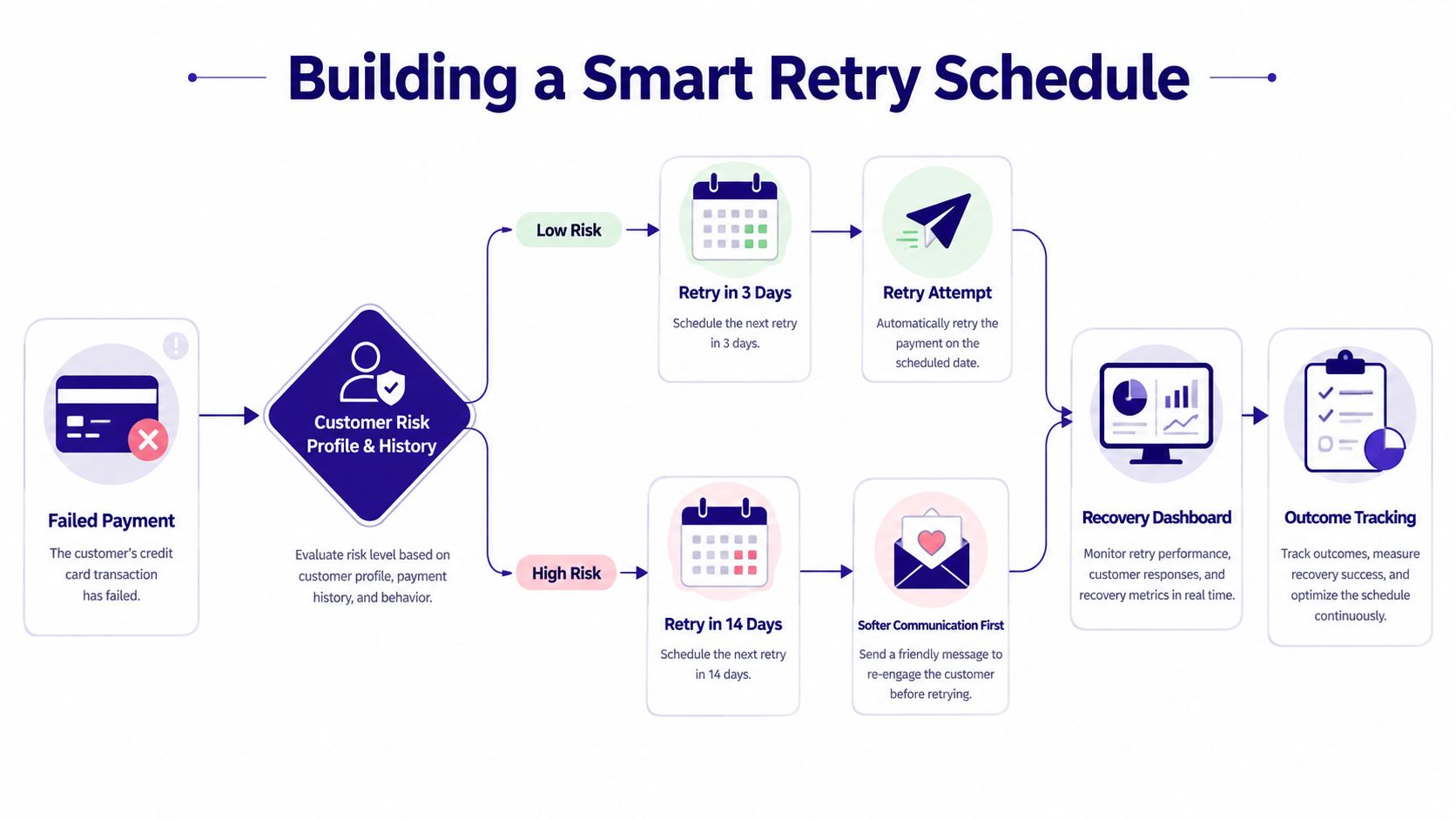
A fixed rule such as “retry every three days for two weeks” is easy to ship and difficult to defend. It ignores the reason for failure, the customer's payment history, the subscription's value, and the fact that retry attempts become less productive as the sequence continues.
Reported platform benchmarks put the first retry within 48 hours at roughly 24% to 35% recovery, with cumulative recovery after three attempts reaching around 50%. By five attempts, roughly 50% of recoverable payments may already have been recaptured, and 90% of recovered transactions occur within the first 10 days as summarized in billing retry benchmarks. The practical conclusion is simple: act early, but don't hammer the network.
Start with an event listener
Listen for the processor's failed-payment and subscription-renewal events. The listener should:
Verify the webhook signature and record the event ID.
Write the raw event to durable storage before starting recovery logic.
Reject duplicate event IDs through an idempotency table.
Resolve the affected customer, subscription, invoice, payment method, and outstanding balance.
Create one recovery case with a stable case ID.
Enqueue the next action rather than performing a retry inside the webhook request.
That last step protects availability. Webhook providers expect a fast acknowledgement, while payment work may involve classification, rate limits, customer notifications, and processor calls.
A recovery case should contain the initial failure timestamp, normalized reason, processor reference, attempt count, next eligible attempt, account value tier, payment-method fingerprint, and current state. Keep the state machine explicit. Useful states include failed, scheduled, retrying, recovered, action_required, paused, and closed.
Give each bucket its own policy
For insufficient funds, schedule an early retry and then widen the interval if it fails. For an expired payment method, send the customer to an update page before attempting the old instrument again. For a processor timeout, retry cautiously with the same idempotency key or an equivalent processor-supported deduplication mechanism.
Priority belongs in the queue, not in a pile of conditional statements. High-value accounts can receive faster human escalation, but they shouldn't automatically receive unlimited payment attempts. Low-value accounts still deserve a consistent customer experience, while the system can cap operational effort when the expected recovery value is small.
Use a circuit breaker around processor calls. If a processor or network begins returning infrastructure failures, pause that failure class for a controlled interval and alert the billing team. A circuit breaker prevents your recovery system from turning a processor incident into a flood of duplicate or futile requests.
For teams comparing implementation options, the recurring payment credit card guidance from Suby is a useful reference point for thinking about recurring-card behavior and payment-method changes. Whatever provider you use, the core safeguards remain the same: idempotency, bounded attempts, reason-aware scheduling, and durable event history.
Designing Effective Dunning and Self-Serve Flows
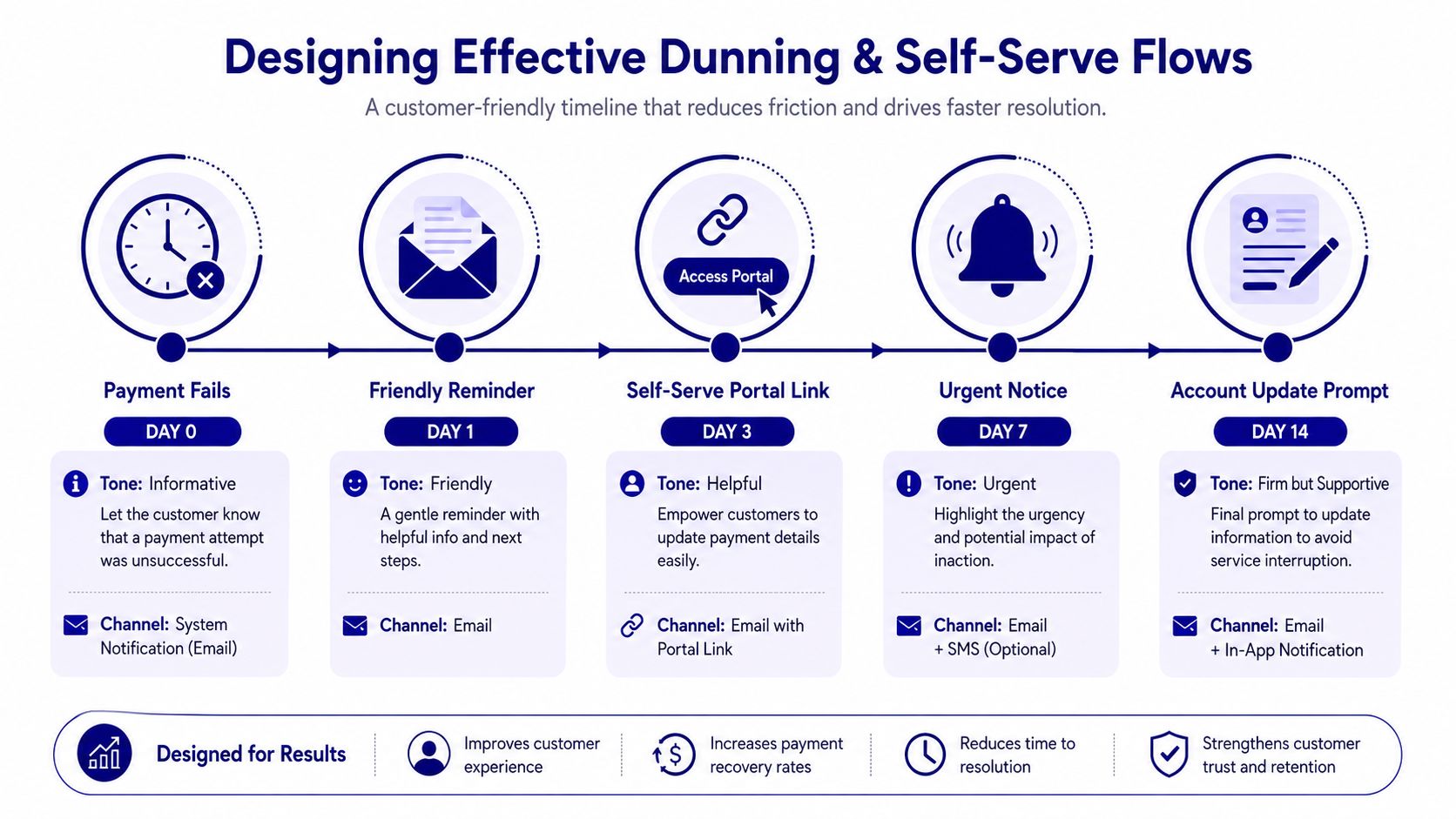
A customer whose payment failed doesn't necessarily need a warning. They need a clear explanation and a safe way to resolve the problem. The strongest dunning flow I've worked with separates background retries from customer action, so the customer isn't asked to do something the system could solve automatically.
The first message should be calm and specific. Explain that the latest payment didn't complete, identify the product or invoice without exposing sensitive payment details, and provide one direct button to update the method. Don't make the customer search through account settings, remember a password, or re-enter information on a page that isn't optimized for mobile.
A practical customer journey
Suppose an automatic renewal fails because the issuer returns a potentially temporary response. The recovery engine schedules a retry, then sends a friendly notice that tells the customer what happened without implying misconduct. If the retry succeeds, the system immediately suppresses all pending messages and records the recovery source.
If the retry doesn't succeed, the next message should contain a short-lived, authenticated payment-update link. The page should show the account context, support the payment methods your processor accepts, and return the customer to a clear success state. Never treat “the customer clicked” as recovery. The subscription remains unresolved until the new method is successfully authorized or the outstanding invoice is collected.
A later message can explain the consequence of inaction, such as a pause in access, but it shouldn't use threatening language. For practical guidance on structuring the message itself, this payment email reminder resource offers a useful starting point. Adapt the wording to your product, support model, and actual suspension policy.
Remove friction from payment updates
A self-serve page should be pre-authenticated through a signed, expiring token. It should never place card details in your application logs, and it should hand sensitive collection to the processor's hosted fields or equivalent secure components. After the update, invalidate the token, attach the new method to the correct customer, and trigger collection against the intended invoice with a new idempotency key.
Two edge cases need explicit handling:
The replacement method fails: show the precise next action, preserve the case state, and don't loop the customer through the same page without new information.
The customer has already fixed the issue: make every page and message read the current subscription state before displaying an action. A stale email can create distrust even when the payment is already settled.
High-value accounts may need a CRM task for a customer success manager, but that escalation should coexist with automation. The account manager needs the failure reason, attempts made, amount outstanding, and customer actions already completed. Sending a generic “please investigate” task moves the same ambiguity from billing to support.
Choosing the Right Recovery Channels
Email, SMS, in-app prompts, and human outreach support different recovery jobs. Selecting a channel based on the failure state reduces unnecessary contact and gives customers a clear next action.
Precision matters more than message volume. A 2025 retention report attributed 28.1% of recoveries to precision retries, compared with 8.4% from email, 0.6% from SMS, and 3.5% from a failed-payment wall, as reported in the channel analysis. These figures are reported recovery shares, not universal conversion rates. They still challenge the assumption that sending more reminders automatically recovers more revenue.
Compare channels by job
Channel | Avg. Recovery Rate | Cost per Recovery | Best Use Case | Recommended Timing |
|---|---|---|---|---|
Precision retry | 28.1% of reported recoveries | Variable processor and operational cost | Temporary or diagnosable failures | Early, reason-aware window |
8.4% of reported recoveries | Usually low marginal cost | Explanation, payment update, and account context | After classification and before access changes | |
SMS | 0.6% of reported recoveries | Messaging cost and consent requirements | A narrowly targeted reminder or escalation | Only where consent and urgency justify it |
In-app wall | 3.5% of reported recoveries | Product implementation and support cost | Customers still actively using the product | When the user is authenticated in the product |
Human outreach | Not established in the cited dataset | Highest operational cost | Strategic or complex accounts | After automated context is available |
Treat the table as directional evidence, not a forecast for every billing system. Your webhook events, processor mix, customer behavior, and retry policy determine actual results.
Email remains useful because it can explain the failure, show the account context, and link to a secure payment-update flow. It also reaches customers who are not logged in. Build the send worker around current invoice and subscription state. Otherwise, the customer may receive the same reminder after updating the payment method or settling the invoice.
SMS has a narrower role. Use it for a time-sensitive reminder when the customer has opted in and the account warrants interruption. Routine billing notices sent by text can feel invasive, particularly after the customer has already acted through email or in-app messaging.
In-app prompts work for authenticated, active users. They provide immediate context, but they cannot reach customers who have stopped visiting the product. Keep an external recovery path available, and render the prompt from live billing state rather than a cached failure event.
Recovery channels should follow the diagnosis. The payment state is the source of truth, not the message sequence.
Suppression logic needs the same implementation care as delivery logic. Each channel worker should check whether the recovery case is already recovered, paused, or action_required before sending. Process webhook updates idempotently, then re-evaluate queued messages against the latest state. This prevents a “final notice” from arriving after successful payment.
Measuring Recovery Performance Accurately
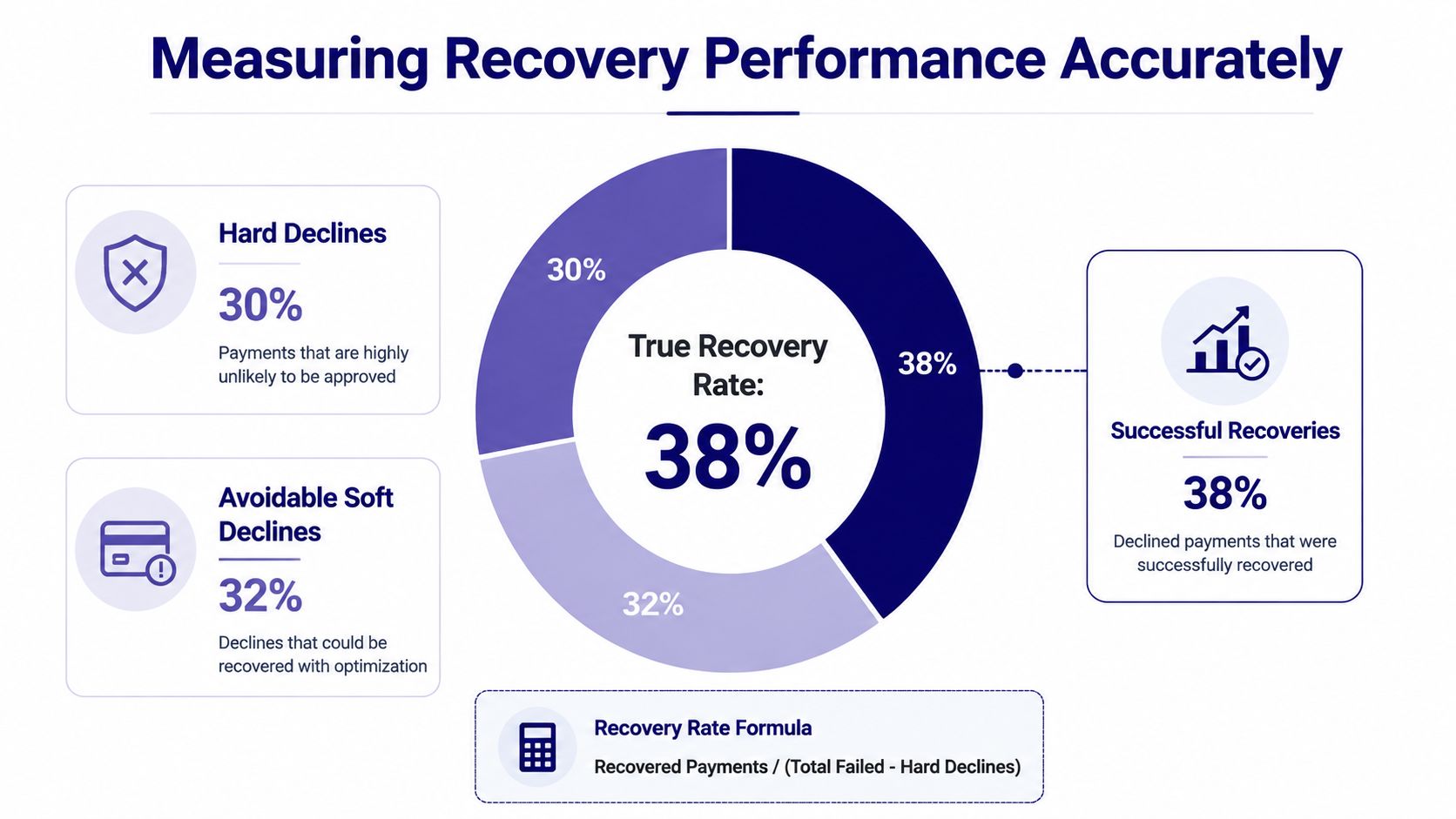
A recovery dashboard can look impressive while measuring the wrong thing. The most common error is dividing collected payments by every failed transaction, then comparing that result with a benchmark calculated from attempted recoveries or a different recovery window.
The first step is to count every initial failure and assign it a stable case ID. Then record all later outcomes, including automatic retries, customer-driven card updates, manual collection, permanent closure, and cases intentionally excluded from automation. A customer who updates a card and pays later is still a recovery, even though no retry succeeded.
Use a consistent measurement model
A practical dashboard should show:
Recovery rate by failure category: Separate soft, hard, payment-method, processor, and risk-related outcomes.
Time to recovery: Measure from the initial failure to successful collection.
Recovered revenue: Track collected value, refunds, fees, and any write-off policy separately.
Recovery source: Attribute the result to retry, update flow, email, in-app prompt, SMS, or human intervention.
Involuntary churn: Count accounts that lose access or cancel because the payment issue remained unresolved.
Attempt volume and cost: Include processor fees, messaging costs, support time, and infrastructure effort.
For an addressable-pool view, use:
Recovered payments / (initial failed payments - confirmed hard declines and excluded cases)
For a dunning-system view, use:
Recovered payments / recovery attempts
The second formula evaluates what the recovery system attempted. The first estimates performance against a defined recoverable pool. Neither is automatically correct without a written policy describing exclusions, attribution, and the closing window.
Prevent false improvement
Cohort by failure date, processor, payment method, geography, plan, and failure reason. Compare cohorts only after the same recovery window has elapsed. Otherwise, a newer cohort will look weaker just because it hasn't had enough time to resolve.
Don't count every successful retry as a new recovered customer. One initial failure should map to one recovery outcome, even if the system made several attempts. Also separate processor authorization changes from customer action. That distinction tells you whether to improve retry timing, payment-method UX, communication, or account management.
For teams building a broader payment analytics model, Suby's payment analytics resource provides relevant context for organizing payment events and outcomes. The operational principle is straightforward: measure the full case lifecycle, not just the last request sent to the processor.
Implementing the Recovery Stack
A production recovery stack has four connected layers: the payment processor, a webhook listener, a retry engine, and a customer communication layer. The system works when each layer has a narrow responsibility and shares a durable payment-case record.
The processor creates the payment result. The webhook listener receives and stores it. The retry engine decides whether and when another attempt is allowed. The communication layer explains the customer action and opens a secure path to resolution. Customer actions then feed back into the case, so the retry engine doesn't continue operating on stale information.

Build the interfaces before the automation
Start with a normalized payment-event schema. Include the provider, event ID, payment reference, customer reference, invoice or subscription reference, currency, amount, failure data, and event timestamp. Preserve the raw payload separately so future classification changes don't require reconstructing history from logs.
The retry service should consume cases from a durable queue. It needs idempotency keys, attempt limits, per-provider rate controls, a circuit breaker, and a dead-letter path for events that can't be resolved automatically. It also needs a reconciliation job that compares internal state with processor outcomes, because webhooks can arrive late, out of order, or more than once.
The communication service should subscribe to state changes rather than guessing from time alone. A recovered case cancels pending notices. An action_required case sends the update link. A paused case creates a support task instead of another automated email.
Choose managed or custom logic deliberately
Built-in smart retries reduce engineering work and can be a sensible default, especially when a team lacks reliable payment-event infrastructure. Custom logic gives more control over segmentation, customer value, multi-entity billing, and communication, but it creates responsibility for testing, monitoring, reconciliation, and processor-specific behavior.
Don't replace a working billing system merely to improve recovery. An additive recovery layer can consume failed-payment events, apply bounded decisions, and return outcomes through webhooks while the existing subscription system remains authoritative. If your operations team is also evaluating automation beyond billing, resources such as browsing AI employee deployment can help frame where human review should remain in the loop.
For payment infrastructure that supports recurring billing, developers can review the Suby subscription billing API as one implementation reference. Suby provides an API that lets businesses accept payments by card or crypto, and it offers native integrations with Discord and Telegram for subscriptions, paid access, and online communities.
A launch checklist should include replay testing for webhooks, duplicate-event tests, processor outage behavior, payment-method replacement failures, message suppression after recovery, reconciliation against settled transactions, and cohort-level dashboard validation. Keep the old billing flow observable during rollout, run the recovery layer on a controlled segment first, and define a rollback that pauses new recovery actions without corrupting subscription state.
Suby is payment infrastructure for the global internet economy, with Suby Payments, Suby Crypto, Suby Gating, and Suby Invoicing in one product. Businesses can accept cards, wallets, bank transfers, and crypto through its API, while customers can pay their preferred way and the business can receive funds in a bank account or stablecoins such as USDC. Visit Suby to review the payment methods, API, recurring payment capabilities, Discord and Telegram integrations, and method-dependent pricing.
