

Gaspard LEZIN
What Is Stablecoin Settlement? a Clear Guide
Learn what is stablecoin settlement, how it works, its benefits and risks, and key finality questions for businesses in 2026.
Stablecoin settlement is the final transfer of a stablecoin-denominated payment obligation from payer to recipient, with the value recorded on a blockchain and no longer reversible under the relevant settlement rules. In practice, usable settlement may come later, because conversion, off-ramp, compliance, and treasury steps can still stand between a completed token transfer and money a merchant can spend.
What is stablecoin settlement if a transaction appears in a block but the finance team still can't use the funds? That question exposes the gap in many explanations. A blockchain event, technical finality, and end-to-end payout availability are related, but they aren't identical.
The distinction matters for any business evaluating stablecoins for checkout, supplier payments, payroll, or treasury movement. Stablecoins can move quickly across blockchain rails, but the practical result depends on the chain, the asset, the wallet, the conversion route, and the controls around the payment.
Table of Contents
Understanding Stablecoin Settlement
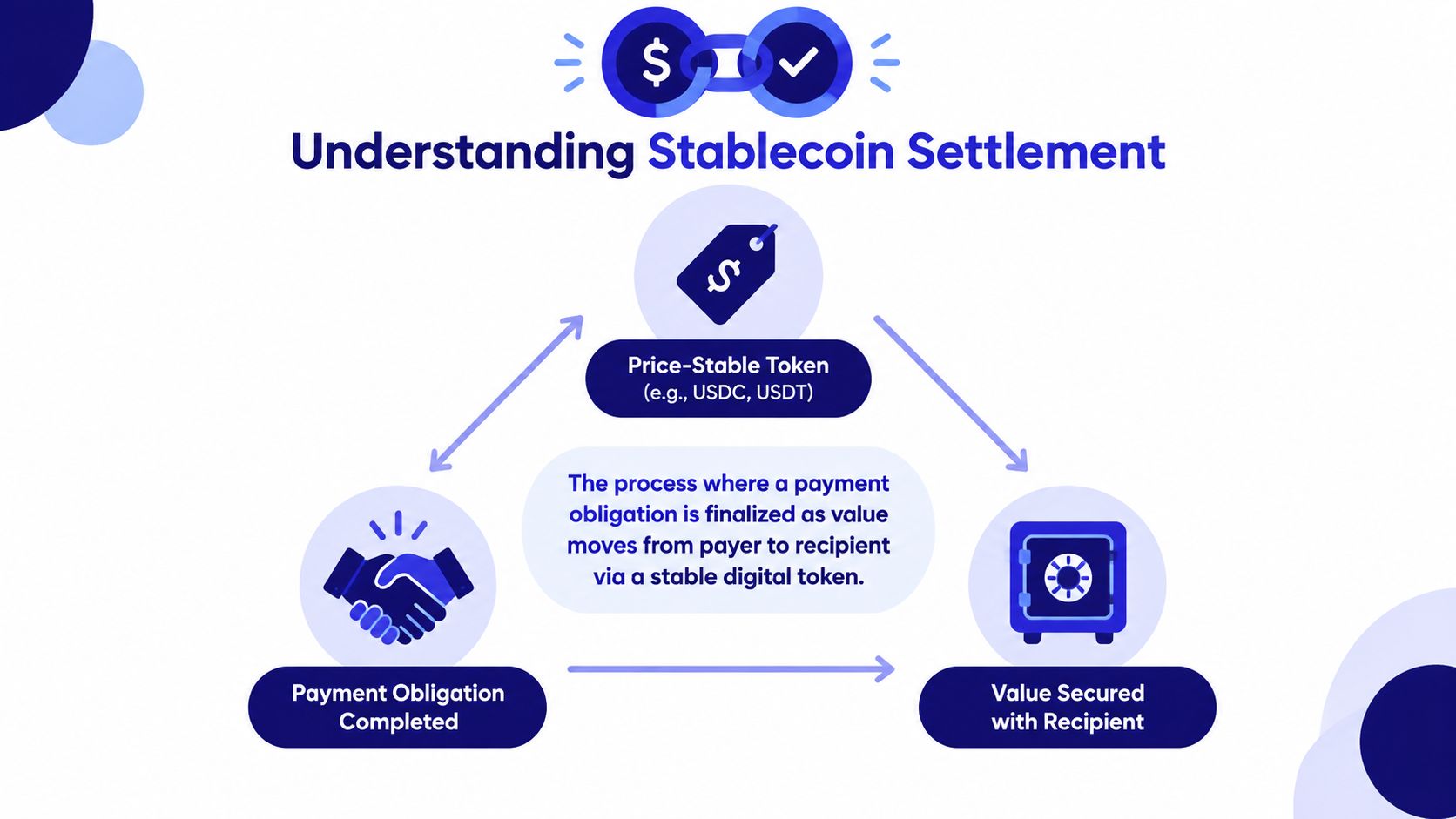
Stablecoin settlement means completing a payment obligation in a price-stable digital token such as USDC or USDT. The payer sends the agreed value, the recipient receives it, and the transfer becomes final under the technical and operational rules of the blockchain or payment arrangement.
That doesn't happen the moment someone signs a transaction. A signed transaction is only an instruction. A broadcast transaction is waiting to be processed. Even block inclusion may not represent final settlement if the chain can reorganize or reverse the event before its required finality threshold.
The Bank for International Settlements guidance on stablecoin arrangements describes proper settlement in terms of clear and certain final settlement, at least by the end of the value date, with transfers becoming irrevocable under the operational method used. For businesses, that means the accounting event should occur at the point where the legal and technical meanings of “settled” match.
The token transfer is only one layer
A stablecoin normally aims to track a reference value, often a fiat currency or assets intended to support that reference. That makes it different from a volatile cryptocurrency whose market price can change substantially while a payment is moving.
Traditional card settlement follows a different path. A card transaction is authorized, cleared, and settled through merchants, acquirers, and card-network systems. The merchant may see an approved payment quickly, while the actual movement of funds follows the network's settlement process.
On-chain settlement offers a shared, verifiable ledger and can support programmable payment rules. Yet a merchant receiving USDC may still need to convert it to local currency, send it to a bank account, or move it into an approved treasury wallet. Until that happens, the token may be technically settled but not operationally usable for ordinary expenses.
Businesses learning how to accept crypto payments should therefore define settlement in two ways. The first is blockchain settlement, meaning the transfer has reached the required finality. The second is business settlement, meaning the recipient can use the value for the purpose that matters.
How Stablecoin Settlement Works
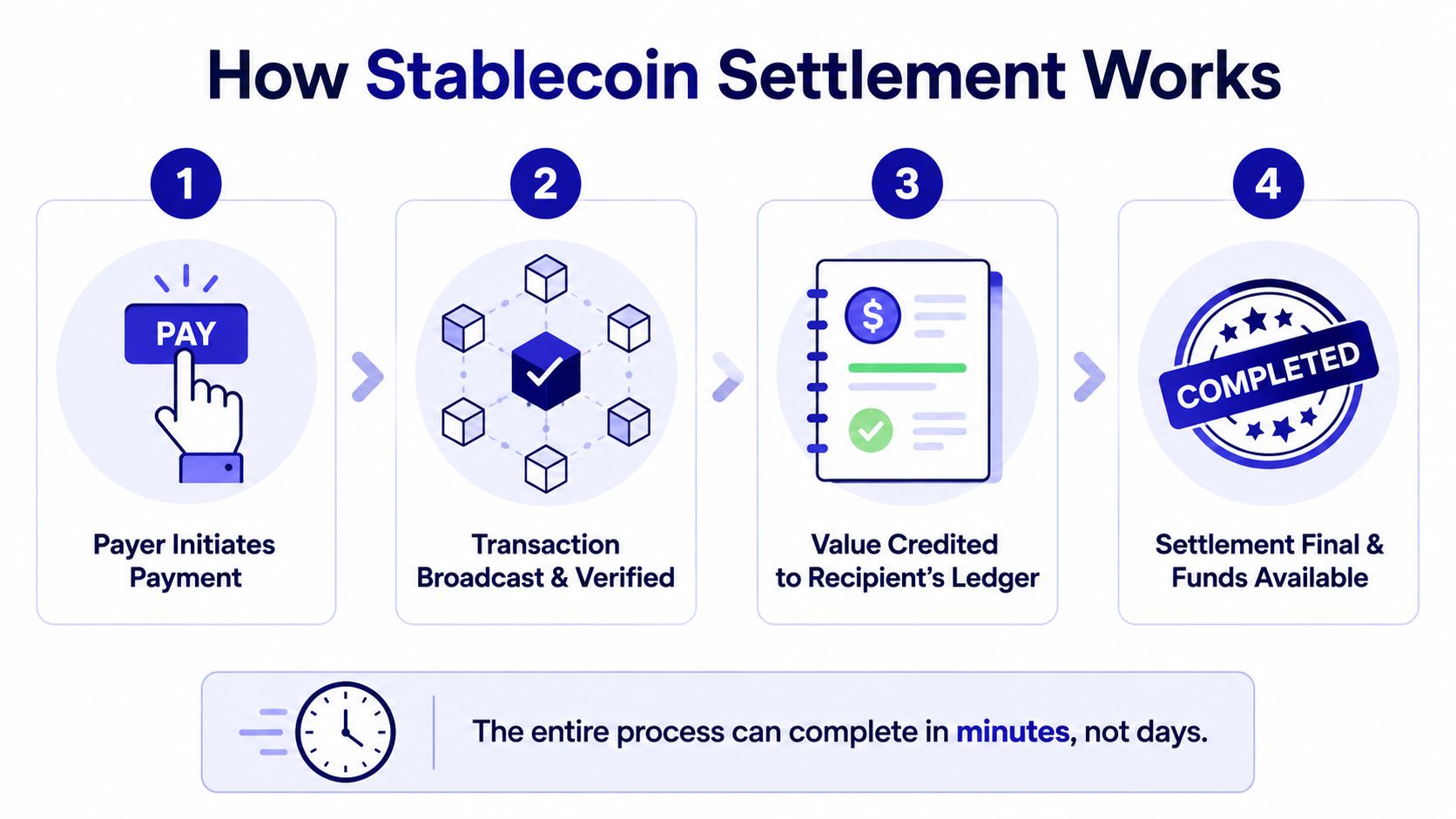
A stablecoin payment usually passes through four practical stages. Each stage answers a different question, from “Did the payer authorize this?” to “Can the recipient spend or reconcile the funds?”
1. The payer initiates the payment
The payer chooses a wallet, exchange account, or payment interface. That system identifies the recipient address, the token contract, the amount, and the blockchain network. The wallet then signs the transaction with the payer's authorization.
At this point, no settlement has occurred. The payer has created a valid instruction, but the recipient can't safely treat the funds as final until the network processes the instruction.
2. The network receives and verifies it
The signed transaction is broadcast to the selected blockchain. Validators or other network participants check whether the transaction follows the network's rules, including authorization and available balance. The transaction waits for inclusion in a block or for the chain's equivalent confirmation event.
The time varies by network. A technical review of B2B stablecoin payments describes Ethereum mainnet confirmation at roughly 12 seconds, with economic finality around 12 minutes, while Solana can finalize in sub-second to second-scale times and Stellar can finalize in under five seconds. These figures describe chain behavior, not the full time required for a bank payout or fiat conversion. The review of cross-border stablecoin settlement also notes that bridge and off-ramp steps can dominate end-to-end timing.
3. The recipient's balance updates
Once the transfer reaches the recipient's required confirmation threshold, the wallet, custodian, or payment platform credits the value. The recipient can verify the token, network, amount, destination, and transaction hash.
A treasury team shouldn't rely only on a wallet notification. It should reconcile the blockchain record with the invoice, order, or payout instruction. Token contracts can be imitated, and a payment sent on the wrong network may not be usable even if the transaction itself is valid.
For teams comparing token conversion tools, a resource such as Memecoin Swap can help illustrate how swapping differs from settlement. A swap changes one asset for another, while settlement completes the underlying payment obligation.
4. The recipient chooses what usable value means
The recipient may hold the stablecoin, exchange it for another asset, or off-ramp it into fiat. A crypto payment processor can coordinate some of these steps, but the business still needs to understand which event triggers its accounting entry and which event makes the funds available for spending.
That is why choosing a crypto payment processor requires more than checking blockchain speed. The important questions include supported networks, confirmation policy, conversion liquidity, bank payout timing, reconciliation data, and exception handling.
Finality and End-to-End Availability
A finance team needs a clear finality policy before it accepts stablecoins at scale. “Confirmed” can mean different things depending on the chain and the provider's risk model.
Probabilistic finality means confidence rises as additional blocks confirm the transaction. A reorganization becomes less likely, but the system is managing risk rather than reaching an absolute guarantee immediately. Deterministic finality describes systems where the protocol reaches a defined final state. Economic finality means reversing the transaction would be impractical because the cost or consequence is too high.
The BIS framing is useful because it moves the discussion beyond block explorers. A settlement process should make finality clear and transfers irrevocable under the method being used. Businesses need to translate that principle into internal rules.
Practical checks before marking funds settled
A treasury workflow can include these controls:
Set a chain-specific threshold: Decide how much confirmation or finality evidence is required for each network and payment risk level.
Verify the transaction hash: Match the hash, recipient address, token contract, network, and amount to the expected instruction.
Check the asset: Confirm that the token is the intended stablecoin, not a similarly named or wrapped asset.
Reconcile the amount: Compare the received value with the invoice or payout record after considering fees and conversion.
Review availability: Confirm whether the funds are spendable in the destination wallet or still waiting for a provider, bridge, compliance review, or bank transfer.
Blockchain | Typical Confirmation Depth for Settlement | Finality Character | Common Stablecoins |
|---|---|---|---|
Ethereum | Provider-defined threshold, with economic finality around 12 minutes described in a technical review | Probabilistic and economic | USDC, USDT |
Solana | Provider-defined threshold, with sub-second to second-scale finalization described in a technical review | Fast protocol finality, subject to operational policy | USDC, USDT |
Stellar | Provider-defined threshold, with finalization under five seconds described in a technical review | Fast protocol finality, subject to operational policy | USDC, USDT |
The table isn't a universal approval policy. Providers can require different thresholds, and a bridge transfer introduces another trust and execution layer. A chain reorganization, wrapped asset issue, or delayed off-ramp can still prevent a technically completed payment from becoming usable cash.
Teams that care about clean reconciliation can also study digna financial data observability as a broader example of why monitoring the full data path matters. For cross-border flows, cross-border payment solutions should be evaluated against the same standard. The question isn't only whether the token moved. It's whether the business can prove, reconcile, and use the value.
Benefits and Risks for Businesses
Stablecoin settlement can improve a payment workflow, but the advantage appears only when the surrounding process supports it. A fast blockchain transfer doesn't automatically produce a cheaper bank payout or a simpler accounting record.
Dimension | Potential Benefit | Risk or Limitation |
|---|---|---|
Speed | On-chain value can move in seconds or minutes | Confirmation policies, compliance checks, bridges, and off-ramps can add delay |
Availability | Blockchain networks can operate outside normal banking schedules | The recipient's bank, provider, or treasury team may still follow operating hours |
Intermediaries | A direct digital ledger can reduce reliance on correspondent payment steps | The business may still depend on exchanges, custodians, banks, or liquidity providers |
Cost | Some cross-border flows may avoid parts of traditional payment routing | Network fees, conversion spreads, payout charges, and provider fees still apply |
Programmability | Payment rules can connect to software and automated workflows | Integration, monitoring, key management, and exception handling require specialist controls |
Global reach | A business can receive a token across borders without asking every payer to use the same bank rail | Laws, licensing, sanctions screening, tax treatment, and local payout access vary by jurisdiction |
Operational rule: Measure the time and cost from customer authorization to usable funds, not from wallet broadcast to block inclusion.
The strongest use case is often a business payment rather than consumer checkout. One estimate cited by McKinsey and Artemis put B2B stablecoin payments at about $226 billion out of roughly $390 billion in real-world stablecoin payments in 2025, or around 60% of the total, as reported by Sentora's analysis of real-world stablecoin payments. That suggests supplier payments, treasury transfers, and cross-border working capital deserve at least as much attention as retail checkout.
The scale also needs careful interpretation. Raw on-chain transfer volume exceeded $33 trillion in 2025, above the combined $25.5 trillion handled by Visa and Mastercard that year, according to Forbes' analysis of stablecoin settlement volume. Raw transfers can include trading, arbitrage, and internal treasury movement, so businesses shouldn't treat network volume as proof that every transfer represents a merchant payment.
Risks include exposure to a stablecoin losing its reference value, issuer or custodian failure, private-key loss, mistaken addresses, frozen assets, regulatory uncertainty, and insufficient local liquidity. A sensible evaluation compares those risks with the specific friction in the existing payment route.
Merchant, Payroll, and Treasury Uses
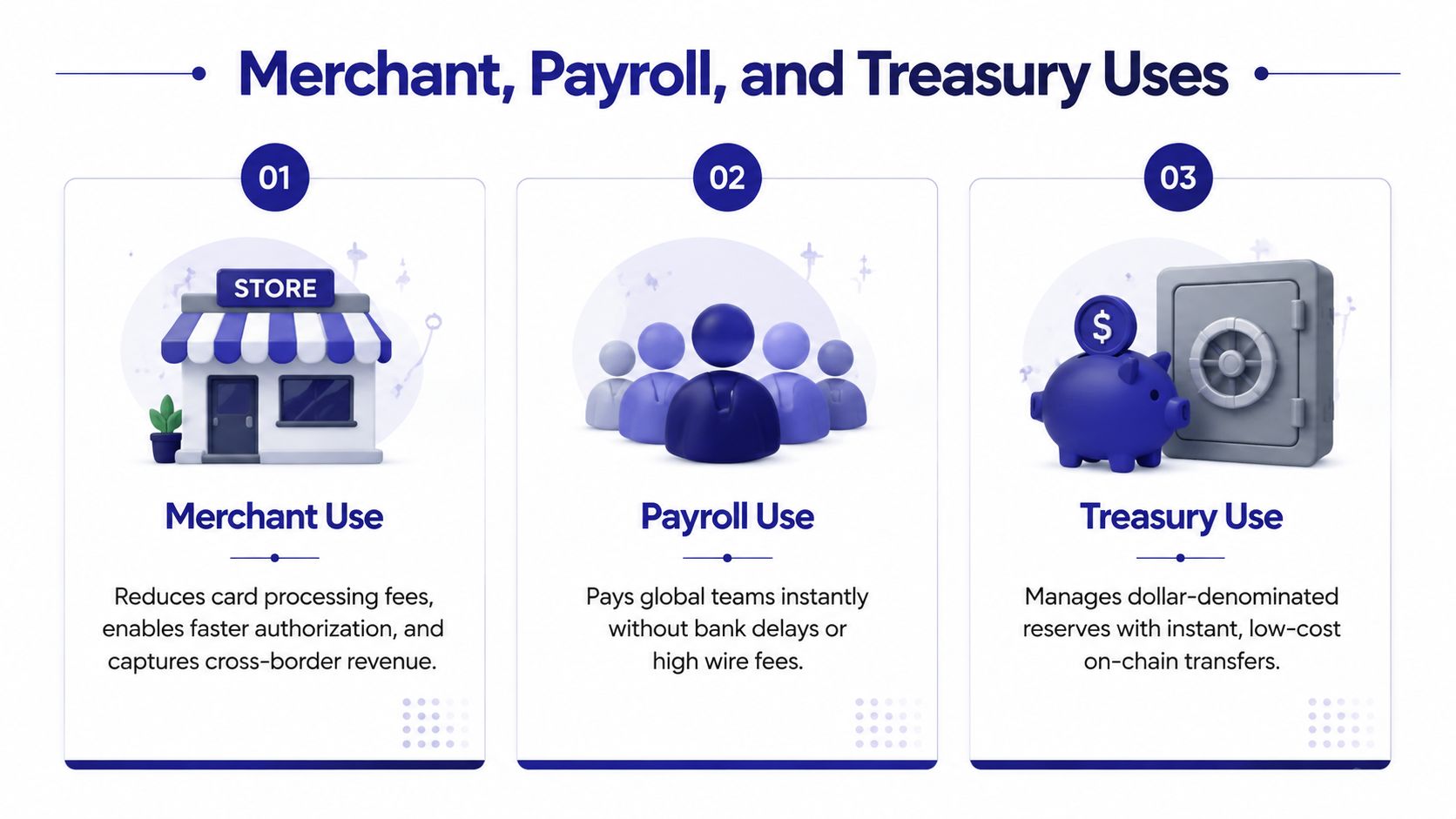
The same token transfer can solve different problems depending on who receives the funds. The correct design for an online merchant won't necessarily work for payroll or corporate treasury.
Merchant settlement
An online merchant may let a customer pay by card while receiving USDC. In that model, the customer experience can remain familiar, while the merchant selects a different payout asset. This can help a business centralize cross-border receipts or keep part of its operating balance in a dollar-referenced token.
Card-network settlement has an important limitation. The customer transaction is still authorized and cleared on the card network, and only the settlement leg moves in stablecoins. Visa says its U.S. stablecoin settlement launch allows select issuer and acquirer partners to settle VisaNet obligations in Circle's USDC, with seven-day availability and faster blockchain-based funds movement, without changing the consumer card experience, as described by this overview of card stablecoin settlement.
The business question is: Will stablecoin receipt improve the merchant's treasury workflow after conversion, fees, and reconciliation are included?
Cross-border payroll
A company paying remote workers may use stablecoins to move a dollar-denominated obligation across borders, then offer recipients a local conversion or payout route. This can reduce dependence on several correspondent banks in a payment chain, but it doesn't remove the need to assess employment rules, licensing, tax reporting, sanctions screening, and foreign-exchange exposure.
The employee also needs a usable exit route. A token arriving in a wallet isn't the same as local purchasing power arriving in a bank account. The operational question is: Can each worker legally and reliably convert the payment in the place where they live?
Treasury operations
A treasury team might use stablecoins for supplier settlement, intragroup rebalancing, or movement between approved wallets. Those transfers can be programmable and visible on-chain, but the team still needs wallet permissions, dual approval, exposure limits, accounting treatment, and a process for failed or delayed transactions.
A business reviewing this stablecoin treasury management guide should focus on policy rather than token enthusiasm. The deciding question is: Does the organisation have the controls to treat a blockchain wallet as part of its financial operations?
Each scenario has a different success condition. Merchants care about payout and reconciliation, payroll teams care about lawful access and employee usability, and treasury teams care about control, liquidity, and auditability.
Settlement Options with Suby
Suby is a single payment product with four ways to use it. Its API lets any business accept payments by card or crypto, while its native integrations with Discord and Telegram support use cases such as subscriptions, paid access, and online communities.
The operating model separates how the customer pays from how the business receives the money. A customer can pay by card, wallet, bank method, or crypto, while the business can choose bank settlement, stablecoin settlement such as USDC, or another supported currency path. The exact timing and cost depend on the selected payment and payout methods, so businesses should check the Suby pricing page for current method-specific figures rather than assume a flat rate.
Four ways to use one product
Suby Payments: An API-first payment stack for accepting cards and crypto through one checkout, with dashboard and integration options.
Suby Crypto: A crypto payment gateway that handles the swap, sponsors the gas, and settles to a non-custodial wallet or the Suby balance.
Suby Gating: Paid access for Discord, Telegram, downloads, and courses, including subscription-style community and digital-product use cases.
Suby Invoicing: Client billing where the payer chooses the method and the business chooses what it receives.
A typical flow starts when the customer authorizes a card or crypto payment. The payment is processed, the funds reach the Suby balance, and the business selects its payout route. That route might lead to a bank account or a stablecoin wallet, depending on the business's preference and the supported method.
This creates several practical use cases. A crypto-native merchant can accept digital assets and settle to a chosen wallet. A traditional business can accept crypto without making every customer use it or requiring the business to manage the conversion itself. A freelancer or distributed team can invoice globally and choose a stablecoin payout. A crypto-focused company can pay suppliers or contractors through a workflow that separates customer checkout from treasury receipt.
The core choice remains simple, even though the underlying operations aren't. Customers pay any way they want, and businesses get paid the way they choose.
A Practical Settlement Decision Framework
A confirmed token transfer isn't automatically usable settlement. Before adopting stablecoins, compare the complete payment journey with the existing bank or card process.
Use five checks:
Finality: Does the destination chain provide enough certainty for the amount and risk involved?
Off-ramp access: Can the recipient convert or spend the stablecoin, and what fees or counterparty steps apply?
Treasury fit: Can finance workflows handle confirmation timing, wallet approvals, and balance changes?
Compliance and reconciliation: Can the business screen, document, match, and report every payment?
Provider resilience: Do the provider's service commitments and exception processes hold up during high demand?
Score each check against traditional rails. Stablecoin settlement may be faster for the on-chain leg, but a bank payout can still win for a particular currency, jurisdiction, or accounting process. Likewise, a lower apparent transfer cost can disappear after network fees, conversion spreads, and operational work.
Start with a controlled pilot using small flows. Measure the time from authorization to funds that the business can use, then review conversion, reporting, reconciliation, and failed-payment handling before expanding.
Suby provides an API for accepting card and crypto payments in one checkout, with settlement options that can include a bank account or stablecoins such as USDC. Visit Suby to evaluate the payment, gating, invoicing, and payout workflows against your own settlement requirements.
