

Gaspard LEZIN
List Price vs Net Price: A Complete Guide for Merchants
Learn the difference between list price vs net price and how each affects your pricing strategy for better profits.
Most advice on list price vs net price treats the gap like a simple discount exercise. That's too neat for real pricing work. In practice, the answer changes depending on whether you're looking at a contract, a cart, an invoice, or a cross-border settlement flow, and that's exactly where teams get forecasting and margin analysis wrong.
For merchants and SaaS operators, list price is the published anchor, while net price is the realized transaction price after the adjustments that hit revenue. Some pricing systems include taxes and fees in net price, some exclude them, and some use the term to mean whatever the customer ultimately pays at checkout. If you don't define it tightly, you'll end up comparing different numbers as if they were the same thing.
Term | What it usually means | Why it matters |
|---|---|---|
List Price | Published reference price, sticker price, catalog price, or MSRP | Sets the anchor for discount governance and negotiations |
Net Price | Realized transaction price after discounts and, depending on context, taxes, fees, rebates, or credits | Should drive revenue, margin, and tax modeling |
Checkout Total | What the buyer sees before paying | Can differ from both list and contract net price |
Invoice / Contract Net | The amount defined in the commercial agreement | Often used in B2B, but not always the same as customer out-of-pocket cost |
Pricing teams don't operate in a single clean model. A SaaS renewal, an ecommerce checkout, and a cross-border invoice all compress list price into net price in different ways. If you want reliable pricing decisions, you have to know which version of “net” you're using.
Table of Contents
Why Net Price Is Not as Simple as It Sounds
A lot of explainers stop at “net price equals list price minus discount.” That's useful, but it's incomplete. In actual commercial work, the term gets used in different ways, and that inconsistency creates confusion the first time a finance team, sales team, and checkout team all try to reconcile the same deal.
The definition changes by context
Some sources treat net price as the amount paid after discounts only, while others fold in taxes, fees, and required charges. That's not a minor wording issue. If one team uses net price to mean the contract value after rebate, and another uses it to mean the amount charged at checkout, the same transaction can appear to have two different economics.
Practical rule: if your team can't say which charges are included, the number is not ready for forecasting.
This matters most when you're building workflows around revenue recognition, quoting, or checkout. A list price is a reference point. A real operating number needs a definition that tells everyone whether taxes, shipping, payment fees, installation, FX, and other charges sit inside or outside the net calculation.
Why the confusion hurts real decisions
Pricing confusion doesn't stay theoretical. Buyers compare headline prices against final totals, especially in ecommerce and SaaS, and they're quick to notice when a public number doesn't match the invoice or checkout amount. That means your pricing page, your CPQ logic, and your billing system need to agree on what “net” means before you publish anything.
The problem is even sharper in cross-border selling. A public list price might look clean, then taxes, platform fees, shipping, or currency conversion change the final payable amount. If your internal model doesn't separate those components, margin analysis gets fuzzy fast.
A better way to think about it is simple. List price is the marketing anchor. Net price is the operational number, but only after you define the rules behind it. Without that definition, the term sounds precise while hiding three different calculations under one label.
Core Definitions and the Net Price Formula
List price is the published price before any reduction, the number a customer sees on a pricing page, catalog, or quote. It's the anchor, not the outcome. Net price is the realized transaction price after the commercial and transactional adjustments are applied, and in practice that can include discounts, rebates, credits, taxes, and fees depending on how your business defines it.
A working formula you can actually use
The simplest operational pattern is:
Net Price = List Price − Discounts + Taxes + Fees
That formula works when you're modeling the final payable amount or merchant realized revenue. Some organizations simplify it to list price minus discounts when taxes and fees are excluded, but that only works if everyone agrees those charges sit outside the net number. The cleanest approach is to store discount logic separately from tax logic, because the two affect different parts of the audit trail and margin analysis.
Here's a worked example with a list price of 100, a 10 discount, 8 tax, and 2 in fees.
Adjustment | Amount | Running Total |
|---|---|---|
List Price | 100 | 100 |
Discount | -10 | 90 |
Tax | +8 | 98 |
Fees | +2 | 100 |
The final net price is 100 in this example because the charges offset the discount. If your team uses “net” to mean realized revenue, you'd want to be even more explicit about whether tax is pass-through, whether fees are absorbed, and whether the number represents customer out-of-pocket cost or merchant receipts.
Why clean data separation matters
If discounts, taxes, and fees are all blended into one field, reporting gets messy. Finance can't tell what was a commercial concession versus what was a jurisdictional charge. Sales can't tell whether a lower net result came from negotiation or from a new tax regime. A CPQ workflow should start from list price, apply discount governance, then calculate the final net only after the transaction-specific charges are known.
That separation is what makes the number useful. Without it, the math may look right, but the business logic won't.
What Drives the Gap Between List and Net Price
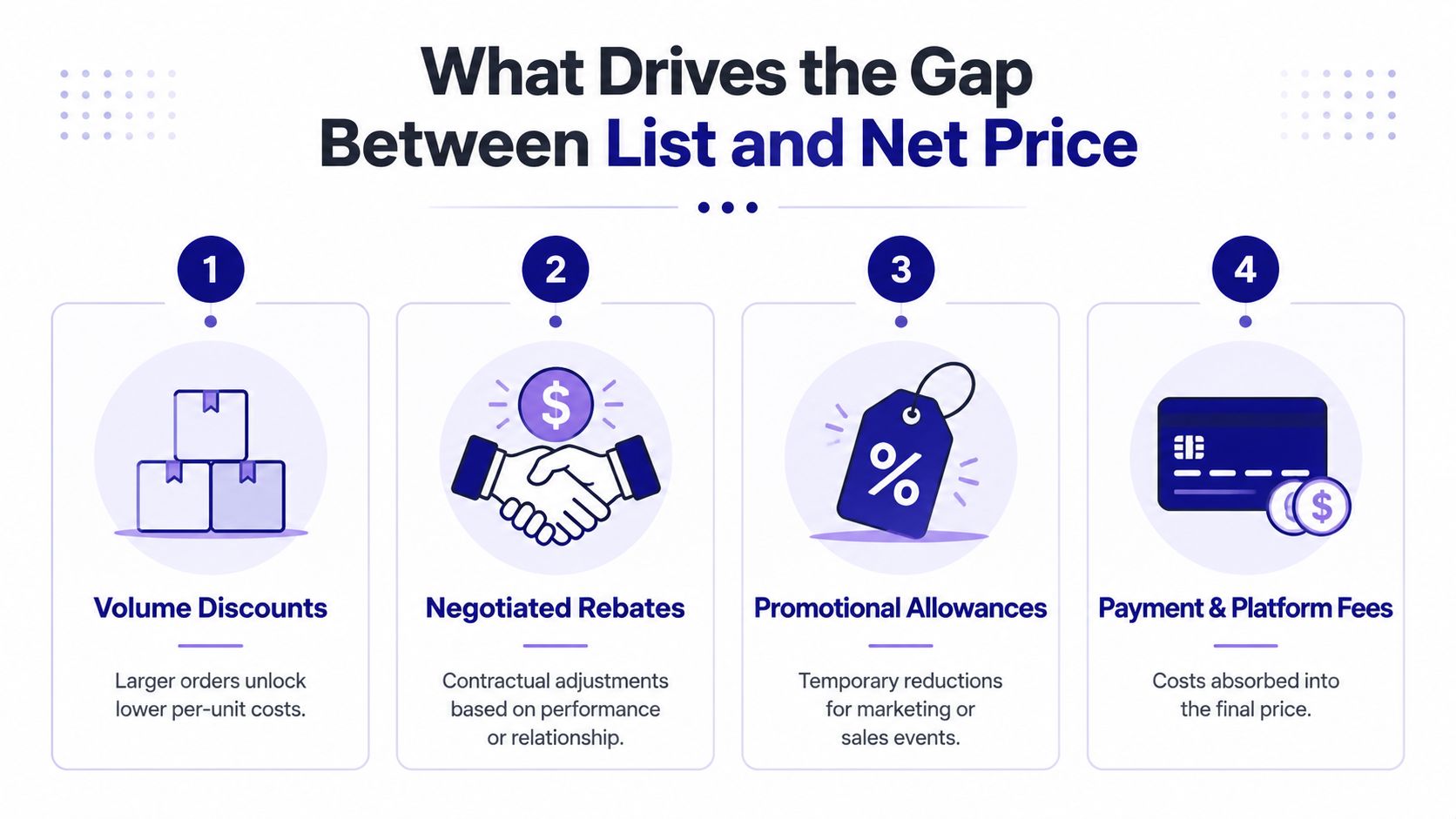
The gap between list and net price usually comes from more than one lever. In real deals, it's rarely just a coupon or a sales rep discount. It's a mix of commercial concessions, channel rules, tax treatment, and payment-related costs that change the realized number long after the list price has done its job as an anchor.
The commercial side of compression
Volume discounts are the first obvious driver. Larger orders often justify lower per-unit economics, especially when the buyer brings predictable demand or lower support overhead. Negotiated rebates are different. They usually sit in the contract and depend on performance, volume thresholds, or relationship terms rather than a one-time sale.
Promotional allowances are also common, but they tend to be temporary. They're useful for launches, seasonal pushes, and sales campaigns, then they disappear from the next booking period. The important thing is that all three of these sit on the commercial side of the gap, not the tax side.
For readers mapping this to enterprise selling, one practical benchmark from the published material on enterprise software is that 30% to 70% off list is described as routine in some deal structures, with some volume deals going higher. A separate benchmark in pharma shows gross-to-net discounts for major U.S. brand portfolios averaging 36% to 60% off list, which means realized receipts often land far below the published number. Those are very different markets, but they show the same thing, list price is an anchor, not a promise. Enterprise software discount patterns and gross-to-net pricing in U.S. drug portfolios
The visible price is often just the starting point for negotiation, not the economic endpoint.
The transaction side of compression
Payment and platform fees also affect what survives to net. So do taxes, shipping, installation, and jurisdiction-specific charges like VAT or GST. In some markets, those items increase the final payable amount above list price. In others, they reduce what the seller keeps after the sale.
That's why a merchant can't assume that net price always means “lower than list.” Sometimes the customer-facing total is higher because mandatory charges get added after the headline price. The best pricing teams treat those charges as separate layers, because the mechanics differ even when the outcome lands in one final number.
For a useful breakdown of how payment-related cost lines can shape the final price, see this practical fee guide. The specific label doesn't matter as much as the discipline of separating commercial discounting from checkout economics.
How List and Net Price Differ Across Business Models

The same words behave differently depending on the business model. In B2B SaaS, list price often functions like a published starting point for a negotiated contract. In ecommerce, list price is closer to a shelf tag, while the final number is shaped by cart-level additions. In wholesale, the list can be purely catalog-based and the invoice becomes the commercial record.
B2B SaaS and enterprise contracts
SaaS teams often publish a standard list price but close deals at a negotiated net. That's why renewal pricing matters so much. The first sale may carry one economics profile, while the renewal can reset the deal shape entirely. If you're benchmarking your own pricing, the question isn't just what the list says, it's how much of that list survives after procurement, seat count, term length, and service packaging are negotiated.
That's also why a value-based approach is useful. A solid framing for founders is the value based pricing framework for founders, because it forces the list number to reflect value capture rather than just cost-plus habit. In SaaS, that matters more than people admit, since a weak list price gives away negotiation room before the buyer even engages.
Ecommerce and checkout economics
Ecommerce is more literal. The customer sees a headline price, then the cart may add shipping, taxes, and other mandatory costs. In that setting, the final net can be higher than the posted price, which is why checkout transparency matters so much. If the public number and the final payable total diverge too sharply, buyers abandon trust before they abandon the cart.
Wholesale and cross-border commerce
Wholesale pricing usually leans on volume tiers, invoicing rules, and rebate structures. Cross-border commerce adds another layer, because FX and payment processing can affect the merchant's realized amount even when the customer sees a stable local price. If you sell globally, your pricing model has to answer two questions at once. What does the buyer pay, and what does the business keep?

For a concrete example of how teams package pricing around different customer types, it helps to review our price plans alongside the structure above. The point isn't the brand, it's the discipline of making sure the public anchor and the transaction value still make sense after channel-specific adjustments.
Accounting and Reporting Implications for Merchants
Pricing mechanics turn into accounting issues fast. Revenue, margin, and tax treatment should be modeled off net price, not headline price, because that's the amount that survives after concessions and charges. If a team forecasts from list price alone, it can overstate expected cash collection and create avoidable surprises in finance review.
Why quoting and CPQ need separate logic
A quote should start with list price, then apply discount governance before calculating the net. That structure gives sales a clear place to negotiate while still keeping finance in control of the final commercial terms. If discount logic is mixed into tax logic, no one can tell whether a lower number came from approval policy or from a jurisdiction-specific charge.
That separation also helps auditability. A clean record shows what changed the price, why it changed, and whether the change was commercial or regulatory. The reporting conversation gets much easier when each layer has its own field, its own rule, and its own approval path.
What gets measured needs to be comparable
One of the biggest mistakes in pricing ops is comparing list-price performance across deals that were never priced the same way. A quote with heavy concessions, a checkout with mandatory charges, and a contract with embedded fees don't belong in the same bucket unless the definitions are aligned. That's why revenue reporting discipline matters as much as the initial price design.
Model the transaction the way the money actually moves, not the way the sales deck presents it.
Payment infrastructure changes the final number too. Different payment methods carry different processing costs, and those costs affect what the business receives. For any merchant that wants clean reporting, the system needs to track discount logic, tax logic, and fee logic separately, then roll them up into the net figure only at the end.
Negotiation and Pricing Strategy Takeaways
List price works best as an anchor. It sets expectations, creates room for negotiation, and signals the value band you're willing to defend. Net price is the primary lever, because it shows where the deal ultimately lands once market pressure, customer size, and commercial terms are all accounted for.
Where the list price should sit
A list price that's too low leaves no room for discount governance. A list price that's too high can make the product look uncompetitive before sales even gets involved. The best operators use the list to preserve perceived value, then reserve the net for targeted concessions that are justified by volume, term length, or strategic account value.
Tiered pricing helps here, but only if the tiers are built to reduce channel conflict. Different customer segments should land at different net prices for clear reasons, not because the rules are vague. If a smaller customer sees a better deal than a larger one without an obvious explanation, trust starts to erode inside the channel.
How to handle renewals and concessions
Renewal pricing deserves special attention in SaaS. The first-sale net price may reflect a land-and-expand tactic, while the long-term net price should reflect retention economics and product usage reality. If you don't separate those two stages, you'll misread your own pricing power.
This pricing resource is useful if you're evaluating the infrastructure side of those decisions, because payment economics influence how much of the deal survives after checkout and settlement. The strategic point is simple. Discount when it protects value or finalizes a deal. Hold firm when a concession would dilute the anchor without changing the outcome.
Verifying Platform Fees and Payment Method Costs
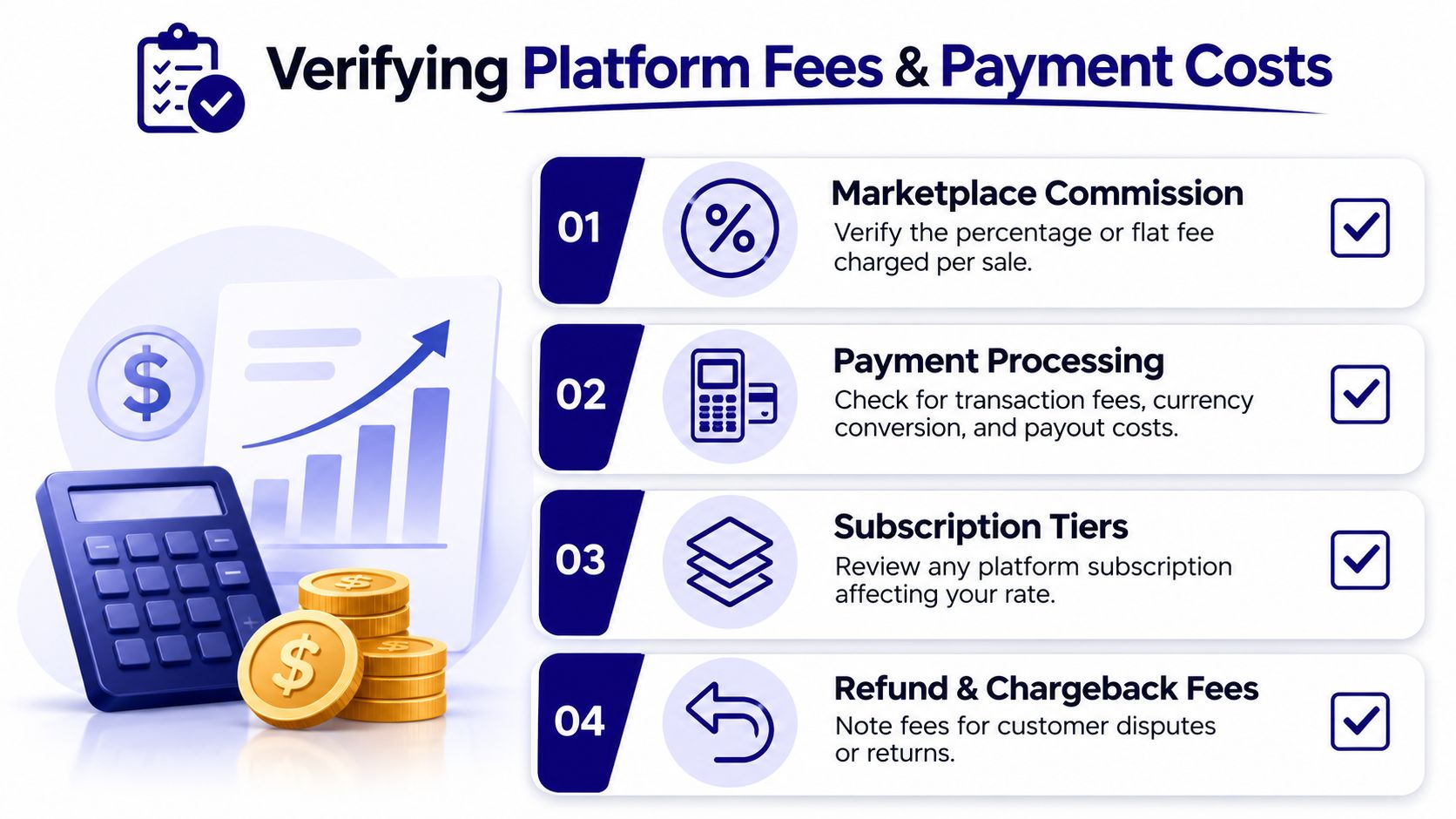
The last check before you lock a pricing model is straightforward. Trace every cost between the number the customer sees and the amount that lands in the business account. That means processing fees, FX costs, settlement charges, refund handling, and any platform-specific charges attached to a payment method.
A practical verification checklist
Marketplace commission: Confirm whether the platform takes a percentage, a flat fee, or both.
Payment processing: Check the provider's pricing page for exact transaction costs, currency conversion charges, and payout costs.
Subscription tiers: Review whether your plan level changes the effective rate or gives you different features.
Refund and chargeback fees: Verify the cost of disputes, reversals, and returns before you model margins.
Payment method choice changes the economics, so there is no single flat rate you can safely assume. Verify the exact figures on the provider's pricing page before publication or launch. That matters for businesses that accept card, wallet, bank, or crypto payments and then settle to a bank account or to stablecoins like USDC, because the final economics depend on the path the money takes.
A merchant also has to reconcile how different industries define net price. In ecommerce, net may mean gross minus processing and fulfillment-related fees. In SaaS, it often means subscription revenue after discounts, credits, and billing friction. Cross-border setups add another layer, because FX spread and payout timing can move the realized amount even when the headline fee looks clean. For a closer look at the fee side of the equation, see payment gateway pricing considerations.
Once those costs are mapped, the list price vs net price model stops being a guess and starts being a usable operating tool. It also gives pricing, finance, and checkout teams a shared reference point when they compare B2B quotes, ecommerce checkout flows, and cross-border settlement paths.
