

Gaspard LEZIN
How to Monetize Online Courses: 2026 Playbook
Learn how to monetize online courses with our 2026 playbook. Discover pricing, sales funnels, payment setups, and strategies to build your course business.
You've finished the course, the lessons are recorded, and the landing page is half ready. Then the key question hits: how do you turn all that work into actual income without guessing your way through pricing, funnels, and payments?
The creators who do this well stop thinking like course builders and start thinking like business owners. How to monetize online courses comes down to a system, not a single tactic, so the right mix usually includes a sales model, pricing logic, a funnel, payment infrastructure, and ongoing optimization.
Table of Contents
From Course Creator to Business Owner
A lot of creators get stuck right after shipping the curriculum. They have polished videos, a decent curriculum map, and no clear path from attention to revenue. That gap is usually where the money is lost, not in the teaching itself.
Treat the business as a connected system. Revenue depends on who sees the offer, how many buy, what they pay, and how the payment and delivery flow works. That's why course monetization is never just about content quality, it's about building an audience, validating demand, and choosing a price that matches the value of the transformation being sold, as outlined in the course earnings calculator guide from Influencer Marketing Hub.
Practical rule: If one part of the system is weak, the whole business feels slow. A strong course with no audience still underperforms, and a big audience with weak checkout flow leaks revenue.
The smartest move is to think in five layers. First comes the sales model, meaning whether you sell once, subscribe, license, or bundle. Second is pricing, because the wrong price can suppress demand or cap growth. Third is the funnel, which turns strangers into buyers. Fourth is payments and delivery, which makes the sale real. Fifth is optimization, where you improve conversion, retention, and expansion over time.
That mindset shift matters because it stops the endless cycle of “just one more module.” Instead, you're asking better business questions. Where does demand come from? What proof reduces hesitation? Which checkout path works for your audience? If you want a broader framework for turning expertise into a durable digital business, the playbook at this info product business guide is worth reading alongside your course plan.
Choosing Your Course Monetization Model
The biggest mistake is choosing a format before choosing the business model. A course can be sold as a one-time purchase, a subscription, a cohort, a licensed asset, or part of a larger offer. Each one works, but each one solves a different problem.
One-time purchase works best when the transformation is clear
A standalone course is usually the simplest path when the buyer wants a defined outcome and doesn't need ongoing access. It's easy to explain, easy to market, and easier to automate than a live-heavy offer. The downside is that revenue depends on continued acquisition, so the offer needs strong positioning and a clear promise.
Subscription and membership models work when access matters
Recurring revenue makes sense when the value comes from ongoing updates, fresh content, or community access. That's where a course turns into a library or a membership. A paid newsletter is often a weak fit for this unless the audience is already very engaged, because the subscription has to justify constant renewal pressure.
Cohorts, licensing, and bundles fit different buyers
Cohort-based classes work well when accountability is part of the value. Corporate licensing is better when a team needs repeated access, internal training, or compliance-style learning. Bundling works when the course sits next to coaching, templates, audits, or consulting and the buyer wants a fuller outcome, not just videos.
The other major choice is distribution. Marketplaces can help discovery, but they limit freedom and often reduce control over pricing and customer relationships. Owning your own site, email list, and checkout flow gives you more room to sell through higher-intent channels, which is the direction newer creator guidance keeps moving toward, as noted in Elearning Industry's overview of marketplace versus self-hosted course sales.
Decision shortcut: If your audience is cold and discovery matters more than margin, a marketplace can be a useful starting point. If you already have trust, a list, or a community, owning the sale usually gives you more leverage.
For a practical overview of proven monetization models, it helps to compare how digital businesses layer offers instead of relying on one checkout point. That same logic shows up in modern course businesses too, especially when the course is only the first product in the stack.
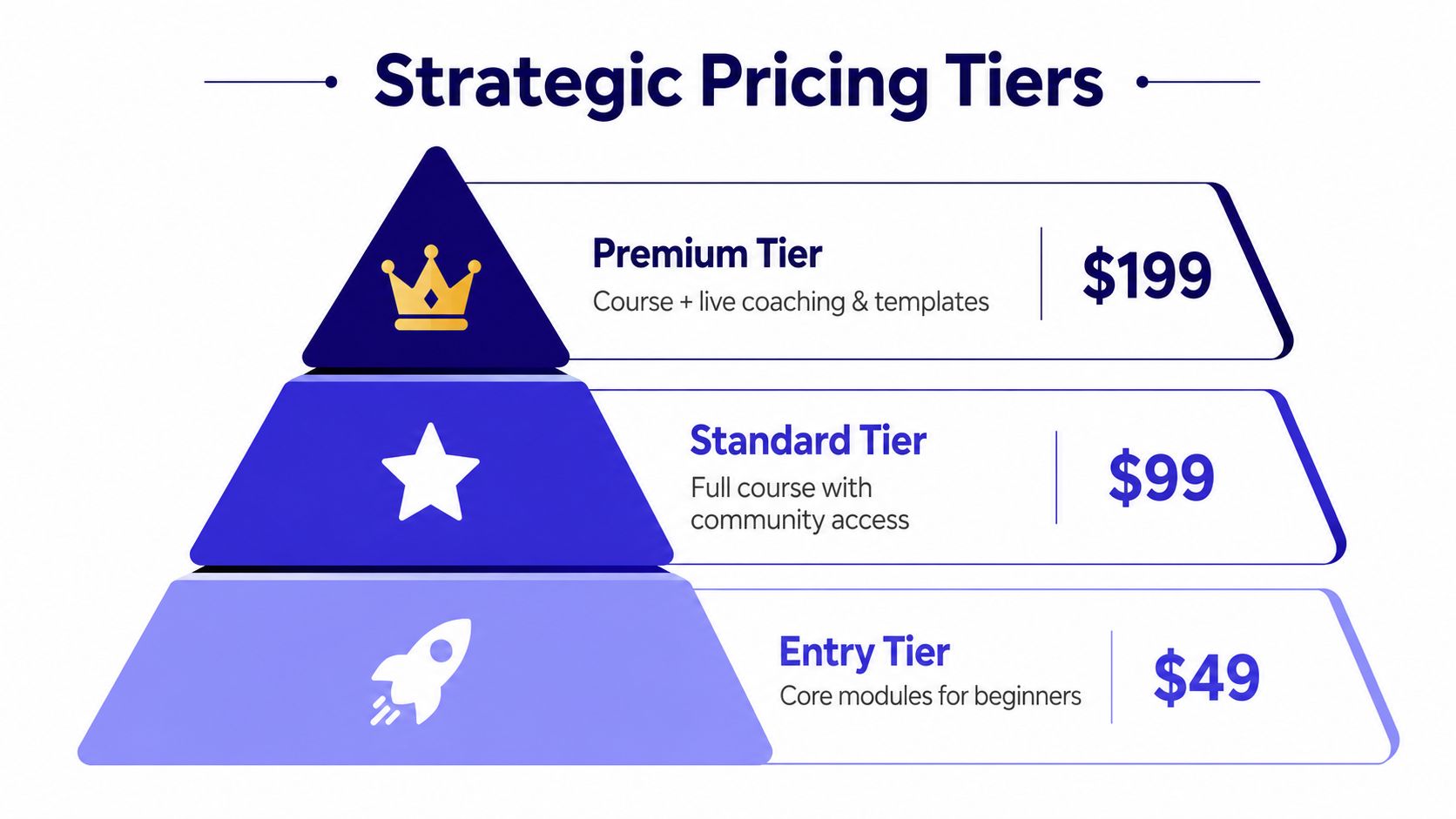
Three-tier pricing also changes the model conversation. Forbes describes Scott's approach as launching with high, medium, and low tiers, which makes the same course accessible to different buyer segments while keeping a premium path open for higher-touch support.
Pricing Your Online Course for Sustainable Profit
Pricing gets clearer when you stop asking, “What feels fair?” and start asking, “What result does this create for the buyer?” Strong pricing follows the outcome the course delivers, not the number of lessons or modules inside it.
A practical benchmark some course operators use is to set the maximum price at roughly an expert's hourly rate multiplied by the time required to solve the problem, then launch at 10 to 20% of that maximum as an entry price, according to Softbook's pricing guide. That gives you a ceiling for value and a lower-risk starting point for market testing, especially when you are still learning how your audience responds to the offer.
Use value, not fear, as the anchor
Underpricing usually starts with uncertainty. Creators worry the offer will not sell, so they pick a number that feels safe instead of one that reflects the transformation they are selling. That choice often creates more work later, because lower prices usually require much higher volume to matter.
The better process is straightforward. Decide the outcome, estimate the buyer's gain, decide the support level, then test the price against real demand. If the course changes a business process, saves time, or helps someone earn more, the price should reflect that result, not just the content length.
Tiered pricing gives buyers a cleaner decision
Tiering works because different buyers want different levels of help. A lean entry tier can cover the core course, a middle tier can add community access, and a premium tier can include coaching, templates, or implementation support. Forbes' pricing example and the broader course-business guidance both point in this direction, because it gives buyers a clear path without forcing everyone into one number.
A practical next step is to test the price with a waitlist, a beta offer, or a live launch before you lock it in permanently. Teachable's guidance says that if 25 people commit financially or join a waitlist, you have validated demand, which is a much better signal than guessing in private. That aligns with the broader advice to pre-sell before full production, so the market helps shape the final offer.
For course creators deciding whether to keep a one-time purchase or move into recurring access later, the subscription pricing models guide gives a useful framework for comparing those options.
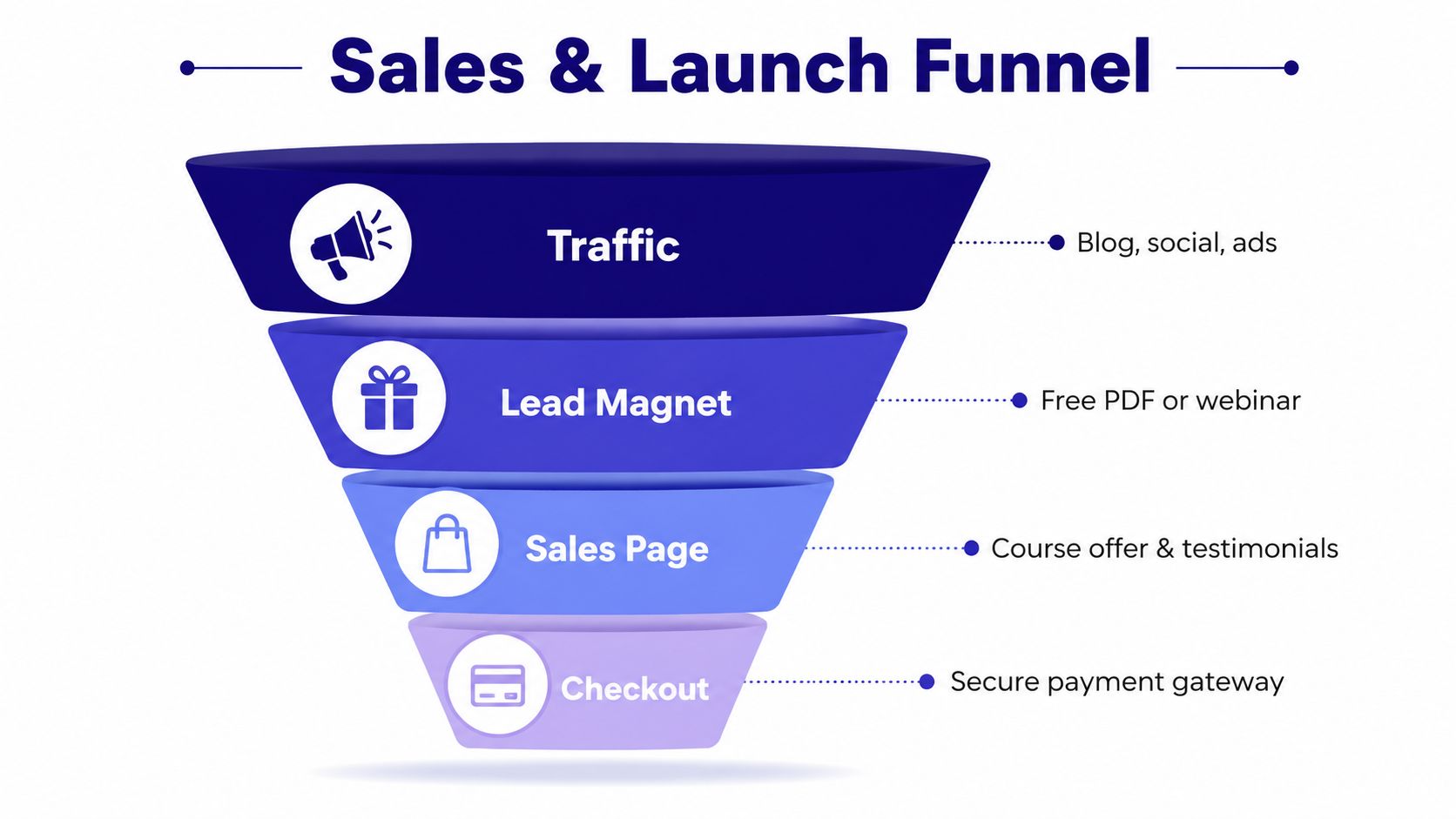
A guide to building profitable funnels matters at this stage because pricing and acquisition work together. If the funnel brings in low-intent leads, the price has to do more convincing. If the funnel filters for buyers who already trust the outcome, you can hold firmer on price and offer a cleaner upgrade path.
Building a Sales and Launch Funnel That Converts
A course launch often breaks before checkout. The offer can be solid, but the creator never builds the bridge between attention and purchase. A funnel works only when it follows how buyers decide, starting with curiosity, then proof, then commitment.
A practical launch usually starts with interviews, a lead magnet, and a landing page. One 12-month framework recommends 5 to 10 interviews in week 1, a lead magnet plus landing page in week 2, and a 3 to 5 email nurture sequence in week 3 before traffic goes live, according to Done With You's monetization strategy guide (https://donewithyou.com/monetization-strategy/). That sequence matters because it surfaces objections before you spend heavily on production or promotion.
People rarely buy the first time they hear about a course. They buy after repeated exposure to a clear outcome, a relevant example, and a low-friction next step.
The math behind the funnel is straightforward. Revenue = Audience size × Conversion Rate × Price of Your Course, as stated in Influencer Marketing Hub's earnings calculator guide (https://influencermarketinghub.com/earnings-calculator/). If you have 10,000 email subscribers, convert 2% of them, and price the course at $199, that implies about $39,800 in gross revenue from one launch, using the same source's example. The point is not that every launch reaches that figure, it is that a modest lift in any one variable changes the result quickly.
Email still does a lot of the heavy lifting. Kwiga reports email marketing returns 4200% on investment (https://kwiga.com/blog/email-marketing-roi), and its workflow uses free lead magnets like e-books or webinars to collect contacts before sending launch updates, discounts, and promotional messages. In practice, that means the funnel should not stop at the landing page. It needs a clear email sequence, a sales page that handles objections, and a checkout path that does not create friction.
If you want a fuller map of how the pieces fit together, the guide to building profitable funnels is useful context while you connect lead capture to checkout. The strongest funnels do not feel clever. They feel obvious once the buyer sees the path.
Setting Up Payments and Gated Content Delivery
A course sale isn't real revenue until the money clears and the buyer gets access. That's where many creators discover their payment stack is too rigid, especially if they sell globally or offer different access types like downloads, communities, and memberships.
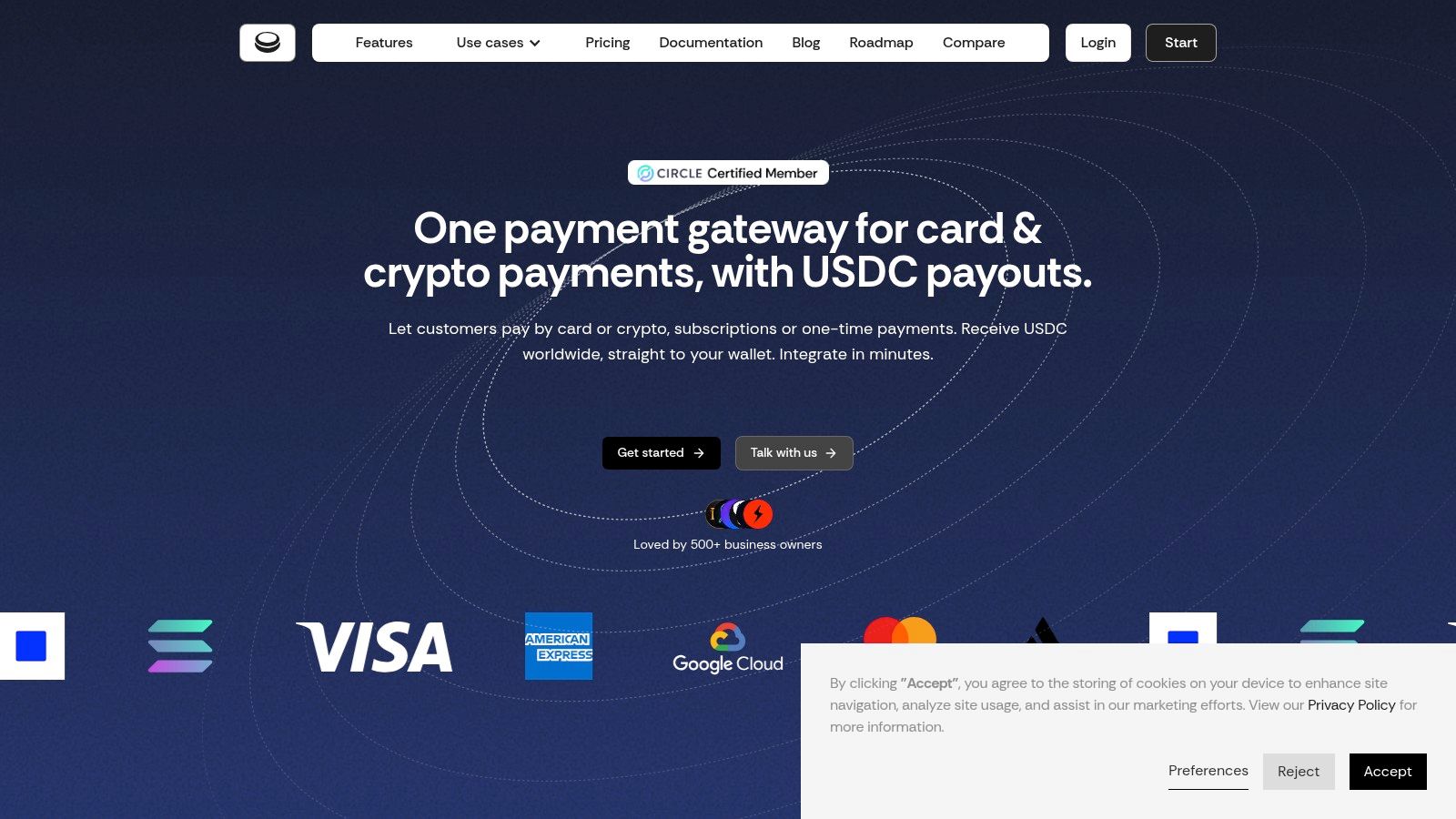
Suby is one option for this layer. It's payment infrastructure that lets businesses accept cards, wallets, bank payments, or crypto, and then settle the money to a bank account or to stablecoins like USDC. Suby Payments is the API-first payment stack, Suby Crypto handles crypto swaps and gas sponsorship, Suby Gating is for paid access to Discord, Telegram, downloads, and courses, and Suby Invoicing lets clients pay how they want while the business receives what it wants. The key flow to understand is that a customer can pay by card while the business receives USDC, but that's one path inside a broader setup.
Payment flexibility matters more than people expect
The reason this matters is simple. A global audience won't always want to pay the same way. Some buyers prefer cards, some want wallets or bank rails, and some operate in crypto-native workflows. Suby's product model is built around that reality, with one balance, multiple payin methods, and payouts in the currency you choose.
Suby also supports native integrations with Discord and Telegram, which is useful when the course includes a private community, paid access, or subscription-based delivery. That kind of gating is often cleaner than stitching together separate tools for checkout, access control, and community permissions.
If your course relies on video hosting, it's smart to compare the delivery stack before you commit. The comparison of video hosting solutions for 2026 is a good reference point when you're deciding how much control you want over playback, access, and delivery experience.
A good payment flow reduces drop-off. A bad one creates support tickets, delayed access, and refunds that never needed to happen.
For automation-minded creators, the internal guide on automated provisioning pairs well with gated delivery because it shows how access can be tied to payment status instead of manual admin work. That matters once sales start coming from multiple channels and customer expectations rise.
Optimizing Revenue and Scaling Your Course Business
Once the first launch is live, the work begins. Revenue grows when you stop treating the course as a finished object and start treating it as a measurable asset. That means watching conversion points, checking where buyers hesitate, and improving the parts of the funnel that leak.
The easiest wins usually come from the checkout and offer stack. A/B test the sales page headline, the order of benefits, the guarantee language, and the way tiers are presented. If you use a one-time offer now, keep an eye on whether a bundle, an upsell, or a recurring access option would fit the value better. Modern course guidance increasingly points to tiered pricing, bonuses, discounts, and community monetization as normal tactics, which means one price point rarely has to do all the work.
Know when to move beyond the standalone course
Not every course should become a subscription, but some should. If the buyer's outcome improves over time, or if the value comes from updates, support, or community, recurring access can make sense. The broader market shift away from marketplace dependence toward owned distribution also makes this easier, because you're not trapped inside someone else's product rules.
The other expansion path is higher-touch service. Many creators move from course sales into coaching, consulting, or implementation support once they see that buyers want help applying the material. That approach fits the monetization gap identified in recent coverage, which notes that creators often talk about pre-selling and email marketing, but less often about when to shift into recurring revenue, licensing, or service layers.
Run the business like a business
You also need basic operational hygiene. Create clear terms of service, publish a refund policy, and keep your tax setup organized from the start. If you sell across borders, the checkout and payout structure should be simple enough that finance doesn't become a bottleneck every time a sale lands.
The most durable course businesses don't rely on one launch. They grow through better targeting, cleaner offers, stronger distribution, and smoother payment infrastructure. That's the core answer to how to monetize online courses, because the money comes from the whole system working together, not from one clever sales page.
If you're building a course business and want a payment setup that matches how modern buyers pay, Suby can handle card and crypto checkout, gated access, and flexible settlement in one flow. Visit Suby to see how it fits your course, your audience, and the way you want to receive revenue.
