

Gaspard LEZIN
How to Obtain an EIN Number: Complete 2026 Guide
Learn how to obtain an EIN number with this step-by-step guide. Covers online, fax, and mail methods, timelines, entity types, and common mistakes to avoid.
You've formed the company, chosen a name, and found a business bank account. Then the bank asks for an EIN, and the launch plan suddenly depends on one IRS application. Most founders don't struggle with the concept. They lose time because they start before gathering the right information, leave the online session idle, or choose a filing route that doesn't match their location.
The good news is that the IRS process is straightforward once you understand its practical limits. The online application is usually the fastest route for eligible U.S.-based applicants, while fax, mail, and phone support matter for people who can't use that system. This guide explains how to obtain an EIN number without getting caught by the timing traps and routing mistakes that generic checklists often overlook.
Table of Contents
What an EIN Is and Why You Need One
A founder preparing to open a business bank account usually encounters the EIN at exactly the wrong moment. The entity may already exist, the first customer may be ready to pay, and the bank still wants a federal tax identifier before it will finish onboarding.
An Employer Identification Number, or EIN, is the IRS identifier used for a business entity that needs one. It appears on tax returns, statements, and other business documents, and it becomes part of the company's operating records. The IRS Form SS-4 guidance explains that entities without an existing EIN must obtain one before using it on those filings and documents. The IRS Form SS-4 instructions provide the underlying application framework.
An EIN also supports ordinary business administration. Banks may request it when opening an account, employers use it for payroll reporting, and businesses rely on it for federal tax registrations. If you're building an online business, the number can also become part of the documentation used by vendors, payment providers, and financial institutions. For related planning, the discussion of taxes for online businesses can help you organize the broader compliance picture.
When an LLC needs an EIN
A multi-member LLC generally needs an EIN because its ownership structure creates a separate federal tax reporting obligation. An LLC that hires employees also needs one, and a business that elects corporate tax treatment may need an EIN as part of that change.
A single-member LLC with no employees may not always be required to obtain one for federal income tax reporting. Even then, getting an EIN can simplify banking and keep the owner's Social Security number out of routine business paperwork. The exact answer depends on the entity's structure, tax treatment, and activities, so don't treat the single-member rule as a universal exemption.
Founders with multiple entities should also avoid assuming that one number covers every company. Each legal entity has its own records and may need its own EIN. If you're comparing entity-by-entity obligations, this guide to how many EINs for separate LLCs is a useful supplementary reference.
Who the responsible party is
The responsible party is the person who controls, manages, or directs the entity and its funds. For many small companies, that's the owner or managing member. For a corporation, it may be an officer or another person with effective control.
The applicant shouldn't enter the name of whoever happens to be completing the form. The IRS uses the responsible party information to connect the EIN application with the person accountable for the entity. Confirm the person's legal name and taxpayer identification details before you begin.
Information to Gather Before You Apply
Preparation is the difference between a clean application and a frustrating restart. The IRS online tool doesn't let you save an unfinished session and return later, so opening it before your information is ready creates unnecessary risk.
Gather the following in one working document:
Legal entity name: Use the name shown on the formation paperwork. If another entity owns the applicant, keep the parent entity's EIN available where the form asks for it.
Responsible party details: Record the responsible party's legal name, title, address, and valid SSN, ITIN, or EIN where applicable.
Formation information: Have the state or territory of formation and the company's principal physical address ready.
Business dates: Note the formation date or the date the business started operating.
Business activity: Describe what the company does in plain language and identify the activity category that best fits.
Ownership and tax structure: Confirm whether the entity is a single-member LLC, multi-member LLC, corporation, partnership, or another recognized type.
Employment plans: Prepare the expected number of employees and the relevant payroll information if the company plans to hire.

Resolve the responsible party question first
The responsible party's taxpayer identification status determines which application route is available. For the online method, the principal business, office, or legal residence must be in the United States or a U.S. territory, and the responsible party must have a valid SSN, ITIN, or EIN. The IRS EIN requirements explain this location and identification distinction.
A foreign responsible party without a U.S. SSN or ITIN shouldn't guess or insert someone else's number. That situation requires a different route, which may include fax, mail, or the IRS international applicant phone line. Decide this before opening the online assistant.
Match the entity to the formation documents
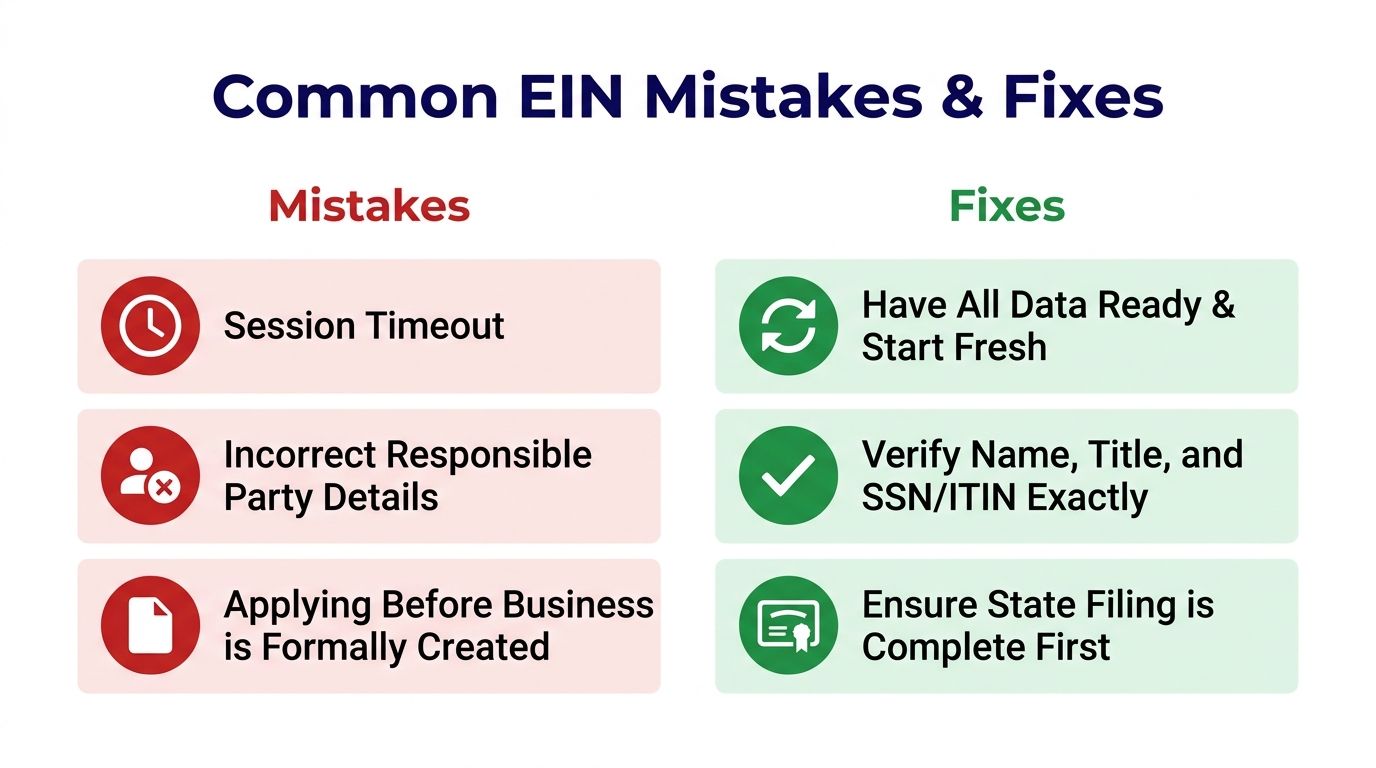
The application should reflect the legal entity that already exists. If the LLC hasn't been formed with the state, stop and complete that filing first. Choosing the wrong entity classification or using a trade name in place of the legal name can create records that need correction later.
For state-specific formation work, founders in Washington may benefit from this 2026 guide for Washington founders. Once the legal name, state, address, and tax structure are settled, preserve the same information in your internal compliance documentation.
Completing the Online EIN Application
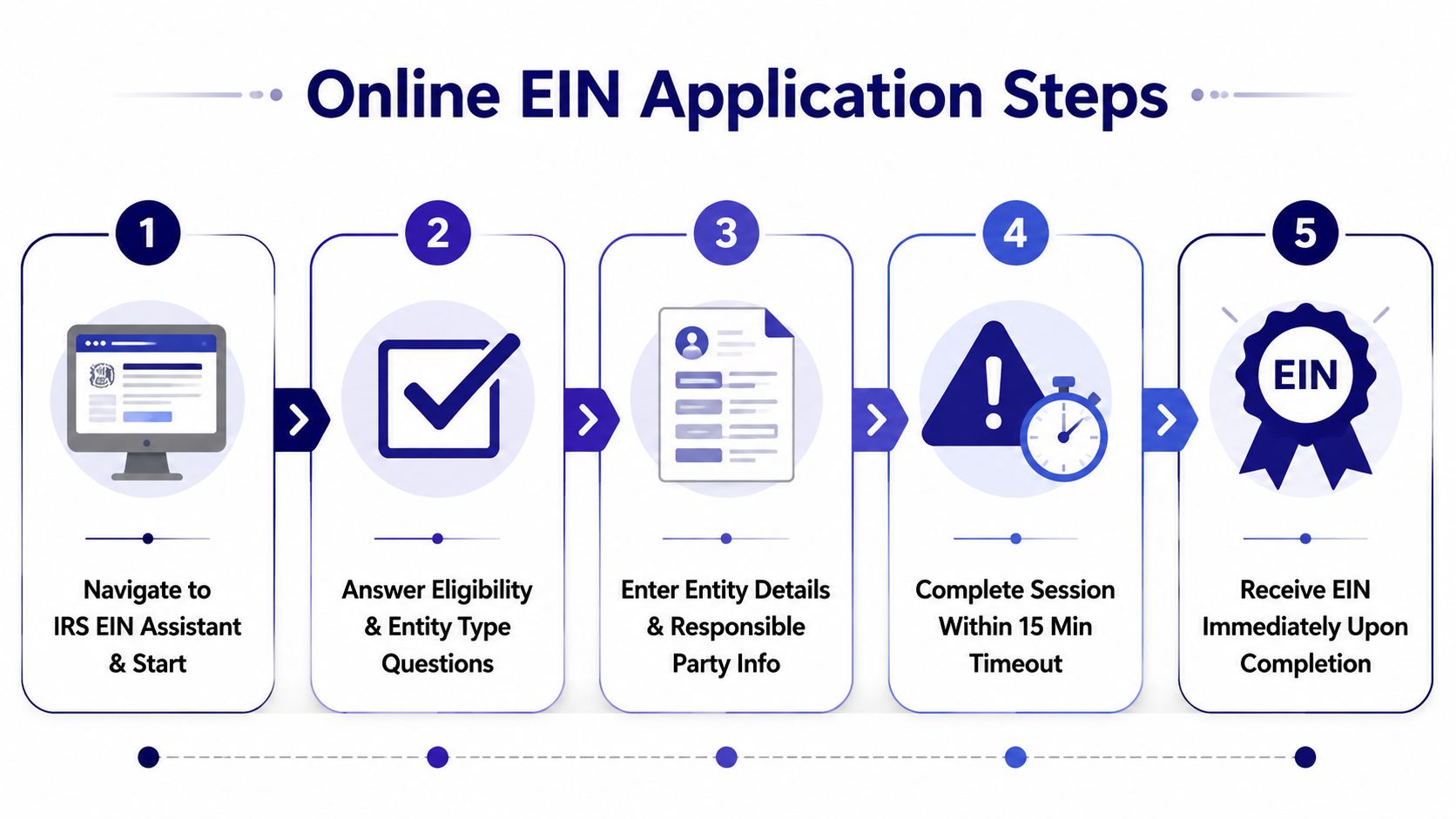
For an eligible U.S.-based applicant, the IRS online application is the fastest way to obtain an EIN. When the system validates the information successfully, it issues the number immediately. The application is free when completed directly through the IRS, and there's no reason to pay a third-party service to transmit the form.
The operational catch is that the session must be completed in one sitting. The system expires after 15 minutes of inactivity, and it doesn't provide a save-and-return function. Treat the application like a timed workflow, not a form you can casually research as you go.
Prepare before opening the tool
Fill out the relevant Form SS-4 information in a separate document first. Keep the legal name, address, responsible party details, entity classification, formation date, and business activity description visible while you work. This reduces pauses and prevents the common mistake of leaving the browser open while searching for information.
The IRS online service operates during these Eastern Time windows, as summarized by the Taxpayer Advocate Service's EIN guidance:
Monday through Friday: 6:00 a.m. to 1:00 a.m.
Saturday: 6:00 a.m. to 9:00 p.m.
Sunday: 6:00 p.m. to 12:00 a.m.
Check the time before you start, particularly if you're applying from outside the Eastern Time zone. A session started near the closing window can become a poor use of your preparation.
Submit, save, and understand the delay
Answer the eligibility and entity questions, enter the company information, identify the responsible party, and review every field before submitting. After validation, the EIN appears immediately in the completed workflow.
Download, save, and print the confirmation notice before closing the browser. The number has been assigned, but the IRS notes that it can take up to two weeks to appear in permanent records used for electronic filing and payment processing. That distinction matters if a bank, payroll provider, or tax system can't verify the number right away.
Practical rule: Treat the confirmation notice as a document you'll need later, not as a screen you can recreate from memory.
A visual walkthrough can reinforce the sequence, but the preparation and timeout discipline matter more than watching a demonstration.
Alternative Methods for Fax, Mail, and Phone Applications
The online route isn't available to every applicant. Businesses whose principal business, office, or legal residence is outside the United States and its territories can't use the online EIN assistant, so international founders need to select another channel.
Fax is usually the practical fallback when speed matters and the applicant can prepare Form SS-4 accurately. The IRS instructions indicate that fax filing generally produces an EIN within four business days. Mail is slower, with processing that can take about four weeks, so it's poorly suited to a founder waiting to complete an urgent bank or tax registration step. These timelines are summarized in the EIN processing overview.
Applicants with no legal residence, principal place of business, or principal office in the United States or U.S. territories can also use the IRS phone option. The number is 267-941-1099, available Monday through Friday from 6:00 a.m. to 11:00 p.m. Eastern Time. This route still requires a responsible party, and many non-governmental applicants need a taxpayer identification number.
EIN application methods compared
Method | Timeline | Eligibility | Key Requirement |
|---|---|---|---|
Online | Immediate issuance after successful validation | Principal business, office, or legal residence in the United States or a U.S. territory | Responsible party must have a valid SSN, ITIN, or EIN, and the session must be completed in one sitting |
Fax | Generally within 4 business days | Applicants able to submit Form SS-4 through the fax route | Complete Form SS-4 accurately and provide the required responsible party information |
About 4 weeks | Applicants using the paper filing route | Allow for the longest processing period and delivery time | |
Phone | Discussed directly with the IRS | Applicants with no U.S. or U.S. territory legal residence, principal business, or principal office | Call 267-941-1099 during the stated Eastern Time hours and have the application details ready |
The EIN is assigned before the confirmation letter arrives. The IRS and related federal guidance indicate that the mailed letter can take up to four weeks, even though the number itself may already exist. Don't confuse the letter's arrival with the assignment date when planning your next administrative step.
Common Application Mistakes and How to Fix Them
Most EIN problems are preventable. They come from starting too early, choosing the wrong route, or entering information that doesn't match the company's legal records.
The online timeout is the easiest mistake to avoid. Applicants often open the assistant, pause to locate a formation document, and return after the session has expired. Because the application can't be saved, the fix is simple: collect everything first and restart with the full data set available.
Check the person behind the application
A responsible party mismatch can stop an otherwise complete filing. The person entered on the application should be the individual who controls the entity, not merely an accountant, assistant, or formation service completing the paperwork. The taxpayer identification information must correspond to that person.
If the responsible party is a foreign national without an SSN or ITIN, don't use a U.S. resident's number as a workaround. The applicant should use the route available to an international entity, including the IRS phone line, fax, or mail, and follow the identification requirements that apply to the particular entity.
Correct the entity record before submitting
An LLC's legal classification should match its actual ownership and tax election. A single-member LLC and a multi-member LLC don't present the same facts, and a company formed as a corporation shouldn't be entered as an LLC merely because the founder prefers a simpler label.
Use this diagnostic list when an application fails or the issued notice contains an error:
Session expired: Start again with every field prepared and avoid inactivity.
Responsible party rejected: Check the legal name, role, address, and taxpayer identification details against the responsible party's records.
Entity classification looks wrong: Review the state formation documents and tax election before resubmitting.
Information on the notice is incorrect: Contact the IRS using the appropriate correction process rather than applying for another EIN.
Applicant is outside the United States: Stop trying to use the online assistant and choose phone, fax, or mail based on urgency and eligibility.
An incorrect EIN record is an administrative problem to resolve, not a reason to create a second identity for the same entity.
Next Steps After Receiving Your EIN
Save the confirmation notice in more than one secure business location, then use the EIN consistently. The immediate priorities usually include opening the business bank account, completing state tax registrations, setting up payroll accounts if the company will hire, and giving accurate information to vendors or financial providers that request the federal identifier.
Remember the timing distinction. The online system issues the EIN immediately after successful validation, but the number may take up to two weeks to appear in permanent IRS records for electronic filing and payment purposes. A confirmation notice proves the assignment, while a downstream system may still need time before it recognizes the number.
Choose the filing route by constraint
Use the online method when the principal business, office, or legal residence is in the United States or a U.S. territory and the responsible party has the required taxpayer identification. Use fax when you need a non-online route with a shorter stated processing period. Choose mail only when its longer timeline fits your plan, and consider the IRS phone option when the applicant has no qualifying U.S. residence or principal office.
Once the EIN is active in your operating workflow, connect it to the systems that receive and send money. For international billing, this guide to how to invoice international clients can help you think through the administrative side of cross-border work.
Payment infrastructure can also support different customer and settlement preferences. Suby is a single product with four ways to use it, Suby Payments, Suby Crypto, Suby Gating, and Suby Invoicing, all within one account according to the official Suby site. Its API lets businesses accept payments by card or crypto, while native Discord and Telegram integrations support use cases such as subscriptions, paid access, and online communities. Customers can pay by card, wallet, bank, or crypto, while the business can choose whether to receive funds in a bank account or stablecoins such as USDC, in the currency it prefers. Pricing depends on the payment method, so check the official pricing page for exact figures rather than relying on a flat-rate assumption.
If you're setting up payment collection after receiving your EIN, visit Suby to review its API-first card and crypto checkout, Discord and Telegram access tools, and invoicing options. Choose the customer payment methods and settlement path that fit your business, then confirm the current method-specific pricing before you launch.
