

Gaspard LEZIN
How to Reduce Churn: A Practical Guide for SaaS
Learn how to reduce churn with proven tactics for SaaS and subscription businesses, from onboarding to billing recovery and retention campaigns.
You can usually tell churn is getting away from you before the dashboard admits it. A renewal comes in lower than expected, support starts seeing the same complaint over and over, and finance is left explaining why growth feels harder than it should. If that sounds familiar, the fix is probably not another broad “retention strategy.” It's a tighter grip on billing recovery, onboarding, pricing, and the payment rail itself.
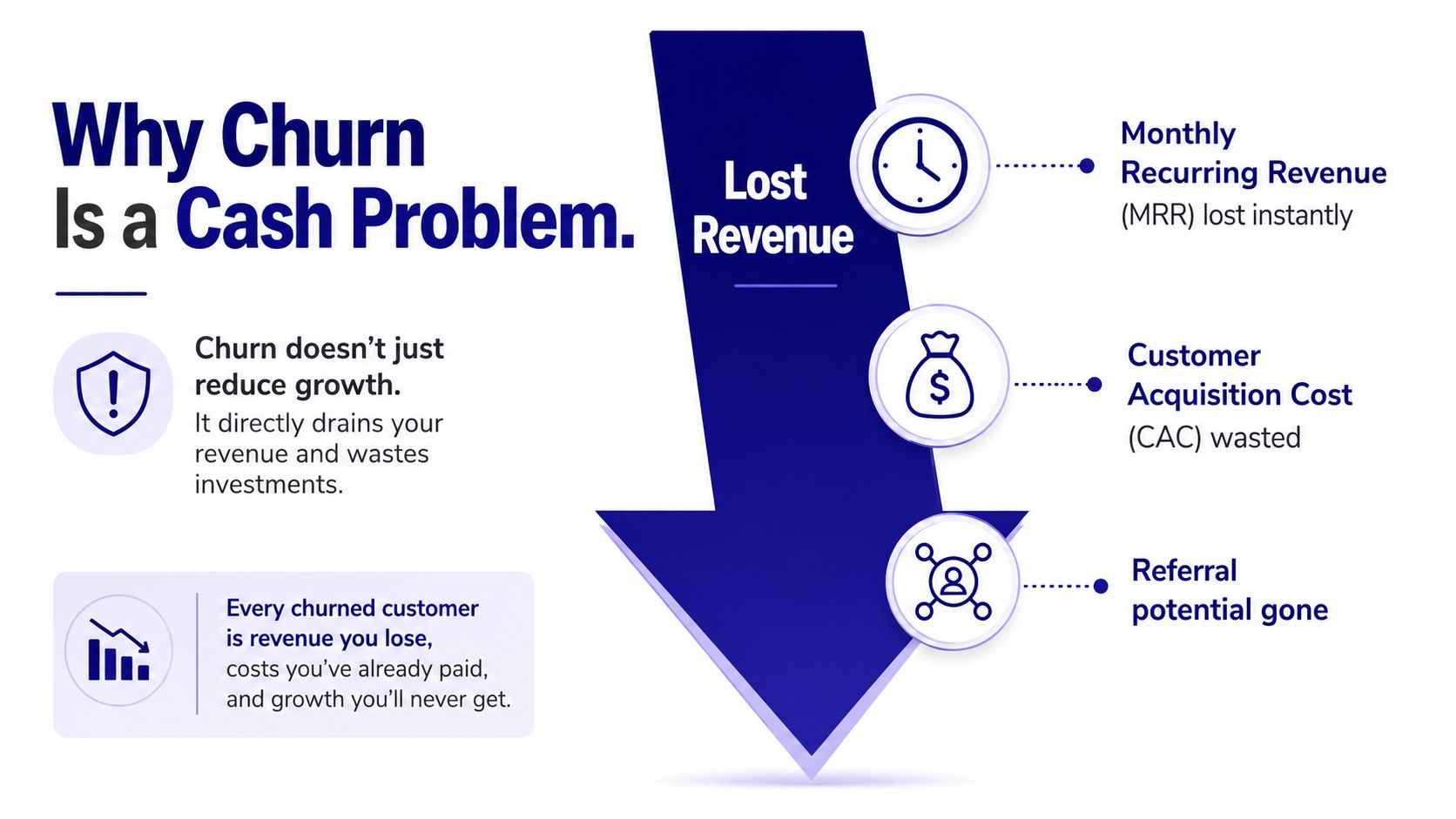
How to reduce churn starts with treating it like a cash problem. Every cancellation is revenue you already worked to earn, and the fastest wins usually come from the customers you already have, not from chasing more leads. That's why the retention principle that a 5% increase in customer retention can lift profits by 25% to 95% still matters so much for SaaS and recurring revenue businesses, because small improvements compound fast when lifetime value keeps extending worldmetrics.org customer retention statistics.
Table of Contents
Why Churn Is a Cash Problem, Not a Vanity Metric
Churn usually shows up in the same place every operator cares about most, cash flow. A customer leaves, the revenue is gone, and the team starts spending more to replace it than to protect it. The reason this hurts so much is simple, keeping a customer is usually cheaper than winning a new one, and the retention lift compounds inside the base you already paid to acquire.
Start with the right churn math
Use the standard formula first, customers lost divided by customers at the start of the period, multiplied by 100 worldmetrics.org customer churn statistics. Then separate logo churn, revenue churn, and net revenue retention so you can see whether you're losing lots of small accounts or a few large ones. If you skip that split, you'll waste time fixing the wrong problem.
Practical rule: if you can't say whether churn is concentrated in small accounts, large accounts, or failed renewals, you don't have a churn problem yet. You have a measurement problem.
Cohort work is where signal shows up. Segment customers by tenure, especially early life cohorts, because churn tends to cluster in the first months after purchase. One industry summary says 70% of annual revenue churn comes from customers with only 3 to 12 months of tenure, which is why onboarding and first-renewal attention matter so much worldmetrics.org customer churn statistics.
Reason codes matter just as much. Build a mandatory cancellation picklist with price, missing feature, low usage, switched competitor, and billing failure. If you don't do that, every other retention effort is a guess. You'll argue about roadmap priorities, but the data will be too muddy to settle the argument.
If you want a practical overview of retention outreach, the framework in outreach tips for customer retention is worth reading alongside your own cancellation data, because outreach only works when it matches the reason people are leaving.
The hard truth is that many teams spend too much energy on acquisition and too little on the revenue they already own. The churn report should tell you where to act next, not just how badly you lost.
Calculating churn rate is worth doing with real cohorts, not just one top-line number, because the diagnosis changes once you see which customers are slipping out and when.
Recover the Hidden Revenue Hiding in Failed Payments
Failed payments are the cleanest churn win in most SaaS businesses because the customer didn't make a product decision. The card expired, the issuer declined the charge, or a payment step never completed, and the customer drifted into involuntary churn. In subscription businesses, that kind of churn is commonly estimated at 20% to 40% of total churn Baremetrics.
Fix the recovery path first
A dumb retry is not enough. Build a dunning sequence that starts immediately, follows up again if needed, and gives the customer a direct path to update payment details. The cleanest version is simple, clear notice, easy retry, and a billing page that doesn't make the user hunt.
Don't let a failed renewal sit silent. If finance or success can't see it quickly, the account is already slipping.
The operational checklist is blunt. Route declines through a payment service that returns useful reason codes. Send a customer alert before the payment fails if the card is close to expiring. Then keep the retry and notification loop tight enough that recovery isn't left to chance.
For teams that want a deeper view of the mechanics, mailX deliverability solutions is relevant because failed recovery often dies in the inbox before it dies in billing.
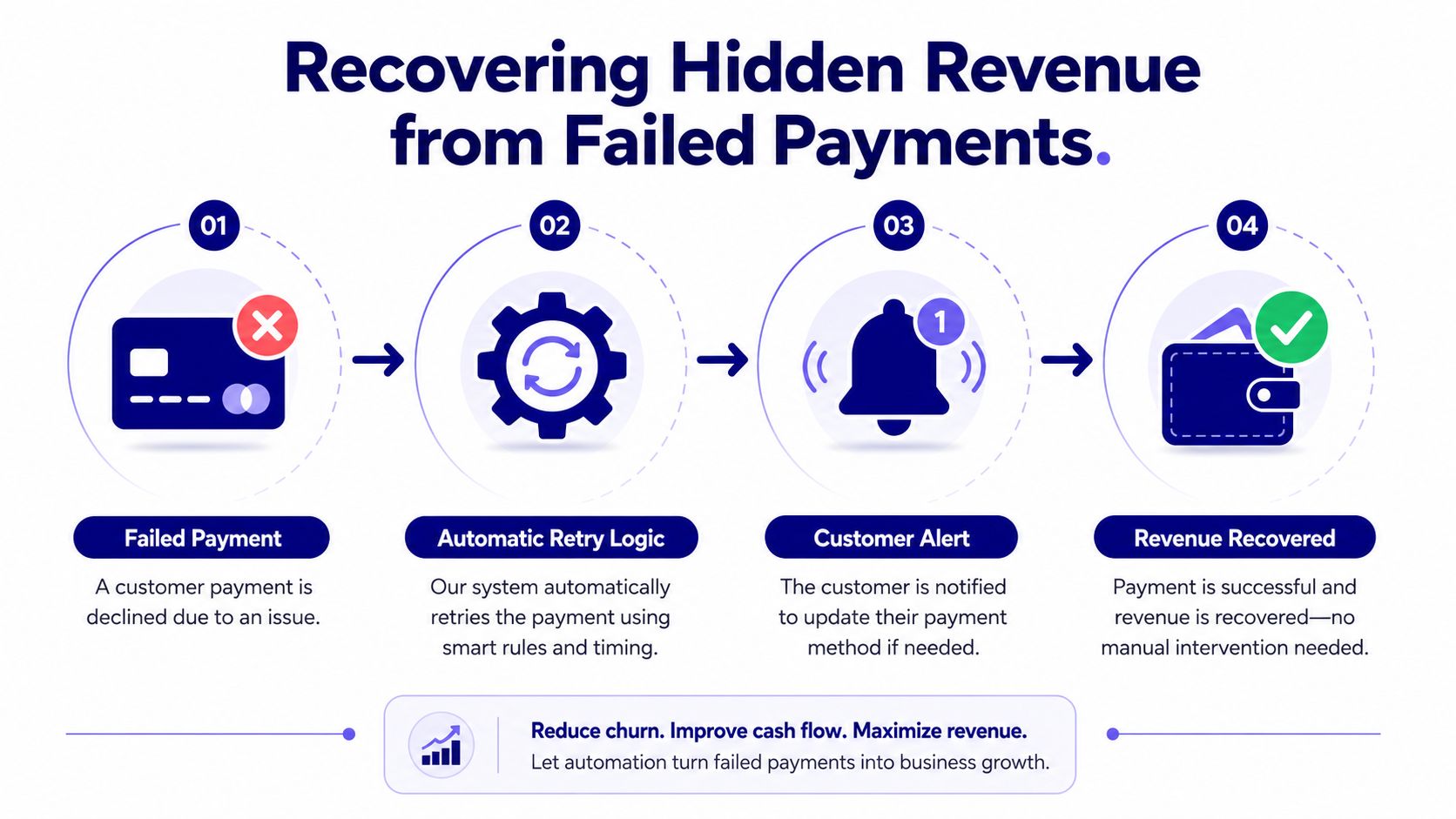
The mistake is treating billing failure like a back-office issue. It isn't. It's a churn event that happens before the customer has consciously decided to leave.
What is dunning process is a useful operational reference if your team wants the recovery flow laid out clearly before you automate it.
Onboarding That Survives the Critical 30 Days
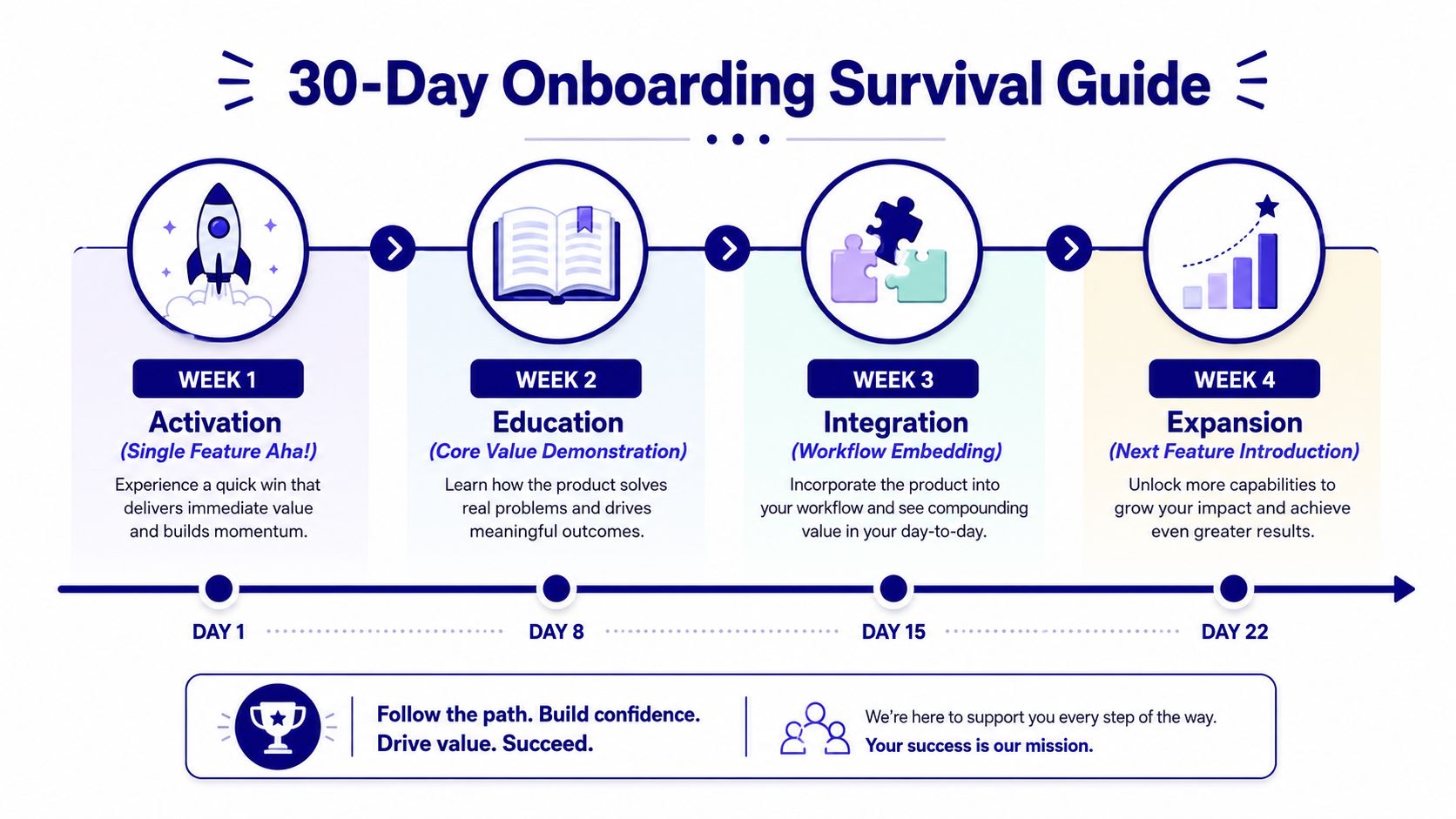
The first 30 days decide far more than teams like to admit. If a customer doesn't reach value early, every later retention effort has to work against confusion, low confidence, and weak habit formation. The early lifecycle is where you stop churn before it becomes a renewal conversation.
Week by week, not guess by guess
Week 1 should force a single aha moment. Tie it to one feature, send the welcome email within 10 minutes, and check in within 48 hours if activation hasn't happened. Don't wait for a broad “getting started” journey to do the work that one focused milestone should have done already.
Week 2 should push depth. Get the user to a second use case or a collaboration action, and watch for accounts stuck in single-user mode. If the product is meant to spread inside a team, single-user behavior is a warning, not a detail.
Week 3 is where integration starts. Show how the tool replaces part of the current workflow, not just how to poke around inside it. If the customer is still doing the work somewhere else, they haven't adopted you yet.
Week 4 should be a habit check. Look at usage frequency, support tickets, and whether there's a clear human outreach trigger for accounts below your threshold.
Operational rule: fire interventions by behavior, not by the calendar. Date-based onboarding is lazy. Behavior-based onboarding protects revenue.
Anything the user hasn't achieved by day 30 tends to echo later. That's why early lifecycle work is not “nice to have.” It's the main defense against the churn that shows up in month three.
If you sell into communities or subscriptions, Suby also offers native integrations with Discord and Telegram for paid access, subscriptions, and online communities, which matters because onboarding has to match the actual use case, not a generic SaaS playbook.
Pricing, Plan Fit, and the Renewal Conversation
A customer on a Pro plan who is paying for two seats they never use is already halfway out the door by the time they see an annual renewal charge. The cancellation wasn't caused by product hate. It was caused by a plan that stopped matching reality.
Surface the mismatch before the invoice does
Run a plan-fit check at day 30, then again about 60 days before renewal. Compare actual usage with the plan limits, and flag overage risk or downgrade options inside the product before the renewal email lands. If the customer discovers the mismatch from a bill, you've already lost the easiest version of the conversation.
The renewal message should be a two-step process. First, send a short value summary in the 30 days before renewal that reminds the customer what they've used. Then give them a confirm-or-change prompt that defaults to the right plan, not just the current one.
That's the part that gets missed. They write renewal emails like they're asking for permission to keep billing the same amount. They should be helping the customer choose the right fit before the charge surprises them.
Cancellation churn often looks like product rejection, but it's usually a plan-fit problem or a surprise charge. Fix the pricing conversation earlier, and you remove a lot of avoidable exits.
Retention Campaigns That Match the Real Reason for Leaving
Generic save attempts are weak because they ignore why the customer is leaving. The right campaign depends on the trigger, not on whatever your email platform makes easiest to send. If the reason is wrong, the campaign is noise.
Match the format to the failure
Lifecycle email is the cheap option for low usage and engagement drop-off. It works best when customers have gone quiet but haven't yet hit a hard cancellation point. In-app nudges are better when the user is active but hasn't found the feature that delivers value.
Save-the-cancel flows should branch by reason. Offer a pause for budget objections, a downgrade for plan-fit issues, and a human callback for product-fit complaints. Win-back sequences belong after cancellation, and they should be staggered over time with a different offer each time instead of one repetitive blast.
Retention Campaign Format | Churn Reason It Fixes | Build Cost | Typical Lift |
|---|---|---|---|
Lifecycle email | Low usage, engagement drop-off | Low | Modest |
In-app nudges | Feature discovery gaps | Low to medium | Modest |
Save-the-cancel flow | Budget, plan fit, product-fit objections | Medium | Meaningful when reason-coded well |
Win-back sequence | Recent churned accounts | Low to medium | Variable |
The routing rule is the win. Tag cancellation reasons at the source and send each reason to one campaign. A generic save flow is usually lazy, and laziness is expensive when you're trying to hold onto revenue.
The Payment Rail Is a Churn Variable Most Teams Ignore
Teams still treat the payment stack like plumbing. That's a mistake. The rail itself changes churn because different payment methods fail in different ways, and some rails are easier for customers to keep current.
Why renewal failures happen
Cards expire. Issuers decline charges. 3DS creates friction. Regional preferences also matter, because customers don't all want to pay the same way. The answer isn't to admire the problem. It's to accept more usable methods and build a recovery system instead of a one-shot retry.
The data point people overlook is simple: payment method can be a significant predictor of churn, and a telecom study found that e-check users had about 45% churn versus roughly 18% to 20% for automatic payment methods PMC article. The exact industry differs, but the lesson doesn't. Easier rails reduce friction.
A serious payment stack should include adaptive retry logic, account updater services such as Visa Account Updater, pre-dunning email sequences, and clear decline handling. If your stack can't do that cleanly, you're bleeding revenue in a place the product team never sees.
Payment processor for SaaS is a good reference if you're reviewing whether your current stack is set up for recurring revenue instead of one-off checkout.
Suby is one option in this category. It's a single product with four ways to use it. Suby Payments accepts cards and crypto through one checkout, Suby Crypto handles the swap and sponsors the gas, Suby Gating supports paid access for Discord, Telegram, downloads, and courses, and Suby Invoicing lets the client pay how they want while the business receives what it wants. Pricing depends on the payment method used, so check the pricing page for exact figures Suby pricing.
Your 90-Day Churn Reduction Plan
The first 30 days are about visibility and recovery. Instrument churn measurement, segment by tenure and reason codes, and stand up failed-payment recovery first, because it usually pays back fastest. For a practical external benchmark on the wider retention workflow, the playbook for reducing customer churn is useful context, but your own reason codes matter more than any generic framework.
Days 1 to 30
Get the numbers right before you polish campaigns. Measure gross MRR churn, net MRR churn, involuntary churn rate, payment recovery rate, and 30-day activation rate every week. If those numbers are muddy, fix the tracking first.
Days 31 to 60
Ship the onboarding fixes that protect the first 30 days of tenure. Deploy save-the-cancel flows, and align pricing pages with actual usage patterns so customers spot fit issues earlier. This is the window for cutting avoidable churn caused by confusion and surprise.
Days 61 to 90
Launch win-back campaigns for the most recent cancel cohort. A/B test retention offers, then review the payment stack for more recovery gains. Many organizations still treat the payment stack like plumbing, but the rail itself changes churn. If churn still stalls, work the order of operations in this sequence, payments, onboarding, then campaigns, because that is where the advantage sits.
If you want customers to pay by card, wallet, bank, or crypto while your business settles to a bank account or stablecoins like USDC, Suby gives you that payment infrastructure in one place, with a single API for payments and native Discord and Telegram use cases. Visit Suby and see whether your churn problem is really a billing and payment problem in disguise.
