

Gaspard LEZIN
Recurring Payment Credit Card: How Authorization, SCA
Learn how recurring payment credit card billing works, from authorization and SCA compliance to retry logic and failure modes. Practical guide
Recurring subscription authorization requests can exceed a 20% decline rate, while in-person transactions sit at about 1%, according to Visa-referenced data in a fraud report on failed recurring payments. That gap explains why recurring payment credit card systems fail in production even when the checkout works perfectly. The difficult part isn't collecting the first payment. It's preserving authorization quality, proving the original customer consent, recovering temporary failures, and preventing an understandable renewal from becoming a chargeback.
A recurring card payment is a stored relationship between a customer, merchant, issuer, acquirer, and payment network. Each renewal has to carry the right transaction indicators and credential data, arrive at a sensible time, and give the customer a clear way to recognize the charge. If one of those pieces is missing, a loyal subscriber can look like an unauthorized or risky transaction.
Table of Contents
Why Recurring Credit Card Payments Matter Now
Recurring card billing is already ordinary consumer behavior. In 2021, Chase reported that 78% of survey participants had at least one recurring subscription, while half had at least three, as reported by Yahoo Finance. That means stored card credentials sit behind far more than streaming services. They support software, memberships, digital products, household services, and other ongoing commercial relationships.
Credit cards also remain a central rail for subscription purchases. A 2022 industry survey found that consumers used credit cards for video streaming, music streaming, news or magazine subscriptions, software, premium apps, and box-of-the-month services, with the reported shares varying by category in PaymentsJournal's subscription payment overview. The same source cites a recurring payments market-size estimate of USD 48.96 trillion in 2026, a projection that illustrates the scale attributed to automated billing infrastructure.
The operational mistake is treating a renewal like a delayed one-time sale. A customer-present purchase happens while the cardholder is actively watching the transaction. A renewal happens later, often off-session, with no customer interaction at the point of authorization.
Dimension | One-Time Payment | Recurring Payment |
|---|---|---|
Customer interaction | The customer is usually present | The merchant initiates the renewal |
Authentication | Often completed during checkout | Usually established during the first payment |
Credential risk | Limited to the immediate purchase | Continues across future billing cycles |
Failure response | The customer can try again immediately | The merchant must classify, retry, notify, or suspend |
Revenue exposure | Usually isolated to one transaction | A failure can interrupt an ongoing account |
Dispute risk | The purchase is relatively fresh | Customers may forget the subscription or fail to recognize the descriptor |
Practical rule: Treat recurring billing as an authorization-management system, not just a billing-calendar feature.
Product teams should therefore monitor more than successful checkouts. They need visibility into initial authorization, merchant-initiated transaction indicators, token lifecycle events, decline reasons, retry timing, customer notifications, and dispute outcomes. The payment provider may expose some of this in a dashboard, but the merchant still owns the customer experience and the decision about when access should end.
A recurring payment credit card setup also creates compounding economics. A failed renewal can lead to a retry, a dunning message, a support ticket, involuntary churn, or a dispute. The right intervention depends on why the issuer declined the transaction. A blanket retry policy turns an operational problem into additional issuer friction and potentially higher chargeback exposure.
How Authorization and Capture Work for Subscriptions
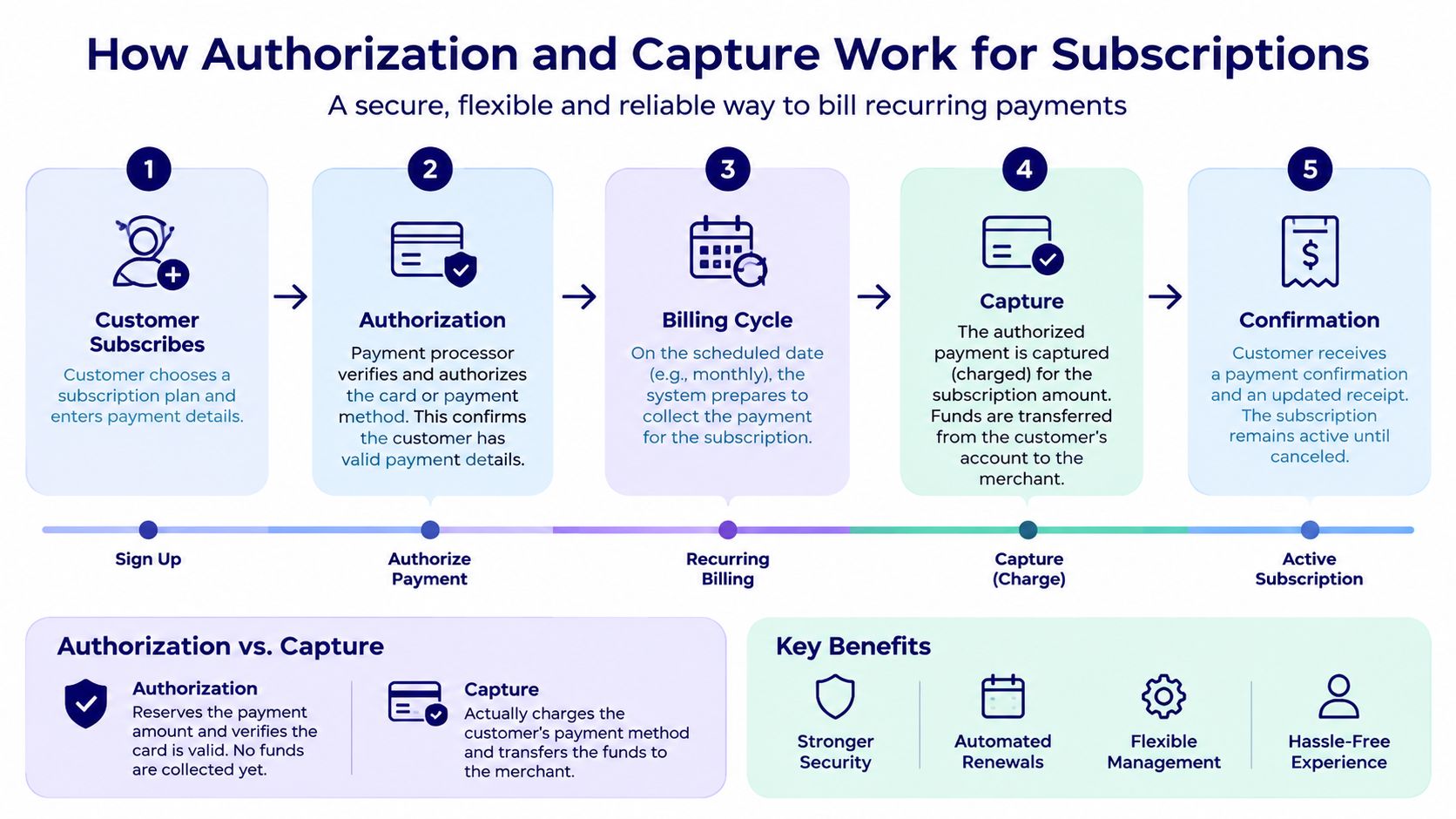
The first subscription payment establishes the commercial and technical foundation for later renewals. The customer enters card details, the merchant sends an authorization request through its payment provider and acquirer, the card network routes it to the issuer, and the issuer approves or declines it. An approval generally includes an authorization code and reserves the approved amount according to the issuer's rules.
The first payment establishes the record
At this stage, the merchant should persist more than a local subscription ID. Store the payment method reference, the processor's transaction identifier, the network transaction ID when exposed, the authorization result, and the consent record that connects the customer to the subscription terms. These identifiers help the processor link later merchant-initiated transactions to the original customer-present event.
An authorization isn't the same as a settled payment. It confirms that the issuer is willing to approve the transaction at that point. Capture tells the acquirer to complete the charge. If the merchant captures the authorization, the transaction enters the provider's settlement process. If the merchant lets the authorization expire or cancels it, the hold can be released without becoming a completed payment.
Subscription businesses often capture the first charge immediately, then create later charges as separate merchant-initiated transactions. The exact timing and batching behavior depends on the processor and acquiring setup. The important implementation distinction is that a renewal isn't a replay of the first request. It needs the correct recurring or MIT indicators and a reference to the original transaction where the provider requires one.
Renewals depend on accurate metadata
A common failure occurs when engineering stores only the card token and subscription date. The next request may contain a valid payment credential, yet lack the transaction relationship that tells the issuer why the customer isn't present. Another failure occurs when the merchant sends a renewal as if it were a customer-present purchase. That can produce unnecessary authentication demands or an issuer decline.
Authorization codes also aren't permanent payment permissions. They relate to a particular authorization and can expire, while a captured transaction follows a separate settlement path. Your system should therefore model authorization, capture, settlement, renewal, and failure as separate states rather than collapsing everything into “paid” or “unpaid.”
A reliable event model should answer four questions for every invoice:
What initiated the payment? The customer at checkout or the merchant during renewal.
Which original transaction created the mandate? Store the provider and network references.
Was the payment authorized and captured? Keep both results.
What should happen next? Retry, request customer action, suspend access, or stop permanently.
The first authorization is where the merchant earns permission to continue the billing relationship. Each renewal is a fresh authorization attempt that must accurately describe that relationship.
SCA Compliance and the First Charge Mandate
Strong Customer Authentication changes the first-charge workflow for many card-not-present subscriptions. The initial customer-present payment typically needs to complete SCA. After that, later renewal charges can be processed as merchant-initiated transactions that are out of scope for SCA, provided the merchant correctly links them to the original authenticated mandate, as explained in Global Payments' recurring payments guidance.

The first charge should be treated as a mandate-capture event, not merely a successful checkout. If the issuer or payment service provider requests a challenge, the customer needs a clear path to complete it without losing the subscription state. Your application should keep the order or subscription pending while the authentication flow completes, then activate service only after the payment outcome is confirmed.
Persist the evidence
At minimum, keep the metadata your provider supplies for the initial authenticated payment:
Original transaction reference: This connects the renewal to the first customer-present event.
Authentication result: Preserve the method and outcome returned by the authentication flow.
Consent record: Store the customer's agreement to the amount, cadence, terms, and future charges.
Payment method reference: Use the provider's reusable reference rather than exposing sensitive card data in your application.
The precise field names differ across providers. What matters is that your billing service can reconstruct the mandate and pass the relevant references in each MIT request. If your integration throws away authentication metadata after checkout, the renewal engine may have no defensible way to demonstrate that the first charge was authenticated.
For practical implementation context, review this guide to 3-D Secure payments. It should sit alongside your provider documentation, because providers expose SCA and MIT fields differently.
Design for the exception
A renewal can still require customer involvement. A card may be replaced, the issuer may request authentication, the mandate may be missing, or the transaction may be outside the permitted recurring model. Your system needs a recovery path that sends the customer to an authenticated payment update or payment confirmation flow rather than retrying indefinitely.
The regional rule set also matters. Consumer guidance says a cardholder can cancel a recurring payment through the card provider, and should do so before the business day before the next due date, as described by MoneySavingExpert. The UK FCA treats recurring card payments as authorizations that can be canceled through the merchant or card issuer, while India's rules add electronic-mandate registration and authentication limits, including special higher thresholds for credit card bills. A global product shouldn't assume that one mandate design works identically in every market.
Common Failure Modes in Recurring Billing
A renewal can fail because the request is technically valid but operationally incomplete. For example, an integration may send a merchant-initiated transaction without the original authentication reference or the correct mandate data. The issuer then treats the renewal differently from a properly linked recurring charge. As noted earlier, recurring declines can exceed 20%, so the billing system needs more than a generic retry button.
Separate recoverable failures from final failures
Start with the processor response code and network retry guidance. An insufficient-funds response may resolve later, while an issuer risk block, invalid account, or explicit do-not-retry instruction requires a different path. A network interruption can justify a controlled retry, but only after idempotency checks confirm that the original request did not succeed.
Failure Mode | Typical Share of Declines | Decline Type | Automated Recovery Possible | Recommended Action |
|---|---|---|---|---|
Insufficient funds | Varies by portfolio | Often soft | Sometimes | Retry at a later, controlled interval and notify the customer |
Expired or replaced card | Varies by portfolio | Credential issue | Often, with updater or token lifecycle support | Refresh the payment credential or ask for an update |
Issuer risk block | Varies by issuer | Often hard | Limited | Stop repeated attempts and request a new payment method |
Network or processor interruption | Varies by incident | Temporary | Often | Retry after service recovery, with idempotency protection |
Missing MIT or mandate reference | Varies by integration | Data or compliance failure | Only after correction | Fix request construction before attempting again |
Customer doesn't recognize the charge | Not a decline category | Dispute risk | No | Improve descriptor, receipts, cancellation access, and customer records |
A missing MIT or mandate reference is an integration defect, not a funding problem. Retrying the same malformed request only produces more declines. Log the original transaction identifier, authentication result, mandate reference, exemption data, and network response so support and engineering can distinguish a bad request from an issuer decision.
Network tokenization can improve authorization context and help with card replacement. Each renewal uses a transaction-specific cryptogram tied to a token rather than the underlying PAN. Industry reporting cites average approval-rate uplifts of about 2.1% to 4.6% versus standard PAN processing in Solidgate's tokenization analysis. Tokens may remain usable when the physical card number changes, but the merchant still has to process token lifecycle events and handle tokens that become unavailable.
Chargebacks change the economics of recovery. Research cited in the failed-payments material reported average chargeback rates at 0.17% in Q1 2025, rising to 0.26% in Q3 2025. Those figures do not establish whether a particular retry is safe. They do show why recovered revenue must be measured against dispute expense, customer support effort, and future payment risk.
Make the customer recognize the renewal
A customer may dispute a legitimate renewal when the descriptor differs from the product name, the receipt arrives late, or a plan change was unclear. Send a renewal message that identifies the merchant, plan, amount, billing date, cancellation path, and support route. Clear records reduce “not recognized” disputes and give support enough context to resolve questions before a chargeback is filed.
Use this practical explanation of the dunning process to structure the customer-facing recovery sequence. The system should distinguish a payment requiring a credential update from one that should never be retried, then route each case to the appropriate customer or operational action.
Retry Logic and Billing Cadence Strategies
A retry engine should make fewer, better attempts. Sending the same authorization repeatedly at short intervals doesn't demonstrate persistence. It can create issuer suspicion, duplicate-charge risk, and unnecessary customer friction.
Start with the decline response. Group responses into temporary technical failures, likely temporary funding issues, credential problems, and hard issuer decisions. Each group needs a separate policy. A temporary processor error can be retried after service recovery. An expired card needs an updater or customer action. A hard decline generally shouldn't receive a long automated sequence.
Use time as a payment signal
Exponential backoff with jitter is a sound foundation because it prevents every failed account from retrying at exactly the same moment. The delay should reflect the likely cause, the billing amount, the customer's time zone, and the network's rules. Keep attempts idempotent so a timeout doesn't create duplicate charges when the first request succeeded.
Before retrying a stale credential, check whether a network token or account updater has supplied a current payment reference. Tokenization can improve the authorization signal and reduce some replacement-card failures, but it isn't a substitute for response-code handling. If the payment method needs customer action, move quickly to a hosted update flow rather than spending the recovery window on blind attempts.
Retry boundary: A retry is justified by a plausible temporary condition. It isn't justified merely because the invoice matters to the merchant.
Dunning should begin when the customer can still save the subscription, not after access has already disappeared. The first message can explain the failed renewal and provide a payment-update link. Later communication should state the service impact and cancellation or suspension timing. Keep the messages factual and consistent with the subscription terms.
Choose cadence deliberately
Monthly billing creates more authorization events and more opportunities for a credential or funding problem. Annual billing reduces the number of renewal attempts but creates a larger single renewal event and a longer period between customer interactions. Neither cadence is universally superior. Match it to customer cash flow, product value delivery, refund policy, and the cost of failed recovery.
Proration needs the same discipline. If an upgrade creates an unexpected amount or multiple near-simultaneous charges, the customer may question the renewal and the issuer may see unusual activity. Calculate the adjustment transparently, show it before confirmation, and make the resulting invoice easy to reconcile.
For each plan, define:
Attempt policy: Which response codes qualify for automated retry.
Customer path: Where the subscriber updates the card or completes authentication.
Access policy: Whether the account remains active during recovery.
Stop condition: When the system ends retries and marks the subscription unpaid.
Audit record: What request, response, notification, and customer action gets stored.
The strongest retry design is conservative. It recovers plausible failures while protecting authorization quality and the customer relationship.
Choosing Payment Infrastructure for Recurring Revenue
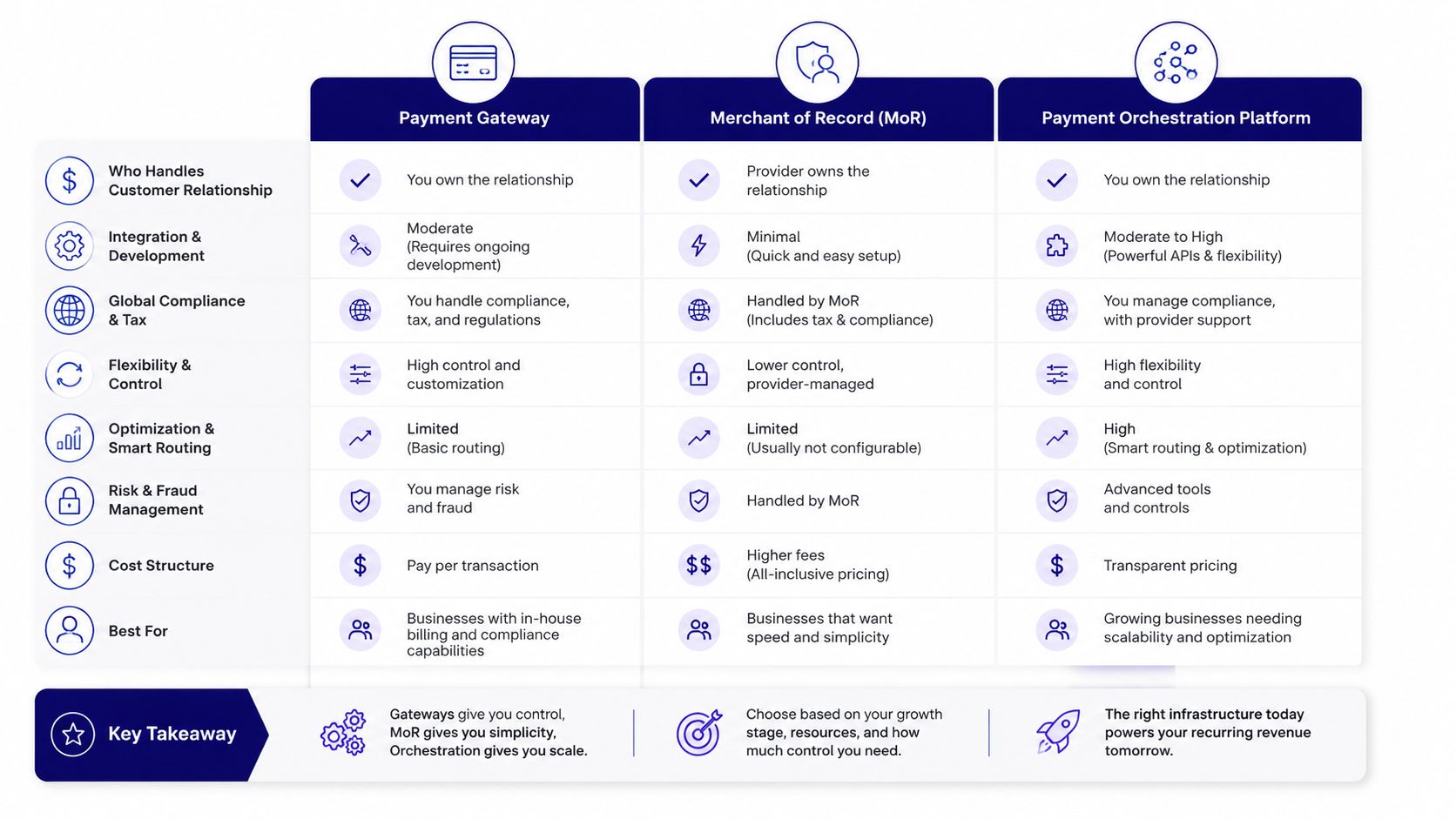
The infrastructure choice determines how much of this logic your team builds and how much control it retains. A card-only billing platform can simplify plans, invoices, tax handling, retries, and customer portals. That convenience is valuable for an early SaaS company, but the provider's data model and retry policy may constrain how thoroughly your team can tune decline handling.
A modular payment stack offers more control over routing, credential storage, event handling, and recovery. It also creates more integration work. Your team becomes responsible for connecting payment events to entitlement state, reconciling asynchronous outcomes, preserving mandate references, and maintaining compliance evidence.
Compare the operating models
Infrastructure approach | What it simplifies | Where it can constrain you | Suitable decision |
|---|---|---|---|
Card-focused billing platform | Plans, invoices, renewals, dunning, and customer management | Less control over routing and provider-specific decline behavior | Useful when speed and a standard subscription model matter most |
Hybrid card and bank-debit stack | Payment-method choice and account-based collection | More regional rules and settlement behaviors to manage | Useful when customers prefer bank payments or card retries are costly |
Card and crypto settlement infrastructure | Card acceptance with alternative settlement options | Requires careful treasury, conversion, and reconciliation design | Useful for global businesses that want customers to pay by card or crypto while choosing how to receive funds |
Tokenization, account updater support, MIT metadata, SCA handling, webhooks, and retry controls should be evaluation criteria, not checkbox features. Ask to see the actual event payloads and failure states. A dashboard that shows “payment failed” without the network reason or original transaction reference won't help engineers repair the workflow.
All-in-one systems reduce the number of moving parts. They can also make it harder to implement a custom grace period, a segment-specific dunning policy, or a different recovery route for high-value accounts. Modular systems expose more control, but only if the team has the operational maturity to use it safely.
For a broader evaluation of provider roles and SaaS requirements, use this payment processor for SaaS guide. Suby provides an API that lets businesses accept payments by card or crypto through one checkout, and it also offers native Discord and Telegram integrations for use cases such as subscriptions, paid access, and online communities. Its four product uses are Suby Payments, Suby Crypto, Suby Gating, and Suby Invoicing.
Suby's documented checkout supports cards, Apple Pay, Google Pay, direct bank transfer, and stablecoin payments, while its crypto flow handles the swap, sponsors gas, and lets the merchant settle to a non-custodial wallet or aggregate funds in the Suby balance, according to the crypto product documentation and the general payment documentation. Prices are defined in USD and crypto conversion uses real-time Pyth price feeds with the rate locked when payment begins, as described in the supported currencies documentation. Pricing depends on the payment method, so check the Suby pricing page for exact figures.
Launching Your Recurring Billing System
Launch recurring card billing as a controlled payment operation, not as a feature toggle. Before production, verify that the first payment creates a usable mandate and that every required MIT reference survives from checkout through renewal.
Pre-launch checklist
Mandate evidence: Store the original transaction reference, authentication result, consent record, and reusable payment method reference.
Renewal construction: Confirm that subsequent requests carry the correct recurring or MIT indicators and original-transaction linkage.
Event handling: Configure webhooks for authorization, capture, settlement, failure, refund, dispute, and subscription-state changes.
Idempotency: Protect every charge and retry operation from duplicate processing after timeouts or repeated events.
Recovery paths: Test insufficient funds, stale credentials, hard declines, technical failures, authentication requests, and customer cancellation.
Customer messaging: Make the merchant descriptor, amount, cadence, cancellation route, and payment-update path consistent across receipts and dunning.
Run a low-volume pilot before scaling. Compare the provider's transaction records with your internal invoice and entitlement states, then inspect every failed renewal manually. A system that looks correct in a successful test can still lose the original network reference, misclassify a soft decline, or grant access before capture completes.
Track authorization rate, involuntary churn, recovery time for failed renewals, retry outcomes by response code, customer payment updates, and dispute outcomes. Don't optimize one metric in isolation. A higher recovery rate isn't useful if it comes with more chargebacks or repeated attempts that damage issuer trust.
For teams assessing subscription billing management solutions, the key comparison point is operational control, not just plan creation. Revisit the infrastructure when volume makes reconciliation difficult, when recovery policies need segmentation, or when expansion introduces new mandate and SCA interpretations.
Regional expansion should trigger a compliance review before launch. Keep the mandate audit trail available, document the first-charge authentication, and confirm how the payment provider represents exemptions and merchant-initiated renewals in each target market.
Suby provides an API for accepting card or crypto payments through one checkout, with customers choosing how to pay and businesses choosing whether to receive funds in a bank account or stablecoins such as USDC. Visit Suby to evaluate its Payments, Crypto, Gating, and Invoicing options for recurring billing, paid access, communities, and global payment collection.
