

Gaspard LEZIN
Debit Memo Definition and Practical Uses for Business
Learn the debit memo definition, how it differs from a credit memo, real journal entry examples, and when to use it in billing and banking.
You're staring at an invoice that looked fine when it went out, then someone in finance spots the problem. A line item was underbilled, a late fee never made it onto the original document, or the buyer sent back part of the order and the books still don't reflect it. That's the moment a debit memo stops being a definition exercise and turns into a practical fix.
A debit memo is one of those documents people hear about only after a dispute starts. The wording can feel slippery because the same phrase also appears on bank statements, where it means something different. In billing, it's a post-invoice adjustment. In banking, it's a deduction from balance.
Table of Contents
Why a Simple Definition Is Not Enough
A seller sends out an invoice, the buyer pays it, and then someone catches a mistake. Maybe the service team logged extra work that never got billed. Maybe the original price was too low. Maybe a contract clause triggers a fee after the fact. In each case, the seller needs a way to correct the record without pretending the original invoice never happened.
That's why the debit memo definition matters in real work, not just in a glossary. A debit memo adds an amount after the invoice is already live, so the original invoice stays intact and the adjustment sits beside it as a separate charge. The same idea shows up in enterprise billing systems, where the document increases receivables instead of replacing the old record, and that difference makes reconciliation much cleaner.
Practical rule: if the first invoice is still the valid starting point, a debit memo is usually the cleaner correction.
For a finance team, that separation matters. It keeps the audit trail readable, helps collections understand why the balance changed, and avoids rewriting history just because one line was missed. If you want a broader finance context for how revenue timing and billing records can interact, this revenue recognition guide is a useful companion read.
The rest of the billing story turns on one question, what changed after the invoice went out. If the answer is “the buyer owes more,” a debit memo may be the right tool. If the answer is “the buyer owes less,” another document is usually the better fit.
What a Debit Memo Really Means in Accounting
The plain-English version
A debit memo functions like a correction slip that sits next to the original invoice. The seller is saying, “The first bill was too low, so here's the extra amount you still owe.” In banking, the same phrase can mean the bank has reduced the account balance, which is why people get confused when they see it in a statement.
The key idea is direction. In billing workflows, a debit memo increases what the buyer owes. In bank-statement usage, it can mean a deduction from the account balance. Context decides the meaning, not the words by themselves.
The accounting version
In enterprise ERP and billing systems, a debit memo is a transactional adjustment with a ledger effect. SAP describes it as a billing document created from a debit memo request that increases receivables in Financial Accounting, which is what makes it different from a credit memo that reduces receivables. That is the accounting heart of the term, not just the paperwork.
A debit memo is not a new sale. It is a formal adjustment to an existing receivable.
The operational version
This is the version most finance teams use. A debit memo handles underbilling, late fees, price corrections, cancellation fees, and returned-good adjustments without forcing a new billing cycle. It preserves the original invoice, leaves a traceable reason for the change, and gives collections or procurement a clean trail to follow.
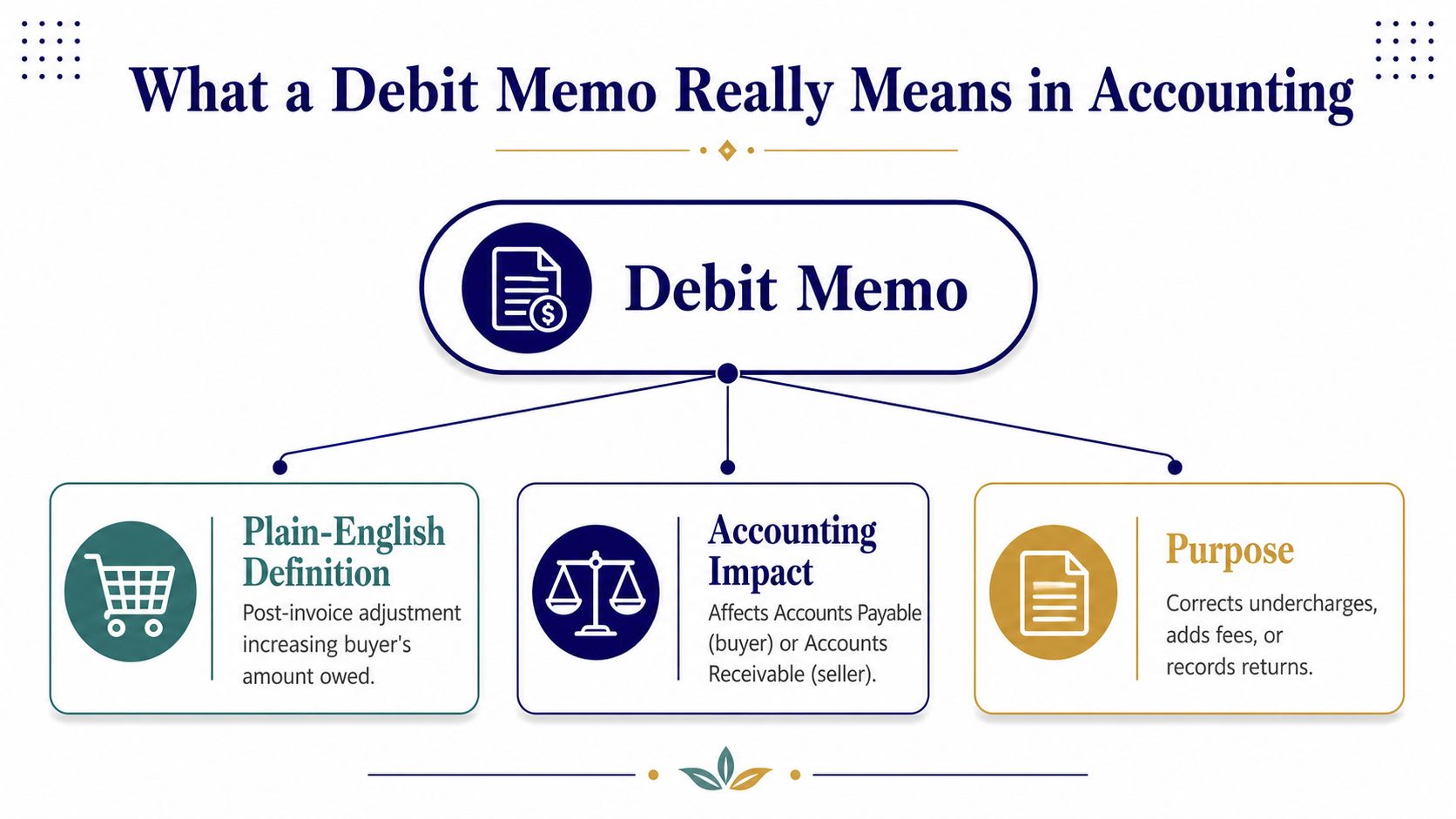
At the desk, the simplest way to explain it is this. A debit memo is the document you use when the original invoice was right enough to keep, but wrong enough to adjust. That is why it matters in receivables, procurement, and bank reconciliation.
Debit Memo vs Credit Memo and How to Choose
The direction of the adjustment
A debit memo moves the balance upward. A credit memo moves it downward. That's the shortest reliable distinction, and it's the one that matters when you're deciding what to issue after an invoice has already gone out.
The trigger usually tells you which document fits. If the invoice was too low, the debit memo corrects the undercharge. If the invoice was too high, or the buyer returned goods, the credit memo reduces what's owed. When the original billing document itself needs to be replaced rather than adjusted, a corrected invoice may be cleaner than either memo.
Side-by-side comparison
Criterion | Debit Memo | Credit Memo |
|---|---|---|
Direction of adjustment | Increases what the buyer owes | Decreases what the buyer owes |
Common trigger | Underbilling, late fees, added charges, post-issue corrections | Overbilling, returns, refunds, discounts |
Ledger effect | Raises receivables or payable balance, depending on who issued it | Lowers receivables or payable balance, depending on who issued it |
Audit trail | Keeps the original invoice and adds a separate charge | Keeps the original invoice and adds a separate reduction |
Best used when | The customer should pay more | The customer should pay less |
A buyer can also issue a debit note in return situations, which is where people often trip up. The direction depends on who is initiating the adjustment and what the transaction context is. In cross-border trade, that detail matters because disputes, partial returns, and invoice corrections all create different document trails.
Practical rule: invoice too low, issue a debit memo. Invoice too high or items returned, issue a credit memo.
The safest question to ask is, “Do I need to add to the outstanding balance or reduce it?” If the answer is add, the debit memo is the document you want. If the answer is reduce, the credit memo usually fits better.
Real Journal Entries for Common Debit Memo Cases
A debit memo is only useful when the ledger entry matches the paper trail. That starts with the journal entry, the bookkeeping record that pushes the adjustment into the books. For a plain-language refresher on what is a journal entry, the basic mechanics are laid out clearly in that glossary.
Underbilling after the invoice is closed
A seller who finds an underbilling records the correction directly in the accounts. Debit Accounts Receivable, Credit Revenue. The receivable increases because the buyer now owes more, and the revenue side captures the additional amount earned from the original sale.
The key is keeping the entry tied to the invoice that was short. If the memo says the customer was underbilled for consulting hours, the journal entry should point to the same job, period, or service line. That connection makes later review much easier, especially when the adjustment is part of month-end reconciliation. Teams that want a process view of matching documents can use the payment reconciliation guide as a practical reference.
Late fee added after the due date
A late fee follows the same accounting pattern, but the reason field does more work here. The debit memo should identify the overdue invoice and the payment terms that triggered the fee, so anyone reviewing it can see why the charge exists. The ledger entry still raises the amount owed, so the seller records the fee as additional receivable with the matching income account.
That detail matters because a late fee can look routine while still causing confusion if the support trail is thin. A clear memo helps the customer see that the charge came from the agreed terms, not from a fresh billing dispute. It also gives accounting a clean basis for posting the adjustment without reopening the original invoice.
Buyer-issued return or procurement adjustment
Returned goods can push the document flow in the other direction, depending on how the buyer's process is set up. In many buyer-side workflows, the adjustment stays linked to the original purchase order line, while the original price, ordered quantity, and received quantity remain unchanged. The adjustment is then recorded as a separate negative entry. Infor's documentation describes that approach clearly, since it preserves the original PO fields and treats the adjusted amount as negative, which makes audit review easier.
For the accounting side, the usual result is a reduction in the payable or a return-related adjustment account, paired with the offsetting credit entry that reflects the reversal. The exact account names can vary by system, but the logic stays the same. The memo should show that the return relates to the original transaction, not to a new purchase or an unexplained write-off.
Scenario | Debit side | Credit side |
|---|---|---|
Underbilling correction | Accounts Receivable | Revenue |
Late fee | Accounts Receivable | Fee Income |
Buyer-issued return adjustment | Returns, allowances, or payable adjustment account | Accounts Receivable or the offsetting balance account |
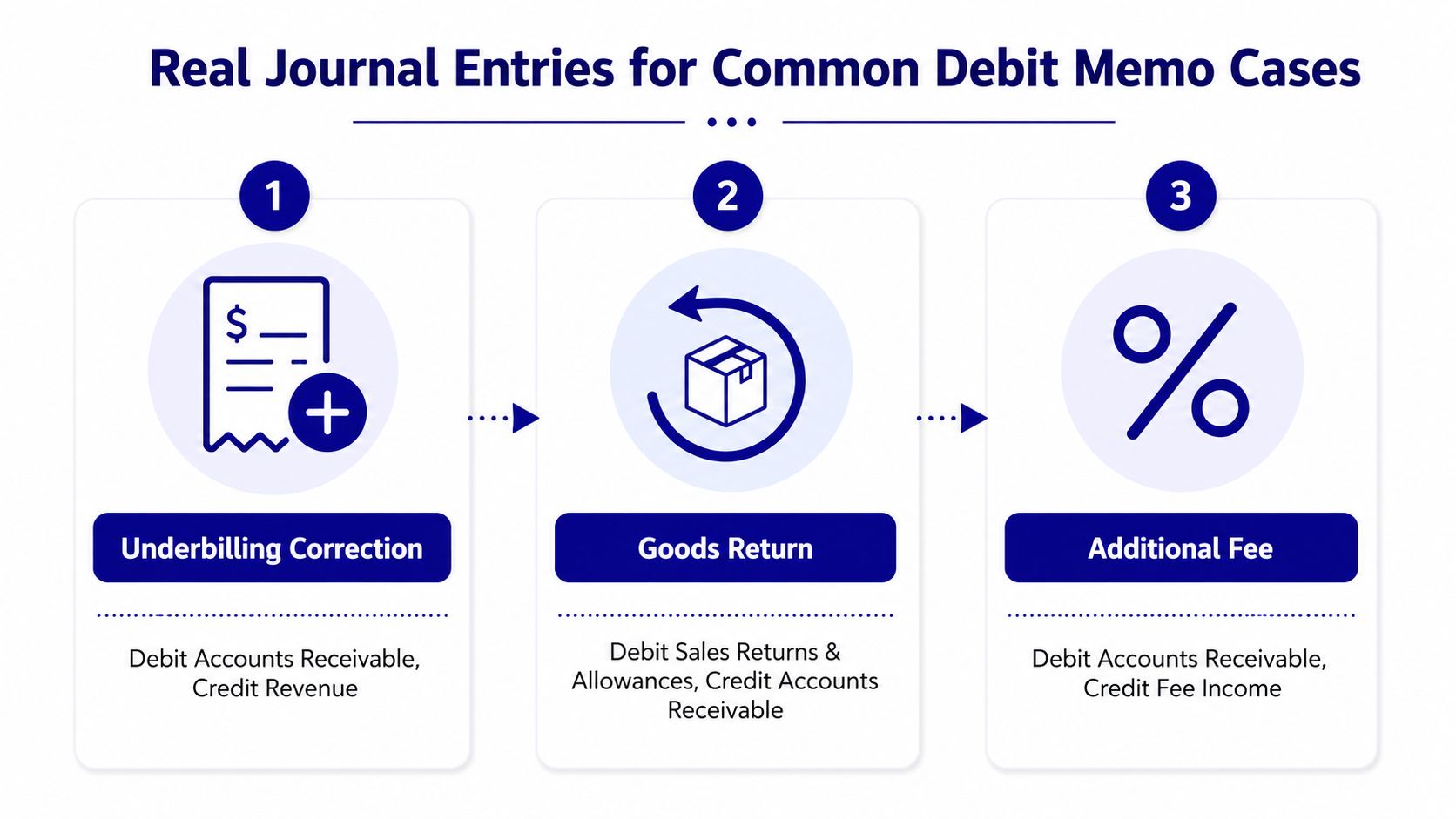
A debit memo only works when the paperwork and the ledger tell the same story. If the memo says “underbilled consulting hours,” the journal entry and invoice reference should point to that same job or period. If the memo describes a return, the adjustment should trace back to the original order line and receipt record. That is what keeps the books readable during close and later dispute review, especially when teams are comparing invoices, memos, and payments side by side.
Required Fields and a Simple Debit Memo Template
The fields that make the memo defensible
A debit memo needs enough detail for someone else to trace it without asking for a story. FreshBooks says the memo should include tax details, descriptions, total price, reference numbers, and payment terms. Ramp adds the practical fields commonly used, including the original invoice number, date of the debit, debit amount, item descriptions, reason for adjustment, and a unique memo number.
Those fields do real work. The invoice number connects the adjustment to the source document, the reason line explains why the charge exists, and the memo number helps prevent duplicates. Tax details and payment terms show how the adjustment should be settled and reported. For more detailed guidance on creating professional invoices, see our invoicing templates guide.
A simple template you can adapt
Debit Memo Number: [Unique memo number]
Date: [Issue date]
Customer Name: [Customer or buyer name]
Original Invoice Number: [Invoice being adjusted]
Reason for Adjustment: [Underbilling, late fee, return, or other cause]
Item Description: [Goods, services, or fee description]
Debit Amount: [Amount added]
Tax Details: [Applicable tax information]
Payment Terms: [Terms for settlement]
Practical rule: if you cannot trace the memo back to the original invoice in one step, the memo is not complete enough.
A simple example helps here. If a seller discovers underbilled consulting hours, the memo should point to the specific invoice, the exact job or period, and the added amount. If the memo covers a return, it should identify the original order line and the receipt record so the adjustment matches the transaction it corrects. That kind of detail keeps the entry readable during close and reduces confusion later when someone checks invoices, memos, and payments side by side.
Larger adjustments often need senior review before they go out, especially in businesses with formal approval thresholds. That protects the seller from avoidable disputes later and keeps the audit trail clear if the buyer pushes back.
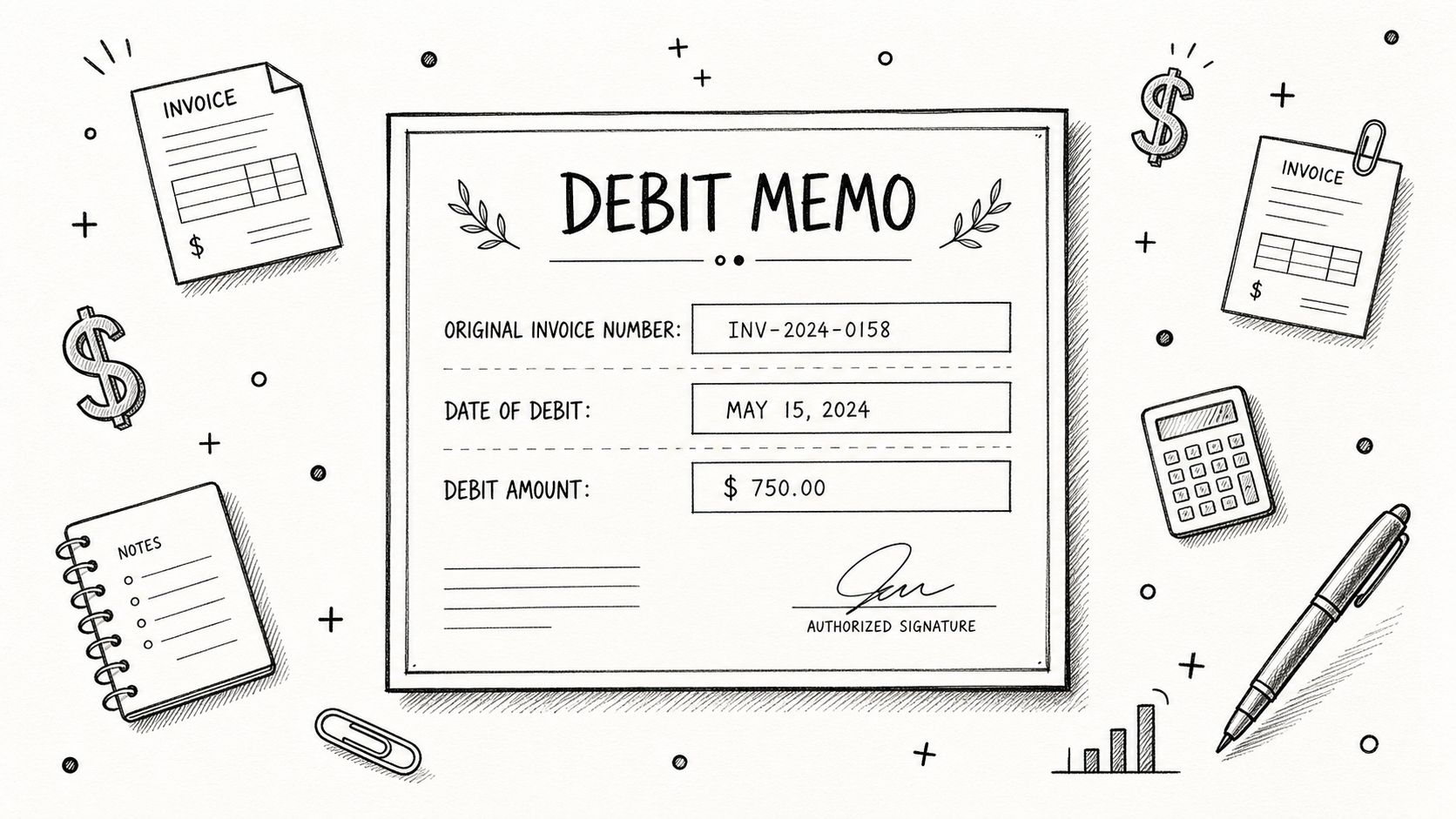
A memo that is clear on paper is easier to post in the ledger and easier to defend in a dispute. That is the value of the required fields. They turn an extra charge into a traceable record instead of a loose note.
The Other Meaning on a Bank Statement
A bank statement can use the same words, and that's where many readers get tripped up. In banking, a debit memo means a deduction from the account balance by the bank itself, not a seller-issued billing correction. AccountingCoach explains it as a deduction by the bank from the company's bank account, and Merriam-Webster defines it as a charge made by a bank against a depositor's account.
That bank-side meaning usually shows up for service fees, bounced-check charges, and other deductions the account holder didn't initiate. The statement is telling you the bank reduced your balance for a specific reason. So if you're staring at a statement and wondering why it says debit memo when you never issued one, the answer is simple. The bank issued it.
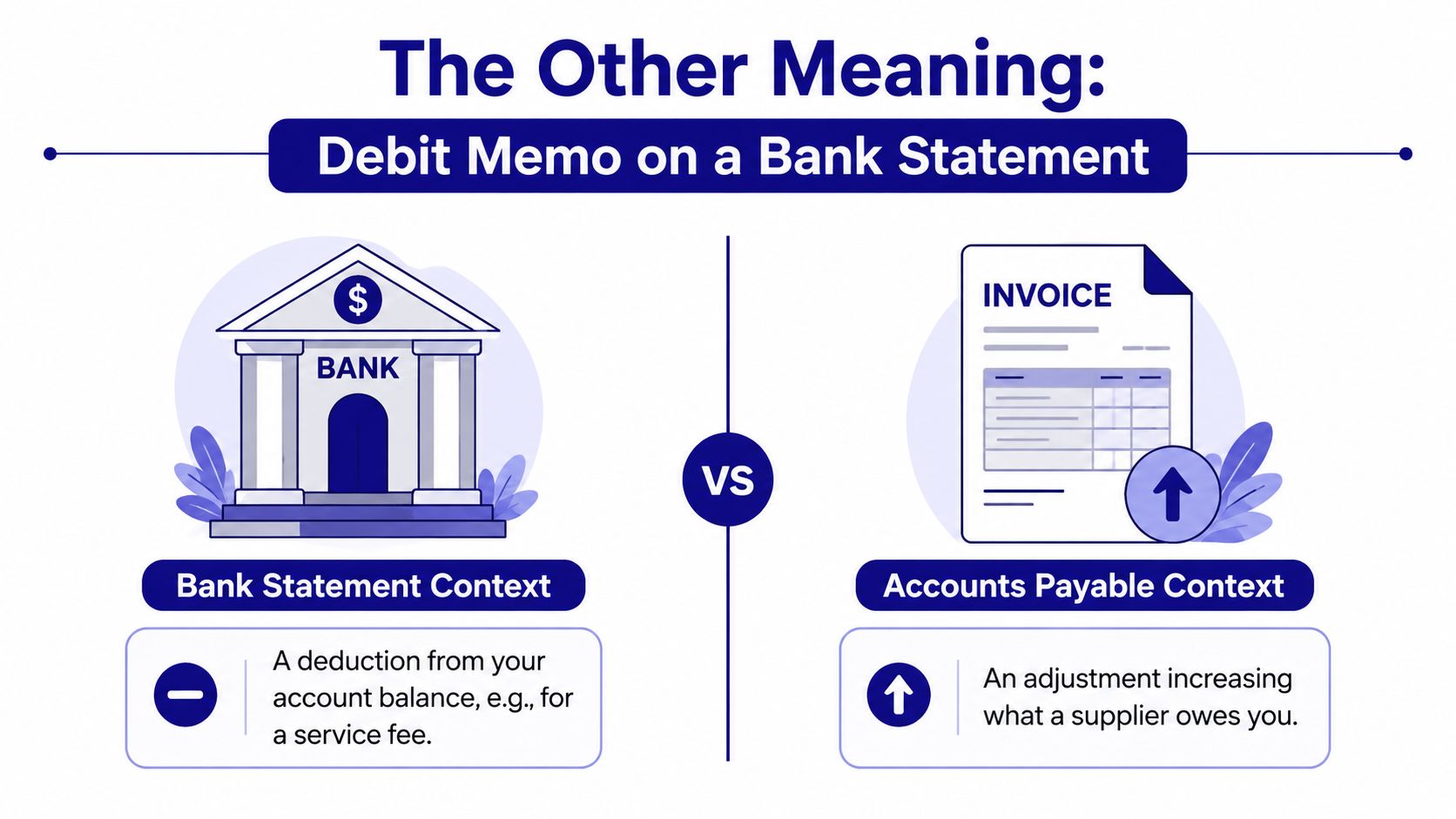
This is the point where context does the heavy lifting. In accounts payable or receivable, the memo usually increases what one party owes another. On a bank statement, it reduces the deposit balance. Same phrase, different ledger, very different action.
Quick Answers and a Template You Can Use Today
When should you use a debit memo instead of a corrected invoice
Use a debit memo when the original invoice is still valid and you just need to add a charge. That works well for underbilling, late fees, and extra services discovered after billing. Use a corrected invoice when the original document itself needs to be replaced, because that changes the document trail in a more direct way.
Who can issue one
Usually the seller issues a debit memo to increase what the buyer owes. In procurement and returns workflows, a buyer can also issue a debit note when goods are returned or a dispute needs to be documented. The direction depends on the transaction and the ledger being adjusted.
Is a debit memo the same as a debit note
In many business contexts, people use the terms interchangeably. In practice, the exact wording matters less than the accounting effect and the reference to the original transaction. If the document increases the amount owed after the invoice, you're dealing with the debit-memo side of the ledger.
A quick decision checklist
Identify the trigger. Underbilling, late fee, return, or fee deduction.
Confirm the original invoice still stands.
Draft the memo with the required fields.
Post the journal entry to the correct account.
Keep the cross-reference for audit and reconciliation.
A debit memo is only useful when it closes the loop cleanly. If the document doesn't explain the reason, point back to the invoice, and match the ledger entry, it'll create more confusion than it solves. Use the memo to make the adjustment obvious the first time someone else reads the file.
If your business bills customers across cards, wallets, bank rails, or crypto, Suby gives you one API to accept payments and native integrations for Discord and Telegram when paid access is the use case. It also lets you align how customers pay with how your business gets settled, so the payment flow matches the way you operate. Visit Suby to see how that can fit invoicing, subscriptions, and global collections in one place.
