
Gaspard LEZIN
Automated Provisioning: Streamline User Access in 2026
Implement automated provisioning for your app or community. Connect payments to user access, manage subscriptions, & streamline operations.
You're probably dealing with some version of this already. A customer pays for access, then waits while your team checks the payment, finds the right account, updates a role, sends an invite, or flips a flag in your app. That works for the first handful of users. It breaks once payments start arriving at all hours, from different countries, through different channels.
That's where automated provisioning stops being an IT term and starts being a revenue operation. If payment is what grants access, your system should grant, update, and revoke that access automatically, with clear rules and an audit trail. For developers building paid communities, subscription apps, and gated products, the key challenge isn't just identity. It's connecting checkout, settlement, and access control in one reliable flow, especially when users pay by card or crypto and the business receives USDC.
Table of Contents
Why manual access breaks fast
Where traditional IAM stops helping
Start with the trigger, not the UI
Map events to access states
A secure webhook handler in Node.js
Three targets, three different operational models
A clean access service layer
Grace periods, downgrades, and reversals
Build for retries and mistakes
Roll out in stages
Moving Beyond Manual Access Management
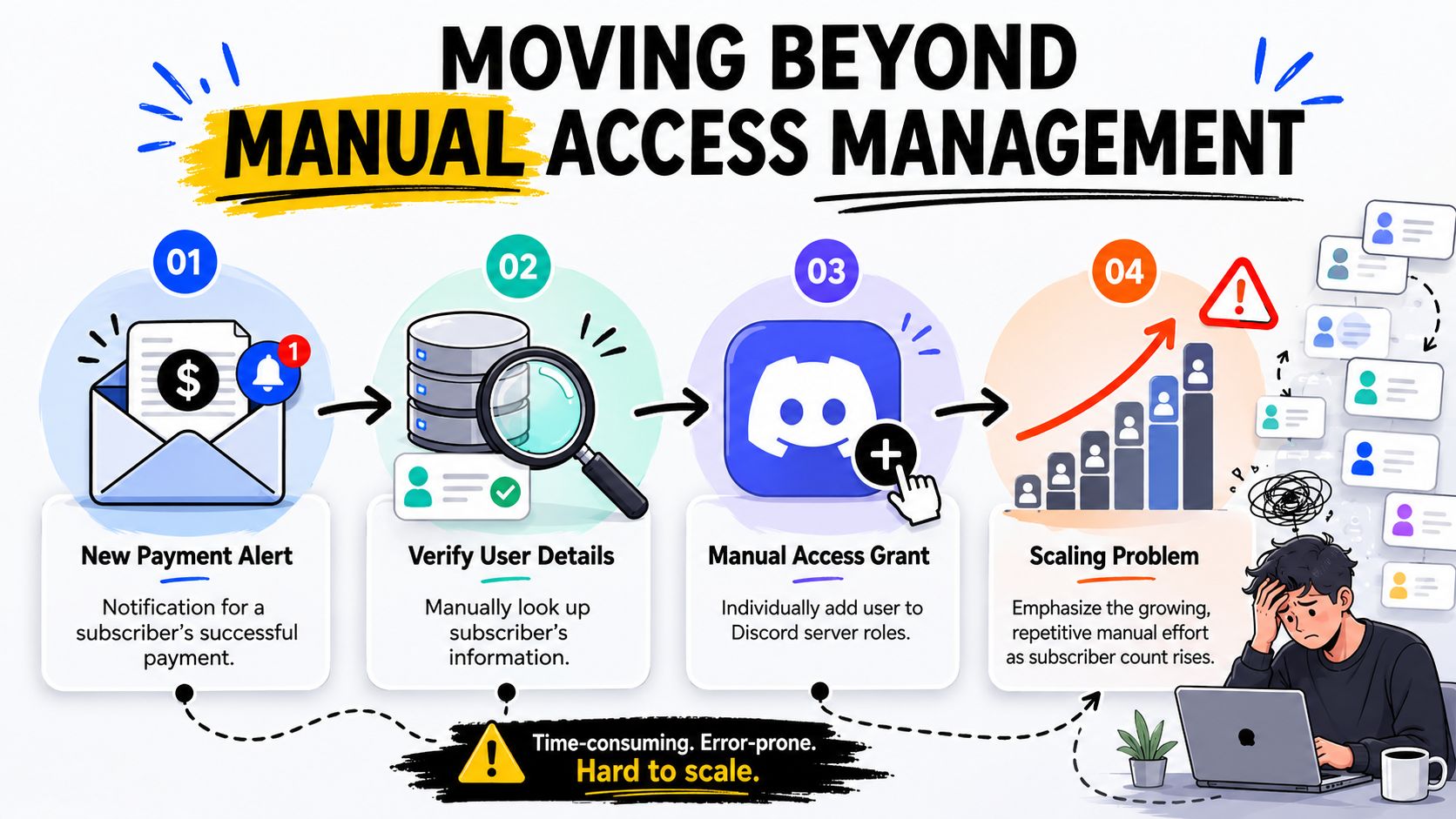
Manual access management usually starts as a convenience. Someone pays, you get a notification, and an admin updates Discord, Telegram, or your own database. The hidden cost isn't just time. It's inconsistency. One user gets access late, another keeps access after cancellation, and a third is assigned the wrong role because your payment record and access record drifted apart.
In traditional IAM, automated provisioning is a core practice that grants, updates, and revokes access through predefined rules instead of manual IT work. It's triggered by onboarding, role changes, and departure, and it's meant to enforce least-privilege access immediately while creating audit-ready logs (MiniOrange on automated user provisioning). That model still applies here. The only difference is the trigger. Instead of an HR system changing an employee's status, your trigger might be a successful subscription payment or a failed renewal.
Why manual access breaks fast
The pattern is easy to spot:
Payment lives in one system: your checkout confirms the charge.
Identity lives somewhere else: Discord, Telegram, or your app account stores the user.
Access depends on human handoff: someone has to connect the two.
Failures become silent: nobody notices a missed revocation until support tickets arrive.
Practical rule: If access depends on payment, the payment event must be machine-readable and tied to a user identifier you trust.
That's what developers need from a modern provisioning stack. Not a generic “member added” workflow, but a deterministic path from payment success to access granted, and from payment failure or cancellation to access removed.
Where traditional IAM stops helping
Most IAM material assumes SaaS apps, directories, and employee accounts. It doesn't spend much time on community products or payment-triggered access. That leaves a real gap for creators and internet-native teams. Existing guidance largely ignores how to automate access for communities based on USDC payment verification, even though 68% of digital creators now monetize via communities like Discord and Telegram (Suby creator payments and access workflows).
That gap matters because community access has the same lifecycle problems as enterprise identity. Users join, upgrade, lapse, cancel, and sometimes return under a different account or email. If you don't automate those transitions, your “membership business” becomes a spreadsheet and support queue.
Architecting Your Automated Provisioning Flow
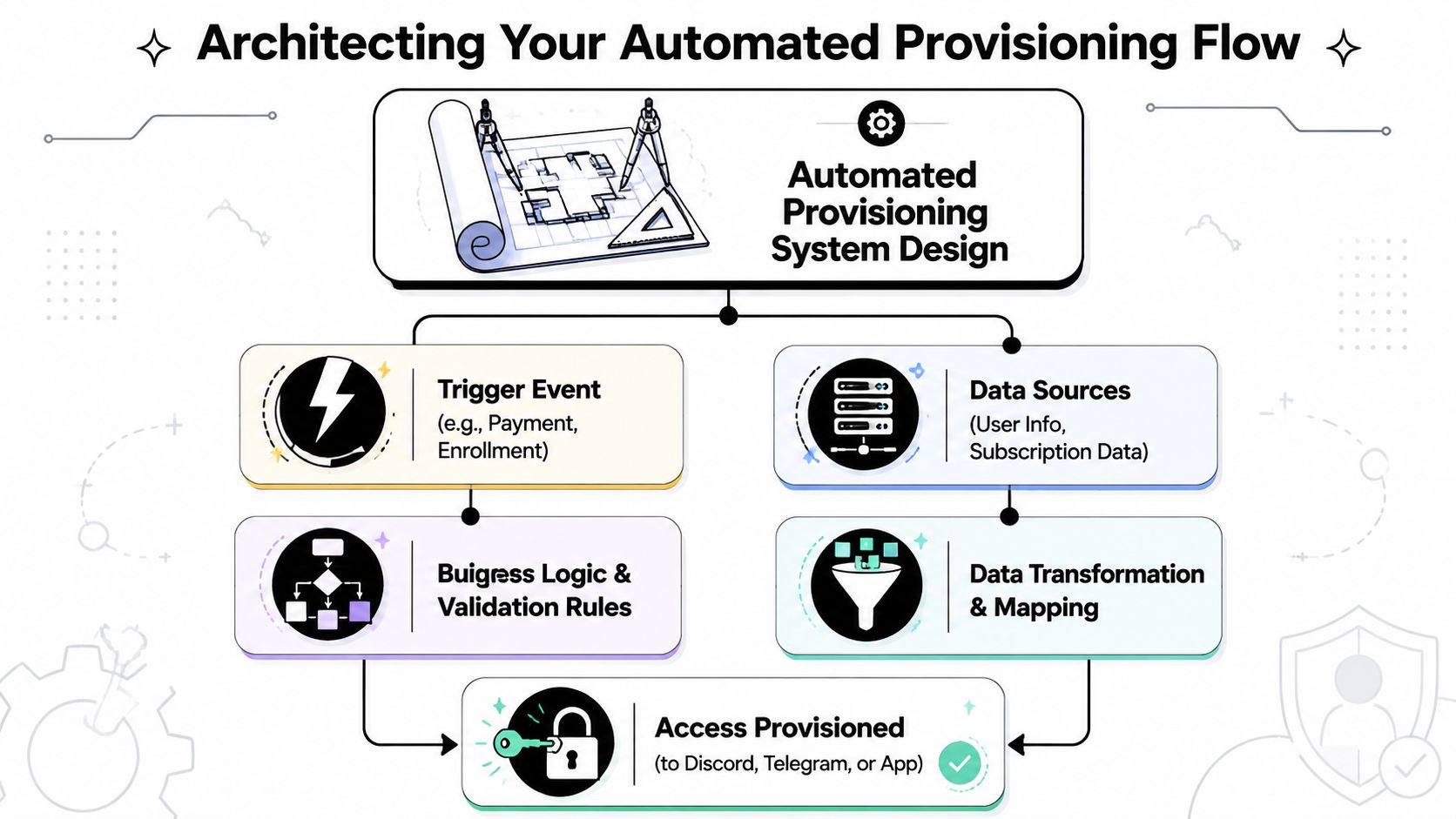
Good automated provisioning starts before code. You need a precise answer to one question: what exact event changes a user's access state?
If you skip that design step, you end up writing handlers that “mostly work” until renewals, retries, refunds, and upgrades arrive. I've seen teams define access around checkout completion, then discover that finance, support, and product all mean something different by “paid user.” Provisioning needs one canonical trigger and one canonical record of state.
Start with the trigger, not the UI
A reliable flow usually looks like this:
Customer submits payment
Payment system emits an event
Your backend validates the event
Business rules decide the target access state
A provisioning worker applies that state
Logs capture what changed and why
For cross-border products, this gets more important because settlement timing affects when you should grant access. Existing guides often assume bank-based delays, which is a poor fit for internet-native businesses. One cited angle is that 57% of cross-border companies face payout delays, and that instant access on flexible settlement (to your bank account, or in stablecoins (USDC, EURC) to your wallet) changes the operational model qualitatively (Suby cross-border payment automation).
A useful mental model comes from infrastructure work. Provisioning and configuration are related, but not identical. If you want a concise comparison of that split, IaC vs configuration management is worth reading. The same distinction applies here. “Create a paid membership” is provisioning. “Keep the right role, entitlement, and renewal status over time” is ongoing configuration and lifecycle control.
Map events to access states
Don't map events directly to API calls first. Map them to states.
Event | Internal state | Access action |
|---|---|---|
Initial payment confirmed | active | grant access |
Renewal confirmed | active | keep or refresh access |
Payment failure | past_due or grace | hold changes or limit access |
Cancellation at period end | scheduled_end | keep access until expiry |
Subscription expired | inactive | revoke access |
That table sounds simple, but it prevents common mistakes. For example, a cancellation event should not always remove access immediately. A failed renewal shouldn't necessarily remove a role if you offer a grace period. A plan upgrade may require replacing one role with another, not stacking both.
Provisioning logic should answer, “What should this user have now?” not, “What did the last event tell me to do?”
That shift is what keeps your system stable when events arrive late, arrive twice, or arrive in an unexpected order.
Connecting Suby Payments and Webhooks
A buyer pays with a card or crypto, the charge settles in USDC, and they expect access right away. That handoff is where payment systems usually break. The payment succeeds, but the webhook is missing, duplicated, or processed out of order, and someone ends up with the wrong Discord role or app entitlement.
Suby fits this developer and creator workflow well because the same payment flow can drive access for apps and communities, not just back-office billing. If you want more context on the request and response side before wiring your webhook consumer, this guide to payment gateway API integration with Suby is a useful companion.
Start with one payment flow and one webhook endpoint. A hosted paylink is often enough for the first version. That keeps the surface area small while you prove the event path from successful payment to access grant.
For a lightweight primer on event delivery patterns, webhooks for static sites gives a simple explanation that still maps well to this setup.
The practical rule is simple. Treat the webhook as a trusted signal to start work, not as permission to mutate access inline. Signature verification, idempotency checks, and queueing belong at the edge. Plan lookup, identity mapping, and entitlement changes belong deeper in your application where you can test them properly.
A secure webhook handler in Node.js
Your webhook endpoint should do four jobs well:
Read the raw body: signature checks often fail if middleware mutates the payload.
Verify authenticity: never trust event payloads without signature validation.
Acknowledge quickly: push heavy work into a queue or background job.
Record idempotency data: store event IDs so retries don't duplicate actions.
A minimal Express example looks like this:
Verify the signature before parsing business fields. If you reverse that order, untrusted input gets to influence control flow.
One more warning from production systems. Do not grant access directly from event.type alone. Payment events are transport messages, not business truth. Use the event to fetch or validate the current subscription record, confirm the customer identity you linked earlier, and then decide what access the user should have now. That extra lookup adds a bit of latency, but it prevents the expensive class of bugs where a retry, late event, or stale payload flips access incorrectly.
Implementing Access for Discord Telegram or Your App
Once your webhook is trustworthy, the actual work starts. The destination system changes the shape of the problem.
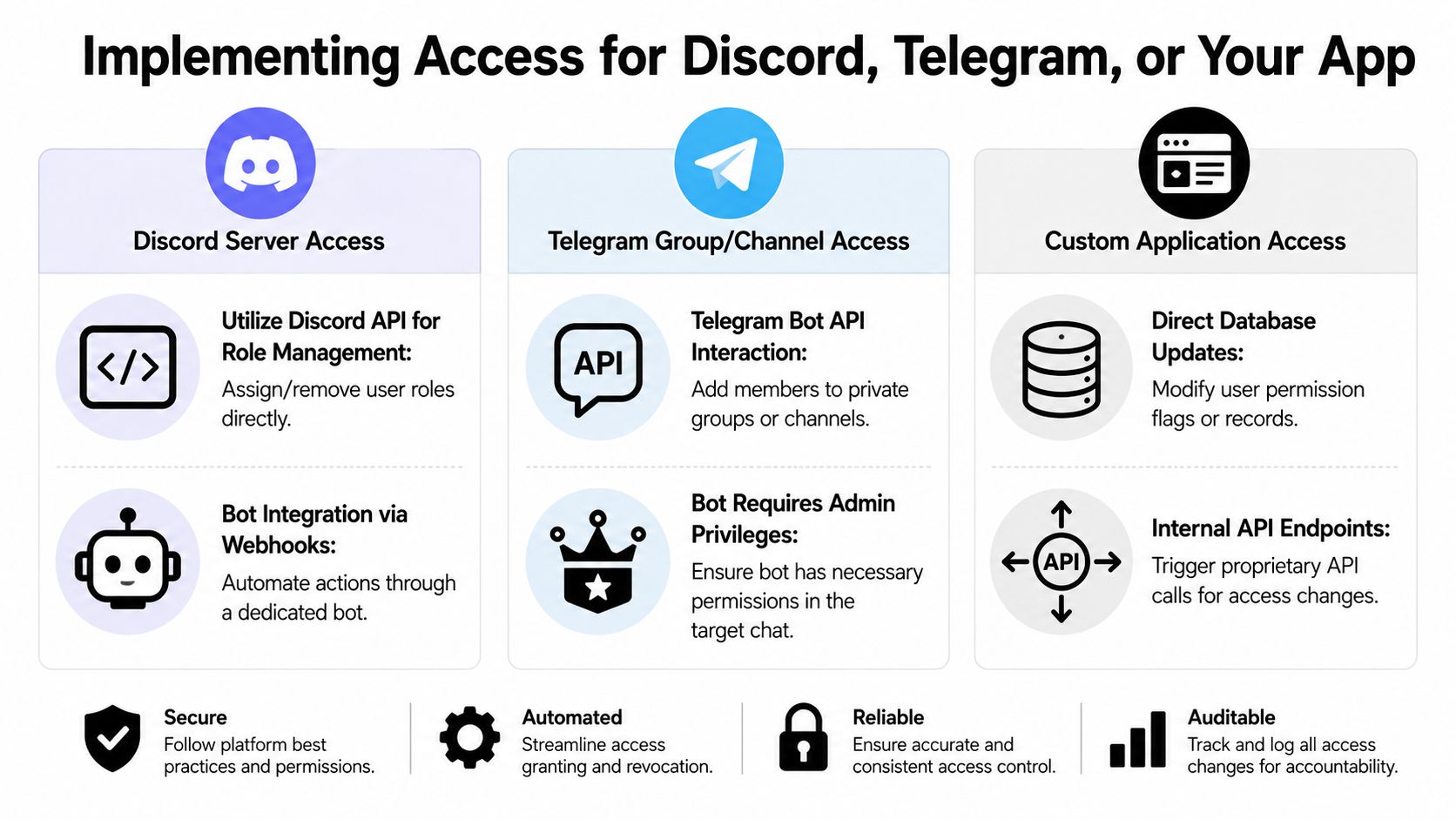
Three targets, three different operational models
Here's the practical comparison:
Target | Typical action | Main risk | Best pattern |
|---|---|---|---|
Discord | assign or remove role | wrong user mapping | store Discord user ID early |
Telegram | invite, approve, or remove member | bot permission issues | keep bot admin rights scoped tightly |
Your app | update entitlement fields | stale state in app cache | centralize permission reads |
Discord is role-centric. Telegram is chat-permission-centric. Your own app is state-centric. Don't force one model onto another.
For Discord, identity matching is usually the hard part. Payment records often contain email, while Discord actions require a platform-specific user ID. That means you need a trusted linking step before provisioning can be fully automatic. If your onboarding flow still relies on users manually messaging an admin, the automation chain is already broken. Related account setup issues also come up during community onboarding, so a practical explainer like How to verify Discord without personal number can help support teams understand one source of user friction.
If you're building a custom role bot around payment-triggered memberships, this walkthrough on building a Discord payment bot gives a useful implementation reference.
A simple app-side entitlement update might look like this:
A clean access service layer
Avoid writing Discord, Telegram, and database code directly inside the webhook handler. Use an internal service boundary instead.
That separation buys you three things:
Testability: you can replay old events safely in staging.
Recoverability: failed Discord calls don't corrupt your payment record.
Portability: adding a new access target doesn't require rewriting webhook logic.
The cleanest payment-to-access systems treat payment events as inputs, not commands.
Managing the Full Subscription Lifecycle
A payment-to-access system usually looks correct on launch day. The first subscription comes in, Suby sends the event, the role gets assigned, and everyone relaxes. However, the critical test starts a week later when a renewal fails, a user upgrades mid-cycle, or a canceled member still has paid access inside Discord because nobody removed the old role.
That is the part to design on purpose.
For developers and creators selling access to an app, a private Discord, or a Telegram group, lifecycle handling is the product. If billing state and access state drift apart, support inherits the gap. Users get locked out after paying, or keep access after churn, and both cases cost time and trust.
Your logic should cover the full set of state changes:
Initial access grant: active subscription creates the correct entitlement.
Renewal: successful recurring payment keeps access in place and extends the period end.
Cancellation: access stays active until the paid-through date, if that matches your policy.
Failed renewal: account moves into grace, restricted, or inactive state.
Expiration: paid access is removed, including roles, memberships, and in-app flags.
Reactivation: access is restored without duplicate records or stale permissions.
If you want a product-side view of how these billing states behave over time, Suby's guide to managing SaaS subscriptions is a useful companion to the access logic here.
A lifecycle-oriented event handler might look like this:
That handler is fine as a starting point, but production systems usually need one more distinction. “Active” is not a single case. A new subscription, a successful renewal, and a reactivation after failed payment can all map to active, but they often require different side effects. Renewals usually just extend dates. Reactivations may need role restoration, cache invalidation, and a message to the user that access is back.
I usually model that separately:
Grace periods, downgrades, and reversals
Teams often get the happy path working and leave money-sensitive edge cases half-defined.
A failed payment should not automatically remove access unless that is the business rule. Many paid communities and SaaS products give a short grace window. In practice, that means the user keeps core access until graceEndsAt, while your system marks the subscription as at risk and limits actions that should not continue indefinitely, such as new API usage, premium downloads, or private channel posting.
Downgrades need even more care. Adding the new lower-tier entitlement is only half the job. You also need to remove the old one everywhere it exists. That includes Discord roles, Telegram group membership rules, app feature flags, and any cached authorization data. If one layer updates and another does not, users see inconsistent access and support gets a confusing ticket.
Use a small rules table in code or config so policy stays explicit:
Billing condition | Access policy |
|---|---|
renewal paid | keep current access |
payment failed | enter grace or restricted mode |
subscription canceled but still paid through date | keep access until period end |
plan upgraded | swap to higher entitlement set |
plan downgraded | remove old entitlement set, apply new one |
subscription ended | revoke all paid access |
Refunds and chargebacks deserve their own path. Treat them as separate lifecycle events, not as delayed cancellations. Card payments can be reversed after access has already been granted, and crypto payments settled in USDC can have different finality and review workflows depending on how you handle fulfillment. Decide that policy early. Some teams revoke immediately on chargeback. Others freeze access and send the case to review if the account has already consumed high-value benefits.
One warning from experience. Do not key revocation only off subscription.canceled. Cancellation usually means “will end later,” not “remove access now.” The date that matters is the effective access end, not the moment the customer clicks cancel.
The systems that hold up in production are the ones that treat lifecycle state as first-class data. Payment events change subscription state. Subscription state drives access. That separation keeps Discord roles, app permissions, and paid community membership aligned even when renewals fail, plans change, or users come back after churn.
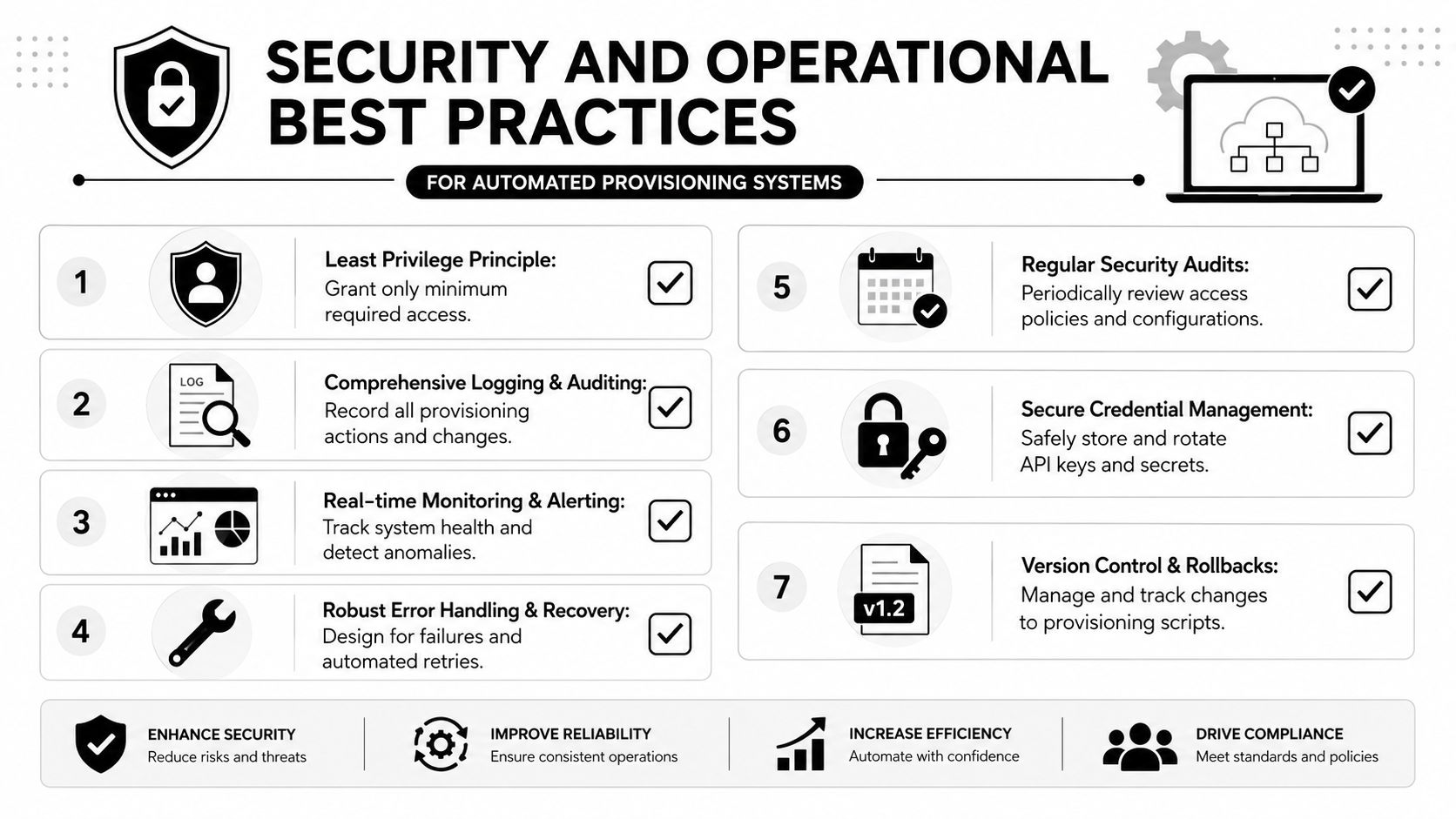
Security and Operational Best Practices
Production provisioning systems fail in boring ways. Duplicate events, bad role mappings, expired secrets, partial API outages, and silent data mismatches do more damage than dramatic hacks.
Build for retries and mistakes
Implementation discipline matters more than tooling alone. Work on automation programs outside pure IAM has highlighted the same pattern repeatedly: define measurable goals first, align stakeholders, standardize workflows, monitor continuously, train operators, and plan maintenance. Common failure modes include employee resistance, weak documentation, and data-security concerns, while scalable architecture and a dedicated project team show up as critical success factors (review of automation implementation practices).
For day-to-day engineering, that turns into a short checklist:
Use idempotency: if the same event arrives twice, the second run should do nothing harmful.
Log every access decision: record event ID, mapped user, target state, action taken, and result.
Separate validation from execution: parse and verify first, provision second.
Keep least privilege tight: bots and API tokens should only have the permissions they need.
Add manual replay tools: support should be able to safely retry a failed provisioning action.
A webhook handler that can't survive duplicate delivery isn't production-ready yet.
Roll out in stages
Provisioning should be staged, not dumped into production as a one-click deployment. Role definitions come first, then edge-case testing, then detailed logging and recurring audits to catch orphaned or misassigned access (TechPrescient on staged provisioning practice).
A sensible rollout sequence is:
Shadow mode: receive events and log intended actions without changing access.
Small cohort: enable automation for internal accounts or a limited user group.
Controlled expansion: turn on one access target at a time, such as app entitlements before community roles.
Audit cadence: review mismatches, orphaned memberships, and failed jobs on a schedule.
This is not optional. Payment-triggered access systems touch revenue, support, and security at the same time. If they fail unnoticed, you lose money in one direction and user trust in the other.
Suby is a payment gateway. Your customers pay with card, bank transfer, Apple Pay, Google Pay, Klarna, and more, or stablecoins, and you get paid out to your bank account, or directly in stablecoins (USDC, EURC) to your wallet, anywhere in the world, no bank account required. It provides an API and webhooks, plus native Discord and Telegram integrations for subscriptions, paid access, and online communities. For automated provisioning, that gives you one machine-readable payment event to drive every grant, renewal, and revocation, so access stops depending on manual handoffs.
