

Gaspard LEZIN
Your Info Product Business: A 2026 Guide to Success
Launch and scale your info product business. This guide covers product types, pricing, marketing, and global payment solutions for creators and entrepreneurs.
You already know the attractive version of the story. You package what you know into a course, ebook, membership, or template. You put up a landing page. Sales come in while you sleep.
What usually gets left out is the operational reality. Selling knowledge online is one problem. Collecting money from buyers around the world, settling it cleanly, handling subscriptions, and keeping delivery simple is a different problem. A lot of info product businesses stall there, not because the product is weak, but because the business underneath it is messy.
A good info product business works when three things line up. The offer solves a painful, specific problem. The distribution engine brings the right buyers in. The payment and delivery stack doesn't create friction after the customer has already decided to buy.
Table of Contents
Selling knowledge instead of inventory
Why the model works
A practical comparison
A quick walkthrough of common formats
Price the outcome, not the file size
The models that usually work
Packaging beats discounting
Start with owned audience
Match the channel to the product
A simple funnel that holds up
Keep the stack simple and dependable
Payments decide how global your business really is
Choose payment infrastructure for the business you want to run
The mistakes that waste the most time
What to do instead
Conclusion Your Path to a Scalable Global Business
What Is an Info Product Business
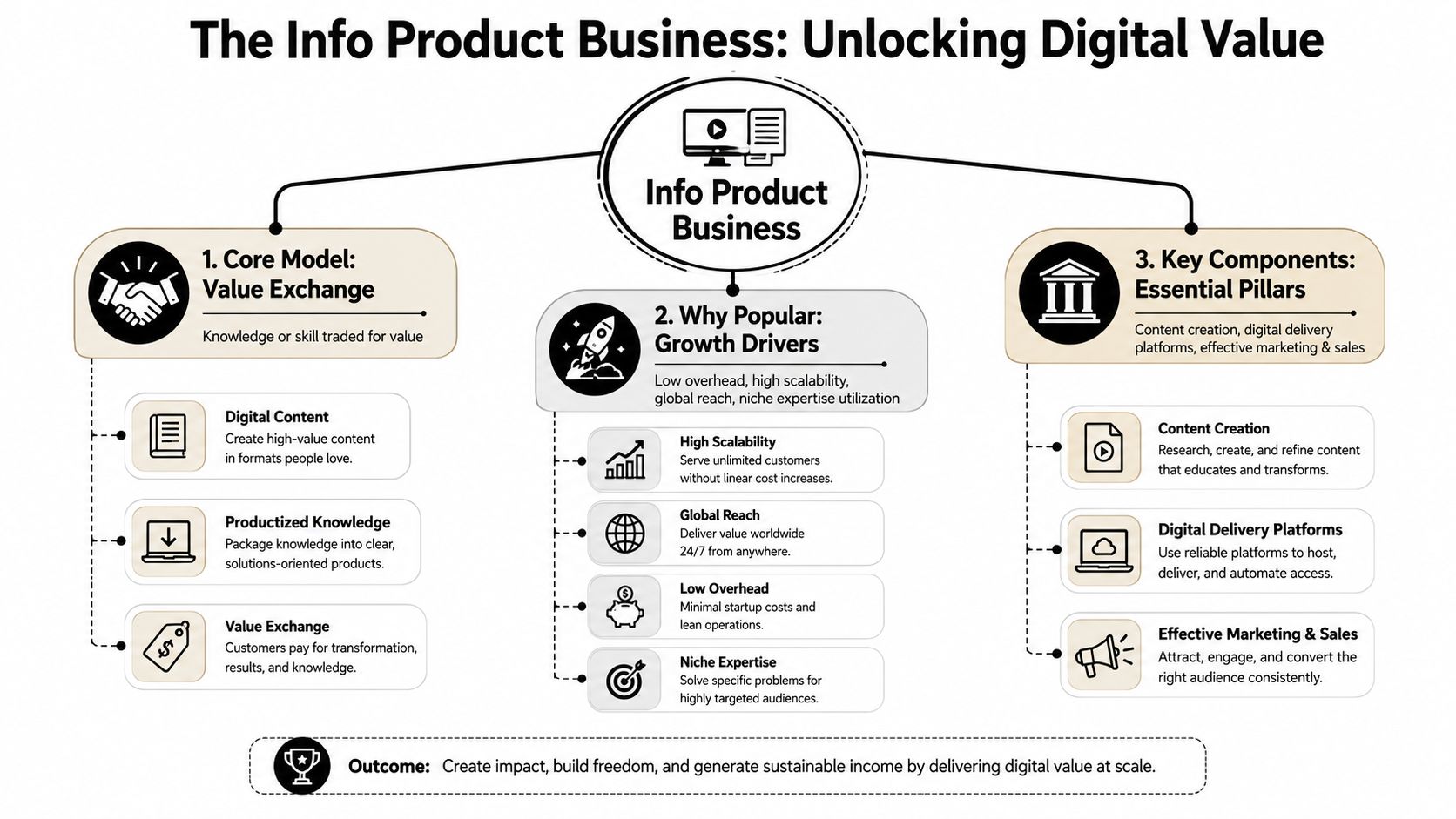
An info product business sells knowledge in a digital format. Instead of shipping a box, you deliver expertise. That expertise might be packaged as a course, guide, webinar, template, report, worksheet, newsletter, or membership.
Selling knowledge instead of inventory
The easiest way to understand the model is to compare a digital library with a physical bookstore. A bookstore has to buy, store, and ship inventory. A digital library creates the asset once, then delivers it again and again without printing, warehousing, or freight getting in the way.
That economic difference is the whole game. As ClickHelp explains in its overview of information products, an info product business is a low-marginal-cost digital distribution model. Once the asset is created, the per-unit delivery cost is near zero, so profitability depends more on acquisition efficiency and payment processing than on manufacturing.
That's why this model attracts creators, consultants, agencies, coaches, and software founders. It lets you turn expertise into an asset. If you're exploring formats, this guide to building a digital products store is a useful companion to think through storefront structure and delivery.
Why the model works
Info products became mainstream as internet distribution matured in the 1990s and 2000s. What started as downloadable guides turned into a broad commercial category. One industry guide now lists 11 distinct types of info products, including online courses, research reports, and membership sites, which shows how mature and flexible the category has become for internet businesses, as noted by Growbo's breakdown of info product types.
In practice, the appeal comes down to a few things:
Scalable delivery: The same product can be sold repeatedly without physical fulfillment.
Global reach: A buyer in another country can access the product as easily as a buyer in your city.
Flexible positioning: You can sell low-touch downloads, premium implementation help, or recurring memberships.
Asset creation: Revenue is no longer tied only to billable hours.
Practical rule: Passive income is the wrong mental model for most first-time sellers. Front-loaded work is the right one.
A weak info product business usually treats the product as a file. A strong one treats it as a solution. Buyers aren't paying for pages, videos, or templates by themselves. They're paying for clarity, speed, and a better result than they'd get alone.
The Four Main Types of Information Products
A lot of founders lose months here. They see a polished course launch online, assume that is the serious option, then spend weeks recording lessons before they have proof that buyers want the topic. Meanwhile, the same audience might have paid for a template bundle or short guide in a fraction of the time.
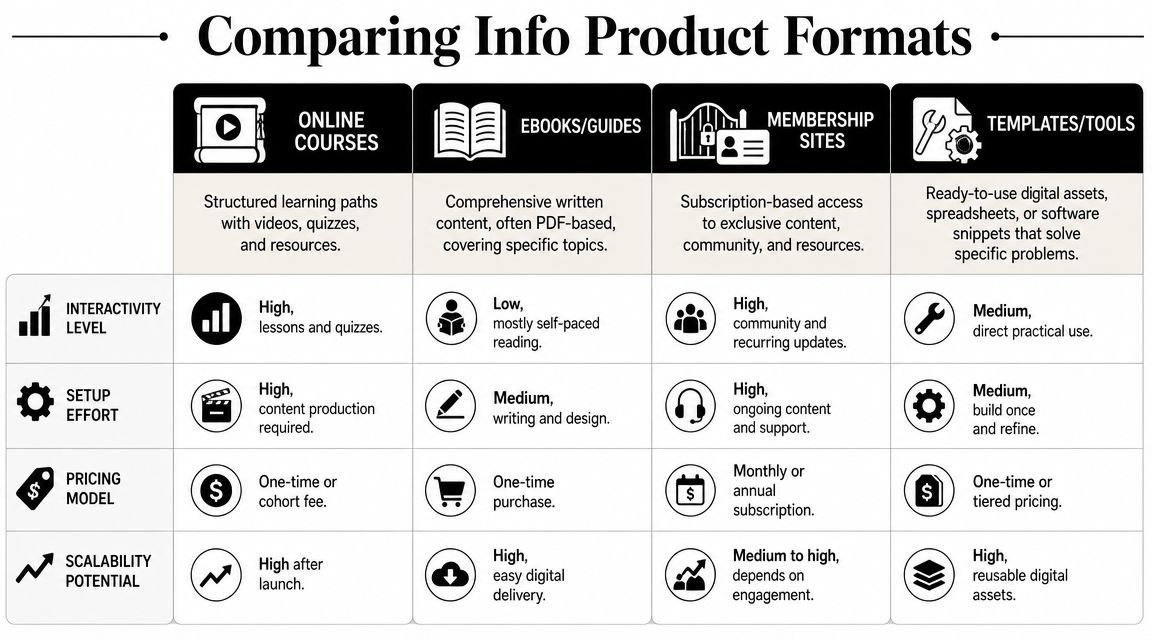
Format choice affects more than production. It changes support volume, refund risk, how often you need to update the offer, and how you collect revenue across countries. A one-time template sale is operationally simple. A recurring membership with international subscribers creates a different billing burden, especially if you want renewals to run cleanly and payouts to arrive on schedule.
A practical comparison
Product type | Best for | Creation effort | Support load | Typical strength |
|---|---|---|---|---|
Online courses | Deep transformation | High | Medium to high | Premium positioning |
Ebooks or guides | Clear education or thought leadership | Low to medium | Low | Fastest launch |
Membership sites | Ongoing updates, community, access | Medium to high | High | Recurring revenue |
Templates and tools | Fast implementation | Medium | Low to medium | High conversion from pain |
Each format can work. The mistake is choosing based on status instead of buyer behavior.
Online courses fit problems that need sequence, examples, and repetition. They sell well when the buyer wants a clear path and is willing to spend time learning. They are also the hardest format to keep sharp. Lessons age, screenshots break, and support requests rise once students start applying the material in different situations.
Ebooks and guides are stronger businesses than many creators assume. They are faster to produce, easier to revise, and easier for a cold buyer to say yes to. If the topic is narrow and urgent, a guide often beats a course because the buyer wants an answer, not a curriculum.
Membership sites work when the value keeps changing. Research updates, office hours, market breakdowns, coaching access, or active community discussion can justify recurring charges. If the product depends on monthly billing, operations matter a lot. Failed renewals, weak dunning, and poor cross-border payment acceptance can hurt retention just as much as weak content.
Templates and tools often win early. They solve a problem fast, which makes them easier to demonstrate and easier to recommend. A worksheet, calculator, Notion system, prompt library, checklist pack, or client-facing document set can produce faster customer feedback than a large education product.
That speed matters.
A practical example is tutoring. A tutor can sell lessons as knowledge, but a packaged system often has more commercial value than raw teaching time. A bundle with session plans, parent communication scripts, and admin workflows can become a stronger product than recorded advice alone. If that business also includes services, how to automate tutoring invoices becomes part of the operating model, not a back-office detail.
This broader list of digital products to sell online is useful if you are comparing educational products with more utility-driven offers.
Use this filter before you build:
Choose a course if the result depends on instruction, sequence, and practice.
Choose a guide if the buyer needs clarity, context, or a decision framework.
Choose a membership if you can publish or facilitate fresh value on a reliable schedule.
Choose templates if the buyer wants to skip setup and apply a working system immediately.
One rule has held up across every info product business I have seen. Buyers say yes faster to products they can use the same day.
A quick walkthrough of common formats
This video gives a useful visual overview before you commit to one path.
The right format is the one that matches the buying context, the support you can realistically deliver, and the payment model you can run without friction for customers in different countries.
Effective Revenue and Pricing Strategies
Most pricing mistakes come from treating information like a commodity. Sellers count pages, modules, or bonuses, then try to justify a price with volume. Buyers don't think that way. They ask a simpler question. Will this help me get a result faster, with less risk or confusion?
Price the outcome, not the file size
That's why pricing in crowded markets depends more on trust and proof than on content volume. The issue isn't whether you wrote a long guide or recorded many lessons. The issue is whether the buyer believes your offer is relevant and likely to work for their situation. That tension is captured well in Harvard Business School Online's discussion of finding a market need, which notes the importance of matching format and price to what buyers will pay for speed, convenience, or implementation help.
If your offer saves time, reduces mistakes, or gives a proven process, you can price around that value. If it's broad, generic, and unsupported, even a low price can feel expensive.
A practical way to think about pricing:
Entry product: Low-friction, narrow promise, fast purchase decision.
Core product: Deeper transformation, stronger authority, clearer support.
Premium layer: Access, feedback, review, community, or implementation help.
The models that usually work
One-time sales work well for guides, workshops, swipe files, and templates. They're simple to understand and simple to fulfill. They also make the funnel cleaner because there's only one buying decision.
Recurring subscriptions work when the buyer keeps receiving something new or keeps benefiting from access. That might be ongoing market analysis, a private community, monthly resources, or regular coaching. If the value peaks on day one, don't force a subscription.
Bundled pricing often beats stand-alone pricing. A guide plus checklist plus template pack usually makes more sense to a buyer than three disconnected products. The bundle feels complete.
A useful test: If a buyer asks, “Why does this cost this much?” your page should answer that with outcome, credibility, and support, not with a longer feature list.
In education-adjacent businesses, invoicing and billing also shape what customers perceive as premium. If you run tutoring, cohort learning, or recurring instruction, this guide on how to automate tutoring invoices is worth studying because it shows how clean billing operations support retention and trust.
Packaging beats discounting
Discounting is often a shortcut for weak positioning. If sales are soft, the problem is usually one of these:
Unclear buyer: The page tries to speak to everyone.
Weak promise: The result is vague.
Thin proof: There's no reason to trust the offer.
Poor fit: The format doesn't match the urgency of the need.
Better packaging fixes more than lower prices do. Add implementation help. Split the offer into tiers. Include review or feedback. Narrow the promise so the right buyers immediately recognize themselves.
Premium info products don't win because they contain more material. They win because buyers trust the seller to get them from problem to result with less friction.
Distribution and Marketing Your Info Product
A good offer with no distribution is a hidden file on the internet. Most info product businesses don't fail because the content is awful. They fail because nobody relevant sees it often enough to care.
Start with owned audience
If you're early, build around channels you control. Email is still the most dependable one because it doesn't depend on a platform deciding whether your audience sees you. Social can create awareness, but email closes more consistently because it gives you room to educate, segment, and follow up.
For creators who need a practical refresher, this piece on email marketing for lead generation is useful because it focuses on how to turn attention into a list you can sell to later.
Your early distribution stack should be simple:
Lead magnet: A checklist, teardown, lesson, or template that attracts the right buyer.
Landing page: One promise, one audience, one action.
Email sequence: Education first, offer second.
Content engine: Posts, videos, or articles built around the pain your product solves.
Match the channel to the product
Different products sell better through different channels.
A course often benefits from authority-driven content. That means longer explanations, live workshops, webinars, and teaching clips. Visual products lean the other way, much like physical categories where sellers learning how to sell jewelry online win with imagery over long copy. Templates do better when shown in action. Quick demos, before-and-after examples, and workflow videos usually convert better than abstract thought leadership.
Memberships need relationship. People subscribe for continuity, not just information. That means your marketing should show the ongoing experience, not only the resource library.
Here's the mistake I see a lot. Sellers try to be everywhere at once and end up weak in every channel. It's better to dominate one attention source and one conversion path than spread thin across five.
A simple funnel that holds up
You don't need a complicated funnel to start. You need one that matches buyer intent.
Attract the right problem-aware audience. Write or record content around the specific issue your offer solves.
Capture interest with something useful. Give away a small asset that creates a quick win.
Follow up with education. Use email to explain the cost of the problem and the logic of your solution.
Present the offer clearly. Show who it's for, what result it helps create, and what happens after purchase.
Keep selling after launch. Evergreen beats one dramatic launch followed by silence.
Launches are events. Businesses are systems.
Pre-selling can also be smart. A workshop, pilot cohort, or paid beta tells you more than a month of guessing. If buyers won't pay for the first version, the issue usually isn't your checkout page. It's the offer itself.
Building Your Modern Tech and Payments Stack
A lot of info product businesses look healthy from the front end. The sales page works, the checkout loads, customers come in. Then the operator spends evenings fixing access, chasing failed renewals, answering payment complaints, and waiting on payouts from platforms that were easy to start with but hard to scale across borders.
That is a stack problem.
A modern setup should reduce operator work as volume grows. If every new sale creates manual cleanup, the business is not automated. It is just digitized.
Keep the stack simple and dependable
The best stack is usually the one you can explain on one screen. A page to sell, a system to deliver, a CRM to follow up, a checkout that can handle one-time and recurring payments, and reporting that tells you what happened after the sale.
For most info product businesses, that means five functional layers:
Storefront or landing pages: a site builder, CMS, or focused funnel tool
Product delivery: course hosting, file delivery, a knowledge base, or gated content
Email and CRM: broadcasts, automations, tags, and customer lifecycle messaging
Checkout and subscriptions: one-time charges, recurring billing, refunds, and failed payment recovery
Analytics and payout visibility: conversion tracking, renewals, churn, and settlement reporting
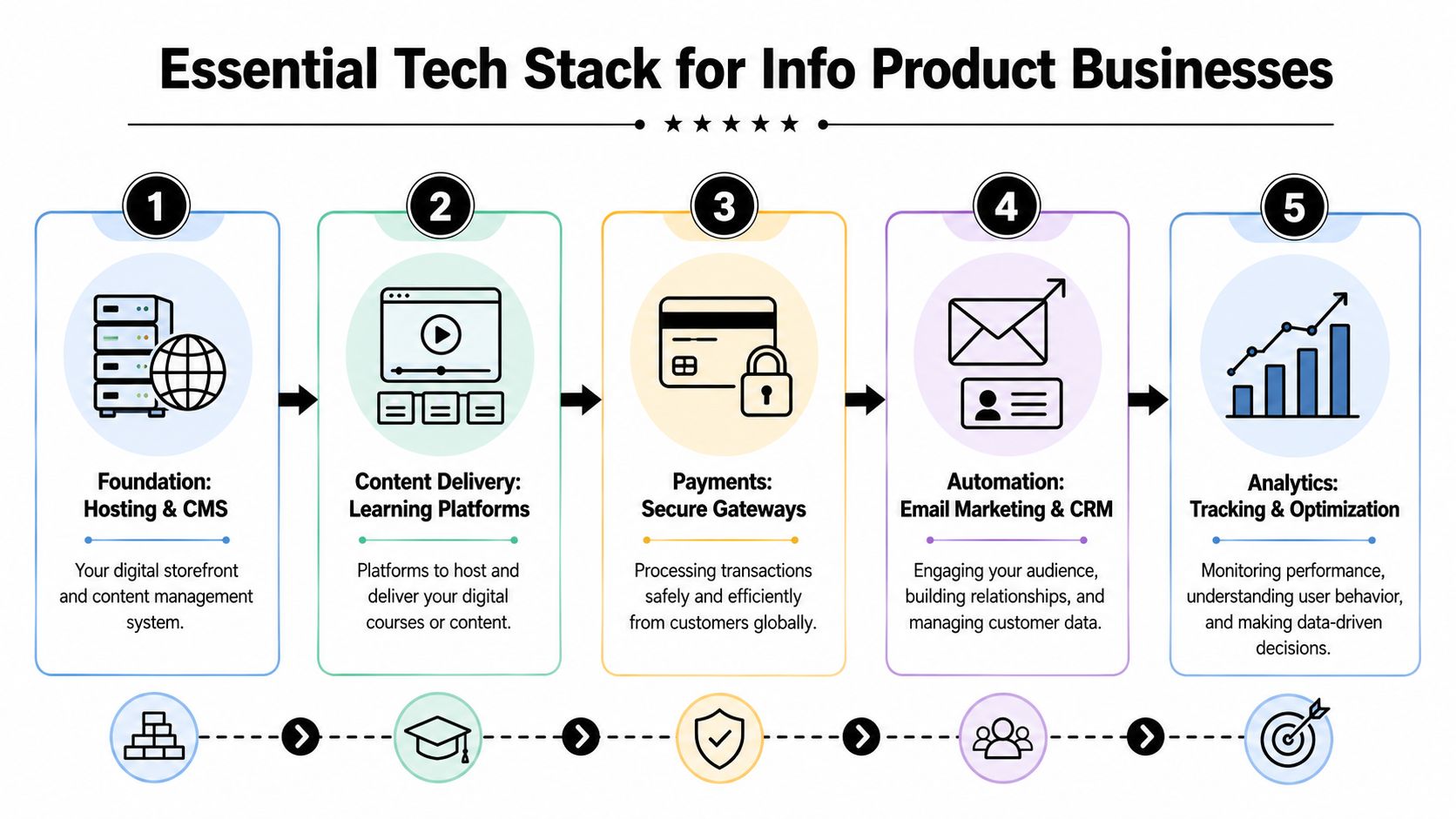
The primary cost is rarely the monthly software bill. It is the operational mess created by too many disconnected tools. I have seen creators save a small amount on software, then lose far more time handling support tickets caused by bad integrations, delayed access, and payment events that never sync correctly.
Payments decide how global your business really is
This is the part many guides gloss over. Selling globally is not just a traffic and conversion question. It is also a settlement, reconciliation, and payout question.
A checkout can accept an order and still create downstream problems. Buyers may face currency confusion. The seller may get paid late. Recurring billing may live in one system while access control lives in another. Refunds and disputes can turn into manual operations once volume picks up.
Bain's discussion of underserved markets and cross-border frictions points to the broader issue. Cross-border payments are often harder than the sale itself.
For an info product business, that friction usually shows up in a few predictable places:
Currency mismatch: the buyer experience and the seller payout experience do not line up
Delayed settlement: revenue is booked, but cash arrives later than expected
Subscription failure handling: retries, dunning, and access rules sit in separate tools
Refund and dispute workload: support volume rises as payment volume rises
These are operating issues, not edge cases.
Checkout starts the money movement, the access workflow, and the support burden.
That is why payments belong in the core architecture of the business. They affect conversion, customer trust, fulfillment, and cash flow at the same time.
Choose payment infrastructure for the business you want to run
If you expect international customers, paid communities, recurring memberships, or creator products with ongoing access, the payment layer needs the same scrutiny as your funnel. A useful starting point is this overview of a global payment API for cross-border digital businesses, which frames payments as infrastructure rather than a widget.
Suby is one example of that approach. It offers an API for card and crypto payments, with businesses receiving USDC. It also supports shareable paylinks, embeddable checkout, recurring subscriptions, and native integrations with Discord and Telegram for paid access, subscriptions, and online communities.
That setup will not fit every operator. Some businesses want the familiarity of a standard merchant account and local bank settlement. Others care more about faster settlement, international reach, or direct links between payment status and access control. The right choice depends on where your buyers are, how you deliver access, what currencies you need to support, and how much operational complexity you are willing to absorb.
The stack that holds up under scale is usually the simplest one that still covers the hard parts. Clear pages. Reliable checkout. Automated access. Clean reporting. Predictable payouts.
Common Pitfalls to Avoid in Your Business
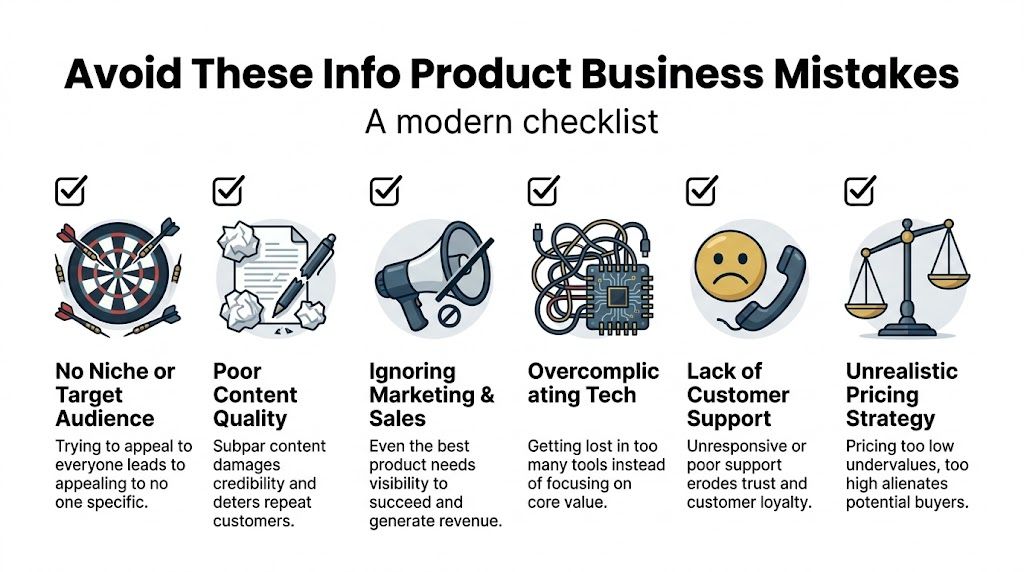
Most failures in an info product business look different on the surface, but they usually come from the same handful of mistakes. People build too much before validating demand. They underprice out of insecurity. They hide behind production instead of talking to buyers. Or they chase the fantasy that “passive” means effortless.
The mistakes that waste the most time
One industry view that gets repeated for a reason is that info products have "limitless inventory" and "uncapped earning potential," but the work is concentrated upfront, with delivery becoming more automated afterward, as described in Empire Flippers' explanation of the info product model. The problem is that many sellers hear the upside and ignore the workload.
Common traps include:
Building in isolation: You create the product before proving anyone wants it.
Selling broad advice: Generic content blends into the background.
Underpricing from fear: The low price attracts the least committed buyers.
Overcomplicating tools: You spend more time integrating software than selling.
Ignoring support: Buyers need onboarding, clarification, and fast responses.
What to do instead
Validate before you build the full version. Sell a workshop. Run a pilot. Offer a beta. If people hesitate, ask what they expected the product to do for them. That answer is more useful than another week of editing slides.
Narrow the promise until the right buyer feels seen. “Learn marketing” is weak. “Create a simple email funnel for a niche course launch” is stronger because it gives the buyer a concrete job to hire your product for.
A short operating checklist helps:
Start with a painful problem: Don't lead with your expertise. Lead with their friction.
Choose one format on purpose: Match the product to urgency, complexity, and support load.
Test pricing, don't guess: Try tiers or bonuses before cutting the base price.
Keep the stack lean: Every extra tool adds another point of failure.
Plan post-purchase experience: Access, onboarding, and support shape referrals.
If buyers are confused before purchase, support tickets multiply after purchase.
The info product businesses that last are rarely the flashiest. They're the ones with a sharp offer, a believable promise, and a simple operation behind the scenes.
Conclusion Your Path to a Scalable Global Business
A strong info product business isn't built on content alone. It's built on fit. The offer fits a real problem. The format fits the buyer. The pricing fits the value of the result. The delivery and payment setup fit the reality of selling online across borders.
That's what makes this model powerful. You can create once and sell repeatedly. You can serve buyers outside your local market. You can build an asset instead of only trading hours for income. But none of that works if the business is held together by guesswork.
The practical path is usually straightforward. Start with a narrow problem you understand well. Pick the simplest format that helps buyers get a real result. Price it around trust, speed, and usefulness, not around content length. Build a distribution engine you can repeat. Then make sure payments, access, and subscriptions are stable enough to support growth.
You don't need a huge catalog to make this work. You need one offer that solves one problem clearly, then a system that helps you sell and deliver it without friction.
Suby is a payment gateway and payment processor. Your customers pay with card, bank transfer, Apple Pay, Google Pay, Klarna, and more, or stablecoins, and you get paid out to your bank account, or directly in stablecoins (USDC, EURC) to your wallet, anywhere in the world, no bank account required. For an info product business selling globally, Suby ties checkout, subscriptions, and access together through paylinks, embeddable checkout, and native Discord and Telegram integrations, so payment operations stop leaking value as volume grows.
