

Gaspard LEZIN
Cross Border Payments Crypto Transforms Global Trade
Discover how cross border payments crypto simplifies global business. Stablecoin settlements cut costs, speed up transactions, and unlock new markets.
If you've ever stared at a payment statement and wondered where all the money went on its way from an international customer, you're not alone. High foreign exchange fees, agonizingly slow wire transfers, and unpredictable settlement delays have long been the frustrating cost of doing business globally.
But what if you could sidestep that entire creaky, old banking system? Using cross border payments crypto, specifically stablecoins like USDC, isn't a far-off futuristic idea. It's a practical way to get paid faster, cheaper, and with far more certainty.
The New Era of Global Commerce with Crypto Payments
For any online business, selling internationally has always felt like a game of trade-offs. The traditional payment rails we rely on, like SWIFT and correspondent banking, were designed for a world that no longer exists. They are notoriously slow, often taking three to five business days for money to land in your account. That's a huge cash flow gap for any growing business.
And then there's the cost. When you tally up all the hidden charges, like wire fees, intermediary bank cuts, and opaque foreign exchange (FX) spreads, it's not uncommon to see 2% to 7% of your revenue simply vanish. That bites directly into your profit margins and makes it tough to price your products competitively for a global audience. Worse, the whole process is a black box, leaving you to guess when the money will show up and what the final amount will actually be.
This is where a new model for global commerce comes into play. Forget the hype around speculative crypto trading. This is about using new payment technology to solve very old problems. The core idea is brilliantly simple: your customers pay with their card, but you receive your funds instantly and predictably as USDC.
This isn't just a minor upgrade; it's a fundamental shift that allows SaaS platforms, online creators, and e-commerce stores to expand globally with way less friction. The focus is on using stable, dollar-pegged assets like USDC as the settlement layer, which cuts out the volatility and delays baked into traditional finance.
How It Works for Your Business
Let's make this real. Imagine a customer in Europe buys your service with their credit card.
Instead of that payment taking a long, winding journey through multiple banks over several days, a modern payment provider processes it on the spot. The funds are settled directly to you as USDC, a digital dollar that maintains a one-to-one value with the U.S. dollar. This gives you a few immediate wins:
Global Acceptance: You can take payments from customers almost anywhere in the world, whether they use a credit card or their own crypto.
Predictable Payouts: Because you get paid in USDC, you completely sidestep the risk of currency values changing between the sale and when you get your money. What you charge is what you get.
Simplified Operations: A single integration can handle everything. We provide an API that allows any business to accept payments by card or crypto. We also offer native integrations with platforms like Discord and Telegram, which is perfect for anyone monetizing an online community with subscriptions or paid access.
This guide will walk you through exactly how your business can use cross border payments crypto to finally achieve faster, cheaper, and more reliable global transactions, all while your customers enjoy the same simple checkout experience they're used to.
How Crypto Payment Rails Actually Work
So, what’s going on under the hood with crypto cross-border payments? To understand the difference, let’s first look at the old way of doing things.
Imagine you're sending money from New York to Tokyo. With traditional banking, that money doesn't fly directly. Instead, it gets routed through a series of correspondent banks, like a flight with multiple, lengthy layovers. Each stop adds delays, paperwork, and its own set of fees.
Crypto payment rails are the nonstop, direct flight. They offer a fundamentally better route for money to travel globally.
The Problem With Old-School Payment Systems
For decades, the SWIFT network has been the backbone of international finance. But here's the thing: SWIFT is just a messaging system. It doesn't actually move money; it just sends payment orders from one bank to another in a chain.
This clunky, multi-step process is a constant source of friction for any business operating internationally. You've likely felt the pain yourself:
Painful Settlement Delays: Payments often get stuck in transit for 3-5 business days, which can wreak havoc on your cash flow.
Sky-High Costs: Between bank wire fees and less-than-favorable currency conversion rates, a significant chunk of your revenue simply vanishes along the way.
Zero Transparency: Ever had a client ask, "Where's the money?" With SWIFT, it's nearly impossible to track a payment in real time, leaving both you and your customer in the dark.
This system was built for a different era. Today, businesses need something that moves at the speed of the internet.
Stablecoins: The Digital Dollar for Global Business
This is where stablecoins change the game. A stablecoin is a digital currency specifically built to hold a consistent value. They are typically pegged 1-to-1 with a major fiat currency, like the US dollar. For example, one USDC is designed to always be redeemable for one US dollar.
This stability is what makes them so powerful for commerce. They act like digital dollars that can be sent over modern blockchain networks, like financial superhighways, arriving almost instantly, any time of day, any day of the year. You get the benefits of crypto's speed without the price swings of other assets.
By settling transactions in a stablecoin like USDC, your business gets the global reach and near-instant speed of crypto without taking on any price volatility. You bill in dollars, and you get paid in dollars, it’s just a much, much faster and cheaper journey.
This simple diagram breaks down how a payment platform uses these new rails to connect your business with customers anywhere in the world.
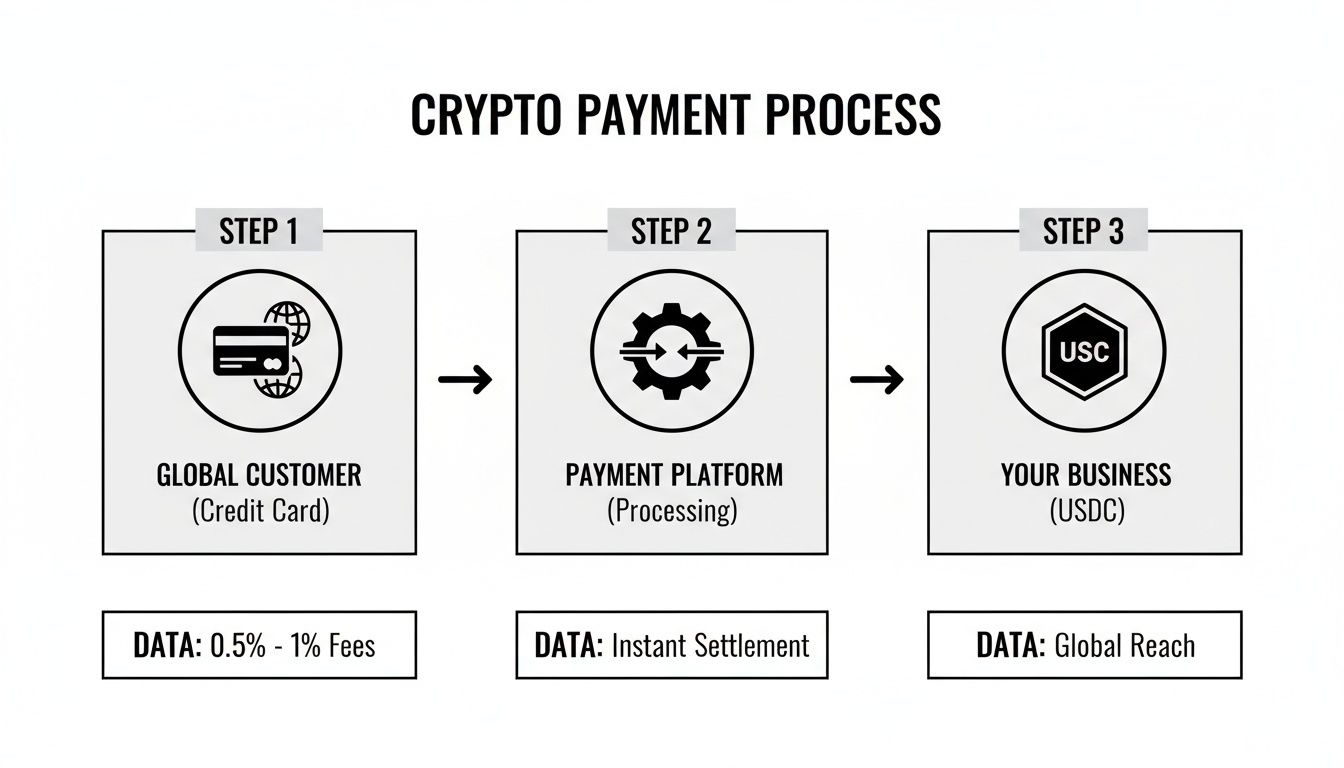
As you can see, the experience is simple for the customer, but the back-end process delivers incredible efficiency for the business by settling payments in USDC.
Making It Effortless for Your Customers
Here's the best part: your customers don't need to know or care about any of this. A well-designed payment platform abstracts away all the complexity. From their perspective, they’re just making a standard online purchase with their Visa or Mastercard.
Behind the scenes, the platform securely processes their card payment, handles the currency conversion, and delivers the final USDC settlement directly into your business wallet. The customer gets a familiar, smooth checkout, and you get the advantages of instant, global settlement.
For developers and businesses wanting to tap into this, integration is often just a matter of using an API. This allows you to accept card or crypto payments and receive USDC payouts. For other use cases, like running a paid Discord or Telegram community, some providers offer native bots that manage subscriptions and one-time access, showing just how flexible a modern crypto payment gateway can be.
The Real-World Benefits of Crypto for Cross-Border Transactions
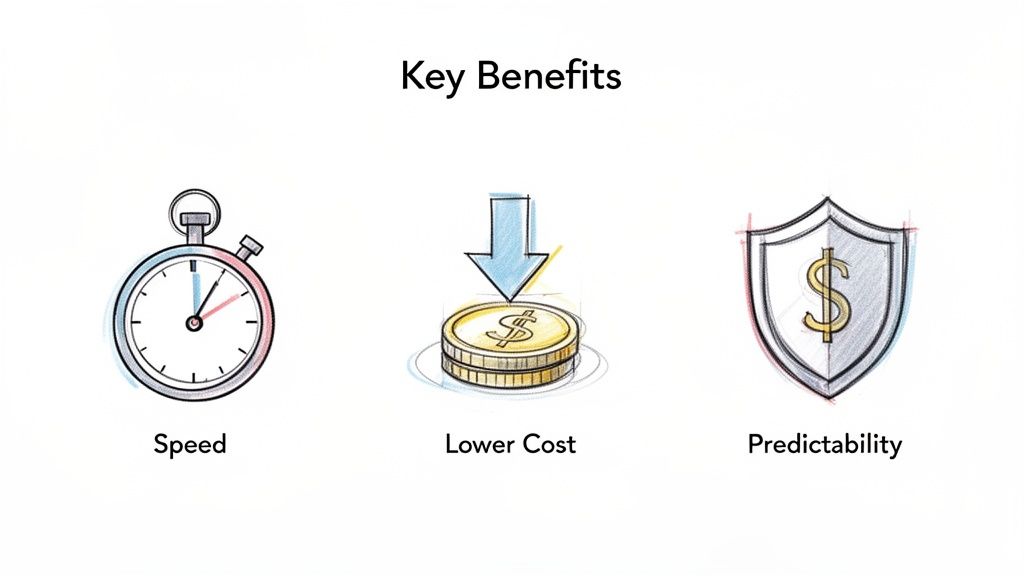
The advantages of using modern crypto rails for your global business aren't just theoretical. We're talking about direct, measurable improvements to your cash flow, profit margins, and financial stability.
By moving past outdated banking systems, you can finally solve three of the biggest headaches that have always been part of international commerce: slow payments, high fees, and unpredictable currency risk.
The key is using stablecoins like USDC as the settlement asset. Instead of bouncing a payment through a slow chain of intermediary banks, funds move directly from point A to point B on a blockchain. This seemingly simple change has a massive impact on how you manage global revenue.
Let's dig into what that actually means for your business.
Benefit 1: Get Your Money in Minutes, Not Days
In any online business, cash flow is oxygen. Traditional cross-border payments, unfortunately, force you to hold your breath. A standard wire transfer using the SWIFT network can easily take 3 to 5 business days to land in your account, and that’s if you’re lucky enough to avoid weekends or bank holidays.
This delay creates a painful gap between making a sale and actually having the cash on hand. For a SaaS company paying for servers or an e-commerce brand ordering new inventory, that lag is a serious operational bottleneck.
Cross-border payments using crypto rails completely erase that waiting period. Blockchain transactions run 24/7/365 and settle in a matter of minutes. Your revenue becomes accessible almost immediately, allowing you to pay suppliers, cover expenses, or reinvest in growth without waiting for the old banking system to wake up.
Think about it. You could invoice a client on a Friday afternoon and have the funds settled in your wallet before you even log off for the weekend. With a wire transfer, you'd be waiting until Wednesday.
Benefit 2: Stop Overpaying for Every Transaction
Beyond the speed, the cost savings are what get most businesses' attention. International payments are notoriously expensive, but the real cost is often buried in a string of small, hard-to-track fees.
When a customer pays you from another country, the money gets hit with multiple charges:
Wire Fees: Both the sending and receiving banks take a flat fee.
Intermediary Bank Fees: Each bank in the middle of the transfer takes its own cut.
Foreign Exchange (FX) Spreads: This is the big one. Banks give you a less-than-ideal exchange rate and pocket the difference.
All in, these fees can easily skim 2% to 7% off your total transaction value. That’s a direct hit to your profit margin on every single international sale.
For a global business, switching to stablecoin rails can be dramatic. Some enterprises have cut their cross-border costs by up to 80% by ditching wire transfer fees. This approach allows internet-native companies to scale globally, accepting cards or crypto and settling in stablecoins without the friction and volatility of traditional finance. You can learn more about how blockchain is reshaping global business payments and see the data behind these savings.
A modern payment platform built on stablecoin rails usually rolls all of this into a single, transparent fee. You finally know exactly what you’re paying.
To see just how different these two worlds are, let's put them side-by-side.
Traditional Payments vs. Stablecoin Rails: A Comparison
The table below breaks down the core differences between old-school payment rails and the new standard of stablecoin settlement. It's a clear look at why so many businesses are making the switch.
FeatureTraditional Payment Rails (SWIFT/Wire)Stablecoin Payment Rails (e.g., USDC)Settlement Speed3-5 business days, subject to banking hours and holidays.Near-instantaneous, typically settling in minutes.Operating HoursStandard business hours only (Mon-Fri, 9-5).24/7/365, including weekends and holidays.Transaction Costs2%-7% of transaction value (wire fees + FX spread + intermediary fees).Typically a single, low, and transparent processing fee.Cost TransparencyPoor. Costs are often hidden in FX spreads and intermediary fees.High. A single, clearly stated fee.Currency Risk (FX)High. The exchange rate can change during the multi-day settlement period.None. Settlement in a 1:1 pegged stablecoin like USDC eliminates volatility.Global ReachExtensive, but can be slow and complex in certain regions.Global from day one. Anyone with an internet connection can participate.
As you can see, the operational and financial advantages of stablecoin rails are compelling. They offer a fundamentally more efficient and predictable way to manage money across borders.
Benefit 3: Achieve Rock-Solid Payment Predictability
This might be the most underrated benefit of all: predictability. When you charge a customer $100, you should receive $100, minus a clear processing fee. With traditional international payments, that’s rarely the case.
Because of the multi-day settlement delay, the exchange rate can move against you. A sudden dip in the customer's currency value means you get less money than you were expecting. This foreign exchange risk wreaks havoc on financial planning and can quietly eat away at your profits.
Settling payments in a stablecoin like USDC solves this problem instantly. Since USDC is designed to maintain a 1-to-1 value with the U.S. dollar, its value doesn't fluctuate.
This gives your business total certainty:
The price you charge is the amount you receive.
You no longer have to guess or worry about currency swings.
Financial forecasting becomes accurate and reliable.
This kind of predictability is a game-changer for any business operating in more than one market. You can set firm pricing without having to build in a "buffer" for potential FX losses, making you more competitive on a global scale.
How Your Business Can Integrate Crypto Payments
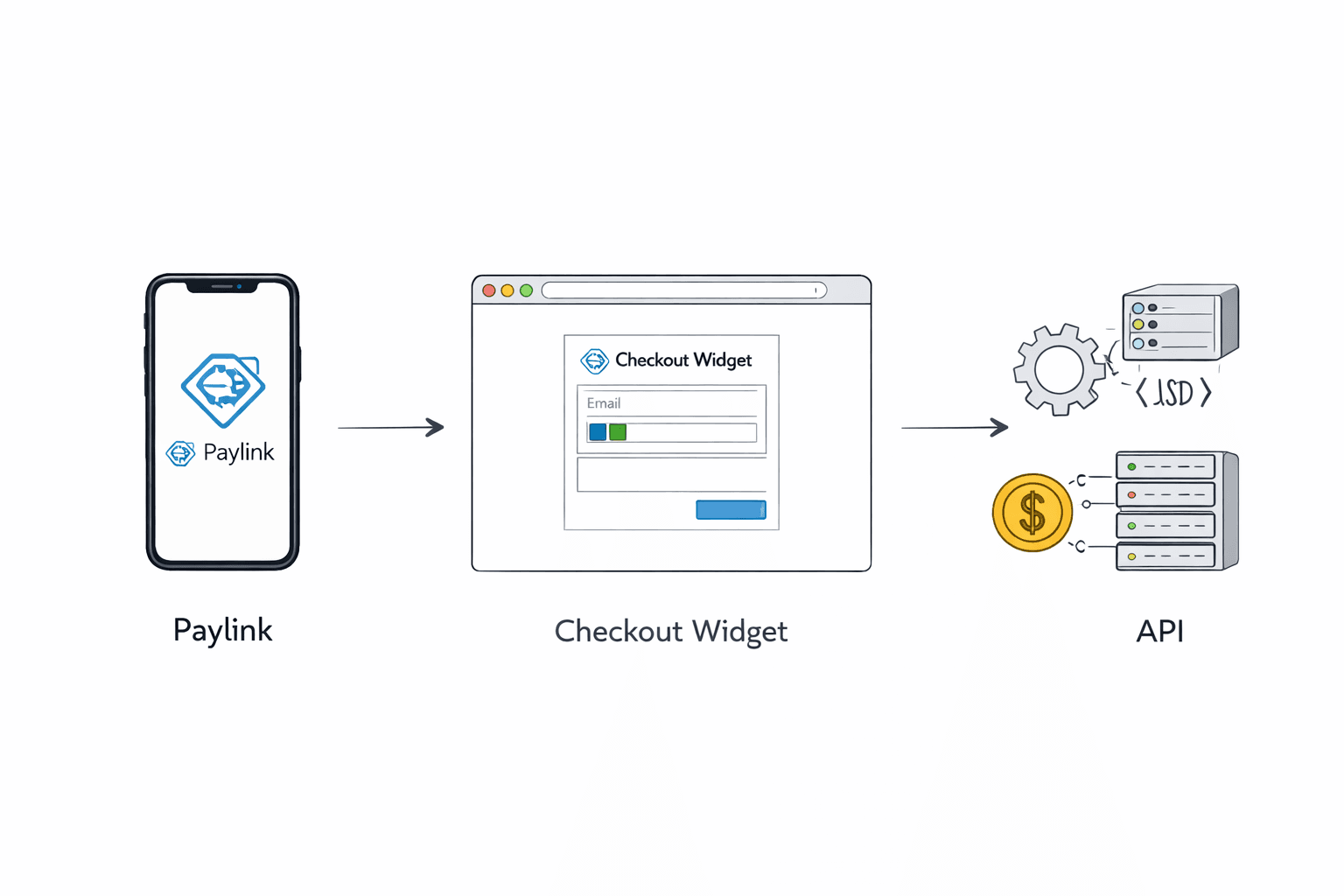
It's one thing to see the potential of faster, cheaper global payments, but actually making it work for your business is another. Thankfully, getting set up with cross border payments crypto isn't the complex technical hurdle it once was. Modern payment platforms have done the heavy lifting, so you can often get up and running in just a few minutes.
At its heart, the process is incredibly direct: you need a way for customers to pay you with their card, and for you to get your money as USDC. This can look different depending on your business, whether you need simple invoices or fully customized payment flows, but the result is the same: a single, streamlined system for all your global revenue.
Simple Tools for Non-Technical Users
You don't have to be a coder to tap into this. For freelancers, creators, and agencies, the easiest on-ramp is often a simple, shareable payment link.
Paylinks: Think of a paylink as a digital, reusable invoice. You create a link for a service or product and send it to your client through email, a message, or even a social media post. They click it, see a simple checkout page, and pay with their card. You receive the funds settled as USDC.
This approach is perfect for one-off projects, consulting gigs, or selling digital goods without the overhead of a full e-commerce site. It cuts right through the typical delays and headaches of international wire transfers.
Seamless Integration for Websites and Platforms
If you have a SaaS platform or an online store, a smooth checkout is non-negotiable. This is where embeddable widgets and direct API integrations come into play, offering a lot more power.
A great payment experience should feel like a natural part of your website, not a clunky add-on. The best solutions let customers pay with their card without ever leaving your site, all while ensuring you receive stable USDC payouts.
An embeddable checkout widget is a great middle ground. You can add it to your site by pasting a few lines of code, giving you a secure, conversion-focused payment form that handles both one-time sales and subscriptions. From the customer's perspective, it's a familiar and trustworthy checkout; for you, it's a powerful global payment engine working in the background. Our guide on how to accept crypto payments walks through this process in more detail.
Full Customization with an API
For businesses that need total control or have very specific needs, a direct API integration is the way to go. An API (Application Programming Interface) is essentially a toolkit that lets your developers build payment flows directly into your app from the ground up.
With our API, you get maximum flexibility to:
Design a checkout experience that perfectly matches your brand.
Handle complex subscription models and billing cycles.
Connect payments with your existing CRM and user management systems.
Automate your invoicing and reconciliation processes.
An API-first approach provides everything you need to accept card payments and get USDC settlements in a way that’s custom-fit to your business model, creating a unified payment layer for your global operations.
Unlocking New Revenue Streams for Communities
These flexible payment rails are also opening doors to entirely new business models. For example, creators and community managers on platforms like Discord and Telegram can now monetize their audiences with ease.
Using our native integrations, you can sell access to exclusive channels or offer different subscription tiers for your community. The system takes care of collecting payments from members around the world and automatically grants or revokes access based on their status. All the revenue settles in USDC, giving you a predictable income stream from your community without the manual work.
Platforms like Suby are at the forefront of this shift, combining card acceptance with instant USDC settlements for both one-time and recurring payments via an API or simple paylinks. This model completely bypasses the need for traditional bank accounts or SWIFT, offering a transparent and often more cost-effective fee structure. You can explore more cross-border payment statistics on ElectroIQ.com to see how the market is evolving.
Getting Security and Compliance Right in 2026
Anytime you're talking about new payment technology, the conversation naturally turns to security and compliance. For any business looking into cross-border payments crypto, these aren't just boxes to check, they're the foundation for operating with any real confidence. The good news? The industry has grown up a lot, and there are now clear standards and solid solutions to protect both your business and your customers.
The first move is always to partner with a provider that lives and breathes security. When you’re handling customer card data, you’re taking on a serious responsibility. That’s why it’s absolutely critical to choose a platform that works with a PCI-DSS Level 1 certified processor. This is the gold standard for card payment security, and it guarantees that all sensitive information is encrypted and managed under the strictest industry rules. You can get a deeper understanding of this in our guide explaining what is PCI-DSS compliance.
This level of security means that when your customers pay with their Visa or Mastercard, the experience is just as safe and familiar as ever. Meanwhile, on your end, you get all the benefits of settling in USDC. It’s the best of both worlds.
How Modern Platforms Keep Your Business Safe
Beyond just taking a payment, a truly reliable platform has to handle the day-to-day realities of running a business online. This means everything from verifying who your customers are to dealing with the occasional dispute. The best solutions build these protections right into their core system.
Here are a few key security features you should be looking for:
Strong Customer Authentication (SCA): This is your front line of defense against fraud. It adds an extra verification step for card payments, protecting you from unauthorized charges.
Dispute and Refund Management: If a customer has an issue, you need a straightforward process. Look for platforms that offer simple, zero-fee refunds and a clear system for managing disputes if they pop up.
Secure Access Controls: Things like two-factor authentication (2FA) for your own account aren't just nice to have; they're non-negotiable. This ensures only you and your team can access your funds and data.
For web app companies and creators, this kind of built-in security makes global sales possible without the usual headaches and risks. Platforms like Suby take care of these complexities by guaranteeing PCI-DSS Level 1 security, offering zero-fee refunds, and even providing unified access management for communities, getting rid of tedious manual work.
Keeping Up with the Rules
The idea that digital assets are some kind of "wild west" is long gone. Around the world, regulators are putting clearer frameworks in place that recognize stablecoins as legitimate and dependable tools for commerce. This growing clarity is fantastic news because it provides a stable ground for businesses to build on.
As businesses tap into the growing crypto payments ecosystem, ensuring adherence to regulatory compliance is a critical step. These clear rules are making it safer for companies to use stablecoin rails for everything from simple invoicing to managing subscriptions.
This regulatory maturity makes your choice of partner more important than ever. A compliant provider will handle the essential checks and balances behind the scenes, so you can focus on running your business. While there are always risks with any financial technology, they become much easier to manage when your platform is built on a solid foundation of security and regulatory awareness. With the right partner, you can unlock the benefits of global USDC settlements with real peace of mind.
Your Global Business Should Run on Global Rails
Let's be clear: using crypto for cross-border payments isn't some far-off idea for the future. It’s a practical tool you can use right now to gain a serious edge. This isn't about speculating on tokens; it's about upgrading your company's financial plumbing to a system built for the internet age.
When you start settling payments with stablecoins, you’re finally running your business at the speed of the web. It's a move that frees you from the old-world headaches of banking hours, settlement delays that can stretch for days, and the sting of unpredictable foreign exchange fees. You're no longer stuck waiting on a system that wasn't designed for a global, 24/7 economy.
Predictable Revenue, Truly Global Reach
The numbers don't lie. We're seeing explosive growth in both the cross-border payment market and stablecoin transaction volumes. For any business that's paying attention, this isn't just noise, it's a massive opportunity to find new customers and run a leaner operation.
The model is surprisingly straightforward:
Familiar Checkout for Customers: Your buyers pay with their credit cards, just like they do on any other website. No crypto knowledge is needed on their end.
Predictable Payouts for You: Revenue lands in your wallet as USDC, which means you get paid in a stable currency without the risk of conversion rate surprises.
Simple Setup: Getting started is easier than you think. You can use simple paylinks, integrate a direct API, or even use our native tools for communities on Discord and Telegram.
This system gives you the reliability of a standard credit card checkout for your customers, while your business gets all the benefits of speed, low cost, and predictability that come with stablecoin rails.
This isn't just about shaving a few points off transaction fees. It's about fundamentally rewiring your company's cash flow. You get to scale globally without the friction that has traditionally held businesses back.
Stop Leaving Money on the Table
Ultimately, these tools put the power back in your hands. Building a resilient, scalable global business is no longer a privilege reserved for massive corporations with dedicated treasury teams. It’s now accessible to any creator, SaaS founder, or e-commerce shop with an internet connection.
Take an honest look at your current payment processor. How much are you losing to hidden fees? How often is your cash flow stuck in limbo, waiting for a settlement? How many potential customers have you lost simply because your payment options didn't work for them?
Modern payment rails are the direct answer to these problems. It's time to see how this technology can open up new markets, simplify your finances, and help you build a more predictable, profitable business. The next wave of global commerce is being built onchain, and your business can be right there with it.
Frequently Asked Questions
Let's walk through some of the most common questions businesses ask when they're thinking about switching to crypto for cross-border payments.
Do I Have to Handle Crypto Volatility?
This is the big one, and the short answer is no, you don't. It's a common fear that keeps a lot of great businesses on the sidelines.
The entire system is built for predictability. The moment a customer pays with their card, it's instantly settled to you as USDC, a stablecoin that’s pegged 1-to-1 with the U.S. dollar. This means your revenue is always stable and you're never exposed to market volatility.
Is It Complicated for My Customers to Pay?
Not in the slightest. From your customer’s point of view, the experience is exactly what they’re used to. They can pay with a standard Visa or Mastercard, just like any other checkout they’ve ever used.
All the magic, the conversion and settlement into USDC on your end, happens completely behind the scenes. For anyone paying by card, the process is invisible. The key is that your customers get a simple, familiar experience.
The goal is a seamless checkout for every single customer, no matter how they pay. This keeps your conversion rates high while you get all the benefits of instant USDC settlement on the back end.
How Do I Get Started with Cross-Border Payments?
Getting set up is surprisingly quick. With a platform like Suby, you can create an account and be ready to accept payments in minutes. You don’t need any crypto knowledge or special bank accounts to begin.
You get a few different tools right out of the box:
Paylinks: Generate a shareable link for a quick invoice or a one-off sale.
Embeddable Checkouts: Easily add a secure checkout form directly onto your website.
API Integration: If you need more custom control, our developer-friendly API lets you integrate payments deeply into your own platform.
These options make it simple to start, whether you’re a freelancer, run a SaaS business, or even manage an online community with our integrations for Discord and Telegram.
What Are the Real Costs Compared to Traditional Methods?
When you look at costs, you have to consider the total cost, not just the advertised fee. Traditional international payments are notorious for hidden charges that can easily stack up to 2-7% of the transaction value. Think wire fees, cuts taken by intermediary banks, and murky currency exchange rates.
In contrast, a modern platform using stablecoin rails usually has a single, transparent fee. While that percentage might look similar at first, it ends up being far more affordable once you remove all the other costs. You eliminate FX fees, multi-day settlement delays, and the headache of reconciling complex bank statements. Instant USDC settlement means your cash flow improves, and you're never hit with surprise charges.
Suby is a payment gateway and Merchant of Record. Your customers pay with card, bank transfer, Apple Pay, Google Pay, Klarna, and more, or stablecoins. You get paid out to your bank account, or directly in stablecoins (USDC, EURC) to your wallet, anywhere in the world, no bank account required. For cross-border crypto payments, that means faster, cheaper, more predictable global revenue without SWIFT delays or FX surprises.
