

Gaspard LEZIN
Subscription Billing API: A Practical Guide for Builders
Learn how to design a subscription billing API that handles recurring plans, trials, webhooks, dunning, and global payouts without the usual headaches.
A customer clicks Subscribe, the first payment succeeds, and the product grants access. A month later, the card fails, the webhook arrives twice, the retry runs at the wrong time, and the customer remains active in one system but delinquent in another. The original checkout call was easy. The lifecycle is where subscription businesses lose revenue.
A subscription billing API should be treated as a systems design decision, not a wrapper around a recurring charge. It connects pricing, payment methods, customer access, failure recovery, tax handling, webhooks, refunds, and settlement. The strongest implementations decide those boundaries before the first production payment.
Table of Contents
What a Subscription Billing API Actually Does
A developer integrating recurring payments for the first time usually starts with a simple requirement: charge a customer every month and let the application know whether access should continue. That sounds like one API request. In production, the request creates a chain of obligations. The system must store the billing agreement, collect future payments, react to failures, update entitlements, notify the customer, and preserve an audit trail.
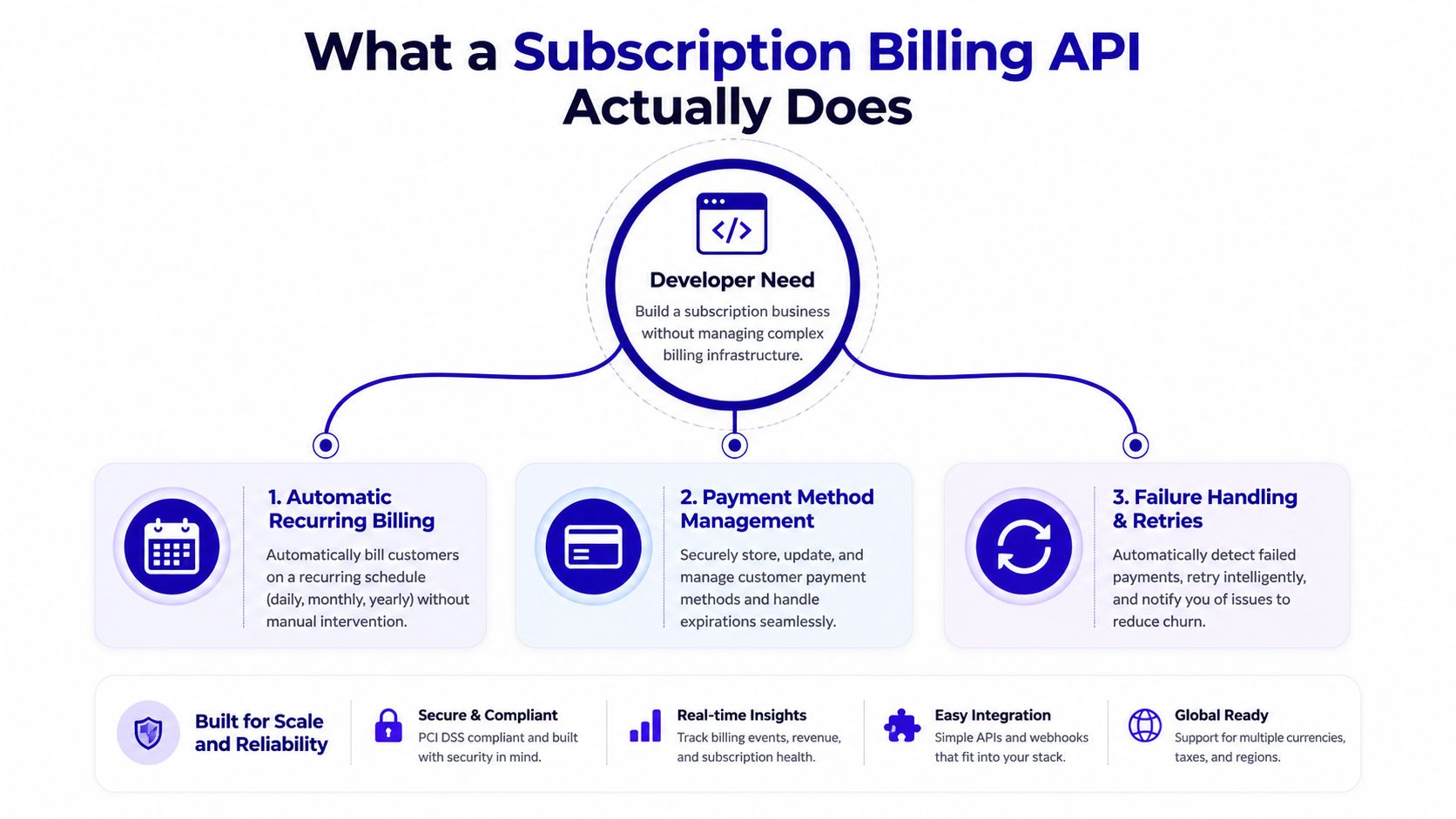
The useful mental model is a state machine. A subscription moves from creation to active billing, then potentially to trial conversion, payment failure, recovery, pause, cancellation, or refund. Your application shouldn't infer those states from a single successful checkout response. It should receive authoritative lifecycle events and reconcile them against the provider's records.
Five decisions shape the build
Pricing model: Decide whether the customer pays a fixed recurring amount, a usage charge, a seat charge, or a combination. This choice determines what you meter and when you close an invoice.
Payment method: Cards are familiar, but global customers may prefer wallets, bank methods, or crypto. A platform that accepts several methods needs a normalized internal payment record, not separate business logic for every rail.
Settlement destination: The customer's payment method and your payout preference don't have to match. A customer can pay by card while the business receives stablecoins such as USDC, or the business can use a bank payout in its chosen currency.
Retry policy: A failed payment needs classification and a bounded recovery schedule. Repeating the same attempt every day is not a recovery strategy.
Cancellation behavior: Decide whether cancellation is immediate, end-of-period, or tied to a refund rule. Then make access control follow that decision consistently.
A subscription billing API therefore owns more than invoices. It coordinates money movement and product state. If those two systems disagree, support teams end up manually deciding who should have access and whether a payment is owed.
Subscription Models You Can Build With One API
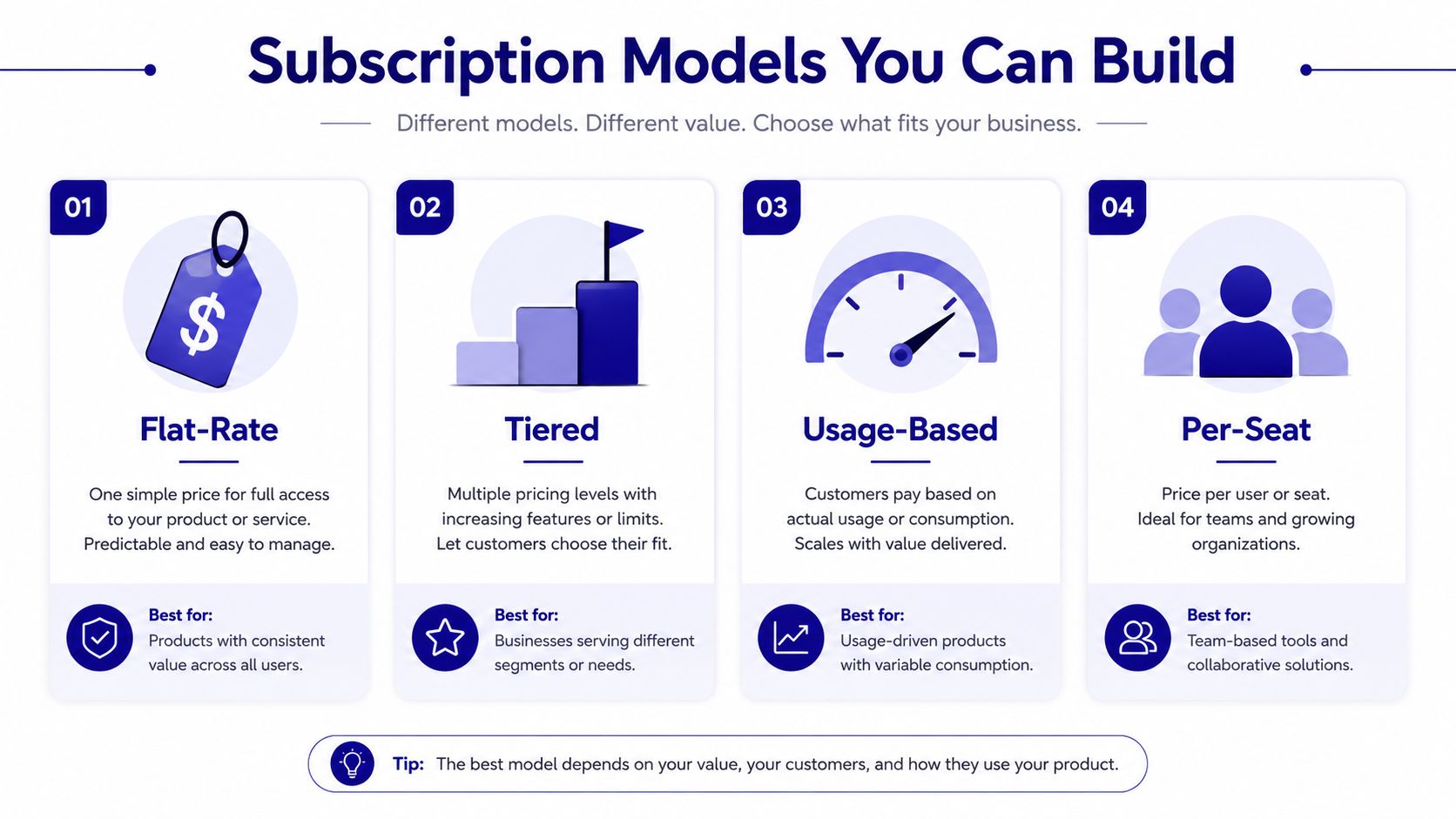
Flat-rate subscriptions remain the cleanest starting point. Define a product, price, currency, billing cycle, and entitlement set. The API creates the recurring agreement, while your application maps an active subscription to access. This model breaks when customers consume materially different amounts of the product but pay the same fixed fee.
A metered plan records usage during a billing period and converts that usage into a charge. The API needs an event or usage record with a stable customer identifier, a billable metric, a quantity, and a timestamp. Your entitlement service also needs a clear rule for limits. A customer may be allowed to use a feature until the period closes, or access may stop as soon as an allowance is exhausted.
Match the model to the product
A free trial adds a conversion boundary. You need to know whether a payment method is collected at signup, whether the trial ends on a fixed date or after a duration, and what happens when conversion fails. The dangerous implementation grants permanent access because the trial flag was never reconciled with the first invoice.
Hybrid billing combines a base subscription with variable usage. It fits products that have a predictable platform component and an unpredictable consumption component, including software that combines human access with compute or API activity. The invoice needs separate line-item semantics so customers can understand what was fixed and what was measured.
Model | API data | Typical failure point |
|---|---|---|
Flat-rate recurring | Price, currency, cycle, entitlement | Plan changes create inconsistent access |
Metered usage | Usage events, quantity, period, rate | Late or duplicated usage records |
Trial conversion | Trial status, conversion date, payment method | Access continues after failed conversion |
Hybrid | Base charge, usage items, invoice rules | Variable usage is delivered without billing |
Do not include automation-heavy usage inside a human seat plan. Scripted, agentic, or third-party-client activity can consume far more value than interactive use, and the customer may not understand why the subscription includes it. Define whether automation is covered, capped, or billed separately through usage credits before launch.
Revenue rule: Every billable action needs an owner, a quantity, and a point at which the system can prove it was included in an invoice.
API Endpoints and the Subscription Lifecycle
A provider-neutral subscription lifecycle usually starts with a plan or price definition. The configuration should identify the amount, currency, billing cycle, trial behavior, and the features granted by the plan. Keep the price object separate from the customer record. That makes it possible to add a new currency or regional tax treatment without rewriting historical subscriptions.
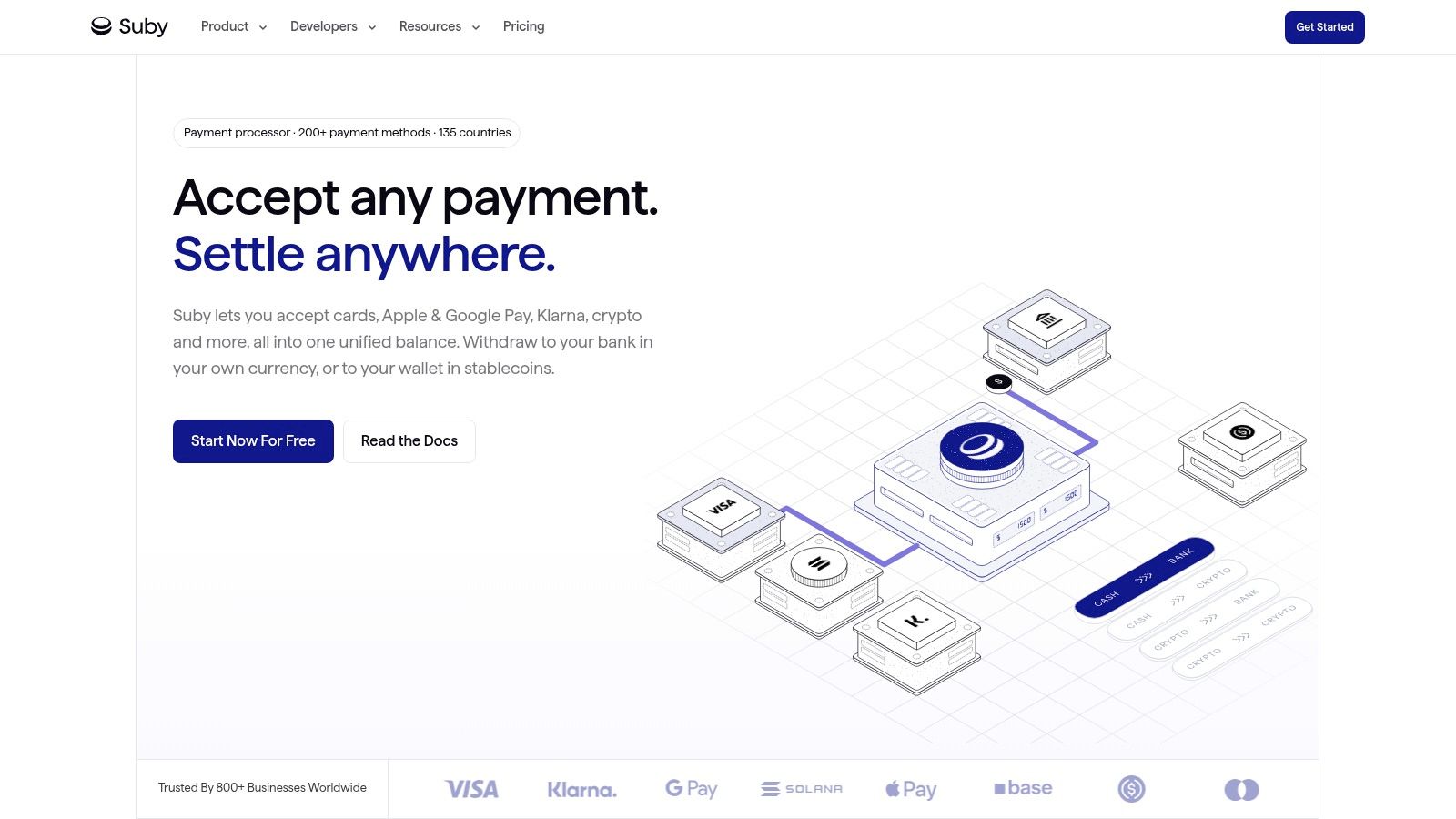
Suby documents a flow where a merchant sets price, currency, cycle, and trial in the dashboard or through one API call, then shares a hosted checkout link or embeds checkout. Its API documentation describes endpoints to create a subscription payment, list subscriptions, retrieve a subscription by ID, cancel a subscription, and refund a card payment, alongside automated access management for communities such as Discord and Telegram after payment. See the documented subscription payment endpoints for the provider-specific request details.
The lifecycle calls your backend needs
Create a plan or price: Store the commercial terms as an immutable version where possible.
Create a subscription: Associate the customer, selected price, payment method, trial state, and return or management URL.
Retrieve and list subscriptions: Use retrieval for a single customer view and listing for reconciliation, support, and scheduled audits.
Update a subscription: Handle plan changes, quantity changes, and billing-cycle changes as explicit transitions. Record whether the change applies immediately or at the next renewal.
Cancel a subscription: Store the cancellation timestamp and effective access end. Don't rely on a deleted row to explain what happened.
Refund a payment: Link the refund to the original payment and update your entitlement policy separately. A refund does not automatically answer whether access should end.
Request and response shapes should expose stable IDs, status, amount, currency, period boundaries, customer identity, and timestamps. Your internal model should preserve provider IDs and your own idempotency key. Never use a display name as the identity of a price or subscription.
Webhooks and Event Handling That Will Not Break at 3am
The webhook endpoint is not a notification inbox. It's a state transition boundary exposed to the network. Treat every delivery as untrusted input until the signature is verified, and assume the provider may deliver the same event more than once or deliver related events out of order.
Signed lifecycle webhooks are part of Suby's documented subscription flow, but the implementation responsibility remains yours. Verify the signature against the raw request body before parsing it, reject stale or malformed requests according to the provider's rules, and store the event ID before applying business effects.
Make processing repeatable
Idempotency starts with a durable event table. Store the event ID, event type, received time, processing status, and error details. If the same event arrives again, return a successful delivery response without granting access or issuing a second refund.
Out-of-order delivery needs a second defense. A cancellation event may arrive before a payment-success event that was generated earlier. Compare event timestamps and subscription versions where the provider supplies them, or fetch the current subscription state before applying a destructive transition.
Keep the webhook transaction small. Verify, persist, enqueue, and acknowledge. A worker can then apply access changes, send email, update analytics, and trigger internal workflows. If processing fails repeatedly, move the event to a dead-letter queue with enough context for replay after the code or data issue is fixed.
Operational distinction: A successful HTTP response proves delivery was accepted. It doesn't prove that your customer record, entitlement system, and ledger now agree.
A production checklist should include:
Signature verification: Test valid, invalid, altered, and replayed payloads.
Idempotent effects: Run the same event repeatedly and confirm the result stays unchanged.
Ordering tolerance: Deliver cancellation, renewal, and failure events in different sequences.
Dead-letter recovery: Replay a failed event without creating duplicate side effects.
Access reconciliation: Compare internal status with provider status on a scheduled basis.
Retry Logic and Dunning Without Burning Customer Trust
A failed payment should enter a controlled recovery state, not trigger immediate cancellation. Classify the failure, decide whether another attempt makes sense, notify the customer, and set a clear recovery deadline. Your dunning process should connect those decisions to subscription status, entitlement changes, and customer communication.
Stripe documents Smart Retries policies of 1 week, 2 weeks, 3 weeks, 1 month, or 2 months, with a recommended default of 8 tries within 2 weeks. Its next_payment_attempt field exposes the next scheduled collection attempt, allowing your application to coordinate notices, access rules, and recovery workflows through the practical dunning process guide.
Fixed daily retries are simple to code, but they can submit the same failing transaction repeatedly, frustrate customers, and handle temporary issues like permanent declines. Configure retry timing around the decline category and the signals exposed by your payment provider. A soft decline may justify another attempt, while an invalid payment method should send the customer to an update flow instead.
Use the metrics that expose the leak
Industry guidance summarized by Zuplo places initial payment failures at 3 to 5% and recurring subscription failures at 5 to 8%. It also describes recovery increasing from 12% with one retry after 7 days, to 24% with retries at 1, 3, and 7 days, and up to 38% when timing uses card-network data. These figures are directional. Customer mix, billing model, issuer behavior, and retry policy can change the outcome. The dunning recovery analysis provides that comparison.
Baremetrics reports a 12.7% median attempted recovery rate across 119 typical US B2B SaaS companies in May 2026. It also reports 808% median month-over-month ROI on its recovery tool, with 95% of companies seeing payback within that month. Those results describe a specific benchmark population and tool, so validate them against your own failed-payment cohorts before using them in a forecast.
Track failure rate, recovery rate, involuntary churn, and days to recovery by decline type, plan, and payment method. Stop retrying when the decline indicates low recovery potential. Expose the next scheduled attempt to internal systems, and preserve access rules that match your grace period. A bounded policy protects revenue without turning collection into repeated customer disruption.
Taxes, Compliance, and Settlement Choice
Recurring billing crosses several operational boundaries at once. The API may create the payment, but your business still needs rules for sales tax, VAT, cross-border business purchases, reverse-charge handling, Strong Customer Authentication in the EEA, disputes, and customer records. PCI-DSS responsibilities also depend on how payment data is collected and processed, so the integration should document which systems handle card data and which only receive tokens or payment status.
Settlement adds another decision that teams often postpone. The customer may pay by card, wallet, bank method, or crypto, while the business may prefer a bank payout in its operating currency or stablecoin settlement in USDC. That choice affects treasury operations, reconciliation, accounting, and the process for matching a payout to the original invoice.
Suby's documented crypto flow handles the swap and sponsors the gas. It lets a merchant settle to a non-custodial wallet or to the Suby balance, and supports a flow where the customer pays in any token while the business receives USDC, as described in the official crypto payment documentation.
Option | Best for | Key consideration |
|---|---|---|
Bank payout | Businesses with conventional accounting and treasury workflows | Reconcile currency, timing, fees, and local banking requirements |
Stablecoin payout | Teams that want digital settlement and treasury flexibility | Define wallet controls, accounting treatment, and conversion policy |
Balance aggregation | Merchants accepting several payment methods | Keep payment, refund, fee, and payout records linked |
A merchant-of-record arrangement can change who carries particular tax and payment obligations, so teams should understand the operational model before selecting it. The merchant-of-record overview is useful context, but it isn't a substitute for professional tax or legal advice.
Testing, Monitoring, and Scaling Without Surprise Outages
A subscription integration isn't ready when the first checkout succeeds. It's ready when the system behaves correctly after duplicate events, failed renewals, delayed workers, changed currencies, and a processor outage during a billing cycle.
Start with tests that simulate the failure paths your dashboard won't show:
Verify webhook signatures: Alter the payload and confirm the event is rejected.
Repeat idempotency keys: Submit the same create and refund request more than once and verify that only one business action occurs.
Simulate decline categories: Test transient failures, authentication requirements, expired credentials, and non-recoverable declines.
Exercise currency edges: Check rounding, zero-value adjustments, price changes, and a customer moving between currencies.
Kill the processor mid-cycle: Let the payment dependency fail during renewal and confirm the job can resume without double collection or accidental cancellation.
The monitoring dashboard should separate payment status from access status. Record failure rate, recovery rate, involuntary churn, time-to-recovery, and the share of subscribers currently in dunning. Alert on changes in those measures, not only on API latency. A fast endpoint that fails to log renewal events is still losing money.
Use real-time transaction monitoring guidance to shape the operational view, then add subscription-specific reconciliation. Your team should be able to answer which invoice failed, which retry is next, whether access changed, whether a refund was issued, and where the funds settled.
Pre-launch checks
Reconcile states: Compare provider subscriptions, internal entitlements, invoices, and payouts.
Version prices: Preserve the terms that applied when each customer subscribed.
Protect usage records: Deduplicate metering events and define a late-arrival policy.
Test plan changes: Cover upgrades, downgrades, trials, cancellations, and refunds.
Exercise settlement paths: Verify bank and stablecoin records map back to the same payment identity.
Prepare replay tools: Give support and engineering a controlled way to reprocess failed events.
Growth exposes flaws that a small launch hides. Adding another currency can reveal assumptions in price storage. Moving from flat-rate to hybrid usage can expose missing metering ownership. Adding crypto alongside cards can reveal that settlement and payment method were incorrectly modeled as the same field.
Suby provides an API that lets businesses accept payments by card or crypto, with native Discord and Telegram integrations for subscriptions, paid access, and online communities. If you need customers to pay any way they want while your business receives funds the way you choose, visit Suby and review the available payment, gating, invoicing, and settlement options.
