

Gaspard LEZIN
Dispute Management System: A Practical Guide for 2026
Learn what a dispute management system is, how chargeback workflows run, who owns each step, and the metrics that matter most for merchants.
Mastercard and Datos Insights project 261 million chargeback disputes worldwide in 2025, rising to 324 million by 2028, a 24% increase in only three years. The financial impact is projected to grow from $33.79 billion to $41.69 billion over the same period (Mastercard's chargeback cost analysis). Those figures change the question for every payment team. A dispute management system isn't just a queue for customer support. It's an operating layer that protects revenue, organizes evidence, manages deadlines, and helps merchants and issuers make better decisions.
The system matters because a dispute starts with a customer, moves through an issuer and card network, reaches an acquirer and merchant, and may return to the network for escalation. Each participant has different information, incentives, and deadlines. A reliable process must account for all of them.
Table of Contents
Why Dispute Management Is Now a Frontline Payment Capability
The cost of a dispute extends well beyond the transaction value. A related industry analysis cited by Mastercard says merchants lose roughly $4.61 for every $1 of fraud after chargeback, operational, and related costs are included (Mastercard's chargeback cost analysis). That is why dispute handling belongs beside authorization, fraud screening, reconciliation, and settlement in the payment operating model.
The pressure is strongest in card-not-present commerce. Industry reporting says card-not-present payments account for 63% of merchants' transactions, while first-party and third-party fraud together represent about 45% of merchant dispute volume (Sift's disputes index). In a remote transaction, the merchant can't rely on a physical card, a cashier, or a face-to-face confirmation. The evidence has to come from transaction records, authentication data, delivery events, customer communications, and clearly disclosed policies.
Disputes affect growth decisions
A merchant can respond to rising fraud by tightening approval rules. That may reduce some unauthorized payments, but an overly aggressive filter can reject legitimate customers. Dispute data helps the team distinguish between genuine fraud, unclear billing, delivery friction, subscription confusion, and friendly fraud. Those distinctions matter because each cause requires a different operational response.
The scale is still projected to increase. Mastercard's related research forecasts 359 million chargeback transactions annually by 2029, up 37% from 2025, with total chargeback value reaching $46.1 billion (Sift's disputes index). For a growing SaaS business, disputes can therefore compete with checkout and authorization for engineering attention.
Operational rule: Treat every dispute outcome as payment data. A lost case may reveal weak evidence, a confusing descriptor, a fulfillment gap, or a risk rule that needs adjustment.
A mature dispute management system turns that data into a closed loop. It captures the case, assigns responsibility, preserves the timeline, and records the result in a form that finance, support, fraud, and engineering can use. The result isn't merely a faster response. It's a more informed payment operation.
What a Dispute Management System Actually Does
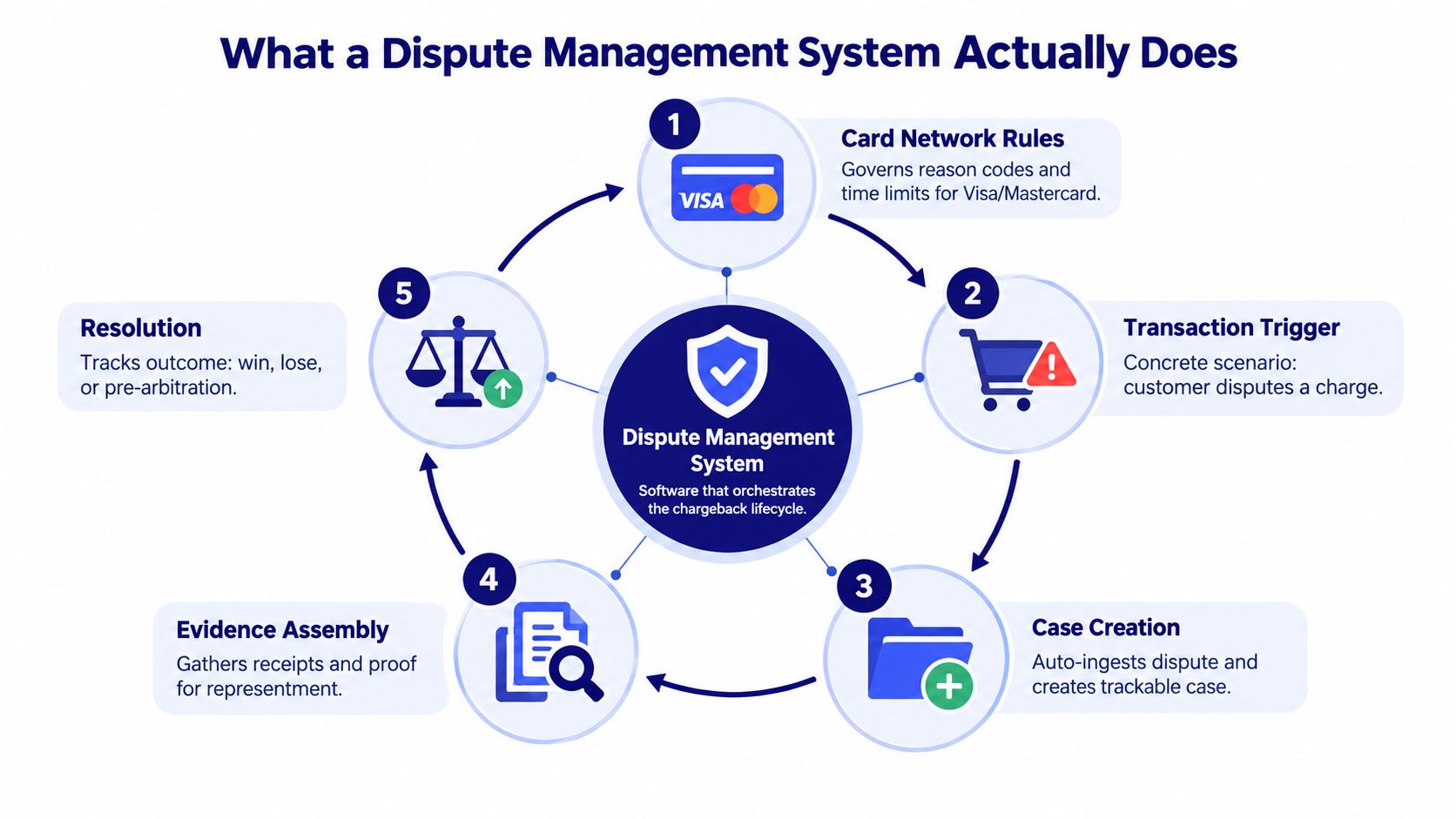
A dispute management system is software that coordinates the card dispute lifecycle from intake through resolution. It receives notifications from networks, processors, or acquirers, matches each case to an internal order, routes the case to an owner, tracks the response deadline, assembles evidence, supports representment, and records the final result.
The underlying mechanics are simple to describe but difficult to manage at scale. A cardholder contacts the issuing bank. The issuer evaluates the complaint and may file a chargeback through the relevant card network. The acquirer passes the case to the merchant, and the merchant must decide whether to refund, accept the loss, or submit evidence to challenge the reversal. The exact timing and documentation depend on the network, reason code, acquirer, and case type, so a system must preserve those details rather than flattening every dispute into a generic support ticket.
For a plain-language explanation of the distinction between a customer complaint and a formal reversal, see this guide to what a chargeback is.
A concrete case
Suppose a customer buys a $189 annual subscription on March 14. On March 28, the customer disputes the payment using a “product not received” explanation. The merchant sees a $189 hold, a case notification, and a network deadline. The immediate decision isn't “win or lose.” The team must determine whether the service was delivered, whether the customer used it, whether the subscription terms were visible, whether the customer contacted support, and whether the evidence supports a response.
A system should connect those records automatically. It should show the order, payment, subscription status, account activity, communications, policy acceptance, and any available delivery or access event in one case view. It should also present the response options clearly, including refunding the customer, accepting the chargeback, or preparing representment.
What separates it from other tools
A CRM can store conversations. A fraud tool can score a transaction. A payment gateway can authorize and settle a payment. None of those tools, by themselves, necessarily owns network reason codes, evidence requirements, submission formats, and response deadlines.
That ownership is the defining feature of a dispute system. It turns scattered operational records into a case with a clock, an accountable person, a documented decision, and an auditable outcome.
The Dispute Lifecycle From First Contact to Escalation
A dispute lifecycle has several handoffs. The safest design names the actor, the artifact, and the deadline at each point. The clock starts when the network or acquirer notification arrives, not when an internal team happens to open the email.
Stage one, pre-dispute inquiry
The cardholder first contacts the issuer. In some workflows, the merchant receives an inquiry before the issuer files a formal chargeback. The merchant can then review the transaction, contact the customer, issue a refund, or provide clarification. The useful artifact is an inquiry record linked to the original payment, customer account, and communication history.
A fast answer can prevent escalation, but the decision still needs controls. Refunds should be recorded against the original transaction, and any customer communication should remain attached to the case.
Stage two, formal chargeback
If the issuer proceeds, the merchant receives a formal notification with the amount, reason code, case identifier, and response deadline. The merchant must classify the case, confirm the transaction, and decide whether the available evidence justifies a response.
Automated intake earns its place. A webhook or processor feed should create the case immediately, preserve the original timestamp, and start internal reminders before the external deadline becomes urgent.
Stage three, representment
Representment is the merchant's evidence-based response. The package may include receipts, customer communications, delivery or access records, policy disclosures, authentication data, and other transaction-specific material. The evidence should answer the stated reason code directly rather than burying the reviewer under unrelated files.
Stripe's dispute evidence best practices recommend chronological presentation, grouping documents by type, and adding short explanations that help the reviewer map the facts to the claim.
Stage four, escalation
If the issuer maintains its position, the case may move toward network escalation or arbitration, depending on the rules and the parties' decisions. At that point, the case record must show the original claim, the merchant's response, the issuer's position, and every relevant deadline. Escalation should be a controlled financial decision, not an automatic reaction.
Stage | Actor | Artifact | Typical window |
|---|---|---|---|
Pre-dispute inquiry | Issuer and merchant | Inquiry record and refund or clarification decision | Set by the program or processor |
Chargeback filed | Issuer, network, acquirer, and merchant | Chargeback notice with reason code and deadline | Set by the network and acquirer |
Representment | Merchant and acquirer | Reason-code-specific evidence package | Set by the network and acquirer |
Escalation or arbitration | Network, issuer, acquirer, and merchant | Complete case history and final response | Set by the applicable rules |
A useful API representation might look conceptually like this:
case_id, reason_code, amount, deadline_iso, evidence_required, evidence_status
The important point isn't the exact field names. It's the discipline of treating every case as structured data. That makes routing, reminders, reporting, and reconciliation possible.
Roles and Responsibilities on Both Sides of a Chargeback
A chargeback isn't a merchant-only workflow. The issuing bank has to interpret the cardholder's claim, apply the relevant reason code, communicate through the network, and make a decision about the evidence. The merchant and acquirer must then identify the transaction, assess the financial exposure, and respond within the permitted process.
The issuer and cardholder side
The cardholder begins the process by reporting an unauthorized, duplicated, unrecognized, or unsatisfactory transaction. The issuer reviews the claim, may provide provisional credit under its process, assigns the appropriate category, and sends an inquiry or chargeback through the network. It then evaluates the merchant's response and decides whether to accept the evidence, continue the case, or pursue escalation.
Issuers carry their own operational burden. A global survey of 1,350 card-issuing institutions found that over half had seen dispute volumes rise in the previous year. Some issuers handle more than 5 million inquiries, write off an average of $3.3 million annually, pursue chargebacks in only 39% of received dispute cases, and win 60% of those chargebacks (ServiceNow's state of payment disputes).
The merchant and acquirer side
The acquirer or processor passes the case to the merchant. A payment operations lead owns the case, an analyst gathers the evidence, finance tracks the reserve and accounting impact, support supplies customer history, and engineering maintains the event and data integrations.
Each role produces a different artifact:
Participant | Primary responsibility | Key artifact |
|---|---|---|
Cardholder | Reports the transaction and explains the issue | Dispute claim |
Issuer | Reviews the claim and forwards the case | Chargeback notification |
Acquirer | Communicates network requirements to the merchant | Case request and submission channel |
Payment operations | Owns routing, deadlines, and decision quality | Case record and action log |
Evidence analyst | Builds the response around the reason code | Representment package |
Finance | Tracks funds, reserves, fees, and outcomes | Reconciliation entry |
Engineering | Maintains intake, retrieval, and submission workflows | Webhook and API events |
The financial exposure includes the disputed amount and any applicable fees or account-level consequences. Network monitoring thresholds can also affect the merchant's relationship with its acquirer, so finance and compliance should see the same dashboard as payment operations.
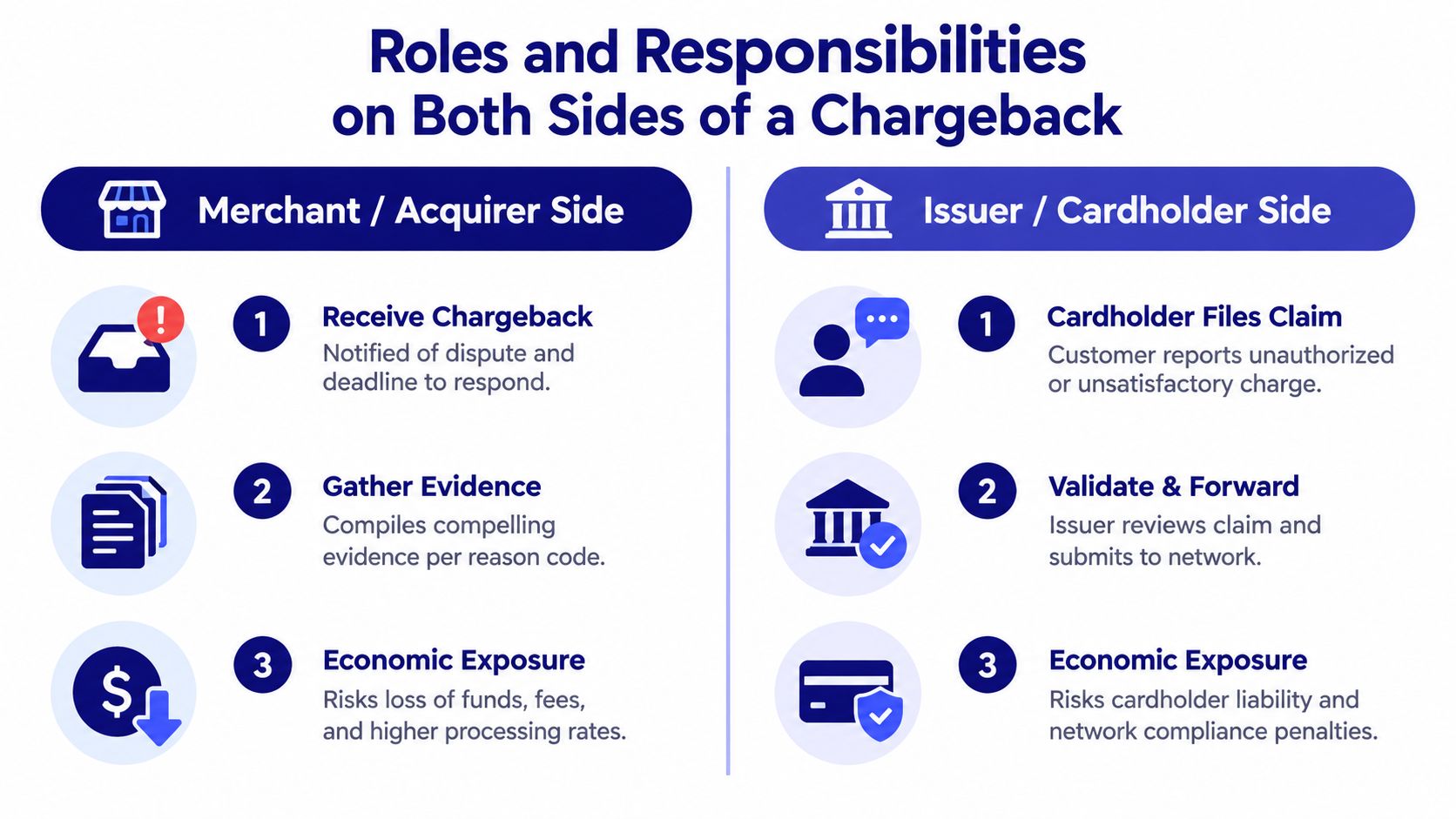
The two-sided view changes system design. The merchant wants a clear path to defend a valid payment, while the issuer needs a consistent way to validate the cardholder's claim and assess the response. Better case data helps both sides reduce ambiguity.
Best Practices for Prevention, Response, and Automation
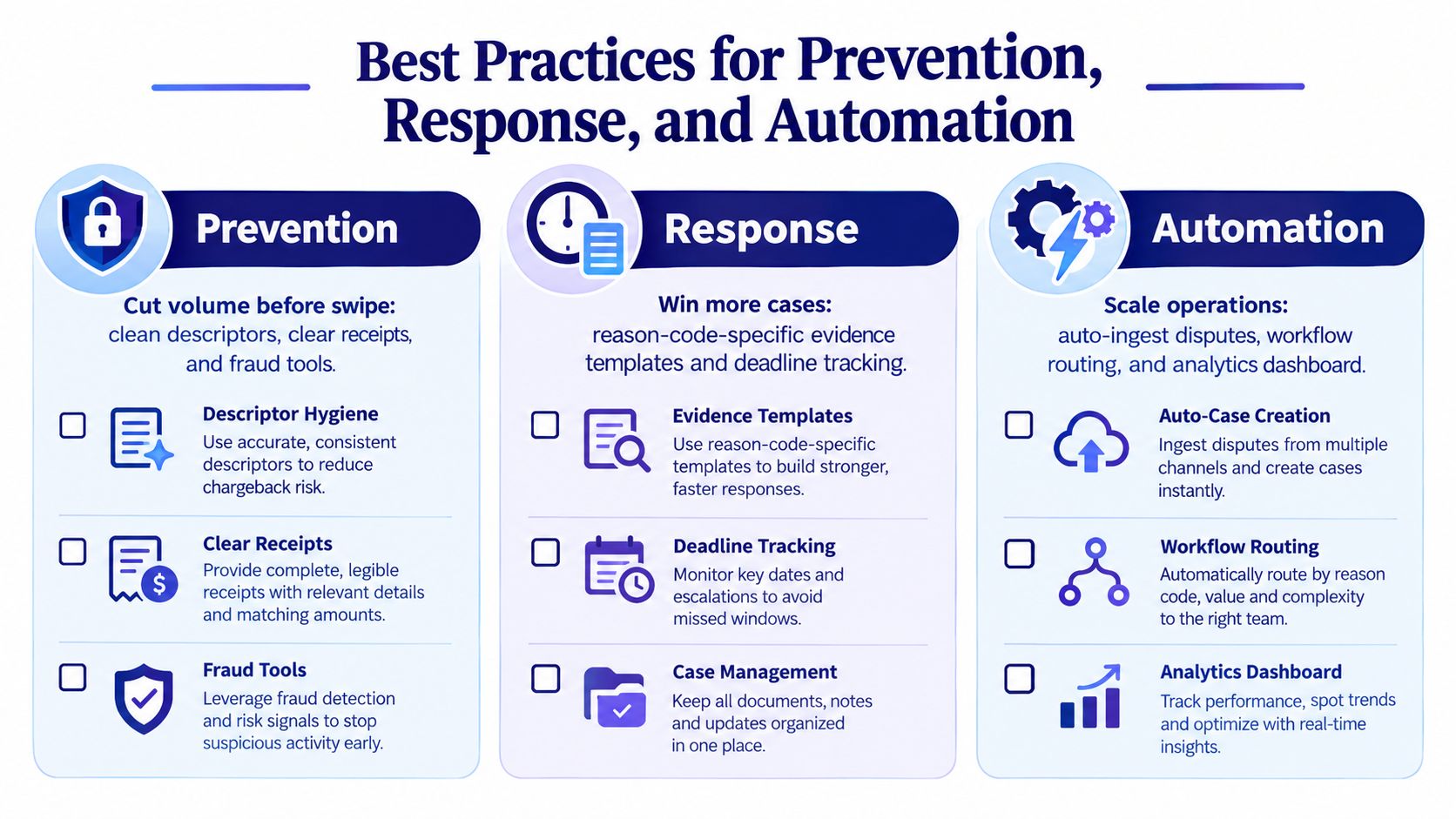
Good dispute management starts before the chargeback. It then depends on disciplined evidence handling and automation that supports human judgment instead of hiding it.
Prevention
Start with the statement descriptor. Customers are less likely to recognize a payment when the business name is abbreviated, inconsistent, or unrelated to the product they remember buying. Make the descriptor, receipt, renewal notice, and support contact reinforce the same identity.
Use authentication and address checks thoughtfully. Address verification and Strong Customer Authentication can provide useful signals, especially for transactions where fraud exposure is material. The control should fit the payment flow and customer experience rather than creating unnecessary friction.
Confirm fulfillment or access. For physical goods, retain shipping and delivery records. For digital products and subscriptions, retain account access, activation, usage, and cancellation events. A refund or replacement path can resolve legitimate dissatisfaction before it becomes a formal dispute.
Response
Evidence quality matters more than document volume. Match the reason code to the records that answer it, then present those records in chronological order with short explanations. Stripe's 3-D Secure payments guide is useful background when authentication is part of the transaction history.
Common weaknesses are practical:
Unclear receipts: A low-resolution or incomplete receipt makes the reviewer work harder.
Missing fulfillment proof: A shipping record without delivery context may not answer a non-receipt claim.
Late filing: A strong response submitted after the deadline may not be considered.
Generic explanations: A long narrative that doesn't address the reason code creates ambiguity.
Set an internal response target that is earlier than the external deadline. That gives the analyst time to find missing records, ask support for context, and obtain approval for a refund or representment decision.
Automation
Automate the repetitive actions first. A dispute-created event should open a case, attach the payment, pull the order and shipment records, assign an owner, and schedule reminders. A templated evidence draft can save time, but a person should review the facts before submission.
Legible, time-stamped, transaction-specific evidence beats a large attachment folder.
Automation should also feed outcomes back into fraud rules, billing language, fulfillment operations, and customer support. That feedback loop is where a dispute system becomes a prevention tool rather than a faster filing cabinet.
How a Dispute System Fits Into Your Payments Stack
A dispute management system sits beside the gateway, fraud controls, ledger, customer support tools, and fulfillment systems. It doesn't replace those systems. It connects the records they already hold and adds the case state, ownership, evidence workflow, and deadline controls that the other tools lack.
Dashboard
The dashboard should give payment operations a complete case view without requiring constant visits to a processor portal. At minimum, show the case state, reason code, amount, deadline, evidence status, assigned owner, refund decision, and final outcome.
Finance needs the same source of truth for reconciliation. Support needs the customer history. Risk teams need reason-code trends and transaction context. Role-based access can expose the right records without giving every user unrestricted control over payments.
Webhooks
Event-driven intake is the first important engineering decision. Subscribe to the processor or network events that indicate case creation, updates, closure, and approaching deadlines. Your endpoint should process duplicate deliveries safely, store the original event identifier, and avoid creating multiple cases when a provider retries the same notification.
A practical event set could include dispute.created, dispute.updated, dispute.closed, and evidence.due_soon. The exact names depend on the provider, but the design principle is stable: receive the event, persist it, acknowledge it, and let a separate worker perform enrichment and routing.
Evidence submission and refunds
Evidence handling needs secure file storage, controlled retrieval, clear file metadata, and an audit trail. The system should pull order, payment, account, and fulfillment records from internal sources, then let an analyst confirm that the packet answers the reason code.
Refund orchestration needs explicit policy. Some merchants refund low-value or weak-evidence cases, while others defend cases when the transaction record is strong. Either approach can work if the decision is recorded and the result returns to the ledger.
For teams designing ownership and escalation across support and finance, this law firm customer service guide offers useful context on organizing customer-facing operations.
Suby provides an API that lets businesses accept payments by card or crypto, and it also offers native integrations with Discord and Telegram for subscriptions, paid access, and online communities. Its four uses are Suby Payments, an API-first stack for cards and crypto through one checkout, Suby Crypto, a gateway that handles the swap, sponsors gas, and settles to a non-custodial wallet or Suby balance, Suby Gating for paid Discord, Telegram, downloads, and courses, and Suby Invoicing, where clients choose how to pay while the business chooses how to receive funds. Customers can pay by card, wallet, bank, or crypto, while the business can settle to a bank account or in stablecoins such as USDC, in the currency it chooses.
The Metrics That Actually Tell You How You Are Doing
A dispute team needs a small scorecard that separates prevention from response. The most useful measures connect directly to a decision, such as changing a descriptor, adjusting a refund policy, reviewing a customer segment, or improving evidence retrieval.
Track the dispute rate against transactions, including the 0.9% threshold referenced in Visa monitoring discussions, and review it by payment method, product, geography, and customer segment. Track representment win rate to understand whether the team is choosing the right cases and submitting persuasive evidence. Time to first response shows whether intake and ownership work before the deadline becomes a crisis.
Evidence completeness should measure whether the required records are present and usable, not merely whether files were uploaded. Recovery after escalation shows the financial value of continuing a case. The dispute-to-refund ratio helps reveal whether earlier customer resolution is preventing formal network activity or moving losses into refunds.
Metric | Target band | Data source | Operational decision it informs |
|---|---|---|---|
Dispute rate | Below applicable network monitoring levels | Transaction and case records | Risk-rule, descriptor, and product review |
Representment win rate | Improving for well-supported case types | Submission and outcome records | Evidence template and case-selection changes |
Time to first response | Consistently ahead of the external deadline | Event timestamps and case log | Staffing, routing, and alert changes |
Evidence completeness | Required, legible records present before submission | Evidence checklist | Data-integration and analyst workflow changes |
Recovery after escalation | Positive enough to justify escalation cost and effort | Case outcome and finance records | Escalation policy review |
Dispute-to-refund ratio | Aligned with the merchant's customer-resolution policy | Refund and dispute records | Refund threshold and support policy changes |
Leading indicators, such as response time and evidence completeness, deserve daily attention. Lagging indicators, such as dispute rate and monthly loss, are better for trend reviews. A payment analytics guide can help teams connect payment events with operational reporting.
Putting It All Together and Your Next Steps
A dispute management system becomes valuable when it closes the loop between prevention, intake, evidence, decision, and learning. The merchant monitors the payment funnel, reduces avoidable confusion, responds quickly when a case arrives, submits focused evidence, reconciles the result, and uses the outcome to improve the next transaction.
The issuer belongs in that loop too. Issuers are managing their own workload, validation decisions, and financial exposure, while merchants are managing revenue recovery, customer relationships, and operational cost. Designing only for the merchant side leaves important causes of delay and ambiguity unresolved.

Start with a focused operating review:
Pull your recent dispute records: Group cases by reason code, product, payment method, customer segment, and outcome.
Audit response quality: Measure how quickly cases receive an owner and whether the evidence answers the claim.
Map the stack: Document the links between checkout, processor, fraud tool, order system, fulfillment, support, ledger, and reporting.
Assign one accountable owner: Give payment operations authority to set deadlines, routing rules, and escalation criteria.
Create the initial scorecard: Track dispute rate, representment win rate, time to first response, evidence completeness, recovery after escalation, and dispute-to-refund ratio.
The merchants that manage chargebacks well don't wait for isolated fires. They operate a repeatable system, keep both sides of the workflow visible, and turn every outcome into a payment improvement.
Suby gives businesses an API to accept card or crypto payments, plus native Discord and Telegram integrations for subscriptions, paid access, and online communities. Visit Suby to review how customers can pay the way they want while your business settles to its bank account or in stablecoins such as USDC, according to the payment method and payout choice.
